Modular Design of Electronic Voting Machine for
Future Elections
1R.Radeep Krishna,2A.Lakshmipriya,3S.kalaiselvi, 4A.Hilalkhan
Abstract—Representative government assumptions gamble on the nationality’s agreement extremely, to huge perception, ourselves have the rights to precede the truthful agreement. This can be created by “voting”. Thetraditional balloting structure pursues promulgate of citizen identity and more specifics which it is provoke possibility of angular difference faults. Furthermore, the Balloting device possibly fictional just as if the nationality what so ever and whomever they ballot, is going to be indoctrinated into some one’s gathering or competitors. It perhaps downtrodden. To get out of this situation the computerization was appeared and evolved. Many associations and evolved nations have agreed the computerized function.
Keywords—Arduino, LCD, GSM, Finger print, voltage regulator
I. INTRODUCTION
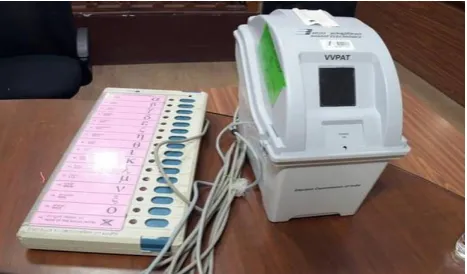
In our Nation, We have to choose our leader for the democrat by the choice of election. In election, voting process is done to choose our own leaders. Balloting machine plays a vital role to choose our nation. Voting machine consists of Balloting unit and control unit. Voters have to put the vote in their polling officer will notice our voting progress by pressing the button while we push the ballot of the appropriate candidates, the long noisy beep sound will be came after the voting process is finished by the individual voter, then this will be noticed by the polling officer and will press the button and the allow the other individual to vote.
Fig 1: Electronic voting machine
Nowadays, electronic voting machine is not secured and it is not believable, people have a lot of doubt to use an electronic voting machine, we are going to Re-design the entire electronic voting machine with the more security features
with the title “Modular Design of Electronic Voting Machine for Electron “In this project, we are going to change the protocol of the Electronic Voting Machine through theArduino. With the help of the GSM module we will send the SMS through Smart phone while we are going to add the security features that will be hack proof with the enchained security. We will reduce the paper wastage inside the Balloting unit. And the timing of counting the votes. So the people will be more convenient to put the vote without doubt.
II. PROPOSED SYSTEM
Fig 2: Proposed system
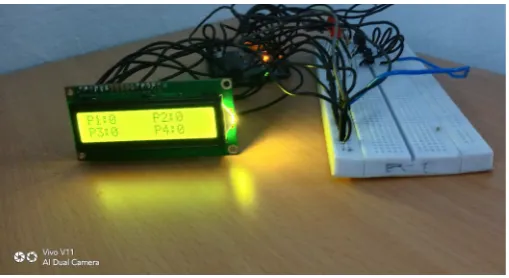
Fingerprint and it will give information about the individual voters and it will let them to vote. The GSM module is connected to the Arduino and it will send the SMS to the mobile for the verification The LCD display will display will display the number of votes and it will be easy to count the vote and it will minimize the time.
Internal unit:
The main board is connected with the control unit and the internal battery which the internal battery will get changing. The control unit will perform its function by controlling the peripherals of the balloting unit which it takes a main role to
External unit:
which it operates at the frequency band of 850MHZ,
900MHZ, 1800MHZand1900MHZ…
Fig 3: GSM
ARDUINO: Usually Arduino is free and open source hardware technology. It’s coming with inbuilt microcontroller for building digital devices. The boards have several I/O pins with various functions. It is attached with serial featured communication with serial featured communication with Universal Serial Bus (USB).It is used to load programs from software complier in computer. The microcontrollers like AT mega 168 microcontrollers like AT mega 38 and AT mega 168 microcontrollers are programmed from the computer and also its program platforms are C and C++. The Arduino platforms are providing integrated platform for based on the complier in computer. The microcontroller like AT mega 168 microcontrollers like ATmega38 AT168 microcontrollers are programmed from the computer and also its program platform are c and c++. The Arduino platforms are providing interred platform for based on the complier language.
Fig 4: Arduino
Fig 5: Fingerprint sensor
III LITERATURE REVIEW:
In(1 )In electronic voting progress Bogus voting is taking part and it confuses the people and the people losses their hope .This can be prevented by the Biometry voting system by using finger print sensor and it will be easy to cast the votes, GSM is also connected to their system to send the SMS to the authority
In (2) the electronic voting machine can also be secured by authenticating the data be processing using thumb Impressing. This indicates the finger print voting method by using atmega328p this can be finger print. The wireless technology is used with the help of the atmega328p that combines with an embedded system; signee module is used for the wireless system.
In(3) the Electronic voting machine can to more secured by using Biometric verification system and there will be more easy and convenient to prevent the Bogus vote ,In this project ,Biometrics verification can be done through the offline system and there will be less expensive and done in a faster method for this progress of voting.
In(4) the electronic machine can be secured by using appropriate devices which it can also be secured by using RFID.the RFID can be used for Biometric voting machine which it’s also linked to the Aadhar card for the safety and also for the secured method of voting this will prevent the
morecompatible for the electronic voting machine and it will save the time of voting progress.
Software description:
Fig 6: NI Lab output
NI lab software is used mainly in this project. NI lab view software is highly used in the real time applications. Nowadays, NI lab view software is the best platform for the modern day projects. The push button used in the voting system is been working by the NI lab software.
IV RESULT
Finally, this method of balloting system has been established to create the doubt-free progress among the people by using fingerprint module based electronic voting machine to get the Authentication from its entire system and it will allow the citizen to vote by the identification and scanning of their fingerprint to read their information through the fingerprint module. This will send the message to the given number through the Gsm module. This work is entirely different from the other methods where the paper system will also be minimized and the duration of time is also reduced. This type of voting progress is very useful and welcomed to this technological world. This will restrict the voter to put the second vote by the identification of their fingerprint and thus the biometric system is very secured and safe for this purpose of voting to avoid the bogus voting.
V CONCLUSION
refuses the voter for attempting the second vote by identifying them and such this way. It is modeled and it very much better for the future elections. Biometric system and the GSM modulebring more features to the secured voting system which it avoids the bogus voting for the future elections.
Reference:
1. AshokkumarD, Ummalsariba BegumT.,International journal of innovative Technology &creative Engineering (ISSN: 20458711), Vol.1, No.1.pp:1219, Jan 2011.
2. AsifAhmed Anik,Rayeesa jameel,Abul FarahAnik, Nowroze Akter,Network systems and security (NSYSS) 2017 International conference on,pp.127-131,2017.
3. M. Tarek Ibn Ziad, Amr al-anwar, Yousra Alkabani,M.Watheq El-kharashi, Hassan Bedour, Advanced Information Networking and Application Workshops(WAINA)2014 28th International Conference on,pp.269-274,2014
4. Chaum.D.IEEE Security and Privacy, 2(1):38-47, 2004.
5. RahilRezwan,HuzaifaAhmed,M.R.N.Biplob,S.M.Sh uvo,Md.Abdur Rahman 2017 IEEE Region 10 Humanitarian technology conference(R10-HTC)2017
First Author R.Radeepkrishna Assistant professorElectronics and communication Engineering, Kalasalingam academy of research and education Madurai, India [email protected]
Second Author A.Lakshmipriya Electronics and communication Engineering, Kalasalingam academy of research and education
Madurai, India
Third Author A.Hilalkhan Electronics and communication Engineering, Kalasalingam academy of research and education Madurai, India
Fourth Author S.Kalaiselvi Electronics and communication Engineering, Kalasalingam academy of research and education
Madurai, India