Urinary Tract Infection as a Risk Factor for Preterm Delivery :
A Tertiary Hospital-Based Study
Infeksi Saluran Kemih (ISK) sebagai Faktor Risiko Persalinan Preterm :
Penelitian Berbasis Rumah Sakit Tersier
Nuring Pangastuti, Lathifa N Indraswari, Shinta Prawitasari
Department of Obstetrics and Gynecology Faculty of Medicine Universitas Gadjah Mada
Dr. Sardjito Hospital, Yogyakarta
Correspondence author: Nuring Pangastuti. [email protected]
Research Article
Abstract
Objective : To investigate the correlation between the incidence of urinary tract infection (UTI) and preterm delivery.
Methods : We conducted a cohort retrospective research using patients medical records. We analysed the incidence of UTIandpreterm delivery from January to December 2015, in Dr. Sardjito Hospital, Yogyakarta.
Results : The sample of this study covers medical records of 45 patients with preterm delivery.From total sampel, only 25 patients (55.6%) underwent urinalysis. Of these 25 patients, 15 (60%) had UTIs and all of them had preterm delivery. The result showed that 13 (86.7%) of 15 patients with bacteriuriawere asymptomatic. Bacteriuria that was found in 15 subjects was not statistically signifi cant when compared to preterm delivery indicatedwith relative ratio of 1,083 (p = 0.581 > 0.05). Multivariate logistic regression analysis showed that preterm delivery were not directly related to UTI (p = 0.704), gestational age (p = 0.274), symptom of UTI (0.699), history of UTI (p=0.999), and history of coitus (p = 0.872).
Conclusions : The study revealed that preterm delivery was not related to UTI. Other causes should be considered. Routine urinalysis test is recommended for pregnant women to prevent preterm delivery.
Keywords : bacteriuria, preterm delivery, UTIs.
Abstrak
Tujuan : Mengetahui hubungan antara infeksi saluran kemih dengan kejadian persalinan preterm.
Metode : Penelitian ini merupakan penelitian kohort retrosprektif, menggunakan data rekam medis pasien. Analisis dilakukan terkait adanya infeksi saluran kemih pada pasien yang mengalami persalinan preterm, mulai bulan Januari sampai dengan Desember 2015, di RSUP Dr. Sardjito Yogyakarta.
Hasil : Sampel penelitian diambil dari data rekam medis 45 pasien dengan persalinan preterm. Dari seluruh sampel, hanya 25 pasien (55,6%) yang memiliki data pemeriksaan urinalisis. Dari 25 pasien ini, 15 (60%) dengan infeksi saluran kemih (ISK) serta persalinan prematur. Hasil urinalisis menunjukkan 13 (86,7%) dari 15 pasien adalah dengan bakteri uria asimtomatik. Bakteriuria yang ditemukan pada 15 subyek tidak bermakna secara statistik bila dibandingkan dengan terjadinya persalinan preterm, rasio relatif 1,083 (p = 0,581> 0,05). Analisis regresi logistic multivariate menunjukkan bahwa persalinan premature tidak terkait langsung dengan ISK (p-value = 0,704), usia gestasi (p-value = 0,274), gejala ISK (0,699), riwayat ISK (p = 0,999), dan riwayat koitus (p-value = 0,872).
Kesimpulan : Penelitian menunjukkan bahwa persalinan premature tidak terbukti secara statistik memiliki hubungan dengan kejadian ISK. Perlu dipertimbangkan penyebab lain. Pemeriksaan urin alisis rutin untuk perempuan hamil dapat dipertimbangkan sebagai upaya pencegahan persalinan preterm.
INTRODUCTION
Preterm delivery is the leading cause of perinatal morbidity and mortality in developing countries1
Recurrent urogenital infections in pregnant women can cause preterm delivery. Yet, the correlation between asymptomatic bacteriuria and preterm delivery is still controversial.1
Preterm delivery is defi ned as delivery before 37 weeks gestation. This term will be further divided into two, early and late preterm2 Early
preterm is defi ned as gestational age below 33 weeks, while gestational age of 34 until 36 weeks is called late preterm. Preterm delivery is the major cause of neonatal mortality. About 1 in 10 births in the US are preterm delivery, and 40% of preterm deliveries are caused by various kinds of infections3 UTI is one of the infections that often
occur in pregnant women4.
UTI is a term that indicates the presence of microorganisms in urine5. Signifi cant bacteriuria
implies pure growth of microorganisms of more than 105 colony forming units (CFU / ml) in the
urine culture. Signifi cant bacteriuria might occur without causing any clinical symptoms of UTI. This condition is called asymptomatic (covert) bacteriuria. Conversely, signifi cant bacteriuria with clinical presentation of UTI is called signifi cant symptomatic bacteriuria5
A pregnant woman has a 2-10% risk of UTIs, where 20-40% cases are asymptomatic bacteriuria, 1-4% are cases of acute cystitis, even 0.5-2% is pyelonephritis. Cases of acute pyelonephritis are commonly found in the second trimester, with complications such as preterm delivery, low birth weight, preeclampsia, hypertension, kidney failure and fetal death6 Many microorganisms cause
symptomatic and asymptomatic infections which then cause preterm delivery, preterm rupture of membranes, or both. The most likely mechanism is the stimulation of bacteria by prostaglandins synthesis. This can happen through the phospholipase A2 and C pathway or as a result of bacterial endotoxins entering amniotic fl uid that stimulate decidual cells, which in turn produce cytokines and prostaglandins that trigger preterm delivery. The indirect pathway that does not go through substances such as interleukin 1, tumour necrosis factor and platelet-activating factor, can be found in the infected amniotic fl uid 7.
Meanwhile, according to Cuningham et al.
2014, it happened due to the ascending colonies of microorganisms in cervix, decidua, membrane, even up into the amnion. Lipopolysaccharide or toxins produced by the bacteria induces immune cells in the reproductive tract, production of cytokines by immune or cervix cells, decidua, and the membrane itself. It affects the myometrium and cervical effacement. Some microorganisms such as Gardnerellavaginalis, Fusobacterium, Mycoplasma hominis, and Ureaplasmaurealyticum were detected more frequently than other bacteria in the amniotic fl uid of pregnant women with preterm delivery. This discovery proves that pathogenic bacteria can trigger preterm delivery2.
UTI during pregnancy is a type of complicated UTIs. If left untreated, the presence of symptomatic bacteriuria potentially causes pyelonephritis, premature infants, anaemia, or pregnancy-induced hypertension. UTI that happened in the third trimester have risks such as mental retardation, slow infant growth, cerebral palsy, and fetal death5. In 2012, ACOG recommended
screening for bacteriuria in the fi rst antenatal visit. In the advanced state, the principle of management of UTIs in adult patients includes
fl uid intake, adequate antibiotics, and if necessary, symptomatic treatment for urine alkalinization5.
This study investigates the correlation between the incidences of UTI and preterm delivery.
METHODS
were history of UTIs, sexual history, and history of leukorrhea.
All the data was tabulated, continued by statistical analyses (statistical signifi cance defi ned as p <0.05). Data analysis was done using univariate, bivariate and multivariate analyses. In bivariate analysis, we assessed using Chi-square and in the last step was multivariate analysisusing logistic regression analysis. This research had received an approval letter from the ethics committee to conduct basic/clinical research at Dr. Sardjito Hospital / Faculty of Medicine, Universitas Gadjah Mada, Yogyakarta.
RESULT
The study involved 45 of 47 medical records of patients who experienced preterm delivery in Dr. Sardjito Hospital from January to December 2015.
Tabel 2. Demographic Characteristic of Subject
Variable Category Percentage
(%) n
UTI
Preterm Delivery
High-Risk Pregnancy
Symptom of UTI
History of UTI
History of coitus
Bacteriuria Nonbacteriuria
Early Late Yes
No Yes No Yes No Yes No
33.30 66.70 82.20 17.80 26.70 73.30 11.10 88.90 4.40 95.60 13.30 86.70 15
30 37 8 12 33 5 40
2 43
6 39
Table 1. Descriptive Statistics of Subject
Variable n Min Max Mean SD
Age
Gestational Age Birth Weight
45 45 45
16 25 525
43 36 2860
26.289 30.644 1539.98
6.851 3.046 589.49
Tabel 3. Chi-square Test
Variable Preterm Delivery
Early Late Low Upper
RR CI P-value
UTI
High-Risk Pregnancy
Symptom of UTI
History of UTI
History of Coitus
Yes No Yes No Yes No Yes No Yes No
13 (28.9) 24 (53.3) 3 (6.7) 34 (75.6)
4 (8.9) 33 (73.3)
2 (4.4) 35 (77.8)
5 (11.1) 32 (71.1)
0.829
0.684
0.612
0.706
0.669 2 (4.4)
6 (13.3) 2 (4.4) 6 (13.3)
1 (2.2) 7 (15.6)
0 (0) 8 (17.8)
1 (2.2) 7 (15.6)
1.415
2.932
1.537
0.939
1.450
0.581
0.168
0.890
0.501
0.939 1.083
1.417
0.970
0.814
0.985
The mean age of the patients was 26.29 ± 6.85 years; mean gestational age 30.64 ± 3.04 weeks; and mean birth weight 1539.98 ± 589.49 grams. Thirty-seven births were early preterm, and the remaining 8 were late preterm.
Bacteriuria found in 13 (28.9%) early preterm delivery and 2 (4.4%) late preterm delivery was not statistically signifi cant when compared to preterm delivery with relative ratio of 1.083 (p-value = 0.581 > 0.05). The women who had high-risk pregnancy was not statistically signifi cant when compared with those with preterm delivery with numbers relative ratio 1.417 (p-value = 0.168> 0.05). The number of the relative ratio indicated that those aged older than 35 years of age has the possibility to have early preterm delivery 1.4 times compared to late preterm delivery. 4 (8.9%) cases that were symptomatic founded at early preterm delivery, 1 (2.2%) cases founded at late preterm delivery with relative ratioof 0.970 (p-value = 0.890>0.05 ).
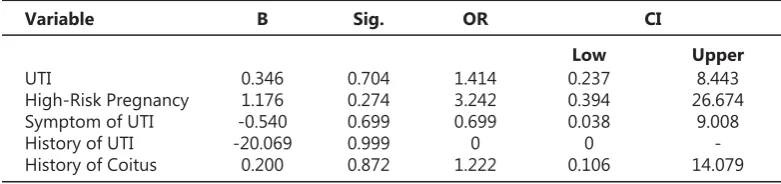
From multivariate logistic regression analysis, preterm delivery was not directly related to UTI (p = 0.704), gestational age (p-value = 0.274), symptomatic UTI (0.699), history of UTI (p-value=0.999) and history of coitus (p-value = 0.872). One study showed that patients with asymptomatic bacteriuria had a higher average of preterm delivery compared to patients with bacteriuria. About 40 to 80 per cent of pregnancy complications due to acute pyelonephritis can be prevented by treating asymptomatic bacteriuria3.
DISCUSSION
Bacteriuria is one of the clinical problems which is quite serious in pregnancy. If left unhandled, can there are many such complications ascendent infection (pyelonephritis), the occurrence of premature rupture of membrane, preterm delivery, until infection in the neonate 9. Prevalence of
UTI diagnosis from the result of urinalysis reach 55.17% at this study. Another study obtained a diagnosis of UTI in reaching pregnancy 2.5%-8.7%. Maternal age is not is a risk factor signifi cant in this study, where results it cannot be a role model due to lack of sample size 10.In a previous
study, reported that the incident bacteriuria was associated with preterm delivery 11.In this study,
the association between age pregnancy with bacteriuria not signifi cant meaning. Parity has a relationship with the occurrence of bacteriuria on pregnancy. Multiple patient more risk 4.78 times to get fi ndings of bacteriuria were compared with primigravida patients10.From the results
of this study, parity is not related directly with bacteriuria.
The fi ndings of this retrospective study revealed that the average age of the patients with preterm deliverywas 26.29 ± 6.85 years which means none of the samples was in high-risk pregnancy according to their age.These
fi ndings are almost comparable with the earlier study done by Patel1. The result showed that
13 (86.7%) of 15 patients with bacteriuria were asymptomatic. In one study present that women with asymptomatic bacteriuria have higher preterm delivery incidence compared with women with symptomatic bacteriuria. Around 40-80% of pregnancy complications due to acute pyelonephritis can be prevented by giving therapy in asymptomatic bacteriuria.3.
From multivariate logistic regression analysis, preterm delivery was not directly related to UTI (p-value = 0.704) which is different from the
The relative ratio of 0.970 indicated that the probability of symptomatic UTI that provokes early preterm delivery and late preterm delivery was practically comparable. All subjects with a history of UTI were 2 (4.4%) cases, founded at early preterm birth had numbers relative ratio 0.814 (p-value = 0.501> 0.05). The number showed that the possibility between those with history of UTI in early and late preterm birth was equal. The correlation between preterm delivery with a history of coitus found 5 (11.1%) cases at early preterm delivery, and 1 (2.2%) case at late preterm delivery showed relative ratioof 0.985 (p-value = 0.939> 0.05 ). The relative ratio indicated that the odd from a history of coitus at early and late preterm delivery was compatible.
Table 4. Binary Logistic Regression Analysis
Variable B Sig. OR
Low Upper
CI
UTI
High-Risk Pregnancy Symptom of UTI History of UTI History of Coitus
0.346 1.176 -0.540 -20.069
0.200
0.704 0.274 0.699 0.999 0.872
1.414 3.242 0.699
0 1.222
0.237 0.394 0.038 0 0.106
8.443 26.674
fi ndings of a study conducted by Patel1. Other
factors such as age, symptoms of UTI, history of UTI, and history of coitus also showed no signifi cant effect on preterm delivery. Moreover, the history of UTI had a number of odds ratio of0which indicated that it was not identifi ed contributing any infl uence on preterm delivery.
The difference of the results in these two studies was likely due to the existence of other risk factors that have a more dominant infl uence to cause preterm delivery in each patient and required further investigation. These other risk factors include the history of previous preterm birth as the most common cause, history of vaginal discharge, examination of vaginal swab to diagnose bacterial vaginosis, current infection in the system and other organs such as periodontal disease, lifestyle, and possible genetic involvement.
The results showed unsatisfactory results because no signifi cant variable effect on preterm delivery was found. The number of medical records data (45 observations) within one year (2015) is not suffi ciently related to cases of preterm labour. Research should be developed further by extending the time of data collection in order to fi nd more scientifi c results. Furthermore, consideringthat this study only comprised premature delivery (early and late delivery), the involvement of normal deliverycanclearly present the comparison between both normal and preterm delivery.
CONCLUSION
This study revealed that preterm delivery was not related to UTI. It should be considered some other causes. However, the discovery of asymptomatic bacteriuria in patients with preterm delivery indicated that this might be one of the risk factors for preterm delivery. A urinalysis should be performed routinely in every pregnancy for reducing the risk factor.
REFERENCES
Patel, UM.,Jani, PS., Kakani, CR. Original Article A Case-1.
Control Study On Correlation Between Genitourinary Infection And Preterm Labour. Nat J Med Research, 5(1), 2015;83-6.
Cunningham, FG.,Leveno, KJ., Bloom, SL., Spong, CY., 2.
Dashe, JS., Hoffman, BL., et.al. William Obstetric 24th ed., Section 11: Obstetrical Complication, Chapter 42: Preterm Labor. McGraw-Hill Education.New York, United States, 2014.
Cram, LF., Zapata MI., Toy EC., Baker B 3rd. Genitourinary 3.
infections and their association with preterm labour. Am Fam Physician, 2002;65(2):241–8.
Johnson, E.K. Urinary Tracts Infections in Pregnancy. 4.
Medscape, 2016.https://emedicine.medscape.com article/452604.
Sukandar, E. Infeksi Saluran Kemih Pasien Dewasa. 5.
dalam: Buku Ajar Ilmu Penyakit Dalam. Jilid I. Ed ke-4. Departemen Ilmu Penyakit Dalam Fakultas Kedokteran Universitas Indonesia. Balai Penerbit FKUI Jakarta, 2007;553-7.
HUGI. Infeksi Saluran Kemih pada Kehamilan. Pedoman 6.
Nasional Pelayanan Kedokteran (PNPK). HUGI, Jakarta, 2015: 1–12.
S a n g k o m
7. k a m h a n g , U S . , L u m b i g a n o n P . , Prasertcharoensuk W., Laopaiboon M. Antenatal
lower genital tract infection screening and treatment programs for preventing preterm delivery. Cochrane Library. 2015;1-27.
Chen YK.,Chen SF., Li HC., Lin HC. No increased risk 8.
of adverse pregnancy outcomes in women with UTIs: a nationwide population-based study. NCBI, 89(7), 2010;882–8
Morgan, K. L.Management of UTIs during pregnancy. 9.
MCN: Am J Maternal/Child Nurs. 2004;29:254-8. Haider G., Zehra N., Munir AA.,HaiderA. Risk factors of 10.
urinary tract infection in pregnancy. JPMA.2010;60:213. Foxman, B. Epidemiology of urinary tract infections: 11.