Accelerated Alternating Projections for Robust Principal
Component Analysis
HanQin Cai [email protected]
Department of Mathematics
University of California, Los Angeles Los Angeles, California, USA
Jian-Feng Cai [email protected]
Department of Mathematics
Hong Kong University of Science and Technology Hong Kong SAR, China
Ke Wei [email protected]
School of Data Science Fudan University Shanghai, China
Editor:Sujay Sanghavi
Abstract
We study robust PCA for the fully observed setting, which is about separating a low rank matrixL and a sparse matrix S from their sum D =L+S. In this paper, a new algorithm, dubbed accelerated alternating projections, is introduced for robust PCA which significantly improves the computational efficiency of the existing alternating projections proposed in (Netrapalli et al., 2014) when updating the low rank factor. The acceleration is achieved by first projecting a matrix onto some low dimensional subspace before obtaining a new estimate of the low rank matrix via truncated SVD. Exact recovery guarantee has been established which shows linear convergence of the proposed algorithm. Empirical performance evaluations establish the advantage of our algorithm over other state-of-the-art algorithms for robust PCA.
Keywords: Robust PCA, Alternating Projections, Matrix Manifold, Tangent Space, Subspace Projection
1. Introduction
Robust principal component analysis (RPCA) appears in a wide range of applications, including video and voice background subtraction (Li et al., 2004; Huang et al., 2012), sparse graphs clustering (Chen et al., 2012), 3D reconstruction (Mobahi et al., 2011), and fault isolation (Tharrault et al., 2008). Suppose we are given a sum of a low rank matrix and a sparse matrix, denoted D =L+S. The goal of RPCA is to reconstruct L and S simultaneously from D. As a concrete example, for foreground-background separation in video processing, L represents static background through all the frames of a video which should be low rank while S represents moving objects which can be assumed to be sparse since typically they will not block a large portion of the screen for a long time.
c
RPCA can be achieved by seeking a low rank matrix L0 and a sparse matrix S0 such that their sum fits the measurement matrix D as well as possible:
min
L0,S0∈
Rm×n
kD−L0−S0kF subject to rank(L0)≤r and kS0k0≤ |Ω|, (1)
where r denotes the rank of the underlying low rank matrix, Ω denotes the support set of the underlying sparse matrix, and kS0k0 counts the number of non-zero entries in S0. Compared to the traditional principal component analysis (PCA) which computes a low rank approximation of a data matrix, RPCA is less sensitive to outliers since it includes a sparse part in the formulation.
Since the seminal works of (Wright et al., 2009; Cand`es et al., 2011; Chandrasekaran et al., 2011), RPCA has received intensive investigations both from theoretical and algo-rithmic aspects. Noticing that (1) is a non-convex problem, some of the earlier works focus on the following convex relaxation of RPCA:
min
L0,S0∈
Rm×n
kL0k∗+λkS0k1 subject to L0+S0 =D, (2)
where k · k∗ is the nuclear norm (viz. trace norm) of matrices, λ is the regularization parameter, and k · k1 denotes the`1-norm of the vectors obtained by stacking the columns of associated matrices. Under some mild conditions, it has been proven that the RPCA problem can be solved exactly by the aforementioned convex relaxation Cand`es et al. (2011); Chandrasekaran et al. (2011). However, a limitation of the convex relaxation based approach is that the resulting semidefinite programming is computationally rather expensive to solve, even for medium size matrices. Alternative to the convex relaxation, many non-convex algorithms have been designed to target (1) directly. This line of research will be reviewed in more detail in Section 2.3 after our approach has been introduced.
This paper targets the non-convex optimization for RPCA directly. The main contribu-tions of this work are two-fold. Firstly, we propose a new algorithm, accelerated alternating projections (AccAltProj), for RPCA, which is substantially faster than other state-of-the-art algorithms. Secondly, exact recovery of accelerated alternating projections has been estab-lished for the fixed sparsity model, where we assume the ratio of the number of non-zero entries in each row and column ofS is less than a threshold.
1.1. Assumptions
It is clear that the RPCA problem is ill-posed without any additional conditions. Common assumptions are thatL cannot be too sparse andS cannot be locally too dense, which are formalized in A1 and A2, respectively.
A1 The underlying low rank matrixL∈Rm×n is a rank-rmatrix withµ-incoherence, that
is
max
i ke T
i Uk2 ≤
r
µr
m, and maxj ke T
jVk2≤
r
µr n
hold for a positive numerical constant 1≤µ≤ min{rm,n}, where L=UΣVT is the SVD of
Assumption A1 was first introduced in (Cand`es and Recht, 2009) for low rank matrix completion, and now it is a very standard assumption for related low rank reconstruc-tion problems. It basically states that the left and right singular vectors of L are weakly correlated with the canonical basis, which implies L cannot be a very sparse matrix.
A2 The underlying sparse matrixS ∈Rm×nis α-sparse. That is, S has at most αn
non-zero entries in each row, and at most αm non-zero entries in each column. In the other
words, for all 1≤i≤m,1≤j≤n,
keTi Sk0 ≤αn and kSejk0 ≤αm. (3)
In this paper, we assume1
α.min
1
µr2κ3, 1
µ1.5r2κ, 1
µ2r2
, (4)
where κ is the condition number of L.
Assumption A2 states that the non-zero entries of the sparse matrix S cannot concen-trate in a few rows or columns, so there does not exist a low rank component in S. If the indices of the support set Ω are sampled independently from the Bernoulli distribution with the associated parameter being slightly smaller thanα, by the Chernoff inequality, one can easily show that (3) holds with high probability.
1.2. Organization and Notation of the Paper
The rest of the paper is organized as follows. In the remainder of this section, we introduce standard notation that is used throughout the paper. Section 2.1 presents the proposed algorithm and discusses how to implement it efficiently. The theoretical recovery guarantee of the proposed algorithm is presented in Section 2.2, followed by a review of prior art for RPCA. In Section 3, we present the numerical simulations of our algorithm. Section 4 contains all the mathematical proofs of our main theoretical result. We conclude this paper with future directions in Section 5.
In this paper, vectors are denoted by bold lowercase letters (e.g.,x), matrices are denoted by bold capital letters (e.g.,X), and operators are denoted by calligraphic letters (e.g.,H). In particular,ei denotes theith canonical basis vector,I denotes the identity matrix, andI
denotes the identity operator. For a vectorx,kxk0counts the number of non-zero entries in
x, andkxk2denotes the`2norm ofx. For a matrixX, [X]ij denotes its (i, j)thentry,σi(X)
denotes its ith singular value, kXk∞ = maxij|[X]ij| denotes the maximum magnitude of
its entries, kXk2 = σ1(X) denotes its spectral norm, kXkF = q
P
iσi2(X) denotes its
Frobenius norm, and kXk∗ = Piσi(X) denotes its nuclear norm. The inner product of
two real valued vectors is defined ashx,yi=xTy, and the inner product of two real valued matrices is defined as hX,Yi = T race(XTY), where (·)T represents the transpose of a
vector or matrix.
Additionally, we sometimes use the shorthand σiA to denote the ith singular value of a matrix A. Note that κ = σL1/σrL always denotes the condition number of the underlying 1. The standard notion “.” in (4) means there exists an absolute numerical constantC >0 such thatα
rank-r matrix L, and Ω = supp(S) is always referred to as the support of the underlying sparse matrix S. At the kth iteration of the proposed algorithm, the estimates of the low rank matrix and the sparse matrix are denoted byLk and Sk, respectively.
2. Algorithm and Theoretical Results
In this section, we present the new algorithm and its recovery guarantee. For ease of exposition, we assume all matrices are square (i.e., m = n), but emphasize that nothing is special about this assumption and all the results can be easily extended to rectangular matrices.
2.1. Proposed Algorithm
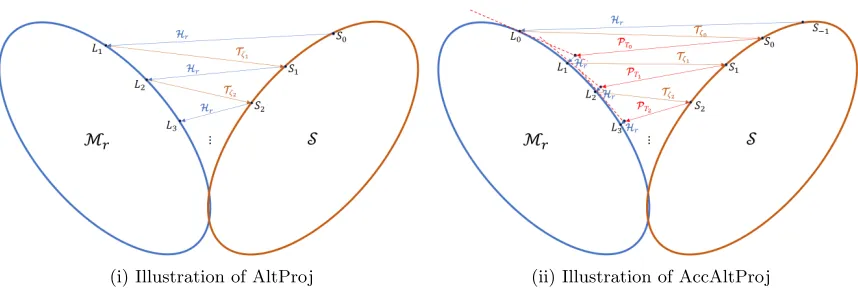
Alternating projections is a minimization approach that has been successfully used in many fields, including image processing (Wang et al., 2008; Chan and Wong, 2000; O’Sullivan and Benac, 2007), matrix completion (Keshavan et al., 2012; Jain et al., 2013; Hardt, 2013; Tanner and Wei, 2016), phase retrieval (Netrapalli et al., 2013; Cai et al., 2017; Zhang, 2017), and many others (Peters and Heath, 2009; Agarwal et al., 2014; Yu et al., 2016; Pu et al., 2017). A non-convex algorithm based on alternating projections, namely AltProj, is presented in (Netrapalli et al., 2014) for RPCA accompanied with a theoretical recovery guarantee. In each iteration, AltProj first updatesLby projecting D−S onto the space of rank-r matrices, denoted Mr, and then updates S by projecting D−L onto the space of
sparse matrices, denotedS; see the left plot of Figure 1 for an illustration. Regarding to the implementation of AltProj, the projection of a matrix onto the space of low rank matrices can be computed by the singular value decomposition (SVD) followed by truncating out small singular values, while the projection of a matrix onto the space of sparse matrices can be computed by the hard thresholding operator. As a non-convex algorithm which targets (1) directly, AltProj is computationally much more efficient than solving the convex relaxation problem (2) using semidefinite programming (SDP). However, when projecting D−Sonto the low rank matrix manifold, AltProj requires to compute the SVD of a full size matrix, which is computationally expensive. Inspired by the work in (Vandereycken, 2013; Wei et al., 2016a,b), we propose an accelerated algorithm for RPCA, coined accelerated alternating projections (AccAltProj), to circumvent the high computational cost of the SVD. The new algorithm is able to reduce the per-iteration computational cost of AltProj significantly, while a theoretical guarantee can be similarly established.
Our algorithm consists of two phases: initialization and projections onto Mr and S
alternatively. We begin our discussion with the second phase, which is described in Algo-rithm 1. For geometric comparison between AltProj and AccAltProj, see Figure 1.
Let (Lk,Sk) be a pair of current estimates. At the (k+ 1)th iteration, AccAltProj first
trims Lk into an incoherent matrix Lek using Algorithm 2. Noting that Lek is still a
rank-r matrix, so its left and right singular vectors define an (2n−r)r-dimensional subspace (Vandereycken, 2013),
e
(i) Illustration of AltProj (ii) Illustration of AccAltProj
Figure 1: Visual comparison between AltProj and AccAltProj, where Mr denotes the
manifold of rank-r matrices and S denotes the set of sparse matrices. The red dash line in (ii) represents the tangent space of Mr at Lk. In fact, each circle represents a sum of
a low rank matrix and a sparse matrix, but with the component on one circle fixed when projecting onto the other circle. For conciseness, the trim stage, i.e.,Lek, is not included in
the plot for AccAltProj.
Algorithm 1 Robust PCA by Accelerated Alternating Projections (AccAltProj)
1: Input: D = L+S: matrix to be split; r: rank of L; : target precision level; β: thresholding parameter;γ: target converge rate;µ: incoherence parameter of L. 2: Initialization
3: k= 0
4: while <kD−Lk−SkkF/kDkF ≥> do
5: Lek= Trim(Lk, µ)
6: Lk+1=Hr(PTek(D−Sk))
7: ζk+1 =β
σr+1
P
e
Tk(D−Sk)
+γk+1σ1
P
e
Tk(D−Sk)
8: Sk+1=Tζk+1(D−Lk+1) 9: k=k+ 1
end while
10: Output: Lk,Sk
where Lek = UekΣekVekT is the SVD of Lek2. Given a matrix Z ∈ Rn×n, it can be easily
verified that the projections of Z onto the subspaceTek and its orthogonal complement are
given by
P
e
TkZ=UekUe
T
kZ+ZVekVekT −UekUekTZVekVekT (6)
and
(I − P
e
Tk)Z = (I −UekUe
T
k)Z(I −VekVekT). (7)
2. In practice, we only need the trimmed orthogonal matricesUekandVekfor the projectionPTek, and they
can be computed efficiently via a QR decomposition. The entire matrixLek should never be formed in
Algorithm 2 Trim
1: Input: L=UΣVT: matrix to be trimmed;µ: target incoherence level.
2: cµ= q
µr n
3: for<i= 1 to m>do
4: A(i)= min{1, cµ
kU(i)k}U(i)
end for
5: for<j= 1 to n>do
6: B(j)= min{1, cµ
kV(j)k}V(i)
end for
7: Output: Le=AΣB
As stated previously, AltProj truncates the SVD ofD−Skdirectly to get a new estimate
ofL. In contrast, AccAltProj first projectsD−Sk onto the low dimensional subspaceTek,
and then projects the intermediate matrix onto the rank-r matrix manifold Mr using the
truncated SVD. That is,
Lk+1 =Hr(PTek(D−Sk)),
whereHr computes the best rank-r approximation of a matrix,
Hr(Z) :=QΛrPT whereZ =QΛPT is its SVD and [Λr]ii:= (
[Λ]ii i≤r
0 otherwise. (8)
Before proceeding, it is worth noting that the set of rank-r matrices Mr form a smooth
manifold of dimension (2n−r)r, and Tek is indeed the tangent space ofMr atLek
(Vander-eycken, 2013). Matrix manifold algorithms based on the tangent space of low dimensional spaces have been widely studied in the literature, see for example (Ngo and Saad, 2012; Mishra et al., 2012; Vandereycken, 2013; Mishra and Sepulchre, 2014; Mishra et al., 2014; Wei et al., 2016a,b) and references therein. In particular, we invite readers to explore the book (Absil et al., 2009) for more details about the differential geometry ideas behind manifold algorithms.
One can see that a SVD is still needed to obtain the new estimateLk+1. Nevertheless, it can be computed in a very efficient way (Vandereycken, 2013; Wei et al., 2016a,b). Let (I−
e
UkUekT)(D−Sk)Vek=Q1R1and (I−VekVekT)(D−Sk)Uek=Q2R2be the QR decompositions
of (I −UekUekT)(D −Sk)Vek and (I −VekVekT)(D −Sk)Uek, respectively. Note that (I −
e
UkUekT)(D−Sk)Vek and (I −VekVekT)(D−Sk)Uek can be computed by one matrix-matrix
subtraction between ann×nmatrix and ann×nmatrix, two matrix-matrix multiplications between an n×n matrix and an n×r matrix, and a few matrix-matrix multiplications between ar×nand an n×r or between ann×r matrix and ar×r matrix. Moreover, A little algebra gives
P
e
Tk(D−Sk) =UekUe
T
k(D−Sk) + (D−Sk)VekVekT −UekUekT(D−Sk)VekVekT
=UekUekT(D−Sk)(I −VekVekT) + (I−UekUekT)(D−Sk)VekVekT +UekUekT(D−Sk)VekVekT
=hUek Q1 iUeT
k(D−Sk)Vek RT2
R1 0
e
VkT QT2
:=
h
e
Uk Q1
i
Mk
e
VkT QT2
,
where the fourth line follows from the factUekTQ1 =VekTQ2 =0. Let Mk =UMkΣMkVMT
k
be the SVD ofMk, which can be computed usingO(r3) flops sinceMk is a 2r×2r matrix.
Then the SVD of P
e
Tk(D−Sk) =UekΣekVe
T
k can be computed by
e
Uk+1=
h
e
Uk Q1
i
UMk, Σek+1=ΣMk, and Vek+1 =
h
e
Vk Q2
i
VMk (9)
since both the matrices hUek Q1 i
and hVek Q2 i
are orthogonal. In summary, the overall
computational costs of Hr(PTek(D−Sk)) lie in one matrix-matrix subtraction between an n×n matrix and an n×n matrix, two matrix-matrix multiplications between an n×n
matrix and an n×r matrix, the QR decomposition of two n×r matrices, an SVD of a 2r×2r matrix, and a few matrix-matrix multiplications between a r ×n matrix and an n×r matrix or between an n×r matrix and a r ×r matrix, leading to a total of 4n2r+n2+O(nr2+r3) flops. Thus, the dominant per iteration computational complexity of AccAltProj for updating the estimate of L is the same as the novel gradient descent based approach introduced in (Yi et al., 2016). In contrast, computing the best rank-r
approximation of a non-structured n×n matrixD−Sk typically costs O(n2r) +n2 flops
with a large hidden constant in front ofn2r.
After Lk+1 is obtained, following the approach in (Netrapalli et al., 2014), we apply the hard thresholding operator to update the estimate of the sparse matrix,
Sk+1 =Tζk+1(D−Lk+1), where the thresholding operatorTζk+1 is defined as
[Tζk+1Z]ij = (
[Z]ij |[Z]ij|> ζk+1
0 otherwise (10)
for any matrix Z ∈ Rm×n. Notice that the thresholding value of ζ
k+1 in Algorithm 1 is chosen as
ζk+1 =β
σr+1
P
e
Tk(D−Sk)
+γk+1σ1
P
e
Tk(D−Sk)
,
which relies on a tuning parameter β > 0, a convergence rate parameter 0 ≤ γ < 1, and the singular values ofP
e
Tk(D−Sk). Since we have already obtained all the singular values
of P
e
Tk(D−Sk) when computing Lk+1, the extra cost of computing ζk+1 is very marginal.
Therefore, the cost of updating the estimate ofS is very low and insensitive to the sparsity of S.
In this paper, a good initialization is achieved by two steps of modified AltProj when setting the input rank to r, see Algorithm 3. With this initialization scheme, we can construct an initial guess that is sufficiently close to the ground truth and is inside the “basin of attraction” as detailed in the next subsection. Note that the thresholding parameterβinit
Algorithm 3 Initialization by Two Steps of AltProj
1: Input: D=L+S: matrix to be split;r: rank of L;βinit, β: thresholding parameters.
2: L−1 =0 3: ζ−1 =βinit·σD1 4: S−1 =Tζ−1(D−L−1) 5: L0 =Hr(D−S−1) 6: ζ0 =β·σ1(D−S−1) 7: S0 =Tζ0(D−L0) 8: Output: L0,S0
2.2. Theoretical Guarantee
In this subsection, we present the theoretical recovery guarantee of AccAltProj (Algorithm 1 together with Algorithm 3). The following theorem establishes the local convergence of AccAltProj.
Theorem 1 (Local Convergence of AccAltProj) Let L∈Rn×n andS ∈
Rn×nbe two
symmetric matrices satisfying Assumptions A1 and A2. If the initial guesses L0 and S0
obey the following conditions:
kL−L0k2 ≤8αµrσ1L, kS−S0k∞≤
µr n σ
L
1, and supp(S0)⊂Ω,
then the iterates of Algorithm 1 with parameters β = µr2n and γ ∈√1
12,1
satisfy
kL−Lkk2 ≤8αµrγkσL1, kS−Skk∞≤
µr n γ
kσL
1, and supp(Sk)⊂Ω.
The next theorem states that the initial guesses obtained from Algorithm 3 fulfill the conditions required in Theorem 1.
Theorem 2 (Guaranteed Initialization) Let L∈Rn×n and S∈Rn×n be two symmet-ric matsymmet-rices satisfying Assumptions A1 and A2, respectively. If the thresholding parameters
obey µrσ1L
nσD
1
≤βinit≤ 3µrσ
L
1
nσD
1
and β= 2µrn, then the outputs of Algorithm 3 satisfy
kL−L0k2 ≤8αµrσ1L, kS−S0k∞≤
µr n σ
L
1, and supp(S0)⊂Ω.
The proofs of Theorems 1 and 2 are presented in Section 4. The convergence of AccAlt-Proj follows immediately by combining the above two theorems together.
L and S as L:=
0 · · · 0
..
. . .. ...
0 · · · 0
LT · · · LT
| {z }
dtimes L .. . L 0 dtimes
, S :=
0 · · · 0
..
. . .. ...
0 · · · 0
ST · · · ST
| {z }
dtimes S .. . S 0 dtimes .
Then it is not hard to see that L is O(µ)-incoherent, and S is O(α)-sparse, with the hidden constants being independent ofd. Moreover, based on the connection between the SVD of the augmented matrix and that of the original one, it can be easily verified that at thekth iteration the estimates returned by AccAltProj with input D=L+S have the form
Lk =
0 · · · 0
..
. . .. ...
0 · · · 0
LT
k · · · LTk
| {z }
dtimes Lk .. . Lk 0 dtimes
, Sk=
0 · · · 0
..
. . .. ...
0 · · · 0
ST
k · · · SkT
| {z }
dtimes Sk .. . Sk 0 dtimes ,
whereLk,Sk are the the kth estimates returned by AccAltProj with inputD =L+S.
2.3. Related Work
As mentioned earlier, convex relaxation based methods for RPCA have higher computa-tional complexity and slower convergence rate which are not applicable for high dimensional problems. In fact, the convergence rate of the algorithm for computing the solution to the SDP formulation of RPCA (Cand`es et al., 2011; Chandrasekaran et al., 2011; Xu et al., 2010) is sub-linear with the per iteration computational complexity beingO(n3). By con-trast, AccAltProj only requires O(log(1/)) iterations to achieve an accuracy of , and the dominant per iteration computational cost is O(rn2).
There have been many other algorithms which are designed to solve the non-convex RPCA problem directly. In (Wang et al., 2013), an alternating minimization algorithm was proposed for (1) based on the factorization model of low rank matrices. However, only convergence to fixed points was established there. In (Gu et al., 2016), the authors developed an alternating minimization algorithm for RPCA, which allows the sparsity level
α to be O(1/(µ2/3r2/3n)) for successful recovery, which is more stringent than our result whenrn. A projected gradient descent algorithm was proposed in Chen and Wainwright (2015) for the special case of positive semidefinite matrices based on the `1-norm of each row of the underlying sparse matrix, which is not very practical.
(GD) from (Yi et al., 2016). GD attempts to reconstruct the low rank matrix by minimizing an objective function which contains the prior knowledge of the sparse matrix. The table displays the computational complexity of each algorithm for updating the estimates of the low rank matrix and the sparse matrix, as well as the convergence rate and the theoretical tolerance for the number of non-zero entries in the sparse matrix.
From the table, we can see that AccAltProj achieves the same linear convergence rate as AltProj, which is faster than GD. Moreover, AccAltProj has the lowest per iteration computational complexity for updating both the estimates ofLandS (ties with AltProj for updating the sparse part). It is worth emphasizing that the acceleration stage in AccAltProj which first projectsD−Skonto a low dimensional subspace reduces the computational cost
of the SVD in AltProj dramatically. Overall, AccAltProj will be substantially faster than AltProj and GD, as confirmed by our numerical simulations in next section. The table also shows that the theoretical sparsity level that can be tolerated by AccAltProj is lower than that of GD and AltProj. Our result looses an order in r because we have replaced the spectral norm by the Frobenius norm when considering the reduction of the reconstruction error in terms of the spectral norm. In addition, the condition number of the target matrix appears in the theoretical result because the current version of AccAltProj deals with the fixed rank case which requires the initial guess is sufficiently close to the target matrix for the theoretical analysis. Nevertheless, we note that the sufficient condition regarding toα
to guarantee the exact recovery of AccAltProj is highly pessimistic when compared with its empirical performance. Numerical investigations in next section show that AccAltProj can tolerate as largeα as AltProj does under different energy levels.
Table 1: Comparison of AccAltProj, AltProj and GD.
Algorithm AccAltProj AltProj GD
UpdatingS O n2
O rn2
O n2+αn2log(αn)
UpdatingL O rn2 O r2n2 O rn2
Tolerance of α Omax{µr2κ3,µ11.5r2κ,µ2r2}
Oµr1 Omax{µr1.51κ1.5,µrκ2}
Iterations needed O log (1)
O log (1)
O κlog(1)
3. Numerical Expierments
In this section, we present the empirical performance of our AccAltProj algorithm and compare it with the state-of-the-art AltProj algorithm from (Netrapalli et al., 2014) and the leading gradient descent based algorithm (GD) from (Yi et al., 2016). The tests are conducted on a laptop equipped with 64-bit Windows 7, Intel i7-4712HQ (4 Cores at 2.3 GHz) and 16GB DDR3L-1600 RAM, and executed from MATLAB R2017a. We implement AltProj by ourselves, while the codes for GD are downloaded from the author’s website3. Hand tuned parameters are used for these algorithms to achieve the best performance in the numerical comparison. The codes for AccAltProj can be found online:
https://github.com/caesarcai/AccAltProj_for_RPCA.
Notice that the computation of an initial guess by Algorithm 3 requires the truncated SVD on a full size matrix. As is typical in the literature, we used the PROPACK library4 for this task when the size ofD is large andr is relatively small. To reduce the dependence of the theoretical result on the condition number of the underlying low rank matrix, AltProj was originally designed to loopr stages for the input rank increasing from 1 tor and each stage contains a few number of iterations for a fixed rank. However, when the condition number is medium large which is the case in our tests, we have observed that AltProj achieves the best computational efficiency when fixing the rank to r. Thus, to make fair comparison, we test AltProj when input rank is fixed, the same as the other two algorithms.
Synthetic Datasets We follow the setup in (Netrapalli et al., 2014) and (Yi et al., 2016) for the random tests on synthetic data. An n×n rank r matrix L is formed via L = P QT, whereP,Q ∈
Rn×r are two random matrices having their entries drawn i.i.d from
the standard normal distribution. The locations of the non-zero entries of the underlying sparse matrix S are sampled uniformly and independently without replacement, while the values of the non-zero entries are drawn i.i.d from the uniform distribution over the interval [−c·E(|[L]ij|), c·E(|[L]ij|)] for some constant c >0. The relative computing error at the
kth iteration of a single test is defined as
errk=
kD−Lk−SkkF
kDkF . (11)
The test algorithms are terminated when either the relative computing error is smaller than a tolerance, errk < tol, or a maximum number of 100 iterations is reached. Recall that µ
is the incoherence parameter of the low rank matrix L and α is the sparsity parameter of the sparse matrixS. In the random tests, we use 1.1µin AltProj and AccAltProj, and use 1.1α in GD.
Though we are only able to provide a theoretical guarantee for AccAltProj with trim in this paper, it can be easily seen that AccAltProj can also be implemented without the trim step. Thus, both AccAltProj with and without trim are tested. The parametersβ and
βinit are set to beβ= 21√.1mnµr andβinit = 1√.1mnµr in our experiments, andγ = 0.5 is used when
α <0.55 and γ = 0.65 is used whenα≥0.55.
We first test the performance of the algorithms under different values of α for fixed
n = 2500 and r = 5. Three different values of c are investigated: c ∈ {0.2,1,5}, which represent three different signal levels of S. For each value of c, 10 different values of
α from 0.3 to 0.75 are tested. We set tol = 10−6 in the stopping condition for all the test algorithms. The backtracking line search has been used in GD which can improve its recovery performance substantially in our tests. An algorithm is considered to have successfully reconstructedL(or equivalently, S) if the low rank output of the algorithmLk
satisfies
kLk−LkF
kLkF ≤10
−4.
Table 2: Rate of success for AccAltProj with and without trim, AltProj, and GD for different values of α.
c= 0.2 0.3 0.35 0.4 0.45 0.5 0.55 0.6 0.65 0.7 0.75
AccAltProj w/ trim 10 10 10 10 10 10 10 10 4 0 AccAltProj w/o trim 10 10 10 10 10 10 10 10 4 0
AltProj 10 10 10 10 10 10 10 10 0 0
GD 10 10 10 0 0 0 0 0 0 0
c= 1 0.3 0.35 0.4 0.45 0.5 0.55 0.6 0.65 0.7 0.75
AccAltProj w/ trim 10 10 10 10 10 10 10 9 0 0 AccAltProj w/o trim 10 10 10 10 10 10 10 9 0 0
AltProj 10 10 10 10 10 10 10 8 0 0
GD 10 10 10 10 9 0 0 0 0 0
c= 5 0.3 0.35 0.4 0.45 0.5 0.55 0.6 0.65 0.7 0.75
AccAltProj w/ trim 10 10 10 10 10 10 10 5 0 0 AccAltProj w/o trim 10 10 10 10 10 10 10 5 0 0
AltProj 10 10 10 10 10 10 10 3 0 0
GD 10 10 10 10 10 10 7 0 0 0
The number of successful reconstructions for each algorithm out of 10 random tests are presented in Table 2. It is clear that AccAltProj (with and without trim) and AltProj exhibit similar behavior even though the theoretical requirement of AccAltProj with trim is a bit more stringent than that of AltProj, and they can tolerate larger values of α than GD when cis small.
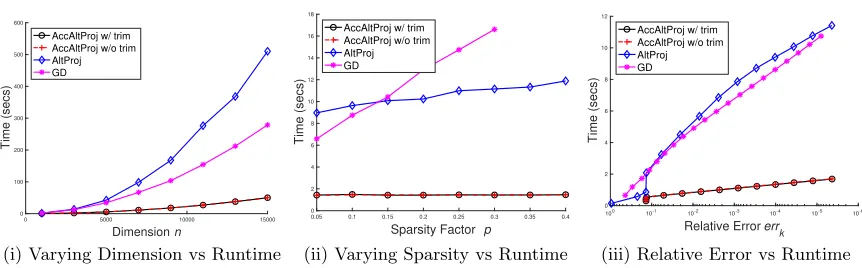
Next, we evaluate the runtime of the test algorithms. The computational results are plotted in Figure 2 together with the setup corresponding to each plot. Figure 2(i) shows that AccAltProj is substantially faster than AltProj and GD. In particular, when n is large, it achieves about 10×speedup. Figure 2(ii) shows that AccAltProj and AltProj are less sensitive to the sparsity of S. Notice that we have used a well-tuned fixed stepsize for GD here so that it can achieve the best computational efficiency. Thus, GD fails to converge whenα≥0.35 which is smaller than the largest value ofα for successful recovery corresponding to c = 1 in Table 2. Lastly, Figure 2(iii) shows the lowest computational time of AccAltProj against the relative computing error.
Video Background Subtraction In this section, we compare the performance of Ac-cAltProj with and without trim, AltProj and GD on video background subtraction, a real world benchmark problem for RPCA. The task in background subtraction is to separate moving foreground objects from a static background. The two videos we have used for this test are Shoppingmall and Restaurant which can be found online5.The size of each frame
of Shoppingmall is 256×320 and that of Restaurant is 120×160. The total number of
frames are 1000 and 3055 in Shoppingmall and Restaurant, respectively. Each video can be represented by a matrix, where each column of the matrix is a vectorized frame of the
0 5000 10000 15000
Dimension n 0
100 200 300 400 500 600
Time (secs)
AccAltProj w/ trim AccAltProj w/o trim AltProj GD
(i) Varying Dimension vs Runtime
0.05 0.1 0.15 0.2 0.25 0.3 0.35 0.4 Sparsity Factor p
0 2 4 6 8 10 12 14 16 18
Time (secs)
AccAltProj w/ trim AccAltProj w/o trim AltProj GD
(ii) Varying Sparsity vs Runtime
10-6
10-5
10-4
10-3
10-2
10-1
100
Relative Error err k
0 2 4 6 8 10 12
Time (secs)
AccAltProj w/ trim AccAltProj w/o trim AltProj GD
(iii) Relative Error vs Runtime
Figure 2: Runtime for synthetic datasets: (i) Varying dimensionnvs runtime, wherer= 5,
α = 0.1, c = 1, and n varies from 1000 to 15000. The algorithms are terminated after
errk < 10−4 is satisfied. (ii) Varying sparsity factor α vs runtime, where r = 5, c = 1
and n = 2500. The algorithms are terminated when either errk < 10−4 or 100 number
of iterations is reached, whichever comes first. (iii) Relative error errk vs runtime, where
r = 5, α = 0.1, c= 1, and n = 2500. The algorithms are terminated after errk <10−5 is
satisfied so that we can observe more iterations.
Table 3: Computational results for video background subtraction. Here “S” represents
Shoppingmall, “R” representsRestaurant, andµis the incoherence parameter of the output
low rank matrices along the time axis (i.e., among different frames).
AccAltProj w/ trim AccAltProj w/o trim AltProj GD
runtime µ runtime µ runtime µ runtime µ
S 38.98s 2.12 38.79s 2.26 82.97s 2.13 161.1s 2.85 R 28.09s 5.16 27.94s 5.25 69.12s 5.28 107.3s 6.07
video. Then, we apply each algorithm to decompose the matrix into a low rank part which represents the static background of the video and a sparse part which represents the moving objects in the video. Since there is no ground truth for the incoherence parameter and the sparsity parameter, their values are estimated by trial-and-error in the tests. We setγ = 0.7 andr= 2 in the decomposition of both videos, andtolis set to 10−4in the stopping criteria. All the four algorithms can achieve desirable visual performance for the two tested videos and we only present the decomposition results of three selected frames for both AccAltProj with trim and without trim in Figure 3.
Figure 3: Video background subtraction: The top three rows correspond to three different frames from the videoShoppingmall, while the bottom three rows are frames from the video
Restaurant. The first column contains the original frames, the middle two columns are the
4. Proofs
4.1. Proof of Theorem 1
The proof of Theorem 1 follows a route established in (Netrapalli et al., 2014). Despite this, the details of the proof itself are nevertheless quite involved because there are two more operations (i.e., projection onto a tangent space and trim) in AccAltProj than in AltProj. Overall, the proof consists of two steps:
• When kL−Lkk2 and kS−Skk∞ are sufficiently small, and supp(Sk) ⊂ Ω, then
kL−Lk+1k2deceases in some sense by a constant factor (see Lemma 12) andkL−Lk+1k∞ is small (see Lemma 13).
• WhenkL−Lk+1k∞ is sufficiently small, we can chooseζk+1 such thatsupp(Sk+1)⊂ Ω andkS−Sk+1k∞ is small (see Lemma 14).
These results will be presented in a set of lemmas. For ease of notation we defineτ := 4αµrκ
and υ:=τ(48√µrκ+µr) in the sequel.
Lemma 3 (Weyl’s inequality)Let A,B,C ∈Rn×n be the symmetric matrices such that
A=B+C. Then the inequality
|σiA−σiB| ≤ kCk2
holds for all i, where σA
i and σiB represent theith singular values of A and B respectively.
Proof This is a well-known result and the proof can be found in many standard textbooks, see for example Bhatia (2013).
Lemma 4 Let S ∈ Rn×n be a symmetric sparse matrix which satisfies Assumption A2. Then, the inequality
kSk2≤αnkSk∞
holds, where α is the sparsity level of S.
Proof The proof can be found in (Netrapalli et al., 2014, Lemma 4).
Lemma 5 Let Trim be the algorithm defined by Algorithm 2. If Lk ∈ Rn×n is a rank-r matrix with
kLk−Lk2 ≤
σrL
20√r,
then the trim output with the level qµrn satisfies
kLek−LkF ≤8κkLk−LkF, (12)
max
i ke T
i Uekk2 ≤
10 9
r
µr
n , and maxj ke T
jVekk2 ≤
10 9
r
µr
where Lek=UekΣekVekT is the SVD of Lek. Furthermore, it follows that
kLek−Lk2 ≤8
√
2rκkLk−Lk2. (14)
Proof Since both L andLk are rank-r matrices,Lk−L is rank at most 2r. So
kLk−LkF ≤
√
2rkLk−Lk2≤
√
2r σ
L r
20√r = σL
r
10√2.
Then, the first two parts of the lemma, i.e., (12) and (13), follow from (Wei et al., 2016a, Lemma 4.10). Noting thatkLek−Lk2 ≤ kLek−LkF, (14) follows immediately.
Lemma 6 Let L=UΣVT and Lek =UekΣekVekT be the SVD of two rank-r matrices, then
kU UT −UeUeTk2 ≤
kLek−Lk2
σL r
, kV VT −VeVeTk2≤
kLek−Lk2
σL r
, (15)
and
k(I − P
e
Tk)Lk2≤
kLek−Lk22
σL r
. (16)
Proof The proof of (15) can be found in (Wei et al., 2016b, Lemma 4.2). The Frobenius norm version of (16) can also be found in (Wei et al., 2016a,b). Here we only need to prove the spectral norm version, i.e., (16). SinceL=U UTL and Lek(I−VekVekT) =0, we have
k(I − P
e
Tk)Lk2 =k(I−UekUe
T
k)L(I −VekVekT)k2
=k(I−UekUekT)U UTL(I−VekVekT)k2
=k(U UT −UekUekT)U UTL(I −VekVekT)k2
=k(U UT −UekUekT)L(I−VekVekT)k2
=k(U UT −UekUekT)(L−Lek)(I −VekVekT)k2
≤ k(U UT −UekUekT)k2k(L−Lek)k2k(I −VekVekT)k2
≤ kLek−Lk
2 2
σL r
,
where the last inequality follows from (15).
Lemma 7 Let S∈Rn×n be a symmetric matrix satisfying Assumption A2. Let e
Lk ∈Rn×n
be a rank-r matrix with 10081µ-incoherence. That is,
max
i ke T
i Uekk2 ≤
10 9
r
µr
n and maxj ke T
jVekk2 ≤
10 9
r
µr n ,
where Le =UekΣekVekT is the SVD of Lek. If supp(Sk)⊂Ω, then
kP
e
Proof By the incoherence assumption of Lek and the sparsity assumption of S −Sk, we
have
[P
e
Tk(S−Sk)]ab =hPTek(S−Sk),eae
T bi
=hS−Sk,PTek(eae
T b)i
=hS−Sk,UekUekTeaeTb +eaeTbVekVekT −UekUekTeaeTbVekVekTi
=h(S−Sk)eb,UekUekTeai+heaT(S−Sk),eTbVekVekTi − hS−Sk,UekUekTeaeTbVekVekTi
≤ kS−Skk∞
X
i|(i,b)∈Ω
|eTi UekUekTea|+ X
j|(a,j)∈Ω
|eTbVekVekTej|
+kS−Skk2 kUekUekTeaeTbVekVekTk∗
≤2αn100µr
81n kS−Skk∞+αnkS−Skk∞kUekUe
T
keaeTbVekVekTkF
≤ 200
81 αµrkS−Skk∞+αn
µr
nkS−Skk∞
= 4αµrkS−Skk∞,
where the first inequality uses H¨older’s inequality and the second inequality uses Lemma 4. We also use the fact UekUekTeaeTbVekVekT is a rank-1 matrix to bound its nuclear norm.
Lemma 8 Under the symmetric setting, i.e., U UT = V VT where U ∈ Rn×r and V ∈
Rn×r are two orthogonal matrices, we have
kPTZk2≤
r
4 3kZk2
for any symmetric matrix Z∈Rn×n. Moreover, the upper bound is tight.
Proof First notice that
PTZ =U UTZ+ZU UT −U UTZU UT
is symmetric. Let y ∈ Rn be a unit vector such that kPTZk2 = |yT(PTZ)y|. Denote
y1=U UTy and y2= (I−U UT)y. Then,
kPTZk2 =|yT(PTZ)y|
=|y1TZy+yTZy1−y1TZy1| =|y1TZy1+y1TZy2+yT2Zy1| =|hy1y1T +y1y2T +y2y1T,Zi|
≤ ky1yT1 +y1yT2 +y2yT1k∗kZk2.
Leta=ky1k22. Sincey1 ⊥y2, we haveky1k22+ky2k22 = 1, which impliesky2k22= 1−aand
y1yT1 +y1yT2 +y2yT1 =
y1 y2
1 1 1 0
y1 y2
=h√y1
a
y2 √
1−a
i a pa(1−a)
p
a(1−a) 0
hy 1 √ a y2 √ 1−a iT . Since hy 1 √ a y2 √ 1−a i
is an orthogonal matrix, one has
ky1y1T +y1y2T +y2y1Tk∗=
a pa(1−a)
p
a(1−a) 0
∗ =pa2+ 4a(1−a)
=
s
4 3−3
a−2
3 2 ≤ r 4 3,
which complete the proof for the upper bound.
To show the tightness of the bound, let U =V =
1 0
and Z =
1 √2
√
2 −1
. It can be
easily verified that kPTZk2 =
q
4 3kZk2.
Lemma 9 Let U ∈Rn×r be an orthogonal matrix withµ-incoherence, i.e.,keT
i Uk2 ≤ q
µr n
for all i. Then, for any Z∈Rn×n, the inequality
keTi ZaUk2 ≤max
l r
µr n (
√
nkeTl Zk2)a
holds for alli and a≥0.
Proof This proof is done by mathematical induction.
Base case: When a= 0,keTiUk ≤qµrn is satisfied following from the assumption.
Induction Hypothesis: keTi (Z)aUk2≤maxl q
µr n(
√
nkeTl Zk2)afor alliat theathpower.
Induction Step: We have
keTi Za+1Uk22=keTi ZZaUk22
=X
j X
k
[Z]ik[ZaU]kj
!2
= X
k1k2
[Z]ik1[Z]ik2
X
j
[ZaU]k1j[Z
aU] k2j
= X
k1k2
[Z]ik1[Z]ik2he
T k1Z
aU,eT k2Z
aUi
≤ X
k1k2
|[Z]ik1[Z]ik2|ke
T k1Z
aUk
2 keTk2Z
aUk
≤max
l
µr n(
√
nkeTl Zk2)2aX
k1k2
|[Z]ik1[Z]ik2|
≤max
l
µr n(
√
nkeTl Zk2)2a(
√
nkeTiZk2)2
≤max
l
µr n(
√
nkeTl Zk2)2a+2.
The proof is complete by taking a square root from both sides.
Lemma 10 Let L ∈ Rn×n and S ∈
Rn×n be two symmetric matrices satisfying
Assump-tions A1 and A2, respectively. Let Lek∈Rn×n be the trim output of Lk. If
kL−Lkk2 ≤8αµrγkσ1L, kS−Skk∞≤
µr nγ
kσL
1, and supp(Sk)⊂Ω, then
k(P
e
Tk− I)L+PTek(S−Sk)k2 ≤τ γ
k+1σL
r (18)
and
max
l
√
nkeTl [(P
e
Tk− I)L+PTek(S−Sk)]k2 ≤υγ
kσL
r (19)
hold for all k ≥ 0, provided 1 > γ ≥ 512τ rκ2 + √1
12. Here recall that τ = 4αµrκ and
υ=τ(48√µrκ+µr).
Proof For all k≥0, we get
k(P
e
Tk− I)L+PTek(S−Sk)k2≤ k(PTek− I)Lk2+kPTek(S−Sk)k2
≤ kL−Lekk
2 2
σL r
+
r
4
3kS−Skk2
≤ (8 √
2rκ)2kL−Lkk22
σL r
+
r
4
3αnkS−Skk∞
≤128·8αµr2κ3kL−Lkk2+
r
4
3αnkS−Skk∞
≤ 512τ rκ2+1 4
r
4 3
!
4αµrγkσ1L
≤4αµrγk+1σL1,
=τ γk+1σrL
where the second inequality uses Lemma 6 and 8, the third inequality uses Lemma 4 and 5, the fourth inequality follows from kL−Lkk2
σL
r ≤8αµrκ, and the last inequality uses the bound
of γ.
To compute the bound of maxl
√
nkeT
l [(PTek − I)L+PTek(S−Sk)]k2, first note that
max
l ke T
l (I − PTek)Lk2 = max
l ke T
≤max
l ke T
l (U UT −UekUekT)k2kL−Lekk2kI−UekUekTk2
≤
19 9
r
µr n
kL−Lekk2,
where the last inequality follows from the factL isµ-incoherent andLekis 100
81µ-incoherent. Hence, for allk≥0, we have
max
l
√
nkeTl ((P
e
Tk − I)L+PTek(S−Sk))k2≤maxl
√
nkeTl (I − P
e
Tk)Lk2+
√
nkeTl P
e
Tk(S−Sk)k2
≤ 19 √
n
9
r
µr
n kL−Lekk2+nkPTek(S−Sk)k∞
≤ 19
9 8
p
2µrκkL−Lkk2+ 4nαµrkS−Skk∞
≤24√µrκ·8αµrγkσ1L+ 4nαµr·µr
n γ
kσL
1 =υγkσrL,
where the third inequality uses Lemma 5 and 7.
Lemma 11 Let L ∈ Rn×n and S ∈Rn×n be two symmetric matrices satisfying
Assump-tions A1 and A2, respectively. Let Lek∈Rn×n be the trim output of Lk. If
kL−Lkk2 ≤8αµrγkσ1L, kS−Skk∞≤
µr nγ
kσL
1, and supp(Sk)⊂Ω, then
|σLi − |λ(ik)|| ≤τ σrL (20)
and
(1−2τ)γjσ1L≤ |λ(rk+1) |+γj|λ(1k)| ≤(1 + 2τ)γjσ1L (21)
hold for all k ≥0 and j ≤k+ 1, provided 1 > γ ≥ 512τ rκ2 +√1
12. Here |λ
(k)
i | is the ith
singular value of P
e
Tk(D−Sk).
Proof Since D =L+S, we have
P
e
Tk(D−Sk) =PTek(L+S−Sk)
=L+ (P
e
Tk− I)L+PTek(S−Sk).
Hence, by Weyl’s inequality and (18) in Lemma 10, we can see that
|σiL− |λ(ik)|| ≤ k(P
e
Tk− I)L+PTek(S−Sk)k2
≤τ γk+1σrL
Notice that L is a rank-r matrix, which impliesσLr+1= 0, so we have
||λ(rk+1) |+γj|λ1(k)| −γjσ1L|=||λ(rk+1) | −σrL+1+γj|λ(1k)| −γjσL1| ≤τ γk+1σrL+τ γj+k+1σLr
≤1 +γk+1
τ γjσLr
≤2τ γjσ1L
for all j≤k+ 1. This completes the proof of the second claim.
Lemma 12 Let L ∈ Rn×n and S ∈
Rn×n be two symmetric matrices satisfying
Assump-tions A1 and A2, respectively. Let Lek∈Rn×n be the trim output of Lk. If
kL−Lkk2 ≤8αµrγkσ1L, kS−Skk∞≤
µr nγ
kσL
1, and supp(Sk)⊂Ω, then we have
kL−Lk+1k2 ≤8αµrγk+1σ1L,
provided 1> γ ≥512τ rκ2+ √1
12.
Proof A direct calculation yields
kL−Lk+1k2 ≤ kL− PTe
k(D−Sk)k2+kPTek(D−Sk)−Lk+1k2
≤2kL− P
e
Tk(D−Sk)k2
= 2kL− P
e
Tk(L+S−Sk)k2
= 2k(P
e
Tk− I)L+PTek(S−Sk)k2
≤2·τ γk+1σLr
= 8αµrγk+1σ1L,
where the second inequality follows from the fact Lk+1 = Hr(PTek(D−Sk)) is the best
rank-r approximation of P
e
Tk(D−Sk), and the last inequality uses (18) in Lemma 10.
Lemma 13 Let L ∈ Rn×n and S ∈
Rn×n be two symmetric matrices satisfying
Assump-tions A1 and A2, respectively. Let Lek∈Rn×n be the trim output of Lk. If
kL−Lkk2 ≤8αµrγkσ1L, kS−Skk∞≤
µr nγ
kσL
1, and supp(Sk)⊂Ω, then we have
kL−Lk+1k∞≤
1 2 −τ
µr n γ
k+1σL
1,
provided 1> γ ≥max{512τ rκ2+√1
12,
2υ
Proof Let P
e
Tk(D−Sk) =
Uk+1 U¨k+1
Λ 0
0 Λ¨
UkT+1 ¨ UkT+1
= Uk+1ΛUkT+1+ ¨Uk+1Λ¨U¨kT+1 be its eigenvalue decomposition. We use the lighter notation λi (1 ≤ i ≤ n) for the
eigenvalues of P
e
Tk(D −Sk) at the k-th iteration and assume they are ordered by |λ1| ≥
|λ2| ≥ · · · ≥ |λn|. Moreover, Λ has its r largest eigenvalues in magnitude, Uk+1 contains the first r eigenvectors, and ¨Uk+1 has the rest. It follows that Lk+1 =Hr(PTek(D−Sk)) = Uk+1ΛUkT+1.
DenoteZ=P
e
Tk(D−Sk)−L= (PTek− I)L+PTek(S−Sk). Letuibe thei
theigenvector
of P
e
Tk(D−Sk). Noting that (λiI−Z)ui =Lui, we have
ui =
I− Z
λi
−1
L λi
ui = I+
Z λi + Z λi 2 +· · · ! L λi ui
for all ui with 1≤i≤r, where the expansion is valid because
kZk2
λi
≤ kZk2
λr
≤ τ
1−τ <1
following from (18) in Lemma 10 and (20) in Lemma 11. This implies
Uk+1ΛUkT+1=
r X
i=1
uiλiuTi
= r X i=1 X a≥0 Z λi a L λi
uiλiuTi X b≥0 Z λi b L λi T =X a≥0
ZaL
r X
i=1
ui
1
λai+b+1u
T i ! LX b≥0 Zb = X a,b≥0
ZaLUk+1Λ−(a+b+1)UkT+1LZb.
Thus, we have
kLk+1−Lk∞=kUk+1ΛUkT+1−Lk∞ =kLUk+1Λ−1UkT+1L−L+
X
a+b>0
ZaLUk+1Λ−(a+b+1)UkT+1LZbk∞
≤ kLUk+1Λ−1UkT+1L−Lk∞+
X
a+b>0
kZaLUk+1Λ−(a+b+1)UkT+1LZbk∞ :=Y0+
X
a+b>0
Yab.
We will handle Y0 first. Recall that L =UΣVT is the SVD of the symmetric matrix
L which obeys µ-incoherence, i.e.,U UT =V VT and keTi U UTk2 ≤
q µr
n for alli. So, for
each (i, j) entry ofY0, one has
Y0 = max
ij |e T
= max
ij |e T
i U UT(LUk+1Λ−1UkT+1L−L)U UTej|
≤max
ij ke T
i U UTk2 kLUk+1Λ−1UkT+1L−Lk2 kU UTejk2
≤ µr
nkLUk+1Λ
−1
UkT+1L−Lk2,
where the second equation follows from the fact U UTL = LU UT = L. Since L =
Uk+1ΛUkT+1+ ¨Uk+1Λ¨U¨kT+1−Z, there hold
kLUk+1Λ−1UkT+1L−Lk2
=k(Uk+1ΛUkT+1+ ¨Uk+1Λ¨U¨kT+1−Z)Uk+1Λ−1UkT+1(Uk+1ΛUkT+1+ ¨Uk+1Λ¨U¨kT+1−Z)−Lk2 =kUk+1ΛUkT+1−L−Uk+1UkT+1Z−ZUk+1UkT+1−ZUk+1Λ−1UkT+1Zk2
≤ kZ−U¨k+1Λ¨U¨kT+1k2+ 2kZk2+
kZk2 2
|λr|
≤ kU¨k+1Λ¨U¨kT+1k2+ 4kZk2
≤ |λr+1|+ 4kZk2
≤5kZk2
≤5τ γk+1σ1L,
where the fifth inequality uses (18) in Lemma 10, and notice that kZk2 |λr| ≤
τ
1−τ < 1 since
τ < 12 and |λr+1| ≤ kZk2 sinceL is a rank-r matrix. Thus, we have
Y0 ≤
µr n5τ γ
k+1σL
1. (22)
Next, we derive an upper bound for the rest part. Note that
Yab= max ij |e
T
i ZaLUk+1Λ−(a+b+1)UkT+1LZbej|
= max
ij |(e T
i ZaU UT)LUk+1Λ−(a+b+1)UkT+1L(U UTZbej)|
≤max
ij ke T
i ZaUk2 kLUk+1Λ−(a+b+1)UkT+1Lk2 kUTZbejk2
≤max
l
µr n (
√
nkeTl Zk2)a+bkLUk+1Λ−(a+b+1)UkT+1Lk2,
where the last inequality uses Lemma 9. Furthermore, by using L = Uk+1ΛUkT+1 + ¨
Uk+1Λ¨U¨kT+1−Z again, we get
kLUk+1Λ−(a+b+1)UkT+1Lk2
=k(Uk+1ΛUkT+1+ ¨Uk+1Λ¨U¨kT+1−Z)Uk+1Λ−(a+b+1)UkT+1(Uk+1ΛUkT+1+ ¨Uk+1Λ¨U¨kT+1−Z)k2 =kUk+1Λ−(a+b−1)UkT+1−ZUk+1Λ−(a+b)UkT+1−Uk+1Λ−(a+b)UkT+1Z+ZUk+1Λ−(a+b+1)UkT+1Zk2
≤ |λr|−(a+b−1)+|λr|−(a+b)kZk2+|λr|−(a+b)kZk2+|λr|−(a+b+1)kZk22 =|λr|−(a+b−1) 1 +
2kZk2
|λr|
+
kZk2
|λr|
=|λr|−(a+b−1)
1 +kZk2
|λr|
2
≤ |λr|−(a+b−1)
1 1−τ
2
≤
1 1−τ
2
(1−τ)σrL−(a+b−1)
,
where the second inequality follows from kZk2 |λr| ≤
τ
1−τ, and the last inequality follows from
Lemma 11. Together with (19) in Lemma 10, we have
X
a+b>0
Yab≤ X
a+b>0
µr n
1 1−τ
2
υγkσLr
υγkσrL
(1−τ)σL r
a+b−1
≤ µr
n
1 1−τ
2
υγkσL1 X
a+b>0
υ
1−τ
a+b−1
≤ µr
n
1 1−τ
2
υγkσL1 1
1− υ
1−τ !2 ≤ µr n 1 1−τ −υ
2
υγkσ1L. (23)
Finally, combining (22) and (23) together gives
kLk+1−Lk∞=Y0+
X
a+b>0
Yab
≤ µr
n 5τ γ
k+1σL
1 +
µr n
1 1−τ−υ
2
υγkσL1
≤
1 2 −τ
µr nγ
k+1σL
1, where the last inequality follows from γ ≥ 2υ
(1−12τ)(1−τ−υ)2.
Lemma 14 Let L ∈ Rn×n and S ∈
Rn×n be two symmetric matrices satisfying
Assump-tions A1 and A2, respectively. LetLek∈Rn×nbe the trim output ofLk. Recall thatβ = µr2n.
If
kL−Lkk2≤8αµrγkσ1L, kS−Skk∞≤
µr nγ
kσL
1, andsupp(Sk)⊂Ω then we have
supp(Sk+1)⊂Ω and kS−Sk+1k∞≤
µr nγ
k+1σL
1,
provided 1> γ≥max{512τ rκ2+√1
12,
2υ
Proof We first notice that
[Sk+1]ij = [Tζk+1(D−Lk+1)]ij = [Tζk+1(S+L−Lk+1)]ij =
(
Tζk+1([S+L−Lk+1]ij) (i, j)∈Ω
Tζk+1([L−Lk+1]ij) (i, j)∈Ω
c.
Let|λ(ik)|denote ith singular value of P
e
Tk(D−Sk). By Lemmas 11 and 13, we have
|[L−Lk+1]ij| ≤ kL−Lk+1k∞≤
1 2 −τ
µr nγ
k+1σL
1
≤
1 2 −τ
µr n
1 1−2τ
|λ(rk+1) |+γk+1|λ(1k)|
=ζk+1
for any entry ofL−Lk+1. Hence, [Sk+1]ij = 0 for all (i, j)∈Ωc, i.e., supp(Sk+1)⊂Ω. Denote Ωk+1 := supp(Sk+1) = {(i, j) | [(D −Lk+1)]ij > ζk}. Then, for any entry of
S−Sk+1, there hold
[S−Sk+1]ij = 0
[Lk+1−L]ij
[S]ij
≤ 0
kL−Lk+1k∞
kL−Lk+1k∞+ζk+1
≤
0 (i, j)∈Ωc 1
2 −τ
µr
nγ k+1σL
1 (i, j)∈Ωk+1
µr
nγk+1σL1 (i, j)∈Ω\Ωk+1. Here the last step follows from Lemma 11 which implies ζk+1 = 2µrn(|λ
(k)
r+1|+γk+1|λ (k) 1 |) ≤ 1
2 +τ
µr
nγ k+1σL
1. Therefore,kS−Sk+1k∞≤ µrnγk+1σ1L. Now, we have all the ingredients for the proof of Theorem 1.
Proof [Proof of Theorem 1] This theorem will be proved by mathematical induction.
Base Case: When k= 0, the base case is satisfied by the assumption on the intialization.
Induction Step: Assume we have
kL−Lkk2≤8αµrγkσL1, kS−Skk∞≤
µr nγ
kσL
1, and supp(Sk)⊂Ω
at the kth iteration. At the (k+ 1)th iteration. If follows directly from Lemmas 12 and 14 that
kL−Lk+1k2≤8αµrγk+1σL1, kS−Sk+1k∞≤
µr n γ
k+1σL
1 and supp(Sk+1)⊂Ω, which completes the proof.
Additionally, notice that we overall require 1> γ ≥max{512τ rκ2+√1 12,
2υ
(1−12τ)(1−τ−υ)2}. By the definition ofτ and υ, one can easily see that the lower bound approaches √1
12 when the constant hidden in (4) is sufficiently large. Therefore, the theorem can be proved for any γ ∈√1
12,1
4.2. Proof of Theorem 2
We first present a lemma which is a variant of Lemma 9 and also appears in (Netrapalli et al., 2014, Lemma 5). The lemma can be similarly proved by mathematical induction.
Lemma 15 Let S ∈Rn×n be a sparse matrix satisfying Assumption A2. LetU ∈
Rn×r be
an orthogonal matrix with µ-incoherence, i.e., keTi Uk2 ≤qµrn for alli. Then
keTi SaUk2 ≤
r
µr
n (αnkSk∞)
a
for all iand a≥0.
Though the proposed initialization scheme (i.e., Algorithms 3) basically consists of two steps of AltProj (Netrapalli et al., 2014), we provide an independent proof for Theorem 2 here because we bound the approximation errors of the low rank matrices using the spectral norm rather than the infinity norm. The proof of Theorem 2 follows a similar structure to that of Theorem 1, but without the projection onto a low dimensional tangent space. Instead of first presenting several auxiliary lemmas, we give a single proof by putting all the elements together.
Proof [Proof of Theorem 2] The proof can be partitioned into several parts.
(i) Note that L−1 = 0 and
kL−L−1k∞=kLk∞= max
ij
eTi UΣUTej
≤max
ij ke T
i Uk2kΣk2kUTejk2≤
µr n σ
L
1, where the last inequality follows from Assumption A1, i.e., L is µ-incoherent. Thus, with the choice ofβinit≥
µrσL
1
nσD
1
, we have
kL−L−1k∞≤βinitσD1 =ζ−1. (24) Since
[S−1]ij = [Tζ−1(S+L−L−1)]ij =
(
Tζ−1([S+L−L−1]ij) (i, j)∈Ω
Tζ−1([L−L−1]ij) (i, j)∈Ωc,
it follows that [S−1]ij = 0 for all (i, j)∈Ωc, i.e. Ω−1:=supp(S−1)⊂Ω. Moreover, for any entries ofS−S−1, we have
[S−S−1]ij =
0
[L−1−L]ij
[S]ij
≤
0
kL−L−1k∞
kL−L−1k∞+ζ−1
≤
0 (i, j)∈Ωc
µr nσ
L
1 (i, j)∈Ω−1 4µr
n σ L
1 (i, j)∈Ω\Ω−1
,
where the last inequality follows from βinit ≤
3µrσL
1
nσD
1
, so that ζ−1 ≤ 3nµrσ1L. Therefore, if follows that
supp(S−1)⊂Ω and kS−S−1k∞≤ 4µr
n σ
L
By Lemma 4, we also have
kS−S−1k2≤αnkS−S−1k∞≤4αµrσL1.
(ii) To bound the approximation error of L0 toL in terms of the spectral norm, note that
kL−L0k2 ≤ kL−(D−S−1)k2+k(D−S−1)−L0k2
≤2kL−(D−S−1)k2 = 2kL−(L+S−S−1)k2 = 2kS−S−1k2,
where the second inequality follows from the fact L0 = Hr(D−S−1) is the best rank-r approximation of D−S−1. It follows immediately that
kL−L0k2 ≤8αµrσ1L. (26)
(iii) SinceD=L+S, we haveD−S−1=L+S−S−1. Letλi denotes theitheigenvalue of
D−S−1 ordered by|λ1| ≥ |λ2| ≥ · · · ≥ |λn|. The application of Weyl’s inequality together
with the bound of α in Assumption A2 implies that
|σLi − |λi|| ≤ kS−S−1k2≤
σL r
8 (27)
holds for all i. Consequently, we have
7 8σ
L
i ≤ |λi| ≤
9 8σ
L
i , ∀1≤i≤r, (28)
kS−S−1k2
|λr|
≤
σL r
8 7σL
r
8 = 1
7. (29)
Let D −S−1 = [U0,U¨0]
Λ 0
0 Λ¨
[U0,U¨0]T = U0ΛU0T + ¨U0Λ¨U¨0T be its eigenvalue de-composition, where Λ has ther largest eigenvalues in magnitude and ¨Λ contains the rest eigenvalues. Also, U0 contains the first r eigenvectors, and ¨U0 has the rest. Notice that
L0 =Hr(D−S−1) =U0ΛU0T due to the symmetric setting. DenoteE =D−S−1−L=
S −S−1. Let ui be the ith eigenvector of D −S−1 = L+E. For 1 ≤ i ≤ r, since (L+E)ui =λiui, we have
ui =
I− E
λi
−1
L λi
ui = I+
E λi
+
E λi
2
+· · ·
!
L λi
ui
for each ui, where the expansion in the last equality is valid because
kEk2 |λi| ≤
1
7 for all 1≤i≤r following from (29). Therefore,
=kLU0Λ−1U0TL−L+
X
a+b>0
EaLU0Λ−(a+b+1)U0TLEbk∞
≤ kLU0Λ−1U0TL−Lk∞+
X
a+b>0
kEaLU0Λ−(a+b+1)U0TLEbk∞ :=Y0+
X
a+b>0
Yab.
We will handle Y0 first. Recall thatL=UΣVT is the SVD of the symmetric matrix L which isµ-incoherence, i.e.,U UT =V VT and keTi U UTk2 ≤qµrn for alli. For each (i, j) entry ofY0, we have
Y0= max
ij |e T
i (LU0Λ−1U0TL−L)ej|
= max
ij |e T
i U UT(LU0Λ−1U0TL−L)U UTej|
≤max
ij ke T
i U UTk2 kLU0Λ−1U0TL−Lk2 kU UTejk2
≤ µr
n kLU0Λ
−1UT
0 L−Lk2,
where the second equation follows from the fact L = U UTL = LU UT. Since L = U0ΛU0T + ¨U0Λ¨U¨0T −E,
kLU0Λ−1U0TL−Lk2
=k(U0ΛU0T + ¨U0Λ¨U¨0T −E)U0Λ−1U0T(U0ΛU0T + ¨U0Λ¨U¨0T −E)−Lk2 =kU0ΛU0T −L−U0U0TE−EU0U0T −EU0Λ−1U0TEk2
≤ kE−U¨0Λ¨U¨0Tk2+ 2kEk2+
kEk2 2
|λr|
≤ kU¨0Λ¨U¨0Tk2+ 4kEk2
≤ |λr+1|+ 4kEk2
≤5kEk2,
where the first and fourth inequality follow from (27) and (29), and |λr+1| ≤ kEk2 since
σrL+1 = 0. Together, we have Y0 ≤
5µr
n kEk2 ≤5αµrkEk∞, (30)
where the last inequality follows from Lemma 4.
Next, we will find an upper bound for the rest part. Note that
Yab= max ij |e
T
i EaLU0Λ−(a+b+1)U0TLEbej|
= max
ij |(e T
i EaU UT)LU0Λ−(a+b+1)U0TL(U UTEbej)|
≤max
ij ke T
≤ µr
n (αnkEk∞)
a+bkLU
0Λ−(a+b+1)U0TLk2
≤αµrkEk∞
σLr
8
a+b−1
kLU0Λ−(a+b+1)U0TLk2,
where the second inequality uses Lemma 15. Furthermore, by using L = U0ΛU0T + ¨
U0Λ¨U¨0T −E again, we have
kLU0Λ−(a+b+1)U0TLk2
= k(U0ΛU0T + ¨U0Λ¨U¨0T −E)U0Λ−(a+b+1)U0T(U0ΛU0T + ¨U0Λ¨U¨0T −E)k2
= kU0Λ−(a+b−1)U0T −ELU0Λ−(a+b)U0T −LU0Λ−(a+b)U0TE+ELU0Λ−(a+b+1)U0TEk2
≤ |λr|−(a+b−1)+|λr|−(a+b)kEk2+|λr|−(a+b)kEk2+|λr|−(a+b+1)kEk22 = |λr|−(a+b−1) 1 +
2kEk2
|λr|
+
kEk2
|λr|
2!
= |λr|−(a+b−1)
1 +kEk2
|λr|
2
≤ 2|λr|−(a+b−1)
≤ 2
7 8σ
L r
−(a+b−1)
,
where the second inequality follows from (29) and the last inequality follows from (28). Together, we have
X
a+b>0
Yab≤ X
a+b>0
2αµrkEk∞ 1 8σ
L r
7 8σLr
!a+b−1
≤2αµrkEk∞
X
a+b>0
1 7
a+b−1
≤2αµrkEk∞ 1 1−1
7
!2
≤3αµrkEk∞. (31)
Finally, combining (30)) and (31)) together yields
kL0−Lk∞=Y0+
X
a+b>0
Yab
≤5αµrkEk∞+ 3αµrkEk∞
≤ µr
4nσ
L
1, (32)
(iv) From the thresholding rule, we know that
[S0]ij = [Tζ0(S+L−L0)]ij =
(
Tζ0([S+L−L0]ij) (i, j)∈Ω
Tζ0([L−L0]ij) (i, j)∈Ωc
.
So (28), (32) and ζ0 = µr2nλ1 imply [S0]ij = 0 for all (i, j) ∈ Ωc, i.e., supp(S0) := Ω0 ⊂ Ω. Also, for any entries ofS−S0, there hold
[S−S0]ij =
0
[L0−L]ij
[S]ij
≤
0
kL−L0k∞
kL−L0k∞+ζ0
≤
0 (i, j)∈Ωc
µr
4nσ L
1 (i, j)∈Ω0
µr nσ
L
1 (i, j)∈Ω\Ω0. Here the last inequality follows from (28) which impliesζ0= µr2nλ1≤ 34µrnσL1. Therefore, we have
supp(S0)⊂Ω and kS−S0k∞≤
µr n σ
L
1. The proof is compete by noting (26) and the above results.
5. Discussion and Future Direction
We have presented a highly efficient algorithm AccAltProj for robust principal component analysis. The algorithm is developed by introducing a novel subspace projection step be-fore the SVD truncation, which reduces the per iteration computational complexity of the algorithm of alternating projections significantly. Theoretical recovery guarantee has been established for the new algorithm, while numerical simulations show that our algorithm is superior to other state-of-the-art algorithms.
There are three lines of research for future work. Firstly, the theoretical number of the non-zero entries in a sparse matrix below which AccAltProj can achieve successful recovery is highly pessimistic compared with our numerical findings. This suggests the possibility of improving the theoretical result. Secondly, recovery stability of the proposed algorithm to additive noise will be investigated in the future. Finally, this paper focuses on the fully observed setting. The proposed algorithm might be similarly extended to the partially observed setting where only partial entries of a matrix are observed. It is also interesting to study the recovery guarantee of the proposed algorithm under this partial observed setting.
Acknowledgments
This work was supported in part by grants HKRGC 16306317, NSFC 11801088, and Shang-hai Sailing Program 18YF1401600.
References
P-A Absil, Robert Mahony, and Rodolphe Sepulchre. Optimization algorithms on matrix
Alekh Agarwal, Animashree Anandkumar, Prateek Jain, Praneeth Netrapalli, and Rashish Tandon. Learning sparsely used overcomplete dictionaries. In Conference on Learning
Theory, pages 123–137, 2014.
Rajendra Bhatia. Matrix analysis, volume 169. Springer Science & Business Media, 2013.
Jian-Feng Cai, Haixia Liu, and Yang Wang. Fast rank one alternating minimization algo-rithm for phase retrieval. arXiv preprint arXiv:1708.08751, 2017.
Emmanuel J Cand`es and Benjamin Recht. Exact matrix completion via convex optimiza-tion. Foundations of Computational mathematics, 9(6):717, 2009.
Emmanuel J Cand`es, Xiaodong Li, Yi Ma, and John Wright. Robust principal component analysis? Journal of the ACM (JACM), 58(3):11, 2011.
Tony F Chan and Chiu-Kwong Wong. Convergence of the alternating minimization algo-rithm for blind deconvolution. Linear Algebra and its Applications, 316(1-3):259–285, 2000.
Venkat Chandrasekaran, Sujay Sanghavi, Pablo A Parrilo, and Alan S Willsky. Rank-sparsity incoherence for matrix decomposition. SIAM Journal on Optimization, 21(2): 572–596, 2011.
Yudong Chen and Martin J Wainwright. Fast low-rank estimation by projected gradient descent: General statistical and algorithmic guarantees.arXiv preprint arXiv:1509.03025, 2015.
Yudong Chen, Sujay Sanghavi, and Huan Xu. Clustering sparse graphs. In Advances in
neural information processing systems, pages 2204–2212, 2012.
Quanquan Gu, Zhaoran Wang, and Han Liu. Low-rank and sparse structure pursuit via alternating minimization. In Artificial Intelligence and Statistics, pages 600–609, 2016.
Moritz Hardt. On the provable convergence of alternating minimization for matrix comple-tion. arXiv preprint arXiv:1312.0925, 2013.
Po-Sen Huang, Scott Deeann Chen, Paris Smaragdis, and Mark Hasegawa-Johnson. Singing-voice separation from monaural recordings using robust principal component analysis. In
Acoustics, Speech and Signal Processing (ICASSP), 2012 IEEE International Conference on, pages 57–60. IEEE, 2012.
Prateek Jain, Praneeth Netrapalli, and Sujay Sanghavi. Low-rank matrix completion using alternating minimization. In Proceedings of the forty-fifth annual ACM symposium on
Theory of computing, pages 665–674. ACM, 2013.
Raghunandan Hulikal Keshavan et al. Efficient algorithms for collaborative filtering. PhD thesis, Stanford University, 2012.