1
Evaluating the importance of the Crown Film Unit, 1940 – 1952
Alan James Harding
A thesis submitted in partial fulfilment of the requirements of the
Nottingham Trent University and Southampton Solent University for the
degree of Doctor of Philosophy
2
This work is the intellectual property of Alan James Harding. You may copy up to 5% of this work for private study, or personal, non-commercial research. Any re-use of the information contained within this document should be fully
3
Abstract
The Crown Film Unit (CFU) was the British Government’s principal in-house film production facility during the years 1940 to 1952. Over this period it produced around 225 films of different types and lengths ranging from short five minute Public
Information Films to feature length cinema exhibited pictures. A very few of the latter, such as Target for Tonight (1941) or Fires Were Started (1943) have become iconic representations of both the bomber offensive and the Blitz during the Second World War. Although these films only represented a very small percentage of the CFU’s entire catalogue they have, in the main, dominated academic discourse about the Unit. This research has sought to explore the full production canon of the CFU and, in particular, to examine its importance and legacy. In doing so it has also engaged with the debates about the role of film propaganda especially as it impacted upon the self-image and morale of the British people during and after the War. It also
examines the role and position of the Unit in the development and history of the Documentary Movement.
To achieve these research aims the Crown Film Unit is first situated in its historical context and the influences of its predecessors over the previous forty or so years are examined. Subsequently a new classification paradigm is developed which allows the films themselves to be reviewed according to theme. Locating each of the films in a particular dynamic framework enables them to be evaluated from the
appropriate social, economic, political or military perspectives. The films are also considered in the context of their reception which, in the case of the CFU was not just cinematic exhibition but also a substantial non-theatrical audience watching, not only in the UK, but across the world. The penultimate chapter examines the legacy of the CFU demonstrating that it had an important impact upon British and overseas feature film making in the 1950s, but it also made a currently undervalued
contribution to the subsequent development of both Public Information, training, advertising and instructional films.
4
Acknowledgements
The completion of this research project has been longer and more tortuous than I originally anticipated. The reasons for the delay were many and complex sometimes outside of my control and sometimes, regrettably, within.
The result of nearly two decade of research, admittedly not consistent, have meant that many people have been involved and I have received support, encouragement and help from a variety of people in many institutions and organisations for which a blanket thank you is inadequate but is, for reasons of brevity, a necessity.
There are, however, some individuals who must be identified and thanked for their contribution because, without them, it would never have been completed. It is impossible to quantify the importance and value of their support so, in chronological order, rather than anything else, I wish to place on record my sincere gratitude for the help, support and enthusiasm I have received. The seed of the idea for the project was planted by the late Frank ‘Jonah’ Jones, cameraman of the Crown Film Unit. It was established as a viable
project by the late Prof John Ramsden of Queen Mary, University of London. Its early development was in the hands of Dr Mark Glancy, also of Queen Mary, University of London. After a long hibernation it was revived by Prof Karen Randell, now of the University of Bedfordshire, and brought to fruition by Drs Mark Aldridge and Claire Hines of Southampton Solent University.
Any project such as this which has had a lengthy gestation period requires the help and support of close family members. In this I have been extremely, perhaps exceptionally, fortunate. From my late father, James, I hope I have inherited his objectivity and analytical skills and from my mother, Kathleen, the enthusiasm and love of history. However, the person I have to thank most profoundly is my wife, Mo. Without her support both in this project and in my life generally I am sure I would have abandoned it ages ago.
5
Contents
Page
Preface 7
Chapter 1 Introduction 9
Chapter 2 Government use of Film: The Antecedents of the Crown Film Unit
43
Chapter 3 A Thematic Examination of the Crown Film Unit’s Wartime Productions, 1940 – 1945
72
Chapter 4 Post-War Production Themes, 1946 - 1952 110 Chapter 5 Exhibition and Audiences for Crown Film Unit Films 148
Chapter 6 The Legacy of the Crown Film Unit 190
Chapter 7 Conclusion 219
Illustrations
Figure 1 Roving Cinema van in Bermondsey 153
Figure 2 Royal Society for the Prevention of Accidents Daylight Cinema van
153
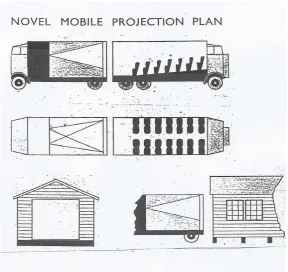
Figure 3 Novel Mobile Cinema van 154
Figure 4 Conservative Party Mobile Cinema van 154
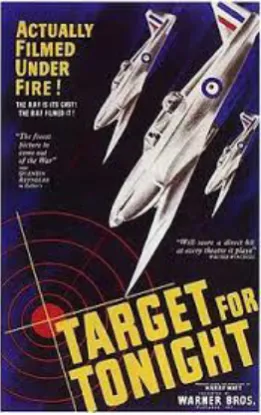
Figure 5 Target for Tonight – American Cinema Poster 176
Figure 6 Western Approaches – Cinema Poster 176
Tables
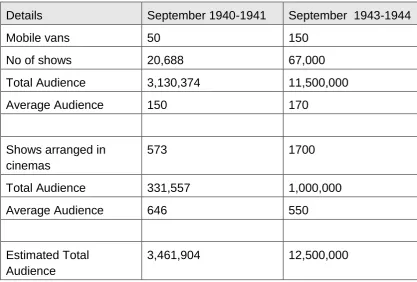
Table 1 Ministry of Information Film Audiences 1940 - 1944 157 Table 2 Central Office of Information Productions on Cinema
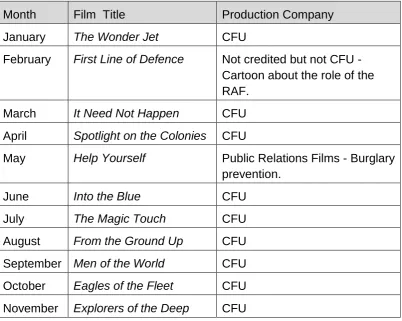
Exhibitor Association Scheme 1950
171
Bibliography 230
Appendices
6
Appendix 1 Crown Film Unit Films – Wartime Themes 1940 - 1945 256 Appendix 2 Crown Film Unit Films – Credits, etc., 1940 - 1945 263 Appendix 3 Crown Film Unit Films – Post-War Themes 1946 - 1952 272 Appendix 4 Crown Film Unit Films – Credits, etc., 1946 - 1952 289 Appendix 5 Crown Film Unit Annual record of Completed Films and
Running Times: 1940 - 1952
306
Appendix 6 A Review of Film Classification taxonomies as previously applied to CFU productions
308
Appendix 7 A Brief Note on contemporary short film Production Companies
311
Appendix 8 A sketch diagram of the Crown Film Unit’s Studios at Beaconsfield
319
7
Preface
A Personal Perspective
My interest in the Crown Film Unit (CFU) came about as a result of a coincidence of two themes, one in my academic life and the other in my personal life. I have always been interested in the role played by the visual media. During my Post-Graduate Education course at the University of Leicester in 1971 my Special Study was on the educational role of film and television. My supervisor for this project was the late Prof James Halloran, at the newly opened Centre for Mass Communication Studies. It always seemed to me strange that, at that time, visual images were as often as not rejected or at least relegated to a very subordinate role by many historians. As Christopher Roads had written in the Journal of Archivists in 1965;
I feel the value and use of film as historical evidence can be appreciated only if the prospective user has a broad grasp of the circumstances surrounding its creation, preservation and accessibility, and therefore, its relationship with other classes of records… Film is an awkward,
inconvenient, expensive, vulnerable and inaccessible medium (p.183). However, even before the digitisation of images and the development of on-line streaming, the existing visual record appeared to me to be as equally a valid source requiring, of course, the same degree of caution and qualification as to provenance as any written material. History is essentially a record of human events in the past and, for more than a century now that record has existed on film and more recently on videotape, disk and microchip. This particular
perspective was endorsed during my Master’s course at Queen Mary College, University of London where my supervisor the late Prof John Ramsden
introduced his students to such seminal film works as Leni Riefenstahl’s
8
a history course from GCSE to Post-Graduate level which does not include at least a reference to Riefenstahl’s film when discussing Nazi Germany. The moving visual image gave reality, however vicarious, to events and
personalities.
This academic interest coincided with a piece of family history which began my interest in the CFU in particular. My wife’s uncle was Frank (Jonah) Jones who, along with H. E. ‘Chick’ Fowle and Fred Gamage, was a senior cameraman at the CFU. Before his premature death in 1973 Frank would regularly regale family gatherings with tales of the early years of the film industry especially, in his view, its contribution to the war effort. Occasionally his younger sister Iris (my mother in law), had been included in visits to studios and locations where she met some of the luminaries of the time such as Humphrey Jennings, Harry Watt and Jack Holmes. Frank’s descriptions were often graphic and not
altogether complimentary. Indeed, Nora Lee, another former CFU employee recalled him as a ‘somewhat argumentative character’.1 Those were certainly
pioneering days, especially given the bulky nature of the equipment which was often secured hazardously to such positions as a locomotive’s buffer bar as in
Night Mail (1936) or in Close Quarters (1943) when Jonah created a ‘rig’ above
a submarine’s conning tower. The resulting shot as the vessel dives and water pours over the casing has reappeared in almost every other film featuring a submarine, from Above Us the Waves (1955), through Das Boot (1985) to
Down Periscope (1996). The shot is even more impressive when it is realised that Jonah could not swim. It will be a minor theme of this study to recall those cinematic techniques used in, especially, the CFU wartime productions, which appeared and were later developed by commercial cinema during the 1950s and later. Inevitably, the historian in me or maybe just a natural inquisitiveness caused me to read up about the CFU. Surprisingly, although much has been written about the more famous films and film-makers which will be referred to below, there was very little about the development of the Unit, the film themes and almost nothing on its eventual demise or legacy.
9
1. Introduction
Following the General Election of 25 October 1951, one of the first actions of the new Conservative administration was to close down the Government’s main film production facility, the Crown Film Unit (CFU). Twelve years of film making were dismissed in a Central Office of Information (COI) circular which was both brutal and to the point, ‘The Crown Film Unit will be disbanded and the mobile projection service abolished. There will be no more home theatrical distribution and narrow limits placed on home film production’ (TNA: COI 352, 29 January 1952). The Unit’s political executioner John Boyd-Carpenter, the Financial Secretary to the Treasury, later managed to spare it a couple of lines in his autobiography, commenting;
The CFU made, at Government expense, beautiful films often of high artistic merit. They were also films which no commercial producer would make because they would not pay. So, regrettably, I came to the
conclusion that this was not a necessary function of Government (1980, p.100).
In 1952 Boyd-Carpenter had disregarded the fact that these ‘beautiful films’ had only recently been endorsed internationally by the award of the Oscar for the Best Documentary (Feature) Film for Daybreak in Udi; a film about
10
success (and eventual decline) of the CFU and other documentary units in terms of a major art movement.
You start by being wild men, then you become established, and then you become old fashioned. Just like the French impressionists were first of all regarded as raving lunatics, then they were popular, and then they became old-fashioned although their effect is seen to this day on railway posters and hoardings and that sort of thing (Sussex, 1975, p.175). As might be expected the most vocal opponents of the closure of the CFU were those with a vested interest in the continuation of the Unit. As early as 14
January, 1952 Ralph Nunn May, the CFU General Manager, had written to R. A. Butler, the Chancellor of the Exchequer, making a desperate plea to avert the strongly trailed execution,
There are, alas few things of which it can be truly said that Britain has the best in the world. The CFU has an unchallengeable position as the best short film unit in the world. In war it proved itself a vital weapon; and in peace a skilful and adaptable instrument making films of many
different kinds for almost every department; making them all well; and not only doing a thoroughly practical and useful job, but winning awards the world over for the quality of the films – in itself no bad thing for British prestige (TNA: Treasury GS 49/019A).
In a similar vein Roger Manvell of the British Film Academy who, in a letter to
The Times on 18 July 1952 wrote of a recent visit to the USA, ‘everywhere I
went I was asked why the famous CFU had been closed down. This it was implied, was a great blow to British prestige, especially at a time when the maintenance of our prestige matters greatly to America’.
11
the Government intends to make certain economies leading to decreased production by the various film units with which it is concerned…..We would strongly oppose any steps’. However, such opposition failed to convince the Government to reverse its verdict.
Although the decision to close the CFU generated a substantial amount of opposition at the time, it was perhaps fitting that its obituary was eloquently summarised by Sir Stephen Tallents in the Kinematograph Weekly, the trade journal of the cinema owners. Tallents had been Secretary of the Empire Marketing Board between 1926 and 1933 and had not only recruited John Grierson but also, with him, introduced and developed the idea of using documentary films to support the Board’s objectives. Out of the Empire Marketing Board Film Unit (EMBFU) came the General Post Office Film Unit (GPOFU) which later became the Crown Film Unit (CFU). Tallents emphasised that the importance of the CFU was that it was not just a film production house but an important training facility and a model upon which ‘several national organisations have modelled their units, amongst them the Canadian National Film Board, which was established with the assistance and advice of John Grierson’ (Kinematograph Weekly, 7 January 1952).
However, much of the opposition to the closure of the CFU came from a
relatively small, if vocal, group of interested individuals like Tallents who tended to play down the fact that most of the Unit’s output were not feature length cinema exhibited films but rather short public informational films (PIFs) of between five and twenty minutes, sponsored either by the Ministry of
Information (MoI) or, after the Second World War, by particular Government Departments through the Central Office of Information. Topics ranged widely from Malta GC (1943), a film celebrating the heroic defence of the island in the face of massive aerial bombardment, to Breeding for Milk (1947) a specialist film for those in the dairy industry and Festival in London (1951) which,
12
Consequently, millions of people in the UK and also overseas in both colonies and independent countries saw CFU productions. As Tallents explained, not only was the CFU a major production unit of international reputation but it also fostered eminent film directors and others including cameramen, sound and ancillary technicians who became the backbone of much of the British film and later television industries of the 1950s and 1960s.
Outlining an Argument – Restoring Crown?
In order to achieve the predominantly revisionist intentions of this project it will be necessary to address three fundamental, if overlapping, research questions. Firstly, what films did the CFU produce between 1940 and 1952? By
identifying and re-examining as many of the production catalogue that are still available to access it should be possible to ascertain whether there are any common characteristics in CFU films. Such a review will also facilitate a
classification of each film’s content which in turn will enable both categorisation and a recognition whether a particular theme was transformed as the context of its production changed.
Secondly, how did the CFU respond to the changing political, economic, military and social circumstances during its lifetime? As the Government’s principal film production facility during the years 1940 to 1952 its establishment was a function of a variety of historical and other factors. Thus the importance of its predecessors from the First World War and the 1930s helped shape its initial structure, personnel and attitude to such issues as propaganda. As the 1940s progressed the changing national and international circumstances impacted upon the organisation, its approach to film making and the contemporary perception of its importance.
13
artefacts which give an insight into the British way of life between 1940 and 1952.
By addressing these questions, and the supplementaries they engender, the project will achieve the overall aim of rehabilitating the role and importance of the CFU in academic discourse.
As will be seen below a great deal has been written about aspects of the CFU but this has usually been of the cherry picking variety as the Unit has, as yet, to be considered in its entirety. Those who have approached the films from an auteur perspective, such as Brian Winston (1999), have perhaps unsurprisingly concentrated on the major feature length films. Yet, Humphrey Jennings,
probably the CFU’s most famous director, not only directed Silent Village
(1943) but also Defeated People (1946); producer Ian Dalrymple not only produced Fires Were Started (1943) but a year earlier Builders (1942), cameraman Jonah Jones not only shot Target for Tonight (1941) but also
Children’s Charter (1945) for example. A small group of people, admittedly a fluctuating membership, produced a variety of films from 1940 until 1952 but there has, as yet, been no attempt to consider the Unit as a whole. There has only been a limited academic discourse on the Crown Film Unit and, as previously stated, this has usually been restricted to the more famous feature films, even when examined in the contexts of propaganda or national identity. A critical review of the Unit and its complete production canon informed by
original archival research is thus timely and the primary purpose behind this study.
14
were therefore regarded as undeserving of academic study. Perhaps too, even though the Unit was clearly an important part of the British Documentary
Movement, its instrumental and sometimes propagandist output was thought unworthy.
Consequently the study will endeavour to place the Unit within its historical, political, social and filmic contexts. It will be especially concerned with explaining why, in the 1940s and early 1950s the Unit had developed a substantial national as well as international reputation. As far as reception is concerned it will consider whether its output contributed to the British morale and self-image not only during wartime but also in the subsequent, and less well studied, post-war years of austerity. Thus it can reasonably be expected to make a contribution to the debates about national and cultural identity in
wartime as discussed by such authors as Frances Thorpe and Nicholas Pronay (1980), Jeffrey Richards (1987), S. O. Rose, (2003), James Chapman (2005) and Jeremy Havardi (2014).
The study will also seek to contribute to the examination of the role of film and image in wartime propaganda (Karine Hildenbrand & Gérard Hugues, 2008) and Public Information Films (Andrew Spicer, 2003). It will also assist in
determining the influence of the CFU on the development of the British films of the 1950s and early 1960s including, for example, war films (John Ramsden, 1998 or Christine Geraghty, 2000) but also other genres and approaches. Finally, as much of the CFU’s output could be, and has been, described as documentary, the research will reflect upon the Unit’s place in the development of the British Documentary Movement (Aitken, 2006; Chapman, 2015).
15
A Review of Sources
It is perhaps a little surprising given that the Crown Film Unit was the British Government’s own film production facility during the turbulent war-time and immediate post-war worlds that it has, as yet, failed to substantially trouble academic discourse. Although the recently published BFI collection of essays on the GPO Film Unit (Scott Anthony & James Mansell, 2011) does provide some valuable information and discussion about the CFU’s immediate predecessor, including biographical chapters on the major directors and the development of film technology, other than a somewhat incongruous chapter on Jennings’ Silent Village, it effectively concludes in 1940. The BFI’s failure to
address the CFU is doubly perplexing as, not only did the CFU employ many ex-GPOFU individuals who were, or became, household names, but the follow up volume Shadows of Progress: Documentary Film in Post-War Britain (2010) by Patrick Russell and James Piers Taylor also has little on the Crown Film Unit.
It is certainly true that in the biographies or autobiographies of John Grierson (1966, 1978, 1979, 1990, 2000), Laurie Lee (2000, 2014) and even John Mortimer (1982, 2005) to name a few, the CFU made cameo appearances but, in the main, it was seen as either transitory or, at best, marginally
transformative. Mortimer, for example, a young scriptwriter who was exempted military service on health grounds, was somewhat scathing in his retrospective account of the films; ‘though efficient at showing the herring fleet putting out to sea, or bombers rising into the air to the accompaniment of symphonic music by Vaughan Williams, they were poor at dealing with human motives and dilemmas’ (New Statesman, 4 May 1979, p.6). This judgement at thirty five years distance does not seem to reflect that of the Unit’s contemporary reviewers as will be seen.
16
Arts Enquiry and entitled The Factual Film (1947). 2 Essentially this was a
review of documentaries and documentary-type films produced during the Second World War. It is valuable in that it not only reviewed the essential themes covered but also looked at the distribution and exhibition of these films. It definitely confirms that there was a ready audience for them as, ‘in the
ordinary cinema over 25 million attendances are being recorded each week’ (The Factual Film, 1947, p.151). Indeed its conclusions were quite upbeat and optimistic as it argued that ‘the success of the MoI’s non-theatrical film service during the war [in particular] and the development of film for educational, social and cultural purposes shows an increasing interest in the wider use of film’ (The Factual Film, 1947, p.153).
Yet within four years the newly elected Conservative Government had
announced the dissolution of the CFU and this engendered perhaps the most disputatious and widely circulated of all the published material. Much of this appeared inevitably in the trade and popular press in the early 1950s. The speed and apparent remorselessness of the decision to close the CFU did cause some shock and, as such, claims that it was a political vendetta.3 As the Manchester Guardian reported on 30 January 1952,
Mr J A Boyd-Carpenter, Financial Secretary to the Treasury, amplifying the Chancellor’s statement that expenditure on Government information services in 1952-3 would be reduced by at least £1.2m below the 1951-2 figure, [announced] that production of the films by the Central Office of Information would cease.
This announcement not only terminated the activities of the Crown Film Unit but also closed its new studios at Beaconsfield and ended the exhibition of Central Office of Information Films through the use of mobile cinema vans. At the
2Dartington Hall, near Totnes, Devon, was the headquarters of a charitable trust which
specialised in, amongst other things, investigating and supporting the arts.
3 Many Conservative politicians were hostile to the whole idea of Government information
17
stroke of a pen, a dozen years of film production on behalf of the Government was ended. As has been seen the opposition to the closure did not just come from the documentarists themselves but also included representatives of the relevant trades unions and others on the left of British politics. Perhaps
surprisingly there was even some reservation from the commercial sector of the industry, not natural opponents of a Conservative Government. The wartime agreements made with the Cinematograph Exhibitors Association (CEA) and the Kinematograph Renters Society (KRS) had continued beyond 1945. These arrangements permitted the free distribution of twelve official short films and 30 trailers a year on commercial circuits, giving access to some 4,700 cinemas. It has been estimated that ‘one short could be seen by as many as six million, and it was theoretically possible for the ‘flashes’ to be shown 47,000 times over a three-week period’ (Wildy, 1988, p.195). The exhibitors were thus assured of something ‘new’ and free for their programmes and this also enabled the Government to spread appropriate informational messages. Although by 1951 many cinema owners and managers had become less than sympathetic towards these Government film shorts, their trade journal the Kinematograph Weekly reacted to the closure of the CFU with some reservations;
18
categories which are subsequently reviewed in more detail below:- individual film monographs, film history and especially that of the Documentary
Movement, biographies and autobiographies of CFU staff, and film and propaganda.
Unsurprisingly the most complete and tangible records of the Crown Film Unit are the films themselves. During the twelve years of its existence about 225 films of varying lengths, topics and quality were produced. (A fuller description and analysis of the films can be found in Chapters Three and Four.) The vast majority of these films are archived and available through either the BFI or the Imperial War Museum.4 Many have also recently found their way on to
YouTube and other free access internet sites having been uploaded from a variety of sources. Yet despite this fairly ready availability and the fact that the original screenings of many of the short films had formed regular parts of individual cinema programmes, and that also there was a flourishing non-theatrical exhibition circuit, both of which guaranteed a substantial
contemporary audience, very little has been written about the films from the perspective of either historical or film analysis.
Of course there are notable exceptions to this and these tend, generally, to fall into two categories; either individual film monographs or, more frequently, as part of film histories which are usually thematically or chronologically titled. In the former category Kenneth Short’s (1997) RAF Bomber Command: Target for Tonight, which was a review of Watt’s 1941 film, neatly encapsulated some of
the key features of subsequent CFU productions examined later in this research.
Target for Tonight must be judged, in its own right and in its own time; applying those criteria, Target for Tonight was a fine piece of
moviemaking by a very talented filmmaker… What Watt achieved in 1941 figuratively blew away audiences and critics alike with the realism of his camerawork and his unmatched skill in leading non-professional actors to authentic performances, immeasurably enhanced by the skilled
19
cutting of Stewart McAlister. And yet the film was still largely artifice;
Target for Tonight was not the real thing, including the compression of an eighteen-hour period into forty-eight to fifty minutes. It was still ‘Lights, Camera, Action!’ in a cut-open Wellington fuselage on a sound-stage at Denham Studios (Short, 1997, p.200).
As will be discussed in Chapter Five much of the contemporary success of the CFU’s feature films was attributed to their realism and authenticity. However, as Short observed a great deal of the production was traditional film craft and deception.
Short’s review was followed a few years later by Brian Winston’s 1999 BFI study of Jennings’ Fires were Started which stands out as an exemplar of an in-depth analysis of a particular CFU film. Along very similar lines Adrian Smith focussed on another Jennings film, Heart of Britain (1941), in 2003. His and Winston’s approach differ slightly from Short in that the films are primarily vehicles for examining the methods and ideas of the director, Humphrey Jennings. Smith, for example, considered Jennings’ depiction of the working class asking;
Did Heart of Britain simply confirm the prejudices of Jennings’ fiercest
critics on the left, not least those admirers of John Grierson grouped around the Documentary News Letter who lambasted the supposedly naive, romanticised, sentimentalist view of a ‘mass observation lad’? …Jennings’ view of a class from which, for all his good intentions, he remained so detached [was probably influenced by] trudging the rubble-strewn streets of Coventry or the East End (2003, p.135).
Indeed in his later wartime CFU films Jennings continued to present ‘ordinary’ people as idealistic and heroic as, for example, the miners in Silent Village, the firemen in Fires were Started and Goronwy and Bill, respectively the miner and train driver, in A Diary for Timothy (1945).
This director-focussed approach has been adopted elsewhere in the occasional review of individual CFU productions which have appeared in a variety of
20
emerged, somewhat bizarrely, in Beautiful Things in Popular Culture (McKee, 2007).
However, discussion of the films produced by the CFU appear most frequently in those texts which can be described as histories of film and these also usually fall also into two distinctive, but inevitably, overlapping categories. In both cases the authors’ choices of films tend to be limited to a few of the more famous feature-length productions. In the former category, CFU films feature significantly in books concerning the Documentary Movement whereas the latter would include those about films, both contemporary and later, concerning the Second World War.
The post-war academic reflection on the importance of the British Documentary Movement commenced in some senses with the work of Elizabeth Sussex who, in 1975, published The Rise and Fall of the British Documentary. Sussex made substantial use of the reminiscences of many of the individuals who played an important part in both the British Documentary Movement and the CFU in particular. For example, she quoted the May 1943 resignation letter of Ian Dalrymple, the CFU Executive Producer, who clearly identified the uneasy relationship between the Unit and the cinema owners, ‘the commercial
exploitation of our films [was] exposed to the mercy of the whims and waggles of private distribution, with the result that the same old artificial conditions are created to prevent the producer covering his costs’ (1975, p.151). Indeed it was a common complaint from Alberto Cavalcanti to John Grierson and beyond that Government-employed documentary film makers would be far better
remunerated in the private sector. Grierson also made an early appearance in Sussex’s book which to some extent may be seen as something of a response to Grierson’s own 1946 book On Documentary which had been reprinted in 1969. As far as the Documentary Movement was concerned it is hardly surprising that Grierson should have pride of place given that he credited himself with inventing the term ‘documentary’.
21
talking about “films documentaires” … When I used the word
‘documentary’ of Bob Flaherty’s Moana, I used it as an adjective. Then I got to using it as a noun, ‘the documentary’ (Quoted in Sussex, 1975, p.3).
Certainly, as one of the architects of the Movement, Grierson was a powerful influence on many of the CFU directors and indeed, was himself the CFU’s Controller of Films from 1948 -1950. Although a great deal has been written subsequently about Grierson and the Documentary Movement (Ellis, 1984, 2005; Swann, 1989; Aitken 1993, 1998) any study of the CFU should identify those elements which formed the intellectual and production ethos that underpinned much of the output of the Unit. There can be no doubt that Grierson’s somewhat catholic and eclectic approach to film making struck a particular chord amongst a group of generally middle and upper class independent film makers during the 1930s. Grierson’s film Drifters (Empire Marketing Board Film Unit, 1929) was generally accepted as the seminal work of the British Documentary Movement combining, as it does, American
influences (Robert Flaherty’s 1922 film Nanook of the North for example), with the cutting techniques of Sergei Eisenstein and his own social imperative.5
Although there was a convergence of opportunity and personality, according to the histories of the Movement, Grierson’s importance to the development of the Crown Film Unit lay not only in his own productions but also in the areas of the training and recognition of talent, the identification and exploitation of
alternative distribution means and finally, in the proselytising of the
Documentary Movement to which many in the CFU professed adherence. Much of the eventual success of the Documentary Movement and, by implication the CFU, was owed to Grierson's skill as a publicist. He wrote prolifically, founding such journals as Cinema Quarterly and World Film News, and was a regular contributor to debates in both the national press and trade journals such as the Kinematograph Weekly. Such was his post-war clarion call in support of the CFU and the value of documentaries as he wrote,
5 See Paul Swann (1989), pp.30–36 for a fuller examination of Grierson’s role in the
22
We have, in short, to realise the part we [the documentary producers such as the CFU] shall be required to play in giving men the kind of mind and spirit that will bring the world to order. This involves a new measure of understanding and a will to use the medium more directly than we have done in the past’ (Kinematograph Weekly, 20 December, 1945, p.63).
Despite this it is probably true to say that, like the Documentary Movement itself, his influence was essentially metropolitan and intellectual rather than widespread and popular. According to Jack Ellis and Betsy McLane,
It [the Documentary Movement] had prestige among the educated classes and fit [sic] in with the thirties’ ideas about art in relation to
society. A movement with trained and skilled workers, it offered a distinct style as well as purpose and innovations in form and technique that are arguably Britain’s most important contribution to the development of the motion picture (2005, p.105).
Grierson’s success was to define the nature and role of the documentary which was he said, ‘the creative treatment of actuality’ (Grierson, 1933, p.8).
Newsreels, on the other hand, were essentially visual newspapers which, although capable of being editorialised, tended to be two-dimensional and, unlike much of the documentary output, lacked the narrative framework and exploitation of commercial cinematographic techniques.
23
A decade later Ian Aitken consolidated the existing state of scholarship
regarding the British Documentary with his edited collection, The Documentary Film Movement – An Anthology (1998). Certainly his description of the
institutional and organisational features of the Documentary Movement were neatly encapsulated as a
set of affiliated, often loosely connected organisations, concerned primarily with film production and film distribution, but with also the questions of public education and corporate publicity production….. The mode of (film) production was craft, rather than mass production-based and had little connection with the commercial film industry (1998, p.9). Although an excellent review its range and scope means that occasionally it does contain a number of generalised contentions which could be
reconsidered. For example, Aitken assured the reader that the ‘one significant fact connecting [the documentarists] is that they were old enough to have been directly affected by two of the most important radicalising events of the first half of the twentieth century; the Great War and the General Strike’ (1998, p.7). There is nothing especially wrong with this assertion although it does significantly omit to mention the Great Depression or the Spanish Civil War both of which were also radicalising events (Peter Miles & Malcolm Smith 2013, Tom Buchanan 1997, Paul Preston 1978, David Archibald 2005). The present study will certainly seek to rectify or qualify such claims made in respect of the CFU.
Furthermore given that the Crown Film Unit produced films during the 1940s it is hardly surprising that it should feature both in general film histories as well as those directly concerned with the Second World War. Certainly books by
Frances Thorpe and Nicholas Pronay (1980), Anthony Aldgate and Jeffrey Richards (1986, 1994 and 2007) have contributed significantly both to the scholarship and understanding about cinema and film in wartime. However the CFU’s appearance again tends to be limited as in Britain Can Take it (Aldgate and Richards, 1986) the representative films chosen were Fires Were Started
24
Dixon’s Reviewing British Cinema 1902-1992 discussed the 1955 film Dam Busters and briefly mentioned that it can be seen as a linear descendant of the CFU’s Target for Tonight (1994, p.149). In a more restricted time frame Charles Drazin published in 1998 The Finest Years; British Cinema of the 1940s. As the title suggests this was a comprehensive review of film production and reception during the decade. Again, as might be reasonably expected, a great deal of the text was given over to those commercially produced feature films which were deemed box office successes, such as Henry V (1944) and Brief Encounter
(1945). However, this is one of the few texts which included a substantial section on films produced by the CFU although, as with other authors, there was a tendency to review from a director-focussed perspective rather than from a thematic or contextual approach. For example, John Watt’s contribution to film making was summed up as his ‘importance to the British Cinema lay far more in his ability to inspire others with the cause of realism in his own films, which are on the whole rather crude’ (Drazin, 1998, p.142). Watt was, of course, the director of the critically acclaimed Target for Tonight. Watt’s film
also featured in an earlier review of wartime cinema in Clive Coultass’s British Feature Films of the Second World War (1984) but, as the title suggests, the discussion of the CFU’s output was quite limited. Some years later in 2001 Simon Mackenzie’s British War Films 1939 – 1945 was essentially a review of successful commercial films produced during the war, such as In Which We Serve (1942). The same omission of the CFU is generally true of the varying texts and articles written subsequently about British films in wartime, such as Robert Murphy (2005). Even those authors who have reviewed the British War Films produced in the 1950s (such as Geraghty, 2000 or Ramsden, 1998) only give scant recognition to the work of the CFU as precursor.
25
Journal of British Cinema and Television demonstrates. This commenced with a review of documentary films by Martin Stollery in 2013 and was followed by a riposte from Brian Winston (2014) a couple of issues later and subsequently a rejoinder by Scott Anthony and Patrick Russell (2014). Winston had been defending the more traditional periodisation of British documentary which essentially views the post-war years, especially after 1951, as one of decline. Stollery, Anthony and Russell take a much more nuanced perspective on the supposed decline. No doubt this debate will continue over the next few years. Of course those with a less high profile or more limited contact with the Crown Film Unit tend to have either fewer biographies or autobiographies and often the Unit is dismissed in a few sentences or paragraphs. Certainly the
autobiographies of Basil Wright (1976) or Pat Jackson (1999) show some insight both into the production of films and the workings of the Unit. However, for some important participants in the development of the Unit, such as Sir Kenneth Clark who was the Ministry of Information’s Head of the Film Division in 1939, his film role warranted only a small flippant aside. He regarded his appointment as inexplicable and went on to explain it in his autobiography The Other Half, ‘[as] commonly attributed to the fact that in those days films were
spoken of as “pictures” and I was believed to be an authority on pictures’ (1977, p.10). Clark was, of course,Director of the National Gallery and Surveyor of the King's Pictures. Other biographies can be quite obscure and appear to be rarely accessed. Representative of this category would be Cally Trench’s (2012) brief but obviously heartfelt online tribute to her father, Terry Trench, who worked for the CFU as both a director and editor. Amongst a long list of documentary films up until his death in 1975 Trench’s CFU credits included editing The True Story of Lili Marlene (1944) and This was Japan (1945) and directing The Way from Germany (1946). According to his daughter his work was characterised by the realisation that, as most cinema audiences see a film only once, ‘no editor should be pleased with a film which, however ingenious, is not clearly understood and does not make an emotional impact first time’
(Trench, 2012).
26
but also sometimes about the workings of the CFU itself. It is still possible to hear some of the reminiscences of CFU employees as a few have been recorded as part of the BECTU (Broadcasting, Entertainment, Cinematograph and Theatre Union) History Project, and are available through the BFI’s
Reuben Library. Occasionally, of course, the self-justification aspect of the recollections successfully camouflaged the reality, but normally this can be filtered to provide snippets of information about the operation of the Crown Film Unit. For example, in her BECTU interview in 1994, Nora Lee revealed that the development of shooting scripts and the careful consideration of camera angles was often determined by the need to be economical with film stock which was in short supply during the war years.
Despite the difficulties of film making any examination of the CFU must also consider the nature of film exhibition and audiences in the 1940s as this underpins the argument that these films have a significant importance for the study of wartime and post-war Britain. Unlike the more conventional
commercial film studios which essentially provided films for commercial cinema, the CFU’s exhibition outlets were many and varied. There was a thriving non-theatrical exhibition circuit in which CFU films were loaned, normally free of charge, to almost any organisation which had access to a 16mm film projector and associated sound equipment. Others were literally taken onto the street corners of Britain by a fleet of cinema vans operated by the Ministry of Information. So, as will be seen, films were distributed and shown in factory canteens and village halls to audiences which ranged from the war workers, the Salvation Army to Boy Scouts. As more men and women were conscripted into the forces the films were shown in NAAFIs (Navy, Army and Air Force Institutes) both in the UK and wherever British forces were fighting. Although the majority of CFU films fell into the short category of between five and twenty minutes in length its productions also included films of feature length like, the already mentioned, Target for Tonight or Western Approaches,
27
Portsmouth which has been studied in depth by Sue Harper (2004 and 2006). Finally, there were the very small cinemas, often in rural situations, with seating for a hundred or so people. These types of cinema are just about recognisable in the early part of the twenty-first century but the newsreel cinema which, in the 1940s, was often to be found in most city centres, often in railways stations such as Baker Street (a major London Underground interchange), have almost entirely disappeared. The newsreel cinema was an American import of the early 1930s and concentrated on regular repeated, normally hour long shows of, unsurprisingly, newsreels but also increasingly animated cartoons and travelogues. Normally the newsreel theatres were tied to one of the main newsreel producers such as Pathé or Movietone. However, during wartime, Ministry of Information (MoI) shorts, including CFU produced ones, were also inserted into their daily programmes.
As CFU productions were commissioned by Government and were exhibited regularly in various ways to a national audience there has been an almost inevitable categorisation of them in the literature as propaganda films. While watching today, normally on television or increasingly digitised through the Internet, a CFU production from the 1940s with its cosy stereotypes and worthy storylines there is sometimes an uncomfortable feeling that this really is
propaganda dressed up as documentary. It is by no means as brutal or blatant as Triumph of the Will (1934) but the films could possibly fit at the opposite end of the same continuum. This impression is hardly surprising as after all the CFU was an organ of government directly responsible to the MoI. Indeed, Sir
Kenneth Clark, the unlikely Head of the Films Division of the MoI, was an early and passionate advocate for the role film could play, announcing to
Kinematograph Weekly that;
28
This observation was made despite the reluctance of many in Government to become actively engaged in something as nefarious as propaganda, and this perspective was quite deeply ingrained. The Official History of the Second World War does not include a volume on the MoI and even the ancillary volume on Morale by Col J.H.A. Sparrow (1949) referred almost entirely to morale within the armed forces rather than that of the civilian population. It was not until some thirty years after the conflict that Ian McLaine (1979) published
Ministry of Morale, his study on the MoI which in turn seemed to spawn a number of journal articles and books over the next twenty or so years which began to use the word “propaganda” in their titles. The apparent acceptance of the term enabled film historians and others to reflect and examine film
production and distribution within a new context. Thus, for example, T. J. Hollins in 1981 examined the use of film in his English History Review article, ‘The Conservative Party and Film Propaganda between the Wars’ and a few years later Tom Wildy looked at the post-war situation in his From MoI to COI –
Publicity and Propaganda in Britain, 1945-51 (1986). Books published on this topic range from Nicholas Pronay and D. Spring’s Propaganda, Politics and Film in 1982, through William Crofts’ 1989 Coercion or Persuasion,
Propaganda in Britain after 1945 culminating at the end of the millennium with James Chapman’s 1998 The British at War, Cinema, State and Propaganda
and Nicholas Reeve’s 1999 The Power of Film Propaganda, Myth or Reality?
Thus over a period of twenty or so years what had been avoided previously had become conventional so that recent studies of the films sponsored by MoI, and its later iteration, the Central Office of Information have been generally ascribed to the ‘propaganda’ category. Reeves (1999), for example, entitled his chapter on the CFU and other productions, ‘Official Propaganda in Britain during the Second World War’, and by 2007 Jo Fox was able to conflate into the same conceptual idea what would have seemed inimical forty years before as Film Propaganda in Britain and Nazi Germany: World War II Cinema. However, before accepting these assumptions it is worthwhile to review exactly what ‘propaganda’ can and does mean in the context of the films produced by the
29
Trotsky’s description of cinema and film as ‘the best instrument of propaganda’ (cited in Taylor, R., 1998, p.16) has been echoed by politicians of every
particular persuasion almost from the beginning of film. Film is able to
communicate a visual message to a mass audience in a way which does not require the mediation of literacy. Visual images and simple story lines could, for the first time, be transmitted to large groups of people in a single event. Not only was this medium extremely powerful but the very novelty engaged audiences in an unsophisticated and uncritical manner. Although film and cinema were well over forty years old by the time that the Crown Film Unit was created much of this early enthusiasm for the moving picture was still evident in cinema and non-theatrical exhibitions in Britain. The apparent power of the medium and the potential passivity of the audience inevitably drew those who wished to utilise it for purposes other than entertainment.
Predictably perhaps, although there are propaganda studies of many nations, much of this work has concentrated upon reworking themes within the Nazi and Soviet systems.6 Consequently, it is often difficult to employ the term
‘propaganda’ without being aware of its pejorative connotations. Indeed its negative and insidious associations were aptly reinforced as early as 1933 by Josef Goebbels, who required of propaganda the achievement of the following aim: ‘It is not enough to reconcile people more or less to our regime, to move them towards a position of neutrality towards us, we want rather to work on people until they are addicted to us’ (cited in Reeves, 1999, p.88). More recently, with the work of David Welch (1994) and others, propaganda has been placed on a scale of advocacy which Governments and institutions have adopted for centuries; ‘Throughout history the governors have always
attempted to influence the way the governed see the world. Propaganda is not simply what the other side does, while one’s own side concentrates on
“information” or “publicity”’ (Welch, 1999, p.24).
6 See for example Mariel Grant (1994) Propaganda and the Role of the State in Interwar
Britain, or Philp Taylor, (1999) British propaganda in the Twentieth Century: Selling
Democracy, or George Roeder (1993) The Censored War, American Visual Experience during
30
The origins of the term propaganda lie with the creation in 1622, by Pope Gregory XV of the ‘Congregatio de Propaganda Fide’, the Congregation for Propagating the Faith. In response to both the spread of the Reformation and the conquest of the New World this was a committee of cardinals charged with the responsibility of overseeing the spread of Catholicism and the regulation of ecclesiastical affairs in non-Catholic countries. Indeed the Latin root propagare
conveys a sense of both propagation and spreading. According to Welch, the first official propagandist institute was a body charged with improving the dissemination of a group of religious dogmas. The word
“propaganda” came to be applied to any organisation set up to spread a doctrine; then it was applied to the doctrine itself which was being
spread; and lastly to the methods employed in the dissemination’ (1999, p.25).
In many senses the impact and influence of these propaganda messages is symbiotic with the development of the media which carry them. Although there were examples of printed pamphlets and newsletters proselytising political and religious ideas during the English Civil War it was only with the spread of
general literacy on the one hand and steam and electric printing presses on the other that both the vehicle and the audience existed for mass persuasion. The ‘public’ and public opinion began to be seen as phenomena capable of being manipulated.
31
‘injecting’ them with messages designed to trigger required responses. In many ways this was the assumption that lay behind much of the propaganda efforts in wartime Germany and the Soviet Union. The audience was perceived to be passive and, providing that there were no alternative sources of information, they would end up believing and accepting what was ‘injected’ into them. The ‘Two Step Flow Theory’ is slightly more sophisticated in that it postulates that certain individuals within society are opinion formers or opinion leaders and it is these people who need to be ‘targeted’. This approach has been adopted frequently by the advertising industry in its attempts to sectionalise and classify markets. Products are therefore often promoted with celebrity endorsement to encourage sales within particular groups in society. There is less evidence that this approach has been taken to ‘spin’ political ideas and opinions through the productions of the Crown Film Unit, however celebrities, such as the Crazy Gang, Bernard Miles and others do occasionally appear in reassuring rather than actively indoctrinating roles. The more complex ‘Diffusions of Innovation Theory’ argues that although opinion formers are important in the spread of ideas and innovations there are social and psychological factors which
predispose individuals to accepting or rejecting a particular view or commodity. Amongst these factors would be the terminal level of education for example or perhaps the perceived need for the change. The theory identifies five ‘adopter’ categories 1) innovators, 2) early adopters, 3) early majority, 4) late majority and 5) laggards. Although it might be conceivable to review Nazi propaganda activity in Germany from the1920s onwards on the basis of this perspective it is outside the scope of this study. However, within the Crown Film Unit and other MoI and COI productions it is possible to identify recurring themes which could be interpreted as either reinforcement of ideas and opinions or as addressing slightly different audiences who may be examples of the adopter categories. It is certainly plausible that some of the output of the Crown Film Unit fell into the category of ‘propaganda films’ as it was, after all, a Government
organisation producing films which, especially after 1946, were normally
32
short films commissioned by the Government in its various guises both during and after the war.7 The adoption of a case study approach will indeed examine
whether there was any evidence to be found of the insidious or grotesque ‘selling the message’ during the lifetime of the CFU. Furthermore the research will also assess the legacy of the Unit in a number of areas but, in respect of this particular issue, it will investigate whether or not the CFU made any significant contribution to those key aspects of successful propaganda; public morale as described by Robert MacKay (2002) and to the concept of British nationhood as recently discussed by James Chapman (2005, 2013 and 2015).
Methodology
The diversity of the resources for this study, including films and written archive material as well as interview records and contemporary correspondence, alongside the decision to utilise case studies as exemplars would suggest that this research should adopt a mixed methodological approach. This in itself raises a couple of basic philosophical questions about the research strategy. Firstly, there has always been a debate about the respective values of
qualitative and quantitative approaches and each perspective is supported by a large and complex literature (Davies, 2007, p.10). Unfortunately the
proliferation of the literature has resulted in a lack of clear consensus regarding appropriate definitions. This is often compounded by the frequent
interchangeability of terms such as method, design, approach, paradigm and perspective thus making comparison and analysis problematic. However, this lack of consistency could be an advantage as, argues Egon Guba ‘it is
important to leave terms in a problematic limbo, because it is then possible to reshape them as our understanding of the many implications improves. Having the terms not cast in stone is intellectually useful’ (1990, p.17). Secondly, given the nature of the evidence available it would indicate that methodologically this research fits into an interpretivist approach which, according to Richard Pring, ‘seeks to understand the world from the perspective of the participant, or to
7 For a brief contextualising review of short films in the 1940s see Andrew Spicer’s Extending
people's minds for a brief time every day: the wartime propaganda shortin the Journal of Media
33
understand a set of ideas from within the evolving tradition of which they are part’ (2000, p.56). Indeed as the researcher is at the heart of the process, especially in the selection of the case studies, the interpretation of the evidence is as much a result of personal factors and values as the evidence itself.
Given the distance in time even the interpretivist approach is constrained by the availability or authenticity of the evidence. Of course at the core of this research are the films themselves but these are historical artefacts liable to decay and are often highly flammable. Consequently, unless an archive has taken the time and trouble to record them onto a safer and longer lasting medium or kept them in a dry environment there is a high probability that the film will have been lost or damaged irretrievably. Many duplicates of Crown and other contemporary films have already been lost often having been destroyed, sometimes
deliberately in the past, in an attempt to recover the silver content from the film stock. This means that the availability for viewing of a particular film will depend upon a number of, seemingly, random variables; principally whether it has been lodged within an archive such as the British Film Institute (BFI) or the Imperial War Museum (IWM) and whether it is in a safe condition to be viewed.
Understandably the archives are reluctant both to hazard a researcher reviewing a fire risk film or, perhaps also, to pay for its safe duplication when demand to see it is minimal.
Those relatively few, often feature length films directed by one of the more famous CFU personnel such as Humphrey Jennings or Harry Watt, have often been made available to other platforms such as television or, more recently, through the internet and have, effectively, been given both a wider audience and have been saved for future generations to appreciate. This, unfortunately, cannot be said about the majority of the CFU productions which have
languished, usually unseen, for well over half a century. Most of these films exist in the BFI and IWM archives and these, along with a small number of often specialist films available in a variety of collections such as, for example, Jennings’ Spring Offensive (1940) which is in the University of East Anglia’s
34
An annoying practical complication exists to confound research into the CFU in that it is sometimes surprisingly difficult to confirm a particular film’s production provenance. Indeed the research quite early on established that the listings held by both the BFI and the Imperial War Museum are neither comprehensive nor entirely accurate. Even a contemporary catalogue, such as that of the trade journal, Cine-Technician (Nov-Dec 1952, p.143) has errors. In these
circumstances it was decided to include in the research films in which either the appearance of the Crown Film Unit name or logo in the introductory credits or, exceptionally when it is absent, the direct mention of its production in the documentary record. However, even these basic criteria have raised
anomalies, especially in the early months of Crown and also again in its later years. As the GPOFU morphed into the CFU films already in production were sometimes prefaced by the Crown name or logo and sometimes by that of the GPOFU. Some films such as Men of the Lightship (1940) have no production acknowledgements other than the ubiquitous MoI Films credit. At the other extreme, confusingly Christmas Under Fire (1941) has both GPOFU and CFU logos. In order to accommodate these inconsistencies this research
incorporates, where it can reasonably be ascertained, those films which were completed after the GPOFU became directly under MoI control in April 1940 but before it formally became the CFU on I January 1941. Similarly, by the later years of the CFU even the Crown logo was inadequate as evidence of
production as the imprimatur had been expropriated by the Central Office of Information for its own use. Where some doubt may still exist as to provenance this is mentioned in Appendices 1 and 3. Even when a film may be safely verified as having been produced by the CFU it was often the case that the credits omit mention of the director or production staff. This, of course, does reduce the opportunities for differentiating or analysing films on the basis of the production personnel.
The absence of any form of production credit was especially true of the brief 60-90 second trailers or ‘flashes’ which were a regular part of cinema
35
telephonists or hospital domestics. In the post-war era Public Information Film ‘flash’ topics have included road safety or, bizarrely, encouraged people to volunteer for agricultural ‘holidays’ to bring in the potato harvest. Some of these would have been produced by the CFU but this form of PIF did not normally identify the production company and were, in wartime, prefaced only by the MoI logo. This uncertain authenticity is further compounded as the documentary record about wartime and post-war ‘flashes’ is neither exhaustive nor complete. In these circumstances the very short 60-90 second films have been excluded from this study, although should appropriate records and a sufficient number of extant and viewable films be discovered in future then, no doubt, they would be a suitable topic for research.
Therefore the selection of films in this study has been determined essentially by the survival and safe availability of the films themselves. Appendices 1 and 3 include descriptions of those films identified as being produced by the CFU firstly during the war and latterly in the post-war years. They also describe, where appropriate and possible, which films were issued in different versions, usually length, such as, for example, Jennings’ 1944 films about the second London Blitz, Eighty Days (14 minutes) and V1 (8 minutes). Some films were retitled, normally to appeal to overseas audiences, thus Jackson’s Western Approaches became The Raider, when distributed in the USA. The Appendices further clearly indicate which films were available for viewing by the researcher along with those that were not.8
Not only is the filmic record of the CFU incomplete so too is the associated documentation. As has been indicated above there is a significant canon of published material which provides an important element of secondary evidence for the study. The main archival source for the CFU is the National Archive at Kew and those documents relating to the CFU are to be found principally in the INF1, 6 or 12 classifications. However, many other relevant documents are not only located in other INF sections but across the whole range of Government Department records. The location of the relevant documents are clearly
8 Some films were started in production, such as Escort Carriers (1944), but never completed or
36
indicated in the text, normally prefaced by the abbreviation TNA (The National Archive). Other documentary evidence of direct relevance to the CFU exists in a number of University and related libraries and has been consulted in support of this research. In this category would be the Grierson Archive in Stirling, the Conservative Party Archive at the Bodleian, Oxford and Mass Observation at Sussex. As far as contemporary journals are concerned the BFI Library is well stocked with trade journals such as the Kinematograph Weekly or specialist film ones such as the Documentary News Letter. Newspaper and relevant magazines were available through the British Library at Colindale, although this has recently transferred to Wetherby, West Yorkshire. Local newspapers, such as the Yorkshire Post, supplied some non-metropolitan evidence for regional critical review and audience response. University Library collections have provided much secondary and occasionally primary research materials, although ease of access is often determined by the transparency and
effectiveness of the overall indexing systems. I have spent many long and often fruitless hours rummaging around in the Libraries of the Universities of London (Senate House), Queen Mary, Royal Holloway, Southampton, Solent, Surrey and Winchester, although this tedium was occasionally dramatically relieved by the discovery of some vital nugget of information. Other artefacts were found elsewhere, frequently quite randomly, cinema posters, comments by local history societies or parish magazines, often these are reported recollections which, of course, have to be considered cautiously given the problems
associated with historical ethnographical research. In this respect Janet Staiger has reviewed these issues comprehensively in her 2005 book, Media
Reception Studies. She adapted the findings of the famous 1920 Hawthorne Management Study9 to the media environment by identifying ‘[the] problems
with investigating audiences and fans, including the power differential between
9 The term was coined in 1950 by Henry A. Landsberger when analysing earlier experiments
from 1924–32 at the Hawthorne Works (a Western Electric factory outside Chicago). The Hawthorne Works had commissioned a study to see if their workers would become more productive in higher or lower levels of light. The workers' productivity seemed to improve when changes were made, and slumped when the study ended. It was suggested that the
37
ethnographers and their subjects and more specific matters such as leading audiences and interviewees toward answers that the interviewers require’ (2005, p.14).
Sadly most of the active participants in Crown have now passed away. As mentioned in the personal perspective in the Preface the initial idea was generated from discussions with Jonah Jones and his immediate family. Conversations were also had with Nora Lee back in 2000 and with Humphrey Jennings’ daughter, Mary-Lou. These are all, of course, anecdotal but they provide an important impression of what it was like to be part of the CFU. These personal reflections give background colour to the research providing assertions and assumptions which can be challenged or confirmed by other source material.
The lengthy gestation of this project occurred during a period when the
theoretical underpinning to such a study was in a state of some flux. Initially it had been conceived as, essentially, an historical study which ‘told the story’ of the Crown Film Unit recognising it as an important organisation within the development and history of the British cinema and film industry at a significant time in national history and this still remains an important goal. However, given the conceptual transformation in film history studies over recent years it would be difficult now to construct the study without taking cognisance of the
intellectual changes which have occurred.
These developments have been admirably summarised in James Chapman, Mark Glancy and Sue Harper’s book The New Film History (2007). As far as the CFU is concerned their analysis situates most of the early published works on the Unit (as mentioned in the Literature section above) clearly in either the auteur or textual analysis branches of film history, and certainly these
38
films are shaped and determined by a combination of historical
processes (including, but not limited to, economic constraints, industrial practices, studio production strategies and relationships with external bodies such as official agencies, funding councils and censors) and individual agency (representing the creative and cultural competence of their art directors, composers, costume designers, directors, editors, producers, stars, writers, etc.) (Chapman, Glancy and Harper, 2007, p.6).
Chapman has further argued that New Film History has extended the more traditional debate about whether films provided an accurate historical
representation to one which considers more thoughtfully the political and social context which underpins them. This, in turn, impacts upon the ‘extent to which popular cinema contributes to the discourse of nationhood and national identity’ (Chapman, 2007, p.65). This latter point is especially important to the study of the CFU as not only did the Unit produce feature length films10 which are
frequently referred to in histories both popular and academic but also in
television shows and documentaries. For example, a recent BBC documentary
Operation Jericho (first broadcast by BBC 2 on 29 October 2011) used footage from the CFU’s Target for Tonight (1941). If it can be reasonably assumed that CFU feature films contributed towards the debate on nationhood and national identity by constructing and reconstructing significant moments in the nation’s history then surely those myriad CFU shorts presented as an integral part of almost every cinema programme from 1940 until 1952 provided an
unconscious underpinning to the contemporary appreciation of that national identity. Indeed if CFU feature films such as Target for Tonight (1941) provided key and stark prompts in bolstering the ideas surrounding British nationhood, the many shorts were more subliminal, a wallpaper of moods and situations which reinforced and strengthened the overall sense of national identity both during and immediately after the war.
10 The BFI has defined ‘feature length films’ as those over 40 minutes duration. The number of