STUDENT AND STAFF PERCEPTIONS ON THE IMPACT
OF LECTURE CAPTURE
Daran Price and Timos Almpanis
Southampton Solent University
Southampton, UK
Abstract
This paper summarises interim research findings from a pilot project on lecture capture. The background and the objectives of the pilot are described, followed by a literature review on the subject in order to contextualise the research focus of the project. The methodology followed is outlined, and the project findings with a focus on staff and student perceptions of lecture
capture’s impact on satisfaction, attendance and performance are subsequently described and discussed. The main outcomes from the research are
summarised and ideas for further research on the subject are indicated in the conclusion.
Introduction
Lecture capture has been cited (Greenberg & Nilssen, 2011) as one of the most transformative technologies to impact Higher Education Institutions (HEIs) in recent times. It is rapidly being adopted as a core service by the majority of UK HEIs and has a marked positive impact on levels of student satisfaction.Whilst being cautious about the nature of some of the claims that may be attached to the adoption of lecture capture, interim findings of a pilot study at Southampton Solent University (SSU) offer a demonstrable
enthusiasm toward the availability of recorded lectures.
Background
Lecture capture is often used as an umbrella term describing a range of technologies used to digitally record and distribute lectures. Some of the characteristics that now might be expected of a lecture capture system, such as automated recordings alongside associated lecture notes and annotations, were germinating 20 years ago, as in the Classroom 200 project initiated in 1995 at Georgia Tech (Abowd, 1999).
Historically, the term was inclusive of various ad hoc methods of recording a session including video cameras, flip cameras, or even plain audio recorders. Whilst the breadth of technologies used has varied significantly, recent developments have seen Software as a service (SaaS) solution come to the fore. The main advantages of SaaS solutions for lecture capture are lower entry thresholds for hardware and infrastructure, as well as the training and support requirements needed to enable lectures to be recorded easily and at scale.
2014 UCISA survey (Walker et al., 2014) where 63% of HEIs were now seen to be supporting lecture capture as a core service.
The Learning Technologies Department at SSU initiated a series of pre-pilot trials to evaluate the potential lecture capture solutions might afford. The trials’ focus enabled a comparative study against existing services being delivered at SSU, alongside the usability, interoperability and pedagogic benefits for staff and students. The outcome of the investigative trials was the selection of Panopto as a preferred solution to be adopted for a pilot period over the academic year 2014/15. A call for participation to all academic staff was issued via the University news channels as well as via the university's main annual conference in September 2014 (Price & Almpanis, 2014). Academics were asked to submit proposals outlining their expressions of interest; a resultant 28 members of staff were invited to participate in the pilot. Proposals were received across the three University faculties, representing a broad range of courses, and a total of 68 unit pages were enabled for lecture capture on the Virtual Learning Environment (VLE). The enabled units had at least one active recoding attached to them and 1,501 enrolled students in total. During the period under consideration, a total of 455 lectures were recorded, which equates to 253.36 hours of recordings; these were viewed a total of 3,910 times.
Objective
This paper will examine the perceptions and self-reported use of lecture capture of both academics and students. It considers project findings over a fifteen-week period during semester 1 of the pilot.
Students and staff were invited to take part in online surveys and focus groups to gather interim feedback on the impact lecture capture seen to have had on teaching and learning. By focusing on the perceptions of participants at this interim stage, the authors of the paper aim to use these initial findings towards comparative longitudinal studies.
Literature Review
This section will look at studies in the area of lecture capture that have taken place in the UK and globally, with an emphasis on lecture capture impact on satisfaction, attendance and performance.
Lecture Capture and Student Satisfaction
Lecture Capture and Student Attendance
Some studies on lecture capture have looked at the impact of lecture capture on student attendance. One study focusing on the impact of audio recorded lectures showed that attendance remained high throughout the semester and that “contrary to popular belief, generation Y students in general, do not aspire to replace lectures with downloadable, online versions” (Larkin, 2010, p.238). In another study (Nashash & Gunn, 2013) students indicated that the
availability of the recordings did not encourage them to skip or miss any classes. In a study by Copley (2007), which surveyed 84 students, the majority of them (59%) stated that recorded lectures would not reduce their attendance, while 12% of students stated that access to recordings would increase
likelihood of absence. The remaining 31% of students stated that their decision would depend on the course. A study by Traphagan, Kucsera, and Kishi (2009) showed that the availability of webcasts negatively impacted student attendance by 9% on average.
Lecture Capture and Student Performance
Some studies in the area of lecture capture have looked at correlations of lecture capture and student performance. A study on lecture availability in introductory psychology (Hove & Corcoran, 2008) suggested that posting lectures to supplement a traditional college class was associated with a small, positive effect on academic achievement. Another study (Traphagan et al., 2009) regarding webcasts’ impact on performance found that among students with access to webcasts more viewing was associated with higher
performance; however, overall, students with webcast access did not differ on performance measures from students in the control group who had no webcast access. According to the same study, webcast viewing appears to nullify the negative effect student absenteeism can have on student performance.
While student satisfaction is evident in most studies on lecture capture so far, as students respond positively to having their lectures recorded and express their wish for more of them to be captured, the impact of lecture capture on student attendance and student performance is far more complex and context specific, as there are many variables involved. Acknowledging this, the authors of this paper have decided to investigate these areas - impact on attendance and impact on grades - as perceived by staff and students who participated in the lecture capture pilot. In other words, instead of making any claims that the introduction of lecture capture has or has not impacted student attendance and grades at this early stage, the results will highlight the impact on attendance and performance as perceived by students and staff who participated in the pilot.
Methodology
but allowed participants to respond in a more discursive way, expanding on the answers given in the surveys.
Results Student Perceptions
Students were sent an email link to an online survey created with Google Forms to which there were 93 respondents. Following that, three student focus groups (with 6-8 participants in each) took place in order to further elaborate on the questions providing some additional qualitative data.
Student use of lecture captures. The survey highlighted the variety of devices and platforms students used to view recorded lectures, taking advantage of the flexibility and manner in which they could engage with the resources. With applications for Panopto available for smart phones and tablets, they both featured in the responses, and 42 (45%) students indicated they had used more than one device. However, as shown in Figure 1, the most common device was a laptop (n.56 - 60%).
Figure 1. I have accessed video recordings from the following devices (tick all that apply).
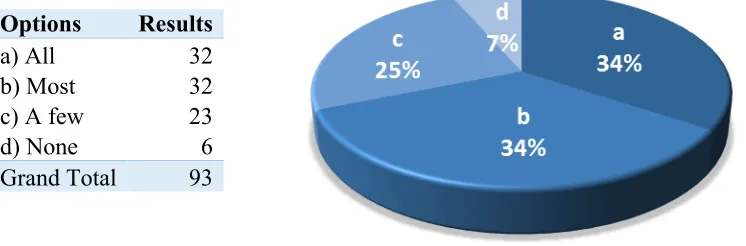
The majority of students reported viewing the recordings with 76 (82%) of students indicating they had viewed at least a few of the resources. When asked how many of the resources they were expecting to watch by the end of the academic year, this figure increased to 87 (93%), as shown in Figure 2.
Figure 1. How many of the recordings are you planning to watch by the end of the academic year?
Options Results
a) All 32
b) Most 32
c) A few 23
d) None 6
The recordings were seen to be easy to understand, with 66 (71%) of students either agreeing or strongly agreeing. An equally positive response was
received when students were asked about ease of access, with 77 (82%) agreeing or strongly agreeing that they were easy to access.
When asked if they would like to see the continuation of lecture capture, a significant majority 74 (80%) of students expressed they would agree or strongly agree as shown in Figure 3.
Likert Results 1) Strongly Disagree 0
2) Disagree 5
3) Neutral 14
4) Agree 22
5) Strongly Agree 52 Grand Total 93
Figure 2. I would like to see more of my lectures being recorded in the future.
Student perception on whether lecture capture will improve their
grade/performance. Both the survey and focus groups considered the benefit lecture capture might have in supporting students learning and learning outcomes. When asked if the recordings supported their learning, 59 (64%) either agreed or strongly agreed they had.
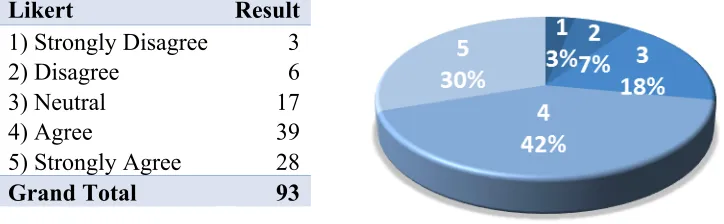
There was a strong perception that lecture capture would improve students’ performance and grades with 67 (72%) of respondents agreeing or strongly agreeing there would be a positive impact, as shown in Figure 4.
Likert Result 1) Strongly Disagree 3
2) Disagree 6
3) Neutral 17
4) Agree 39
5) Strongly Agree 28 Grand Total 93
Figure 3. I think that the lecture recordings/video tutorials will improve my grades/performance.
It’s like exceeding them really because you wouldn’t get that anywhere else. If you went to school you wouldn’t go home and get a lecture capture and video of your lessons, so it is like better than I expected when I came here.
Another student reflected on the benefits of being able to engage more effectively in class rather than concentrate on taking lecture notes:
I also find lecture capture really useful instead of those notes because usually other classmates have questions about those slides and they ask the question and the lecturer can answer the question instead of
everyone sending emails to the lecturer. Lecture capture is good because everyone gets the same information at the same time.
Moreover, one student added that access to the lectures might have a positive impact on student grades:
Definitely, because a lot of the time I do not want to be sitting there and writing notes (in class) when I write notes I miss out on what the lecturer is saying. So it is better for me to write out what I can in the lesson and the things that I missed I can go home and look at. It definitely helps to improve my grades because I get more from the lesson.
Whilst it is often problematic to empirically prove an actual positive impact on student grades based on the introduction of a new technology alone, it seems to be clear that students' perceptions are that lecture capture will improve their performance. The initial findings of the pilot clearly indicate a beneficial impact on student satisfaction.
Student perceptions on whether lecture capture will encourage them to skip lectures. When asked tor the reasons why they accessed the lecture capture resources, 58 students (62%) selected more than one option. The majority of students --55 (59%) -- indicated they would view the recordings to revise before an assessment point and 53 (56%) in order to clarify difficult concepts. However, 31 (33%) of students also indicated they had viewed recordings in part due to a missed lecture.
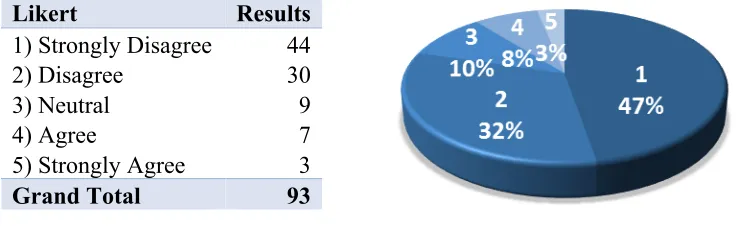
Likert Results 1) Strongly Disagree 44
2) Disagree 30
3) Neutral 9
4) Agree 7
5) Strongly Agree 3 Grand Total 93
Figure 5. The availability of the recordings will encourage me to skip classes.
The significant majority of students (n.74 - 79%) indicated that they strongly disagreed or disagreed that lecture capture would encourage them to miss lectures. This appears to reflect recommendations in the Quality Assurance Agency (QAA) report on Student Expectations and Perceptions in Higher Education where it is highlighted that students want to utilise technology in order to enhance their learning through teaching, rather than replace it:
Institutions should be cautious of using technology as a replacement for face-‐to-‐face interactions, or as a substitute for developing an active and collaborative learning environment and community. (Kandiko & Mawer, 2013, p2)
Responses from the student focus groups echoed the survey findings, with the importance of lecture attendance being highlighted:
I think it’s your own personal mind-set, how much you want to get out of university yourself; because I think if you miss a lecture, you are going to miss out what the tutor said and it’s not really the same - having it recorded - as being there. You can’t ask individual questions, if you got your own problems. I think it’s better to be there.
Another student comment reflected on the importance of lecture attendance and interaction with peers:
The most important thing for me is the interaction; like, you are in the mood, in the class mood, you are interacting with all that is happening around you whereas at home you are just in front of the screen; you need a lot of attention to concentrate; and you are not going to sit and watch video every single day.
Whilst there is strong justification that any potential adverse impact is carefully monitored and evaluated over a longer period than represented by these initial pilot findings, student perceptions are that attendance will not be impacted by the use of lecture capture.
Staff Perceptions
more detailed feedback about the project. The online questionnaire returned 12 responses, while 8 members of staff attended a focus group or an interview. As the questionnaires were anonymous, it is possible that some members of staff that took the online survey subsequently participated in a focus group or interview, and, due to this, but also due to the small number or responses, no statistical analysis will be attempted on the staff perceptions of lecture capture at this stage. Instead, these datasets will be discussed qualitatively, with an aim to highlight lecturers' early responses to lecture capture practices and in particular their perceptions on whether lecture capture can support students' learning and the possible impact on student attendance, student satisfaction and student performance.
Staff perceptions on whether lecture capture can support students' learning. The majority of staff agreed or strongly agreed that lecture recordings can support their students' learning; only a couple of them were unsure but nobody disagreed with that statement. One lecturer who thought that lecture capture could support students' learning attributed this to the fact that students can focus more on the session, as they don't need to take notes:
It’s actually the learning cycle stuff, the Kolb stuff; by giving students the lecture, one of the things I found is that I can say to them “don’t write things down, pay attention to me, let’s problem solve this as a class” and then they can go back and then make notes…
Another lecturer pointed out that lecture recordings offer various benefits depending on the type of the recording; these include the ability to catch up with the lecture if one has missed it, but also for revision for those who have been in the class:
Where you’re just doing a traditional lecture and going through a PowerPoint, then it’s most useful for the ones who have missed it, but when I’m teaching numerical based subjects and problem solving type things, then they find it incredibly useful to be able to go back and listen...
One member of staff claimed that lecture capture could support students' learning near assessment points in particular:
I think in terms of having that as a resource, as assessments and assignments come in, when they see the relevance of it immediately they can go back and look at it. In terms of supporting their learning it is a valuable resource.
Furthermore, the sole presence of the video provided some sense of security to students, as they knew that the lecture would be available as and when they need it, according to another lecturer.
It increases attendance because you get students more confident to come back here if they miss a session.
I’ve only seen evidence to the contrary, in that we’ve used a previous system clearly to this one over the last two years and found an increase in level 6 in student attendance of about 20%.
One lecturer in the focus group expressed some concerns regarding lecture capture and student attendance:
There is a danger that, I’m thinking in that one professional course, I have put some very comprehensive content and a couple (of students) made a comment that ‘”you’ve got such a lot up there I don’t think that I need to come,” which is a danger for me because actually what is discussed in class is important and has made me thinking that perhaps I shouldn’t be putting everything up on myCourse (Moodle VLE); I don’t know.
However, as another lecturer pointed out, lecture capture is more likely to be seen by students as a complementary technology rather than a replacement for classes:
I think that when PowerPoint started to go on myCourse there was a worry that students would not come, that’s another step on from that but students do on the whole still go to lectures; they might then use it as additional resource and I think ultimately, students will see this is an additional resource and nothing like being in the class; the atmosphere and the discussion, the interactivity cannot be replaced with a video; I think it enhances the class rather than replaces it.
Staff perception on whether lecture capture will improve students' grades/performance. Most staff agreed or strongly agreed that the lecture recordings will improve students' grades/performance. Only one member of staff was unsure and another one disagreed with that statement.
The possible improvement of students' grades was attributed to the fact that lecture recordings provide an opportunity to students to catch-up with their course, which in turn raises their confidence:
Yes, I do. If a student is more confident to come for the next lecture it’s because he feels up-to-date and that’s inevitably going to affect their grades. If a student is more confident about a subject, they may wish to enquire deeper into some of the questions and become more interested and cognitively more engaged in the process.
Difficult to prove empirically but I would say that, anecdotally, I get better questions in the classroom because I think that those who watch it and come back to the next session are much more confident.
Conclusion
This paper summarised the interim findings from piloting lecture capture at Southampton Solent University. Background information on the uptake of similar technologies has been provided and the literature review in this area has been discussed in order to contextualise the project. It has been noted that some of the key areas of focus around the deployment of such technologies include student satisfaction, impact on student attendance and impact on student performance. The pilot's initial findings have indicated a beneficial impact on student satisfaction. Regarding student attendance, there has not been an indication that the introduction of lecture capture will negatively affect student attendance, but that, however, it will provide a fall back plan for those students who might miss a session for whatever reason. Whilst it is often problematic to empirically prove an actual positive impact on student grades based on the introduction of a new technology alone, students' perceptions are that lecture capture will improve their performance.
The project will continue, and more data will be gathered in the end of year 1 in order to see whether there are any changes in staff and students' perceptions of lecture capture. Furthermore, usage data will be looked at more closely, in order to fully understand how and when students engage with lecture
recordings. Peak times of student usage will be identified and will be compared against assessment points in order to see whether there is a
correlation between the two. The nature of the recordings with the most views will also be discussed with participating lecturers and students in an attempt to understand the parameters that affect usage. Furthermore, viewings of the recordings will be compared with physical attendance records in order to find out more about whether students view the recordings more for revision or in order to catch-up with a missed lecture.
References
Abowd, G. (1999). Classroom 2000: An experiment with the instrumentation of a living educational environment. IBM Systems Journal, 38(4), 508-530.
Cooke, M., Howards, M., Watson, B., Johnston, A., Blacklock, E., Tower, M., Mansah, M., & Murfield, J. (2011). Lecture capture: First year student nurses’ experiences of a web-based lecture technology. Australian Journal of Advanced Nursing, 29(3), 14-21.
Copley, J. (2007) Audio and video podcasts of lectures for campus-based students: production and evaluation of student use. Innovations in Education and Teaching International, 44(4), 387–399.
Gosper, M., McNeill, M., Phillips, R., Preston, G., Woo, K., & Green, D. (2010). Web-based lecture technologies and learning and teaching: A study of change in four Australian universities. Research in Learning Technology, 18(3), 251- 263.
Hove, M. C., & Corcoran, K. J. (2008). If you post it will they come? Lecture availability in Introductory Psychology. Teaching of Psychology, 35, 91-95.
Kandiko, C. B., & Mawer, M. (2013). Student expectations and perceptions of higher education. London: King’s Learning Institute. Retrieved from http://www.kcl.ac.uk/study/learningteaching/kli/research/student-experience/QAAReport.pdf
Larkin, H. (2010). “But they won’t come to lectures…” The impact of audio recorded lectures on student experience and attendance. Australasian Journal of Educational Technology, 26(2), 238-249.
Nashash, H. A., & Gunn, C. (2013). Lecture capture in engineering classes: Bridging gaps and enhancing learning. Educational technology & Society, 16 (1), 69-78.
Price, D., & Almpanis, T. (2014). Supporting student learning with lecture capture. Solent eXchange 2014. Southampton, UK: Southampton Solent University.
Traphagan, T., Kucsera, J. V., & Kishi, K. (2010). Impact of class lecture webcasting on attendance and learning. Educational Technology Research and Development, 58(1), 19-37.
Walker, R., Voce, J., & Ahmend, J. (2012). 2012 Survey of Technology Enhanced Learning for higher education in the UK. Oxford, UK: Universities and Colleges Information Systems Association (UCISA): Retrieved from
http://www.ucisa.ac.uk/~/media/groups/ssg/surveys/TEL_survey_2012_fi nal_ex_apps
Walker, R., Voce, J., Nicholls, J., Swift, E. Ahmed, J., Horrigan, S., & Vincent, P. (2014). 2014 Survey of Technology Enhanced Learning for higher education in the UK. Oxford, U.K.: Universities and Colleges Information Systems Association (UCISA). Retrieved from
http://www.ucisa.ac.uk/~/media/groups/dsdg/TEL%20Survey%202014_2 9Sep2014.ashx
Author Details Daran Price
[email protected] Timos Almpanis