Peer Interaction Effectively, yet Infrequently,
Enables Programmers to Discover New Tools
Emerson Murphy-Hill and Gail C. Murphy
ABSTRACT
Computer users rely on software tools to work effectively and efficiently, but it is difficult for users to be aware of all the tools that might be useful to them. While there are sev-eral potential technical solutions to this difficulty, we know little about social solutions, such as one user telling a peer about a tool. To explore these social solutions in one partic-ular domain, we describe a series of interviews with 18 pro-grammers in industry that explore how tool discovery takes place. These interviews provide a rich set of qualitative data that give us detailed insights into how programmers discover tools. One finding was that, while programmers believe that discovery from peers is effective, they actually discover tools from peers relatively infrequently. Another finding was that programmers can effectively discover tools from their peers both in a co-located and remote settings. We describe sev-eral implications of our findings, such as that discovery from peers can be enhanced by improving programmers’ ability to communicate openly and concisely about tools.
ACM Classification Keywords
D.2.6 Software Engineering: Coding Tools and Techniques
General Terms Human Factors
Author Keywords
discovery, learning, programmers, programming tools
INTRODUCTION
Software features or tools, such as the ability to correct gram-mar in Microsoft Word or to recover recently closed tabs in Mozilla Firefox, allow users to perform their tasks more ef-ficiently and do things they were unable to do previously. However, users have difficulty becoming aware of tools that might be useful to them. For example, when Grossman and colleagues conducted a study of 10 users of a computer-aided drafting application, they found that a “typical prob-lem was that users were not aware of a specific tool or oper-ation which was available for use” [6, p. 655]. As another
NCSU CSC Tech Report TR-2010-19
(02:02:21 PM) FEZ: Hold on.
(02:02:23 PM) FEZ: What did you just do?
(02:02:39 PM) HAL: Replace the first three argu-ments with a combined one.
(02:02:39 PM) FEZ: How’d you do that delete?
(02:02:45 PM) HAL: Oh. ’d%’
(02:02:59 PM) FEZ: But then you deleted the ->
too.
(02:03:19 PM) HAL: Yeah, it scans forward for the next open thingy, then to the matching close thingy.
Figure 1: A snippet of an instant-messaging session where one user learns about a software feature from another user.
example, Campbell and Miller have noted that awareness is a problem in integrated development environments that are used by programmers [2]. It is arguable that in any at least moderately sophisticated application, many users will remain unaware of the full range of tools available.
Several technical solutions to the problem of lack of aware-ness have been proposed. Some applications attempt to solve this problem with tip-of-the-day messages or role- or task-based customizations of the user interface. Researchers have proposed other technical solutions as well, such as recom-mender systems that suggest tools that you are not currently using [9,10,12].
While there has been much research intotechnical solutions, there has been relatively little research intosocial solutions, where a user learns about a tool from another user. To il-lustrate what we mean by social solutions to the awareness problem, let us give two examples drawn from the study we describe in this paper.
The second example illustrates how ELIhas often failed to learn about useful tools from other people. ELIis an inter-active media producer who uses Twitter (twitter.com), a so-cial network where people share very brief messages via mi-croblogging. ELIrarely discovers useful tools through Twit-ter because the people he inTwit-teracts with tend to recommend the “latest and greatest” tools, but not necessarily the most useful ones.
What are the key differences in the social and technical con-texts that allow FEZto discover useful tools when program-ming with a peer, yet often disallow ELIto discover them through microblogs? In this paper, we explore these contexts by focusing on programmers, both because we are conver-sant with the tools that programmers may use and because the range of tools available to programmers is so wide. Our long-term research goal is to encourage software users to discover tools more successfully, more frequently.
Previous research by Cockburn and Williams [3] has sug-gested that tools are frequently discovered when mers work together in an activity known as pair program-ming. We call this mode of discoverypeer interaction,where programmers discover tools from their peers during normal software development activities. Using Cockburn and Williams’ research as a starting point, we conducted interviews to de-termine how peer interaction works and how it relates to other modes of discovery, such as Twitter and exploring an application’s user interface. Based on our observations, we then discuss several implications for helping programmers discover new tools.
The three main contributions of this paper are:
• a characterization of peer interaction, a mode of discov-ery where programmers learn about the existence of new tools from peers;
• evidence that peer interaction may be the most effective way for programmers to learn new tools, yet it appears to occur infrequently; and
• implications for how the social process of peer interac-tion can be fostered so that it can occur more frequently in the future.
TERMINOLOGY
We are interested in how programmers discover tools, but what are tools, and what is discovery? By tools, we mean any software that helps a programmer accomplish a task, in-cluding standalone programs like development environments and features or commands in those environments, like source code formatters. Note that, while we will mention several tools in this paper in examples of discovery, we will not ex-plain the specifics of those tools.
When we say that a programmer discovers something, we mean that she becomes aware of that feature. Findlater and McGrenere distinguish findability from awareness; “findabil-ity measures the speed with which users can find known functions, and awareness measures the degree to which users are conscious of the full set of available functions” [5].
Sim-ilarly, we define a discovery to mean the event in which a user finds out about a tool that she did not know about.
Discovery is also closely related to, but distinct from, learn-ing, in that discovery can be thought of as the first stage of some kinds of learning. We defer a thorough discussion of the relationship between learning and discovery to the Re-lated Work section.
A STUDY OF PEER INTERACTION
To study whether and how programmers discover new tools from peers, we conducted a series of interviews with pro-grammers in industry. In the interviews, we discuss two forms of peer interaction:peer recommendation andpeer observation. We hypothesized that peer recommendation and peer observation may occur during pair programming, when two programmers work on the same programming task at the same computer. In such situations, the “driver” is at the keyboard, and the “navigator” is sitting beside the driver, observing and making suggestions [3]. We hypothesized that a programmer may discover a new tool in either role:
• The driver may discover a new tool when the navigator says something like, “you know, you could really use tool X instead.” We call this peer recommendation.
• The navigator may discover a new tool when observing the driver using the tool, saying something like, “how did you do that?” We call this peer observation.
Methodology
To better understand peer interaction, we wanted to collect a substantial number of descriptions of peer interaction. Ide-ally, we might have observed programmers learning tools during their normal software development activities. Instead, we opted to conduct retrospective interviews for several rea-sons. First, we suspected that peer interaction occurs so in-frequently that direct observation is impractical; this suspi-cion was confirmed by subjects, as we will explain. Second, interviews allow us to speak with a variety of programmers at different companies and with varying experience. Third, interviews allow participants to reflect on motivations and long-term effects of peer interaction, not just the short-term effects that are visible from an observing researcher’s per-spective.
We conducted one-on-one, semi-structured telephone or instant-messaging interviews lasting about an hour each.1 The in-terview began with questions to ascertain the subject’s pro-gramming experience. Next, we referred the subject to a document that listed several pictures of different kinds of programming tools, which we chose from theEclipseand Vi-sual Studiodevelopment environments, as well as the extensi-ble editorsvimandemacs. Although retrospective interviews are common, the results can be influenced by people’s mem-ory of discovery and adoption. Therefore, we used the tool list to help stimulate the subject’s memories of tools that she
Table 1: Seven discovery modes, as read to subjects.
Peer Observation where you observe someone else use a tool while programming that you didn’t know about
Peer Recommendation where someone observes you programming and suggests the new tool
Tool Encounter where you just happen to find the tool by exploring the user interface of your development envi-ronment
Tutorialwhere you are reading or watching a tutorial that mentions a new tool
Written Descriptionwhere you notice that a tool is men-tioned on a website or publication
Twitter or RSS Feed where you learn about tool from someone or some site that you are following
Discussion Threadwhere you learn about a new tool af-ter reading it on list of comments, forum, or email discus-sion
might have discovered, using them as recall cues for known-item memory retrieval [1]. We asked the subject to pick three tools from the list (or tools similar to tools on the list) and to describe how she discovered and learned about them. The purpose was to attempt to ascertain the most frequently oc-curring modes of discovery, on the assumption that the most frequently mentioned modes for a certain set of tools are the most frequent modes.
We then asked the subject to choose, in her experience, the two most effective modes for discovering new tools. We clarified effectiveness as how effective each mode is on “your likeliness to use a tool again.” We gave the subject a list of seven different discovery modes, as shown in Table1. We also encouraged the subject to think of other modes. We then asked the subject which, in her experience, are the two least effective modes.
At this point, we revealed to subjects that we were specif-ically interested in peer observation and peer recommenda-tion, and asked for the subject to describe her experiences learning new tools in those modes. We asked the subject to relate experiences when she was the learner or teacher dur-ing peer observation and peer recommendation. For each experience, we asked a semi-structured set of questions to elicit detailed responses, including the context in which the learning happened, the nature of the relationship with the peer, and what was said or done to facilitate learning.
We then asked the subject directed questions about her expe-rience with peer interaction, including how often she learns or teaches, and how it has changed over her programming ca-reer. Finally, we asked the subject some opinion questions, then thanked the subject and concluded the interview.
To analyze the data that we collected, we recorded the in-terviews, transcribed and summarized them, categorized the contents of the summaries by question, characterized the
re-sponses to each question, and identified patterns in rere-sponses and relationships between responses.
Subjects
We recruited subjects from two main sources. First, we emailed invitations to 62 participants who volunteered to be contacted at Open Source Bridge 2009, a conference for “developers working with open source technologies and for people interested in learning the open source way” (http:// opensourcebridge.org). Second, we sent emails to personal contacts at seven large companies, asking them to pass on our invitation to potentially interested colleagues. Two peo-ple volunteered through these personal contacts and the rest through Open Source Bridge.
Overall, 18 people responded and completed the interview, comparable to the size of similar studies such as those by Twidale (5 subjects) [17] and Rieman (14 subjects) [15]. Subjects had between 3 and 32 years of professional pro-gramming experience (median=9); not all were employed as programmers or software developers, although program-ming played a role in their job, or most recently held job. Subjects were between the ages of 21 and 51 (median=30.5). Subjects reported using a total of 18 different editors or de-velopment environments within the last year; the common ones (ordered from most to least frequently mentioned) be-ingvi/vim,emacs,Visual Studio,TextMate,Eclipse, andNetbeans. Subjects reported using a total of 24 different languages within the last year; the common ones being python, javascript, PHP, Ruby, Java, C, and perl.
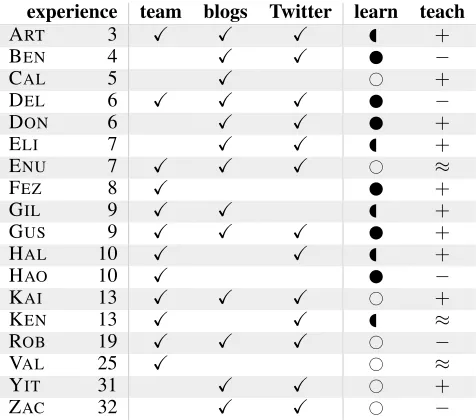
Subjects reported a variety of working experience, which we suspected had some effect on peer interaction. We will refer to subjects in our study by pseudonyms, listed in the left-most column of Table2. In the next column to the right, we list how many years of experience each subject reported. In the next column, we list whether or not each subject works on a team with other programmers in their current or most recent job. The next two columns show which subjects reg-ularly read technical blogs — websites where people post regular writings on technical topics — and which subjects are users of Twitter. We were interested in blogs and Twitter because we suspected that they played a role in tool discov-ery. We explain the right two columns of Table2in the next section.
Results
Overall, subjects reported 41 different instances of peer in-teraction, of which 27 were peer observation and 14 were peer recommendation. In this section, we describe based on the data how peer interaction relates to other types of dis-covery and how it works in the field. At the end of each subsection, we briefly summarize our findings.
The Steps of Peer Observation
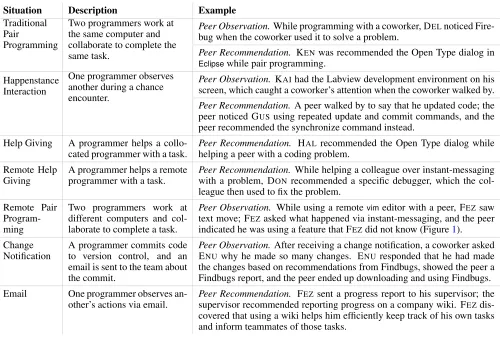
Table 3: Situations in which tool discovery occurred via peer observation and peer recommendation, with examples.
Situation Description Example
Traditional Pair
Programming
Two programmers work at the same computer and collaborate to complete the same task.
Peer Observation.While programming with a coworker, DELnoticed Fire-bug when the coworker used it to solve a problem.
Peer Recommendation. KENwas recommended the Open Type dialog in
Eclipsewhile pair programming. Happenstance
Interaction
One programmer observes another during a chance encounter.
Peer Observation.KAIhad the Labview development environment on his screen, which caught a coworker’s attention when the coworker walked by.
Peer Recommendation.A peer walked by to say that he updated code; the peer noticed GUSusing repeated update and commit commands, and the peer recommended the synchronize command instead.
Help Giving A programmer helps a collo-cated programmer with a task.
Peer Recommendation. HALrecommended the Open Type dialog while helping a peer with a coding problem.
Remote Help Giving
A programmer helps a remote programmer with a task.
Peer Recommendation.While helping a colleague over instant-messaging with a problem, DONrecommended a specific debugger, which the col-league then used to fix the problem.
Remote Pair Program-ming
Two programmers work at different computers and col-laborate to complete a task.
Peer Observation. While using a remotevimeditor with a peer, FEZ saw text move; FEZasked what happened via instant-messaging, and the peer indicated he was using a feature that FEZdid not know (Figure1).
Change Notification
A programmer commits code to version control, and an email is sent to the team about the commit.
Peer Observation.After receiving a change notification, a coworker asked ENUwhy he made so many changes. ENU responded that he had made the changes based on recommendations from Findbugs, showed the peer a Findbugs report, and the peer ended up downloading and using Findbugs.
Email One programmer observes an-other’s actions via email.
Peer Recommendation. FEZ sent a progress report to his supervisor; the supervisor recommended reporting progress on a company wiki. FEZ dis-covered that using a wiki helps him efficiently keep track of his own tasks and inform teammates of those tasks.
follows, we describe what programmers told us happens dur-ing each of these stages.
Observation Situation.Peer observation occurred with sub-jects in four kinds of situations (Table3): traditional pair programming, remote pair programming, happenstance in-teraction, and change notification.
Tools Observed. Subjects described teaching or learning a variety of different tools, including tools for debugging (such as Firebug and Web Developer), tools to help change code (such as sed/awk and refactoring), operating system tools (such as quicksilver), tools for collaboration (such as screen sharing), and shortcuts (such asvimmacros).
Interruption Timing. Subjects reported that the learner al-most always interrupted work to question the teacher, typ-ically immediately after the tool is used. FEZ also pointed out an instance where the learner asked the teacher even be-fore she was finished using the tool and ZACdescribed an instance after repeated uses of the tool in the same program-ming session. In contrast, BENnoted that, over the course of learningvimfrom peers, for the most part he did not ask questions while learning new tools withinvim, presumably because the commands that his teacher was executing were largely visible and self-explanatory.
Interruption Wording. Typically the interruption is a com-ment along the lines of “what is that?” (ELI, HAO, ZAC), “how did you do that?” (FEZ, GUS, HAO, ROB), or an ex-clamation of amazement or surprise (BEN). Such reactions to initial tool use were not always polite, such as in the case of KEN, who recalled a peer remark in response to his tool use, “what the hell is all this crap?”
Response to Interruption. The teachers’ response to the in-terruption from the learner varied, though subjects reported that typically the teacher gave an explanation of what the tool did and a short demonstration (less than a couple of minutes). Several subjects also reported that they followed up with this discovery episode by trying the tool out when the teacher and learner separated. Other subjects reported being given URLs by the teacher for later reference.
Table 2: Subjects’ pseudonms are displayed in the left-most column; pseudonyms assigned alphabetically based on subjects’ experience level (in years). Next, potentially programming-relevant social activities are listed. Finally, likeliness to learn or teach tools via peer interaction is listed. means that a subject learns via peer interaction between once every week and twice per month; a Gmeans that a subject learns every one or two months; and a#means that the programmer learns between once every three months and once per year. Programmers estimated that they taught less often (−), about equally often (≈), or more often (+) than they learned via peer interaction.
experience team blogs Twitter learn teach
ART 3 X X X G +
BEN 4 X X −
CAL 5 X # +
DEL 6 X X X −
DON 6 X X +
ELI 7 X X G +
ENU 7 X X X # ≈
FEZ 8 X +
GIL 9 X X G +
GUS 9 X X X +
HAL 10 X X G +
HAO 10 X −
KAI 13 X X X # +
KEN 13 X X G ≈
ROB 19 X X X # −
VAL 25 X # ≈
YIT 31 X X # +
ZAC 32 X X # −
The Steps of Peer Recommendation
The process of peer recommendation has steps similar to peer observation: programmers interact in some situation, the teacher observes the learner do something for which the teacher knows an tool alternative exists, the teacher inter-rupts the learner, and then the teacher delivers the recom-mendation.
Recommendation Situation. Subjects reported that peer rec-ommendation happened in five kinds of situations (Table3): traditional pair programming, happenstance interaction, help giving, remote help giving, and email.
Interruption Timing and Wording.As with peer observation, most subjects reported that the person making the recom-mendation made it immediately. The recomrecom-mendation was sometimes direct, as in “you should use X” (BEN, CAL, ENU, KEN), and sometimes more subtle, as in “you might try X” (HAL, GUS). However, not all subjects reported this immediate interruption. For instance, HALdescribed watch-ing a colleague repeatedly open classes inefficiently, and rec-ommended the Open Type dialog after some time:
I’ll generally leave them to their way of working for a while before observing a pattern that I think I can help with. . . they may feel comfortable with what they’re do-ing, and comfort is important. . . I try to introduce things
slowly, especially when I’m not sure that the person I’m working with sees it as a problem or thinks that they need help. If it doesn’t look like they’re suffering too much, it may be better to leave them alone.
Tools Recommended. Subjects mentioned a variety of tools that they had learned about via peer recommendation, the common ones being the Open Type dialog inEclipse(ENU, HAL, KEN) and Firebug (ART, HAO). Subjects also de-scribed discovering Postgres, FTP,emacs tags, a debugger, and a tool for collaboration.
Recommendation Delivery. As with peer observation, most subjects reported that the recommender responded by demon-strating the tool in a task-relevant manner. For example, when ARTrecommended Firebug, he demonstrated how it was used on the same webpage with which the learner was having trouble. The learner also sometimes followed up the recommendation by visiting websites or tutorials, and trying out the tool on their own.
In sum, subjects reported that peer recommendation hap-pened in similar circumstances to peer observation, with sim-ilar follow-up. However, in contrast to peer observation, where the interruption was often made with little trepida-tion, during peer recommendation subjects reported some-times exercising more sensitivity to the learner. These re-sults may suggest that programmers are more comfortable professing ignorance than expertise.
Frequency of Peer Interaction
We estimated how often peer interaction happens in two dif-ferent ways. The first way was to ask programmers to tell us about situations in which they learned about a new tool. We then categorized each situation according to Table1and compared how often peer interaction was mentioned versus other discovery modes. This provided an estimate of rela-tive frequency. The second way was to ask programmers how many times per year, month, or day they learned about a new tool. This provided an estimate of absolute frequency. We also asked programmers to estimate how their frequency of learning has changed over time.
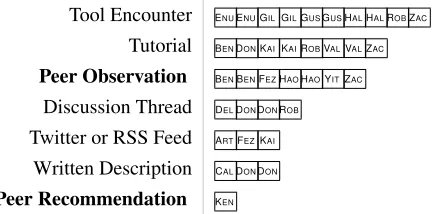
Peer interaction did not appear to occur particularly frequently, compared to how often other discovery modes were men-tioned. In Table2, a name in a box represents one subject’s description of an instance of discovery. The number of boxes in each mode is the total number of instances of discovery that subjects mentioned. For example, subjects mentioned a total of three instances of written description: one from CAL and two from DON. Peer observation was mentioned seven times by five people; peer recommendation was mentioned only once.
Likewise, subjects reported learning and teaching via peer interaction fairly infrequently. The right two columns of Ta-ble2indicate how often subjects reported learning or teach-ing a tool via peer interaction.
observa-Tool Encounter ENUENUGILGILGUSGUSHALHALROBZAC
Tutorial BENDONKAIKAIROBVALVALZAC
Peer Observation BENBENFEZHAOHAOYITZAC
Discussion Thread DELDONDONROB
Twitter or RSS Feed ARTFEZKAI
Written Description CALDONDON
Peer Recommendation KEN
Figure 2: A histogram of the most frequent discovery modes.
tion and, especially, peer recommendation, were less fre-quently reported modes of discovery, compared to the most frequently mentioned mode. This finding is consistent with Rieman’s field study of learning and discovery, a study which provided evidence that tool encounter is the most frequent way of discovering tools in a variety of applications [15].
Effectiveness of Discovery Modes
We asked participants to rate how effective each mode is in terms of their likeliness to use a tool again in the future. Specifically, we asked subjects to name their two most ef-fective modes, though we did not force subjects to choose exactly two. Figure3displays the results.
Peer observation and peer recommendation were rated as the most effective modes. These ratings are notable because the question was askedbeforewe revealed to subjects that we were particularly interested in these two modes.
Effectiveness of Peer Interaction.Subjects reported that peer observation and peer recommendation were effective for sev-eral reasons:
• the learner has respect and trust in the teacher, so if the teacher had a good experience with the tool then the learner should take it seriously (BEN, CAL, DEL, GUS); • the learner can reflect on the teacher’s use and apply it to
her own programming (DON, HAL, KEN, YIT);
• programmers enjoy demonstrating their skills (ELI, HAO, ZAC); and
• the learner and the teacher share a common background so the tool is more likely to be relevant (ELI, HAL).
Also, subjects found peer observation effective because:
• the learner can see the value of a tool while it is in use on a real problem (ENU, KEN, ROB, YIT);
• the teacher imparts a minimal amount of tool informa-tion, allowing the learner to feel like she discovered it herself and look up more material later (DEL, ELI); and • the learner can associate the tool with its context of use,
which makes it memorable (FEZ).
Subjects also reported instances when peer observation and peer recommendation were ineffective, as we will describe in the Barriers to Peer Interaction section.
Peer Observation BENCALDONDELELIENUFEZHALHAOKENROBVAL
Peer Recommendation BENCALFEZGILGUSKENHALVALYIT
Twitter or RSS Feed ARTDELDONROBZAC
Discussion Thread ELIHALYIT
Tool Encounter GILHALZAC
Tutorial ARTENUKAI
Written Description HAO
Figure 3: A histogram of the most effective discovery modes.
Effectiveness of Twitter/RSS.Subjects reported that Twitter/RSS are effective mechanisms because they trust or value the opin-ion of the people that they follow (ART, ROB) and they can gather the opinions of many people all at once (DEL, DON). However, some subjects reported finding Twitter/RSS inef-fective, because the density of recommendations is too low (ART, ELI, HAL, HAO), people tend to recommend the most popular tools but not the most useful ones (ELI), the sources have low credibility (CAL), some messages feel like adver-tising (CAL), and most messages are not relevant to pro-gramming (KEN). Moreover, HALfelt that Twitter/RSS and discussion threads were ineffective for the same reasons: the other party does not have a similar background.
Effectiveness of Discussion Threads. Subjects reported that discussion threads are effective because subjects reported having trust in the sources (YIT) and because discussion threads tend to have a high level of detail (KAI). Others reported them being ineffective because the people who post are outside of their trust network (ROB, GUS, CAL).
Effectiveness of Tutorials. Subjects said that tutorials are effective because they fit with their personal learning style (ART) and because tutorials, specifically in the form of on-line screencasts, typically have a real-world example and are “highly rewindable” (KAI). Other subjects reported that tu-torials are ineffective because the tools used in tutu-torials are not useful, esoteric, or not widely available (FEZ), and be-cause tutorials require a significant investment of time (YIT).
Effectiveness of Tool Encounters. Although some subjects reported that tool encounters (finding a tool by chance in the user interface) were effective, none gave a rationale. Some subjects reported that tool encounters were ineffective be-cause the environment that they use does not lend itself to exploration (BEN, DEL, HAO), a tool encounter takes too long (HAO), tools found in this manner are easily forgot-ten (DON), and because exploration tends to lessen as the programmer becomes more familiar with their environment (ENU).
In sum, subjects rated peer observation and peer recommen-dation as the most effective modes for discovering new tools. However, these modes also occur less frequently than other discovery modes (see Figure2). This confirms McGrenere’s conjecture, who pointed out that exploratory learning is the most frequent kind of learning, but “it may not necessarily be the most efficient or effective method of learning how to use a system” [13, p. 15]. Indeed, these results confirm that it is not the most effective. Another important finding is that the determinant that subjects most cited as important to the effectiveness of discovery, whichever the mode, was trust.
Barriers to Peer Interaction
While subjects rated peer interaction as effective, when prompted, they also listed situations when it had not been effective. First, physical isolation makes peer interaction difficult be-cause it is difficult to observe other programmers remotely, although other programmers reported effective remote ob-servation. Second, when coworkers are working in entirely different programming environments, such as one usingvim
and another usingEclipse, then there are fewer tools that they can share. Third, once programmers have worked together for a certain amount of time, they get acclimated to each others’ toolsets, so the possibility of discovery is reduced. Fourth, company policies can inhibit social learning; sub-jects reported companies dictating which tools to use, even when they were not the best tool for the job. Fifth, when a project is under time pressures, such as a release deadline, programmers may not be willing to set aside time to dis-cuss a tool during a development task. Sixth, programmers’ themselves are sometimes unwilling to share tool knowl-edge.
We were especially interested in this last barrier to peer in-teraction; when are people unwilling to teach or learn? It is worth mentioning that, for the most part, the program-mers that we interviewed appeared to be enthusiastic about learning and teaching tools to peers. However, subjects men-tioned several cases where a programmer was unwilling to share or receive tool knowledge. First, ELIand HAL men-tioned that people are sometimes unwilling to learn about a new tool because they are not sufficiently mature to ap-preciate the tool’s usefulness. Second, ROBsaid that some programmers simply do not have an interest in learning new tools. Third, KAI and YIT mentioned that programmers sometimes feel that they do not need to discover a new tool because existing tools will do the job. Playing the role of such a programmer, YITsaid:
“Why should I bother? I’ve got ido-mode, I’ve got ack, I’ve got this, that, and the other. . . the feeling is that, so far, I’ve made it without that [new] tool.” Developer inertia, I guess you could call it.
Fourth, FEZmentioned that, in any given programming ses-sion, the programmers involved need to feel that they have made progress to feel positive, and when they end up spend-ing all of their time learnspend-ing about new tools, they have the feeling that it was not time well spent. Finally, DON de-scribed not learning new tools while programming because
he was uncomfortable billing clients for learning about new tools.
In sum, subjects reported the barriers to effective peer inter-action are isolation, toolset differences, toolset acclimation, company policy, time pressures, peer maturity, lack of in-terest, “developer inertia,” the necessity of sensing progress, and client pressures. It is notable that these barriers occur because of a wide variety of internal and external sources: the client, the company, the management, the programmer, the development environment, and the tool.
Flow of Peer Interaction
Although we did not plan to ask subjects explicitly, we be-came interested in whether peer interaction occurs between peers or between a supervisor and a subordinate. If inci-dental tool learning is largely a kind of apprenticeship learn-ing [8], then we should expect tool knowledge to flow largely from senior to junior programmers. While ART, FEZ, and GILeach described an instance of recommendations coming from supervisors, our results suggest that this is not always the case.
First, the instances of peer interaction were more often be-tween peers than bebe-tween programmers at different experi-ence levels. As HALexplained, “differences [in skill sets] make the collaboration interesting, but the similarities make the collaboration easier.”
Second, two subjects took the opposite view, that during peer interaction, it is more often the junior programmers who are the teachers. FEZ and KENexplained this position; junior members have more free time to explore new tools, making them more likely to bring new tools into the organization. KENsaid:
The junior members tend to be more voracious in their desire to learn new APIs and tools, and stay plugged in to what’s going on with languages and stuff. My time is spent digging in to more bugs and more things that I’m responsible for delivering, I have less time to do independent research. . . No one is upset when a junior member says they have a better way to do things.
FEZconfirmed this:
There’s a fair amount of bias towards me teaching [other engineers] something. . . I’m a student, an intern; I’m in the process of learning as much as I can from as many tools as I can. . . several developers I know, especially those that have 10, 20, 30, 40 years of experience, tend to say that they know the tools that they use, and they do not necessarily have the time, or more commonly, the patience to sit down and fiddle with a new tool.
These quotes provide anecdotal evidence that learning about tools can flow from the bottom upwards.
subor-dinatesandfrom subordinates to supervisors. This finding may be a result of the relatively flat organization of many software teams, where programmers feel comfortable ask-ing about and recommendask-ing tools to other programmers, regardless of seniority.
A Remote Pair Programming Vignette
During the study, we learned that FEZand HALsometimes pair programmed together using a remotevimsession. This offered a unique look into how peer interaction happens, from the perspective of both peers. Moreover, the two par-ticipants had saved full instant-messaging histories of their remote pair sessions, and were willing to share a few snip-pets of those histories with us.
Figure1displays one such occurrence. FEZreported such occurrences were fairly common, where he would see some-thing happen on the screen, ask about it, and HALwould reply. Interestingly, both peers gave examples of learning from one another, confirming the bidirectionality of peer in-teraction. One curious aspect of Figure 1 is that in order to learn the tool, FEZneeded to understand both the cause (pressing d%) and the effect (replacing the first three argu-ments with a combined one). We discuss the significance of understanding causes and effects in the next section.
Threats to Validity
While this study provided a unique look into how program-mers discover new tools, there are several threats to the va-lidity of our study design.
Some subjects noted that it was difficult to remember in-stances of peer interaction. This difficulty of recall may have affected the accuracy of the results, especially when we asked subjects to estimate how often they learn via peer interaction. We tried to address this threat by focusing on specific instances of learning rather than generalizations, and when we did ask subjects more general questions, such as to estimate discovery modes’ effectiveness, we preceded those questions by asking subjects to focus on specific instances.
To make conducting the study easier for the interviewer, we introduced the different discovery modes in a fixed order for every subject, as shown in Figure1. This order may have biased subjects’ effectiveness responses.
The study may suffer from ascertainment bias, because the programmers are not representative of all programmers, for two main reasons. First, although we did not ask subjects about their cultural or geographic background, we suspect that subjects are largely Americans living in the western United States. Second, because each study participant volunteered to spend an hour talking to a researcher about discovery and learning, it may be that these programmers are more positive about social learning than the average programmer. Future studies should be conducted over a wider variety of program-mers, both socially and culturally.
IMPLICATIONS
We have explored how peer interaction works, as well as shown that programmers have found it effective yet rela-tively infrequent. Our results have several implications for how to make it easier for programmers to discover new tools from their peers. Moreover, we suspect that these implica-tions are applicable beyond software development environ-ments to a variety of applications. We discuss two impli-cations in this section: how tools and development environ-ments can make it easier for programmers to discover tools from peers and how programming teams can encourage peer interaction.
Improving Tool Discoverability
The results of this study suggest at least two ways toolsmiths can make programming tools and environments more dis-coverable, so that when programmers interact, peer interac-tion is successful.
Noticeable Causes.If the manner in which a tool is used can be easily observed, then an observing programmer is more likely to both recognize that a tool was used and, implicitly, know how the tool is used. Hotkeys, used in many develop-ment environdevelop-ments so that programmers can quickly invoke commands, are a negative example because the keys that are pressed are typically not visible on the screen. One solution is to show the keys that are pressed on the screen for a few seconds.
Noticeable Effects. In addition to making the causes of a tool invocation obvious, peer interaction may be facilitated if the effects of a tool are clear. Eclipse’s Organize Imports command is an example of a tool that may not have notice-able effects; the tool automatically adds and removes import statements from Java files, but if those statements are not visible on screen, then an observer may not notice the effect of running the command.
Peer Interaction without Collocation
As software is developed on a global scale, teams become more and more distributed, reducing the discovery of tools during traditional pair programming. The results of our study also suggest that peer interaction can be facilitated when tra-ditional pair programming is not possible.
a tool requires several complicated steps to use, the teacher may be forced to say “first you click here, then here, then here, then type in this,” and so on. More elegantly, if the pro-grammers choose to collaborate using an environment with purely textual commands, likevim, the steps can be easily represented as a series of brief commands.
Learning from the Strengths of Peer Interaction. In the fu-ture, we might expect that collocated peer interaction will decrease as teams become more distributed, while at the same time, Twitter and internet tutorials (screencasts) may be increasingly common. Unfortunately, the results of our study suggest that Twitter and screencasts are not as consis-tently effective as peer interaction. We view this as an op-portunity: what can we learn from peer interaction to make other discovery modes more effective?
Twitter bears some similarity to peer recommendation in that both are types of social discovery. One reason that sub-jects cited for Twitter being ineffective is lack of trust in the sources and lack of relevance. From the interviews, it appears what programmers meant by trust was that the rec-ommender (human or otherwise) must have had some prior interaction with the developer, so that the developer can es-timate the recommender’s knowledge and skills. Our study suggests that trust and relevance might improve if the Twit-ter messages originated from a trusted peer, someone that a programmer works with or has worked with in the past. Rather than burdening the trusted peer with having to report whenever she discovers a new tool, we imagine a system that automatically notices when she uses a novel tool and gener-ates Twitter messages on her behalf.
Several subjects reported watching screencasts that were pro-fessionally produced (e.g.,peepcode.com). Although watch-ing screencasts is similar to peer observation, subjects re-ported that the tools used in screencasts may not be very rel-evant, presumably because the people who made the profes-sional screencasts did not have working styles that aligned with individual subjects’ working styles. Because peers are more likely to have similar working styles, a screencast pro-duced by a peer is potentially more relevant. However, no subject reported watching a screencast produced by a peer. We suspect that the reason that programmers do not make screencasts for their peers is that the costs (recording, edit-ing, and distributing) are too high compared to the benefits (the possibility of a peer discovering a tool). KAIhinted at this; “I wish people did make more screencasts; they’re a pain in the ass to make.” Better tool support for creation, editing, and distribution of screencasts may make it more likely that programmers will produce screencasts for their peers, improving screencasts’ effectiveness.
RELATED WORK
The study presented in this paper is the first study of which we are aware of how programmers discover new tools, but several different research areas are closely related to peer interaction.
Diffusion of Innovations
Diffusion of Innovationsis a theory that attempts to explain “the process by which an innovation is communicated through certain channels over time among the members of a social system” [16]. Typical studies of diffusion of innovations include research about internet use, hybrid corn in the US, and water sanitation in developing countries. The study pre-sented in this paper can be considered a diffusion of innova-tion study that investigates tool discovery by programmers.
While we are not aware of any studies about diffusion of innovations involving programmers, several studies have in-vestigated diffusion of innovations in the more general case of software engineering. For example, Fichman and Ke-merer describe how relational databases, programming lan-guages, and Computer-Aided Software/Systems Engineer-ing (CASE) tools are acquired and deployed in organiza-tions [4]. Similarly, Iivari described a study that suggests that the reason that companies do not use CASE tools is be-cause of a lack of management support, a lack of perceived advantage, and a lack of freedom of choice [7].
Such research addresses critical issues, but it also tends to focus on tools that require a significant investment of time or money, and thus warrant careful organizational consider-ation of whether or not to adopt. In contrast, our research seeks to investigate a broad spectrum of tools, all the way down to simple features such as code formatters, which likely require significantly less consideration from individual pro-grammers than higher-level tools. Thus, while existing re-search has helped to determine how and why software envi-ronments have been adopted by organizations, our research also helps explain how and why programmers discover fea-tures within those environments.
Learning in Context
Several types of discovery that are similar to peer interaction have been documented in the literature.
One is Lave and Wegner’s situated learning [8], where the learning occurs in the same place that the learning is used, a more general form of peer interaction. For instance, ap-prenticeships are a kind of situated learning. Whereas Lave and Wegner have focused largely on a fixed teacher-learner relationship, our research on peer interaction is on learning in peer-peer relations. Despite a focus on teacher-learner relationships, Lave and Wegner imply that there is signifi-cant potential in peer-peer learning: “There is anecdotal ev-idence. . . that where circulation of knowledge among peers and near-peers is possible, it spreads exceedingly rapidly and effectively” [8, p. 93]. Our study confirms this implication.
Yet another type is over-the-shoulder learning, where col-leagues help each other informally to use a computer ap-plication [17]; over-the-shoulder learning is closely related to peer interaction in that they both occur among peers and both in a technology setting. The difference is that work on over-the-shoulder learning has primarily focused on tions where the learner explicitly asks for help, not in situa-tions when the learner discovers a new tool by observation. In peer interaction, the learner does not initially know that she might find a tool useful.
Learning During Programming
As mentioned in the Introduction, Cockburn and Williams have described the learning of tools from peers during pair programming [3, p. 6–7]:
Knowledge is constantly being passed between part-ners, from tool usage tips (even the mouse), to program-ming language rules, design and programprogram-ming idioms, and overall design skill. Learning happens in a very tight apprenticeship mode.
The partners take turns being the teacher and the taught, from moment to moment.
Similar statements, describing peer interaction (as well as other kinds of learning), which suggests that knowledge about tools is passed between programmers, is oft repeated in the literature, but little evidence previously existed to support it. Both Cockburn and Williams [3] and M¨uller and Tichy [14] provide evidence that student programmers learn a variety of technologies during pair programming, but as M¨uller and Tichy question, “are these conclusions generalizable to pro-fessional software developers?”
Indeed, these studies prompt many questions about peer in-teraction. Does this kind of learning happen in the work-place, as well as in the university? Does it only happen during formal pair programming sessions, or in other situ-ations as well? What kinds of tools do programmers learn in this way? How effective is learning in this way versus other kinds of learning? What makes this kind of learning effec-tive or ineffeceffec-tive? How often does it happen? In this paper, we have extended Cockburn and Williams’ and M¨uller and Tichy’s findings by providing a more detailed analysis of the conditions, process, and results of this kind of learning for professionals with a variety of programming experience.
CONCLUSION
A wide variety of tools have been built to help programmers, but individuals must necessarily discover those tools before they can be used. In this paper, we have described a discov-ery mode called peer interaction, which encompasses both peer observation and peer recommendation, in which pro-grammers learn about the existence of new tools. Based on information that we have collected in a series of interviews, peer interaction is the most effective mode for programmers to discover new tools. Unfortunately, it currently does not occur as frequently as in other discovery modes. The results suggest new ways to make existing tools and environments more discoverable and distributed collaboration more
effec-tive. Likewise, our results may be used to help other types of software users effectively discover new tools.
REFERENCES
1. B. Allen. Recall cues in known-item retrieval.J. of the American Soc. for Inf. Science, 40(4):246–252, 1989.
2. D. Campbell and M. Miller. Designing refactoring tools for developers. InWRT ’08, pages 1–2, 2008.
3. A. Cockburn and L. Williams. The costs and benefits of pair programming. InXP ’00, pages 223–247, 2000.
4. R. G. Fichman and C. F. Kemerer. The illusory
diffusion of innovation: An examination of assimilation gaps.Inf. Systems Research, 10(3):255–275, 1999.
5. L. Findlater and J. McGrenere. Evaluating
reduced-functionality interfaces according to feature findability and awareness. InINTERACT ’07, pages 592–605, 2007.
6. T. Grossman, G. Fitzmaurice, and R. Attar. A survey of software learnability: metrics, methodologies and guidelines. InSIGCHI ’09, pages 649–658, 2009.
7. J. Iivari. Why are CASE tools not used?
Communications of the ACM, 39(10):94–103, 1996.
8. J. Lave and E. Wenger.Situated Learning: Legitimate Peripheral Participation. Cambridge University Press, 1st edition, September 1991.
9. F. Linton, D. Joy, H. Schaefer, and A. Charron. OWL: A recommender system for organization-wide learning. Educational Technology & Soc., 3(1):62–76, 2000.
10. C. Maltzahn. Community help: discovering tools and locating experts in a dynamic environment. InSIGCHI ’95, pages 260–261, New York, NY, USA, 1995. ACM.
11. V. J. Marsick and K. E. Watkins. Informal and incidental learning.New Directions for Adult and Continuing Education, 2001(89):25–34, 2001.
12. J. Matejka, W. Li, T. Grossman, and G. Fitzmaurice. CommunityCommands: command recommendations for software applications. InUIST ’09, pages 193–202, 2009.
13. J. McGrenere.The Design and Evaluation of Multiple Interfaces: A Solution for Complex Software. PhD thesis, The University of Toronto, 2002.
14. M. M. M¨uller and W. F. Tichy. Case study: Extreme programming in a university environment. InICSE ’01, pages 537–544, 2001.
15. J. Rieman. A field study of exploratory learning strategies.ACM TOCHI, 3(3):189–218, 1996.
16. E. M. Rogers.Diffusion of Innovations. Free Press, 5th edition, 2003.