D A T A B A S E
Open Access
Validation of an
International Classification
of Disease, Ninth Revision
coding algorithm
to identify decompressive craniectomy for
stroke
Hormuzdiyar H. Dasenbrock, David J. Cote, Yuri Pompeu, Viren S. Vasudeva, Timothy R. Smith
and William B. Gormley
*Abstract
Background:AlthoughInternational Classification of Disease, Ninth Revision, Clinical Modification(ICD9-CM) coding is the basis of administrative claims data, no study has validated an ICD9-CM algorithm to identify patients
undergoing decompressive craniectomy for space-occupying supratentorial infarction.
Methods:Patients who underwent decompressive craniectomy for stroke at our institution were retrospectively identified and their associated ICD9-CM codes were extracted from billing data. An ICD9-CM algorithm was generated and its accuracy compared against physician review.
Results:A total of 10,925 neurosurgical operations were performed from December 2008 to March 2015, of which 46 (0.4%) were decompressive craniectomy for space-occupying stroke. The ICD9-CM procedure code for craniectomy (01. 25) was only encoded in 67.4% of patients, while craniotomy (01.24) was used in 19.6% and lobectomy (01.39, 01.53, 01.59) in 13.1%. The ICD-9-CM algorithm included patients with a diagnosis codes for cerebral infarction (433.11, 434.01, 434.11, and 434.91) and a procedure code for craniotomy, craniectomy, or lobectomy. Patients were excluded with an ICD9-CM diagnosis code for brain tumor, intracranial abscess, subarachnoid hemorrhage, vertebrobasilar infarction, intracranial aneurysm, Moyamoya disease, intracranial venous sinus thrombosis, vertebral artery dissection, congenital cerebrovascular anomaly, head trauma or an ICD9-CM procedure code for laminectomy. This algorithm had a sensitivity of 97.8%, specificity of 99.9%, positive predictive value of 88.2%, and negative predictive value of 99.9%. The majority of false-positive results were patients who underwent evacuation of a primary intracerebral hematoma. Conclusion:An ICD-9-CM algorithm based on diagnosis and procedure codes can effectively identify patients undergoing decompressive craniectomy for supratentorial stroke.
Keywords:Decompressive craniectomy, International classification of disease, Ischemic stroke, Validation
Background
International Classification of Diseases, Ninth Edition, Clinical Modification (ICD9-CM) coding has been in-creasingly used in medical research. Administrative claims data, including Medicare claims files and hospital administrative records, comprise data that are collected for billing: such data have also been employed for research, and are particularly useful for rare diseases or
procedures, where the number of patients at a single center may be comparatively small [1]. Additionally, administrative data have been used to evaluate temporal trends in management of conditions [2]. However, the validity of administrative claims research is dependent upon the accuracy of the ICD9-CM coding upon which it is based.
Although several studies have evaluated the accuracy of ICD9 based coding to identify acute ischemic stroke [3–13], patients with space-occupying supratentorial cerebral infarction represent a unique subset of stroke,
* Correspondence:[email protected]
Cushing Neurological Outcomes Center, Brigham and Women’s Hospital, Harvard Medical School, 75 Francis Street, Boston, MA 02115, USA
in whom decompressive hemicraniectomy may be mor-tality and morbidity sparing [14–16]. Nevertheless, no ICD9 based algorithm has specifically examined patients undergoing decompressive craniectomy for stroke. The goal of this analysis was to construct and validate against physician review an ICD9-CM based algorithm to iden-tify patients undergoing decompressive craniectomy for stroke.
Construction and content
All decompressive craniectomies performed for acute space-occupying cerebral infarction between December 15, 2008 and March 15, 2014 were retrospectively identi-fied by physician review after approval by our institu-tional review board. Thereafter, our instituinstitu-tional billing data were queried to evaluate the concordance of desig-nated coding with physician chart review. The primary documented CM procedure code and all ICD9-CM diagnosis codes for patients who underwent a neurosurgical intervention during the selected time period were analyzed. Thereafter, ICD9-CM diagnosis and procedure codes that were pertinent to decom-pressive craniectomy for supratentorial space-occupying infarction were identified. These codes were then used to query all patients who underwent a neurosurgical intervention. The results of this initial query were used to identify pertinent ICD9-CM exclusion criteria, based on patients retrieved by the initial criteria but who had not undergone craniectomy for supratentorial cerebral in-farction. Finally, the ICD9-CM based algorithm involving both inclusion and exclusion criteria was constructed, and it was applied to billing data from our institution during this time period. The final algorithm was selected as the combination of inclusion and exclusion criteria that optimized the classification of patients who underwent decompressive craniectomy.
Additionally, the ability of ICD9-CM coding to indi-cate hemorrhagic conversion of infarction was evaluated. Hemorrhagic conversion was defined as any intrapar-enchymal hemorrhage noted on review of the radiology reports of the patient’s postoperative computed tomog-raphy or magnetic resonance imaging. Postoperative extra-axial and petechial intraparenchymal hemorrhages were not considered to be hemorrhagic conversion.
Statistical analysis
Descriptive statistics were performed evaluating patients who underwent decompressive craniectomy for infarction. Thereafter, the sensitivity, specificity, positive and negative predictive values of the ICD9-CM based algorithm were determined by comparing patients identified with this ap-proach to those known to have undergone decompressive craniectomy for space-occupying infarction, as determined by physician review of the operative note. All data analysis
was performed with IBM® Statistical Package for the Social Sciences (SPSS)® version 23 (IBM Inc., 2014).
Utility
Between December 15, 2008 and March 15, 2014, a total of 10,925 operations were performed by a neurosurgeon at our institution, of which 46 (0.4%) were decom-pressive craniectomy for acute space-occupying infarc-tion. The mean age of patients was 54.3 (standard deviation: 10.7, range: 23–72) years, 65.2% (n= 30) were male and 34.8% (n = 16) were female. The laterality of the infarction was right-sided on 69.6% (n= 32) and left-sided on 30.4% (n= 14). The operation performed was a decompressive craniectomy with duraplasty in 82.6% (n = 38) of patients; however, 17.4% (n = 8) underwent decompressive craniectomy and duraplasty with con-comitant excision of infarcted region (anterior temporal lobectomy alone in 7, with temporal and frontal lobec-tomy in 1). The ICD9-CM code indicating cerebral infarction was 433.11 (occlusion and stenosis of the carotid artery with infarction) in 26.1% (n = 12) of pa-tients, 434.01 (cerebral thrombosis, with infarction) in 2.2% (n= 1), 434.11 (cerebral embolism, with infarction) in 41.3% (n= 19), and 434.91 (cerebral artery occlusion, unspecified, with infarction) in 28.3% (n = 13). One pa-tient (2.2%) had an inaccurate ICD9-CM diagnosis code of 433.01 (occlusion and stenosis of the basilar artery with infarction). The ICD9-CM procedure code re-corded was craniectomy (01.25) in 67.4% (n= 31), crani-otomy (01.24) in 19.6% (n = 9), other incision of the brain (01.39) in 2.2% (n = 1), lobectomy of the brain (01.53) in 8.7% (n = 4), and other excision of lesion of the brain (01.59) in 2.2% (n= 1).
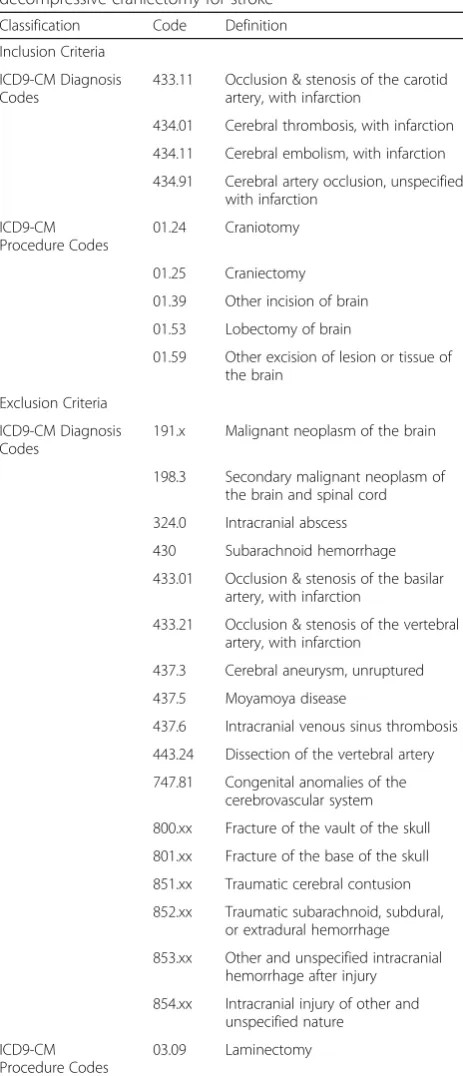
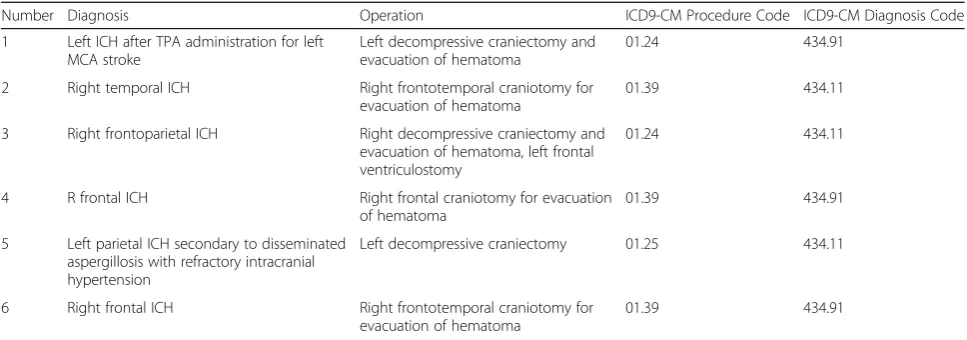
An ICD9-CM based algorithm was constructed to identify patients undergoing decompressive craniectomy for stroke (Table 1). Application of this algorithm to our institutional billing data for all patients who underwent a neurosurgical operation during the study period identi-fied 51 patients, of whom 45 underwent decompressive craniectomy for stroke and 6 were false positives. The majority of false positive patients underwent evacuation of an intracerebral hematoma (Table 2). During the same period, 33 patients underwent posterior fossa craniect-omy for infarction, all of whom were excluded with this algorithm. Only one patient who underwent decom-pressive craniectomy for a supratentorial stroke was not identified using this algorithm (and thereby a false nega-tive), in whom the cerebral infarction was miscoded as oc-clusion and stenosis of the basilar artery with infarction. Therefore, the ICD9-CM based algorithm had a sensitivity of 97.8%, specificity of 99.9%, positive predictive value of 88.2%, and negative predictive value of 99.9%.
regions and who sustained hemorrhagic conversion of the infarction was evaluated among patients who underwent decompressive craniectomy for space-occupying infarction. Among the patients who underwent decompressive cra-niectomy for stroke, 17.4% (n = 8) also underwent a
concomitant excision of the infarcted regions. When ana-lyzing the accuracy of coding of the performance of exci-sion of infarcted regions, the sensitivity of the primary procedure code was 62.5%, specificity 97.4%, positive pre-dictive value 83.3%, negative prepre-dictive value 92.5%, and correct classification 91.3%; these values were calculated based on 5 true positive, 1 false positive, 3 false negative, and 37 true negative classifications. Moreover, among pa-tients who underwent decompressive craniectomy, 32.6% (n= 15) had hemorrhagic conversion of the infarct. The ICD9-CM code (431) for intracerebral hemorrhage was evaluated to determine its accuracy for denoting hemorrhagic conversion of the infarction, and the sensitiv-ity was 66.7%, specificsensitiv-ity 93.5%, positive predictive value 83.3%, negative predictive value 85.3%, and correct classifi-cation 84.8%. These values were calculated based on 10 true positive, 2 false positive, 5 false negative, and 29 true negative classifications.
Discussion
The use of ICD9-CM indicators to identify patients with acute ischemic stroke has been viewed with trepidation by some authors [17]. In 1998, Goldstein evaluated the accuracy of ICD9-CM coding, reporting a 61% accuracy for acute ischemic stroke, even when the modifier indi-cating infarction (which follows stenosis and occlusion of a specific artery) was considered [7]. Likewise, Reker et al. found significant variability in risk-adjusted mortal-ity rates using ICD9-CM codes for acute ischemic stroke [9]. In a recent systematic review, McCormick et al. re-ported that the positive predictive value of ICD9-CM coding for acute stroke was typically less than 68% [4]; some authors, however, have found that the accuracy of ICD-CM coding of stroke has increased with time [18]. Nonetheless, patients with space-occupying cerebral in-farction undergoing decompressive craniectomy repre-sent a unique subset of patients with acute ischemic stroke [19], and the utility of ICD9-CM coding in this population remains unknown. Moreover, due to the rarity of decompressive craniectomy for stroke, single in-stitution studies are limited by a relatively small sample size [20–28]. Thus, an effective ICD9-CM algorithm that accurately identifies patients who underwent craniect-omy for stroke would allow population-based outcomes studies to be performed with greater legitimacy.
The goal of this study was to construct and validate an ICD9-CM based algorithm to identify patients undergo-ing decompressive craniectomy for space-occupyundergo-ing supratentorial cerebral infarction. This algorithm uses different ICD9-CM diagnosis and procedure codes for inclusion and exclusion. Patients were included who had one of four ICD9-CM diagnosis codes indicating acute ischemic stroke and one of five codes documenting a neurosurgical intervention; those with a diagnosis code Table 1ICD9-CM based algorithm for identifying
decompressive craniectomy for stroke
Classification Code Definition
Inclusion Criteria
ICD9-CM Diagnosis Codes
433.11 Occlusion & stenosis of the carotid artery, with infarction
434.01 Cerebral thrombosis, with infarction
434.11 Cerebral embolism, with infarction
434.91 Cerebral artery occlusion, unspecified, with infarction
ICD9-CM Procedure Codes
01.24 Craniotomy
01.25 Craniectomy
01.39 Other incision of brain
01.53 Lobectomy of brain
01.59 Other excision of lesion or tissue of the brain
Exclusion Criteria
ICD9-CM Diagnosis Codes
191.x Malignant neoplasm of the brain
198.3 Secondary malignant neoplasm of the brain and spinal cord
324.0 Intracranial abscess
430 Subarachnoid hemorrhage
433.01 Occlusion & stenosis of the basilar artery, with infarction
433.21 Occlusion & stenosis of the vertebral artery, with infarction
437.3 Cerebral aneurysm, unruptured
437.5 Moyamoya disease
437.6 Intracranial venous sinus thrombosis
443.24 Dissection of the vertebral artery
747.81 Congenital anomalies of the cerebrovascular system
800.xx Fracture of the vault of the skull
801.xx Fracture of the base of the skull
851.xx Traumatic cerebral contusion
852.xx Traumatic subarachnoid, subdural, or extradural hemorrhage
853.xx Other and unspecified intracranial hemorrhage after injury
854.xx Intracranial injury of other and unspecified nature
ICD9-CM Procedure Codes
03.09 Laminectomy
indicating a brain tumor, subarachnoid hemorrhage, ver-tebrobasilar infarction, cerebral aneurysm, Moyamoya disease, intracranial venous sinus thrombosis, vertebral artery dissection, congenital anomaly of the cerebral vas-culature (often used to indicate an arteriovenous malfor-mation) [29], and head trauma, or a procedure code indicating a laminectomy (as a C1 laminectomy is a stand-ard component of a suboccipital decompression for infra-tentorial stroke) [30–32] were excluded. This algorithm effectively identified patients who underwent decom-pressive craniectomy for supratentorial infarction, with a 97.8% sensitivity and 88.2% positive predictive value.
This complex ICD9-CM algorithm was more effective at identifying patients who underwent decompressive craniectomy for stroke than the ICD9-CM procedure code for craniectomy alone, which was only encoded in 67.4% of patients. This difference is partially because 17.4% of patients at our institution also underwent ex-cision of infarcted territory—primarily the anterior temporal lobe—at the time of craniectomy, to reduce the risk of transtentorial herniation. Although the utility of a concomitant lobectomy (described as a strokectomy) is debated [33, 34], at our institution, its performance is determined based on the consensus of the neurosurgeon and neurocritical care team. Almost one-fifth of patients had a documented procedure code of craniotomy, however, indicating limited ability of administrative coding to differentiate between a cra-niectomy and craniotomy.
When the ICD9-CM algorithm was applied to admis-sions at our institution, there were six patients who met the criteria of our algorithm but did not undergo decompressive craniectomy for space-occupying infarc-tion, and were therefore false positives, all of whom had an intracerebral hemorrhage. One patient had
post-thrombolytic hemorrhagic conversion of cerebral infarction, another underwent decompressive craniect-omy for medically refractory hypertension, while the remainder were operations for surgical evacuation of a primary intracerebral hemorrhage. The ICD9-CM indi-cator for intracerebral hemorrhage (431) could not be used as exclusion criteria, however, as this is the same code that represents hemorrhagic conversion of a pri-mary cerebral infarction. Notably, another concern of using ICD9-CM indicators to identify patients under-going craniectomy for stroke is the lack of procedure-specific ICD9 code differentiating supratentorial and infratentorial craniectomies—which represent very dif-ferent operations and indications for surgery. However, the use of ICD9-CM diagnosis codes for vertebrobasi-lar circulation infarction and vertebral artery dissection as well as the procedure code for a laminectomy excluded all of posterior fossa craniectomies in this patient population.
Additionally, the accuracy of the ICD9 identifier 431 to denote hemorrhagic conversion of the infarction was evaluated. While the specificity of this indicator was strong (93.5%), its sensitivity was only moderate (66.7%), indicating that administrative coding of hemorrhagic conversion is less robust.
There are several limitations of the present analysis. First, as a single-center study, the proposed ICD9-CM al-gorithm could only be validated based on the billing codes employed at our institution. Therefore, the generalizability of this ICD9-CM based algorithm could not be evaluated with the study design, and only the internal validity could be assessed. Future analysis of the external validity of this algorithm, with confirmation of the utility of its appli-cation at other centers, will further increase the reliabil-ity of the proposed algorithm. Moreover, ICD-10 codes Table 2Details of the false positive patients determined by the ICD9-CM algorithm
Number Diagnosis Operation ICD9-CM Procedure Code ICD9-CM Diagnosis Code
1 Left ICH after TPA administration for left MCA stroke
Left decompressive craniectomy and evacuation of hematoma
01.24 434.91
2 Right temporal ICH Right frontotemporal craniotomy for evacuation of hematoma
01.39 434.11
3 Right frontoparietal ICH Right decompressive craniectomy and evacuation of hematoma, left frontal ventriculostomy
01.24 434.11
4 R frontal ICH Right frontal craniotomy for evacuation of hematoma
01.39 434.91
5 Left parietal ICH secondary to disseminated aspergillosis with refractory intracranial hypertension
Left decompressive craniectomy 01.25 434.11
6 Right frontal ICH Right frontotemporal craniotomy for evacuation of hematoma
01.39 434.91
Abbreviations:ICD9-CMinternational classification of diseases, ninth revision, clinical modification,ICHintracerebral hemorrhage,MCAmiddle cerebral artery,TPA
were not used at our institution during the years evalu-ated, and therefore, an ICD-10 based algorithm could not be proposed.
Conclusions
Although the ICD9-CM code for craniectomy is not strin-gently coded, an algorithm of ICD9-CM diagnosis and pro-cedure codes effectively identifies patients undergoing decompressive craniectomy for acute, space-occupying cerebral infarction. The sensitivity of the diagnosis codes to identify hemorrhagic conversion of the infarct and of the procedure codes to indicate excision of infarcted regions, however, are less robust.
Abbreviations
ICH:Intracerebral hemorrhage; MCA: Middle cerebral artery; TPA: Tissue plasminogen activator; ICD9-CM: International Classification of Diseases, Ninth Edition, Clinical Modification
Acknowledgements None
Funding None
Availability of data and materials
The datasets used to analyze the data are not available due to patient privacy and institutional review board requirements, but are available from the corresponding author upon reasonable request & approval of a data use agreement by Partners Healthcare.
Authors’contributions
Conception & Design: HHD, TRS; Acquisition of Data: HHD, DJC, YP, VSV; Analysis & interpretation of data: all authors; Drafting the Article: HHD; Critically Revising the Article: all authors; Study Supervision: HHD, TRS, WBG All authors read and approved the final manuscript.
Competing interests
W.B.G.: Codman; H.H.D., D.J.C., Y.P., V.S.V., & T.R.S: The authors declare that they have no competing interests.
Consent for publication Not applicable.
Ethics approval and consent to participate
The research protocol was approved by the Institutional Review Board of the Brigham and Women’s Hospital. Protocol number: 2010P001804.
Publisher’s Note
Springer Nature remains neutral with regard to jurisdictional claims in published maps and institutional affiliations.
Received: 13 October 2016 Accepted: 26 April 2017
References
1. Johnson EK, Nelson CP. Values and pitfalls of the use of administrative databases for outcomes assessment. J Urol. 2013;190(1):17–8. 2. Ramirez L, Kim-Tenser MA, Sanossian N, Cen S, Wen G, He S, Mack WJ,
Towfighi A. Trends in acute ischemic stroke hospitalizations in the United States. J Am Heart Assoc. 2016;5(5):e003233.
3. Golomb MR, Garg BP, Saha C, Williams LS. Accuracy and yield of ICD-9 codes for identifying children with ischemic stroke. Neurology. 2006;67(11):2053–5. 4. McCormick N, Bhole V, Lacaille D, Avina-Zubieta JA. Validity of diagnostic codes for acute stroke in administrative databases: a systematic review. PLoS One. 2015;10(8):e0135834.
5. Ramalle-Gomara E, Ruiz E, Serrano M, Bartulos M, Gonzalez MA, Matute B. Validity of discharge diagnoses in the surveillance of stroke.
Neuroepidemiology. 2013;41(3–4):185–8.
6. Jones SA, Gottesman RF, Shahar E, Wruck L, Rosamond WD. Validity of hospital discharge diagnosis codes for stroke: the atherosclerosis risk in communities study. Stroke; a journal of cerebral circulation. 2014;45(11):3219–25. 7. Goldstein LB. Accuracy of ICD-9-CM coding for the identification of patients
with acute ischemic stroke: effect of modifier codes. Stroke; a journal of cerebral circulation. 1998;29(8):1602–4.
8. Leone MA, Gaviani P, Ciccone G. Inter-coder agreement for ICD-9-CM coding of stroke. Neurological sciences : official journal of the Italian Neurological Society and of the Italian Society of Clinical Neurophysiology. 2006;27(6):445–8. 9. Reker DM, Rosen AK, Hoenig H, Berlowitz DR, Laughlin J, Anderson L,
Marshall CR, Rittman M. The hazards of stroke case selection using administrative data. Med Care. 2002;40(2):96–104.
10. Tonarelli SB, Tibbs M, Vazquez G, Lakshminarayan K, Rodriguez GJ, Qureshi AI. Accuracy of the new ICD-9-CM code for "drip-and-ship" thrombolytic treatment in patients with ischemic stroke. Journal of stroke and cerebrovascular diseases: the official journal of National Stroke Association. 2012;21(2):121–3.
11. Mullen MT, Moomaw CJ, Alwell K, Khoury JC, Kissela BM, Woo D, Flaherty ML, Khatri P, Adeoye O, Ferioli S, et al. ICD9 codes cannot reliably identify hemorrhagic transformation of ischemic stroke. Circulation Cardiovascular quality and outcomes. 2013;6(4):505–6.
12. Kokotailo RA, Hill MD. Coding of stroke and stroke risk factors using international classification of diseases, revisions 9 and 10. Stroke; a journal of cerebral circulation. 2005;36(8):1776–81.
13. Thigpen JL, Dillon C, Forster KB, Henault L, Quinn EK, Tripodis Y, Berger PB, Hylek EM, Limdi NA. Validity of international classification of disease codes to identify ischemic stroke and intracranial hemorrhage among individuals with associated diagnosis of atrial fibrillation. Circulation Cardiovascular quality and outcomes. 2015;8(1):8–14.
14. Geurts M, van der Worp HB, Kappelle LJ, Amelink GJ, Algra A, Hofmeijer J. Surgical decompression for space-occupying cerebral infarction: outcomes at 3 years in the randomized HAMLET trial. Stroke; a journal of cerebral circulation. 2013;44(9):2506–8.
15. Juttler E, Schwab S, Schmiedek P, Unterberg A, Hennerici M, Woitzik J, Witte S, Jenetzky E, Hacke W. Decompressive surgery for the treatment of malignant infarction of the middle cerebral artery (DESTINY): a randomized, controlled trial. Stroke; a journal of cerebral circulation. 2007;38(9):2518–25. 16. Vahedi K, Vicaut E, Mateo J, Kurtz A, Orabi M, Guichard JP, Boutron C,
Couvreur G, Rouanet F, Touze E, et al. Sequential-design, multicenter, randomized, controlled trial of early decompressive craniectomy in malignant middle cerebral artery infarction (DECIMAL trial). Stroke; a journal of cerebral circulation. 2007;38(9):2506–17.
17. Leibson CL, Naessens JM, Brown RD, Whisnant JP. Accuracy of hospital discharge abstracts for identifying stroke. Stroke; a journal of cerebral circulation. 1994;25(12):2348–55.
18. Aboa-Eboule C, Mengue D, Benzenine E, Hommel M, Giroud M, Bejot Y, Quantin C. How accurate is the reporting of stroke in hospital discharge data? A pilot validation study using a population-based stroke registry as control. J Neurol. 2013;260(2):605–13.
19. Zweckberger K, Juettler E, Bosel J, Unterberg WA. Surgical aspects of decompression craniectomy in malignant stroke: review. Cerebrovascular diseases (Basel, Switzerland). 2014;38(5):313–23.
20. Carandang RA, Krieger DW. Decompressive hemicraniectomy and durotomy for malignant middle cerebral artery infarction. Neurocrit Care. 2008;8(2):286–9. 21. Carter BS, Ogilvy CS, Candia GJ, Rosas HD, Buonanno F. One-year outcome
after decompressive surgery for massive nondominant hemispheric infarction. Neurosurgery. 1997;40(6):1168–75. discussion 1175-1166 22. Foerch C, Lang JM, Krause J, Raabe A, Sitzer M, Seifert V, Steinmetz H,
Kessler KR. Functional impairment, disability, and quality of life outcome after decompressive hemicraniectomy in malignant middle cerebral artery infarction. J Neurosurg. 2004;101(2):248–54.
23. Gupta R, Connolly ES, Mayer S, Elkind MS. Hemicraniectomy for massive middle cerebral artery territory infarction: a systematic review. Stroke; a journal of cerebral circulation. 2004;35(2):539–43.
24. Harscher S, Reichart R, Terborg C, Hagemann G, Kalff R, Witte OW. Outcome after decompressive craniectomy in patients with severe ischemic stroke. Acta Neurochir. 2006;148(1):31–7. discussion 37
infarction: improved survival but poor functional outcome. J Neurol Neurosurg Psychiatry. 2001;70(2):226–8.
26. Rabinstein AA, Mueller-Kronast N, Maramattom BV, Zazulia AR, Bamlet WR, Diringer MN, Wijdicks EF. Factors predicting prognosis after decompressive hemicraniectomy for hemispheric infarction. Neurology. 2006;67(5):891–3. 27. Uhl E, Kreth FW, Elias B, Goldammer A, Hempelmann RG, Liefner M, Nowak
G, Oertel M, Schmieder K, Schneider GH. Outcome and prognostic factors of hemicraniectomy for space occupying cerebral infarction. J Neurol Neurosurg Psychiatry. 2004;75(2):270–4.
28. Walz B, Zimmermann C, Bottger S, Haberl RL. Prognosis of patients after hemicraniectomy in malignant middle cerebral artery infarction. J Neurol. 2002;249(9):1183–90.
29. Davies JM, Yanamadala V, Lawton MT. Comparative effectiveness of treatments for cerebral arteriovenous malformations: trends in nationwide outcomes from 2000 to 2009. Neurosurg Focus. 2012;33(1):E11.
30. Wijdicks EF, Sheth KN, Carter BS, Greer DM, Kasner SE, Kimberly WT, Schwab S, Smith EE, Tamargo RJ, Wintermark M. Recommendations for the management of cerebral and cerebellar infarction with swelling: a statement for healthcare professionals from the American Heart Association/American Stroke Association. Stroke; a journal of cerebral circulation. 2014;45(4):1222–38. 31. Pfefferkorn T, Eppinger U, Linn J, Birnbaum T, Herzog J, Straube A, Dichgans M, Grau
S. Long-term outcome after suboccipital decompressive craniectomy for malignant cerebellar infarction. Stroke; a journal of cerebral circulation. 2009;40(9):3045–50. 32. Juttler E, Schweickert S, Ringleb PA, Huttner HB, Kohrmann M, Aschoff A. Long-term
outcome after surgical treatment for space-occupying cerebellar infarction: experience in 56 patients. Stroke; a journal of cerebral circulation. 2009;40(9):3060–6. 33. Kostov DB, Singleton RH, Panczykowski D, Kanaan HA, Horowitz MB, Jovin T,
Jankowitz BT. Decompressive hemicraniectomy, strokectomy, or both in the treatment of malignant middle cerebral artery syndrome. World neurosurgery. 2012;78(5):480–6.
34. Cheung A, Telaghani CK, Wang J, Yang Q, Mosher TJ, Reichwein RK, Cockroft KM. Neurological recovery after decompressive craniectomy for massive ischemic stroke. Neurocrit Care. 2005;3(3):216–23.
• We accept pre-submission inquiries
• Our selector tool helps you to find the most relevant journal
• We provide round the clock customer support
• Convenient online submission
• Thorough peer review
• Inclusion in PubMed and all major indexing services
• Maximum visibility for your research
Submit your manuscript at www.biomedcentral.com/submit