R E V I E W
Open Access
Migration and cognitive function: a
conceptual framework for Global Health
Research
Hanzhang Xu
1,2*, Allison A. Vorderstrasse
3, Eleanor S. McConnell
1,4, Matthew E. Dupre
5,6,7, Truls Østbye
1,2,6,8and Bei Wu
3Abstract
Background:
Migration is a fundamental demographic process that has been observed globally. It is suggested
that migration is an issue of global health importance that can have an immediate and lasting impact on an
individual
’
s health and well-being. There is now an increasing body of evidence linking migration with cognitive
function in older adults. In this paper, we synthesized the current evidence to develop a general conceptual
framework to understand the factors contributing to the association between migration and cognitive function.
Methods:
A comprehensive review of the literature was conducted on the associations between migration and
cognition among middle-aged and older adults.
Results:
Five potential mechanisms were identified from the literature: 1) socioeconomic status
—
including
education, occupation, and income; 2) psychosocial factors
—
including social networks, social support, social
stressors, and discrimination; 3) behavioral factors
—
including smoking, drinking, and health service utilization; 4)
physical and psychological health status
—
including chronic conditions, physical function, and depression; and 5)
environmental factors
—
including both physical and social environment. Several underlying factors were also
identified
—
including early-life conditions, gender, and genetic factors.
Conclusions:
The factors linking migration and cognitive function are multidimensional and complex. This
conceptual framework highlights potential implications for global health policies and planning on healthy aging
and migrant health. Additional studies are needed to further examine these mechanisms to extend and refine our
general conceptual framework.
Background
Migration is the geographic movement of individuals
across a specified boundary for the purpose of establishing
a new residence [
1
]. Migrant populations, both within
countries and internationally, have been increasing for the
past few decades [
2
]. According to recent estimates, in
2013, there were more than 232 million international
mi-grants; and another 740 million internal migrants
world-wide
[
2
].
This
dramatic
increase
in
the
migrant
populations has drawn particular attention to migration
and health and highlights the needs to identify best
practices to promote healthy aging for migrant populations.
Cognitive impairment, often defined as an individual
’
s
ex-perienced difficulties in remembering things, learning new
skills, concentrating on tasks, or making decisions, is a
common problem in old age [
3
]. As these migrant
popula-tions get older, many will experience cognitive decline [
4–
6
]. Increasing number of older adults experiencing some
level of cognitive decline continue to put enormous strain
on healthcare systems and on caregivers who provide care
for people with cognitive impairment [
6
,
7
]. Thus, it is
im-portant to understand how migration may relate to initial
levels of cognitive function and the rate of cognitive change
over time [
8
]. A variety of factors
—
such as
sociodemo-graphic background, health behaviors, and genetic traits
—
can influence levels of cognitive function and changes over
time [
9
]. Likewise, the migration process is related to many
* Correspondence:[email protected]1School of Nursing, Duke University, Durham, NC, USA
2Department of Community and Family Medicine, Duke University, Durham, NC, USA
Full list of author information is available at the end of the article
of these factors and, therefore, may be important
mecha-nisms in the association between migration and cognitive
function.
The purpose of this paper is to present a general
concep-tual framework of the linkages between migration and
cog-nitive function. We conduct a comprehensive review of the
literature and discuss the possible mechanisms that may
explain the association between migration and cognitive
function. Furthermore, synthesizing the current evidence
to provide a conceptual framework will help elucidate
im-portant mechanisms and provide guidance for researchers
to develop effective approaches to prevent cognitive
decline among older adult populations. In addition, this
conceptual framework will highlight potential actionable
areas that inform the development of global health policies
and planning on healthy aging and migrant health.
Theories and current literature on migration and
cognitive function
Our previous systematic review synthesized the current
literature on migration and cognitive function [
10
]. We
found that different migration patterns have different
im-pacts on cognitive function [
10
]. We also found that there
is a lack of a conceptual framework that elucidates the
po-tential pathways between migration and cognitive function
in the current literature [
10
]. Existing theories, such as the
push-pull theory that has been widely used by economists,
do not explicitly explain how migration might influence an
individual
’
s cognitive status [
11
,
12
]. Given the sheer
num-ber of migrants across the globe, it is important to develop
a conceptual framework to examine the underlying
linkages that connect migration and cognition. Building on
our published systematic review, we first reviewed three
theories and models that have been used in the current
literature related to migration and health.
Life course perspective
The life course perspective has served as a useful
interdis-ciplinary framework in social, behavioral, and health
sci-ence research [
13–15
]. Elder and colleagues describe the
life course as
“
consisting of age-graded patterns that are
embedded in social institutions and history
”
[
15
]. To
illus-trate, social and physical exposures during critical periods
(e.g. gestation, childhood, and adulthood) may have
cumu-lative effects on health status in later life, such as through
increasing the risk of chronic conditions and influencing
functional status [
16
]. In the context of migration and
cog-nitive function, migration may alter an individual
’
s
trajec-tory of cognitive function. The timing and duration of
migration might have an impact on the magnitude of the
relationship between migration and cognition. Still, the life
course perspective fails to incorporate the determinants of
health status
—
cognitive function in this case
—
and the
rea-sons for migration. Therefore, other theories and models
are needed to address the limitation of life course theory in
guiding future research on migration and cognition.
Social determinants of health
The World Health Organization first introduced the
concept
“
determinants of health
”
to illustrate the idea
that an individual
’
s health status is determined by
many factors together [
17
]. Based on the social
deter-minants of health model, factors that influence health
status include but are not limited to 1) the social and
economic environment (e.g. income, education), 2)
the physical environment (e.g. clean water, safe
hous-ing), and 3) the individual
’
s characteristics and
behav-iors (e.g. access to healthcare, smoking). The social
determinants of health model has been widely
embed-ded in studies related to disease and functional status
[
18
–
20
]. A recent study has comprehensively
summa-rized the key risks and protective factors related to
cognitive impairment [
9
]. However, while this model
is very useful, it does not specifically elucidate the
pathways between migration and cognition.
Push and pull theory
The push-pull theory has been widely used in
geog-raphy and economics research to examine factors that
influence people
’
s decision to migrate [
21
,
22
]. To
il-lustrate, this theory emphasizes the interplay between
sending- and receiving place factors that govern the
migration process. Push factors often include
dissatis-fying conditions (e.g. political instability, heavy
tax-ation) in the sending places that motivate people to
migrate. In contrast to push factors, pull factors are
favorable conditions (e.g. less polluted environment,
health care system) in receiving countries that
facili-tate the migration process. Although the push-pull
theory emphasizes that factors in both sending- and
receiving places are important to the migration
deci-sion, whether these factors can cause accumulation of
disease risks and whether migration is associated with
certain health outcomes are only vaguely implied in
this theory.
Potential mechanisms impacting relationships
between migration and cognitive function
Migration status
An individual
’
s migration status consists of several
inter-correlated key elements, including geographic patterns,
age at migration/length of stay, and reasons for
migra-tion. A major trend in migration in the world today is
that people tend to move from less developed areas (e.g.
rural settings, low- and middle-income countries) to
more developed places (e.g. urban areas, high-income
countries) for more working opportunities, better
educa-tion, or higher payment [
1
]. For example, in China,
mil-lions of people have migrated from rural areas into cities
for employment since the economic reform in 1979 [
23
].
Similar patterns have also been observed in the
immi-grant populations: a significant number of laborers from
Mexico or other Latin American countries moved to the
U.S. and worked in the manufacturing or service sectors
[
24
,
25
]. In addition to this type of migration that is
often described as upward social mobility, other types of
geographic movements also exist, including involuntary
migration due to natural disasters, or migration for the
purpose of marriage or family union [
26–28
]. For
ex-ample, rural to rural migration is commonly seen among
women in India; and a significant proportion of this
rural to rural migration is related to marriage [
29
,
30
].
Age at migration (or length of stay) is another critical
component of an individual
’
s migration status. First, age
at migration is likely to be associated with the length of
exposure to certain physical and social environments.
Additionally, people tend to migrate for specific reasons
at different stages of the life course. For example,
up-ward social mobility is more likely to occur during
young adulthood [
31
].
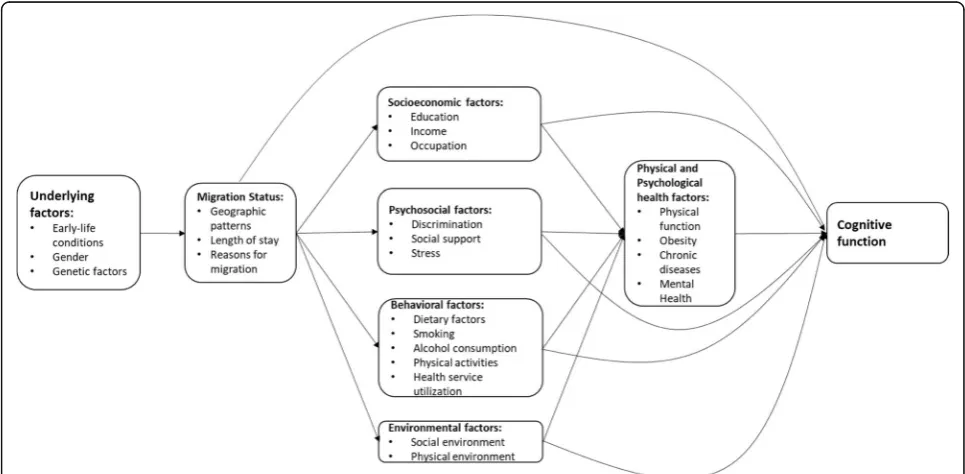
The potential pathways through which migration
af-fects cognitive function are complex and
multifactor-ial. Different geographic movements and the related
reasons for migration are likely to affect cognitive
function though different pathways. These potential
mechanisms can be categorized in terms of
socioeco-nomic, psychosocial and behavioral factors, physical
and psychological health, and environmental factors.
Age at migration can determine the duration of
exposure that ultimately impacts the magnitude of
these effects on cognitive function. Figure
1
, which is
an extension and elaboration of the figure in our
previous systematic review [
10
], depicts factors that
are associated with an individual
’
s cognitive function
and how the migration process may change some of
those factors.
Socioeconomic status (SES)
Socioeconomic factors are often assessed in the
litera-ture using measures such as educational attainment,
income level, and occupational status [
4
]. A number of
studies have shown that adult SES such as education,
income, and occupation are protective factors against
cognitive decline [
8
,
32–34
]. Migrants who moved from
poorer areas to more developed places are likely to
achieve socioeconomic advancement, which is often
de-scribed as upward social mobility [
31
].
Education
Moving from rural areas into cities, or from developing
countries to developed countries, is likely to lead to
more or better education opportunities [
23
,
30
]. People
who receive higher levels of education demonstrated
better cognitive function [
35
,
36
]. One possible
explan-ation is that brain function is stimulated through
learn-ing activities or social engagement [
37
]. Therefore,
higher education is related to more cognitive reserve
that helps people maintain their brain function [
38
].
Income
In addition to education, research has shown that
migrants are likely to receive higher income from their
new job after migration than what they could earn back
home [
1
,
23
,
39
]. Prior research has found that controlling
for education and other factors, higher income has been
independently associated with higher scores in cognition
tests [
8
,
32
]. Higher income level may allow people to
af-ford a good quality diet and better living environment
that, in turn, may have a positive impact on cognitive
health [
40
,
41
]. It is also possible that migration can lead
to an improvement in financial status that increases the
likelihood for migrants to obtain health insurance and use
healthcare services [
42
,
43
], resulting in more preventative
care to reduc the risk of diseases that negatively affect
cog-nitive function in later life [
44
].
Occupation
It is likely that migration results in changes in
occupa-tions [
23
,
30
]. Studies have reported the association
be-tween a highly-skilled occupation and better cognitive
function while adjusting for education and income
fac-tors [
33
,
34
]. Occupation often reflects different work
exposures and activities [
45
]. Therefore, migrants may
benefit from intellectual stimulation by working on
different tasks and learning new skills, which are
associated with better cognitive function [
35–37
,
46
].
Psychosocial factors
Migration involves many psychosocial changes [
47
]. The
following section describes how these migration-related
psychosocial changes are associated with cognitive
function.
Perceived discrimination
A number of studies have documented the hostility and
discrimination that migrants experience [
48
,
49
]. For
ex-ample, rural-to-urban migrants in China have often been
denied access to many of the social welfare programs
such as health insurance and unemployment benefits
that are available to their urban counterparts, even if
they were doing the same job [
50
]. Among immigrants,
discrimination and segregation in host countries are also
often reported [
51
,
52
]. Perceived discrimination may
re-sult in social isolation; and previous studies found that
social isolation is a risk factor for cognitive impairment
and dementia [
53
,
54
].
Social support
Previous research has reported that migrants often
experi-enced various stressful life events, such as separating from
family, both during and after the migration process [
55
].
Family separation is likely related to reduced social support
[
52
,
56
,
57
]. Small social networks and less social support
have been shown to be risk factors forcognitive decline
[
58–60
]. It is also possible that adequate social support and
a large social network can facilitate an individual
’
s access to
health care and promote healthy behaviors, ultimately
re-ducing the impact of other risk factors that affect cognitive
function [
61
].
Stress
In addition to experiencing reduced social networks and
social support, migrants are often under great stress
dur-ing the migration process [
62
,
63
]. Studies have shown
that stressful life events may affect elderly participants'
inhibitory control in attentional and sensorimotor
do-mains and therefore influence their cognitive function
[
64
]. However, a longer stay in a hosting place has been
shown to be associated with less stress and an improved
social network [
65
]. As a result, the effects of these
negative psychosocial factors such as reduced social
net-work and increased stress on cognitive function may
de-crease as migrants stay longer in hosting places.
Behavioral factors
Changes in health behaviors are often observed in migrant
populations. Migrants from less developed areas are likely
to adopt westernized life styles that can negatively affect
health, such as high calorie intake, physical inactivity,
sed-entary employment, and tobacco use [
66–68
]. These
high-risk lifestyles lead to disorders that directly affect an
individual
’
s cognitive function [
69
,
70
], and also serve as
mediators in the relationship between migration and
cognitive function.
Dietary factors
studies have reported that regular intake of fruits,
vege-tables, and fiber is associated with better cognitive
func-tion [
70
,
75
], while westernized food consumption is
related to poorer cognitive performance [
76
,
77
].
There-fore, migration may trigger changes in migrants
’
dietary
behaviors that generate negative effects on their later-life
cognitive function.
Smoking
An increasing prevalence of smoking has been observed
among migrant populations, which may partially explain
the poorer cognitive function found in migrants than
those who did not move. Studies in China and Guatemala
have indicated that moving into cities is associated with
higher likelihood of smoking [
78
,
79
]. Female immigrants
appear more likely to smoke than their counterparts who
remain in home countries [
66
,
80
]. A wealth of data has
shown the negative effect of smoking on cognitive
func-tion [
81–84
], which may occur due to increased risk of
cardiovascular diseases and inflammation [
85
].
Alcohol consumption
Unlike smoking, light-to-moderate alcohol consumption
has been shown to reduce the risk of developing dementia
[
86
,
87
]. One possible explanation is that
light-to-moder-ate drinking might be cardio protective [
86
,
88
]. However,
previous research has yielded inconsistent results on the
association between heavy drinking and cognitive function
[
85
,
89
]. Therefore, the relationship between alcohol
con-sumption and cognitive function might be an inverted
U-shape [
90
]. Still, an increasing trend of alcohol
con-sumption has occurred in both immigrant and internal
migrant populations [
78
,
91
].
Physical activities
A growing body of literature has demonstrated lower
physical activity among rural-to-urban migrants compared
to rural residents, which may be explained by sedentary
employment in the cities [
78
,
92
]. Similarly, immigrants
are also found to be less likely to participate in physical
activities, and longer stays in a hosting country will
-increase this likelihood [
93
,
94
]. Physical activities have
long-term positive effects on later-life cognitive function
[
95–97
]. One possible linkage between physical activity
and cognition is that physical activity leads to
improve-ments in cardiorespiratory fitness that are beneficial for
cognitive function [
96
].
Health services utilization
Despite the negative health behaviors that are related to
migration, people who move to more developed areas or
countries may improve their access to better healthcare
services. It is believed that healthcare in developed
coun-tries is generally better than in developing councoun-tries
[
98
]. Similarly, in developing countries where massive
internal migration occurs, the best healthcare is
central-ized in urban areas [
99
,
100
]. Although migrants from
developing countries or rural areas may have better
ac-cess to healthcare after migration, the utilization of these
services may not be improved immediately. It may take
some time for these migrants to be fully aware of and
gain access to the available healthcare resources [
101
,
102
].
Physical and psychological health
As discussed in previous sections, migration may trigger
changes in several risk and protective factors, including
SES,
psychosocial,
and
behavioral
factors.
These
migration-related factors not only directly interact with
cognitive function, but also have impacts on individuals
’
physical and psychological health and ultimately
influ-ence cognitive function [
69
,
103
].
Physical function
A growing body of literature has demonstrated the
asso-ciation between physical function and cognitive function.
For example, a recent study has demonstrated that
decline in gait and balance function preceded decline in
neurological processing speed tasks [
104
]. Therefore,
factors that are associated with an individual
’
s physical
function may have indirect effects on cognitive function.
Physical function is associated with several factors such
as SES [
105
,
106
], health behaviors [
106
,
107
], and social
support [
108
]. These factors are likely to change during
the migration process. Therefore, migration may
indir-ectly affect an individual
’
s cognitive function through the
pathways that we described above.
Obesity
Changes in health behaviors, such as adopting a
western-ized diet and being physical inactive, are likely to increase
the risk of obesity in the migrant populations [
109
,
110
]. In
addition, a longer stay in the hosting place has been shown
to be significantly associated with obesity or overweight
[
111
,
112
]. The linkage between obesity and cognitive
func-tion is well-established [
77
,
113
]. Therefore, obesity could
mediate the effect of health behavior changes that occurred
along with the migration process on later-life cognitive
function.
Chronic diseases
in their SES that is due to migration, they may be more
likely to use preventive care [
116
]. Also, migration can lead
to improvement in access to healthcare [
99
,
100
], which
can promote better prevention and management of chronic
diseases [
117
]. Increasing evidence suggests that chronic
diseases such as hypertension, diabetes, and arrhythmias
are related to greater risk of cognitive impairment and
dementia [
69
,
103
,
118–122
]. Although the precise
mecha-nisms underlying the association between chronic diseases
and cognitive function remain unclear, one common
ex-planation is that both micro- and macro-vascular
complica-tions increase the risk of cognitive impairment [
123
].
Mental health
Previous research has established linkages between
migration-related psychosocial factors and mental health
[
48
,
56
,
124
,
125
]. For example, perceived discrimination
has been found to be a risk factor for depressive symptoms
[
125
,
126
]. The reduced social networks among
immi-grants also has been shown to have negative effects on
mental health [
65
,
127
]. However, as migrants stay longer
in the hosting places, it is possible that they will rebuild
their social networks, which will reduce the negative effects
on mental health [
65
]. Additionally, longer stays have been
shown to be related to more use of mental health services
that would help improve mental health status [
128
,
129
].
Evidence from previous studies suggests that depressive
symptoms are associated with mild cognitive impairment
and dementia [
130
,
131
]. It is possible that the changes in
psychosocial factors during or after migration will
nega-tively impact migrants
’
mental health status, and therefore
increase the risk of cognitive impairment. However, these
negative impacts on cognitive function could be reduced
gradually as their length of stay increases.
Environmental factors
Moving from one area to another often leads to changes
in both physical and social environment. The following
section discusses the possible linkages between
migra-tion, changes in environmental factors, and cognition.
Social environment
For immigrants, the similarities in social environment
between sending and receiving countries may determine
the amount of change that immigrants experience in
psychosocial and behavioral factors that are associated
with physical and psychosocial health, and, thus, with
cognitive function [
132
]. For example, immigrants from
low-income countries are more likely to experience
dis-crimination when they migrate to a high-income country
[
133
]. Behavioral changes among immigrants also differ
by the countries of origin. For example, the prevalence
of smoking varies between Asian and Latino immigrants
in the United States; and the gender gap in smoking
prevalence is greater among Asian than Latino
immi-grants [
66
]. In addition, country of origin has been
shown to be a significant factor that influences changes
in dietary patterns and risks of chronic diseases among
immigrants [
134
].
Physical environment
Increasing evidence has suggested that certain physical
en-vironments can be a potential risk factor for cognitive
im-pairment. Prior studies have found that people who work
in agricultural settings are more likely to be exposed to
pesticide that increases the risk of cognitive decline [
135
].
In addition, people who live in rural areas especially in
de-veloping countries still often use open fires for cooking
[
136–138
]. Open fire as a major source of indoor
pollu-tion has been shown to be associated with poorer
cogni-tive function [
139
]. Therefore, when people move out of
rural areas with these types of environmental exposures,
they may protect their cognitive function in later life.
However, there is some new evidence suggesting that
exposure to air pollution such as particulate matter or
traffic-related air pollution in urban areas may accelerate
cognitive decline in older ages [
140
,
141
]. As a result,
people who move into cities may also face new
environ-mental risk factors for cognitive decline. Research in this
area is still in its infancy. Future research should
investi-gate whether migration and cognition could be linked
through changes in physical environment.
Underlying Factors
In addition to many factors that may change during the
migration process, there are other time-invariant factors
that may affect an individual
’
s cognitive function. For
ex-ample, early-life conditions, gender, and genetic factors
may each affect cognitive function via various pathways.
Early-life conditions
Gender
Prior research has found that women reported worse
cog-nitive function than men, especially in the oldest old age
range [
149
,
150
]. Gender is an underlying factor that
influ-ences the relationship between migration and cognitive
function through several pathways. First, the migration
patterns may differ between men and women. For
ex-ample, in India, gender differences have been observed in
the migration trends. In male populations, rural-to-urban
migration is the largest stream (39.0%) and employment
and education are the two main reasons for this type of
mi-gration [
30
]. However, in women, rural-to-rural migration
is the predominant stream accounting for 70% of all the
female migration, primarily for the purpose of marriage
[
29
,
30
]. Therefore, changes in SES between male and
fe-male migrants may be different due the reasons for
migra-tion and geographic patterns: in developing countries,
men are more likely to experience upward social mobility
[
28
], and ultimately have better cognitive function [
149
,
150
].
Gender differences have also been found in changes in
health behaviors. For example, research indicates that male
immigrants are more likely to adapted to westernized diets
than their female counterparts [
67
,
71
]. Additionally, the
impact of migration on an individual
’
s smoking behavior
differs by gender, with male migrants less likely to smoke
than females [
66
,
80
]. As a result, the gender differences in
health behaviors among migrants may produce different
influences on later-life cognitive function.
Genetic factors
Research has established linkages between dementia and
two
genes
—
apoliporotein E
(APOE) and
neuronal
sortilin-related receptor (SORL1) [
151–153
]. Studies have
shown that APOE
ε
4 increases the risk of dementia.
How-ever, the effect varies by sex, race/ethnicity, age, and
geo-graphic location [
151
,
154–157
]. The SORL1 gene has
been found as the second most important gene related to
cognitive function [
151
,
158
]. Studies that covered a broad
range of locations and ethnicity groups have shown
SORL1 is a risk gene in cognitive decline [
151
,
159
,
160
].
Conclusions
The association between migration and cognition is
multi-dimensional and complex. This study identifies several
pathways which potentially explain the linkages between
migration and later-life cognitive function. An individual
’
s
cognitive function is associated with SES, psychosocial and
behavioral factors, and physical and psychological health
status. These factors mediate the relationship between
migration and cognitive function. The migration process
may lead to changes in SES, psychosocial and behavioral
factors, and these changes will either positively or
nega-tively influence an individual
’
s cognitive function. Such
changes may also impact cognitive function indirectly by
improving or harming an individual
’
s physical and
psycho-logical health. Age at migration (or the length of stay in the
new location) is associated with levels of change in SES,
psychosocial and behavioral factors, and physical and
psychological health status. Additionally, environmental
factors may potentially mediate the relationship between
migration and cognition. Underlying factors, such as an
individual
’
s early-life exposures, gender, or genetic factors,
which will not change through migration, are also related
to later-life cognitive function.
This conceptual framework has potential implications
for clinical practice and global health policies. First, finding
from this paper supports the trends towards
‘
needs based
’
rather than age-determined health and social services in
countries with both large aging population and migrant
populations. Both primary health care providers and policy
makers should be aware that cognitive impairment/decline
may be more commonly experienced in certain migrant
populations. Therefore, it is crucial to promote early
screening for potential cognitive impairment in clinical
practice and making sure this practice covers these migrant
populations.
In addition, factors that are identified in this framework
that can potentially be used to design tailored interventions
or programs to promote cognitive health. For example,
migration can be a stressful event that may have negative
impacts on individuals
’
psychological well-being. In this
case, migrants might benefit from interventions such as
community-based psychological services that help them
cope with stress and improve mood. In addition to that,
place-based social activities might be helpful to some
mi-grants to expand their social networks, which might have
positive impacts on their cognitive function. We also
iden-tified gender to be a potential underlying factor. This
find-ing highlights the needs of designfind-ing and implementfind-ing
programs to promote gender equality and to empower all
women and girls in multiple aspects (the Sustainable
De-velopment Goal 5). Overall, one of the main outcomes of
this paper is a conceptual framework of the potential
mechanisms linking migration and cognitive function and
related underlying factors. Using this framework, the
relative importance of the identified pathways may be
empirically refined, tested, and validated.
Abbreviations
APOE:Apoliporotein E; SES: Socioeconomic status; SORL1: Neuronal sortilin-related receptor
Acknowledgement Not applicable.
Funding
The authors declare that they have no funding support for this study.
Authors’contributions
HX designed, drafted, and revised the text. AAV, ESM, MED, TO, and BW made critical revisions to the paper for significant intellectual content. All authors read and approved the final manuscript.
Ethics approval and consent to participate Not applicable.
Consent for publication Not applicable.
Competing interests
BW serves on the editorial board of this journal.
Author details
1School of Nursing, Duke University, Durham, NC, USA.2Department of Community and Family Medicine, Duke University, Durham, NC, USA.3New York University Rory Meyers College of Nursing, New York, NY, USA.4Geriatric Research, Education and Clinical Center, Durham Department of Veterans Affairs Healthcare System, Durham, NC, USA.5Department of Population Health Sciences, Duke University, Durham, NC, USA.6Duke Clinical Research Institute, Duke University, Durham, NC, USA.7Department of Sociology, Duke University, Durham, NC, USA.8Duke Global Health Institute, Duke University, Durham, NC, USA.
Received: 23 May 2018 Accepted: 1 November 2018
Reference
1. International Organization for Migration. World Migration Report. 2015. 2. United Nations Department of Economic and Social Affairs. Global
Migration: Demographic Aspects and Its Relevance for Development. 2013; 3. World Health Organization. World report on ageing and health. Geneva:
World Heal. Organ; 2015.
4. Treas J, Gubernskaya Z. Immigration, Aging, and the Life Course. In: Handbook of Aging and the Social Sciences. Academic Press; 2016. p. 143– 61.10.1016/B978-0-12-417235-7.00007-X.
5. Spallek J, Zeeb H, Razum O. Life Course Epidemiology A Conceptual Model for the Study of Migration and Health. In: Schenker MB, Castañeda X, Rodriguez-Lainz A, editors. Migr. Heal. A reserach Methods Handb. Oakland: University of California Press; 2014. p. 38–55.
6. Prince M, Wimo A, Guerchet M, Gemma-Claire A, Wu Y-T, Prina M. World Alzheimer Report 2015: The Global Impact of Dementia - An analysis of prevalence, incidence, cost and trends: Alzheimer’s Dis Int; 2015. p. 84. London.
7. Prince M, Comas-Herrera MA, Knapp M, Guerchet M, Karagiannidou MM. World Alzheimer Report 2016 Improving healthcare for people living with dementia coverage, QualIty and costs now and In the future. 2016 [cited 2017 May 24]; Available from:https://www.alz.co.uk/research/ WorldAlzheimerReport2016.pdf
8. Deary IJ, Corley J, Gow AJ, Harris SE, Houlihan LM, Marioni RE, et al. Age-associated cognitive decline. Br. Med. Bull. 2009;92:135–52.
9. Livingston G, Sommerlad A, Orgeta V, Costafreda SG, Huntley J, Ames D, et al. Dementia prevention, intervention, and care. Lancet (London, England) [Internet]. Elsevier; 2017 [cited 2017 Jul 20];0. Available from:http://www. ncbi.nlm.nih.gov/pubmed/28735855
10. Xu H, Zhang Y, Wu B. Association between migration and cognitive status among middle-aged and older adults: a systematic review. BMC Geriatr. 2017; [Internet] [cited 2017 Aug 22];17:184. Available from:http://bmcgeriatr. biomedcentral.com/articles/10.1186/s12877-017-0585-2.
11. Glick-Schiller N, Basch L, Szanton BC. From Immigrant to Transmigrant: Theorizing Transnational Migration. Anthropol. Q. 1995;68:48–63 [Internet]. Available from:https://www.jstor.org/stable/pdf/3317464.pdf.
12. Schiller NG. Transnational social fields and imperialism: Bringing a theory of power to Transnational Studies. Anthropol Theory. 2005;5:439–61. 13. Orth U, Robins R, Widaman K. Life-span development of self-esteem and its
effects on important life outcomes. J Pers Soc Psychol. 2012;102:1271–88. 14. Liu G, Dupre ME. Health Trajectories of Women in China: The Role of
Parental Caregiving. J Gerontol B Psychol Sci Soc Sci. 2014:1–12 [Internet]. Available from:http://www.ncbi.nlm.nih.gov/pubmed/25315160.
15. Elder GH Jr., Johnson MK, Crosnoe R. The Emergence and Development of the Life Course. In Handbook of the Life Course, eds. J. Mortimer and M. J. Shanahan (H.Kaplan, series, editor) New York: Plenum Publishing; 2003.
16. Kuh D, Ben-Shlomo Y, Lynch J, Hallqvist J, Power C. Life course epidemiology. J Epidemiol Commun Health. 2003;57:778–83. 17. Wilkinson R, Marmot M. Determinants of Health the Solid Facts. World
Health. 2003;2:1–33 [Internet] Available from:http://www.euro.who.int/__ data/assets/pdf_file/0005/98438/e81384.pdf.
18. Marmot M. Public Health Social determinants of health inequalities. Lancet. 2005;365:1099–104.
19. Havranek EP, Mujahid MS, Barr DA, Blair IV, Cohen MS, Cruz-Flores S, et al. Social Determinants of Risk and Outcomes for Cardiovascular Disease: A Scientific Statement From the American Heart Association. Circulation. 2015; [Internet] [cited 2015 Oct 19];132:873–98. Available from:http://www.ncbi. nlm.nih.gov/pubmed/26240271.
20. Dyck RF, Karunanayake C, Janzen B, Lawson J, Ramsden VR, Rennie DC, et al. Do discrimination, residential school attendance and cultural disruption add to individual-level diabetes risk among Aboriginal people in Canada? BMC Public Health. 2015;15:1222.https://doi.org/10.1186/s12889-015-2551-2. 21. Dorigo G, Tobler W. Push-Pull Migration Laws. Ann Assoc Am. 1983;73:1–17
[Internet]. Available from: http://onlinelibrary.wiley.com/doi/10.1111/j.1467-8306.1983.tb01392.x/abstract.
22. Ravenstein EG. The laws of migration. J Stat Soc London. 1885;52:241–305 [Internet] Available from:http://www.jstor.org/stable/10.2307/2979181. 23. Chan KW. Internal labor migration in China: Trends, geography and policies.
Popul Distrib Urban Intern Migr Dev An Int Perspect. 2012:81–102. 24. Chavez Juarez FW. Determinants of internal migration in Mexico at an
aggregated and a disaggregated level; 2009. p. 1–17.
25. Garduño R, Baylis K, PArends-KUENNING M. Regional Economic Analysis of Internal Migration in Mexico. 2011; Available from:https://old.
reunionesdeestudiosregionales.org/Oviedo2013/htdocs/pdf/p649.pdf. 26. Myers CA, Slack T, Singelmann J. Social vulnerability and migration in the
wake of disaster: the case of Hurricanes Katrina and Rita. Popul. Environ: Springer Netherlands; 2008. [Internet]. [cited 2016 Jul 13];29:271–91. Available from:http://link.springer.com/10.1007/s11111-008-0072-y 27. Pedraza S. Women and Migration : The Social Consequences of Gender.
Annu Rev Sociol. 1991;17:303–25.
28. Tienda M, Booth K. Gender, Migration and Social Change Int Sociol. SAGE Publications; 1991 [Internet]. [cited 2016 Jul 13];6:51–72. Available from: http://iss.sagepub.com/cgi/doi/10.1177/026858091006001004 29. Mohapatra S. Almost a third of Indians, or over 300 million people, are
migrants. World Bank. 2010 [Internet] [cited 2015 Dec 19]. Available from: http://blogs.worldbank.org/peoplemove/almost-a-third-of-indians-or-over-300-million-people-are-migrants
30. Bhagat RB. Urban Migration Trends, Challenges and Opportunities in India. World Migr. Rep. 2015 Migrants Cities New Partnerships to Manag. Mobil. Geveva; 2015.
31. Alcántara C, Chen C-N, Alegría M. Do post-migration perceptions of social mobility matter for Latino immigrant health? Soc Sci Med. 2014;101:94–106. 32. Koster A, Penninx BWJH, Bosma H, Kempen GIJM, Newman AB, Rubin SM, et
al. Socioeconomic differences in cognitive decline and the role of biomedical factors. Ann. Epidemiol. 2005;15:564–71.
33. Potter GG, Plassman BL, Helms MJ, Foster SM, Edwards NW. Occupational characteristics and cognitive performance among elderly male twins. Neurology. 2006;67:1377–82 [Internet]. Available from:http://www.ncbi.nlm. nih.gov/pubmed/17060563.
34. Gow AJ, Avlund K, Mortensen EL. Occupational characteristics and cognitive aging in the Glostrup 1914 Cohort. J Gerontol Ser B Psychol Sci Soc Sci. 2014;69:228–36.
35. Cagney KA, Lauderdale DS. Education, wealth, and cognitive function in later life. J. Gerontol. B. Psychol. Sci. Soc. Sci. [Internet]. 2002;57:P163-72. Available from:http://www.ncbi.nlm.nih.gov/pubmed/11867664 36. Lee S, Buring JE, Cook NR, Grodstein F. The relation of education and
income to cognitive function among professional women.
Neuroepidemiology. 2006;26:93–101 [Internet]. Available from:http://www. pubmedcentral.nih.gov/articlerender.fcgi?artid=1361359&tool=
pmcentrez&rendertype=abstract.
38. Valenzuela MJ, Sachdev P. Brain reserve and dementia: A systematic review. Psychol Med. 2006;36:441–54.
39. Garcia AJ, Pindolia DK, Lopiano KK, Tatem AJ. Modeling internal migration flows in sub-Saharan Africa using census microdata. Migr. Stud. 2015;3:89– 110 [Internet]. Available from:http://migration.oxfordjournals.org/cgi/doi/10. 1093/migration/mnu036.
40. Golant SM. Low-income elderly homeowners in very old dwellings: the need for public policy debate. J Aging Soc Policy. 2008; [Internet]. [cited 2018 Mar 4];20:1–28. Available from:http://www.ncbi.nlm.nih.gov/pubmed/ 18198157.
41. Shatenstein B, Ferland G, Belleville S, Gray-Donald K, Kergoat M-J, Morais J, et al. Diet quality and cognition among older adults from the NuAge study. Exp Gerontol Pergamon. 2012; [Internet]. [cited 2018 Mar 4];47:353–60. Available from:https://www.sciencedirect.com/science/article/pii/ S0531556512000332#bbb0075.
42. Chen J. Chronic conditions and receipt of treatment among urbanized rural residents in China. Biomed Res Int. 2013;2013.
43. Richter M, Chersich M, Vearey J, Sartorius B, Temmerman M, Luchters S. Migration Status, Work Conditions and Health Utilization of Female Sex Workers in Three South African Cities. J Immigr Minor Heal. [Internet]. 2014; 16:7–17. Available from: https://doi.org/10.1007/s10903-012-9758-4%5Cnhttp://search.ebscohost.com/login.aspx?direct=true&db=a9h&AN= 93750799&lang=es&site=ehost-live.
44. Pottie K, Rahal R, Jaramillo A, Birtwhistle R, Thombs BD, Singh H, et al. Recommendations on screening for cognitive impairment in older adults. CMAJ. 2016; [cited 2016 Jul 11];188:37–46. [Internet] Available from:http:// www.ncbi.nlm.nih.gov/pubmed/26622001.
45. Winkleby MA, Jatulis DE, Frank E, Fortmann SP. Socioeconomic status and health: how education, income, and occupation contribute to risk factors for cardiovascular disease. Am. J. Public Health [Internet]. American Public Health Association; 1992 [cited 2018 Mar 4];82:816–20. Available from: http://www.ncbi.nlm.nih.gov/pubmed/1585961
46. Schooler C, Mulatu MS, Oates G. Occupational Self-Direction, Intellectual Functioning, and Self-Directed Orientation in Older Workers: Findings and Implications for Individuals and Societies. Am J Sociol. 2004;110:161–97. 47. Bhugra D. Migration, distress and cultural identity. Br. Med. Bull. [Internet].
Oxford University Press; 2004 [cited 2016 Jul 13];69:129–41. Available from: https://www.ncbi.nlm.nih.gov/pubmed/15226202
48. Chou K-L. Perceived discrimination and depression among new migrants to Hong Kong: The moderating role of social support and neighborhood collective efficacy. J Affect Disord. 2012;138:63–70.
49. Zhong BL, Liu TB, Huang JX, Fung HH, Chan SSM, Conwell Y, et al. Acculturative stress of Chinese rural-to-urban migrant workers: A qualitative study. Laks J, editor. PLoS One [Internet]. Public Library of Science; 2016;11: e0157530. [cited 2016 Jul 13] Available from:http://dx.plos.org/10.1371/ journal.pone.0157530
50. Meng X, Manning C, Li S, Effendi TN, editors. The Great Migration: Rural– Urban Migration in China and Indonesia. Cheltenham: Edward Elgar; 2010. 51. Flippen CA, Parrado EA. Perceived discrimination among Latino immigrants
in new destinations: The case of Durham, NC. Sociol. Perspect. [Internet]. NIH Public Access; 2015;58:666–85 [cited 2016 Jul 13]. Available from:http:// www.ncbi.nlm.nih.gov/pubmed/26848208
52. Negi NJ. Battling Discrimination and Social Isolation: Psychological Distress Among Latino Day Laborers. Am. J. Community Psychol. [Internet]. Springer US; 2013;51:164–74 [cited 2016 Jul 13]. Available from:http://doi.wiley.com/ 10.1007/s10464-012-9548-0
53. DiNapoli EA, Wu B, Scogin F. Social Isolation and Cognitive Function in Appalachian Older Adults. Res Aging 2014;36:161–179. [Internet] Available from:http://roa.sagepub.com/cgi/doi/10.1177/0164027512470704 54. Shankar A, Hamer M. Social isolation and loneliness: relationships with
cognitive function during 4 years of follow-up in the English Longitudinal Study of Ageing. Psychosom Med. 2013 75:161–70 [Internet] [cited 2015 Dec 20]. Available from:http://journals.lww.com/psychosomaticmedicine/ Abstract/2013/02000/Social_Isolation_and_Loneliness___Relationships.9.aspx 55. Lu Y, Hu P, Treiman DJ. Migration and depressive symptoms in
migrant-sending areas: Findings from the survey of internal migration and health in China. Int J Public Health. 2012;57:691–8.
56. Jasinskaja-Lahti I. Perceived Discrimination, Social Support Networks, and Psychological Well-being Among Three Immigrant Groups. J Cross Cult Psychol. 2006;37:293–311 [Internet]. Available from:http://jcc.sagepub.com/ cgi/doi/10.1177/0022022106286925.
57. Hurtado-de-Mendoza A, Gonzales FA, Serrano A, Kaltman S. Social Isolation and Perceived Barriers to Establishing Social Networks Among Latina Immigrants. Am. J. Community Psychol. [Internet]. Springer US; 2014 53:73– 82 [cited 2016 Jul 13]. Available from: http://doi.wiley.com/10.1007/s10464-013-9619-x
58. Crooks VC, Lubben J, Petitti DB, Little D, Chiu V. Social network, cognitive function, and dementia incidence among elderly women. Am J Public Health. 2008;98:1221–7 [Internet]. [cited 2015 Dec 20]. Available from:http:// www.pubmedcentral.nih.gov/articlerender.fcgi?artid=2424087&tool= pmcentrez&rendertype=abstract.
59. Yeh S-CJ, Liu Y-Y. Influence of social support on cognitive function in the elderly. BMC Health Serv Res. 2003;3:9.
60. Zhu S, Hu J, Efird JT. Role of social support in cognitive function among elders. J Clin Nurs. 2012;21:2118–25.
61. Kuiper J, Zuidersma M, Oude Voshaar R, Zuidema S, van den Heuvel E, Stolk R, et al. Social relationships and risk of dementia: A systematic review and meta-analysis of longitudinal cohort studies. Ageing Res Rev. 2015;22:39–57 [Internet] [cited 2015 Dec 20]. Available from:http://www.sciencedirect. com/science/article/pii/S156816371500046X.
62. Aroian KJ, Norris AE. Resilience, Stress, and Depression among Russian Immigrants to Israel. West. J. Nurs. Res. [Internet]. SAGE Publications; 2000 22:54–67 [cited 2016 Jul 13]. Available from:http://wjn.sagepub.com/cgi/ doi/10.1177/01939450022044269
63. Hattar-Pollara M, Meleis AI. The Stress of Immigration and the Daily Lived Experiences of Jordanian Immigrant Women in the United States. West. J. Nurs. Res. [Internet]. SAGE Publications; 1995 17:521–39 [cited 2016 Jul 13]. Available from:http://wjn.sagepub.com/cgi/doi/10.1177/
019394599501700505
64. Marshall AC, Cooper NR, Geeraert N. Experienced Stress Produces Inhibitory Deficits in Elderlies’Flanker Task Performance: First Evidence for Lifetime Stress Effects Beyond Memory. Biol Psychol. 2015;113:1–11 [Internet] [cited 2015 Nov 8];. Available from:http://www.sciencedirect.com/science/article/ pii/S0301051115300697.
65. Kim BJ, Sangalang CC, Kihl T. Effects of acculturation and social network support on depression among elderly Korean immigrants. Aging Ment Health Routledge. 2012;16:787–94.
66. Gorman BK, Lariscy JT, Kaushik C. Gender, acculturation, and smoking behavior among U.S. Asian and Latino immigrants. Soc Sci Med. 2014;106:110–8. 67. Akresh IR. Dietary assimilation and health among hispanic immigrants to
the United States. J. Health Soc. Behav. [Internet]. SAGE Publications; 2007 [cited 2016 Jul 12];48:404–17. Available from:http://www.ncbi.nlm.nih.gov/ pubmed/18198687
68. Allen JD, Caspi C, Yang M, Leyva B, Stoddard AM, Tamers S, et al. Pathways between acculturation and health behaviors among residents of low-income housing: The mediating role of social and contextual factors. Soc Sci Med. 2014;123:26–36.
69. Tuligenga RH, Dugravot A, Tabák AG, Elbaz A, Brunner EJ, Kivimäki M, et al. Midlife type 2 diabetes and poor glycaemic control as risk factors for cognitive decline in early old age: A post-hoc analysis of the Whitehall II cohort study. Lancet Diabetes Endocrinol. 2014;2:228–35.
70. Otaegui-Arrazola A, Amiano P, Elbusto A, Urdaneta E, Martínez-Lage P. Diet, cognition, and Alzheimer’s disease: Food for thought. Eur J Nutr. 2014;53:1–23. 71. Cuy Castellanos D. Dietary Acculturation in Latinos/Hispanics in the United
States. Am. J. Lifestyle Med. [Internet]. SAGE Publications; 2015 [cited 2016 Jul 12];9:31–6. Available from:http://ajl.sagepub.com/cgi/doi/10.1177/ 1559827614552960
72. Skoro R, Smith C, Jin Y, Feng Q. Foodways and the Floating Population: Diet and Rural-to-Urban Migration in Nanjing, China. J Nutr Ecol Food Res American Scientific Publishers. 2014;2:353–61.
73. Unwin NN, James P, McLarty DD, Machybia H, Nkulila P, Tamin B, et al. Rural to urban migration and changes in cardiovascular risk factors in Tanzania: a prospective cohort study. BMC Public Health BioMed Central. 2010;10:272 [Internet]. [cited 2016 Jul 12]. Available from:http://bmcpublichealth. biomedcentral.com/articles/10.1186/1471-2458-10-272.
74. Bowen L, Ebrahim S, De Stavola B, Ness A, Kinra S, Bharathi AV, et al. Dietary Intake and Rural-Urban Migration in India: A Cross-Sectional Study. Earnest CP, editor. PLoS One. 2011;6:e14822 [Internet] [cited 2016 Jul 12]. Available from:http://dx.plos.org/10.1371/journal.pone.0014822.
76. Torres SJ, Lautenschlager NT, Wattanapenpaiboon N, Greenop KR, Beer C, Flicker L, et al. Dietary patterns are associated with cognition among older people with mild cognitive impairment. Nutrients [Internet].
Multidisciplinary Digital Publishing Institute (MDPI); 2012 [cited 2016 Jul 12]; 4:1542–51. Available from:http://www.ncbi.nlm.nih.gov/pubmed/23201831 77. Kanoski SE, Davidson TL. Western diet consumption and cognitive
impairment: links to hippocampal dysfunction and obesity. Physiol. Behav. [Internet]. NIH Public Access; 2011 [cited 2016 Jul 12];103:59–68. Available from:http://www.ncbi.nlm.nih.gov/pubmed/21167850
78. Torun B, Stein AD, Schroeder D, Grajeda R, Conlisk A, Rodriguez M, et al. Rural-to-urban migration and cardiovascular disease risk factors in young Guatemalan adults. Int. J. Epidemiol. [Internet]. Oxford University Press; 2002 [cited 2015 Nov 16];31:218–26. Available from:http://www.ncbi.nlm.nih.gov/ pubmed/11914324
79. Cui X, Rockett IRH, Yang T, Cao R. Work stress, life stress, and smoking among rural-urban migrant workers in China. BMC Public Health BioMed Central. 2012;12:979 [Internet]. [cited 2016 Jul 12]. Available from:http:// www.ncbi.nlm.nih.gov/pubmed/23151299.
80. Choi S, Rankin S, Stewart A, Oka R. Effects of acculturation on smoking behavior in Asian Americans: a meta-analysis. J Cardiovasc Nurs. 2008;23:67– 73 [Internet] [cited 2016 Jul 12]. Available from:http://www.ncbi.nlm.nih. gov/pubmed/18158512.
81. Anstey KJ, Von Sanden C, Salim A, O’Kearney R. Smoking as a risk factor for dementia and cognitive decline: A meta-analysis of prospective studies. Am J Epidemiol. 2007;166:367–78.
82. Peters R, Poulter R, Warner J, Beckett N, Burch L, Bulpitt C. Smoking, dementia and cognitive decline in the elderly, a systematic review. BMC Geriatr. 2008;8:36.
83. Sabia S, Elbaz A, Dugravot A, Head J, Shipley M, Hagger-Johnson G, et al. Impact of smoking on cognitive decline in early old age: the Whitehall II cohort study. Arch Gen Psychiatry. 2012;69:627–35 [Internet]. Available from: http://www.pubmedcentral.nih.gov/articlerender.fcgi?artid=3675806&tool= pmcentrez&rendertype=abstract.
84. Nooyens ACJ, van Gelder BM, Verschuren WMM. Smoking and cognitive decline among middle-aged men and women: the Doetinchem Cohort Study. Am J Public Health. 2008;98:2244–50 [Internet]. Available from:http:// www.pubmedcentral.nih.gov/articlerender.fcgi?artid=2636537&tool= pmcentrez&rendertype=abstract.
85. Horvat P, Richards M, Kubinova R, Pajak A, Malyutina S, Shishkin S, et al. Alcohol consumption, drinking patterns, and cognitive function in older Eastern European adults. Neurology. 2015;84:287–95 [Internet]. Available from:http://www.pubmedcentral.nih.gov/articlerender.fcgi?artid= 4335999&tool=pmcentrez&rendertype=abstract.
86. Ronksley PE, Brien SE, Turner BJ, Mukamal KJ, Ghali WA. Association of alcohol consumption with selected cardiovascular disease outcomes: a systematic review and meta-analysis. BMJ. 2011;342:d671 [Internet] Available from:http://www.pubmedcentral.nih.gov/articlerender.fcgi?artid= 3043109&tool=pmcentrez&rendertype=abstract.
87. Peters R, Peters J, Warner J, Beckett N, Bulpitt C. Alcohol, dementia and cognitive decline in the elderly: A systematic review. Age Ageing. 2008;37:505–12. 88. Roerecke M, Rehm J. The cardioprotective association of average alcohol
consumption and ischaemic heart disease: A systematic review and meta-analysis. Addiction. 2012;107:1246–60.
89. Kesse-Guyot E, Andreeva VA, Jeandel C, Ferry M, Touvier M, Hercberg S, et al. Alcohol consumption in midlife and cognitive performance assessed 13 years later in the SU.VI.MAX 2 cohort. PLoS One. 2012:7–e52311 [Internet] Available from:http://www.pubmedcentral.nih.gov/articlerender.fcgi?artid= 3526526&tool=pmcentrez&rendertype=abstract.
90. Horvat P. Life course socioeconomic position, health behaviours and cognitive function in middle-aged and older persons in four Central and Eastern European populations: University College London; 2014. [cited 2015 [Internet] Dec 19]. Available from:http://discovery.ucl.ac.uk/1420271/ 91. Bryant AN, Kim G. The relation between acculturation and alcohol
consumption patterns among older Asian and Hispanic immigrants: Taylor & Francis Group; 2013.https://doi.org/10.1080/13607863.2012.727382 92. Yamauchi T, Umezaki M. Rural-urban migration and changing physical activity
among Papua New Guinea highlanders from the perspective of energy expenditure and time use. Environ Sci. 2005;12:155–66 [cited 2016 Jul 12]. [Internet] Available from:http://www.ncbi.nlm.nih.gov/pubmed/16077467. 93. Tremblay MS, Bryan SN, Pérez CE, Ardern CI, Katzmarzyk PT. Physical activity
and immigrant status: evidence from the Canadian Community Health
Survey. Can. J. public Heal. = Rev. Can. santé publique [Internet]. 2006 [cited 2016 Jul 12];97:277–82. Available from:http://www.ncbi.nlm.nih.gov/ pubmed/16967745
94. Dogra S, Meisner BA, Ardern CI, Buron A, Cots F, Garcia O, et al. Variation in mode of physical activity by ethnicity and time since immigration: a cross-sectional analysis. Int J Behav Nutr Phys Act BioMed Central. 2010;7:75 [cited 2016 Jul 12]. Available from:http://ijbnpa.biomedcentral.com/articles/10. 1186/1479-5868-7-75.
95. Tolppanen A-M, Solomon A, Kulmala J, Kåreholt I, Ngandu T, Rusanen M, et al. Leisure-time physical activity from mid- to late life, body mass index, and risk of dementia. Alzheimers Dement. 2014;4:434–43 Available from:http:// www.ncbi.nlm.nih.gov/pubmed/24721528.
96. Zhu N, Jacobs DR, Schreiner PJ, Yaffe K, Bryan N, Launer LJ, et al. Cardiorespiratory fitness and cognitive function in middle age: the CARDIA study. Neurology. 2014;82:1339–46 [cited 2015 Dec 20]. Available from: http://www.pubmedcentral.nih.gov/articlerender.fcgi?artid=4001190&tool= pmcentrez&rendertype=abstract.
97. Angevaren M, Aufdemkampe G, Verhaar HJJ, Aleman A, Vanhees L. Physical activity and enhanced fitness to improve cognitive function in older people without known cognitive impairment. Cochrane database Syst Rev. 2008: CD005381 Available from:http://www.ncbi.nlm.nih.gov/pubmed/18646126. 98. Peters DH, Garg A, Bloom G, Walker DG, Brieger WR, Hafizur RM. Poverty
and access to health care in developing countries. Ann N Y Acad Sci. 2008; 1136:161–71.
99. Vlahov D, Freudenberg N, Proietti F, Ompad D, Quinn A, Nandi V, et al. Urban as a Determinant of Health. J. Urban Heal. [Internet]. Springer US; 2007 [cited 2016 Jul 18];84:16–26. Available from:http://link.springer.com/10. 1007/s11524-007-9169-3
100. Zhang X, Kanbur R. Spatial inequality in education and health care in China. China Econ Rev. 2005;16:189–204.
101. Newbold B. Health status and health care of immigrants in Canada: a longitudinal analysis. J Health Serv Res Policy. 2005;10:77–83 [cited 2016 Jul 18];. Available from:http://www.ncbi.nlm.nih.gov/pubmed/15831190. 102. Lu Y. Rural-urban migration and health: Evidence from longitudinal data in
Indonesia. Soc Sci Med. 2010;70:412–9 Available from:https://doi.org/10. 1016/j.socscimed.2009.10.028.
103. Helmes E, Ostbye T, Steenhuis RE. Association between diabetes and cognition in older adults without dementia. J Aging Res Clin Pract SCIRP. 2013; [cited 2015 Dec 28]. Available from:https://researchonline.jcu.edu.au/ 29356/.
104. Finkel D, Ernsth-Bravell M, Pedersen NL. Temporal Dynamics of Motor Functioning and Cognitive Aging. J Gerontol A Biol Sci Med Sci. 2016;71: 109–16.
105. Beydoun MA, Popkin BM. The impact of socio-economic factors on functional status decline among community-dwelling older adults in China. Soc Sci Med. 2005;60:2045–57.
106. Smith KV, Goldman N. Socioeconomic differences in health among older adults in Mexico. Soc Sci Med. 2007;65:1372–85.
107. Seeman TE, Merkin SSS, Crimmins EM, Karlamangla AS. Disability trends among older Americans: National Health and Nutrition Examination surveys, 1988-1994 and 1999-2004. Am J Public Health. 2010;100:100–7 [cited 2016 Jul 12]. Available from:http://ajph.aphapublications.org/doi/abs/10.2105/ AJPH.2008.157388.
108. Ashida S, Heaney CA. Differential associations of social support and social connectedness with structural features of social networks and the health status of older adults. J Aging Health. 2008;20:872–93.
109. Commodore-Mensah Y, Samuel LJ, Dennison-Himmelfarb CR, Agyemang C. Hypertension and overweight/obesity in Ghanaians and Nigerians living in West Africa and industrialized countries. J. Hypertens. 2014;32:464–72 [cited 2016 Jul 12]. Available from:http://content.wkhealth.com/linkback/ openurl?sid=WKPTLP:landingpage&an=00004872-201403000-00003. 110. Ebrahim S, Kinra S, Bowen L, Andersen E, Ben-Shlomo Y, Lyngdoh T, et al.
The effect of rural-to-urban migration on obesity and diabetes in India: a cross-sectional study. PLoS Med. 2010;7:e1000268 [cited 2015 Dec 21]. Available from:http://dx.plos.org/10.1371/journal.pmed.1000268. 111. Goel MS, McCarthy EP, Phillips RS, Wee CC. Obesity among US immigrant
subgroups by duration of residence. JAMA. 2004;292:2860–7 [cited 2016 Jul 12]. Available from:http://www.ncbi.nlm.nih.gov/pubmed/15598917. 112. Delavari M, Sønderlund A, Swinburn B, Mellor D, Renzaho A, Finucane M, et