R E S E A R C H A R T I C L E
Open Access
Efficacy of a nootropic spearmint extract on
reactive agility: a randomized, double-blind,
placebo-controlled, parallel trial
Paul H. Falcone
1*, Aaron C. Tribby
1,2, Roxanne M. Vogel
1,3, Jordan M. Joy
1,4, Jordan R. Moon
1,5,
Chantelle A. Slayton
1,6, Micah M. Henigman
1,6, Joanne A. Lasrado
7, Brandon J. Lewis
7, Brenda A. Fonseca
7,
Kristin M. Nieman
7,8and Kelli A. Herrlinger
7Abstract
Background:Proprietary spearmint extract (PSE) containing a minimum 14.5% rosmarinic acid and 24% total phenolic content, has evinced positive effects on cognition in individuals aged 50–70 with memory impairment after chronic supplementation. To address the growing interest in connecting mental and physical performance, the present study examined whether the nootropic effects of PSE translate into changes in reactive agility following daily supplementation with PSE.
Methods:Utilizing a randomized, double-blind, placebo-controlled, parallel design, healthy, recreationally-active men and women (n= 142) received 900 mg of PSE or placebo (PLA) daily for 90 days. Reactive agility, our primary outcome, was determined by measuring the number of hits and average reaction time (ART) on a Makoto Arena II, a 3600audio-visual device that measures stationary, lateral, and multi-directional active choice reaction performance. Safety was evaluated using complete blood count, comprehensive metabolic panel, and blood lipids. Measurements were evaluated on days 7, 30, and 90 of supplementation.
Results:An overall treatment effect (p= 0.019) was evident for increased hits with PSE on the stationary test with footplates, with between group differences at Day 30 (PSE vs. PLA: 28.96 ± 2.08 vs. 28.09 ± 1.92 hits;p= 0.040) and Day 90 (PSE vs. PLA: 28.42 ± 2.54 vs. 27.02 ± 3.55 hits;p= 0.002). On the same task, ART improved (treatment effect,p= 0.036) with PSE at Day 7 (PSE vs. PLA: 0.5896 ± 0.060 vs. 0.6141 ± 0.073 s;p= 0.049) and Day 30 (PSE vs. PLA: 0.5811 ± 0.068 vs. 0.6033 ± 0.055 s; p = 0.049). PSE also significantly increased hits (treatment effect,p= 0.020) at Day 30 (PSE vs. PLA: 19.25 ± 1.84 vs. 18.45 ± 1.48 hits;p= 0.007) and Day 90 (PSE vs. PLA: 19.39 ± 1.90 vs. 18.66 ± 1.64 hits;p= 0.026) for the multi-directional test with footplates. Significant differences were not observed in the remaining Makoto tests. PSE was well tolerated as evidenced by no effects observed in the blood safety panels.
Conclusions:The findings of the current study demonstrate that consumption of 900 mg of PSE improved specific measures of reactive agility in a young, active population.
Trial registration:clinicaltrials.gov,NCT02518165. Registered August 7, 2015–retrospectively registered.
Keywords:Spearmint, Polyphenols, Rosmarinic acid, Cognition, Reaction time, Agility, Makoto, Nootropic
* Correspondence:[email protected]
1MusclePharm Sports Science Institute, Denver, CO, USA
Full list of author information is available at the end of the article
Background
Recent evidence indicates that many individuals are in-creasingly willing to utilize supplements that enhance cognition, known as nootropics, to improve or maintain brain health [1]. While the primary use of nootropics may be for everyday improvements in attention and focus, athletes and active individuals are supplementing with nootropics in an effort to enhance their perform-ance [2–5]. Preliminary evidence indicates that increased focus can improve physical performance [6–9] but there is very little evidence to date indicating that enhanced cognition through supplementation results in improved athletic performance.
Many botanicals have demonstrated nootropic benefits following oral administration, such as gingko biloba [10], ginseng [11], and various members of the mint (Lamia-ceae) family [12–15]. Traditionally, members of the mint family have been utilized for nervous system disorders, as well as respiratory and gastrointestinal issues [16–18], due to active ingredients such as menthone, piperitone oxide, camphor, linalool, and rosmarinic acid [19, 20]. Rosmarinic acid is a caffeic acid ester found in rosemary and spearmint that has demonstrated antimicrobial [21], antiviral [22], antioxidant [21, 23], anti-inflammatory [24], and neuroprotective [25–31] activity in vitro and in vivo. More recently, botanicals in the mint family, such as sage [12–14], rosemary [15], and lemon balm [32], have been shown to benefit memory (speed of memory and secondary) and attention. The proprietary spearmint extract (PSE) utilized in the present study was developed through traditional breeding techniques to contain more than 60 phenolic compounds in addition to higher amounts of naturally-occurring rosmarinic acid (a mini-mum of 14.5%) than other commercially available spear-mint extracts [33]. An open-label human trial showed that 900 mg of PSE for 30 days significantly improved reasoning and attention in individuals aged 50–70 with self-reported, age-related memory issues [34]. A ran-domized, double-blind, placebo-controlled study was conducted in individuals with age-associated memory impairment using PSE supplemented for 90 days [35] and demonstrated significant improvement in both qual-ity of working memory and spatial working memory. Fi-nally, small-scale studies in younger populations, aged 18–50, were conducted which showed that acute con-sumption of PSE numerically improved subjective as-sessment of cognitive improvements and objective measures of attention [36]. Though studies have investi-gated Lamiaceae and cognition, less research has been conducted on spearmint consumption and exercise performance.
Essential oils of Lamiaceae, specifically spearmint and peppermint, have been shown to have positive effects on lung function; therefore, studies have investigated their
effects on exercise performance. An open-label study demonstrated that inhalation of Mentha spicata im-proved lung function and running times of healthy indi-viduals [37]. Similarly, Meamarbashi and colleagues [38] observed that healthy university students improved their ventilatory outcomes, running time to exhaustion, work, and power after 10 days of consumption of 50μl of peppermint. In a follow-up study by the same laboratory utilizing the same population [39], a single dose of 50μl of peppermint increased grip force, vertical jump, and long jump. Additionally, the researchers tested simple reaction time via a passive computerized test battery, and both audio simple reaction time and visual reaction time improved [39]. Though the effects of Lamiaceae on exercise performance and reaction time have been tested within a single study, one cannot draw conclusions link-ing physical and mental performance since these ob-served benefits may have been caused by separate mechanisms, such as improved lung function and in-creased focus, respectively. Preliminary data from our la-boratory indicated that an intervention can differentially affect results from active and passive choice reaction performance testing [40], suggesting that passive choice reaction testing may not necessarily translate to per-formance in athletic endeavors. Active choice reaction performance can translate to athletic performance by en-hancing an athlete’s reactive agility, which can be defined as any unplanned change in direction or speed. Reactive agility is an aspect of physical performance; interestingly, however, data suggest that reactive agility may rely more on cognitive than physical parameters [41]. In fact, react-ive agility correlated more highly with response time and decision-making time–which are aspects of cognition– than sprint speed, change-of-direction speed, or other physical measurements [41]. In order to link mental and physical performance, novel testing devices that combine physical and cognitive activities, like the Makoto device, may be useful. Therefore, the purpose of the present study was to investigate the effects of daily supplementa-tion of 900 mg of PSE, a water extracted proprietary spearmint extract with a robust phenolic profile, on active agility. The primary outcome of the study was re-active agility, as measured by the Makoto Arena II device. Secondary outcomes included inflammation, stress, and safety as measured by analyses of blood bio-markers. The research hypothesis was that daily supple-mentation with 900 mg of PSE will significantly improve reactive agility compared to placebo.
Methods
Experimental design
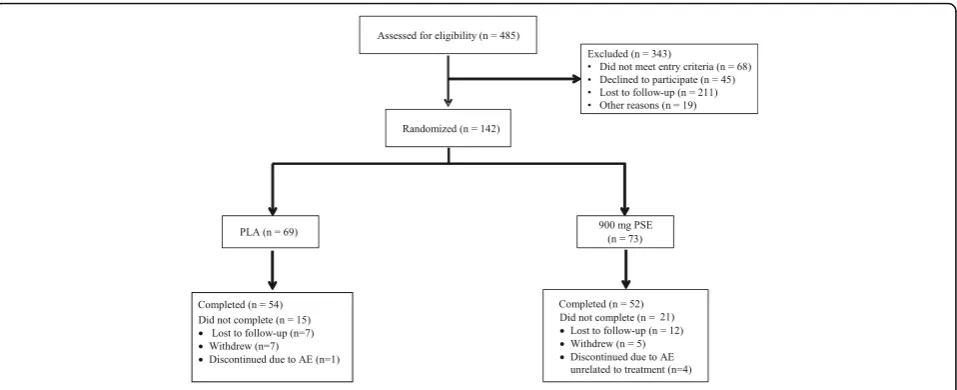
years. A total of 485 individuals were initially contacted via phone to screen for eligibility (Fig. 1). Individuals who met inclusion/exclusion criteria were asked to re-port to the laboratory (MusclePharm Sre-ports Science In-stitute, Denver, CO) for a familiarization visit so that the reactive agility tests could be practiced to minimize any learning effects (Fig. 2). One hundred forty-two partici-pants were randomized into PSE or placebo (PLA) groups in a staggered start design (1 week after screen-ing visit). To generate a randomization schedule usscreen-ing block randomization, participants were stratified by sex and age into four groups: young (18–35 years)/male, older (36–50 years)/male, young/female, and older/female. A random sequence of blinded treatments (A and B) was generated by the principal investigator using 37 blocks of 4 on a research randomizer website (www.randomizer.org). These blocks were applied to each stratum mentioned above as each previous block of 4 was filled by participants. All blood was collected at a LabCorp facility and all other measures were performed at the MusclePharm Sports Science Institute.
At baseline (Day 0) participants were instructed to take two capsules of either PLA or PSE (providing 900 mg PSE/day containing a minimum of 14.5% rosmarinic acid and 24% total polyphenols (expressed as gallic acid equivalents); Neumentix™ Phenolic Complex K110–42, Kemin Foods, L.C., Des Moines, IA) each morning with breakfast for 90 days, except on test days, when they took the capsules directly after testing. Both types of capsules were produced by the same manufacturer to be identical in shape, size, and color, and were sealed in identical bottles. All investigators involved in product dispensing, data collection, and analysis of outcomes were blinded in the following manner: PSE and PLA
bottles were labeled“A”or“B”by unblinded individuals at Kemin Foods LC. who were not involved in subject inter-action or data assessment. All bottles were labeled accord-ing to ICH-GCP guidelines. At each post-supplementation study visit (Days 7, 30, and 90) capsules were counted for compliance. Daily compliance was also logged by the par-ticipants in a study diary as a secondary measure. After fasting for 10 h, participants arrived at the laboratory at baseline, and after 7, 30, and 90 days of consuming the supplement daily. Testing consisted of an interactive audio-visual reaction time test battery, a blood draw, and vital signs assessment. After testing, a meal replacement bar was provided to participants (Combat Crunch™; MusclePharm Inc., Denver, CO). An Institutional Review Board (Quorum Review IRB, Seattle, WA) approved the study protocol and informed consent documents prior to initiation of the study. Furthermore, all study procedures were consistent with Good Clinical Practices under the United States Title 21 of the Code of Federal Regulations and the Declaration of Helsinki.
Participants
Healthy, recreationally-active men and women between the ages of 18–50 years were recruited for the present study. Healthy was defined as having a body mass index be-tween 18.5–29.99 kg/m2or between 30.0–34.99 kg/m2with a body fat of < 39% for women aged 18–39 years, < 40% for women aged 40–50 years, < 25% for men aged 18–39 years, or < 28% for men aged 40–50 years [42]. Body fat was determined using bioelectric impedance analysis (InBody Co., Seoul, South Korea). Health status was assessed using a health history questionnaire. A recreationally-active indi-vidual was defined as≥1 and≤6 h of moderate and/or vig-orous exercise per week as measured by the New Zealand
Physical Activity Questionnaire [43]. Eligibility also in-cluded willingness to abstain from caffeine-containing products for 10 h prior to and during all test visits, from al-cohol consumption and physical activity for the previous 24 h, and from strenuous resistance exercise (defined as heavier than a 6-repetition maximum [the most weight which a participant could successfully lift 6 times]) for 48 h. Participants were required to keep their sleep consistent (within 2 h) each night prior to all study visits. Finally, par-ticipants were required to maintain their normal diet (in-cluding repetition of dietary intake for the 24 h prior to each study visit), exercise, and sleep regimens throughout the study. All females were amenorrhoeic during test visits. A high school diploma or the equivalent was also necessary for inclusion.
Participants were excluded from the study if they had a history or presence of a clinically important cardiac, renal, hepatic, endocrine (including diabetes mellitus), pulmonary, biliary, gastrointestinal, pancreatic, uncon-trolled hypertension, depression or neurologic disorder. Presence of cancer in the past 2 years was a criterion for exclusion. Additional criteria for exclusion included: col-orblindness, pregnancy, history of alcohol abuse (12 months), history of repeated minor head injury or a period of unconsciousness of 1 h or more, high con-sumption of caffeine (≥500 mg/d), marijuana use (in prior 2 months), tobacco use (in prior 6 months), an ac-tive infection, use of psychotropic medications (in prior 4 weeks), use of supplements known to improve cogni-tive function, an allergy to ingredients of the test prod-uct or the snack provided, or a sleep disorder or occupation where sleep during the overnight hours was irregular.
Reaction performance assessments
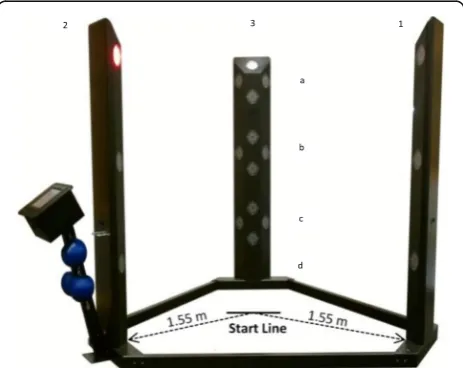
The interactive audio-visual reaction time test battery was performed on the Makoto Arena II device (Makoto USA Inc., Elk Grove Village, IL), a device which has been employed in studies previously [40, 44–47]. The Makoto device is a 3600 audio-visual device consisting
of 3 towers 1.83 m tall in the shape of a triangle with 2.44 m between towers. Each tower consists of 16 tar-gets: 12 on each tower (levels a, b, and c; see Fig.3) and 4 on each footplate on the floor (level d; see Fig. 3) intended to be struck with hands and feet, respectively. A line of black tape was placed on the ground whose center is 1.55 m from each of the first two towers. Par-ticipants started behind the line and faced forward for all tests. Ten tests were utilized to address a variety of perception and movement modalities. The first three tests involved a single-step protocol, where a single tar-get on one of two towers (tower 1 or 2, level b, top of the diamond of four panels; see Fig. 3) would light up once and the participant would move toward the target and strike it. The three single-step tests utilized either an audio stimulus, a visual stimulus, or a combined audio and visual stimulus. To eliminate guessing order by the participant, the single-step tests were each per-formed five times in a random order with two tests to the left (tower 3), two tests to the right (tower 1), and one random direction (left or right) with its score dis-carded. Duplicate scores for each side (left or right) were Fig. 2Experimental study design. Abbreviations: PSE, proprietary spearmint extract; PLA, placebo
averaged for reporting purposes, such that each of the three single-step tests resulted in a score for left and a score for right. The remaining seven tests were all timed tests with the panels exhibiting both audio and visual stimuli in unison until the allotted time was completed. The fourth and fifth tests were 30 s stationary tests with-out or with footplates (level d), in which the participant was in front of one tower (tower 1) and the 12 tower tar-gets (or 16 tartar-gets with footplates) were struck as quickly as possible. The sixth and seventh tests were lat-eral movement tests utilizing two towers (towers 1 and 2), which involved the participant moving back and forth between the two towers as the 12 hand targets from each of the towers (or 16 targets with footplates) acti-vated one at a time for 30 s. The eighth and ninth tests were 30-s multi-directional movement tests using all three towers, and involved the participant moving among the three towers as the 12 hand targets from each of the towers (or 16 targets with footplates). The tenth test was identical to the ninth, except that it lasted 2 min. All the 30-s tests (tests 4–9) were performed in duplicate and scores were averaged. Reaction performance was captured as the number of hits and average reaction time (ART) for all tests, except the single step testing for which only one hit occurred each test and therefore only reaction time was captured. Targets were activated for a maximum of 10 s, so activated targets could not be missed since participants had ample time to strike them. Since the single step tests were short in duration and not fa-tiguing, the rest periods were as short as possible: 5 s. Be-tween every iteration of each 30-s test, participants rested for 30 s. Prior to the 2-min test, participants were given 60 s of rest.
Inflammatory biomarkers and safety assessments
After a 10 h overnight fast, blood samples were collected via venipuncture by a trained phlebotomist. After collec-tion, samples were analyzed (Laboratory Corporation of America, Burlington, NC) for the following parameters: complete blood count (CBC) [white blood cell count (WBC), red blood cell count (RBC), hemoglobin, hematocrit, mean corpuscular volume (MCV), mean corpuscular hemoglobin (MCH), mean corpuscular hemoglobin concentration (MCHC), red blood cell dis-tribution width (RDW), platelets (absolute), neutrophils (percent and absolute), lymphocytes (percent and abso-lute), monocytes (percent and absoabso-lute), eosinophils (percent and absolute), basophils (percent and abso-lute)], comprehensive metabolic panel (CMP) [serum glucose, blood urea nitrogen (BUN), creatinine, esti-mated glomerular filtration rate (eGFR), BUN:creatinine, sodium, potassium, chloride, carbon dioxide, calcium, protein, albumin, globulin, albumin:globulin (A/G), bili-rubin, alkaline phosphatase, aspartate aminotransferase
(AST), alanine aminotransferase (ALT)], lipids [total cholesterol, triglycerides, high density lipoprotein (HDL) cholesterol, very low density lipoprotein (VLDL), low density lipoprotein (LDL) cholesterol, LDL:HDL ratio], and biomarkers of stress and inflammation [cortisol, C-reactive protein, and interleukin 6 (IL6)]. Upon arrival to the laboratory and after resting seated for at least 5 min, vital signs (systolic and diastolic blood pressure, heart rate) were measured in duplicate via an automated digital sphygmomanometer (Omron M6 AC, Omron Inc., Kyoto, Japan) and averaged. Duplicate tests were conducted with a minimum of 2 min between tests. Blood pressure mea-surements were considered accurate if no more than 5 mmHg variation occurred between measurements. In addition to the above, participants were queried on ad-verse events (AE) throughout the trial.
Exercise, sleep, and food logs
To control for changes in exercise, sleep, and diet, par-ticipants were asked to keep exercise, sleep, and diet constant throughout the study period. To monitor ad-herence, exercise, sleep, and food logs were submitted throughout the study. Participants were required to write down the hours and type of exercise performed daily such as strength, cardio, or a combined strength/ cardio exercise (CrossFit, yoga, etc.). The exercise logs were checked each visit to ensure that participants did not exercise 24 h prior or exercise strenuously 48 h prior to study visits. The logs were also evaluated to confirm participants did not exercise more than 6 h/week or less than 1 h/week, the limits set by the inclusion criteria to which participants agreed to keep constant throughout the trial. Hours of sleep per night were also recorded. Average weekly hours of exercise and sleep were evalu-ated at each study visit. A pre-visit food log was cap-tured during the 24 h prior to baseline (Day 0), photocopied and returned to the participants so that they could repeat this diet the day prior to each visit. A 3-day food log was recorded for three non-consecutive days (two weekdays and one weekend day) between each visit, so any changes in diet could be calculated.
Statistical analyses
An evaluable sample size of 53 subjects per group was expected to provide 80% power (two-sided, α= 0.05) to detect an 8% difference in the number of hits in an as-sessment of reactive agility utilizing the Makoto device [44,45]. A sample of at least 69 subjects per group was randomized to account for attrition and non-compliance (Fig.1).
population which included all participants who were randomized into the study and consumed at least one dose of study product. A mixed model of repeated mea-sures (MMRM) analysis was fit to the data for each continuous and assumed continuous study variable. All MMRM models contained the main effect of treatment (active vs. control), the main effect of time, and the interaction between treatment and time.P values using a model fit to raw data values containing treatment (ac-tive vs. control), time (Days 0, 7, 30, and 90), and the treatment x time interaction were evaluated. To ac-count for observed differences at baseline for the in-flammatory marker, CRP, a mixed-effects analysis of covariance (ANCOVA) model was utilized a priori. The ANCOVA model contained treatment (active vs. con-trol), time (Days 7, 30, and 90), and the treatment x time interaction where participants’ baseline data for a given outcome (Day 0) was included as the covariate. A Fisher’s exact test was applied to demographics and at-trition. Total AE and AE related to the study product were evaluated by Chi square analysis. Effect sizes are presented as Cohen’s d and interpreted as 0.2 = small, 0.5 = medium, 0.8 = large. Significance levels for each test, main effect and interaction were evaluated at alpha = 0.05. Data are represented as means ± standard deviation (SD).
Results Demographics
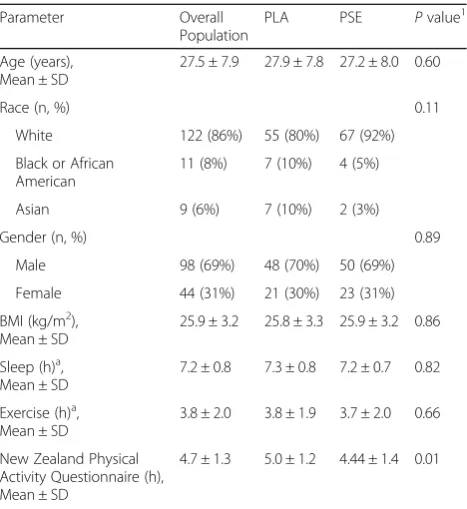
One hundred and forty-two individuals were random-ized, 69 into the PLA and 73 into the PSE groups. Fifty-four and fifty-two participants completed the trial in the PLA and PSE treatment groups, respectively. Demographics are shown in Table 1. Treatment groups were well-balanced in demographics for the baseline characteristics. Although exercise as self-reported on the New Zealand Physical Activity score was different at the screening visit (p= 0.01), comparison of the actual hours of exercise collected on study diaries between screening and baseline visits (Day 0) indicated no differences be-tween groups in exercise.
Compliance
Compliance was not significantly different at any time-point. At Day 90, compliance was 95.4 and 96.8% in the PLA and PSE groups, respectively, with no difference be-tween groups (p= 0.328). Attrition among all partici-pants was 25.4%, and it was not significantly different between treatments or genders (p= 0.5048).
Reaction performance assessments
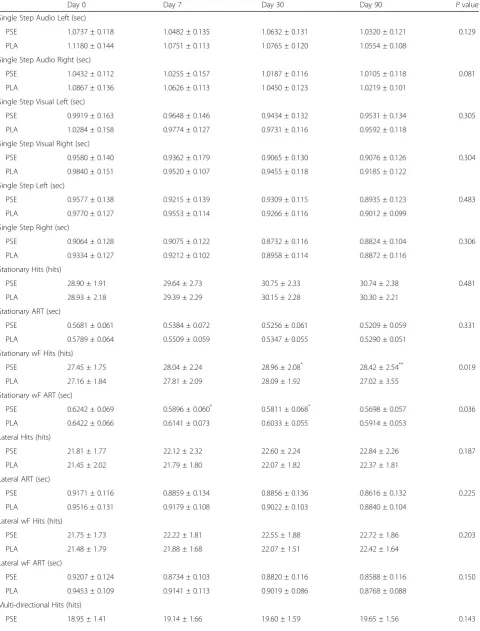
Data and statistical analyses for outcomes obtained utiliz-ing the Makoto device are shown in Table 2. The hits obtained with the stationary test with footplates for 30 s
(Fig. 4) were significantly higher in PSE compared with PLA at Day 30 (PSE vs. PLA: 28.96 ± 2.08 vs. 28.09 ± 1.92 hits; p= 0.040; d = 0.435) and Day 90 (PSE vs. PLA: 28.42 ± 2.54 vs. 27.02 ± 3.55 hits; p= 0.002; d = 0.454). ART for the stationary test with footplates measured for 30 s were significantly lower in PSE compared with PLA at Day 7 (PSE vs. PLA: 0.5896 ± 0.060 vs. 0.6141 ± 0.073 s;p= 0.049; d =−0.367) and Day 30 (PSE vs. PLA: 0.5811 ± 0.068 vs. 0.6033 ± 0.055 s; p = 0.049; d =−0.359). The hits obtained with the multi-directional test with foot-plates (Fig.5) for 30 s were significantly higher in PSE com-pared with PLA at Day 30 (PSE vs. PLA: 19.25 ± 1.84 vs. 18.45 ± 1.48 hits;p= 0.007; d = 0.479) and Day 90 (PSE vs. PLA: 19.39 ± 1.90 vs. 18.66 ± 1.64 hits;p= 0.026; d = 0.411). Significant differences were not observed in the remaining Makoto tests.
Biomarkers of stress and inflammation
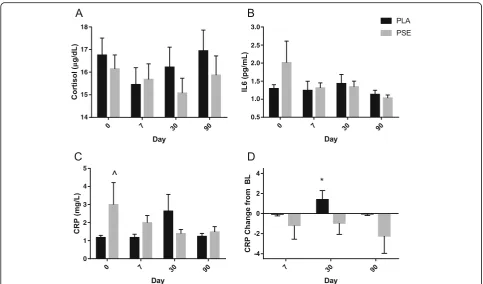
Plasma cortisol, IL6 and CRP were measured at all timepoints and are shown in Fig. 6. Comparisons be-tween PSE and PLA were not significantly different for cortisol and IL6. Differences at baseline (p= 0.03) were present for CRP; therefore, ANCOVA was utilized to identify a significant treatment x visit interaction (p = 0.049) and pairwise comparisons revealed that PSE significantly decreased CRP at Day 30 compared to PLA (p= 0.045).
Table 1Baseline demographics
Parameter Overall
Population
PLA PSE Pvalue1
Age (years), Mean ± SD
27.5 ± 7.9 27.9 ± 7.8 27.2 ± 8.0 0.60
Race (n, %) 0.11
White 122 (86%) 55 (80%) 67 (92%)
Black or African American
11 (8%) 7 (10%) 4 (5%)
Asian 9 (6%) 7 (10%) 2 (3%)
Gender (n, %) 0.89
Male 98 (69%) 48 (70%) 50 (69%)
Female 44 (31%) 21 (30%) 23 (31%)
BMI (kg/m2),
Mean ± SD
25.9 ± 3.2 25.8 ± 3.3 25.9 ± 3.2 0.86
Sleep (h)a, Mean ± SD
7.2 ± 0.8 7.3 ± 0.8 7.2 ± 0.7 0.82
Exercise (h)a,
Mean ± SD
3.8 ± 2.0 3.8 ± 1.9 3.7 ± 2.0 0.66
New Zealand Physical Activity Questionnaire (h), Mean ± SD
4.7 ± 1.3 5.0 ± 1.2 4.44 ± 1.4 0.01
Abbreviations:BMIbody mass index,PSEproprietary spearmint extract,PLA placebo,SDstandard deviation
1P
value for PLA versus PSE calculated via Fisher’s exact test a
Table 2Data for Makoto performance outcomes
Day 0 Day 7 Day 30 Day 90 Pvalue
Single Step Audio Left (sec)
PSE 1.0737 ± 0.118 1.0482 ± 0.135 1.0632 ± 0.131 1.0320 ± 0.121 0.129
PLA 1.1180 ± 0.144 1.0751 ± 0.113 1.0765 ± 0.120 1.0554 ± 0.108
Single Step Audio Right (sec)
PSE 1.0432 ± 0.112 1.0255 ± 0.157 1.0187 ± 0.116 1.0105 ± 0.118 0.081
PLA 1.0867 ± 0.136 1.0626 ± 0.113 1.0450 ± 0.123 1.0219 ± 0.101
Single Step Visual Left (sec)
PSE 0.9919 ± 0.163 0.9648 ± 0.146 0.9434 ± 0.132 0.9531 ± 0.134 0.305
PLA 1.0284 ± 0.158 0.9774 ± 0.127 0.9731 ± 0.116 0.9592 ± 0.118
Single Step Visual Right (sec)
PSE 0.9580 ± 0.140 0.9362 ± 0.179 0.9065 ± 0.130 0.9076 ± 0.126 0.304
PLA 0.9840 ± 0.151 0.9520 ± 0.107 0.9455 ± 0.118 0.9185 ± 0.122
Single Step Left (sec)
PSE 0.9577 ± 0.138 0.9215 ± 0.139 0.9309 ± 0.115 0.8935 ± 0.123 0.483
PLA 0.9770 ± 0.127 0.9553 ± 0.114 0.9266 ± 0.116 0.9012 ± 0.099
Single Step Right (sec)
PSE 0.9064 ± 0.128 0.9075 ± 0.122 0.8732 ± 0.116 0.8824 ± 0.104 0.306
PLA 0.9334 ± 0.127 0.9212 ± 0.102 0.8958 ± 0.114 0.8872 ± 0.116
Stationary Hits (hits)
PSE 28.90 ± 1.91 29.64 ± 2.73 30.75 ± 2.33 30.74 ± 2.38 0.481
PLA 28.93 ± 2.18 29.39 ± 2.29 30.15 ± 2.28 30.30 ± 2.21
Stationary ART (sec)
PSE 0.5681 ± 0.061 0.5384 ± 0.072 0.5256 ± 0.061 0.5209 ± 0.059 0.331
PLA 0.5789 ± 0.064 0.5509 ± 0.059 0.5347 ± 0.055 0.5290 ± 0.051
Stationary wF Hits (hits)
PSE 27.45 ± 1.75 28.04 ± 2.24 28.96 ± 2.08* 28.42 ± 2.54** 0.019
PLA 27.16 ± 1.84 27.81 ± 2.09 28.09 ± 1.92 27.02 ± 3.55
Stationary wF ART (sec)
PSE 0.6242 ± 0.069 0.5896 ± 0.060* 0.5811 ± 0.068* 0.5698 ± 0.057 0.036
PLA 0.6422 ± 0.066 0.6141 ± 0.073 0.6033 ± 0.055 0.5914 ± 0.053
Lateral Hits (hits)
PSE 21.81 ± 1.77 22.12 ± 2.32 22.60 ± 2.24 22.84 ± 2.26 0.187
PLA 21.45 ± 2.02 21.79 ± 1.80 22.07 ± 1.82 22.37 ± 1.81
Lateral ART (sec)
PSE 0.9171 ± 0.116 0.8859 ± 0.134 0.8856 ± 0.136 0.8616 ± 0.132 0.225
PLA 0.9516 ± 0.131 0.9179 ± 0.108 0.9022 ± 0.103 0.8840 ± 0.104
Lateral wF Hits (hits)
PSE 21.75 ± 1.73 22.22 ± 1.81 22.55 ± 1.88 22.72 ± 1.86 0.203
PLA 21.48 ± 1.79 21.88 ± 1.68 22.07 ± 1.51 22.42 ± 1.64
Lateral wF ART (sec)
PSE 0.9207 ± 0.124 0.8734 ± 0.103 0.8820 ± 0.116 0.8588 ± 0.116 0.150
PLA 0.9453 ± 0.109 0.9141 ± 0.113 0.9019 ± 0.086 0.8768 ± 0.088
Multi-directional Hits (hits)
Safety assessment
Adverse events were collected for all participants throughout the study. There was no difference in the total number of AE between groups (p= 0.5935). In addition, the total number of AE related to study prod-uct did not differ between groups (p= 0.3020). Complete blood count, complete metabolic profile, lipids, body metrics, and vital signs were assessed to evaluate overall health status over the study period. No overall treatment effects were observed for any of the outcomes (Add-itional file 1: Tables S1-S4). Four outcomes: absolute monocytes, absolute granulocytes, granulocyte percent-ages, and systolic blood pressure did evince significant
treatment x visit interactions; however, any differences evident at day 30 were not significant at day 90 and all values remained within normal limits and were not deemed clinically relevant.
Diet, exercise, and sleep measurements
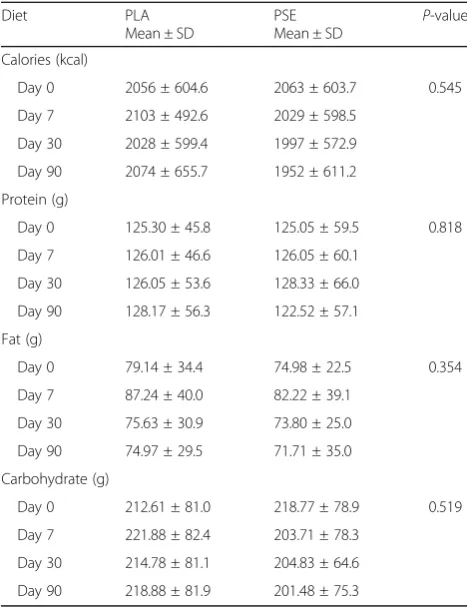
Evaluation of diet records collected at each study period indicated no difference between groups in total calorie, protein, fat, or carbohydrate intake (Table 3). Partici-pants appeared to have maintained consistent diet over the 90-day study period and self-reported sleep and ex-ercise also appeared to have been kept constant and did not differ between groups (Table4).
Table 2Data for Makoto performance outcomes(Continued)
Day 0 Day 7 Day 30 Day 90 Pvalue
PLA 18.76 ± 1.49 18.87 ± 1.38 19.04 ± 1.35 19.26 ± 1.34
Multi-directional ART (sec)
PSE 1.1276 ± 0.131 1.0979 ± 0.130 1.0908 ± 0.129* 1.0730 ± 0.131 0.079
PLA 1.1641 ± 0.117 1.1351 ± 0.113 1.1288 ± 0.106 1.0983 ± 0.098
Multi-directional wF Hits (hits)
PSE 18.54 ± 1.66 18.86 ± 1.86 19.25 ± 1.84** 19.39 ± 1.90* 0.020
PLA 18.12 ± 1.41 18.34 ± 1.41 18.45 ± 1.48 18.66 ± 1.64
Multi-directional wF ART (sec)
PSE 1.1684 ± 0.157 1.1303 ± 0.162* 1.1228 ± 0.160* 1.1025 ± 0.155 0.051
PLA 1.2058 ± 0.139 1.1825 ± 0.132 1.1788 ± 0.124 1.1550 ± 0.140
Multi-directional wF Hits 2 min (hits)
PSE 71.5 ± 6.7 72.4 ± 7.1 74.8 ± 7.5 75.2 ± 7.4 0.178
PLA 70.1 ± 5.3 71.6 ± 5.7 72.1 ± 5.7 73.0 ± 6.1
Multi-directional wF ART 2 min (sec)
PSE 1.188 ± 0.171 1.152 ± 0.169 1.133 ± 0.158 1.110 ± 0.154 0.242
PLA 1.222 ± 0.136 1.181 ± 0.135 1.176 ± 0.124 1.160 ± 0.142
Abbreviations:PSEproprietary spearmint extract,PLAplacebo,wFwith footplates,ARTaverage reaction time,SDstandard deviation Data are presented as mean ± SD. TreatmentPvalues are shown.*
representsp< 0.05 difference from PLA;**
representsp< 0.01 difference from PLA
0 7 30 90
1 5 2 0 2 5 3 0 3 5
D a y
H
its
in
3
0
s
e
c
o
n
ds
P L A
P S E
* * *
Fig. 4Number of hits obtained with the stationary Makoto with footplates assessment for 30 s. Abbreviations: PSE, proprietary spearmint extract; PLA, placebo. Data are presented as mean ± SD. * representsp< 0.05 difference from PLA; ** representsp< 0.01 difference from PLA
0 7 30 90
1 0 1 5 2 0 2 5
D a y
H
its
in
3
0
s
e
c
o
n
ds
P L A
P S E
* * *
Discussion
The results of the present study suggest that consumption of PSE can improve reactive agility. We formally accept our hypothesis that daily supplementation of 900 mg of PSE can significantly improve selected markers of reactive agil-ity, specifically stationary and multi-directional when both hand and foot strikes are involved. The multi-directional test with footplates evinced improvements in hits after long-term supplementation (Day 30 and Day 90), and the reaction time trended toward improvement. The number of hits on the stationary test with footplates was signifi-cantly higher after long-term supplementation (Day 30 and Day 90), and the reaction time improved at Day 7 and Day 30, with a trend observed at Day 90.
To our knowledge, there are no existing studies on re-active agility after supplementation with botanical ingre-dients. The Makoto testing utilized in the present study may address the cognitive aspects of reactive agility, such as choice reaction time, more than the physical aspects, when compared to more common reactive agility testing [41,48]. A typical reactive agility test con-sists of unidirectional running with one unplanned change-of-direction [41], which relies more on physical aspects of agility than the Makoto testing, which utilizes multiple stimuli to invoke constant changes of direction, speed, and decision making and may favor the cognitive
aspects, such as response time. Therefore, it may be use-ful to compare the present findings to cognitive studies that utilized choice reaction time testing. Results from the present study are supported by existing literature on choice reaction time in botanical extracts from the mint family containing rosmarinic acid. Acute administration of 333 mg of an ethanolic extract of sage was found to improve choice reaction time at 4 and 6 h [14]. In addition, acute administration of doses of 300–900 mg of a methanolic lemon balm improved choice reaction time at 2.5, 4 and 6 h post-supplementation [49]. A sec-ond sage study demonstrated no significant changes in choice reaction time; however, the extract was an essen-tial oil high in monoterpenoids and low in rosmarinic acid, which could account for the difference in findings [50]. While the previous studies used acute supplemen-tation of either solvent extracted extracts of the mint family or an essential oil, the present study involved chronic administration of a natural water-extracted PSE. In addition, the choice reaction time testing utilized in the previous studies was very simple (involved pressing “YES” or “NO” buttons when these words were pre-sented on the screen) and passive, while the present study measured active choice reaction performance with tests that varied in complexity, such as the addition of footplates.
18
17
16
15
14
3.0
2.5
2.0
1.5
1.0
0.5
5
4
3
2
1
0
Though few studies have compared active and passive choice reaction performance testing, data from our labora-tory suggest that results may vary between the two types of tests. In one study, healthy, active participants were dehydrated and choice reaction performance was com-pared pre and post-dehydration utilizing both active test-ing via Makoto and passive choice reaction performance
via Stroop test and shifting attention test [40]. Surpris-ingly, dehydration improved choice reaction time as assessed in the shifting attention test and decreased errors during the Stroop test; however, active choice reaction per-formance significantly decreased via 30 s multi-directional test without footplates as measured with Makoto. The findings demonstrate that active and passive choice reac-tion testing may yield significantly different results, sug-gesting that active testing may be more relevant in athletic populations where improved exercise performance may be the goal. Therefore, the use of a novel testing device, such as the Makoto Arena II, which can measure choice reac-tion time while the participant is active, is important to elucidate the connection between cognitive and physical activity.
In the current study, the tests in which significant differ-ences were evident, the stationary and multi-directional tests, also involved footplates. The inclusion of footplates presented an additional shifting attention component, as the participant was required to switch between responding with hands or feet. While classic cognitive attention tests do not require the participants to make similar attention shifts, one study on sage and two studies on PSE evaluated attention and generally support the findings of the present study. An acute dose of 333 mg of sage was shown to in-duce improvements in both accuracy and speed of atten-tion [14]. An open-label study on older individuals with self-reported memory impairment supplemented with 900 mg of PSE improved attention at 2 and 4 h after acute supplementation and after 30 days of chronic supplemen-tation [34]. Additionally, a small-scale study in younger participants numerically improved attention after acute administration with 900 mg of PSE [36]. Furthermore, the addition of footplates may not target attention (sensory in-put) as much as it highlights a complex psychomotor task (output). Unfortunately, no previous studies could be found that investigated shifting hand and foot responses. Of the studies that have previously utilized the Makoto de-vice, two did not involve footplates [44,45]. Studies from our laboratory have utilized the Makoto Arena II with foot-plates; however, neither study directly compared tests with and without footplates [40, 46]. One study utilized tests with and without footplates [40], but the tests varied to such a degree that direct comparisons could not be made. Another study demonstrated sex differences in reaction time after dehydration, but only the multi-directional, 2-min test with footplates was utilized [46]. Since the tests on the Makoto are physical performance tasks, there are important differences in the demands on the lower body when footplates are added from a motor and psychomotor perspective. To our knowledge, the present study is the first to demonstrate improve-ments when the subjects were required to shift atten-tion between hand and foot strikes.
Table 3Self-reported diet evaluation
Diet PLA
Mean ± SD
PSE
Mean ± SD P
-value
Calories (kcal)
Day 0 2056 ± 604.6 2063 ± 603.7 0.545
Day 7 2103 ± 492.6 2029 ± 598.5
Day 30 2028 ± 599.4 1997 ± 572.9
Day 90 2074 ± 655.7 1952 ± 611.2
Protein (g)
Day 0 125.30 ± 45.8 125.05 ± 59.5 0.818
Day 7 126.01 ± 46.6 126.05 ± 60.1
Day 30 126.05 ± 53.6 128.33 ± 66.0
Day 90 128.17 ± 56.3 122.52 ± 57.1
Fat (g)
Day 0 79.14 ± 34.4 74.98 ± 22.5 0.354
Day 7 87.24 ± 40.0 82.22 ± 39.1
Day 30 75.63 ± 30.9 73.80 ± 25.0
Day 90 74.97 ± 29.5 71.71 ± 35.0
Carbohydrate (g)
Day 0 212.61 ± 81.0 218.77 ± 78.9 0.519
Day 7 221.88 ± 82.4 203.71 ± 78.3
Day 30 214.78 ± 81.1 204.83 ± 64.6
Day 90 218.88 ± 81.9 201.48 ± 75.3
Abbreviations:SDstandard deviation,PSEspearmint,PLAplacebo TreatmentPvalues are shown
Table 4Self-reported sleep and exercise
Sleep and exercise PLA Mean ± SD
PSE Mean ± SD
P-value
Self-Reported Sleep (h)
Day 0 7.26 ± 0.81 7.23 ± 0.74 0.223
Day 7 7.40 ± 0.79 7.01 ± 0.81
Day 30 7.33 ± 0.91 7.08 ± 0.89
Day 90 7.30 ± 0.73 7.16 ± 0.72
Self-Reported Exercise (min)
Day 0 230.77 ± 115.8 222.81 ± 122.6 0.761
Day 7 236.88 ± 134.3 236.57 ± 133.4
Day 30 226.47 ± 113.6 234.52 ± 132.1
Day 90 234.61 ± 105.7 221.68 ± 152.4
Abbreviations:SDstandard deviation,PSEproprietary spearmint extract, PLAplacebo
The ability to rapidly shift attention between hand and foot strikes could have practical relevance to sport-specific athletic performance. One relevant application would be in combat sports that allow hand and foot strikes, such as mixed martial arts or kickboxing. Some of the other sports where shifting attention between hands and feet might affect performance include any sport that requires feet to be rapidly adjusted to a set stance and then hands are pri-marily utilized. Some examples include: baseball (running for a ball, then catching and throwing), basketball (run-ning to a shooting spot without the ball, then catching, passing, and shooting), volleyball or tennis (running to a spot, then setting feet and hitting the ball). Though ath-letic performance and exercise performance were not tested directly, active choice reaction performance testing will better translate to athletic performance than standard, passive testing (i.e. cognitive tests that do not involve complex physical responses), and future studies should in-vestigate whether the hypothesis that the beneficial effects that were observed in the present study will translate to factual improvements in athletic performance in response to PSE supplementation.
Several of the results on certain reactive agility tests did not achieve significance, most likely due to variations in the specific domains targeted by the individual tests. The three types of tests where results were not signifi-cant were the lateral test, the single-step tests, and the multi-directional test for 2 min. The lateral test is a sports-specific movement which is highly practiced among specific elite athletes. An example would be when facing an opponent, such as football, soccer, or wrestling. The general population does not practice lat-eral movements and most likely would not be very profi-cient, potentially leading to wider variability and less sensitivity in the measurements. In contrast, the station-ary test (in which we identified differences following PSE supplementation in the current study) does not require movement among towers; therefore, it does not require proficiency in any sport-related movement and could be better suited for a recreationally active population as used in the current study. The multi-directional test (another test where differences were identified in the current study), while involving lower body movement, does not require movement that is as specific as the lateral test. The spinning and pivoting movements that are needed to respond to the 3 towers in the multi-directional test are movements that are required in everyday life to respond to stimuli in 3600of space, whereas the lateral movement in the lateral test occurs less frequently in quotidian life. Therefore, the multi-directional test may be better suited than the lateral test for the recreationally active population used in the current study. The single-step tests, while not requiring any sports-specific proficiency, do involve a skill that may also be better suited to a population of elite
athletes. The single step tests measure the initial burst of acceleration or “first step” after a stimulus is presented; however, acceleration may not be as crucial for recre-ational athletes and, therefore, not be sensitive enough to detect changes following PSE consumption in this popula-tion. The multi-directional test when administered for 2 min is designed to incorporate the influence of fatigue. The results for the multi-directional test with footplates for 30 s were significantly improved following PSE supplemen-tation, thus demonstrating choice reaction time perform-ance in a 3600 audio and visual field with a shifting attention component was improved. However, when con-ducting the identical test elongated for a total of 2 min, fa-tigue becomes a dominant factor as reaction times become slower. Therefore, the lack of significance in this longer test suggests that the current study may not have been pow-ered to evaluate the confounding factor of fatigue on per-formance. Finally, since the results of the tests without footplates were not significant, this suggests that PSE con-sumption significantly enhances performance only in more multi-dimensional, more complex tests of reactive agility.
Blood biomarkers of inflammation and stress were evaluated with all outcomes showing improvement over baseline; however, only CRP scores were significant. The decrease in the inflammatory biomarker CRP is congru-ent with traditional usage of mint as an herbal medicine [17] and the literature in which spearmint decreased in-flammatory signaling. Though studies in humans are scarce, multiple in vitro and in vivo studies have demon-strated the anti-inflammatory benefits of spearmint con-sumption [51–53]. A variety of spearmint bred for high rosmarinic acid was incubated in gastric and intestinal fluids to simulate digestion and absorption, then subse-quently exposed to cartilage cultured with lipopolysac-charide (LPS) [51]. The spearmint significantly inhibited LPS-induced prostaglandin E2 and nitric oxide expres-sion. In rats, four solvent fractions of Mentha spicata were evaluated after acute and 7-day chronic oral ad-ministration [53]. The ethyl acetate extract (160 mg/kg body weight in 25% DMSO) reduced inflammation after both acute and chronic administration at levels compar-able to anti-inflammatory drugs, which served as a posi-tive control. Pearson et al. demonstrated that horses fed 28.1 g/d of high-rosmarinic acid mint for 24 days and then injected with LPS on day 21 exhibited reduced markers of inflammation and immune response in their synovial fluid, including prostaglandin E2, glycosamino-glycans, white blood cells, segmented neutrophils, and lymphocytes [52].
neurotoxic [55]. In neurodegenerative disorders, brain cells produce CRP and other complement proteins leading to chronic inflammation and potentially neuronal cell death [56,57]. Direct reduction of CRP may be neuroprotective; therefore, the present data suggest that chronic adminis-tration of PSE and the resulting improvements on CRP may indirectly contribute to improvements in choice reac-tion performance via reducreac-tion of the low-level inflamma-tion in young, healthy individuals.
The results from the safety blood panel demonstrated that supplementation with PSE for 90 days does not negatively affect complete blood count, complete meta-bolic profile, blood lipids, or vital signs. PSE has been shown to be well tolerated in previous studies and the current trial expands upon the body of evidence sup-porting safety [34–36].
There are limitations regarding interpretation of the re-sults in the current study. First, data collection occurred over a period of several months, which meant that the same laboratory personnel were not able to conduct all the Makoto testing. Therefore, variability in results may have increased due to multiple testing administrators and some variation in their testing approach. However, to minimize variability, all testing administrators were trained by the same person and using the same exact protocols. Second, within subject motivation can be challenging to maintain, especially when testing visits occur months apart, and can affect test scores. To keep participants motivated, re-searchers utilized verbal cues to keep participants engaged and encouraged. Future studies could involve some sub-jective measurement of motivation to ensure consistency across visits. Third, even though a familiarization visit was utilized as recommended by previous reliability studies [47], learning effects could have occurred throughout the study. Learning effects should have been consistent amongst groups; therefore, comparison to a placebo group should have negated the impact of the learning effects.
Conclusion
The present study is the first to observe an improvement in reactive agility following consumption of 900 mg of PSE for 90 days, as measured by the Makoto device using both the stationary test and the multi-directional test with footplates at selected timepoints. By demonstrating improvements on specific measurements of choice reaction performance in a young, healthy population, the findings of the present study expand on previous studies on PSE which showed improve-ment in cognitive function. The present study supports the use of PSE as a safe nootropic with potential downstream benefits in athletic performance, particularly in combat sports. Future research should be conducted to verify the hypothesis that the measured improvements in reactive agility will indeed translate to statistically significant and practically relevant improvements in athletic performance.
Additional file
Additional file 1:Supplemental Safety Tables. (DOCX 82.6 kb)
Abbreviations
A/G:Albumin:Globulin; AE: Adverse event; ALT: Alanine aminotransferase; ANCOVA: Analysis of covariance; ART: Average reaction time; AST: Aspartate aminotransferase; BUN: Blood urea nitrogen; CBC: Complete blood count; CMP: Comprehensive metabolic panel; eGFR: Estimated glomerular filtration rate; HDL: High density lipoprotein; IL6: Interleukin 6; LDL: Low density lipoprotein; LPS: Lipopolysaccharide; MCH: Mean corpuscular hemoglobin; MCHC: Mean corpuscular hemoglobin concentration; MCV: Mean corpuscular volume; MMRM: Mixed model of repeated measures; PLA: Placebo; PSE: Proprietary spearmint extract; RBC: Red blood cell count; RDW: Red blood cell distribution; SD: Standard deviation; VLDL: Very low density lipoprotein; WBC: White blood cell count; wF: with footplates
Acknowledgements
The authors are grateful to Jesse Gwinn, Sarah Dawes, Henry Oliver, Megan Tribioli, Jake Holweger, and Phylicia Williams for their assistance with data collection and data entry. The results of the present study do not constitute an endorsement of any product or companies by the investigators.
Funding
This trial was funded by Kemin Foods, L.C.
Availability of data and materials
The datasets used and/or analyzed during the current study are available from the corresponding author on reasonable request.
Authors’contributions
The present study was designed by PHF, ACT, JRM, BJL, JAL, BAF, KMN, and KAH; data were collected by PHF, ACT, RMV, JMJ, CAS, and MMH; data interpretation and manuscript preparation were undertaken by PHF, JRM, BJL, JAL, BAF, KMN, and KAH. All authors approved the final version of the manuscript.
Ethics approval and consent to participate
Quorum Review IRB, Seattle, WA approved the study protocol and informed consent documents prior to initiation of the study. Participants provided written consent after the study procedures were explained to them.
Consent for publication
N/A
Competing interests
Brandon Lewis, Joanne Lasrado, Brenda Fonseca, and Kelli Herrlinger are employees of Kemin Foods, L.C., manufacturers of PSE.
Publisher’s Note
Springer Nature remains neutral with regard to jurisdictional claims in published maps and institutional affiliations.
Author details
1
MusclePharm Sports Science Institute, Denver, CO, USA.2Mercy Hospital, Springfield, MO, USA.3Gu Energy Labs, Berkeley, CA, USA.4Department of
Nutrition and Food Sciences, Texas Woman’s University, Dallas, TX, USA.
5Impedimed, Inc., Carlsbad, CA, USA.6Metropolitan State University, Denver,
CO, USA.7Kemin Foods L.C, Des Moines, IA, USA.8Katalyses, Ankeny, IA, USA. Received: 1 February 2018 Accepted: 21 November 2018
References
1. David P, Gelfeld V. Brain health research study. Washington, DC: AARP; 2015.
www.aarp.org/research/topics/health/info-2015/staying-sharper-study.html
Retrieved January 2014, 15
ingestion of a pre-workout dietary supplement with and without p-synephrine on resting energy expenditure, cognitive function and exercise performance. J Int Soc Sports Nutr. 2017;14:3.
3. Jung YP, Earnest CP, Koozehchian M, Cho M, Barringer N, Walker D, Rasmussen C, Greenwood M, Murano PS, Kreider RB. Effects of ingesting a pre-workout dietary supplement with and without synephrine for 8 weeks on training adaptations in resistance-trained males. J Int Soc Sports Nutr. 2017;14(1). 4. Tinsley GM, Hamm MA, Hurtado AK, Cross AG, Pineda JG, Martin AY, Uribe
VA, Palmer TB. Effects of two pre-workout supplements on concentric and eccentric force production during lower body resistance exercise in males and females: a counterbalanced, double-blind, placebo-controlled trial. J Int Soc Sports Nutr. 2017;14:46.
5. Kendall KL, Moon JR, Fairman CM, Spradley BD, Tai C-Y, Falcone PH, Carson LR, Mosman MM, Joy JM, Kim MP. Ingesting a preworkout supplement containing caffeine, creatine,β-alanine, amino acids, and B vitamins for 28 days is both safe and efficacious in recreationally active men. Nutr Res. 2014;34:442–9.
6. Causer J, Harvey A, Snelgrove R, Arsenault G, Vickers JN. Quiet eye training improves surgical knot tying more than traditional technical training: a randomized controlled study. Am J Surg. 2014;208:171–7.
7. Causer J, Vickers JN, Snelgrove R, Arsenault G, Harvey A. Performing under pressure: quiet eye training improves surgical knot-tying performance. Surgery. 2014;156:1089–96.
8. Miles CA, Vine SJ, Wood G, Vickers JN, Wilson MR. Quiet eye training improves throw and catch performance in children. Psychol Sport Exerc. 2014;15:511–5.
9. Vine SJ, Wilson MR. The influence of quiet eye training and pressure on attention and visuo-motor control. Acta Psychol. 2011;136:340–6. 10. Kennedy DO, Scholey AB, Wesnes KA. Modulation of cognition and mood
following administration of single doses of Ginkgo biloba, ginseng, and a ginkgo/ginseng combination to healthy young adults. Physiol Behav. 2002; 75:739–51.
11. Kennedy DO, Scholey AB, Wesnes KA. Dose dependent changes in cognitive performance and mood following acute administration of ginseng to healthy young volunteers. Nutr Neurosci. 2001;4:295–310. 12. Tildesley N, Kennedy D, Perry E, Ballard C, Wesnes K, Scholey A. Positive
modulation of mood and cognitive performance following administration of acute doses of Salvia lavandulaefolia essential oil to healthy young volunteers. Physiol Behav. 2005;83:699–709.
13. Tildesley NT, Kennedy DO, Perry EK, Ballard CG, Savelev S, Wesnes KA, Scholey AB. Salvia lavandulaefolia (Spanish sage) enhances memory in healthy young volunteers. Pharmacol Biochem Behav. 2003;75:669–74. 14. Scholey AB, Tildesley NT, Ballard CG, Wesnes KA, Tasker A, Perry EK, Kennedy
DO. An extract of Salvia (sage) with anticholinesterase properties improves memory and attention in healthy older volunteers. Psychopharmacology. 2008;198:127–39.
15. Pengelly A, Snow J, Mills SY, Scholey A, Wesnes K, Butler LR. Short-term study on the effects of rosemary on cognitive function in an elderly population. J Med Food. 2012;15:10–7.
16. Kušan F. Ljekovito i drugo korisno bilje. Poljoprivredni nakladni zavod; 1956. 17. RedžićSS. The ecological aspect of ethnobotany and ethnopharmacology
of population in Bosnia and Herzegovina. Coll Antropol. 2007;31:869–90. 18. VrgočA. Uputa u farmakognoziju. Zagreb: Tiskara Dragutina Spullera u
Samoboru; 1931. p. 331–44.
19. Mimica-DukićN, Božin B, SokovićM, MihajlovićB, Matavulj M. Antimicrobial and antioxidant activities of three Mentha species essential oils. Planta Med. 2003;69:413–9.
20. Hussain AI, Anwar F, Nigam PS, Ashraf M, Gilani AH. Seasonal variation in content, chemical composition and antimicrobial and cytotoxic activities of essential oils from four Mentha species. J Sci Food Agric. 2010;90:1827–36. 21. Moreno S, Scheyer T, Romano CS, Vojnov AA. Antioxidant and antimicrobial
activities of rosemary extracts linked to their polyphenol composition. Free Radic Res. 2006;40:223–31.
22. Swarup V, Ghosh J, Ghosh S, Saxena A, Basu A. Antiviral and anti-inflammatory effects of rosmarinic acid in an experimental murine model of Japanese encephalitis. Antimicrob Agents Chemother. 2007;51:3367–70. 23. Psotova J, Svobodova A, Kolarova H, Walterova D. Photoprotective
properties of Prunella vulgaris and rosmarinic acid on human keratinocytes. J Photochem Photobiol B Biol. 2006;84:167–74.
24. Da Silva S, Calgarotto A, Maso V, Damico D, Baldasso P, Veber C, Villar J, Oliveira A, Comar M, Oliveira K. Molecular modeling and inhibition of
phospholipase A 2 by polyhydroxy phenolic compounds. Eur J Med Chem. 2009;44:312–21.
25. Ito N, Yabe T, Gamo Y, Nagai T, Oikawa T, Yamada H, Hanawa T. Rosmarinic acid from Perillae Herba produces an antidepressant-like effect in mice through cell proliferation in the hippocampus. Biol Pharm Bull. 2008;31:1376–80. 26. Kovatcheva-Apostolova EG, Georgiev MI, Ilieva MP, Skibsted LH, Rødtjer A, Andersen
ML. Extracts of plant cell cultures of Lavandula vera and Rosa damascena as sources of phenolic antioxidants for use in foods. Eur Food Res Technol. 2008;227:1243–9. 27. Orhan I, Aslan S, Kartal M,Şener B, Başer KHC. Inhibitory effect of Turkish Rosmarinus officinalis L. on acetylcholinesterase and butyrylcholinesterase enzymes. Food Chem. 2008;108:663–8.
28. Dastmalchi K, Ollilainen V, Lackman P, af Gennäs GB, Dorman HD, Järvinen PP, Yli-Kauhaluoma J, Hiltunen R. Acetylcholinesterase inhibitory guided fractionation of Melissa officinalis L. Bioorg Med Chem. 2009;17:867–71. 29. Falé PL, Borges C, Madeira PJA, Ascensão L, Araújo MEM, Florêncio MH,
Serralheiro MLM. Rosmarinic acid, scutellarein 4′-methyl ether 7-O-glucuronide and (16S)-coleon E are the main compounds responsible for the antiacetylcholinesterase and antioxidant activity in herbal tea of Plectranthus barbatus (“falso boldo”). Food Chem. 2009;114:798–805. 30. Fallarini S, Miglio G, Paoletti T, Minassi A, Amoruso A, Bardelli C, Brunelleschi S,
Lombardi G. Clovamide and rosmarinic acid induce neuroprotective effects in in vitro models of neuronal death. Br J Pharmacol. 2009;157:1072–84. 31. Braidy N, Matin A, Rossi F, Chinain M, Laurent D, Guillemin G.
Neuroprotective effects of rosmarinic acid on ciguatoxin in primary human neurons. Neurotox Res. 2014;25:226–34.
32. Kennedy DO, Wake G, Savelev S, Tildesley NT, Perry EK, Wesnes KA, Scholey AB. Modulation of mood and cognitive performance following acute administration of single doses of Melissa officinalis (Lemon balm) with human CNS nicotinic and muscarinic receptor-binding properties. Neuropsychopharmacology. 2003;28:1871–81.
33. Cirlini M, Mena P, Tassotti M, Herrlinger KA, Nieman KM, Dall'Asta C, Del Rio D. Phenolic and volatile composition of a dry spearmint (Mentha spicata L.) extract. Molecules. 2016;21.
34. Nieman KM, Sanoshy KD, Bresciani L, Schild AL, Kelley KM, Lawless AL, Ceddia MA, Maki KC, Del Rio D, Herrlinger KA. Tolerance, bioavailability, and potential cognitive health implications of a distinct aqueous spearmint extract. Funct Foods Health Dis. 2015;5:165–87.
35. Herrlinger KA, Nieman KM, Sanoshy KD, Fonseca BA, Lasrado JA, Schild AL, Maki KC, Wesnes KA, Ceddia MA. Spearmint extract improves working memory in men and women with age-associated memory impairment. J Altern Complement Med. 2018;24:37–47.
36. Herrlinger KA, Lewis BJ, Lasrado JA, Sanoshy KD, Baldwin JM, Mah E, Fonseca BA. Acute effects of a proprietary spearmint extract on cognition in healthy men and women. Soc Neurosci. 2016.
37. Jaradat NA, Al Zabadi H, Rahhal B, Hussein AM, Mahmoud JS, Mansour B, Khasati AI, Issa A. The effect of inhalation of Citrus sinensis flowers and Mentha spicata leave essential oils on lung function and exercise performance: a quasi-experimental uncontrolled before-and-after study. J Int Soc Sports Nutr. 2016;13:36.
38. Meamarbashi A, Rajabi A. The effects of peppermint on exercise performance. J Inte Soc Sports Nutr. 2013;10:15.
39. Meamarbashi A. Instant effects of peppermint essential oil on the physiological parameters and exercise performance. Avicenna J Phytomed. 2014;4:72. 40. Falcone PH, Tai C-Y, Carson LR, Joy JM, Mosman MM, Straight JL, Oury SL,
Mendez C Jr, Loveridge NJ, Kim MP. Changes in cognitive function and sport-specific reaction time after active and passive dehydration. In: Med Sci Sports Exerc. Philadelphia: Lippincott Williams & Wilkins; 2014. p. 880. 41. Scanlan A, Humphries B, Tucker PS, Dalbo V. The influence of physical and
cognitive factors on reactive agility performance in men basketball players. J Sports Sci. 2014;32:367–74.
42. Gallagher D, Heymsfield SB, Heo M, Jebb SA, Murgatroyd PR, Sakamoto Y. Healthy percentage body fat ranges: an approach for developing guidelines based on body mass index. Am J Clin Nutr. 2000;72:694–701.
43. Moy KL, Scragg RK, McLean G, Carr H. The New Zealand physical activity questionnaires: validation by heart-rate monitoring in a multiethnic population. J Phys Act Health. 2008;5:S45.
44. Hoffman JR, Kang J, Ratamess NA, Hoffman MW, Tranchina CP, Faigenbaum AD. Examination of a pre-exercise, high energy supplement on exercise performance. J Int Soc Sports Nutr. 2009;6:2.
B-vitamins, amino acids, creatine, and beta-alanine before exercise delays fatigue while improving reaction time and muscular endurance. Nutr Metab (Lond). 2012;9:28.
46. Falcone PH, Tai C, Carson LR, Joy JM, Mosman MM, Straight JL, Oury SL, Mendez C, Loveridge NJ, Griffin JD. Sport-specific reaction time after dehydration varies between sexes. J Int Soc Sports Nutr. 2014;11:P29. 47. Tai C-Y, Crowley KR, Spradley BD, Carson LR, Falcone PH, Esposito EN, Kim
MP, Serrano ER, Moon JR. Reliability of an interactive sport-specific choice reaction time device. J Int Soc Sports Nutr. 2013;10:P18.
48. Spasic M, Krolo A, Zenic N, Delextrat A, Sekulic D. Reactive agility performance in handball; development and evaluation of a sport-specific measurement protocol. J Sports Sci Med. 2015;14:501.
49. Kennedy DO, Scholey AB, Tildesley NT, Perry EK, Wesnes KA. Modulation of mood and cognitive performance following acute administration of Melissa officinalis (lemon balm). Pharmacol Biochem Behav. 2002;72:953–64. 50. Kennedy DO, Dodd FL, Robertson BC, Okello EJ, Reay JL, Scholey AB, Haskell
CF. Monoterpenoid extract of sage (Salvia lavandulaefolia) with cholinesterase inhibiting properties improves cognitive performance and mood in healthy adults. J Psychopharmacol (Oxf). 2011;25:1088–100. 51. Pearson W, Fletcher RS, Kott LS, Hurtig MB. Protection against LPS-induced
cartilage inflammation and degradation provided by a biological extract of Mentha spicata. BMC Complement Altern Med. 2010;10:19.
52. Pearson W, Fletcher RS, Kott LS. Oral rosmarinic acid-enhanced Mentha spicata modulates synovial fluid biomarkers of inflammation in horses challenged with intra-articular LPS. J Vet Pharmacol Ther. 2012;35:495–502. 53. Arumugam P, Priya NG, Subathra M, Ramesh A. Anti-inflammatory activity of
four solvent fractions of ethanol extract of Mentha spicata L. investigated on acute and chronic inflammation induced rats. Environ Toxicol Pharmacol. 2008;26:92–5.
54. Kuo HK, Yen CJ, Chang CH, Kuo CK, Chen JH, Sorond F. Relation of C-reactive protein to stroke, cognitive disorders, and depression in the general population: systematic review and meta-analysis. Lancet Neurol. 2005;4:371–80.
55. Duong T, Acton PJ, Johnson RA. The in vitro neuronal toxicity of pentraxins associated with Alzheimer’s disease brain lesions. Brain Res. 1998;813:303–12.
56. McGeer PL, McGeer EG, Yasojima K. Alzheimer disease and neuroinflammation. J Neural Transm Suppl. 2000;59:53–7.