in the elderly based on the theory of planned
behavior
Mohammad Vahedian-Shahroodi1, Mahdi Moshki2, Habibollah Esmaily3,
Somaye Moradi Gholezo4, Elaheh Lael- Monfared5, Maryam Damirchi6
Abstract
Today, with increasing the lifespan, the importance of health-promoting behavior and paying attention to maintaining individuals' function and autonomy are becoming increasingly evident and regular physical activity is considered as one of the important aspects of healthy lifestyle. This study aimed to apply the theory of planned behavior to predict the intention to do physical activity in the elderly. This study was conducted on the 371 elderly. A three-part questionnaire including demographic, knowledge, and theory of planned behavior questions was used. The views of the elderly were requested directly in this regard. According to the results, the elderly’s mean age was 69 and the sample included 53% women. The behavior intention in this study had a positive significant correlation with all planned behavior theory constructs. The perceived behavior control construct hold the most prediction power regarding the variance of the elderly’s intention of physical activity behavior. The constructs of theory could predict 26.7% of the variance of intention. Based on the results of this study, the theory of planned behavior was successful in predicting the elderly’s intention to do physical activity and the necessity of paying attention to the component is emphasized to teach intention to elderly people, considering the role of the perceived behavior control construct in predicting behavior intention.
Keywords: Elderly, Physical Activity, theory of planned behavior
Journal of Research & Health
Social Development & Health Promotion Research Center
Vol. 9, No.4, Jul & Agu 2019 Pages: 324- 329 DOI: 10.29252/jrh.9.4.324
Original Article
1. Department of Health Education and Health Promotion, School of Health, Mashhad University of Medical Science, Mashhad, Iran 2. Department of Health Education and Health Promotion, School of Health; Social Development and Health Promotion Research Center, Gonabad University of Medical Sciences, Gonabad, Iran
3. Department of Statistics, School of Health, Mashhad University of Medical Science, Mashhad, Iran
4. Correspondence to: Department of Health Education, School of Health, Mashhad University of Medical Science, Mashhad, Iran Email: [email protected]
5. Department of Public Health, Student Research Committee, School of Public Health and Safety, Shahid Beheshti University of Medical Sciences, Tehran, Iran
6. Department of Health Education, school of Health, Baqiyatallah University of Medical Sciences, Tehran, Iran
Received: 4 Apr 2015 Accepted: 23 May 2017
How to cite this article:Vahedian-Shahroodi M, Moshki M, Esmaily H, Moradi Gholezo S, Lael-Monfared E, Damirchi M. Predicting the intention to perform physical activity in the elderly based on the theory of planned behavior in the city of Kalat. J Research & Health2019; 9(4): 324- 329.
Introduction
The world Health Organization (WHO) acknowledges the rate of physical activity and mobility in the society as the first health criterion [1]. Physical activity is a behavior effective in preventing various diseases, promoting a healthy lifestyle, and decreasing mortality due to different reasons. Regular activity as
that immobility is the cause of 10-16% of the diseases such as diabetes and breast, colon, and rectum cancer, and about 22% of the heart ischemic diseases [2]. The studies show that a low level of activity is transformed from youth to adolescence and remains stable [3]. Today, there are over 600 million elderly people which will be doubled by 2025 and reach 2 billion by 2050 from 841 million in 2013 [4]. In Italy, only 3.5% of the elderly have regular activity and 2.2% state that they do not perform regular activity [5]. In the United States of America (USA), 60% of the adolescents do not take part in a regular activity plan and 31% of them never take part in these plans. This issue is different in the elderly so that 66% of the elderly over 75-years-old take part in no regular activity. In addition, 50% of the inactive elderly have no plan to start an activity. According to the Iran ministry of health, treatment, and medical education, over 6.2 of the Iranian population are 65-years-old currently. The studies show that over 80% of the population is physically inactive [6]. The results of a study on over 55-year-old people in Iran showed that no one of the people did sufficiently (20 minutes activity for at least 3 times a week or more) moderate activity, in Tehran also 80% of men and 85% of women do no activity even as walking outside the work or home environment [6].
In the last decades, researchers have used several theoretical models to predict and figure out the behavior of physical activity where the Theory of Planned Behavior (TBP) has taken much attention and its prediction has been shown to be valid in different populations of adolescents [7,8]. According to the TBP, people assess a behavior positively and do it if they believe that important persons think that the behavior is to be done and also doing that behavior is under their control. In this theory, it is assumed that attitude, subjective, and control norms are determined by the underlying ideas of these constructs. The theory constructs often predict 40-50% of the variance of activity in different meta-analyses [9].
Considering the growing proportion of this part of the population in all countries and the
heavy burden of immobile lifestyle on the public health system, there is a need for the development of interventions to promote an active lifestyle. Therefore, the identification of cognitive-social factors of persons' intention to perform a physical activity is an appropriate approach [8]. This can be helpful in educational planning to encourage people to have more physical activity and effective interactions. Therefore, the present study utilized the TBP to investigate the factors related to the intention to perform regular physical activity among the elderly.
Method
of knowledge was 88%, attitude 91%, intention 84%, subjective norms 95%, and perceived behavior control 92%. The content validity ratio for the constructs of knowledge was 85%, attitude 94%, intention 100%, subjective norms 91%, and perceived behavior control 95%. The Cronbach’s alpha of the total questionnaire was 82.8% for reliability measurement.
The knowledge consisted of 10 questions answered as yes, no, and I do not know, so that yes scored 1 while no and I do not know scored zero. The attitude included 11 questions scored on a five-point Likert scale, with a score of 1 to 5 in a way that completely disagree scored 1 and completely agree scored 5. The subjective norms consisted of 3 questions and perceived behavior control included 6 questions, on a five-point Likert scale of completely disagree to completely agree. The behavioral intention included 3 questions on a five-point Likert scale from very likely to very unlikely scoring from 1 to 5. Considering that multiplication and division have no effect on the results of statistical tests, the questionnaire scores were computed based on 100 to simplify comparing all the scores of different parts of the questionnaire.
The questionnaires were distributed to the sample and the aims were declared to the target group to complete the questionnaires for 15 minutes as self-reporting. If someone were illiterate, the
questionnaire would be completed through an interview. After completing all questionnaires, data were entered into the statistical software and analyzed. Data analysis was done using SPSS-16 by descriptive tests (interquartile mean, range, frequency, and percentage) and analytical tests (correlation coefficient, chi-square, and linear regression) at a significance level of 0.05. Is should be noted that participants’ satisfaction was taken before beginning the research and all ethical principles were considered in all of the steps. All steps were done by obtaining a permit from the relevant authorities (Governorate of Kalat, and health and treatment network management).
Results
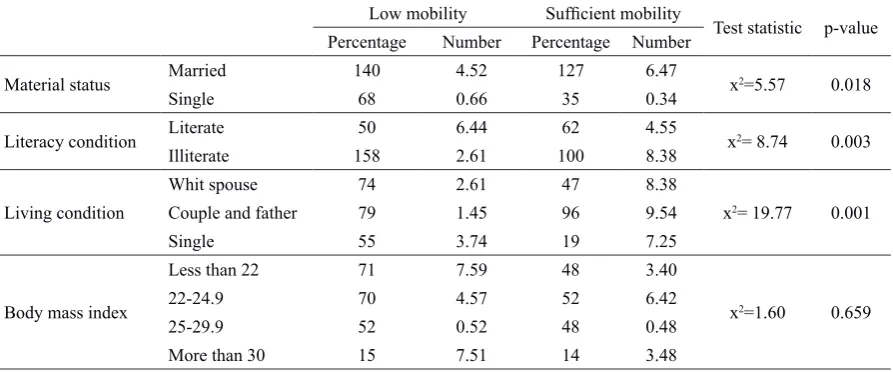
The mean age of the participants was 69 and a mean body mass index was 23.4. In view of demographic variables, 53% were women, 72.2% were married, 69.7% were illiterate, and 1.4% had a diploma or higher degree. 40% of them were living with their spouse and children. In view of physical activity, 56.2% of the elderly were with low activity and 43.8% with sufficient activity. The results showed that the level of physical activity was significantly related to marital status, living condition, and education level of the old person but not to body mass index (Table 1). Table 1 Frequency and percentage of physical activity levels based on demographic variables among the participants
Low mobility Sufficient mobility
Test statistic p-value Percentage Number Percentage Number
Material status Married 140 4.52 127 6.47 x2=5.57 0.018
Single 68 0.66 35 0.34
Literacy condition Literate 50 6.44 62 4.55 x2= 8.74 0.003
Illiterate 158 2.61 100 8.38
Living condition
Whit spouse 74 2.61 47 8.38
x2= 19.77 0.001
Couple and father 79 1.45 96 9.54
Single 55 3.74 19 7.25
Body mass index
Less than 22 71 7.59 48 3.40
x2=1.60 0.659
22-24.9 70 4.57 52 6.42
25-29.9 52 0.52 48 0.48
More than 30 15 7.51 14 3.48
The mean score of knowledge was 80, attitude 81, subjective norms and perceived behavior control 60, and intention 40 (Table 2).
The multiple regression test showed that
Table 2 Scores’ interquartile mean and range of knowledge and constructs of TBP among the participants
Middle Medieval range Minimum Maximum
Knowledge 8 4 0 10
Attitude 45 13 16 55
Subjective norm 9 4 3 15
Perceived behavior control 18 6 6 30
Behavioral intention 6 5 3 15
Table 3 Multiple regression analysis to determine the relationship between the constructs of the TBP and the intention of physical activity behavior among the participants
Dependent variables R2
p-value T
Standardized beta Independent variables
Behavior intention 0.267
0.007 4.12
0.186 Attitude
0.013 2.48
0.138 Subjective norm
0.001 7.00
0.386 Perceived behavior control
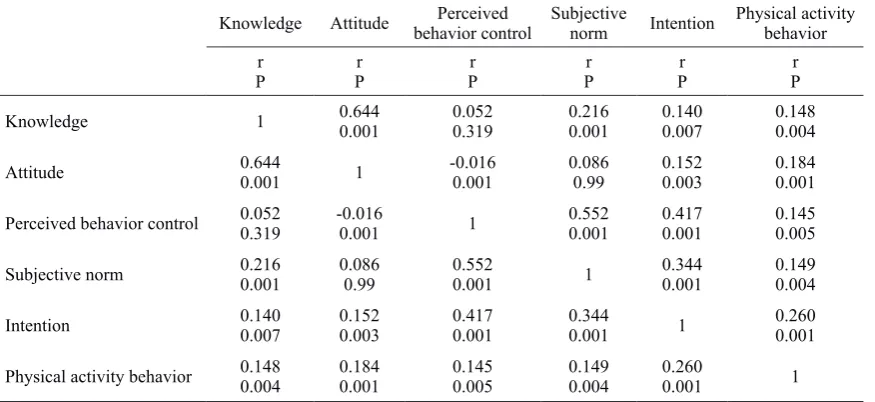
Correlation test results showed a significant relationship between intention to do physical activity and attitude (p=0.003, r=0.152),
perceived behavior control (r=0.417, p<0.001), and subjective norms (p<0.001, r=0.340) (Table 4).
Table 4 Spearman correlation coefficient matrix between the constructs of TBP and the variables of knowledge among the
participants
Knowledge Attitude behavior controlPerceived Subjective norm Intention Physical activity behavior r
P Pr Pr Pr Pr Pr
Knowledge 1 0.6440.001 0.0520.319 0.2160.001 0.1400.007 0.1480.004
Attitude 0.6440.001 1 -0.0160.001 0.0860.99 0.1520.003 0.1840.001
Perceived behavior control 0.0520.319 -0.0160.001 1 0.5520.001 0.4170.001 0.1450.005
Subjective norm 0.2160.001 0.0860.99 0.5520.001 1 0.3440.001 0.1490.004
Intention 0.1400.007 0.1520.003 0.4170.001 0.3440.001 1 0.2600.001
Physical activity behavior 0.1480.004 0.1840.001 0.1450.005 0.1490.004 0.2600.001 1
Discussion
In this study on the elderly's views about physical activity, we observed that the majority of them were in a relatively proper status in terms of knowledge and attitude but they were in a moderate status in terms of other constructs. There was a significant relationship between all the constructs and behavioral intention. In the study of Huger et al. in 2002, there was a real and strong connection between each one of the constructs and physical activity [11]. In this study, the construct of perceived behavior
effect of the other constructs [13], which is consistent with our study results. In the study of Rhodes on examining the factors predicting students' exercise intention, the attitude had the highest correlation with intention and perceived behavior control had the least correlation [14]. In the study of de Bruijin, which was done to determine the use of bicycle using this theory, the attitude had the highest correlation with the intention to use bicycles, followed by the perceived behavior control and abstract norms [15]. In the studies of Gahremani et al. [2], Huger et al. [14], and Jackson et al. [16], contrary to our study, perceived behavior control construct did not have a significant role in predicting physical activity intention in the elderly. Thus, the effect of perceived behavior control depends on the existence or absence of simplifiers or obstacles to do a behavior or perceived power. This result shows that the society feels that there is no control for doing activity due to the existence of some obstacles. The research has shown that one of the determinants of doing activity is obstacles a person is dealing with to do this behavior. In contrast, the abilities to overcome barriers to physical activity have a positive significant relationship with increased physical activity. Physical activity has also a direct connection with having a suitable place for exercise and equipment and providing a vehicle for going to the exercise place. Individuals are tempted to perform healthy behaviors (such as physical activity), and even do it in dealing with challenges if they feel that they are controlling the behavior. It is also necessary for training plans to reinforce this idea in the elderly that they can have regular and sufficient activity despite the obstacles. Using motivating interviews and holding meetings can be helpful to increase self-efficiency in the elderly.
People can promote their life quality and health by assigning a little time to physical activity in daily life. Mobility and regular activity at old ages can decrease pain and disability caused by diseases such as arthritis, osteoporosis, and high blood pressure [17].
Although the results of this study increased our insight into factors explaining physical activity
behavior based on the proposed theory, it still had some limitations. First, a cross-sectional study was used in this design to declare the relationships between variables. The basic feature of cross-sectional studies is that data are collected in a period and this can limit the ability to determine causality relations between the variables. Second, since data are collected as self-report, they may not reflect the real function of individuals. Similar to any other human research that uses a questionnaire, there was the possibility of incorrect responses although we tried to clearly express the research aims and observe ethical principles in the research and more importantly, achieve a high sample size to minimize the effect of this limitation on the results validity.
Conclusion
Totally, the study revealed the relative importance and relations of proposed model constructs with the intention. Thus, it is needed to pay attention to these relationships while designing training interventions to promote activity intention in the elderly. The health observers should work on perceived behavior control, subjective norms, and attitude that are effective on the behavior in order to increase motivation or intention of doing an activity or decrease immobile lifestyle in the elderly. Regarding the results of the study that perceived behavior control was the strongest construct in predicting activity intention, it seems increasing knowledge and providing training are not enough to promote the culture of exercise and activity among the elderly of Kalat city but the authorities must try to decrease and eliminate obstacles and limitations and do more follow-ups. Nevertheless, since a few studies have been done in the country on the intention and studies done based on this model on the other behaviors, especially on physical activity and exercise, have shown different results, other studies are recommended in the field.
Acknowledgments
Governor and the manager of the Health and Treatment Center of Kalat due to the coordination with us and also all the dear elderly who helped us with this research.
Authors’ contributions
Study design: MVSh, MM, SMGh
Data collection and analysis: SM, HE, ELM, SMGh
Manyscript preparation: SMGh, EM, MM All authors have read and approved the final version.
Conflict of Interest
"The authors declare that they have no competing interests".
Funding
The author (s) received no financial support for the research, authorship and/or publication of this article.
Availability of data and materials
The datasets used and/or analyzed during this study are available from the corresponding author on reasonable request.
References
1- Nejati V, Kordi R, Shoaei F. Paper: factors influencing physical activity in the elderly, district 17 of Tehran.
Journal of Ageing2010; 4(14): 52.
2- Saber F, Shhnazi H, Sharifirad GH. Check the ingredients of the theory of planned behavior in physical activity students Nain of Payam Noor University of 2013.Health Systems Research2013; 9(9):10-20.
3- Ziadi Lotf Abaddi M, Vafa F, Tavakkoli Rad M, et al. Elderly & health. Mashhad: Hamsaiee Aftab; 2013. 4- Lucioni DC, Donner C, De Benedetto F, et al. I costi della broncopneumopatia cronica ostruttiva: la fase prospettica dello studio ICE (Italian Costs for Exacerbations in COPD). Pharmacoeconomics Italian Research Articles2005; 7(2): 119-34.
5- Ghahremani L, Nazari M. Comparing prediction power of exercise intention and behavior based on self-efficacy and theory of planned behavior. Payesh2013; 12(1): 99-107.
6- Colcombe SJ, Erickson KI, Raz N, et al. Aerobic
fitness reduces brain tissue loss in aging humans. J Gerontol A Biol Sci Med Sci2003; 58(2): 176-80. 7- Pate RR, Pratt M, Blair SN, et al. Physical activity and public health: a recommendation from the centers for disease control and prevention and the American college of sports medicine. JAMA1995; 1;273(5):402-7.
8- Blue CL. The predictive capacity of the theory of reasoned action and the theory of planned behavior in exercise research: An integrated literature review. Res Nurs Health1995; 18(2): 105-21.
9- Motl RW, Dishman RK, Saunders RP, et al. Examining social-cognitive determinants of intention and physical activity among black and white adolescent girls using structural equation modeling. Health Psychol2002; 21(5): 459-67-
10- Vahedian-Shahroodi M, Lael-Monfared E, Esmaily H, Tehrani H, Hamidreza MH. Prediction of osteoporosis preventive behaviors using the health belief model. Iranina Journal of Health Education and Health Promotion2014; 2(3): 199-207.
11- Hagger MS, Chatzisarantis NL, Biddle SJ. A meta-analytic review of the theories of reasoned action and planned behavior in physical activity: Predictive validity and the contribution of additional variables. J
Sport Exerc Psychol2002; 24(1): 3-32.
12- Godin G, Valois P, Lepage L. The pattern of influence of perceived behavioral control upon exercising behavior: An application of Ajzen's theory of planned behavior. J Behav Med1993;16(1):81-102. 13- Mazloomy Mahmood Abad S, Mehri A, Morovati Sharif Abad M, Fallahzadeh H. Application of extended model of planned behavior in predicting helmet wearing among motorcyclist clerks in Yazd. Journal of Birjand University of Medical Sciences2008; 14(4): 9-15. 14- Rhodes RE, Courneya KS. Threshold assessment of attitude, subjective norm, and perceived behavioral control for predicting exercise intention and behavior.
Psychol Sport Exerc2005; 6(3): 349-61.
15- de Bruijn G-J, Kremers SP, Schaalma H, Van Mechelen W, Brug J. Determinants of adolescent bicycle use for transportation and snacking behavior.
Prev Med2005; 40(6): 658-67.
16- Jackson C, Smith A, Conner M. Applying an extended version of the theory of planned behaviour to physical activity. J Sports Sci2003; 21(2): 119-33. 17- Marcus BH, Pinto BM, Simkin LR, Audrain JE, Taylor ER. Application of theoretical models to exercise behavior among employed women. Am J Health Promot1994; 9(1): 49-55.