International Journal of Engineering
J o u r n a l H o m e p a g e : w w w . i j e . i rLength Scale Effect on Vibration Analysis of Functionally Graded Kirchhoff and
Mindlin Micro-plates
H. R. Nooria, E. Jomehzadeh*b
a Department of Mechanical Engineering, Islamic Azad University, Jiroft Branch, Jiroft, Kerman, Iran b Department of Mechanical Engineering, Graduate University of Advanced Technology, Kerman, Iran
P A P E R I N F O
Paper history:
Received 13 May 2013
Received in revised form 01 July 2013 Accepted 22 August 2013
Keywords: Vibration Micro-plate Functionally Graded Modified Couple Stress Theory
A B S T R A C T
In this paper, the modified couple stress theory is used to study vibration analysis of functionally graded rectangular micro-plates. Considering classical and first order plate theories, the couple governing equations of motion are obtained using the Hamilton’s principle. Using an assumed mode method, the accurate size dependent natural frequencies are established for simply supported functionally graded rectangular micro-plates. To show the accuracy of the formulations, present results in specific cases are compared with available results in literature and a good agreement is seen. It is found that the natural frequency parameter of micro-plates will decrease as thickness-length ratio increases especially for lower length scale values. The effects of length scale, functionally graded parameter and plate theories on natural frequencies of functionally graded micro-plates are discussed in details.
doi:10.5829/idosi.ije.2014.27.03c.11
1. INTRODUCTION1
Experimental results show that as length scales of a material are reduced, the influences of intermolecular cohesive forces on the mechanical properties become important and cannot be neglected. It is well known that size effects often become prominent at micro-length scales, the causes of which need to be explicitly addressed especially with an increasing interest in the general area of micro-structures. Couple stress theory is one of the higher order continuum theories which contain material length scale parameters and can capture the small size effects of microstructure. The classical couple stress theory contains two classical and two additional material constants for isotropic elastic materials.
Yang et al. [1] developed an additional equilibrium relation to govern the behavior of the material in couple stress theory of continuum. The relation constrained the couple stress tensor to be symmetric. The symmetric curvature tensor became the only properly conjugated
1*Corresponding Author Email: [email protected] (E.
Jomehzadeh)
high order strain measures in the theory to have a real contribution to the total strain energy of the system. They introduced a new modified couple stress theory that contains only one additional material length scale parameter. After this pioneer work, many studies have been extensively used the modified couple stress theory to study the behavior of micro structures such as micro-beams and micro-plates.
Park and Gao [2] used modified couple stress theory to study the bending effect of a cantilever Bernoulli-Euler beam. Their model contained an internal material length scale parameter that can capture the size effect. Ma et al. [3] developed Timoshenko beam model based on the modified couple stress theory to study bending and axial deformations of micro-beams. Lazopoulos [4] considered Kirchhoff theory of plates to study bending analysis of strain gradient elastic thin plates. In addition, Kirchhoff plate model was considered for investigating the static analysis of isotropic micro-plates with arbitrary shapes based on a modified couple stress theory by Tsiatas [5]. Asghari et al. [6] studied static and vibration behavior of micro-beams made of functionally graded materials. They used basis of modified couple stress theory in the elastic range and
showed that size effect is more prominent in micro scales. Nonlinear Timoshenko beam model was also established by Asghari et al. [7] to study the bending and free vibration of hinged micro-beams. Gheshlaghi et al. [8] investigated the torsional vibration of nanotubes using modified couple stress theory. Yin et al. [9] considered couple stress theory to study non-classical Kirchhoff plate model for the dynamic analysis of microscale plates. They investigated natural frequencies of rectangular plates with at least two edges simply supported. The equations of motion and boundary conditions were obtained through a variational formulation for a Mindlin plate based on a couple stress theory by Ma et al. [10]. Jomehzadeh et al. [11] used couple stress theory to establish free vibration analysis of rectangular and circular micro-plates based on the Levy type solution. Based on a new modified couple stress theory a model for composite laminated Reddy plate was developed by Chen et al. [12]. Ke et al. [13] established nonlinear free vibration of micro-beams made of functionally graded materials based on modified couple stress theory. Recently, Reddy and Kim [14] presented the mechanical analyses of micro-plates using the third order shear deformation plate theory. Furthermore, Thai and Kim [15] developed a size-dependent model for bending and free vibration of functionally graded Reddy plates.
In the recent studies on new performance materials, new materials have addressed which known as functionally graded materials (FGMs). These are high performance, heat resistance materials able to withstand ultra high temperature and extremely large thermal gradients used in aerospace industries. Vibration analysis of structures made of functionally graded materials has been considered by engineers as a new field for researches. Zhao et al. [16] considered free vibration of moderately thick functionally graded rectangular plates using kp-Ritz method. The decoupling of bending–stretching governing equations of FG rectangular plates was first investigated by Saidi and Jomehzadeh [17]. Hosseini-Hashemi et al. [18] studied the free vibration of FG rectangular plates using first-order shear deformation plate theory. They neglected the effects of in-plane displacement on free vibration of rectangular plates. Using the classical plate theory, Liu et al. [19] studied the free vibration of FG rectangular plates by assuming the in-plane variation of material properties of the plate in which the bending/stretching equations are not coupled. Hasani Baferani et al. [20] found a new exact analytical solution for free vibration characteristics of thin functionally graded rectangular plates with different boundary conditions. Neves et al. [21] derived a higher-order shear deformation theory for modeling functionally graded plates accounting for extensibility in the thickness direction.
Because of unique properties of functionally graded materials, they are widely used in micro structures such as thin films in micro-electromechanical systems (MEMS). Therefore, the vibration analysis of FG micro-films is considered to be necessary. In the present article, size dependent vibration analysis of functionally graded rectangular micro-plates is studied using the modified couple stress theory. The governing equations of motion are obtained for both classical and first order shear deformation micro-plate theories. The partial differential equations of motion are converted into algebraic equations using the admissible functions for displacement components. The nondimensional natural frequency parameter is determined for different powers of FGM and various length scale parameters for both theories.
2. MATERIAL PROPERTIES
Let us consider a rectangular micro-plate of length a, width b and thickness h in x1, x2 and x3 directions, respectively which is made of a functionally graded material (FGM). Although functionally graded materials are locally homogeneous; but, they are globally inhomogeneous due to spatial variations of volume fraction of the components. Mechanical properties of FGMs depend on the volume fraction of each constituent. FGMs are typically made from composition of metals and ceramics or a combination of different metals. Here, it is assumed that the micro-plate is made of a mixture of ceramic and metal in which the properties of functionally graded micro-plate vary smoothly and continuously through the thickness by the power law as follows [22]:
n
m c m
n
m c m
h z z
h z E E E z E
÷ ø ö ç è æ -+ =
÷ ø ö ç è æ -+ =
2 1 ) ( ) (
2 1 ) ( ) (
r r r r
(1)
where, E and r are the Young modulus and density of the micro-plate, respectively, n is the power of FGM or FGM parameter and subscripts m and c refer to metal and ceramic, respectively. Since the variation of Poisson’s ratio is not considerable, the Poisson’s ratio
)
(n of the micro-plate is assumed to be constant.
3. FUNCTIONALLY GRADED KIRCHHOFF MICRO-PLATES
components in the x1, x2 and x3 directions are considered as ) , , ( ) , , ( ) , , ,
(x1x2 x3t u0 x1 x2 t x3w0,1 x1x2t
uk = k - k
) , , ( ) , , ( ) , , ,
(x1 x2 x3t v0 x1x2t x3w0,2 x1 x2t
vk = k - k
) , , ( ) , , ,
(x1 x2 x3 t w0 x1 x2 t
wk = k
(2)
where, uk 0 and
k
v0 are the midplane displacements of the micro-plate in x1 and x2 directions, respectively,
k
w0 is the transverse displacement, comma subscript shows differentiate with respect to coordinate and superscript k denotes Kirchhoff plate theory. Using strain-displacement relations, the strain components at distance x3 from the middle plane are expressed as
k k k u xw
11 , 0 3 1 , 0
11=
-e k vk xwk
22 , 0 3 2 , 0
22=
-e
0
33=
k
e k uk vk xwk
12 , 0 3 1 , 0 2 , 0 12 2
2e = +
-0
2e23k = 2 0
13=
k
e
(3)
It can be found that the out of plane strain components are ignored in this theory. Based on the displacement field of classical plate theory, the rotation components of the micro-plate can be expressed as
k k w 2 , 0 1 =
q k wk
1 , 0
2 =
-q q3k=(vk0,1-u0k,2)/2 (4) The classical continuum elasticity, which is a scale free theory, can not predict the size effects in micro-structures, whereas the modified couple stress theory allows one to account the small length scale effect. It becomes significant when dealing with microstructures by considering only one material constant. According to the modified couple stress theory [1], the strain energy density is a function of both strain and gradient of the rotation vector as
V d m U V ij ij ij ij
ò
+=1/2 (s e c ) (5)
where, mij and cij are deviatory part of couple stress and symmetric curvature components which are defined as
2 / ) ( i,j j,i ij q q
c = + = ()2c /(1+n) ij ij Ezl
m (6)
where, l is a length scale parameter. This length scale parameter is a material property which carried with all of the difference between classical and couple stress elasticity theories. This parameter is small in comparison with the body dimensions. Therefore, its influence might become important as dimensions of a body diminish to the order of the length scale parameter. The equations of motion for a micro-plate based on the modified couple stress theory can be obtained using the Hamilton's principle. The Hamilton’s principle states that
ò
- + =t dt W U T 0 0 )
(d d d (7)
where, T and W are kinetic energy of micro-plate and potential energy of the external loads, respectively. Expressing these parameters and strain energy based on the displacement field of Kirchhoff plate theory and considering the modified couple stress theory, the equations of motion for a micro-plate can be obtained as follows [11]: k k k k k k
k N N Y Y Iu Iw
u0: 11,1+ 12,2+1/213,12+1/2 23,22= 0&&0- 1&&0,1
d (8a) k k k k k k
k N N Y Y Iv Iw
v0: 12,1+ 22,2-1/213,11-1/2 23,12= 0&&0- 1&&,2
d (8b) ) ( ) ( 2 : 22 , 0 11 , 0 2 2 , 0 1 , 0 1 0 0 0 12 , 22 11 , 12 22 , 12 12 , 11 22 , 22 12 , 12 11 , 11 0 k k k k k k k k k k k k k w w I v u I w I p Y Y Y Y M M M w & & & & & & & & &
& + + - +
= -+ + -+ + d (8c)
where, d represents the variational symbol and p0 is
the transverse loading function. In addition, force resultant( k)
ij
N , moments resultant ( k)
ij
M and couple resultants ( k)
ij
Y are defined as
3 2 / 2 / dx N h h k ij k
ij=
ò
- s3 3 2 /
2
/ x dx
M h h
k ij k ij =
ò
- s3 2 /
2
/ m dx
Y h h ij k ij =
ò
-(9)
also, the inertia terms are expressed as
3 2 / 2 / 2 3 3 2 1
0, , ) ( )(1, , )
(I I I h z x x dx h
ò
-= r (10)
By assuming the plane stress state for the FG micro-plate, the force and moment resultants are obtained in the matrix form in terms of displacement components as
ú ú ú ú ú ú ú ú ú ú û ù ê ê ê ê ê ê ê ê ê ê ë é -+ ú ú ú ú ú ú ú ú û ù ê ê ê ê ê ê ê ê ë é = ú ú ú ú ú ú ú ú û ù ê ê ê ê ê ê ê ê ë é k k k k k k k k k k k k k w w w v u v u D B D D B B D D B B B A B B A A B B A A M M M N N N 12 , 0 22 , 0 11 , 0 1 , 0 2 , 0 2 , 0 1 , 0 33 33 22 12 22 12 12 11 12 11 33 33 22 12 22 12 12 11 12 11 12 22 11 12 22 11 2 0 0 0 0 0 0 0 0 0 0 0 0 0 0 0 0 (11a) ú ú ú ú ú ú ú ú ú û ù ê ê ê ê ê ê ê ê ê ë é ú ú ú ú ú ú û ù ê ê ê ê ê ê ë é -= ú ú ú ú ú ú û ù ê ê ê ê ê ê ë é k k k k k k k k k k k k w w w v v u u l A Y Y Y Y Y 12 , 0 22 , 0 11 , 0 12 , 0 11 , 0 12 , 0 22 , 0 2 33 23 13 12 22 11 0 0 0 2 / 1 0 0 2 / 1 0 0 0 0 2 / 1 2 / 1 0 0 1 1 0 0 0 0 2 0 0 0 0 0 0 2 0 0 0 0 0 0 (11b)
ò
-= /22 / 2) , , 1 ( ) , , ( h h ij ij ij
ij B D zz Q dz
A i,j=1,2,3
(12)
ò
-= /2
2 /
h h ij ij Q dz
A i,j=1,2,3
Based on the definition of Young modulus in Equation (1), Qij’s can be found for FG micro-plates as
2 , 1 ) 2 1 ( 1
1- 2+ - 2 - = =
= i j
h z E E
Q m cm n
ij n n
5 , 4 , 3 ) 2 1 ( ) 1 ( 2 ) 1 (
2 + + + - = =
= i j
h z E
E
Q m cm n
ij n n
j i h z E E
Q m cm n
ij ÷ ¹
ø ö ç è æ -+ -= ) 2 1 ( 1 1 n2 n2
n
(13)
The governing equations of motion of a FG micro-plate based on the Kirchhoff theory can be obtained by substituting Equations (11) into equilibrium Equations (8) as follows:
k k k k k k k k k k k w I u I w w B u v u v l A v A A u A u A 1 , 0 1 0 0 122 , 0 111 , 0 11 2222 , 0 1222 , 0 1122 , 0 1112 , 0 2 33 12 , 0 33 11 22 , 0 33 11 , 0 11 ) ( 4 / ) ( ) ( & & & & -= + -+ -+ -+ + (14a) k k k k k k k k k k k w I v I w w B u v u v l A u A A v A v A 1 , 0 1 0 0 222 , 0 112 , 0 11 1112 , 0 1111 , 0 1222 , 0 1122 , 0 2 33 12 , 0 33 11 11 , 0 33 22 , 0 11 ) ( 4 / ) ( ) ( & & & & + = + -+ -+ + (14b) ) w w ( I ) v u ( I w I p ) u v v u ( B ) w w w ( l A ) w w w ( D k , k , k , k , k k , k , k , k , k , k , k , k , k , k , 22 0 11 0 2 2 0 1 0 1 0 0 0 122 0 112 0 222 0 111 0 11 2222 0 1111 0 1122 0 2 33 2222 0 1122 0 111 0 11 2 2 & & & & & & & & &
& + + - +
= + + + + -+ + + + + (14c)
It can be seen that, unlike the classical Kirchhoff plate theory, the current FG Kirchhoff micro-plate model based on the modified couple stress theory contains a material length scale parameter l and can capture the size effect. Furthermore, because of the nonhomogeneous properties of functionally graded materials, the stretching and bending equations of FG micro-plates are couple to each other. In fact B11
parameter, which is zero in isotropic case, causes a coupling between in-plane and out of plane equations.
4. FUNCTIONALLY GRADED MINDLIN MICRO-PLATES
The Mindlin or first order shear deformation plate theory assumes that the plane sections originally perpendicular to the longitudinal plane of the plate remain plane, but not necessarily perpendicular to the longitudinal plane. This theory accounts for the shear strains in the thickness direction of the micro-plate and is based on the displacement field.
) , , ( ) , , ( ) , , ,
(x1 x2 x3 t u0 x1 x2 t x3 1 x1 x2 t
um = m + ym (15)
) , , ( ) , , ( ) , , ,
(x1 x2 x3 t v0 x1 x2 t x3 2 x1 x2 t
vm = m + ym
) , , ( ) , , ,
(x1x2 x3t w0 x1 x2 t
wm = m
where, um 0 and
m
v0 are the midplane displacements of the micro-plate in the x1 and x2 directions, respectively,
m
w0 is the transverse displacement, y1m and m 2
y are rotation functions of the middle surface in the x1 and x2 directions, respectively and superscript m denotes the Mindlin plate theory. Using strain-displacement relations, the strain components at distance x3 from the middle plane which are expressed as
m m m u x
1 , 1 3 1 , 0 11 y
e = +
m m
m v x
2 , 2 3 2 , 0 22 y
e = +
0 33= m
e 2e12m=u0m,2+v0m,1+x3(y1m,2+y2m,1)
m m m w 2 , 0 2 23
2e =y + m m wm
1 , 0 1 13
2e =y +
(16)
It can be seen that, unlike the Kirchhoff plate theory, the out of plane strain components are not zero in this theory. The rotation components based on the Mindlin plate theory can be also obtained as
2 / ) ( 0,2 2 1
m m m w y
q = + q2m=-(w0m,1+y1m)/2 2 / ) ( 0,1 0,2 3 2,1 3 1,2
3m vm um xym xym
q = - - +- (17)
As the Kirchhoff micro-plate, the equations of motion for FG Mindlin micro-plates can be obtained using the Hamilton’s principle. Expressing the strain, kinetic and potential energies in terms of the components of Mindlin theory and substituting the results into Equation (7), the equations of motion of FG Mindlin micro-plates can be defined as
m m m m
m
m N Y Y Iu I
N
u0: 11,1 12,2 1/213,12 1/2 23,22 0 0 1y1
d + + + = && - && (18a)
m m m m
m
m N Y Y Iv I
N
v0: 12,1 22,2 1/213,11 1/223,12 00 1y2
d + - - = && - && (18b)
m m m m m m m m m m I u I H H Y Y Y Q M M 1 2 0 1 12 , 13 22 , 23 2 , 33 2 , 22 1 , 12 13 2 , 12 1 , 11 1 2 / 1 2 / 1 2 / 1 2 / 1 2 / 1 : y dy & & & & -= + + -+ + -+ (18c) m m m m m m m m m m I v I H H Y Y Y Q M M 2 2 0 1 12 , 23 11 , 13 1 , 33 2 , 12 1 , 11 23 2 , 22 1 , 12 2 2 / 1 2 / 1 2 / 1 2 / 1 2 / 1 : y dy & & & & -= -+ -+ (18d) m m m m m m m w I p Y Y Y Y N N w 0 0 0 22 , 12 11 , 12 12 , 22 12 , 11 2 , 23 1 , 13 0 2 / 1 2 / 1 2 / 1 2 / 1 : & & = -+ + -+ d (18e)
While there are three equations in case of Kirchhoff theory, it can be seen that the equations of FG Mindlin micro-plates are five couple equations. Assuming the plane stress state for FG micro-plate, the force and moment resultants are obtained in the matrix form as
ú û ù ê ë é + + ú û ù ê ë é = ú û ù ê ë é m m m m s s m m w w A K A K Q Q 2 2 , 0 1 1 , 0 33 2 33 2 23 13 0 0 y y (19b)
The couple resultant parameters can also be expressed as
) ( 0,12 2,1 33
2
11m l A wm m
Y = +y 33( 0,12 1,2)
2
22m l A wm m
Y =- +y
2 / ) ( 330,11 33 2,11 33 0,12 33 1,12 2
13m l Avm B m A um B m
Y = - y - + y
2 / ) ( 330,12 33 2,12 33 0,22 33 1,22 2
23m l Avm B m A um B m
Y = - y - + y
) ( 2,1 1,2
33 2 33
m m m l A
Y = -y +y
2 / ) ( 0,22 2,2 0,11 1,1 33 2 12 m m m m
m l A w w
Y = +y - -y
(20a) 2 / ) ( 12 , 1 33 12 , 0 33 11 , 2 33 11 , 0 33 2 3 3 2 / 2 / 13 13 m m m m h h m D u B D v B l dx x m H y y + -= =
ò
-2 / ) ( 22 , 1 33 22 , 0 33 12 , 2 33 12 , 0 33 2 3 3 2 / 2 / 23 23 m m m m h h m D u B D v B l dx x m H y y + -= =ò
-(20b)where, Aij,Bij and Dij are the same as Equations (12) and 2
s
K is the shear correction factor.
The governing equations of motion of FG Mindlin micro-plate are obtained by substituting Equations (19) and (20) into Equation (18) as
m m m m m m m m m m m m m m m m m m I u I l B v v u u l A B B v u A v u A 1 1 0 0 1222 , 2 1112 , 2 1122 , 1 2222 , 1 2 33 1222 , 0 1112 , 0 1122 , 0 2222 , 0 2 33 22 , 1 12 , 2 33 12 , 2 11 , 1 11 12 , 0 22 , 0 33 12 , 0 11 , 0 11 ) ( 4 / 1 ) ( 4 / 1 ) ( ) ( ) ( ) ( y y y y y y y y y & & & & -= -+ + -+ -+ + -+ + (21a) m m m m m m m m m m m m m m m m m m I v I l B v v u u l A B B v u A v u A 2 1 0 0 1122 , 2 1111 , 2 1222 , 1 1112 , 1 2 33 1122 , 0 1111 , 0 1222 , 0 1112 , 0 2 33 11 , 2 12 , 1 33 22 , 2 12 , 1 11 11 , 0 12 , 0 33 22 , 0 12 , 0 11 ) ( 4 / 1 ) ( 4 / 1 ) ( ) ( ) ( ) ( y y y y y y y y y & & & & -= -+ -+ + -+ + -+ (21b) m m m m m m m m m m m m m m m m m m m m m m m s m m I u I l D D D v v u u l B v u B w w l A w K A v u B 1 2 0 1 1222 , 2 1112 , 2 1122 , 1 2222 , 1 2 33 12 , 2 22 , 1 33 12 , 2 11 , 1 11 1222 , 0 1112 , 0 1122 , 0 2222 , 0 2 33 12 , 0 22 , 0 33 122 , 0 111 , 0 12 , 2 22 , 1 11 , 1 2 33 1 , 0 1 2 33 12 , 0 11 , 0 11 4 / ) ( ) ( ) ( 4 / ) ( ) ( 2 / ) 2 / 2 / 4 / 3 2 / ( ) ( ) ( y y y y y y y y y y y y y & & & & -= -+ + -+ -+ -+ -+ -+ -+ + (21c) m m m m m m m m m m m m m m m m m m m m m m m s m m I v I l D D D v v u u l B v u B w w l A w K A v u B 2 2 0 1 1122 , 2 1111 , 2 1222 , 1 1112 , 1 2 33 11 , 2 22 , 1 33 22 , 2 12 , 1 11 1122 , 0 1111 , 0 1222 , 0 1112 , 0 2 33 11 , 0 12 , 0 33 222 , 0 112 , 0 12 , 1 11 , 2 22 , 2 2 33 2 , 0 2 2 33 22 , 0 12 , 0 11 4 / ) ( ) ( ) ( 4 / ) ( ) ( 2 / ) 2 / 2 / 4 / 3 2 / ( ) ( ) ( y y y y y y y y y y y y y & & & & -= -+ -+ + -+ + -+ -+ -+ + (21d) m m m m m m m m m m s w I p w l A w w K A 0 0 0 222 , 2 112 , 2 122 , 1 111 , 1 0 4 2 33 2 , 2 1 , 1 22 , 0 11 , 0 2 33 4 / ) ( ) ( & & = + + + + + Ñ -+ y y y y y y (21e)
It can be found that as the length scale parameter is ignored, five couple equations of motion of Mindlin micro-plate convert into equations of classical Mindlin plate (l=0).
5. SOLUTION USING NAVIER’S APPROACH
The developed governing differential equations of motion of Sections 3 and 4 are solved by Navier’s approach for simply supported boundary conditions. For free vibration analysis, the transverse loading function
0
p is considered to be zero. The simply supported boundary conditions for Kirchhoff and Mindlin theories based on the couple stress theory are written as
0 0 0 2 0 2 0 0 13 12 12 11 2 , 13 11 0 0 = = = + = + = = k k k k k k k k Y Y Y M Y N w v
at x1=0,a (22a)
0 0 0 2 0 2 0 0 23 12 12 22 1 , 23 22 0 0 = = = + = + = = k k k k k k k k Y Y Y M Y N w u
at x2=0,b (22b)
0 0 0 0 2 0 2 0 0 0 13 13 12 12 2 , 13 11 2 , 13 11 2 0 0 = = = = + + = + = = = m m m m m m m m m m m H Y Y Y H M Y N w v y
at x1=0,a (22c)
0 0 0 0 2 0 2 0 0 0 23 23 12 12 1 , 23 22 1 , 23 22 1 0 0 = = = = + + = + = = = m m m m m m m m m m m H Y Y Y H M Y N w u y
TABLE 1. Comparison of nondimensional natural frequency ( 2( 2/ ) / ) m m pqp a h r E
w of FG Kirchhoff plates (l=0)
n b/a Mode 1 Mode 2 Mode 3
0
1 Present 115.9251(1,1) 289.7771(1,2) 463.5861(2,2) [20] 115.8695(1,1) 289.7708(1,2) 463.4781(2,2)
2 Present 72.4554(1,1) 115.9251(2,1) 188.3686(3,1) [20] 72.3942(1,1) 115.8695(2,1) 188.2637(3,1)
0.5
1 Present 98.1594(1,1) 245.3676(1,2) 392.5390(2,2) [20] 98.0136(1,1) 245.3251(1,2) 392.4425(2,2)
2 Present 61.3515(1,1) 98.1594(2,1) 159.5006(3,1) [20] 61.3313(1,1) 98.0136(2,1) 159.3448(3,1)
1
1 Present 88.4500(1,1) 221.0595(1,2) 353.7056(2,2) [20] 88.3093(1,1) 221.0643(1,2) 353.6252(2,2)
2 Present 55.2831(1,1) 88.4500(2,1) 143.7232(3,1) [20] 55.1205(1,1) 88.3093(2,1) 143.6239(3,1)
TABLE 2. Comparison of Nondimensional natural frequency
) /
(w11h rc Ec of FG Mindlin plates (l=0)
a
h/ n
0.5 1 4
0.05
Present [19] [16]
0.01254 0.01281 0.01241
0.01131 0.01150 0.01118
0.00982 0.01013 0.0097
0.1
Present [19] [16]
0.04900 0.04920 0.04818
0.04419 0.04454 0.04346
0.03823 0.03825 0.03757
0.2
Present [19] [16]
0.1805 0.1806 0.1757
0.1631 0.1650 0.1587
0.1397 0.1371 0.1356
Figure 1. Comparison of natural frequencies of isotropic Kirchhoff micro plates (n=0)
The following expressions of various generalized displacements have been assumed:
t i q p
k pq k
t i q p
k pq k
t i q p
k pq k
pq pq pq
e x x
w t x x w
e x x
u t x x v
e x x
u t x x u
w w w
h b
h b
h b
) sin( ) sin( )
, , (
) cos( ) sin( )
, , (
) sin( ) cos( )
, , (
2 1
2 1 0
2 1
2 1 0
2 1
2 1 0
= = =
(23a)
t i q p
m pq m
t i q p
m pq m
t i q p
m pq m
t i q p
m pq m
t i q p
m pq m
pq pq pq pq pq
e x x
w t x x w
e x x
t x x
e x x
t x x
e x x
u t x x v
e x x
u t x x u
w w w w w
h b
h b
y y
h b
y y
h b
h b
) sin( ) sin( )
, , (
) cos( ) sin( )
, , (
) sin( ) cos( )
, , (
) cos( ) sin( )
, , (
) sin( ) cos( )
, , (
2 1
2 1 0
2 1
2 2 1 2
2 1
1 2 1 1
2 1
2 1 0
2 1
2 1 0
= = = = =
(23b)
where, bp and hq denote pp/a and qp/b, respectively. In addition, wpq is the natural frequency
of the micro-plate. It can be found that these admissible functions exactly satisfy the boundary conditions of simply supported micro-plates in Equation (22). Substituting proposed series (23a) and (23b) into governing equations of motion of FG Kirchhoff and Mindlin micro-plates in Equations (14) and (21) respectively, a system of homogeneous equations is obtained. In the case of Kirchhoff micro-plates, this system contains three homogeneous equations and in the case of Mindlin micro-plates, five homogeneous equations are obtained. Setting the determinant of coefficient matrix in each case equal to zero, the natural frequencies can be determined for both Kirchhoff and Mindlin micro-plates.
h / l
w
×
1
0
-3
0 2 4 6 8 10
0 1 2 3 4 5 6 7 8 9 10 11
TABLE 3. Nondimensional natural frequency parameter
) h E a
( 2 m m 2
11 r
w of FG Kirchhoff micro-plates (a/b=1)
k h/a h/l
0.25 0.5 1 2 4
0 0.05 96.8087 49.4575 26.7315 16.7841 13.1716 0.1 72.4849 49.1565 26.5688 16.6820 13.0914
0.5 0.05 86.7983 44.2432 23.7331 14.6528 11.2945 0.1 65.0460 43.9647 23.5856 14.5620 11.2246
1 0.05 80.3939 40.9385 21.8856 13.4062 10.2426 0.1 60.2786 40.6581 21.7404 13.3177 10.1752
2 0.05 72.6106 36.9853 19.7876 12.1428 9.2963 0.1 54.4534 36.7003 19.6431 12.0550 9.2292
TABLE 4. Nondimensional natural frequency parameter
) h E a
( m m
2 2
11 r
w of FG Mindlin micro-plates (a/b=1)
k h/a h/l
0.25 0.5 1 2 4
0 0.05 86.7045 47.8202 26.3910 16.6515 13.0782 0.1 68.7814 43.6820 25.3412 16.1900 12.7411
0.5 0.05 77.7758 42.8024 23.4455 14.5473 11.2229 0.1 61.7225 39.1416 22.5472 14.1702 10.9555
1 0.05 72.0592 39.6162 21.6265 13.3139 10.1811 0.1 57.1987 36.2418 20.8068 12.9754 9.9443
2 0.05 65.0917 35.7907 19.5526 12.0584 9.2398 0.1 51.6711 32.7320 18.8001 11.7434 9.0180
6. NUMERICAL RESULTS AND DISCUSSION
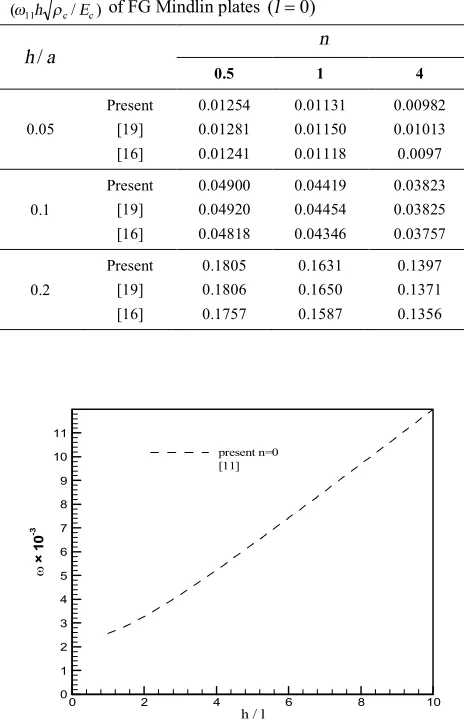
To verify the accuracy of the present formulations, three comparisons have been carried out with available results for all edges simply supported plates. Figure 1 compares the variations of natural frequencies of a homogenous Kirchhoff micro-plate (n=0) with Ref. [11]. The natural frequencies of classical FG plates (l=0) for both Kirchhoff and Mindlin plates are also compared in Tables 1 and 2 with available results in literature. The comparisons show that the present results agree well with those in the literature. For numerical computation, the considered functionally graded material is composed of Aluminum (E 70Gpa, 2707Kg/m3)
m
m= r = and Alumina
) / 3800 , 380
(E Gpa Kg m3
c
c= r = . Since the variation of
Poisson ratio is not considerable changes for different materials, their values are considered to be constants and equal to 30 [23]. Furthermore, for Mindlin micro-.
plates the shear correction factor ( 2) s
K has been considered to be p2/12. The accurate non-dimensional natural frequency parameter (W=wpqa2 rm Emh2) of FG Kirchhoff and Mindlin square micro-plates are tabulated in Tables 3 and 4 for various values of non-dimensional length scale parameter (h/l) and different powers of FGM. Since no experimental date is available for FG micro-plates, the value of material length scale parameter for homogeneous epoxy micro-plate
) 6 . 17
(l= mm is approximately used for FG micro-plates [6, 15]. It can be seen that for a constant nondimensional length scale parameter, the frequency parameter decreases for both theories as the power of FGM(n) increases. The reason is that with increasing the power of FGM, the stiffness of the micro-plate decreases and results in decreasing the natural frequency of the FG rectangular micro-plate.
Figure 2. Variation of fundamental natural frequency of FG Kirchhoff micro-plates
Figure 3. Variation of fundamental natural frequency of FG Mindlin micro-plates
h / l
w
×
10
-6
0 2 4 6 8 10
0.6 0.7 0.8 0.9 1 1.1 1.2 1.3 1.4 1.5 1.6 1.7
n=0 n=0.5 n=1
h / l
w
×
10
-6
0 2 4 6 8 10
0.6 0.8 1 1.2 1.4 1.6 1.8
Figure 4. Variation of natural frequency of FG Kirchhoff and Mindlin micro-plates for first three modes (n=0.5)
In addition, it can be found that as the thickness-length ratio (h/a) increases, the nondimensional frequency parameter will decrease and this effect is more significant for lower nondimensional scale values
) /
(h l especially for Mindlin micro-plates.
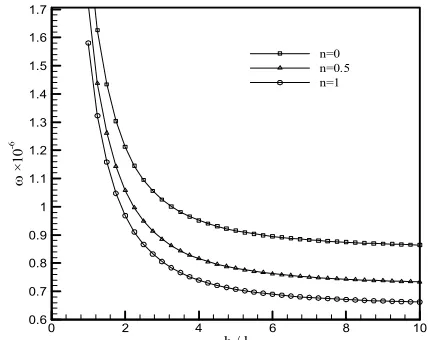
In order to study the effect of power of FGM on natural frequencies of FG micro-plates, the variation of fundamental natural frequencies with respect to length scale parameter is depicted for different FGM parameters in Figures 2 and 3 for Kirchhoff and Mindlin micro-plates, respectively. The thickness of the FG micro-plates is assumed to be constant and equal to
m
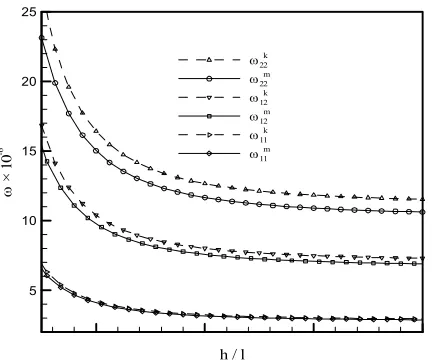
h=17.6m in all figures. It can be concluded that as the isotropic micro-plates, the natural frequencies of FG micro-plates decreases as decreasing of length scale parameter(l). The variations of natural frequencies of first three modes are shown in Figure 4 for both FG Kirchhoff and Mindlin micro-plates. The power of FGM is n=0.5 and the dimensions of the micro-plate is considered to be a=b=176mm. It can be seen that the difference of two theories is considerable in higher modes.
7. CONCLUSION
In this paper, vibration analysis of functionally graded Kirchhoff and Mindlin micro-plates has been studied by considering the small length scale effect. Using the modified couple stress theory, the governing equations of motion have been obtained for both Kirchhoff and Mindlin micro-plates. The accurate natural frequencies have been determined for a simply supported functionally graded rectangular micro-plate. The
nondimensional natural frequency parameter has been determined for different powers of FGM and various length scale parameters for both theories. In addition, the effects of material property, thickness to length ratio and length scale parameter on the vibrational behavior of the FG rectangular micro-plates have been investigated.
8. REFERENCES
1. Yang, F., Chong, A., Lam, D. and Tong, P., "Couple stress based strain gradient theory for elasticity", International Journal of
Solids and Structures, Vol. 39, No. 10, (2002), 2731-2743.
2. Park, S. and Gao, X., "Bernoulli–euler beam model based on a modified couple stress theory", Journal of Micromechanics and
Microengineering, Vol. 16, No. 11, (2006), 2355.
3. Ma, H., Gao, X.-L. and Reddy, J., "A microstructure-dependent timoshenko beam model based on a modified couple stress theory", Journal of the Mechanics and Physics of Solids, Vol. 56, No. 12, (2008), 3379-3391.
4. Lazopoulos, K., "On bending of strain gradient elastic micro-plates", Mechanics Research Communications, Vol. 36, No. 7, (2009), 777-783.
5. Tsiatas, G. C., "A new kirchhoff plate model based on a modified couple stress theory", International Journal of Solids
and Structures, Vol. 46, No. 13, (2009), 2757-2764.
6. Asghari, M., Ahmadian, M., Kahrobaiyan, M. and Rahaeifard, M., "On the size-dependent behavior of functionally graded micro-beams", Materials & Design, Vol. 31, No. 5, (2010), 2324-2329.
7. Asghari, M., Kahrobaiyan, M. and Ahmadian, M., "A nonlinear timoshenko beam formulation based on the modified couple stress theory", International Journal of Engineering Science, Vol. 48, No. 12, (2010), 1749-1761.
8. Gheshlaghi, B. and Hasheminejad, S. M., "Size dependent torsional vibration of nanotubes", Physica E: Low-dimensional
Systems and Nanostructures, Vol. 43, No. 1, (2010), 45-48.
9. Yin, L., Qian, Q., Wang, L. and Xia, W., "Vibration analysis of microscale plates based on modified couple stress theory", Acta
Mechanica Solida Sinica, Vol. 23, No. 5, (2010), 386-393.
10. Ma, H., Gao, X.-L. and Reddy, J., "A non-classical mindlin plate model based on a modified couple stress theory", Acta
Mechanica, Vol. 220, No. 1-4, (2011), 217-235.
11. Jomehzadeh, E., Noori, H. and Saidi, A., "The size-dependent vibration analysis of micro-plates based on a modified couple stress theory", Physica E: Low-dimensional Systems and
Nanostructures, Vol. 43, No. 4, (2011), 877-883.
12. Chen, W., Xu, M. and Li, L., "A model of composite laminated reddy plate based on new modified couple stress theory",
Composite Structures, Vol. 94, No. 7, (2012), 2143-2156.
13. Ke, L.-L., Wang, Y.-S., Yang, J. and Kitipornchai, S., "Nonlinear free vibration of size-dependent functionally graded microbeams", International Journal of Engineering Science, Vol. 50, No. 1, (2012), 256-267.
14. Kim, J. and Reddy, J., "Analytical solutions for bending, vibration, and buckling of fgm plates using a couple stress-based third-order theory", Composite Structures, Vol. 103, (2013) 86-98.
15. Thai, H.-T. and Kim, S.-E., "A size-dependent functionally graded reddy plate model based on a modified couple stress theory", Composites Part B: Engineering, Vol. 45, (2013), 1636-1645..
h / l
w
×
10
-6
5 10 15 20 25
w22
k
w22
m
w12
k
w12
m
w11
k
w11
16. Zhao, X., Lee, Y. and Liew, K., "Free vibration analysis of functionally graded plates using the element-free kp-ritz method", Journal of Sound and Vibration, Vol. 319, No. 3, (2009), 918-939.
17. Saidi, A. and Jomehzadeh, E., "On the analytical approach for the bending/stretching of linearly elastic functionally graded rectangular plates with two opposite edges simply supported",
Proceedings of the Institution of Mechanical Engineers, Part
C: Journal of Mechanical Engineering Science, Vol. 223, No.
9, (2009) 2009-2016.
18. Hosseini-Hashemi, S., Rokni Damavandi Taher, H., Akhavan, H. and Omidi, M., "Free vibration of functionally graded rectangular plates using first-order shear deformation plate theory", Applied Mathematical Modelling, Vol. 34, No. 5, (2010), 1276-1291.
19. Liu, D., Wang, C. and Chen, W., "Free vibration of fgm plates with in-plane material inhomogeneity", Composite Structures, Vol. 92, No. 5, (2010), 1047-1051.
20. Baferani, A. H., Saidi, A. and Jomehzadeh, E., "An exact solution for free vibration of thin functionally graded rectangular plates", Proceedings of the Institution of Mechanical Engineers, Part C: Journal of Mechanical Engineering
Science, Vol. 225, No. 3, (2011), 526-536.
21. Neves, A., Ferreira, A., Carrera, E., Cinefra, M., Roque, C., Jorge, R., and Soares, C., "Static, free vibration and buckling analysis of isotropic and sandwich functionally graded plates using a quasi-3d higher-order shear deformation theory and a meshless technique", Composites Part B: Engineering, Vol. 44, No. 1, (2013), 657-674.
22. Bao, G. and Wang, L., "Multiple cracking in functionally graded ceramic/metal coatings", International Journal of Solids and
Structures, Vol. 32, No. 19, (1995), 2853-2871.
Length Scale Effect on Vibration Analysis of Functionally Graded Kirchhoff and
Mindlin Micro-plates
H. R. Nooria, E. Jomehzadehb
a Department of Mechanical Engineering, Islamic Azad University, Jiroft Branch, Jiroft, Kerman, Iran b Department of Mechanical Engineering, Graduate University of Advanced Technology, Kerman, Iran
P A P E R I N F O
Paper history:
Received 13 May 2013
Received in revised form 01 July 2013 Accepted 22 August 2013
Keywords: Vibration Micro-plate Functionally Graded Modified Couple Stress Theory
هﺪﯿﮑﭼ
ﻪﻟﺎﻘﻣ ﻦﯾا رد قرو وﺮﮑﯿﻣ دازآ تﺎﺷﺎﻌﺗرا ،ﯽﻠﭘﻮﮐ ﺶﻨﺗ هﺪﺷ حﻼﺻا يرﻮﺌﺗ زا هدﺎﻔﺘﺳا ﺎﺑ
درﻮﻣ ﯽﻌﺑﺎﺗ ﺪﻨﻤﻓﺪﻫ ﯽﻠﯿﻄﺘﺴﻣ يﺎﻫ
ﯽﻣ راﺮﻗ ﻪﻌﻟﺎﻄﻣ دﺮﯿﮔ
. يرﻮﺌﺗ ﻦﺘﻓﺮﮔ ﺮﻈﻧ رد ﺎﺑ نﻮﺘﻠﯿﻤﻫ ﻞﺻا زا هدﺎﻔﺘﺳا ﺎﺑ ﺖﮐﺮﺣ تﻻدﺎﻌﻣ ،قرو لوا ﻪﺒﺗﺮﻣ و ﮏﯿﺳﻼﮐ يﺎﻫ
ﯽﻣ ﺖﺳﺪﺑ ﺪﯾآ . ﺲﻧﺎﮐﺮﻓ قرو وﺮﮑﯿﻣ ﯽﻌﯿﺒﻃ يﺎﻫ ﻪﯿﮑﺗ يزﺮﻣ ﻂﯾاﺮﺷ ياﺮﺑ ﯽﺿﺮﻓ ﺪﻣ شور زا هدﺎﻔﺘﺳا ﺎﺑ ﯽﻌﺑﺎﺗ ﺪﻨﻤﻓﺪﻫ يﺎﻫ
هﺎﮔ
ﯽﻣ ﻦﯿﯿﻌﺗ هدﺎﺳ ﺪﻧدﺮﮔ
. ﺞﯾﺎﺘﻧ ،ﺞﯾﺎﺘﻧ ﺖﺤﺻ ﯽﺳرﺮﺑ ﺖﻬﺟ ﺖﻟﺎﺣ رد ﯽﻧﻮﻨﮐ
ﺮﮕﯾد تﺎﻘﯿﻘﺤﺗ رد دﻮﺟﻮﻣ ﺞﯾﺎﺘﻧ ﺎﺑ صﺎﺧ يﺎﻫ
ﺪﯾدﺮﮔ هﺪﻫﺎﺸﻣ ﯽﺒﺳﺎﻨﻣ ﺖﻗد و ﺖﺳا هﺪﺷ ﻪﺴﯾﺎﻘﻣ .
ﺮﺑ ﺎﺑ ﯽﻣ هﺪﻫﺎﺸﻣ ﺞﯾﺎﺘﻧ ﯽﺳر ﻪﺑ هزاﺪﻧا سﺎﯿﻘﻣ ﺮﺛا ﺖﺒﺴﻧ ﺶﻫﺎﮐ ﺎﺑ ﻪﮐ دﻮﺷ
قرو وﺮﮑﯿﻣ ﯽﻌﯿﺒﻃ ﺲﻧﺎﮐﺮﻓ ﺮﺘﻣارﺎﭘ ،قرو ﺖﻣﺎﺨﺿ ﻪﺑ ﺎﻫ
ﯽﻣ ﺶﯾاﺰﻓا هزاﺪﻧا سﺎﯿﻘﻣ ﮏﭼﻮﮐ ﺮﯾدﺎﻘﻣ ياﺮﺑ صﻮﺼﺧ ﺪﺑﺎﯾ
. تاﺮﺛا
يرﻮﺌﺗ و ﺪﻨﻤﻓﺪﻫ ﻊﺑﺎﺗ ﺮﺘﻣارﺎﭘ ،ﮏﭼﻮﮐ سﺎﯿﻘﻣ ﺮﺘﻣارﺎﭘ ﻫ يﺎﻫ قرو وﺮﮑﯿﻣ ﯽﻌﯿﺒﻃ ﺲﻧﺎﮐﺮﻓ يور ﺮﺑ قرو يﺎﻫ
ﯽﻌﺑﺎﺗ ﺪﻨﻤﻓﺪ
ﺖﺳا هﺪﺷ هداد نﺎﺸﻧ
.
doi:10.5829/idosi.ije.2014.27.03c.11