Growth and Some Metabolic Features of Cyanobacterium
Fischerella Sp. FS18 in Different Combined
Nitrogen Sources
N
.
Soltani,
1, *R.A. Khavari-Nejad,
2M. Tabatabaei Yazdi,
3and S. Shokravi
41
Department of Plant Ecology and Systematic, ACECR, Research Institute of Applied Science, Tehran, Islamic Republic of Iran
2
Department of Biology, Faculty of Science, University for Teachers Education, Tehran, Islamic Republic of Iran
3
Department of Pharmaceutical Biotechnology, Faculty of Pharmacy, Tehran University of Medical Sciences, Tehran, Islamic Republic of Iran
4
Department of Biology, Faculty of Science, Islamic Azad University, Branch Gorgan, Gorgan, Islamic Republic of Iran
Abstract
In the present research the growth and metabolism of cyanobacterium
Fischerella
sp
.
FS18, isolated from rice fields of Gillan Province (Iran), were
evaluated in different nitrogen sources. This strain is a good candidate as
biological fertilizer due to high efficiency to N
2fixation. In this way, cells in
logarithmic phase of stock were treated with different nitrogen sources (N-free, 1
& 2 mM NH
4+and 5 and 10 mM NO
3−). Results indicated that maximum growth
rate belonged to NO
3−treatment. Dry weights of
Fischerella
sp. FS18 in N-free
medium and ammonium were in decreasing order of preference; and NH
4+2 mM
was drastically toxic for this strain. The highest chlorophyll concentration was
detected in N-free medium. NO
3−5 mM and NH
4+2 mM had the lower contents
of this pigment. Photosynthesis rate varied the same as chlorophyll. phycocyanin
and phycoerythrin had the highest rate in nitrate. The highest light-saturated
photosynthetic rate and also steepest initial slope clearly belonged to nitrogen
free-medium. All types of combined nitrogen sources had inhibitory effect on
nitrogenase activity, regardless of the concentrations used. Our results indicated
that
Fischerella
sp
.
FS18 is a potent diazotrophic species with increasing growth
in the presence of nitrate; and ammonium 2mM seems to be toxic for it.
Keywords: Ammonium; Cyanobacteria; Fischerella sp.; Nitrate; Nitrogenase; Photosynthesis; Photosynthetic pigments
*
E-mail: [email protected]
Introduction
Nitrogen-fixing cyanobacteria, the major component
of microbial flora in rice paddy fields, are the main contributors to photodependent N2 fixation [21]. The
fixation since the presence of combined nitrogen inhibits nitrogenase activity. Fischerella is one of the most diverse benthic N2 fixing cyanobacteria in paddy
fields of Iran. This strain can be used commonly as biological nitrogen fixer.
Fischerella, as well as all cyanobacteria, utilizes nitrate, nitrite and ammonium as the sole nitrogen source for growth. However, in the presence of different nitrogen sources, cells uptake ammonium, nitrate or N2
(for the nitrogen fixing species), in decreasing order of preference [6]. Urea and inorganic N sources other than ammonium are first metabolized to ammonium to allow assimilation of their N atoms [4]. Biological N2 fixation
is the major replacement mechanism [22].
As cyanobacteria are the early microorganisms on the earth which contribute to altering the atmosphere, they have several adaptative mechanisms to survive in extreme or variable environments [25]. The nutrient medium can affect the growth, metabolism [14], phycobiliproteins [11] or even antimicrobial properties [1].
Studies of Iranian rice fields have revealed not only favorable conditions for biological nitrogen fixation but also development of this cyanobacterium [5, 23 and 24]. This work aims to show the incorporation of different sources of nitrogen by heterocystous cyanobacterium Fischerella sp. FS18. Besides the correlation between nitrogen fixation, photosynthesis and growth rate with different contents of combined nitrogen as well as N-free medium were studied to evaluate the adaptation of this strain to extreme conditions.
Materials and Methods
Organism and Culture Conditions
In the present study filamentous, heterocystous cyanobacterium Fischerella ambigua FS18 was used. It was isolated from soils of paddy fields of Gillan province, Iran. Isolation and purification was performed by plating [26]. Stock cultures were grown in the N-free medium previously described [24]. Temperature was maintained at 30 °C and cultures were bubbled with air under a constant light intensity of 60 µmol photon m−2 s−1 supplied by three fluorescent tubes. Cells in logarithmic phase of growth were collected from stock cultures and used as inoculum for experiments. Ammonium with final concentrations 1 & 2 mM was experimentally added separately for treatments. Nitrate was used with final concentrations 5 & 10 mM as other treatments. Culture medium BG110 was the control.
Analytical Methods
Growth was estimated as the increase in dry matter, as described by Leganés et al. [9]. Chlorophyll content was determined performing overnight extractions using 90% aqueous methanol. Centrifuged extracts were measured at 665 nm and calculated using the extinction coefficient of Marker [12]. Phycobiliproteins were extracted after osmotic shock and measured spectrophotometrically at 652, 615 and 562 nm.
Determination of Nitrogenase Activity
Nitrogenase activity was determined by acetylene reduction using Shimadzu GC-8 gas chromatograph. Prior to incubation, 10 % of the air inside the vial was replaced with the same volume of acetylene. Cells were incubated for 1 hour under the same conditions as they were cultured.
Oxygen Exchange
Oxygen exchange was measured with a Hansatech O2 electrode. Two ml aliquots of cell suspensions were
placed in water-jacketed, temperature-controlled cuvette and placed in dark or illuminated with a quantum flux density of 300 µmol photon m−2 s−1(which was supplied with florescent lamps).
Statistical Analysis
Data are presented as the means and standard deviation of at least four replicates. Statistical differences were examined using the ANOVA test.
Results
Our results showed that maximum growth rate belonged to 5mM nitrate. Lower growth rates were demonstrated in N-free, 10 mM nitrate, 1 and 2 mM ammonium respectively. The growth rate of last treatment (2 mM ammonium) was almost zero (Fig. 1).
The effect of altered N sources on Chl can be seen in Figure 2. Maximum rate of chlorophyll belonged to N free medium (26.2±0.6 µg Chl mg dw−1). But the difference was significant only with NH4+ (ANOVA,
P<0.05). Inorganic nitrogen does not seem to change the chlorophyll significantly except mentioned case.
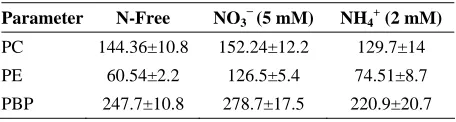
Table 1 describes the phycobiliproteins measured in Fischerella sp. FS18. The amount of PBP in the presence of NO3−(5 mM) was higher than in N free and
NH4+ (Table 1). Differences were statistically
0 0.1 0.2 0.3 0.4 0.5 0.6 0.7
Nfree NO3(5) NO3(10) NH4(1) NH4(2)
Nitrogen Source (mM)
G ro w th r a te (d -1)
Figure 1. The effect of different nitrogen sources on growth rate of Fischerella sp. FS18.
Nitrogen source (mM)
N-Free NO3-(5) NO3-(10) NH4+(1) NH4+(2)
µ g Chl mg d w -1 0 5 10 15 20 25 30
Figure 2. The effect of different nitrogen sources on chl. content of Fischerella sp. FS18.
Light intensity (µE m-2s-1)
0 200 400 600 800 1000 1200 1400 1600
µ mol O 2 mg Chl -1h -1 0 20 40 60 80 100 120 140 160 180 200
Figure 3. Photosynthesis versus irradiance curve of Fischerella sp. FS18 in different nitrogen sources. ––– N free; – – – NH4
+
(1 mM); ··· NO3 −
(5 mM); −·−·− NO3 −
(10 mM).
into account all three sources of N, the PC and PE contents followed the same trend than total PBP, with higher values at NO3−. The PC is the major biliprotein in
Fischerella sp. FS18 (152.24±12.2 µg ml−1 in NO3−
treatment).
The photodependence of C assimilation was investigated by mean of irradiance curve in all three nitrogen sources to analyze the functional significance of the altered pigment pattern referenced to chlorophyll (Fig. 2).
Figure 3 shows the highest Pmax in N-free medium
(179 µmol O2 mg chl−1 h−1). The lower obtained
contents for NH4+ (1 mM), NO3− (5mM) and NO3− (10
mM) respectively (129, 82 & 137 µmol O2 mg chl−1
h−1). With increasing light intensity, in the case of 10 mM NO3−, photosynthesis rate decreased. The N-free
medium also indicated the steepest initial slope (α=2.4 µmol O2 mg chl−1 h−1/µE m−2s−1). This medium seems to
have the highest efficiency to use light. These data give a linear correlation of photosynthesis with nitrogenase (Fig. 4). The maximum rate of photosynthesis belonged to N-free medium completely matched to nitrogenase activity. This correlation was seen in all other cases.
The amount of combined nitrogen used in the above mentioned experiments was in the range of that normally supplied in most culture media, but it was however higher than those usually found in rice field [16]. Figure 4 shows the inhibitory effect of nitrate (10 mM) and ammonium (2 mM). To check this feature, lower concentrations of N sources were used. Nitrogenase activity was fully repressed in the presence of nitrate 5 mM and ammonium 1 mM (Data not shown). Fischerella sp. FS18 fixed 856 nmol ethylene mg dw−1 h−1 in N free medium. This ability disappeared in the presence of combined nitrogen.
0 5 10 15 20 25 30 35 40
N-Free NO3- NH4+
Nitrogen sources nm o l O 2 mg d w -1min -1 0 100 200 300 400 500 600 700 800 900 nm o l C 2 H4 mg d w
-1 h
-1
Table 1. Phycobiliproteins contents in different nitrogen sources (µg ml−1) in Fischerella sp. FS18
Parameter N-Free NO3−(5 mM) NH4+ (2 mM)
PC 144.36±10.8 152.24±12.2 129.7±14
PE 60.54±2.2 126.5±5.4 74.51±8.7
PBP 247.7±10.8 278.7±17.5 220.9±20.7
Discussion
High frequency of Fischerella sp. FS18 were seen in paddy fields of Iran in the last researches [5, 23 and 24]. The adaptation of this unexplored strain to variable culture medium and ability to fix N2 was the main aim
of the present research. As nitrogen constitutes 5-10 % of dry weight of a cyanobacterial cell, physiological responses of this strain in different nitrogen sources were examined. Ammonium can be directly taken up from environment and cyanobacteria are in general able to grow with ammonium as N source, although nitrate is probably the most abundant source of combined N for their nutrition. But preference and selection of each N source is dependent of the strain.
Our results revealed that Fischerella sp. FS18 has the highest biomass in nitrate 5 mM. Ammonium seems to be more effective in decreasing the growth rate of this strain. The growth rate was almost zero in ammonium (2 mM), indicating its toxicity for this strain. Repression of growth with ammonium is concluded in other researches too. Lehtimaki et al. [10] and Rajini & Subramanian [19], for instance, showed decreasing of biomass of Nodularia spumigena and Nostoc sp. in the presence of ammonium respectively. Although based on logics of cell economy, ammonium should be the most preferred nitrogen source, but results gave nitrate as the best in Fischerella sp. FS18. This study confirms that the good or poor growth of cyanobacteria need not only be due to their efficiency to metabolize nitrogen but is actually the sum of the entire physiology and genetics of these organisms. Moore et al. [13] demonstrated the incapability of Prochlorococcus to use NO3− due to the
lack of the genes required for NO3− uptake. Thus
contrary to our finding, the ability of utilizing of NO3−is
not a common feature among phytoplanktons.
In Fischerella sp. FS18, phycocyanin is the major biliprotein and occupies half of PBP approximately. These three nitrogen sources similarly influenced the phycobiliprotein composition of the phycobilisomes, the major light harvesting antennae. Taking into account all treatments, the amount of phycocyanin was diminished 5.3% & 15.1% in N-free medium and ammonium (2mM) respectively in comparison with NO3−. The
concentration of phycoerythrin showed similar trend in altered nitrogen sources. The maximum amount of PE was seen in the presence of nitrate (5 mM). Regarding ammonium treatment, our finding of PE is in agreement with Liotenberg et al. [11]. In contrast, the observed changes in cell pigmentation are reminiscent of the phenomenon of complementary chromatic adaptation. Soltani et al. [24] has demonstrated similar variation in photosynthetic structure in cyanobacterium Fischerella sp. FS18, when light quantity was altered. These results demonstrated some common features of acclimation of this strain to spectral light quality and nitrogen sources.
Variation of chlorophyll was the same as photosynthesis. Our results also showed the higher photosynthetic activity in N-free medium. The highest rate of photosynthesis (Pmax) and the steepest initial
slope (α) in N-free grown cells revealed the highest efficiency of Fischerella sp. FS18 to fix carbon autotrophically in the limitation of light. Determination of Pmax was impossible in ammonium (2mM) due to the
high depression of growth. Also our other results, in the case of NO3− showed photoinhibition of photosynthesis.
It seems that Increasing light seemed to decrease the rate of photosynthesis.
With regards to nitrogenase activity the highest rate was seen in N-free medium as well as photosynthesis. This was predictable from the same data seen in the case of nitrogenase activity. Normally carbon skeleton of nitrogen fixation supplies by photosynthesis. Maximum nitrogenase activity in N-free medium is in agreement with Leganes & Valiente [8] in the case of Nostoc, confirming the correlation between photosynthesis and nitrogenase. Consideration of high demand of energy for biological N2 fixation can explain our finding. The
highest nitrogen fixation rates were shown at the beginning of the exponential growth phase, and usually the nitrogen fixation rate decreased towards the stationary growth phase, may be due to physiological changes in the cultures.
Fields investigations revealed that lack of nitrogen fertilizer is the main limit to crop production globally. Cyanobacteria incorporate to nitrogen supply in paddy fields due to N2 fixation. The relation between nitrogen
and abundance of cyanobacteria is investigated in laboratory experiments [14]. Besides it has shown that nitrogenase activity decreases linearly as the amount of N fertilizer increases in paddy fields [2].
experiments. However, the amount of ammonium used in laboratory experiments is usually higher than that observed in most rice fields [18]. Also recently, Ernst et al. [3] published their work on two strains of Synechococcus spp. showing that nitrate with higher dose than that found in the natural environment, caused lower growth rate. Field studies indicated that at concentrations usually found in the field, nitrogenase activity is partially and in some cases not significantly affected by ammonium and nitrate [17].
These results are similar to the data concluded of experiments with nitrogen-fixing bacteria, in which nitrogenase activity is inhibited after adding ammonium. Decreases of heterocyst differentiation and percent of vegetative cells produced were also seen in the same experiment [7]. According to Reich et al. [20], the important role of pH in the inhibition of nitrogenase activity in Anabeana variabilis in the presence of ammonium, may be due to carbohydrate sources. Prosperi et al. [14, 15] determined the nitrogenase activity of four species in the presence of ammonium and nitrate. Data indicated that ammonium was more effective in inhibition of nitrogenase activity. The maximum contents of nitrate and ammonium in paddy fields were 1.5 and 0.25 mM respectively [16]. This study indicated the inhibition of nitrogenase activity after 24-48 h by ammonium.
In conclusion, our results indicate that Fischerella sp. FS18 is a diazotrophic species with a considerable potential to be used in biofertilizers. Nitrate (5, 10 mM) and ammonium (1, 2 mM) inhibit nitrogenase activity after three days. Nitrate 5 mM promotes growth and survival and ammonium seems to be toxic for this strain.
Acknowledgements
Authors thank Mrs. Ladan Baftechi for her kind cooperation.
References
1. Asthana R.K., Srivastava A., Kayastha A., Nath G., and Singh S.P. Antibacterial potential of Y-linolenic acid from Fischerella sp. Colonizimg Neem tree bark. World Microbiol. Biotechnol., In press (2006).
2. Carreres R., zgonzalez Tome R., Sendra J., Ballesteros R., Valiente E.F., Quesada A., Nieva M., and Leganes F. Effect of nitrogen rates on rice growth and biological nitrogen fixation. J. Agric. Sci., 127: 295-302 (1996). 3. Ernst A., Deicher M., Herman, P.M.J., and Wollenzien
U.I.A. Nitrate and phosphate affect cultivability of cyanobacteria from environments with low nutrient levels. Appl. Environ. Microbiol., 71(6): 3379-3383
(2005).
4. Flores E. and Herrero A. Assimilatory nitrogen metabolism and its regulation. In: Bryant D.A. (Ed), The Molecular Biology of Cyanobacteria, Kluwer Academic Publishers, London, pp. 487-517 (1994).
5. Ghasemi Y., Tabatabaie Yazdi M., Shafiee A., Amini M., Shokravi SH., Zarrini G., and Mohseni F.A. Parsiguine, a novel antimicrobial substance from Fischerella ambigua PTCC 1635. Pharm. Biol., 42(4-5): 318-322 (2004). 6. Guerrero MG. and Lara C. Assimilation of inorganic
nitrogen. In: Fay P. and Baalen C.V. (Eds.) The Cyanobacteria, Elsevier Science, Amsterdam, pp. 163-186 (1987).
7. Kerby N.W., Rowell P., and Stewart W.D.P. Cyanobacterial ammonium transport, ammonium assimilation, and nitrogenase regulation. N. Z. J. Mar. Freshwat. Res., 21: 447-455 (1987).
8. Leganés F. and Valiente E.F. The relationship between the availability of external CO2 and nitrogenase activity in the cyanobacterium Nostoc UAM205. J. Plant Physiol., 139: 135-139 (1991).
9. Leganés F., Sanchez Maeso E. and Valiente E.F. Effect of indoleacetic acid on growth and dinitrogen fixation in cyanobacteria. Plant Cell Physiol., 28: 529-533 (1987). 10. Lehtimaki J., Moisander P., Sivonen K. and Kononen K.
Growth, nitrogen fixation, and nodularin production by two Baltic sea cyanobacteria. Appl. Environ. Microbiol.,
63(5): 1647-1656 (1997).
11. Liotenberg S., Campbell D., Rippka R., Houmard J., and Tandeau de Marsac N. Effect of the nitrogen source on phycobiliprotein synthesis and cell reserves in a chromatically adapting filamentous cyanobacterium. Microbiology, 142: 611-622 (1996).
12. Marker A.F.H. The use of acetone and methanol in the estimation of chlorophyll in the presence of phaeophytin. Freshwat. Biol., 2: 361-385 (1972).
13. Moore L.R., Post A.F., Rocap G., and Chisholm S.W. Utilization of different nitrogen sources by the marine cyanobacteria Prochlorococcus and Synechococcus. Limnol. Oceanogr., 47(4): 989-996 (2002).
14. Prosperi C., Boluda L., Luna C., and Valiente E.F. Environmental factors affecting in vitro nitrogenase activity of cyanobacteria isolated from rice-fields. J. Appl. Phycol., 4: 197-200 (1992).
15. Prosperi C., Luna C. and Valiente E.F. Influence of pH, light intensity and oxygen on the short-term effect of ammonium on nitrogenase activity of cyanobacteria from rice fields. Environ. Exp. Bot., 33(4): 545-552 (1993). 16. Quesada A. Estudio de las pobliciones naturals de
cianobacterias presentes en los arrozales Valencianos, Ph.D. Thesis, Universidad de Autonoma de Madrid, 200 p. (1990).
17. Quesada A., Leganes F., and Valiente E.F. Environmental factors controlling N2 fixation in Mediterranean rice fields. Microb. Ecol., 34: 39-48 (1997).
18. Quesada A., sanchez Maseo E. and Valiente E.F. New incubation device for in situ measurement of acetylene-reducing activity in rice fields. J. Appl. Phycol., 1: 195-200 (1989).
on cyanobacterial nitrogen fixation, IARI, New Delhi, (1990).
20. Reich S. Almon H., and Boger P. Short-term effect of ammonia on nitrogenase activity of Anabaena variabilis (ATCC 29413). FEMS Microbiol. Lett., 34: 53-56 (1986). 21. Roger P.A. and Kulasooriya S.A. Blue-green Algae and Rice. The international rice research institute, Manila, (1980).
22. Roger P.A. and Watanabe I. Technologies for utilizing biological nitrogen fixation in wetland rice: potentialities, current usage, and limiting factors. Fert. Res., 9: 39-77 (1986).
23. Soltani N., Khavari-Nejad R., Tabatabaie M., Shokravi SH., and Valiente E.F. Screening of soil cyanobacteria for antimicrobial activity. Pharm. Biol., 43(5): 455-459
(2005).
24. Soltani N., Khavari-Nejad R., Tabatabaie M., Shokravi S.H., and Valiente E.F. Variation of Nitrogenase Activity, photosynthesis and pigmentation of cyanobacterium Fischerella ambigua strain FS18 under different irradiance and pH. World J Microbiol. Biotechnol., In Press (2006)
25. Tandeau de Marsac N. and Houmard J. Adaptation of cyanobacteria to environmental stimuli: new steps towards molecular mechanisms. FMS Microbiol. Rev.,
104: 119-190 (1993).