Please cite this article as: N. Foroozesh, R. Tavakkoli-Moghaddam, Sustainable Supplier Selection by a New Hybrid Support Vector-model based on the Cuckoo Optimization Algorithm, International Journal of Engineering (IJE), TRANSACTIONS C: Aspects Vol. 30, No. 6, (June 2017) 867-875
International Journal of Engineering
J o u r n a l H o m e p a g e : w w w . i j e . i r
Sustainable Supplier Selection by a New Hybrid Support Vector-model based on the
Cuckoo Optimization Algorithm
N. Foroozesh, R. Tavakkoli-Moghaddam*
School of Industrial Engineering, College of Engineering, University of Tehran, Tehran, Iran
P A P E R I N F O
Paper history:
Received 29 January 2017
Received in revised form 03 April 2017 Accepted 21 April 2017
Keywords:
Computational Intelligence Sustainable Supplier Selection Least Square-Support Vector Machine Cuckoo Optimization Algorithm
A B S T R A C T
For assessing and selecting sustainable suppliers, this study considers a triple-bottom-line approach, including profit, people and planet, and regards business operations, environmental effects along with social responsibilities of the suppliers. Diverse metrics are acquainted with measure execution in these three issues. This study builds up a new hybrid intelligent model, namely COA-LS-SVM, for taking performance variations of the sustainable suppliers quantified by the performance index. The presented artificial intelligent (AI) model is introduced in light of a new combination of least squares-support vector machine (LS-SVM) and cuckoo optimization algorithm (COA). The LS-SVM is used in regards to the mapping capacity amongst performance index and its causative input criteria. The COA is presented to advance LS-SVM tuning parameters. In this exploration, an illustrative database comprising of 80 historical cases is gathered to set up the presented intelligence system. In the light of experimental results, the presented COA-LS-SVM can effectively illustrate performance index’s variances since it has accomplished relatively low statistical metrics. Therefore, the proposed hybrid AI framework can be a promising approach to help the supply chain decision-makers in sustainable supply chain management (SSCM).
doi: 10.5829/ije.2017.30.06c.07
1. INTRODUCTION1
Business associations are under genuine threat to maintain their current supply chain because of globalization, challenging market, and demand uncertainty along with economic competitiveness. The idea of sustainability has picked up unmistakable quality in recent years to follow these developing difficulties. Incorporating sustainability ideas in center business elements of supply chain empowers association to accomplish competitive position in the market, in this contemporary period of an all-around testing environment [1]. Sustainable supply chain management (SSCM) is being regarded as a coming of another time that fuses environmental performance, social performance, and economic contribution-or what has been alluded as a convergence of main spheres of sustainable development [2].
*Corresponding Author’s Email: [email protected] (R. Tavakkoli-Moghaddam)
Supplier selection assumes an imperative part, while dealing with the supply chain. During important tasks of purchasing management in supply chain and in this process, suppliers are investigated, assessed and turn into a part of the company’s supply chain [3]. Number of evaluation factors or criteria expanded as environmental, social, economic and consumer loyalty concerns were added to the customary variables, for example, quality, convey, cost and some more. Notwithstanding this, a portion of the criteria are clashing in nature which requires the use of artificial intelligent (AI) techniques [4-6]. Fundamentally, sustainable supplier selection issue can be seen in two issues: identification of factors and ranking the suppliers by regarding the chose criteria [7].
techniques as a part of the AI approach. Not requiring the complicated process of decision-making is one of the fundamental benefits of the AI models. The innovations in light of the AI approach are utilized in spaces of sustainable-suppliers [8-10].
Amindoust et al. [11] the sustainable supplier selection factors and sub-factors were resolved and in light of those factors and sub-factors a strategy was extended onto evaluation and ranking of a given arrangement of suppliers based on fuzzy inference system (FIS). Kuo et al. [12] built up an intelligent supplier-DSS which could regard the quantitative and subjective factors concurrently based on a particle swarm optimization (PSO)-based fuzzy neural network (FNN). In Azadnia et al.’s study [7], an incorporated approach of fuzzy analytical hierarchy process (AHP) and fuzzy logic were provided with a specific end goal to tackle sustainable supplier selection problem. In Omurca’s study [13], a hybridization of fuzzy c-means (FCM) and rough set theory (RST) procedures was reported as another answer for supplier selection, evaluation and development issue. Jauhar et al. [14] intended to analyze the difficulties of sustainable supplier selection and proposed a differential evolution-based approach for selecting sustainable suppliers in the pulp and paper industry. Jauhar and Pant [15] introduced the supplier contribution in the related activities of the SCM by using differential evolution (DE) to choose the effective practical supplier, giving the greatest satisfaction to the sustainable criteria decided. Bhardwaj [16] built up a model for sustainable system by using an asset-based approach and value chain investigation. Kara et al. [17] intended to investigate the sustainability issues in supplier assessment and to propose sustainable supplier assessment criteria by the related literature. Ahmadi et al. [18] provided an organized and coordinated choice model for assessing suppliers in the SSCM with regards to telecom industry by consolidating the AHP and enhanced grey relational analysis. Ağan et al. [19] introduced a comprehension of environmental supplier development (ESD), which was the improvement of suppliers to producers with the end goal of natural execution with data gathered from several Turkish manufacturing plants. Girubha et al. [20] regarded interpretative structural modelling by hybrid multi-attribute decision-making (MADM) methods to assess sustainable supplier. Luthra et al. [21] considered a structure to assess sustainable supplier selection by using an incorporated AHP and VIKOR within multi-criteria compromise solution approach with an application to automobile company in India. Ghadimi et al. [22] focused on a useful decision-making way to deal with assessing the most sustainable suppliers for an automotive industry by a fuzzy inference system.
In this paper, an endeavor is made to streamline the
SSCM by presenting a novel hybrid AI model. In fact, this paper builds up a new hybrid intelligent model,
namely COA-LS-SVM, for taking performance
variations of the sustainable suppliers quantified by the performance index. The presented AI model is introduced in light of a new combination of least squares-support vector machine (LS-SVM) and cuckoo optimization algorithm (COA). LS-SVM is used for regarding the mapping capacity amongst performance index and its causative input criteria. The LS-SVM is a new neural network and directed learning technique to handle different network issues. Because of their fabulous execution in speculation and their ability for self-learning, the LS-SVM have defeated the potential shortcomings of ordinary expectation procedures, in particular artificial neural networks (ANNs) in real-world applications. The COA is presented to advance LS-SVM tuning parameters. In this exploration, a database comprising of 80 historical cases is gathered to set up the presented COA-LS-SVM model in the SCM. Similar investigations are likewise directed to evaluate the execution of the proposed model and conventional techniques in the related literature, including RBF, MLP neural network and LS-SVM.
The organization of the rest of this paper is provided as follows: In Section 2, the theories on the LS-SVM and COA are presented. Section 3 is devoted to the
description of the COA-LS-SVM model. The
background information for the SSCM problem is given in Section 4. Section 5 provides the comparative assessments. Finally, Section 6 gives some concluding remarks.
2. RESEARCH BACKGROUNDS
2. 1. Least Square-support Vector Machine (LS-SVM) LS-SVM is an adjusted variant of support vector machine (SVM) [23, 24]. In the LS-SVM training, a least solution, cost function has been provided to get a linear set of equations in the dual space. To determine the arrangement, it is necessary to manage an arrangement of linear conditions as opposed to illuminating a nonlinear programming as standard SVM [23, 25]. The detailing of LS-SVM can be expressed as the accompanying optimization issue:
𝑀𝑖𝑛𝑖𝑚𝑖𝑧𝑒 𝐽𝑝(𝑤, 𝑒) =12 𝑤𝑇𝑤 + 𝛾12∑𝑁𝑖=1𝑒𝑖2
(1)
𝑆𝑢𝑏𝑗𝑒𝑐𝑡𝑒𝑑 𝑡𝑜 𝑦𝑖= 𝑤𝑇𝜙(𝑥𝑖) + 𝑏 + 𝑒𝑖 , 𝑖 = 1, … , 𝑁
where 𝑒𝑖∈ 𝑅 are error variables; 𝛾 > 0 is a regularization constant.
primal issue. Subsequently, it is important to set up Lagrangian and infer the double issue. The Lagrangian is reported as follows [27].
𝐿(𝑤, 𝑏, 𝑒; 𝛼) = 𝐽𝑝(𝑤, 𝑒) − ∑𝑁𝑖=1𝛼𝑖{𝑤𝑇𝜙(𝑥𝑖) + 𝑏 +
𝑒𝑖− 𝑦𝑖}
(2)
where 𝛼𝑖 refers to Lagrange multipliers. The conditions are as follows.
{
𝜕𝐿
𝜕𝑤= 0 → 𝑤 = ∑ 𝛼𝑖𝜙(𝑥𝑖)
𝑁
𝑖=1 𝜕𝐿
𝜕𝑏= 0 → ∑ 𝛼𝑖= 0
𝑁
𝑖=1 𝜕𝐿
𝜕𝑒𝑖= 0 → 𝛼𝑖= 𝛾𝑒𝑖 , 𝑖 = 1, … , 𝑁 𝜕𝐿
𝜕𝑎𝑖= 0 → 𝑤
𝑇𝜙(𝑥
𝑖) + 𝑏 + 𝑒𝑖− 𝑦𝑖= 0, 𝑖 = 1, … , 𝑁
(3)
After elimination of e and w, the following linear model can be given by:
[0 1𝑣𝑇
1 𝜔 + 𝐼/𝛾 ] [
𝑏
𝛼] = [
0
𝑦] (4)
where 𝑦 = 𝑦1, … , 𝑦𝑁, 1𝑣 = [1; … ; 1], and 𝛼 =
[𝛼1; … ; 𝛼𝑁]. In addition, the kernel function is applied as follows.
𝜔 = 𝜙 (𝑥𝑖)𝑇 𝜙 (𝑥𝑙) = 𝐾(𝑥𝑖, 𝑥𝑙) (5)
The function estimation is provided by:
𝑦(𝑥) = ∑𝑁𝑖=1𝛼𝑖𝐾(𝑥𝑖, 𝑥𝑙) + 𝑏 (6)
where 𝛼𝑘 and b can be denoted as the solution to the linear model (4). RBF kernel is presented below.
𝐾(𝑥𝑖, 𝑥𝑙) = exp (
‖𝑥𝑖−𝑥𝑙‖2
2𝜎2 ) (7)
where, 𝜎 is the kernel function parameter.
The LS-SVM has widely been applied to engineering applications [28-30]; for instance, data fitting of small samples [31], electrical energy consumption forecasting [32], curing thermal process [33], cosmetics productions [34], river water pollution [35], pipeline critical deposition velocity prediction [36], forecasting in civil engineering [37].
2. 2. Cuckoo Search Algorithm The cuckoo search (CS) or cuckoo optimization (CO) algorithm was initially created by Sun et al. [38]. It is gotten from the activity of cuckoos laying their eggs in the nests of other birds to regard those birds hatch eggs for them. Nonetheless, once the host bird’s creatures find the cuckoo eggs, the eggs could be discarded or the host birds can surrender their homes and revamp another nest somewhere else.
In the CS calculation, every home speaks to an answer. Bouzerdoum [39] introduced in the algorithm, can help in comprehension of the CS procedure. The L'evy flight specified in the pseudo code is created by:
𝑥𝑖𝑡+1= 𝑥
𝑖𝑡+ 𝛼 ⊕ 𝐿´𝑒𝑣𝑦 (𝜆) (8)
Determine the objective function
𝑔(𝑥), 𝑥 = (𝑥1, 𝑥2, . . . , 𝑥𝑑)𝑇;
Initialize the population of 𝑁 host nests 𝑥𝑖 (𝑖 =
1, 2, . . . , 𝑁);
WHILE (The stop criterion has not met)
Choose a cuckoo randomly by L´evy flights and evaluate its goodness of fit or quality 𝐺𝑖
Choose a nest among 𝑁 (say 𝑗) randomly; IF (𝐺𝑖> 𝐺𝑗)
Replace 𝑗 by the new solution; END IF
Abandon a fraction (𝑝𝑎) of worse nests and build new ones;
Keep the best solutions (or nests with quality solutions); Rank the solutions and find the current best solution; ENDWHILE
Post-process results;
Figure 1. Steps of the proposed COA.
where 𝛼 > 0 can be the step size. The product ⊕
denotes entry-wise multiplication location a Levy flight can be regarded when the step-lengths could be distributed according to the probability distribution as:
𝐿´𝑒𝑣𝑦 ∼ 𝑢 = 𝑡−𝜆 , 1 < 𝜆 ≤ 3 (9)
which has an infinite variance. Thus, the consecutive steps of a cuckoo search forms random walk process that obeys a power-law step-length distribution with a heavy tail.
3. Proposed COA-LS-SVM Model
To remedy the deficiencies on generalization ability and suitability along with predictive accuracy of the LS-SVM, a novel AI model is proposed in this paper for the sustainable supply chain. The AI model consists of two new approaches (i.e., LS-SVM and COA) in Figure 2.
The COA within the LS-SVM leads to dynamically optimize the LS-SVM parameters to boost the sustainable supply chain-prediction efficiency. The COA-LS-SVM algorithm for the sustainable supplier selection problem in the SSCM is presented in subsequent steps:
Step 1. Scale data. The input data are normalized to
ensure that diverse units of estimation are evacuated and all factors or attributes are defined in the same range [0,1] by:
min max
min
x
x
x
x
x
isca
(10)After implementing this transformation, the effect of dimension is removed from all the variables.
Step 2. Prepare the necessary data. Training and test
The predictability of sustainable supplier selection is explored by
recurrence plot. Sustainable
suppliers database
Cuckoo optimization algorithm
Cuckoo optimization algorithm-Least square- support vector machine
Forecasting sustainable supplier selection by COA-LS-SVM model
Analysis of forecasting error
Beside the capability of analysis of predictability, recurrence plot can also select the optimal inputs set of least square-support vector model.
LS-SVM
Figure 2. Framework of the proposed COA-LS-SVM
Step 3. Initialize parameters of the COA, range of
kernel function and its parameters(𝛾, 𝜎).
Step 4. Select randomly a kernel function. Generate
a random set of 𝛾 and 𝜎 in the given valuing ranges. Selected kernel function and its parameters such as 𝛾
and 𝜎 is considered as an individual of LS-SVM.
Step 5. Deploy the selected parameters and the
obtained support vectors to represent a LS-SVM model. To test estimation ability of the LS-SVMs, the testing samples are used. Applicability of the model is measured by fitness as:
i i
i p p
function
Fitness min ˆ (11)
where, 𝑝𝑖 and 𝑝̂𝑖 denoted the actual and estimated values of the i-th data.
Step 6. If fitness is accepted, then the training
procedure of LS-SVM terminates and the best SVMs are determined. Otherwise, go to step 7 and produce the new solution.
Step 7. Apportion a determined number of eggs to each
cuckoo in the COA.
Step 8. Calculate egg-laying radius (ELR) for each
cuckoo in the COA. An ELR can be indicated for each cuckoo as:
𝐸𝐿𝑅 = 𝛼 ×𝑁𝑢𝑚𝑏𝑒𝑟 𝑜𝑓𝑐𝑢𝑟𝑟𝑒𝑛𝑡𝑐𝑢𝑐𝑘𝑜𝑜𝑠′𝑒𝑔𝑔
𝑇𝑜𝑡𝑎𝑙 𝑛𝑢𝑚𝑏𝑒𝑟 𝑜𝑓 𝑒𝑔𝑔𝑠 (𝑣𝑎𝑟𝑢𝑏−
𝑣𝑎𝑟𝑙𝑏)
(12)
where 𝑎 ∈ ℤ is supposed to control the maximum value of ELR, 𝑣𝑎𝑟𝑢𝑏 and 𝑣𝑎𝑟𝑙𝑏 are the upper bound and lower bound for variables, respectively.
Step 9. Destroy the detected parasite eggs by host
birds.
Step 10. Let other eggs which are not identified
hatch and attain maturity.
Step 11. Evaluate the habitat of recently grown
cuckoos.
Step 12. Limit the maximum number of cuckoo,
those who live in worst habitat must die.
Step 13. Cluster cuckoos to provide the target habitat
regarding immigration of cuckoos.
Step 14. Let new cuckoo population migrate toward
target habitat.
Step 15. Stop condition checking: if stopping
criteria (maximal running time predefined or the error accuracy of the fitness function) are met, go to step 16. Otherwise, go to the step 3.
Step 16. Terminate the training procedure, output the
best solution.
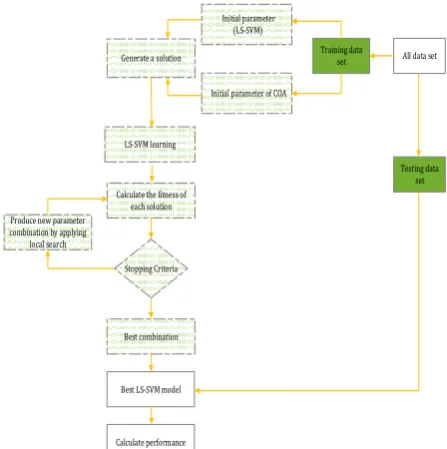
In Figure 3, the flowchart of the proposed COA-LS-SVM model is illustrated. The COA is used to explore a better combination of the two parameters in the LS-SVM model. The values of two parameters are updated when a new solution of the COA is generated. Afterwards, a forecasting process is implemented and a forecasting error is computed. Finally, if the stopping criterion is satisfied, then stop the algorithm and the latest solution is a best solution. This algorithm is employed to find a better combination of the LS-SVM parameters so that a smaller fitness function is attained during estimation iteration.
4. PROPOSED MODEL APPLICATION
Sustainable supplier selection is regarded as a complicated process as it contains numerous evaluation
All data set Training data
set
Testing data set Initial parameter
(LS-SVM)
Generate a solution
LS-SVM learning
Calculate the fitness of each solution Produce new parameter
combination by applying local search
Best LS-SVM model Best combination
Initial parameter of COA
Calculate performance Stopping Criteria
factors or criteria, consideration of criteria weights and the most significant factor is that the selection of suitable factor based on all the three pillars of sustainability. For this purpose, the evaluation criteria are provided by the literature review as given in Table 1 (e.g., [20, 40, 41]).
TABLE 1. Evaluation criteria for the sustainable supplier selection problem
Sustainable supplier selection problem
Criteria Economics sub-criteria
C1 Price performance value
C2 On time delivery
C3 Transportation cost
C4 Compliance with sectorial price behavior
C5 Warranties, claim policies and quality assurance
C6 Organization commitment
C7 Responsiveness
Social sub-criteria
C8 Rights of stakeholders
C9 Work safety
C10 Information disclosure
C11 Respect for policy
Environmental sub-criteria
C12 Green design and Recycling
C13 Green R&D
C14 Environmental management system
C15 Use of environment friendly technology
C16 Pollution control initiatives
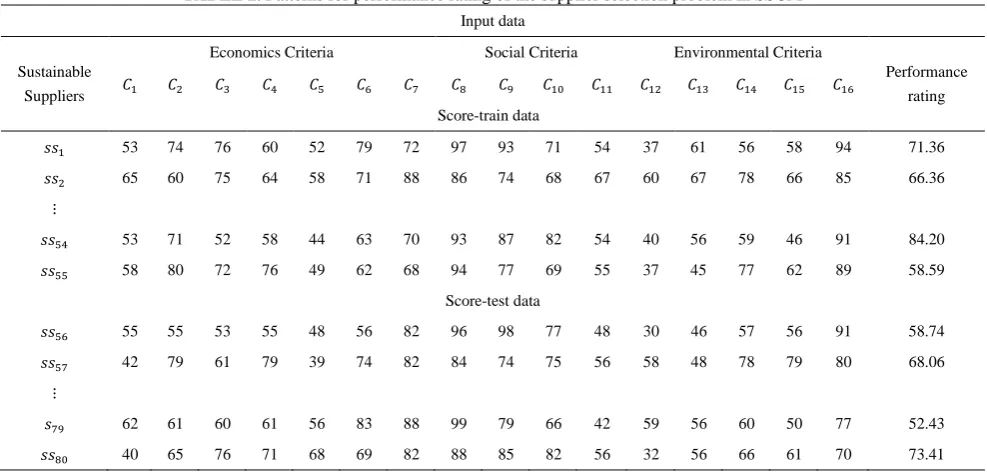
To test the adequacy of the proposed COA-LS-SVM model, we use a genuine arrangement of execution rating of sustainable suppliers in the SSCM. Then, issue of sustainable supplier evaluation and selection can be a standout amongst the most noteworthy errands and exercises of obtaining administration due to the key a portion of sustainable supplier’s performance on cost, quality, delivery and service in achieving objectives of the sustainable supply chain. With a specific end goal to actualize the proposed COA-LS-SVM model the supposed organization is regarded as a dataset in the SSCM. A sum of 55 training data points and 25 training data points are given. Henceforth, the genuine information set is partitioned into training and test data set in the proportion of 69% to 31%. Table 2 outlined 55 input data as for each of sustainable supplier evaluation criteria which are characterized in 3 areas for the sustainable supplier selection problem and 25 approval cases.
Three common statistical metrics including (1) mean absolute percentage error (MAPE), (2) root mean squared error (RMSE), and (3) standard deviation error (SDE) are employed to appraise the estimation performance of the proposed AI model. These metrics are defined by [23, 42-45]:
TABLE 2. Patterns for performance rating of the supplier selection problem in SSCM
Input data
Sustainable
Suppliers
Economics Criteria Social Criteria Environmental Criteria
Performance
rating
𝐶1 𝐶2 𝐶3 𝐶4 𝐶5 𝐶6 𝐶7 𝐶8 𝐶9 𝐶10 𝐶11 𝐶12 𝐶13 𝐶14 𝐶15 𝐶16
Score-train data
𝑠𝑠1 53 74 76 60 52 79 72 97 93 71 54 37 61 56 58 94 71.36
𝑠𝑠2 65 60 75 64 58 71 88 86 74 68 67 60 67 78 66 85 66.36
⋮
𝑠𝑠54 53 71 52 58 44 63 70 93 87 82 54 40 56 59 46 91 84.20
𝑠𝑠55 58 80 72 76 49 62 68 94 77 69 55 37 45 77 62 89 58.59
Score-test data
𝑠𝑠56 55 55 53 55 48 56 82 96 98 77 48 30 46 57 56 91 58.74
𝑠𝑠57 42 79 61 79 39 74 82 84 74 75 56 58 48 78 79 80 68.06
⋮
𝑠79 62 61 60 61 56 83 88 99 79 66 42 59 56 60 50 77 52.43
(1) 1 1 ˆ 100%
Ni i
i i
p p p N
MAPE (13)
(2)
N
i pi pi N
RMSE 1 1 ˆ 2
(14)
(3)
N
i i
i i i i
N
i i i
e N e p p e
e e N SDE
1 1
2
1 , ˆ
; 1
(15)
where, 𝑝𝑖 and 𝑝̂𝑖 represent the actual and estimated values of the i-th data, respectively. Three criteria or metrics were used to quantify the deviation between the actual and predicted values in the SSCM.
The first performance metric (i.e., MAPE) is viewed as a relative measure that considers errors as a rate of the real data, regarded as a viable method for judging the degree or significance of errors for the estimations. The second execution metric (i.e., RMSE) indicates the deviation between the actual and estimated values by the proposed display; consequently, smaller values of this rule are favored for various circumstances into a solitary measure of prescient one. The third performance metric (i.e., SDE) denotes the square root of the variance of error, the deviation between the actual and predicted values.
The above-mentioned criteria are regarded as commonly-used measures for differences between values in statistics in the related literature, particularly in trend estimations [23, 43-52]. The lower values of the three statical criteria (i.e., MAPE, RMSE, SDE) indicate the better performance and more accuracy in the estimations in the SSCM.
In this paper, the radial basis function is employed as the kernel function for performance prediction in the sustainable supplier selection in the SSCM. There are two independent parameters while using RBF kernels (i.e., 𝛾 and 𝜎). Searching two parameters can be very significant for the best forecasting ability. Finally, the parameters in the proposed AI model are as follows: 𝛾 = 58942 and 𝜎 = 0.104.
The processes of determining the parameters for three conventional techniques are presented. The AI technique (i.e., MLP) is a feed forward ANN model that maps sets of input data onto a set of appropriate output [47-52]. The input layer includes three nodes. The number of output nodes can be set to 1. The number of neurons in the hidden layer can be 6. The activation functions for the hidden and output layers are regarded as the hyperbolic tangent transfer function and linear function respectively. To train the network Levenberg-Marquardt back propagation is regarded. The third conventional technique (i.e., SVM) is a machine
learning based on the statistical learning theory by considering several merits over other ANN techniques. There are no general rules for setting the SVM parameters. The authors’ experience and trial-and-error are employed. Finally, the values of parameters obtained by the SVM technique are: 𝛾 = 546000
and𝜎 = 0.081. The overall comparative results based on the MAPE, RMSE, and SDE indices are illustrated for the proposed AI model in Table 3.
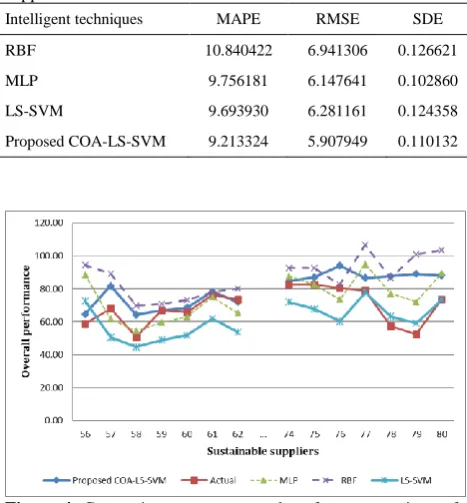
According to three commonly-used measures in the related literature reported in Table 3, the computational results indicate that the proposed COA-LS-SVM model has achieved the lowest prediction error and the highest forecasting ability in SSCM. The proposed AI model is compared with other intelligent techniques, including RBF, MLP and LS-SVM, for performance prediction in the sustainable supplier selection in SSCM. In fact, the proposed COA-LS-SVM has the lower values based on the first three performance criteria (i.e., MAPE, RMSE and SDE). As it can be seen from Table 3, the COA-LS-SVM model is put in the first rank, and other AI models (i.e., LS-SVM, MLP and RBF) are put in the second, third and fourth ranks, separately in the decision problem. In addition, Figure 4 contrasts the outcomes acquired and the expectation comes about because of RBF, MLP, LS-SVM and LS-COA-LS-SVM with actual performance rating of suppliers for test records (56-80) individually.
TABLE 3. Overall comparative results of the sustainable supplier selection
Intelligent techniques MAPE RMSE SDE
RBF 10.840422 6.941306 0.126621
MLP 9.756181 6.147641 0.102860
LS-SVM 9.693930 6.281161 0.124358
Proposed COA-LS-SVM 9.213324 5.907949 0.110132
Figure 4 portrays the performance ratings of the sustainable suppliers for the sustainable supplier evaluation problem in SSCM, contrasted and genuine information from the proposed COA-LS-SVM and other intelligent techniques. The general performance estimation of the suppliers from the intelligent model are close to real performance data in the SSCM. In fact, the COA-LS-SVM has been considered with the maximum generalization ability and can properly be capable to model nonlinear relationships in SSCM.
5. CONCLUSIONS
This paper has displayed a new hybrid intelligent approach (i.e., COA-LS-SVM) to facilitate managers in sustainable supplier performance estimation through improvement of the performance index modeling exactness. The COA-LS-SVM was produced by a new combination of the LS-SVM and COA. The LS-SVM was used to find the basic mapping between affecting components and the sustainable supplier performance records. The COA was proposed as the optimizer to search for LS-SVM ideal parameters. By this component, the proposed AI framework can work independently in light of the fact that it dispenses with the trial-and-error procedure in parameter setting. The LS-SVM used as a main part of this paper can deal with data with nonlinear features, and the COA technique received to improve the estimation approach, which was used to optimize the parameters in the LS-SVM model. Subsequent to being trained, COA-LS-SVM can be regarded as a causal prediction model to make induction of performance index in the SSCM at whatever point an input pattern was given. Through examinations, it was presumed that the proposed COA-LS-SVM has demonstrated a superior generalization performance and yielded a lower estimation error of the sustainable supplier selection problem. In fact, the COA-LS-SVM considered with the maximum generalization ability can properly be capable to model nonlinear relationships in SSCM. For further research directions, the proposed prediction method can be applied to other sustainable supply chain decisions for the mid and long-term planning, e.g., measurement of supply chain agility, minimizing the bullwhip effect, facility location and vehicle routing.
6. REFERENCES
1. Khodakarami, M., Shabani, A., Saen, R.F. and Azadi, M., "Developing distinctive two-stage data envelopment analysis models: An application in evaluating the sustainability of supply chain management", Measurement, Vol. 70, (2015), 62-74. 2. Ansari, Z.N. and Kant, R., "A state-of-art literature review
reflecting 15 years of focus on sustainable supply chain
management", Journal of Cleaner Production, Vol. 142, (2017), 2524-2543.
3. Keskin, G.A., Ilhan, S. and Ozkan, C., "The fuzzy art algorithm: A categorization method for supplier evaluation and selection", Expert Systems with Applications, Vol. 37, No. 2, (2010), 1235-1240.
4. Önüt, S., Efendigil, T. and Kara, S.S., "A combined fuzzy mcdm approach for selecting shopping center site: An example from istanbul, turkey", Expert Systems with Applications, Vol. 37, No. 3, (2010), 1973-1980.
5. Beck, P. and Hofmann, E., "Multiple criteria decision making in supply chain management–currently available methods and possibilities for future research", Die Unternehmung, Vol. 66, No. 2, (2012), 180-213.
6. Selmi, M., Kormi, T. and Ali, N.B.H., "Comparing multi-criteria decision aid methods through a ranking stability index", in Modeling, Simulation and Applied Optimization (ICMSAO), 5th International Conference on, IEEE., (2013), 1-5.
7. Azadnia, A.H., Ghadimi, P., Saman, M.Z.M., Wong, K.Y. and Heavey, C., "An integrated approach for sustainable supplier selection using fuzzy logic and fuzzy AHP", in Applied Mechanics and Materials, Trans Tech Publ. Vol. 315, (2013), 206-210.
8. Ng, S.T. and Skitmore, R.M., "Cp-dss: Decision support system for contractor prequalification", Civil Engineering Systems, Vol. 12, No. 2, (1995), 133-159.
9. Cook, R.L., "Case‐based reasoning systems in purchasing: Applications and development", Journal of Supply Chain Management, Vol. 33, No. 4, (1997), 32-39.
10. Khoo, L.-P., Tor, S.B. and Lee, S.S., "The potential of intelligent software agents in the world wide web in automating part procurement", Journal of Supply Chain Management, Vol. 34, No. 1, (1998), 46-53.
11. Amindoust, A., Ahmed, S., Saghafinia, A. and Bahreininejad, A., "Sustainable supplier selection: A ranking model based on fuzzy inference system", Applied Soft Computing, Vol. 12, No. 6, (2012), 1668-1677.
12. Kuo, R., Hong, S. and Huang, Y., "Integration of particle swarm optimization-based fuzzy neural network and artificial neural network for supplier selection", Applied Mathematical Modelling, Vol. 34, No. 12, (2010), 3976-3990.
13. Omurca, S.I., "An intelligent supplier evaluation, selection and development system", Applied Soft Computing, Vol. 13, No. 1, (2013), 690-697.
14. Jauhar, S.K., Pant, M. and Abraham, A., A novel approach for sustainable supplier selection using differential evolution: A case on pulp and paper industry, in Intelligent data analysis and its applications, volume ii. (2014), Springer.105-117.
15. Jauhar, S. and Pant, M., Sustainable supplier selection: A new differential evolution strategy with automotive industry application, in Recent developments and new direction in soft-computing foundations and applications. (2016), Springer.353-371.
16. Bhardwaj, B.R., "Role of green policy on sustainable supply chain management: A model for implementing corporate social responsibility (CSR)", Benchmarking: An International Journal, Vol. 23, No. 2, (2016), 456-468.
17. Kara, M.E., Yurtsever, O. and Fırat, S.U.O., "Sustainable supplier evaluation and selection criteria", Social and Economic Perspectives on Sustainability, (2016), 159-166.
19. Agan, Y., Kuzey, C., Acar, M.F. and Acıkgoz, A., "The relationships between corporate social responsibility, environmental supplier development, and firm performance", Journal of Cleaner Production, Vol. 112, (2016), 1872-1881. 20. Girubha, J., Vinodh, S. and KEK, V., "Application of
interpretative structural modelling integrated multi criteria decision making methods for sustainable supplier selection", Journal of Modelling in Management, Vol. 11, No. 2, (2016), 358-388.
21. Luthra, S., Govindan, K., Kannan, D., Mangla, S.K. and Garg, C.P., "An integrated framework for sustainable supplier selection and evaluation in supply chains", Journal of Cleaner Production, Vol. 140, (2017), 1686-1698.
22. Ghadimi, P., Dargi, A. and Heavey, C., "Sustainable supplier performance scoring using audition check-list based fuzzy inference system: A case application in automotive spare part industry", Computers & Industrial Engineering, (2017). 23. Suykens, J.A., Van Gestel, T. and De Brabanter, J., "Least
squares support vector machines, World Scientific, (2002). 24. Suykens, J.A. and Vandewalle, J., "Least squares support vector
machine classifiers", Neural Processing Letters, Vol. 9, No. 3, (1999), 293-300.
25. Yu, L., Chen, H., Wang, S. and Lai, K.K., "Evolving least squares support vector machines for stock market trend mining", IEEE Transactions on Evolutionary Computation, Vol. 13, No. 1, (2009), 87-102.
26. Wang, H. and Hu, D., "Comparison of svm and ls-svm for regression", in Neural Networks and Brain,. ICNN&B'05. International Conference on, IEEE. Vol. 1, (2005), 279-283.
27. Cheng, M.-Y., Hoang, N.-D. and Wu, Y.-W., "Hybrid intelligence approach based on ls-svm and differential evolution for construction cost index estimation: A taiwan case study", Automation in Construction, Vol. 35, (2013), 306-313.
28. Vahdani, B., Mousavi, S.M., Mousakhani, M., Sharifi, M. and Hashemi, H., "A neural network model based on support vector machine for conceptual cost estimation in construction projects", Journal of Optimization in Industrial Engineering, Vol. 5, No. 10, (2012), 11-18.
29. Mousavi, S.M., Tavakkoli-Moghaddam, R., Vahdani, B., Hashemi, H. and Sanjari, M., "A new support vector model-based imperialist competitive algorithm for time estimation in new product development projects", Robotics and Computer-Integrated Manufacturing, Vol. 29, No. 1, (2013), 157-168. 30. Mousavi, S.M., Vahdani, B. and Abdollahzade, M., "An
intelligent model for cost prediction in new product development projects", Journal of Intelligent & Fuzzy Systems, Vol. 29, No. 5, (2015), 2047-2057.
31. Wang, H.K., Ma, J.S., Fang, L.Q., Yang, Y.F. and Liu, H.P., "Application of the least squares support vector machine based on quantum particle swarm optimization for data fitting of small samples", in Applied Mechanics and Materials, Trans Tech Publ. Vol. 472, (2014), 485-489.
32. Ahmad, A., Hassan, M., Abdullah, M., Rahman, H., Hussin, F., Abdullah, H. and Saidur, R., "A review on applications of ann and svm for building electrical energy consumption forecasting", Renewable and Sustainable Energy Reviews, Vol. 33, (2014), 102-109.
33. Lu, X., Zou, W. and Huang, M., "A novel spatiotemporal ls-svm method for complex distributed parameter systems with applications to curing thermal process", IEEE Transactions on Industrial Informatics, Vol. 12, No. 3, (2016), 1156-1165. 34. Vahdani, B., Mousavi, S.M., Tavakkoli-Moghaddam, R. and
Hashemi, H., "A new enhanced support vector model based on general variable neighborhood search algorithm for supplier performance evaluation: A case study", International Journal
of Computational Intelligence Systems, Vol. 10, No. 1, (2017), 293-311.
35. Kisi, O. and Parmar, K.S., "Application of least square support vector machine and multivariate adaptive regression spline models in long term prediction of river water pollution", Journal of Hydrology, Vol. 534, (2016), 104-112.
36. Yang, J., Wang, X. and Wu, J., "Application of ls-svm on slurry pipeline critical deposition velocity prediction", in Control and Decision Conference (CCDC), Chinese, IEEE. V, (2016), 1411-1415.
37. Chou, J.S. and Pham, A.D., "Smart artificial firefly colony algorithm‐based support vector regression for enhanced forecasting in civil engineering", Computer‐Aided Civil and Infrastructure Engineering, Vol. 30, No. 9, (2015), 715-732.
38. Sun, H.-x., Zhao, N.-n. and Xu, X.-h., "Text region localization using wavelet transform in combination with support vector machine", Journal-Northeastern University Natural Science, Vol. 28, No. 2, (2007), 165-172.
39. Bouzerdoum, M., Mellit, A. and Pavan, A.M., "A hybrid model (sarima–SVM) for short-term power forecasting of a small-scale grid-connected photovoltaic plant", Solar Energy, Vol. 98, (2013), 226-235.
40. Awasthi, A., Chauhan, S.S. and Goyal, S.K., "A fuzzy multicriteria approach for evaluating environmental performance of suppliers", International Journal of Production Economics, Vol. 126, No. 2, (2010), 370-378.
41. Tseng, M.-L. and Chiu, A.S., "Evaluating firm's green supply chain management in linguistic preferences", Journal of Cleaner Production, Vol. 40, (2013), 22-31.
42. Vahdani, B., Mousavi, S.M., Hashemi, H., Mousakhani, M. and Ebrahimnejad, S., "A new hybrid model based on least squares support vector machine for project selection problem in construction industry", Arabian Journal for Science and Engineering, Vol. 39, No. 5, (2014), 4301-4314.
43. Burges, C.J., "A tutorial on support vector machines for pattern recognition", Data mining and knowledge discovery, Vol. 2, No. 2, (1998), 121-167.
44. Vahdani, B., Razavi, F. and Mousavi, S.M., "A high performing meta-heuristic for training support vector regression in performance forecasting of supply chain", Neural Computing and Applications, Vol. 27, No. 8, (2016), 2441-2451.
45. Deng, S. and Yeh, T.-H., "Applying least squares support vector machines to the airframe wing-box structural design cost estimation", Expert Systems with Applications, Vol. 37, No. 12, (2010), 8417-8423.
46. Chen, K.-Y., Chen, L.-S., Chen, M.-C. and Lee, C.-L., "Using svm based method for equipment fault detection in a thermal power plant", Computers in Industry, Vol. 62, No. 1, (2011), 42-50.
47. Mousavi, S.M., Vahdani, B., Hashemi, H. and Ebrahimnejad, S., "An artificial intelligence model-based locally linear neuro-fuzzy for construction project selection", Multiple-Valued Logic and Soft Computing, Vol. 25, No. 6, (2015), 589-604. 48. Schölkopf, B. and Smola, A.J., "Learning with kernels: Support
vector machines, regularization, optimization, and beyond, MIT press, (2002).
49. Chen, W.-H., Hsu, S.-H. and Shen, H.-P., "Application of svm and ann for intrusion detection", Computers & Operations Research, Vol. 32, No. 10, (2005), 2617-2634.
51. Neshat, N., "An approach of artificial neural networks modeling based on fuzzy regression for forecasting purposes", International Journal of Engineering-Transactions B: Applications, Vol. 28, No. 11, (2015), 1259-1267.
52. Jannatian, M., Karegar, H., Askarian Abyaneh, H., Heidari, G. and Al-Dabbagh, M., "A novel fuzzy and artificial neural network representation of overcurrent relay characteristics", International Journal of Engineering, Transaction B: Applications, Vol. 16, No. 3, (2003), 233-246.
Sustainable Supplier Selection by a New Hybrid Support Vector-model based on the
Cuckoo Optimization Algorithm
N. Foroozesh, R. Tavakkoli-Moghaddam*
School of Industrial Engineering, College of Engineering, University of Tehran, Tehran, Iran
P A P E R I N F O
Paper history:
Received 29 January 2017
Received in revised form 03 April 2017 Accepted 21 April 2017
Keywords:
Computational Intelligence Sustainable Supplier Selection Least Square-Support Vector Machine Cuckoo Optimization Algorithm
ديكچ ه
نیمات باختنا و یبایزرا روظنم هب هب هجوت و هرایس و مدرم ،دوس لماش یتمسق هس درکیور کی قیقحت نیا ،رادیاپ ناگدننک
،راک و بسک تایلمع تیلوئسم اب هارمه یطیحم تسیز تارثا
کیرتم .دریگ یم رظن رد ار ناگدننک نیمات زا یعامتجا یاه
-یم علطم هلئسم هس نیا زا ار ام ،یریگ هزادنا یارجا اب عونتم یاه هلاقم نیا .دزاس
مان هب ،دیدج یبیکرت دنمشوه لدم کی
COA-LS-SVM
نیمات درکلمع تارییغت یمک نییعت یارب ، ناگدننک
یم داجیا درکلمع صخاش زا هدافتسا اب رادیاپ .دنک
یعونصم دنمشوه هدش داهنشیپ لدم
(AI)
تاعبرم لقادح اب نابیتشپ رادرب نیشام زا یدیدج بیکرت
(LS-SVM)
و
هنیهب متیروگلا هتخاف یزاس
(COA)
یم یفرعم .دنک
LS-SVM
صخاش نایم رد تشاگن تیفرظ نایب یارب و درکلمع یاه
.تسا هدش هدافتسا نآ ببسم یدورو یاهرایعم
COA
نازیم دربشیپ روظنم هب رتماراپ یزاس
یاه
LS-SVM
هدش داهنشیپ
زا لکشتم هداد هاگیاپ کی ،وجتسج نیا رد .تسا 80
یروآ عمج ،هدش هئارا دنمشوه متسیس یزادنا هار یارب یخیرات هداد
آ زا ،یبرجت جیاتن وترپ رد .تسا هدش ن
-کیرتم هک اج یم ماجنا مک اتبسن یرامآ یاه
،دریگ
COA
-LS-SVM
یم هب دناوت
بوچراچ ،نیاربانب .دهد ناشن ار سنایراو درکلمع صخاش یرثوم روط
AI
یم هدش هئارا یارب شخبدیما شور کی دناوت
.دشاب رادیاپ نیمات هریجنز تیریدم رد ،نیمات هریجنز ناگدنریگ میمصت هب کمک