Volume 2009, Article ID 690451,6pages doi:10.1155/2009/690451
Research Article
Integrated Phoneme Subspace Method for Speech
Feature Extraction
Hyunsin Park, Tetsuya Takiguchi, and Yasuo Ariki
Graduate School of Engineering, Kobe University, 1-1 Rokkodai-cho, Nada-ku, Kobe 657-8501, Japan
Correspondence should be addressed to Hyunsin Park,[email protected]
Received 31 July 2008; Revised 14 January 2009; Accepted 24 March 2009
Recommended by Ben Milner
Speech feature extraction has been a key focus in robust speech recognition research. In this work, we discuss data-driven linear feature transformations applied to feature vectors in the logarithmic mel-frequency filter bank domain. Transformations are based on principal component analysis (PCA), independent component analysis (ICA), and linear discriminant analysis (LDA). Furthermore, this paper introduces a new feature extraction technique that collects the correlation information among phoneme subspaces and reconstructs feature space for representing phonemic information efficiently. The proposed speech feature vector is generated by projecting an observed vector onto an integrated phoneme subspace (IPS) based on PCA or ICA. The performance of the new feature was evaluated for isolated word speech recognition. The proposed method provided higher recognition accuracy than conventional methods in clean and reverberant environments.
Copyright © 2009 Hyunsin Park et al. This is an open access article distributed under the Creative Commons Attribution License, which permits unrestricted use, distribution, and reproduction in any medium, provided the original work is properly cited.
1. Introduction
In the case of distant (hands-free) speech recognition, system performance decreases sharply due to the effects of reverberation. To solve this problem, there have been many studies carried out on feature extraction, model adaptation, and decoding. Our proposed method focuses on the feature extraction domain.
The Mel-Frequency Cepstrum Coefficient (MFCC) is a widely used speech feature. However, since the feature space of a MFCC obtained using Discrete Cosine Transform (DCT) is not directly dependent on speech data, the observed signal with noise does not show good performance without utiliz-ing noise suppression methods. There are other methods for feature extraction: RASTA-PLP [1,2], normalization [3,4], Principal Component Analysis (PCA) [5–7], Independent Component Analysis (ICA) [8,9], and Linear Discriminant Analysis (LDA) [10] based methods.
In [5,6], the subspace method based on PCA was applied to speech signals in the time domain for noisy speech enhancement, and cepstral features from enhanced speech showed robustness in noisy speech recognition. ICA in [9] was applied to speech data in the time or time-frequency
domain, and gave good performance in phoneme recogni-tion tasks. In [10], LDA that was applied to speech data in the time-frequency domain showed better performance than combined linear discriminants in the temporal and spectral domain in continuous digit recognition task. Comparative experiment results using data-driven methods based on PCA, ICA, and LDA in phoneme recognition tasks were described in [11].
The effectiveness of these subspace-based methods has been confirmed in speech recognition or speech enhance-ment experienhance-ments, but it remains difficult to recognize observed speech in reverberant environments (e.g., [12–
Preemphasis/ windowing FFT
Mel filter
log
DCT IPS Speech
signal MFCC Proposed
feature
|.|2
(a)
IPS
Projecting onto
phoneme subspaces Integration transform
(b)
Figure1: Block diagrams: (a) feature extraction of MFCC and pro-posed feature, (b) integrated phoneme subspace (IPS) transform.
based on [16] in the logarithmic mel-frequency filter bank domain.
Our method differs from conventional methods in that the proposed method attempts to incorporate phonemic information into the feature space. We apply PCA to estimate phoneme subspaces that are selected based on the Minimum Description Length (MDL) principle. Next, PCA or ICA is applied to integrate these phoneme subspaces. Speech feature vectors are obtained by transforming features linearly using a time-invariant transform matrix generated by our method. To evaluate our method, isolated word speech recogni-tion experiments were performed. The proposed method provided higher recognition accuracy than conventional methods in clean and reverberant environments.
The content of this paper is as follows. In Section 2, we propose a new feature extraction method based on the subspace method, MDL-based subspace selection, and ICA. InSection 3, we describe our speech recognition experiments using the proposed method and discuss the results. Finally, conclusions are drawn inSection 4.
2. Proposed Method
Figure 1(a) is a block diagram that illustrates the speech feature extraction methods of MFCC and the proposed speech feature. The proposed feature is obtained by applying an IPS transform instead of DCT in the logarithmic mel-frequency filter bank domain. The IPS transform consists of two transforms: the projection onto phoneme subspaces and integration of phoneme subspaces, as shown inFigure 1(b). These two transforms are conducted by multiplying the feature vector by linear transform matrices.
2.1. Base Feature Extraction. To estimate the IPS transform matrix, we use logarithmic mel-frequency filter bank (called LogMFB) coefficients. As shown in Figure 1(b), speech signals are pre-emphasized by using a first-order FIR filter, and a stream of speech signals is segmented into a series of frames, with each frame windowed by a Hamming window. Next, applying FFT to each frame, the power spectra of time-series are obtained. The power spectra are filtered using a
mel-frequency filter whose center frequency is spaced in mel scale and whose coefficients are weighted according to a triangular shape. Finally, the logarithms of MFB components are then computed based on the fact that the human auditory system is sensitive to speech loudness in the logarithmic scale.
2.2. Phoneme Subspaces Using PCA. To extract phonemic information from speech signals, we use the subspace method with Principal Component Analysis (PCA). PCA is defined as an orthogonal linear transformation that transforms data to a new coordinate system. This is also usually used for dimensionality reduction and decorrelation of feature coefficients. By applying PCA to each clean phoneme feature set, as shown inFigure 2, each respective phoneme subspace is obtained.
PCA is applied to each phoneme data matrix X ∈ RDx×Nx that is a set of D
x-dimensional LogMFB vectors, xt ∈ RDx(t =1,. . .,Nx), and those are randomly sampled
from the frame set for each phoneme. The eigenvectors
φk(k = 1, 2,. . .,Dx) that make the new coordinate system
are computed by eigenvalue decomposition of the covariance matrixSas follows:
Sφk=λkφk,
S= 1
Nx Nx
t=1
(xt−x)(xt−x)T.
(1)
Here x and λk are a mean vector and an eigenvalue
corresponding to theφk, respectively.
When an unknown vector x is inputted, by projecting the x onto the ith phoneme subspace Φi with Qi(< D
x)
eigenvectors corresponding to the Qi largest eigenvalues, a
feature vector yi is defined, ignoring the constant term as
follows:
yi=ΦiTx,
Φi=φ
1,φ2,. . .,φQi
.
(2)
In the next subsection, the method of selecting the optimal dimensionQiof each phoneme subspace is described.
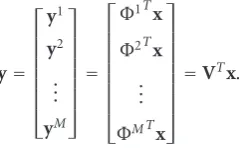
Finally, the super-vectoryis obtained by concatenating yias follows:
y= ⎡ ⎢ ⎢ ⎢ ⎢ ⎢ ⎢ ⎢ ⎣ y1 y2 .. . yM ⎤ ⎥ ⎥ ⎥ ⎥ ⎥ ⎥ ⎥ ⎦ = ⎡ ⎢ ⎢ ⎢ ⎢ ⎢ ⎢ ⎢ ⎢ ⎣
Φ1Tx
Φ2Tx .. .
ΦM Tx
⎤ ⎥ ⎥ ⎥ ⎥ ⎥ ⎥ ⎥ ⎥ ⎦
=VTx. (3)
Here, M indicates the number of phonemes and V is the matrix of the whole phoneme subspace defined as V = [Φ1,Φ2,. . .,ΦM] (∈RDx×Dy). The dimensionality ofy,D
y,
is
Dy= M
i=1
Observation space O
Phoneme subspaces
MDL
-based
PCA
MDL
-based
PCA
MDL
-based
PCA
MDL
-based
PCA
Φ/a/ Φ/i/ Φ/u/ Φ/o/
/a/ /i/ /u/ /o/ · · ·
· · · · · ·
Figure2: Observation space and phoneme subspaces using PCA and MDL-based subspace selection.
When a framex of reverberant speech is inputted, the clean speech portion is projected onto subspace V. Then the reverberant portion projected ontoVc, (complementary
space of V) is reduced as in [7]. The phoneme subspace estimate scheme is represented inFigure 2.
2.3. Optimal Phoneme Subspace Selection Based on MDL. The determination of the dimension for each phoneme subspace,
Qi, requires the use of a truncation criterion. In [5], the MDL
criterion was applied to the subspace selection problem in the case of noisy speech enhancement. Assuming that the redundancy of clean speech is additive white Gaussian in the logarithmic domain, the MDL criterion could be applied to clean speech data as follows:
MDLq= −ln
⎧ ⎨ ⎩
Dx k=q+1λ
1/(Dx−q) k
(1/(Dx−q))
Dx k=q+1λk
⎫ ⎬ ⎭
(Dx−q)Nx
+M·
1 2+ ln
γ−M
q
q
k=1 ln
λk
2
Nx
,
(5)
whereq,γ, andM(=qDx−q2/2 +q/2 + 1) are the dimension
parameter, the selectivity of MDL, and the number of free parameters, respectively. We setγ=32, then the optimalQi
is obtained as follows:
Qi=arg min
q MDL
q. (6)
This criterion provides both consistent and automatic phoneme subspace estimates.
2.4. Integration of Phoneme Subspaces. We made optimal phoneme subspaces and obtained feature vectors that enhance phonemic information from input speech signals. It should be noted that the aforementioned feature vectors are large dimension vectors (sum of each optimal phoneme subspace dimension), and some base vectors may correlate. It
Phoneme subspaces
PCA or ICA Integration matrix /a//i//u/· · ·/o/
Figure3: Estimation of integration matrix.
is efficient to reduce the dimension of the feature vector and to decorrelate components for speech recognition. For this purpose, we apply PCA or ICA to a set of featureyso that the integration matrixWis obtained, as shown inFigure 3. This integration matrix is time-invariant and linear under the assumption that phoneme structures are time-invariant and are composed linearly of decorrelated components. Using the integration matrixW ∈ RDs×Dy, our proposed speech
feature vectorss∈RDsare generated as follows:
s=Wy=WVTx. (7)
In our experiments, for a Hidden Markov Model (HMM)-based recognizer, we normalizedsto zero mean and added the time derivatives to those normalized mean values so that the final dimensionality is 2×Ds.
2.4.1. Integration Using PCA. As stated previously, PCA is able to reduce dimension and to decorrelate the components. Using eigenvalue decomposition of a covariance matrix of the data matrixY ∈ RDy×Ny, eigenvalues and eigenvectors
are obtained, nd by utilizing eigenvectors corresponding to the largest eigenvalues, we are able to construct an integration matrixW=ΦT.
2.4.2. Integration Using ICA. Independent component anal-ysis is a method for separating mutually independent source signals from mixed signals. In [9], ICA was used for speech feature extraction and phoneme recognition resulting in good recognition performance, and it is shown that the filter obtained by applying ICA to a speech data set in the time domain from a single microphone worked like a band-pass filter. Here, we use ICA for integrating phoneme subspaces.
A generative model of ICA is linear,x =As, wherex,A, andsare the observed data vector, mixing matrix, and source vector, respectively. By assuming that only the components of the source vector are mutually independent, an unmixing matrixW(ideallyA−1) and independent componentssare estimated as follows s = Wx. The unmixing matrix W is estimated by maximizing the statistical independence of the estimated components. The statistical independence is usually represented by negentropy or kurtosis that is fourth-order cumulant, and maximization of statistical indepen-dence is implemented in a gradient algorithm or fixed-point algorithm.
Table1: Reverberant conditions.
T60(ms) Room
380 Echo room (cylinder)
600 Tatami-floored room (L)
The FastICA algorithm for finding onew that derives one independent component is as follows.
(1) Center the data to make its mean zero.
(2) Whiten the data to givez.
(3) Choose an initial (e.g., random) vector w of unit norm.
(4) Letw←E{zg(wTz)} −E{g(wTz)}w, wheregis the
function that gives approximations of negentropy. (5) Letw←w/w.
(6) If it is not converged, go back to step (4).
To estimate more independent components, different kinds of decorrelation schemes should be used; please refer to [8] for more information.
Applying ICA to the data matrix Y, the independent components among phonemes are extracted and the dimen-sionality is compressed. The obtained unmixing matrixWis used for the integration matrix. The PCA integration matrix decorrelates the components, and the ICA integration matrix makes the components mutually independent.
3. Experiments
3.1. Experimental Conditions. In order to confirm the effi -ciency of the proposed method, the speech data were extracted from the A-set of the ATR Japanese database and the room impulse response was extracted from the RWCP sound scene database [17]. The total number of speakers was 10 (5 males and 5 females). The training data was composed of 2,620 utterances per speaker, and 1,000 clean or reverberant utterances made by convolving impulse responses [17] were used for testing each speaker. Table 1
shows the reverberant conditions.
Speech signals were digitized into 16 bits at a sampling frequency of 12 kHz. For spectral analysis, an ST-DFT was performed on 32-ms windowed and 8-ms shifted frames. Next, a 24-channel mel-frequency filter bank (MFB) analysis was performed on the aforementioned components. The logarithms of MFB components were then computed.
The experiments were conducted to compare 6 features, MFCC, PCA, ICA, LDA, IPS1, and IPS2, as follows.
(i) MFCC: DCT to LogMFB vectorx.
(ii) PCA: apply PCA to a phoneme balanced set of LogMFB vectors.
(iii) ICA: apply ICA to a phoneme balanced set of LogMFB vectors.
(iv) LDA: apply LDA to a set of phoneme data matrices concurrently.
14 96.8 77.9 50.2 12 96.9 77.9 49.6 10 96.6 78 51.1
8 96.9 77.9 51
MDL
96.9 77.9 51.6 Clean 380 ms 600 ms
0 10 20 30 40 50 60 70 80 90 100
R
ec
o
gnition
ac
cur
acy
(%)
Figure4: Results of isolated word speech recognition with IPS1 feature (average for 10 speakers).
(v) IPS1: apply PCA to a each phoneme data matrixX and apply PCA to the data matrixY.
(vi) IPS2: apply PCA to a each phoneme data matrixX and apply ICA to the data matrixY.
Each phoneme data matrixXconsisted of LogMFB vectors that were randomly selected and were less than 100 frames per speaker. In the case of PCA and ICA, the LogMFB vector set consisted of 5,072 frames that were equally extracted from the above phoneme data matrices. For IPS1 and IPS2, the sample size of Y (Ny) was decided to be 5,336. The
dimensions of the aforementioned features (Ds) were set to
12 from 24 (Dx) for a fair comparison. The super-vector
dimension (Dy) is described in the next subsection.
As an acoustic model, the common HMMs of 54 (M) context-independent phonemes were trained by using 10 sets of 2,620 clean words spoken by 10 speakers, respectively. Each HMM is left-right and has three states and three self-loops. Each state has 20 Gaussian mixture components. The LogMFB analysis, training phoneme HMMs, and testing were realized by using HTK toolkits [18].
3.2. Results and Discussions
3.2.1. MDL-Based Phoneme Subspace Selection. Table 2
shows the results of the MDL-based phoneme subspace selec-tion. LogMFB vectors are projected onto each of the optimal phoneme subspaces. It is confirmed that the dimensions of vowels are larger than those of consonants. In particular, vowel/o/has the largest (10) dimension and consonant/ p/
Table2: Phonemes and optimal subspace dimensions.
Phoneme 1–18 N Q a a− aN aa ai ao b by ch d e eN ee ei f g
Dimension 8 4 7 8 9 7 9 8 6 8 4 6 8 8 9 8 6 8
Phoneme 19–36 gy h hy i i+ iN ii j k ky m my n ny o o− oN oo
Dimension 8 5 4 7 6 9 6 5 6 5 8 7 8 9 10 8 10 10
Phoneme 37–54 ou p r ry s sh t ts u u+ u− ue ui uu w y z pau
Dimension 9 2 8 8 3 4 3 3 8 8 8 9 8 8 9 6 5 2
MFCC 95.4 69.6 46.4 PCA 96.9 77.6 49.7 ICA 96.2 76.7 49.8
LDA 96.3 75.1 49.4 IPS1 96.9 77.9 51.6 IPS2 96 77.7 51.2
Clean 380 ms 600 ms
0 10 20 30 40 50 60 70 80 90 100
R
ec
o
gnition
ac
cur
acy
(%)
Figure5: Results of isolated word speech recognition (average for 10 speakers).
Figure 4shows isolated word speech recognition results with IPS1. This experiment compares manual phoneme sub-space selection to MDL-based selection. Manual phoneme subspace selection means that all phoneme subspaces have the same dimension (Qi) by selecting the eigenvectors
corresponding 8, 10, 12, or 14 largest eigenvalues. However, in the case of MDL-based selection, Qi is decided
inde-pendently of each phoneme. The dimension of y,Dy, was
373 based on the MDL principle. While the best manual selection varies according to the conditions, the MDL-based subspace selection provided the best performance in all conditions, except for the case of 10 dimensions in the 380 ms reverberant condition. From this result, it is shown that MDL-based subspace selection provides good performance without adjusting subspace dimension manually.
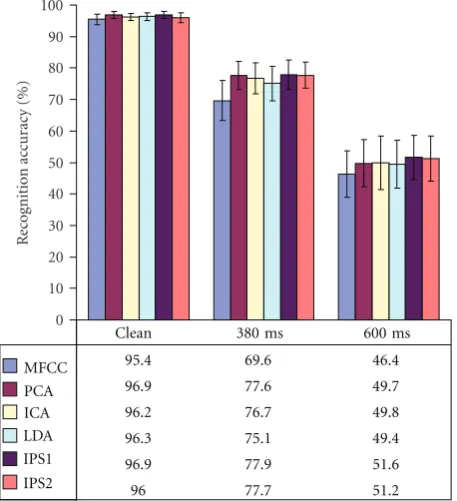
3.2.2. Isolated Word Speech Recognition. Figure 5shows the obtained recognition accuracy. The speaker independent HMMs are trained by clean speech data. The recognition accuracy is the average of the 10 speakers. The ICA-based features (ICA, IPS2) refer to the average of three
experimental results for the different initial values of W. The standard deviations were 0.25 (clean), 0.67 (380 ms), and 1.01 (600 ms) in the case of ICA, and 0.2, 0.9, and 3.0 in the case of IPS2, respectively. As the reverberation time lengthens, the standard deviation increases.
MFCC shows the worst performance in all conditions. The PCA-based methods (PCA, IPS1) show the highest recognition accuracy (96.9%) under clean conditions. In reverberant conditions, the recognition accuracy decreases markedly. However, the proposed methods (IPS1 and IPS2) show better results than conventional methods.
ICA-based methods overall show a lower performance than PCA-based methods, especially under clean conditions. In this paper, we used a Gaussian mixture model (GMM) on each state of HMM. However, this acoustic model is not exactly advisable to exploit the independence of ICA components, because each distribution of independent component obtained by ICA is non-Gaussian [8]. Changing this acoustic model for the independent components may achieve an increase in recognition accuracy, as described in [19], which proposed a method using Factor Analysis (FA) for both feature extraction and acoustic modeling.
Although we used a FastICA algorithm to integrate phoneme subspaces, we believe that the results do not differ in comparison to the use of other ICA algorithms such as the joint approximate diagonalization of eigenmatrices (JADEs) algorithm or Infomax algorithm [20].
4. Conclusions
References
[1] H. Hermansky and N. Morgan, “RASTA processing of speech,”
IEEE Transactions on Speech and Audio Processing, vol. 2, no. 4, pp. 578–589, 1994.
[2] B. E. D. Kingsbury and N. Morgan, “Recognizing reverberant speech with RASTA-PLP,” in Proceedings of IEEE Interna-tional Conference on Acoustics, Speech, and Signal Processing (ICASSP ’97), vol. 2, pp. 1259–1262, Munich, Germany, April 1997.
[3] C. Avendano, S. Tivrewala, and H. Hermansky, “Multiresolu-tion channel normaliza“Multiresolu-tion for ASR in reverberant environ-ments,” inProceedings of the 6th European Conference on Speech Communication and Technology (Eurospeech ’97), pp. 1107– 1110, Rhodes, Greece, September 1997.
[4] D. Gelbart and N. Morgan, “Evaluating long-term spectral subtraction for reverberant ASR,” in Proceedings of IEEE Automatic Speech Recognition and Understanding Workshop (ASRU ’01), pp. 103–106, Madonna di Campiglio, Italy, December 2001.
[5] R. Vetter, N. Virag, P. Renevey, and J.-M. Vesin, “Single channel speech enhancement using principal component analysis and MDL subspace selection,” inProceedings of the 6th European Conference on Speech Communication and Tech-nology (Eurospeech ’99), pp. 2411–2414, Budapest, Hungary, September 1999.
[6] K. Hermus, P. Wambacq, and H. Van Hamme, “A review of signal subspace speech enhancement and its application to noise robust speech recognition,” EURASIP Journal on Advances in Signal Processing, vol. 2007, Article ID 45821, 15 pages, 2007.
[7] T. Takiguchi and Y. Ariki, “PCA-based speech enhancement for distorted speech recognition,”Journal of Multimedia, vol. 2, no. 5, pp. 13–18, 2007.
[8] A. Hyv¨arinen and E. Oja, “Independent component analysis: algorithms and applications,”Neural Networks, vol. 13, no. 4-5, pp. 411–430, 2000.
[9] O.-W. Kwon and T.-W. Lee, “Phoneme recognition using ICA-based feature extraction and transformation,” Signal Processing, vol. 84, no. 6, pp. 1005–1019, 2004.
[10] S. S. Kajarekar, B. Yegnanarayana, and H. Hermansky, “A study of two dimensional linear discriminants for ASR,” in
Proceedings of IEEE International Conference on Acoustics, Speech, and Signal Processing (ICASSP ’01), vol. 1, pp. 137–140, Salt Lake, Utah, USA, May 2001.
[11] P. Somervuo, “Experiments with linear and nonlinear feature transformations in HMM based phone recognition,” in Pro-ceedings of IEEE International Conference on Acoustics, Speech, and Signal Processing (ICASSP ’03), vol. 1, pp. 52–55, Hong kong, April 2003.
[12] K. Kinoshita, T. Nakatani, and M. Miyoshi, “Spectral sub-traction steered by multi-step forward linear prediction for single channel speech dereverberation,” in Proceedings of IEEE International Conference on Acoustics, Speech, and Signal Processing (ICASSP ’06), vol. 1, pp. 817–820, Toulouse, France, May 2006.
[13] A. M. Toh, R. Togneri, and S. Nordholm, “Feature and distribution normalization schemes for statistical mismatch reduction in reverberant speech recognition,” inProceedings of the 8th Annual Conference of the International Speech Communication Association (Interspeech ’07), pp. 234–237, Antwerp, Belgium, August 2007.
[14] R. Petrick, X. Lu, M. Unoki, M. Akagi, and R. Hoffmann, “Robust front end processing for speech recognition in rever-berant environments: utilization of speech characteristics,” inProceedings of the Annual Conference of the International Speech Communication Association (Interspeech ’08), pp. 658– 661, Brisbane, Australia, September 2008.
[15] R. Gomez, J. Even, H. Saruwatari, and K. Shikano, “Distant-talking robust speech recognition using late reflection com-ponents of room impulse response,” inProceedings of IEEE International Conference on Acoustics, Speech, and Signal Processing (ICASSP ’08), pp. 4581–4584, Las Vegas, Nev, USA, March-April 2008.
[16] H. Park, T. Takiguchi, and Y. Ariki, “Integration of phoneme-subspaces using ICA for speech feature extraction and recog-nition,” inProceedings of Hands-Free Speech Communication and Microphone Arrays (HSCMA ’08), pp. 148–151, Trento, Italy, May 2008.
[17] S. Nakamura, K. Hiyane, F. Asano, T. Nishimura, and T. Yamada, “Acoustical sound database in real environments for sound scene understanding and hands-free speech recogni-tion,” in Proceedings of the 2nd International Conference on Language Resources and Evaluation (LREC ’00), vol. 2, pp. 965– 968, Athens, Greece, May-June 2000.
[18] S. Young, G. Evermann, M. Gales, et al.,The HTK Book (for HTK Version 3.4), Cambridge University, Cambridge, UK, 2006.
[19] C.-W. Ting and J.-T. Chien, “Factor analysis of acoustic features for streamed hidden Markov modeling,” in Pro-ceedings of IEEE Workshop on Automatic Speech Recognition and Understanding (ASRU ’07), pp. 30–35, Kyoto, Japan, December 2007.