Jefferson, W., & Spiegel, D. (2009). Implementation of a University Stan-dard for Personal Response Systems. AACE Journal, 17 (1), 1-9.
Implementation of a University Standard for Personal
Response Systems
WIllIam JeffeRSon anD DanIel SPIegel
Kutztown University of Pennsylvania, USA[email protected] [email protected]
Increasing student interaction in the classroom is an area of interest for many faculty members. Personal Response Sys-tems (PRS), also known as classroom clickers, may aid in this goal. In this article, we describe Kutztown University’s pilot PRS program. Included are the criteria we used to select a PRS vendor, our approach in designing and delivering the Kutztown PRS program, and the preliminary results of our year-long pilot.
Personal response systems are handheld keypad devices that are much like a simplified television remote control. Students use clickers to respond to questions the instructor presents to the class through a PowerPoint presen-tation. Student responses are collected and collated automatically through hardware and software that is installed on the instructor’s classroom work-station. after the lesson is presented, the professor can use the PRS software to generate reports that will help gauge student comprehension of the mate-rial.
as with any new technology, PRS devices are of interest to all academ-ic outlets. from informational blurbs in magazines such as the brief artacadem-icle in R&D magazine (2005), to publications from publishers regarding these devices (Broida, 2007), the body of literature pertaining to these devices is growing rapidly.
ex-perimental use of clickers in K-12 settings are described, although the re-sults are reported anecdotally. Similarly, in Trotter (2005) the main topic is the integration of clickers into classrooms in the manassas, Va school dis-trict. Within this article several brands of PRS devices are mentioned, and there is some discussion of educators’ opinions, both pro and con.
These articles were not intended to present any in-depth analysis. Such analysis is referred to in murphy and Smark (2006), which refers to sev-eral in-depth analyses of these devices, which includes freeman and Blaney (2005) and Hake (1998). murphy and Smark concluded that PRS devices permit rapid feedback to both instructors, who were better able to determine how effectively students were learning material; and students, who were better able to understand how they were performing in a course and the ar-eas in which they needed to improve. also, it was concluded that clickers encourage and stimulate peer work, having a positive effect especially on those quieter students that lecturers always encounter and often fail to de-velop meaningful contact with.
at Kutztown, a science professor was the earliest pioneer of use of this technology, and several articles cited herein pertain to PRS devices in biolo-gy classrooms. In Brewer (2004), the use of PRS devices to reinforce learn-ing and a study of results of their use in biology courses at the University of montana is detailed. as before, it was concluded that feedback in both di-rections was a major benefit of employing PRS devices in classrooms. This article also described using other web-based software to facilitate student participation outside class for large classroom settings. This is of interest to the authors’ institution, as a new large classroom building is online with this technology available, and some results reported later emanate from classes in this setting.
In Barrett, Bornsen, erickson, markey, and Spiering (2005) studies were conducted in communications courses, with emphasis on how PRS devic-es can improve the level of instruction in large classroom settings. Sever-al questions in the survey used by the authors asked students to compare courses in large classrooms that used PRS devices with courses that did not employ the devices. less than half of the respondents agreed or strongly agreed with the proposition that they preferred courses that used PRS de-vices. Regrettably, the authors did not provide data on those who did not agree or were neutral, so it is hard to determine if a majority of students actually didn’t like the devices, or if many students were noncommittal. Cu-riously, slightly more than half the students agreed or strongly agreed that they learned material better in courses employing PRS devices.
conclu-sions, instead producing a list of suggestions based upon his experiences. The author of Skiba (2006) acts as an advocate of integrating the devices into large classroom settings and provides resources for acquiring further knowledge. many resources found in database searches and particularly on-line are tools of advocacy for these devices. In this work, we intend to join the ranks of those providing analysis of the level of success of integration of these devices.
PeRSonal ReSPonSe SyStem ImPlementatIon
a variety of different clicker systems have been used in Kutztown Uni-versity courses over time. The rationale for choosing a particular clicker sys-tem varied depending on the instructor and class need. In some instances, a clicker system was selected because it was commonly used in K-12 settings and the professor felt the students would benefit by using the same system they would likely see when they became teachers. In other cases, a clicker was selected because it was part of a textbook bundle. This was convenient for the professor because the bundle included ready to use clicker questions that followed the text chapters.
The downside to this scattershot approach to clicker adoption is that a variety of incompatible clicker systems are being used in different programs across campus. This is obviously frustrating for students who may be re-quired to purchase a clicker for one class, knowing that that clicker might never be used again because a subsequent class may require a different clicker system.
Work to identify a standard clicker system for use across multiple cours-es began in 2006 with a project conceived by Dr. ed Vitz of the Chemis-try Department. Dr. Vitz arranged clicker demonstrations from a number of vendors as part of a summer technology grant project. These demonstrations helped interested faculty learn about the features and technologies offered by a variety of vendors. This in turn helped the university academic Tech-nology Committee (ATC) refine criteria for a university standard. The ATC decided that, at a minimum, a reference clicker system must be:
1. functional on both PC and mac platforms. at the time of our eval-uation, this requirement proved to be a showstopper for many vendors. Some vendors had PC only systems. other vendors had planned or beta Mac software, but nothing that was field ready and proven.
3. easy for a student to adopt and use. This meant that the clickers need to be ruggedly designed and intuitive to use. more importantly, it meant that the clicker must not have an onerous/recurring registration component. Some perfectly good clicker systems were eliminated be-cause they required course-by-course, semester-by-semester web regis-tration. In the past, online registration caused real difficulties for students that did not have credit cards, so this was an important consideration in our system selection.
4. Sufficiently robust to support nontrivial classroom interaction. Cer-tain clickers were very elegant in their simplicity, but they only supported multiple-choice and true/false responses. Some of the more sophisticated systems supported these question types as well as short answer response types as well as the ability to upload a series of homework responses.
5. easy for a professor to adopt and use.Question creation tools and the gradebook component need to be intuitive and easy to use. The in-structor software needed to incorporate report generation capabilities.
6. Reliable in classroom settings of up to two hundred students.at the time of the clicker evaluation, Kutztown University was in the process of completing construction of a large classroom building. The reference clicker system needed to be sufficiently robust and reliable to operate in this environment.
four faculty members agreed to use the Interwrite system in their classes. at the end of the semester, the aTC asked the students in the clicker classes-to complete a simple likert-type survey. The aTC received 145 responses classes-to the following items:
1. The clicker system was easy to use. 2. The clicker system was reliable.
3. The clicker system enhanced teaching and learning. 4. The clicker system improved classroom interaction.
5. Kutztown University should adopt this clicker system as the univer sity standard.
6. It was easy to configure the clicker with my student ID.
Results/Discussion
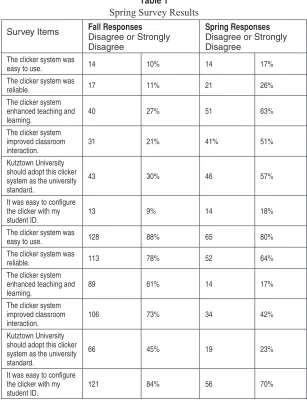
approximately 88% of the students agreed or strongly agreed that the clicker system was easy to use. approximately 78% of the students agreed or strongly agreed that the clicker system was reliable. around 61% of the students agreed or strongly agreed the clicker system enhanced teaching and learning while 27% disagreed or strongly disagreed. about 73% of the stu-dents agreed or strongly agreed the clicker system improved classroom in-teraction.
Student opinion regarding clicker adoption was mixed. approximately 45% of the respondents agreed or strongly agreed that the clicker system should be adopted as the university standard. Twenty five percent (25%) of the students responded “no opinion” and 30% disagreed or strongly dis-agreed that this system should be adopted. eighty four percent (84%) of the students agreed or strongly agreed that it was easy to enter their student ID into the clicker.
The students had the option of submitting comments using a free form text field. We received 73 responses. While it is not within the scope of this article to include all responses, two major themes seemed prevalent in our fall survey. Students generally had strong feelings about the value the clicker system added to the class. Comments seemed roughly divided between pro and con and ranged from “total waste of money” to “great tool and learning device, should use for tests.” many of the comments focused on the price of the device, which at 47 dollars, students believed was expensive.
Results from the spring survey, particularly items three, four, and five, were more negative than those from the fall.
table 1
Spring Survey Results
Survey Items Fall ResponsesDisagree or Strongly Disagree
Spring Responses
Disagree or Strongly Disagree
The clicker system was
easy to use. 14 10% 14 17%
The clicker system was
reliable. 17 11% 21 26%
The clicker system enhanced teaching and
learning. 40 27% 51 63%
The clicker system improved classroom
interaction. 31 21% 41% 51%
Kutztown University should adopt this clicker system as the university standard.
43 30% 46 57%
It was easy to configure the clicker with my
student ID. 13 9% 14 18%
The clicker system was
easy to use. 128 88% 65 80%
The clicker system was
reliable. 113 78% 52 64%
The clicker system enhanced teaching and
learning. 89 61% 14 17%
The clicker system improved classroom
interaction. 106 73% 34 42%
Kutztown University should adopt this clicker system as the university standard.
66 45% 19 23%
It was easy to configure the clicker with my
Results from the spring survey, particularly items three, four, and five, were more negative than those from the fall.
table 1
Spring Survey Results
Survey Items Fall ResponsesDisagree or Strongly Disagree
Spring Responses
Disagree or Strongly Disagree
The clicker system was
easy to use. 14 10% 14 17%
The clicker system was
reliable. 17 11% 21 26%
The clicker system enhanced teaching and
learning. 40 27% 51 63%
The clicker system improved classroom
interaction. 31 21% 41% 51%
Kutztown University should adopt this clicker system as the university standard.
43 30% 46 57%
It was easy to configure the clicker with my
student ID. 13 9% 14 18%
The clicker system was
easy to use. 128 88% 65 80%
The clicker system was
reliable. 113 78% 52 64%
The clicker system enhanced teaching and
learning. 89 61% 14 17%
The clicker system improved classroom
interaction. 106 73% 34 42%
Kutztown University should adopt this clicker system as the university standard.
66 45% 19 23%
It was easy to configure the clicker with my
student ID. 121 84% 56 70%
While the spring results were somewhat disappointing, it should be noted that the results are primarily from one class. The results also suggest that an important item is missing in our survey. While we asked if the clickers improved interaction and enhanced learning, we failed to ask if the instruc-tor used the clicker system effectively. Clearly we should have asked if the instructor was a first-time clicker user or was using the clicker primarily for more mundane tasks such as attendance reporting. This information would have been very helpful in interpreting results from both the fall and spring surveys.
on a positive note, the clicker technology performed well in the large classroom space. only two students out of approximately 130 had defective clickers, but these clickers were easily exchanged on campus. our book-store manager graciously agreed that the bookbook-store would serve as a service point for defective clickers. The bookstore also implemented a clicker buy-back program. This program helps address the student’s cost concerns since used clickers can be purchased for 35 dollars and resold to the bookstore for around 23 dollars—in essence meaning that the students can “rent” a clicker for about 12 dollars a semester.
Professors who have tried the Interwrite clickers in the classroom have generally indicated that they plan to continue using them in the future. most problems reported in the classroom appear to be related to learning the clicker technology rather than failures of the technology itself. even profes-sors that reported a challenging start using clickers at the beginning of the semester shared that despite the occasional technology glitch, the sessions went well once, (a) they became comfortable building clicker lessons and generating clicker reports and (b) the students felt at ease joining a clicker session and responding to questions using the devices.
conclusion
While our survey results clearly varied between semesters, the aTC did recommend the Interwrite system as the standard clicker platform based on the positive feedback from the fall semester. faculty members are not precluded from using another vendor’s clicker system, but using the recom-mended system ensures that training and support will be available from Uni-versity’s Smart Classroom technicians, learning Technologies Center staff, and the bookstore.
as faculty members and students become more accustomed to the click-er capabilities and clickclick-er use, we expect that genclick-eral usclick-er satisfaction and confidence in the devices will increase. This is evident at a micro-level in Kutztown’s Chemistry program. The clickers are used in this program by several professors in four chemistry classes. The instructors have at least a year of experience using the devices, and the department’s internal surveys show a higher degree of clicker satisfaction than our pilot survey.
It is difficult to compare results of studies, but where questions were rel-atively congruent, in areas regarding enhancing learning and whether they would recommend that more classes employ this technology, similar results were noted. In particular, comparison of our results to those in Barrett et al. (2005), we find a slightly higher rate of satisfaction with the devices when used in courses, but less than half still endorsed using the devices in classes.
While we had hoped that we could conclude that clickers should be used in large classroom settings, the results run counter to our hypothesis. as not-ed previously, there was a decline in satisfaction with these devices in the large classrooms. But, it must be noted that there have been some techni-cal difficulties with these devices in the large classroom setting, sometimes precluding their use during classroom sessions. not only do these problems likely degrade the level of satisfaction with the devices, they also engen-der resentment among students who were required to purchase devices that weren’t always employed (not to mention faculty whose course prep went down the drain). Therefore, these large classroom results in particu-lar should be met with some skepticism until the technical difficulties have been completely resolved.
But, in general, the results of our research show satisfaction with click-ers among slightly more than half of the students, and a desire to see these devices employed in other classes among slightly less than half of the stu-dents, which matches the other study referenced.
(particularly science courses where faculty have been using the devices for some time). Between our study and others, it can be safely postulated that these devices are effective in lecture sections of physical science courses.
We intend to repeat this study once a broader cross section of faculty em-ploy this device, as we believe that once faculty become adept at integrating these devices, they will be effective in a broad range of disciplines.
for schools considering a clicker program or pilot, we recommend con-tacting and involving all constituencies. at Kutztown University, interested faculty and students participated in the initial clicker demonstrations and clicker selection. Our IT department assigned a specific technician who in-stalls and supports clicker hardware and software. The learning Technol-ogies Center provides faculty training. our bookstore has been more than supportive, and not only sells the clickers, but also serves as a convenient warranty service point for students.
References
Advantage Business Media. (2005, March). IR system serves as teacher’s aid [Edito-rial]. R&D Magazine. Retrieved December 2, 2007, from http://www.rdmag.com/ ShowPR.aspx?PUBCODE=014&ACCT=1400000100&ISSUE=0503&RELTYPE=P R&ORIGRELTYPE=EMT&PRODCODE=00000000&PRODLETT=M
Barrett, M., Bornsen, S., Erickson, S., Markey, V., & Spiering, K. (2005). The personal response system as a teaching aid. Communication Teacher, 19(3), 89-92. Brewer, C. (2004). Near real-time assessment of student learning and understanding in
biology courses. Bioscience, 54(11), 1034-1039.
Broida, J. (2007). Classroom use of a personal response system: What clickers can do for your students. Upper Saddle River, NJ: Prentice Hall.
Freeman, M., & Blaney, P. (2005, July). Promoting interactive in-class learning environ-ments: A comparison of an electronic system with a traditional alternative. Paper presented at the 11th Australasian Teaching Economics Conference, Sydney, Aus-tralia.
Hake, R. (1998). Interactive-engagement versus traditional methods: A six-thousand-student survey of mechanics test data for introductory physics courses. American Journal of Physics, 66, 64-74.
Murphy, B., & Smark, C. (2006). Convergence of learning experiences for first year ter-tiary commerce students—Are personal response systems the meeting point? The Journal of American Academy of Business, 10(1), 186-190.
O’Hanlon, C. (2007). Press ‘2’ for not guilty. T. H. E. Journal, 34(5), 52-53.
Ribbens, E. (2007, November/December). Why I like personal response systems. Journal of College Science Teaching, (pp. 60-62).
Skiba, D. (2006). Got large lecture hall classes? Use clickers. Nursing Education Per-spectives, 27(5), 278-280.