R E S E A R C H
Open Access
A new technique for convergence
theorem of fixed point problem of
quasi-nonexpansive mapping
Kanyarat Cheawchan
1, Suthep Suantai
2and Atid Kangtunyakarn
1**Correspondence:
1Department of Mathematics,
Faculty of Science, King Mongkut’s Institute of Technology Ladkrabang, Bangkok 10520, Thailand Full list of author information is available at the end of the article
Abstract
For the purpose of this paper, we use the method different from the relaxed extragradient method for finding a common element of the set of fixed points of a quasi-nonexpansive mapping, the set of solutions of equilibrium problems, and the set of solutions of a modified system of variational inequalities without demiclosed condition ofWandWω:= (1 –
ω
)I+ω
W, whereWis a quasi-nonexpansive mapping andω
∈(0,12) in the framework of Hilbert space. By using our main result, we obtain a strong convergence theorem involving a finite family of nonspreading mappings and another corollary. Moreover, we give a numerical example to encourage our main theorem.Keywords: quasi-nonexpansive mapping; equilibrium problem; variational inequality problem; fixed point problem
1 Introduction
LetCbe a nonempty closed convex subset of a real Hilbert spaceH. Recall that the map-pingW:C→Cis calledquasi-nonexpansiveif
Wp–q ≤ p–q,
for allp∈Candq∈F(W). We denote byF(W) the set of fixed points ofW. Fixed point problems have been widely studied and developed in the literature.
Letbe a bifunction ofC×CintoR, whereRis the set of real numbers. The equilib-rium problemfor:C×C→Ris to findp∈Csuch that
(p,ζ)≥, ∀ζ∈C. (.)
We denote the set of solutions of (.) byEP(). Equilibrium problems were introduced by Blum and Oettli [] in and included many well-known problems such as the varia-tional inequality problem, the optimization problem, and the nonexpansive mapping and fixed point problem.
A mappingD:C→His calledd-inverse strongly monotoneif there exists a positive
real numberd> such that
Dp–Dζ,p–ζ ≥dDp–Dζ,
for allp,ζ ∈C.
LetB:C→H. Thevariational inequalityis to find a pointφ∈Csuch that
Bφ,ψ–φ ≥, (.)
for allψ∈C. The set of solutions of (.) is denoted byVIP(C,B). The variational inequal-ities were initially studied and introduced by Lions and Stampacchia [].
The concept of quasi-nonexpansive mapping was investigated by Diaz and Metcalf []. In , Suet al.[] introduced strong convergence theorems for quasi-nonexpansive mappings, the monotone hybrid iteration method used to approximate the fixed point of quasi-nonexpansive mappings. In , Tian and Jin [] introduced an iterative method of a quasi-nonexpansive mapping in the framework of Hilbert space. They proved the strong convergence theorem of iterative scheme{pn}generated by (.) as follows.
Theorem . Let H be a real Hilbert space,let F be aκ-Lipschitzian andη-strongly mono-tone operator on H withκ> ,η> and let W be a quasi-nonexpansive mapping on H,and f is a L-Lipschitzian mapping with coefficient L> for all p,ζ∈H.Assume the set F(W)of fixed points of W is nonempty closed and convex.Let <μ<κη, <γ<μ(η–
μκ
)/L=τ/L
and start with an arbitrary chosen p∈H,let the sequence{pn}be generated by
pn+=αnγf(pn) + (I–αnμF)Wωpn, (.)
where the sequence{αn} ⊂(, )satisfieslimn→∞αn= ,and
∞
n=αn=∞.Alsoω∈(,),
Wω:= ( –ω)I+ωW with two conditions on W:
. Wp–q ≤ p–qfor anyp∈H,andq∈F(W);this means thatW is a quasi-nonexpansive mapping;
. Wis demiclosed onH;that is,if{ζk} ⊂H,ζk ξ,and(I–W)ζk→,thenξ∈F(W).
Then{pn}converges strongly to the p∗∈F(W)which is the unique solution of the VIP:
(μF–γf)p∗,p–p∗≤, ∀p∈F(W).
Many strong convergence theorems of quasi-nonexpansive mappingWwere proved by assuming the following conditions:
. Wω:= ( –ω)I+ωW for allω∈(,),
. Wis demiclosed onH.
In , Donget al.[] proved strong convergence theorem by using a relaxed extragra-dient method as follows.
Theorem . Let C be a nonempty closed convex subset of a real Hilbert space H.Let the mappings D,D:C→H be d-inverse strongly monotone and d-inverse strongly
∞
n=F(Wn)∩EP()∩F(G)=∅.Let f :C→C be a contraction with coefficientρ∈(, /).
Setβ= .For given p∈C arbitrarily,let the sequences{pn},{ζn},{ξn},and{φn}be
gener-ated by ⎧ ⎪ ⎪ ⎪ ⎪ ⎪ ⎪ ⎪ ⎪ ⎨ ⎪ ⎪ ⎪ ⎪ ⎪ ⎪ ⎪ ⎪ ⎩
(φn,ζ) +gnζ–φn,φn–pn ≥, ∀ζ ∈C,
ξn=PC(φn–λBDφn),
ζn=αnf(pn) + ( –αn)PC(ξn–λADξn),
pn+=βnpn+σn
∞
i=(βi––βi)Wiζn
+ ( –βn)( –σn)PC(ξn–λADξn), ∀n∈N,
(.)
whereλA∈(, d),λB∈(, d),and the sequences{αn} ⊂[, ],{βn} ⊂[, ],{σn} ⊂[, ],
and{gn} ⊂(r,∞),r> ,are such that (i) {βn}is strictly decreasing,
(ii) <lim infn→∞βn<lim supn→∞βn< ,
(iii) limn→∞αn= and
∞
n=αn=∞,
(iv) σn> /( –ρ),
∞
n=|σn–σn–|<∞,
(v) ∞n=|gn–gn–|<∞.
Then the sequence{pn}generated by(.)converges strongly to p∗=P·f(p∗),and(p∗,ζ∗)is
a solution of the general system of variational inequalities(.)whereζ∗=PC(p∗–λBDp∗).
Many authors used the extragradient method to prove fixed point theorem of nonlinear mappings.
LetD,D:C→Hbe two mappings. In , Cenget al.[] introduced a relaxed
ex-tragradient method for finding solutions of problem (p∗,ξ∗)∈C×Csuch that ⎧
⎨ ⎩
λADξ∗+p∗–ξ∗,p–p∗ ≥, ∀p∈C, λBDp∗+ξ∗–p∗,p–ξ∗ ≥, ∀p∈C,
(.)
which is called a system of variational inequalities whereλA,λB> .
In , Kangtunyakarn [] modified (.) for finding (p∗,ξ∗)∈C×Csuch that ⎧
⎨ ⎩
p∗– (I–λAD)(ap∗+ ( –a)ξ∗),p–p∗ ≥, ∀p∈C, ξ∗– (I–λBD)p∗,p–ξ∗ ≥, ∀p∈C,
(.)
which is called a modification of system of variational inequalities, for everyλA,λB> and
a∈[, ]. Ifa= , (.) reduces to (.). He introduced the relation between solutions of (.) and fixed point of the mappingGas follows.
Lemma . Let C be a nonempty closed convex subset of a real Hilbert space H and let D,D:C→H be mappings.For everyλA,λB> and a∈[, ],the following statements
are equivalent:
. (p∗,ξ∗)∈C×Cis a solution of problem(.),
. p∗is a fixed point of the mappingG:C→C,i.e.,p∗∈F(G),defined by
G(p) =PC(I–λAD)
ap+ ( –a)PC(I–λBD)p
,
After we investigated Theorem ., Theorem . and researchers in the same direction, we have the questions as follows:
() Can we prove strong convergence theorem without demiclosed condition and Wω:= ( –ω)I+ωW, whereW is a quasi-nonexpansive mapping andω∈(,)in
the framework of Hilbert space?
() Can we prove strong convergence theorem without relaxed extragradient method? In this paper, we give the answer for the mentioned questions and introduce the method of iterative scheme{pn}for finding a common element of the set of fixed points of a quasi-nonexpansive mapping, the set of solutions of equilibrium problems and the set of solu-tions of a modified system of variational inequalities. Applying our main result, we prove strong convergence theorem involving a finite family of nonspreading mappings and an-other corollary. Moreover, We also give a numerical example to support our main theorem.
2 Preliminaries
LetHbe a real Hilbert space with inner product·,· and norm · . In this paper, we use the symbol of weak and strong convergence by ‘’ and ‘→’, respectively. For everyp∈H, there exists a unique nearest pointPCpinCsuch thatp–PCp ≤ p–ζfor allζ∈C.
PCis called themetric projectionofHontoC.
Remark . It is well known that metric projectionPChas the following properties:
. PCis firmly nonexpansive,i.e.,
PCp–PCζ≤ PCp–PCζ,p–ζ , ∀p,ζ ∈H.
. For eachp∈H,
ξ=PC(p) ⇔ p–ξ,ξ–ζ ≥, ∀ζ ∈C.
Recall thatHsatisfiesOpial’s condition[],i.e., for any sequence{pn}withpnp, the
inequality
lim
n→∞infpn–p<nlim→∞infpn–ζ
holds for everyζ∈Hwithζ=p.
Lemma . Let H be a real Hilbert space.Then we have the following well-known results:
. p±ζ=p±p,ζ +ζ, . p+ζ≤ p+ ζ,p+ζ ,
for all p,ζ∈H.
Lemma . ([]) Let(E,·,· )be an inner product space.Then,for all p,ζ,ξ ∈E and
α,α,α∈[, ]withα+α+α= ,we have
αp+αζ+αξ=αp+αζ+αξ–ααp–ζ
For solving the equilibrium problem, we assume that the bifunction:C×C→R satisfies the following conditions:
(J) (p,p) = for allp∈C;
(J) is monotone,i.e.,(p,ζ) +(ζ,p)≤for allp,ζ∈C; (J) for eachp,ζ,ξ∈C,
lim t↓
tξ+ ( –t)p,ζ≤(p,ζ);
(J) for eachp∈C,ζ→(p,ζ)is convex and lower semicontinuous.
Lemma .([]) Let C be a nonempty closed convex subset of H and letbe a bifunction of C×C intoRsatisfying(J)-(J).Let r> and p∈H.Then there existsξ∈C such that
(ξ,ζ) +
rζ–ξ,ξ–p ≥, ∀ζ∈C.
Lemma .([]) Assume that:C×C→Rsatisfies(J)-(J).For r> ,define a map-ping Wr:H→C as follows:
Wr(p) =
ξ∈C:(ξ,ζ) +
rζ–ξ,ξ–p ≥,∀ζ∈C
,
for all p∈H.Then the following hold: () Wris single-valued;
() Wris firmly nonexpansive,i.e.,for anyp,ζ ∈H,
Wr(p) –Wr(ζ)≤Wr(p) –Wr(ζ),p–ζ
;
() F(Wr) =EP();
() EP()is closed and convex.
Lemma .([]) Let{hn}be a sequence of nonnegative real numbers satisfying
hn+≤( –αn)hn+δn, ∀n≥,
where{αn}is a sequence in(, )and{δn}is a sequence such that () ∞n=αn=∞,
() lim supn→∞δn
αn≤or
∞
n=|δn|<∞.
Thenlimn→∞hn= .
Lemma .([]) Let H be a real Hilbert space,let C be a nonempty closed convex subset
of H and let Dbe a mapping of C into H.Let u∈C.Then forλ> ,
u=PC(I–λD)u ⇔ u∈VIP(C,D),
Lemma .([]) Let C be a nonempty closed convex subset of a real Hilbert space H and let W :C→C be a quasi-nonexpansive mapping with F(W)=∅.ThenVIP(C,I–W) = F(W).
Remark . From Lemmas . and ., we have
F(W) =VIP(C,I–W) =FPC
I–λ(I–W),
for allλ> .
3 Main result
Theorem . Let C be a nonempty closed convex subset of a real Hilbert space H, let
, :C×C→Rbe bifunctions satisfying(J)-(J)and let W :C→C be a
quasi-nonexpansive mapping.Let D,D:C→H be d,d-inverse strongly monotone mappings,
respectively. Define the mapping G:C→C by G(p) =PC(I–λAD)(ap+ ( –a)PC(I–
λBD)p)for all p∈C and a∈[, ].AssumeF=EP()∩EP()∩F(G)∩F(W)=∅.
Suppose that p,u∈C and let{pn},{φn},and{ψn}be sequences generated by
⎧ ⎪ ⎪ ⎨ ⎪ ⎪ ⎩
(φn,ζ) +gnζ–φn,φn–pn ≥, ∀ζ ∈C,
(ψn,ζ) +hnζ–ψn,ψn–pn ≥, ∀ζ∈C,
pn+=αnu+βnpn+γnPC(I–λn(I–W))φn+δnG(ψn), ∀n∈N,
(.)
where the sequencesλA∈(, d),λB∈(, d)and{αn},{βn},{γn},{δn} ⊆[, ]withαn+
βn+γn+δn= for all n∈N.Suppose the following conditions hold:
(i) limn→∞αn= and
∞
n=αn=∞,
(ii) <c≤βn,γn,δn≤d< for somec,d> and for alln≥,
(iii) <e≤gn,hn≤f for somee,f > and for alln≥,
(iv) ∞n=λn<∞and <λn< ,
(v) ∞n=|αn+–αn|<∞,∞n=|βn+–βn|<∞,∞n=|γn+–γn|<∞,
∞
n=|λn+–λn|<∞,
∞
n=|gn+–gn|<∞,
∞
n=|hn+–hn|<∞.
Then{pn},{φn},and{ψn}converge strongly to p=PFu and(p,ξ)is a solution of(.)
whereξ=PC(I–λBD)p.
Proof First, we show thatGis a nonexpansive mapping. Letp,ζ ∈C. SinceD,D are
d,d-inverse strongly monotone,λA∈(, d), andλB∈(, d), we have
(I–λAD)p– (I–λAD)ζ
=p–ζ– λAp–ζ,Dp–Dζ +λADp–Dζ ≤ p–ζ– dλADp–Dζ+λADp–Dζ
=p–ζ+λA(λA– d)Dp–Dζ ≤ p–ζ.
ThenI–λADis a nonexpansive mapping. SimilarlyI–λBDis a nonexpansive mapping.
Next, we show{pn}is bounded. Letξ ∈F, thenφn=Wgnpnandψn=Whnpn. It is clear
thatφn–ξ ≤ pn–ξandψn–ξ ≤ pn–ξ. By Remark ., we have
ξ∈FPC
I–λn(I–W)
. (.)
Observe that
Wφn–ξ=(φn–ξ) – (I–W)φn
=φn–ξ–
φn–ξ, (I–W)φn
+(I–W)φn
≤ φn–ξ.
It implies that
(I–W)φn
≤φn–ξ, (I–W)φn
. (.)
From (.) and (.), we have
PC
I–λn(I–W)
φn–ξ
=PC
I–λn(I–W)
φn–PC
I–λn(I–W)
ξ
≤(φn–ξ) –λn
(I–W)φn– (I–W)ξ
=φn–ξ– λn
φn–ξ, (I–W)φn
+λn(I–W)φn
≤ φn–ξ+λn(λn– )(I–W)φn
≤ φn–ξ. (.)
From the definition ofpnand (.), we have
pn+–ξ =αn(u–ξ) +βn(pn–ξ) +γn
PC
I–λn(I–W)
φn–ξ
+δn
G(ψn) –ξ
≤αnu–ξ+βnpn–ξ+γnPC
I–λn(I–W)
φn–ξ
+δnG(ψn) –ξ
≤αnu–ξ+βnpn–ξ+γnφn–ξ+δnψn–ξ ≤αnu–ξ+βnpn–ξ+γnpn–ξ+δnpn–ξ
=αnu–ξ+ ( –αn)pn–ξ.
By induction, we can conclude that
pn–ξ ≤max
u–ξ,p–ξ
,
for alln≥. This implies that the sequence{pn}is bounded and so are{φn},{ψn},{(I– W)φn}, and{PC(I–λn(I–W))φn}.
From the definition ofpnand nonexpansiveness ofG, we have
pn+–pn=(αn–αn–)u+βn(pn–pn–) + (βn–βn–)pn–
+γn
PC
I–λn(I–W)
φn–PC
I–λn–(I–W)
φn–
+ (γn–γn–)PC
I–λn–(I–W)
φn–
+δn
G(ψn) –G(ψn–)
+ (δn–δn–)G(ψn–) ≤ |αn–αn–|u+βnpn–pn–+|βn–βn–|pn–
+γnPC
I–λn(I–W)
φn–PC
I–λn–(I–W)
φn–
+|γn–γn–|PC
I–λn–(I–W)
φn–
+δnG(ψn) –G(ψn–)+|δn–δn–|G(ψn–) ≤ |αn–αn–|u+βnpn–pn–+|βn–βn–|pn–
+γn(φn–φn–) –
λn(I–W)φn–λn(I–W)φn–
–λn(I–W)φn––λn–(I–W)φn–
+|γn–γn–|PC
I–λn–(I–W)
φn–+δnψn–ψn–
+|δn–δn–|G(ψn–)
≤ |αn–αn–|u+βnpn–pn–+|βn–βn–|pn–
+γnφn–φn–+λn(I–W)φn– (I–W)φn–
+|λn–λn–|(I–W)φn–
+|γn–γn–|PC
I–λn–(I–W)
φn–+δnψn–ψn–
+|δn–δn–|G(ψn–). (.)
On the other hand, fromφn=Wgnpnandφn+=Wgn+pn+, we have
(φn,ζ) +
gn
ζ–φn,φn–pn ≥, ∀ζ ∈C (.)
and
(φn+,ζ) +
gn+
ζ–φn+,φn+–pn+ ≥, ∀ζ ∈C. (.)
Puttingζ=φn+in (.) andζ =φnin (.), we have
(φn,φn+) +
gn
φn+–φn,φn–pn ≥
and
(φn+,φn) +
gn+
From (J), we have
φn+–φn,
φn–pn
gn
–φn+–pn+ gn+
≥.
So
φn+–φn,φn–φn++φn+–pn–
gn
gn+
(φn+–pn+)
≥.
Then
φn+–φn≤
φn+–φn,pn+–pn+φn+–pn+–
gn
gn+
(φn+–pn+)
=
φn+–φn,pn+–pn+
– gn
gn+
(φn+–pn+)
≤ φn+–φn
pn+–pn+
– gn
gn+
φn+–pn+
,
and hence
φn+–φn ≤ pn+–pn+
gn+
|gn+–gn|φn+–pn+
≤ pn+–pn+
e|gn+–gn|φn+–pn+. (.) We useψn=Whnpnandψn+=Whn+pn+. By using the same method as (.), we have
ψn+–ψn ≤ pn+–pn+
e|hn+–hn|ψn+–pn+. (.) From (.), (.), and (.), we have
pn+–pn ≤ |αn–αn–|u+βnpn–pn–+|βn–βn–|pn–
+γn
pn+–pn+
e|gn+–gn|φn+–pn+
+λn(I–W)φn– (I–W)φn–+|λn–λn–|(I–W)φn–
+|γn–γn–|PC
I–λn–(I–W)
φn–
+δn
pn+–pn+
e|hn+–hn|ψn+–pn+
+|δn–δn–|G(ψn–)
≤ |αn–αn–|u+βnpn–pn–+|βn–βn–|pn–
+γnpn+–pn+
e|gn+–gn|φn+–pn+
+λn(I–W)φn– (I–W)φn–+|λn–λn–|(I–W)φn–
+|γn–γn–|PC
I–λn–(I–W)
φn–+δnpn+–pn
+
≤( –αn)pn–pn–+|αn–αn–|M+|βn–βn–|M
+|γn–γn–|M+|δn–δn–|M+|λn–λn–|M+λnM
+
e|gn+–gn|M+
e|hn+–hn|M,
where
M:=max n∈N
u,pn,PC
I–λn(I–W)
φn,G(ψn),(I–W)φn,
(I–W)φn+– (I–W)φn,φn–pn,ψn–pn
.
From the conditions (i), (iv), (v), and Lemma ., we have
lim
n→∞pn+–pn= . (.)
SinceWgnis a firmly nonexpansive mapping, we obtain
φn–ξ=Wgnpn–Wgnξ
≤ Wgnpn–Wgnξ,pn–ξ
≤ φn–ξ,pn–ξ
=
φn–ξ+pn–ξ–φn–pn
.
It implies that
φn–ξ≤ pn–ξ–φn–pn. (.)
By using the same method as (.), we have
ψn–ξ≤ pn–ξ–ψn–pn. (.)
From the definition ofpn, (.), (.), and (.), we have
pn+–ξ =αn(u–ξ) +βn(pn–ξ) +γn
PC
I–λn(I–W)
φn–ξ
+δn
G(ψn) –ξ
≤αnu–ξ+βnpn–ξ+γnPC
I–λn(I–W)
φn–ξ
+δnG(ψn) –ξ
–βnγnPC
I–λn(I–W)
φn–pn
–βnδnG(ψn) –pn
≤αnu–ξ+βnpn–ξ+γnφn–ξ+δnψn–ξ
–βnγnPC
I–λn(I–W)
φn–pn
–βnδnG(ψn) –pn
≤αnu–ξ+βnpn–ξ+γn
pn–ξ–φn–pn
+δn
pn–ξ–ψn–pn
–βnγnPC
I–λn(I–W)
φn–pn
=αnu–ξ+ ( –αn)pn–ξ–γnφn–pn
–δnψn–pn–βnγnPC
I–λn(I–W)
φn–pn
–βnδnG(ψn) –pn
≤αnu–ξ+pn–ξ–γnφn–pn–δnψn–pn
–βnγnPC
I–λn(I–W)
φn–pn–βnδnG(ψn) –pn,
which implies that
γnφn–pn≤αnu–ξ+pn–ξ–pn+–ξ ≤αnu–ξ+pn–pn+
pn–ξ+pn+–ξ
.
From the conditions (i), (ii), and (.), we have
lim
n→∞φn–pn= . (.)
By using the same method as (.), we can imply that
lim
n→∞ψn–pn=nlim→∞PC
I–λn(I–W)
φn–pn= lim
n→∞G(ψn) –pn= . (.) From (.) and (.), we have
lim
n→∞φn–ψn= . (.)
Afterwards, we show thatlim supn→∞u–p,pn–p ≤, wherep=PFu. To show this
inequality, take a subsequence{pnj}of{pn}such that
lim sup
n→∞ u–p,pn–p =jlim→∞u–p,pnj–p .
Without loss of generality, we may assume thatunj ωasj→ ∞. From (.), we have vnj ωasj→ ∞. By using the same method as [] in Theorem ., we have
ω∈EP() (.)
and
ω∈EP(). (.)
Furthermore, we show thatω∈F(W). From Remark ., we haveF(W) =F(PC(I–λnj(I– W))). Assume thatω∈/F(W), we haveω=PC(I–λnj(I–W))ω. From (.), we havepnj
ωasj→ ∞. By (.), (.), the condition (iv), and Opial’s property, we have
lim inf
j→∞ pnj–ω< lim infj→∞
pnj–PC
I–λnj(I–W)
ω
≤lim inf
j→∞ pnj–PC
I–λnj(I–W)
+PC
I–λnj(I–W)
unj–PC
I–λnj(I–W)
pnj
+PC
I–λnj(I–W)
pnj–PC
I–λnj(I–W)
ω
≤lim inf j→∞
unj–pnj+λnj(I–W)unj– (I–W)pnj
+pnj–ω+λnj(I–W)pnj– (I–W)ω
=lim inf
j→∞ pnj–ω.
It is a contradiction. So we have
ω∈F(W). (.)
After that, we show thatω∈F(G). Assume thatω∈/F(G), that is,ω=G(ω). Sincepnj
ωasj→ ∞, (.), the condition (iv), and Opial’s property, we have
lim inf
j→∞ pnj–ω< lim inf
j→∞ pnj–G(ω)
≤lim inf j→∞
pnj–G(ψnj)+G(ψnj) –G(pnj)
+G(pnj) –G(ω)
≤lim inf j→∞
ψnj–pnj+pnj–ω
=lim inf
j→∞ pnj–ω.
It is a contradiction. So we have
ω∈F(G). (.)
Thereforeω∈F. Sincepnj ωasj→ ∞, we have
lim sup
n→∞ u–p,pn–p =jlim→∞u–p,pnj–p
=u–p,ω–p ≤. (.)
Finally, we show that the sequences{pn},{φn}, and{ψn}converge strongly top=PFu. From the definition ofpn, (.), andp=PFu, we have
pn+–p =αn(u–p) +βn(pn–p) +γn
PC
I–λn(I–W)
φn–p
+δn
G(ψn) –p ≤βn(pn–p) +γn
PC
I–λn(I–W)
φn–p
+δn
G(ψn) –p+ αnu–p,pn+–p ≤( –αn)pn–p+ αnu–p,pn+–p.
From the condition (i), (.), and Lemma ., we can conclude that the sequence{pn} converges strongly top=PFu. Consequently, we see that{φn}and{ψn}also converge
From our main result, if we takea= , we have the following corollary.
Corollary . Let C be a nonempty closed convex subset of a real Hilbert space H, let
, :C×C→Rbe bifunctions satisfying(J)-(J)and let W :C→C be a
quasi-nonexpansive mapping.Let D,D:C→H be d,d-inverse strongly monotone mappings,
respectively.Define the mapping G:C→C by G(p) =PC(I–λAD)(PC(I–λBD)p)for all
p∈C.AssumeF=EP()∩EP()∩F(G)∩F(W)= ∅.Suppose that p,u∈C and let {pn},{φn},and{ψn}be sequences generated by
⎧ ⎪ ⎪ ⎨ ⎪ ⎪ ⎩
(φn,ζ) +gnζ–φn,φn–pn ≥, ∀ζ ∈C,
(ψn,ζ) +hnζ–ψn,ψn–pn ≥, ∀ζ∈C,
pn+=αnu+βnpn+γnPC(I–λn(I–W))φn+δnG(ψn), ∀n∈N,
(.)
where the sequencesλA∈(, d),λB∈(, d)and{αn},{βn},{γn},{δn} ⊆[, ]withαn+
βn+γn+δn= for all n∈N.Suppose the following conditions hold:
(i) limn→∞αn= and
∞
n=αn=∞,
(ii) <c≤βn,γn,δn≤d< for somec,d> and for alln≥,
(iii) <e≤gn,hn≤f for somee,f > and for alln≥,
(iv) ∞n=λn<∞and <λn< ,
(v) ∞n=|αn+–αn|<∞,
∞
n=|βn+–βn|<∞,
∞
n=|γn+–γn|<∞,
∞
n=|λn+–λn|<∞,
∞
n=|gn+–gn|<∞,
∞
n=|hn+–hn|<∞.
Then{pn},{φn},and{ψn}converge strongly to p=PFu and(p,ξ)is a solution of(.)
whereξ=PC(I–λBD)p. 4 Application
In this section, we use our main result to obtain Theorem . and Theorem .. Before we prove these theorems, we need the following definition and lemma. A mappingW:C→C is said to be nonspreading if
Wp–Wζ≤ Wp–ζ+Wζ–p, ∀p,ζ∈C. (.) Such a mapping is defined by Kohsaka and Takahashi [].
In , Iemoto and Takahashi [] proved that (.) is equivalent to
Wp–Wζ≤ p–ζ+ p–Wp,ζ–Wζ , ∀p,ζ∈C. (.)
Remark . A nonspreading mappingWwithF(W)=∅is quasi-nonexpansive mapping.
Example . LetW: [–,∞)→[–,∞) be defined by
Wp=p–
, ∀p∈[–,∞).
SinceWis a nonspreading mapping andF(W) ={–}, we haveWis a quasi-nonexpansive mapping.
Lemma .([]) Let C be a nonempty closed convex subset of a real Hilbert space H and let D,D:C→H be d,d-inverse strongly monotone mappings,respectively,with VIP(C,D)∩VIP(C,D)=∅.Define a mapping G:C→C by
G(p) =PC(I–λAD)
ap+ ( –a)PC(I–λBD)p
,
for everyλA∈(, d),λB∈(, d)and a∈(, ).Then F(G) =VIP(C,D)∩VIP(C,D).
Lemma .([]) Let H be a Hilbert space,let C be a nonempty closed convex subset of H,and let W be a nonspreading mapping of C into itself.Then F(W)is closed and convex.
In , Kangtunyakarn and Suantai [] introduced the S-mapping generated by W,W,W, . . . ,WN andλ,λ, . . . ,λN as follows.
Definition . LetCbe a nonempty convex subset of a real Banach space. Let{Wi}N i=be
a finite family of (nonexpansive) mappings ofCinto itself. For eachj= , , . . . ,N, letαj=
(αj,αj,αj)∈I×I×I, whereI∈[, ] andαj+αj+αj= . Define the mappingS:C→C as follows:
U=I,
U=αWU+αU+αI,
U=αWU+αU+αI,
U=αWU+αU+αI,
. . . ,
UN–=αN–WN–UN–+αN–UN–+αN–I,
S=UN =αNWNUN–+αNUN–+αNI.
This mapping is called anS-mappinggenerated byW,W, . . . ,WNandα,α, . . . ,αN.
For everyi= , , . . .N, putαi= in Definition ., then theS-mapping is reduced to the K-mapping generated byα
,α, . . . ,αNwhere theK-mapping is defined by Kangtunyakarn
and Suantai [] as follows.
Lemma .([]) Let C be a nonempty closed convex subset of a real Hilbert space.Let
{Wi}Ni=be a finite family of nonspreading mappings of C into C withNi=F(Wi)=∅,and
letαj= (αj,α j ,α
j
)∈I×I×I,j= , , . . . ,N,where I= [, ],α j +α
j +α
j = ,α
j ,α
j ∈(, )
for all j= , , . . . ,N– andαN
∈(, ],αN ∈[, ),α j
∈[, )for all j= , , . . . ,N.Let S be
the mapping generated by W,W, . . . ,WN andα,α, . . . ,αN.Then F(S) =Ni=F(Wi)and
S is a quasi-nonexpansive mapping.
By using these results, we obtain the following theorems.
Theorem . Let C be a nonempty closed convex subset of a real Hilbert space H, let
, :C×C→Rbe bifunctions satisfying(J)-(J)and let W :C→C be a
respectively.AssumeF=EP()∩EP()∩F(W)∩VIP(C,D)∩VIP(C,D)=∅.Suppose
that p,u∈C and let{pn},{φn},and{ψn}be sequences generated by
⎧ ⎪ ⎪ ⎪ ⎪ ⎪ ⎨ ⎪ ⎪ ⎪ ⎪ ⎪ ⎩
(φn,ζ) +gnζ–φn,φn–pn ≥, ∀ζ ∈C,
(ψn,ζ) +hnζ–ψn,ψn–pn ≥, ∀ζ∈C,
pn+=αnu+βnpn+γnPC(I–λn(I–W))φn
+δnPC(I–λAD)(apn+ ( –a)PC(I–λBD)pn), ∀n∈N,
(.)
where the sequencesλA∈(, d),λB∈(, d),and{αn},{βn},{γn},{δn} ⊆[, ]withαn+
βn+γn+δn= ,for all n∈N,and a∈(, ).Suppose the following conditions hold:
(i) limn→∞αn= and
∞
n=αn=∞,
(ii) <c≤βn,γn,δn≤d< for somec,d> and for alln≥,
(iii) <e≤gn,hn≤f for somee,f > and for alln≥,
(iv) ∞n=λn<∞and <λn< ,
(v) ∞n=|αn+–αn|<∞,
∞
n=|βn+–βn|<∞,
∞
n=|γn+–γn|<∞,
∞
n=|λn+–λn|<∞,
∞
n=|gn+–gn|<∞,
∞
n=|hn+–hn|<∞.
Then{pn},{φn},and{ψn}converge strongly to p=PFu and(p,ξ)be a solution of(.)
whereξ=PC(I–λBD)p.
Proof By using Theorem . and Lemma ., we obtain the conclusion.
Theorem . Let C be a nonempty closed convex subset of a real Hilbert space H, let
,:C×C→Rbe bifunctions satisfying(J)-(J).Let{Wi}Ni=be a finite family of
non-spreading mappings of C into C and letαj= (αj,α j ,α
j
)∈I×I×I,j= , , . . . ,N,where
I= [, ],αj+αj+αj= ,αj,αj∈(, )for all j= , , . . . ,N– andαN∈(, ],αN∈[, ),
αj∈[, )for all j= , , . . . ,N.Let S be the mapping generated by W,W, . . . ,WN,and
α,α, . . . ,αN.Let D,D:C→H be d,d-inverse strongly monotone mappings,
respec-tively.Define the mapping G:C→C by G(p) =PC(I–λAD)(ap+ ( –a)PC(I–λBD)p)for
all p∈C and a∈[, ].AssumeF=EP()∩EP()∩F(G)∩
N
i=F(Wi)=∅.Suppose
that p,u∈C and let{pn},{φn},and{ψn}are sequences generated by
⎧ ⎪ ⎪ ⎨ ⎪ ⎪ ⎩
(φn,ζ) +gnζ–φn,φn–pn ≥, ∀ζ ∈C,
(ψn,ζ) +hnζ–ψn,ψn–pn ≥, ∀ζ∈C,
pn+=αnu+βnpn+γnPC(I–λn(I–S))φn+δnG(ψn), ∀n∈N,
(.)
where the sequencesλA∈(, d),λB∈(, d),and{αn},{βn},{γn},{δn} ⊆[, ]withαn+
βn+γn+δn= for all n∈N.Suppose the following conditions hold:
(i) limn→∞αn= and
∞
n=αn=∞,
(ii) <c≤βn,γn,δn≤d< for somec,d> and for alln≥,
(iii) <e≤gn,hn≤f for somee,f > and for alln≥,
(iv) ∞n=λn<∞and <λn< ,
(v) ∞n=|αn+–αn|<∞,
∞
n=|βn+–βn|<∞,
∞
n=|γn+–γn|<∞,
∞
n=|λn+–λn|<∞,∞n=|gn+–gn|<∞,∞n=|hn+–hn|<∞.
Then{pn},{φn},and{ψn}converge strongly to p=PFu and(p,ξ)is a solution of(.)
Proof By using Theorem . and Lemma ., we obtain the conclusion.
The following result is directly proven from Theorem .. Therefore, we omit the proof.
Corollary . Let C be a nonempty closed convex subset of a real Hilbert space H, let
,:C×C→Rbe bifunctions satisfying(J)-(J).Let W be a nonspreading mappings
of C into itself with F(W)=∅.Let D,D:C→H be d,d-inverse strongly monotone
map-pings,respectively.Define the mapping G:C→C by G(p) =PC(I–λAD)(ap+ ( –a)PC(I–
λBD)p)for all p∈C and a∈[, ].AssumeF=EP()∩EP()∩F(G)∩F(W)=∅.
Sup-pose that p,u∈C and let{pn},{φn},and{ψn}be sequences generated by
⎧ ⎪ ⎪ ⎨ ⎪ ⎪ ⎩
(φn,ζ) +gnζ–φn,φn–pn ≥, ∀ζ ∈C,
(ψn,ζ) +hnζ–ψn,ψn–pn ≥, ∀ζ∈C,
pn+=αnu+βnpn+γnPC(I–λn(I–W))φn+δnG(ψn), ∀n∈N,
(.)
where the sequencesλA∈(, d),λB∈(, d)and{αn},{βn},{γn},{δn} ⊆[, ]withαn+
βn+γn+δn= for all n∈N.Suppose the following conditions hold:
(i) limn→∞αn= and
∞
n=αn=∞,
(ii) <c≤βn,γn,δn≤d< for somec,d> and for alln≥,
(iii) <e≤gn,hn≤f for somee,f > and for alln≥,
(iv) ∞n=λn<∞and <λn< ,
(v) ∞n=|αn+–αn|<∞,
∞
n=|βn+–βn|<∞,
∞
n=|γn+–γn|<∞,
∞
n=|λn+–λn|<∞,
∞
n=|gn+–gn|<∞,
∞
n=|hn+–hn|<∞.
Then{pn},{φn},and{ψn}converge strongly to p=PFu and(p,ξ)is a solution of(.)
whereξ=PC(I–λBD)p.
5 Example and numerical results
In this section, we give an example supporting Theorem ..
Example . LetRbe the set of real numbers and let the mappingD,D:R→Rdefined
byDp=p– andDp=p– ,∀p∈R, respectively. Let the mappingW:R→Rbe defined
byWp=p+ ,∀p∈R, let,:R×R→Rbe defined by
(p,ζ) = –(p–ζ)(– +p+ζ), ∀p,ζ ∈R
and
(p,ζ) = –(p– )+ (p– )(ζ– ) + (ζ– ), ∀p,ζ∈R.
By the definition of, we have
≤(φn,ζ) +
gn
ζ –φn,φn–pn
= –(φn–ζ)(– +φn+ζ) +
gn
(ζ–φn)(φn–pn)
= –(φn–ζ)(– +φn+ζ) +
gn
ζ φn–ζpn–φn+φnpn
⇔ ≤–gn(φn–ζ)(– +φn+ζ) +
ζ φn–ζpn–φn+φnpn
= gnφn–φn–gnφn+φnpn+ (–gn+φn–pn)ζ+gnζ.
LetG(ζ) =gnζ+ (–gn+φn–pn)ζ+ gnφn–φn–gnφn+φnpn, which is a quadratic function
ofζ with coefficienta=gn,b= –gn+φn–pn, andc= gnφn–φn–gnφn+φnpn. Determine
the discriminantofGas follows:
=b– ac
= (–gn+φn–pn)– gn
gnφn–φn–gnφn+φnpn
= gn– gnφn– gnφn+φn+ gnφn+ gnφn+ gnpn– φnpn– gnφnpn+pn
= (–gn+φn+ gnφn–pn).
We know thatG(ζ)≥,∀ζ ∈R. If it has at most one solution inR, then≤. So we obtain
φn=
gn+pn
+ gn
. (.)
By using the same method as (.), we have
ψn=
hn+pn
+ hn
. (.)
Letp,u∈R, and{pn}be generated by (.) as follows:
⎧ ⎪ ⎪ ⎨ ⎪ ⎪ ⎩
(φn,ζ) +gnζ–φn,φn–pn ≥, ∀ζ ∈C,
(ψn,ζ) +hnζ–ψn,ψn–pn ≥, ∀ζ∈C,
pn+=αnu+βnpn+γnPC(I–λn(I–W))φn+δnG(ψn), ∀n∈N,
wherea= .,λA= ,λB= ,gn=nn+,hn=nn+,αn=n,βn=n–n,γn=n–n ,δn=n–n,
andλn= n for alln∈N. By the definitions of, , G, andW, we haveEP()∩ EP()∩F(G)∩F(W) ={}. From Theorem ., we can conclude that the sequences{pn}, {φn}, and{ψn}converge strongly to . From (.) and (.), we can rewrite (.) as follows:
⎧ ⎪ ⎪ ⎨ ⎪ ⎪ ⎩
φn=+gn+gpnn,
ψn=+hn+hpnn,
pn+=nu+n–npn+n–n (I–n(I–W))φn+n–nG(ψn), ∀n≥.
(.)
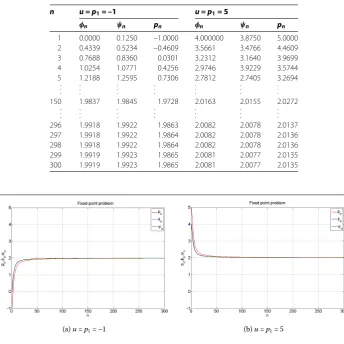
Table shows the values of the sequences{pn},{φn}, and{ψn}whereu=p= – and
u=p= andn= .
Conclusion
. The sequences{pn},{φn}, and{ψn}in Table and Figure converge to , where
{}=EP()∩EP()∩F(G)∩F(W).
Table 1 The values of{φn},{ψn}, and{pn}wheren= 300
n u = p1= –1 u = p1= 5
φn ψn pn φn ψn pn 1 0.0000 0.1250 –1.0000 4.000000 3.8750 5.0000 2 0.4339 0.5234 –0.4609 3.5661 3.4766 4.4609 3 0.7688 0.8360 0.0301 3.2312 3.1640 3.9699 4 1.0254 1.0771 0.4256 2.9746 3.9229 3.5744 5 1.2188 1.2595 0.7306 2.7812 2.7405 3.2694
. . .
. . .
. . .
. . .
. . .
. . .
. . . 150 1.9837 1.9845 1.9728 2.0163 2.0155 2.0272
. . .
. . .
. . .
. . .
. . .
. . .
. . . 296 1.9918 1.9922 1.9863 2.0082 2.0078 2.0137 297 1.9918 1.9922 1.9864 2.0082 2.0078 2.0136 298 1.9918 1.9922 1.9864 2.0082 2.0078 2.0136 299 1.9919 1.9923 1.9865 2.0081 2.0077 2.0135 300 1.9919 1.9923 1.9865 2.0081 2.0077 2.0135
(a)u=p= – (b)u=p=
Figure 1 The convergence comparison of the sequences{pn},{φn}, and{ψn}with different initial valuesuandp1.
Competing interests
The authors declare that they have no competing interests. Authors’ contributions
The authors contributed equally and significantly in writing this paper. All authors read and approved the final manuscript.
Author details
1Department of Mathematics, Faculty of Science, King Mongkut’s Institute of Technology Ladkrabang, Bangkok 10520,
Thailand.2Department of Mathematics, Faculty of Science, Chiang Mai University, Chiang Mai, 50200, Thailand.
Acknowledgements
This paper was supported by the Thailand Research Fund under the research project RTA578007 and the Research Administration Division of King Mongkut’s Institute of Technology Ladkrabang.
Received: 7 April 2015 Accepted: 3 November 2015 References
1. Blum, E, Oettli, W: From optimization and variational inequalities to equilibrium problems. Math. Stud.63(14), 123-145 (1994)
2. Lions, JL, Stampacchia, G: Variational inequalities. Commun. Pure Appl. Math.20, 493-517 (1967)
3. Diaz, JB, Metcalf, FT: On the structure of the set of subsequential limit points of successive approximations. Bull. Am. Math. Soc.73, 516-519 (1967)
4. Su, Y, Wang, D, Shang, M: Strong convergence of monotone hybrid algorithm for quasi-nonexpansive mappings. Int. J. Math. Anal.1, 1235-1241 (2007)
6. Dong, QL, Guo, YN, Su, F: Hybrid iterative scheme by a relaxed extragradient method for equilibrium problems, a general system of variational inequalities and fixed point problems of a countable family of nonexpansive mappings. J. Appl. Math.2012, Article ID 572326 (2012)
7. Ceng, LC, Wang, CY, Yao, JC: Strong convergence theorems by a relaxed extragradient method for a general system of variational inequalities. Math. Methods Oper. Res.67, 375-390 (2008)
8. Kangtunyakarn, A: An iterative algorithm to approximate a common element of the set of common fixed points for a finite family of strict pseudo-contractions and of the set of solutions for a modified system of variational inequalities. Fixed Point Theory Appl.2013, 143 (2013)
9. Opial, Z: Weak convergence of the sequence of successive approximation of nonexpansive mappings. Bull. Am. Math. Soc.73, 591-597 (1967)
10. Osilike, MO, Igbokwe, DI: Weak and strong convergence theorems for fixed points of pseudocontractions and solutions of monotone type operator equations. Comput. Math. Appl.40, 559-567 (2000)
11. Combettes, PL, Hirstoaga, SA: Equilibrium programming in Hilbert spaces. J. Nonlinear Convex Anal.6(1), 117-136 (2005)
12. Xu, HK: An iterative approach to quadric optimization. J. Optim. Theory Appl.116, 659-678 (2003) 13. Takahashi, W: Nonlinear Functional Analysis. Yokohama Publishers, Yokohama (2000)
14. Cheawchan, K, Kangtunyakarn, A: Approximation method for fixed points of nonlinear mapping and variational inequalities with application. Thai J. Math. (in press)
15. Takahashi, S, Takahashi, T: Viscosity approximation methods for equilibrium problems and fixed point problems in Hilbert spaces. J. Math. Anal. Appl.331, 506-515 (2007)
16. Kohsaka, F, Takahashi, W: Fixed point theorems for a class of nonlinear mappings related to maximal monotone operators in Banach spaces. Arch. Math.91, 166-177 (2008)
17. Iemoto, S, Takahashi, W: Approximating common fixed points of nonexpansive mappings and nonspreading mappings in a Hilbert space. Nonlinear Anal.71, 2082-2089 (2009)
18. Kangtunyakarn, A, Suantai, S: Hybrid iterative scheme for generalized equilibrium problems and fixed point problems of finite family of nonexpansive mappings. Nonlinear Anal. Hybrid Syst.3, 296-309 (2009)
19. Kangtunyakarn, A, Suantai, S: A new mapping for finding common solutions of equilibrium problems and fixed point problems of finite family of nonexpansive mappings. Nonlinear Anal.71, 4448-4460 (2009)