Introduction
A number of previous investigators have hypothesized a dopamine receptor hypersensitivity in migraine [1–11]. Migraineurs have exaggerated responses to the physiolog-ical effects of dopamine agonists such as bromocriptine, piribedil, and apomorphine. For example, apomorphine can induce a migraine headache, as well as the associated phenomenon of nausea and photophobia, in individuals with a history of migraine [9]. In addition, intracranial blood flow changes following apomorphine administration occur in migraineurs compared to control subjects [11]. Taken together, these data suggest that migraineurs have an altered responsivity to dopaminergic stimulation.
Molecular genetics offers a novel approach to the understanding and management of migraine since the
dis-order has a strong genetic component [12-15]. The hypoth-esis that activation of dopamine receptors may be involved in the pathophysiology of migraine in certain individuals is consistent with the clinical features of the disorder since many of the symptoms associated with migraine can be attributed to stimulation of dopamine receptors. For exam-ple, nausea and vomiting are common clinical features of migraine in which dopamine receptor stimulation is likely. Gastrokinetic changes, hypotension and other autonomic nervous system changes are additional migraine symptoms that are consistent with activation of dopaminergic neuro-transmission.
The data summarized in the present review indicate that variations within dopamine receptor genes, particular-ly the DRD2 gene, may be the molecular basis for the increased sensitivity of a subset of migraineurs to the physiological effects of dopaminergic agonists.
Molecular variation within the dopamine
receptor DRD2 gene in migraine
S.J. Peroutka () iO Pharmaceuticals
601 Gateway Boulevard, Suite 460, South San Francisco, CA 94080, USA Tel.: +1-650-574-2246
Fax: +1-650-571-6433 Stephen J. Peroutka
Abstract Molecular genetics offers a novel approach to the understanding and management of migraine since the disorder is known to have a strong genetic component. In recent studies, polymorphisms in the genes for dopamine receptors have been evaluated. Both positive and nega-tive association studies have been reported. In particular, these data suggest that activation of the DRD2 receptor plays a modifying role in the pathophysiology of migraine. As a result, existing data provide a mol-ecular rationale for the documented efficacy of dopamine D2 receptor antagonists in the treatment of migraine. Therefore, at the present
time, molecular genetic data provide support for the hypothesis that sus-ceptibility to migraine may be modi-fied, in part, by variations in dopamine DRD2 receptor function.
Key words Dopamine •Migraine •
NcoI polymorphism in the D2 dopamine receptor gene The NcoI polymorphism in the gene encoding the D2 dopamine receptor (DRD2) was evaluated in a group of 250 unrelated individuals [16]. DRD2 was selected as a candi-date gene in migraine since DRD2 antagonists are effective in the acute treatment of migraine and multiple investigators have reported alterations in dopaminergic neurotransmis-sion in migraineurs.
Subjects were identified for this study directly by physi-cian referral. Individuals were evaluated using the diagnos-tic criteria for migraine without aura (MO) and migraine with aura (MWA) established by the International Headache Society (IHS) [17]. The lifetime presence or absence was determined for each of the criteria in the IHS definition of migraine [17]. Interviews were conducted by physicians, nurses and/or trained interviewers. All interviewers were trained by the senior author in the use of the IHS criteria and all clinical data were reviewed by the senior author. Informed consent was obtained and DNA samples collected. All clinical data were obtained independently of the geno-typic data. Control group individuals did not meet IHS cri-teria for migraine (based on direct interview) and were pre-dominantly unaffected spouses of the individuals with migraine.
D2 Dopamine receptor NcoI allele frequencies in the overall dataset
In the dataset (n = 250 individuals), the DRD2 NcoI C allele frequency was 0.73 and the T allele frequency was 0.27. These values are similar to the DRD2 NcoI allele frequen-cies reported in Caucasians of northern or western European descent. In the overall dataset, 54% of individuals had the C/C genotype, 38% had the C/T genotype and 8% displayed the T/T genotype. The average age of the study participants was 52 ± 1 years. No significant differences in gene fre-quencies were found between males (n = 92) and females (n = 158).
D2 dopamine receptor NcoI A allele frequencies in con-trol, MO and MWA groups
The DRD2 NcoI allele frequencies were determined in each subgroup of subjects. Similar DRD2 C allele frequencies were observed in both the control group (0.71; n = 121) and individuals with MO (0.70; n = 77). By contrast, individuals with MWA had a significantly greater frequency of the DRD2 C allele (0.84; n = 52) than the control individuals
(Chi-square = 6.47; p< 0.005) or individuals with MO (Chi-square = 6.15; p< 0.007).
D2 dopamine receptor NcoI allele genotype distributions control, MO and MWA groups
An association of MWA and the DRD2 C allele was also apparent in an analysis of genotype distributions (Table 1). The C/C genotype in the dataset was significantly more fre-quent in individuals with MWA (69%) than in control indi-viduals (p < 0.007) or individuals with MO (p < 0.025). Once again, no significant difference was observed in the genotypic distribution between the control group and indi-viduals with MO. Finally, the incidence of MWA was deter-mined in each genotypic subgroup. MWA was present in 27% of the C/C individuals, 16% of the C/T individuals and 5.2% of the T/T individuals.
Association of DRD2 NcoI alleles and neuropsychiatric disorders
A second study analyzed the possible association of DRD2 NcoI alleles with comorbid neuropsychiatric disorders [18]. Striking similarities exist between the epidemiological char-acteristics of migraine, anxiety and depression [19–29]. All three disorders afflict approximately 10%-25% of the gen-eral population at some point in life and are approximately twice as common in females as in males. Prophylactic med-ications for all three disorders have a subacute onset of action, requiring 3–6 weeks of therapy to measure clinical improvement. In epidemiological studies, a clinical diagno-sis of migraine significantly increases the risk of comorbid anxiety and depression [19–29]. Taken together, these data suggest that a common metabolic variation may underlie comorbid migraine, anxiety and depression.
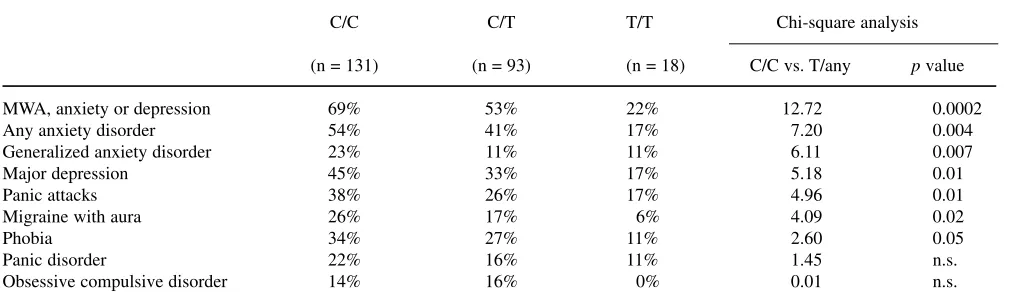
Frequency of neuropsychiatric disorders based on DRD2 NcoI genotypes
T/T individuals (Chi-square = 15.29; p< 0.00005), or the combined T/any group of individuals (Chi-square = 12.72; p< 0.0002).
The presence of an anxiety disorder is significantly more frequent in the C/C individuals than in either the C/T individuals (Chi-square = 3.87; p< 0.02), T/T individuals (Chi-square = 8.92; p < 0.001), or the combined T/any group of individuals (Chi-square = 7.20; p< 0.004). A sim-ilar pattern is seen with generalized anxiety disorder (GAD). Major depression, panic attacks, MWA and phobia are also all increased significantly in the C/C vs. T/any individuals (Table 2). Although both panic disorder and obsessive compulsive disorder (OCD) are more frequent in the C/C vs. T/any individuals, the difference does not reach statistical significance. However, OCD is more fre-quent in the C/C individuals than in the T/T individuals (Chi-square = 2.84; p< 0.05).
DRD2 NcoI allele frequencies in neuropsychiatric disor-ders
DRD2 NcoI allele frequencies were determined in individu-als based on the presence or absence of neuropsychiatric disorders (Table 3) [18]. In individuals with MWA, anxiety disorders and/or major depression, the C allele frequency was 0.80 and the T allele frequency was 0.20. In individuals who have none of these neuropsychiatric disorders, the C allele frequency was 0.63 and the T allele frequency was 0.37. The difference in the DRD2 NcoI C allele frequencies between these two groups of individuals is highly signifi-cant (Chi-square = 17.13; p< 0.00002). These data are con-sistent with the allele frequencies reported in the general Caucasian population where the C allele frequency was reported to be 0.69 and the T allele frequency was reported to be 0.31 [22].
Table 1Genotype distribution in control, migraine without aura and migraine with aura individuals (Modified from Peroutka et al. [16] with permission)a
D2 dopamine receptor NcoI alleles, n (%)
Group C/C C/T T/T
Control 59 (49) 53 (44) 9 (7.4)
Migraine without aura 40 (52) 28 (36) 9 (12)
Migraine with aura 36 (69)*,** 15 (29) 1 (1.9)
*Chi-square = 6.16 (p< 0.007) vs. control group
**Chi-square = 3.83 (p< 0.025) vs. migraine without aura group aA total of 250 individuals were studied
Table 2Incidence of migraine with aura, anxiety disorders and major depression in the current database based on DRD2 NcoI genotypes (Modified from Peroutka et al. [18] with permission)
C/C C/T T/T Chi-square analysis
(n = 131) (n = 93) (n = 18) C/C vs. T/any pvalue
MWA, anxiety or depression 69% 53% 22% 12.72 0.0002
Any anxiety disorder 54% 41% 17% 7.20 0.004
Generalized anxiety disorder 23% 11% 11% 6.11 0.007
Major depression 45% 33% 17% 5.18 0.01
Panic attacks 38% 26% 17% 4.96 0.01
Migraine with aura 26% 17% 6% 4.09 0.02
Phobia 34% 27% 11% 2.60 0.05
Panic disorder 22% 16% 11% 1.45 n.s.
Obsessive compulsive disorder 14% 16% 0% 0.01 n.s.
NcoI C alleles and migraine
Dichgans et al. [30] reported no association between the NcoI allele frequencies and migraine in a German group of 47 patients with MA and 55 patients with MO. No control group was analyzed. The authors concluded that no associ-ation existed between the DRD2 NcoI C allele and MWA.
DRD2 intronic TG dinucleotide polymorphism
Del Zompo et al. [31] studied a clinical cohort consisting of 50 nuclear families from Sardinia. They identified a subgroup of patients with “dopaminergic migraine”, defined by a relatively high frequency of yawning and nausea immediately before or during the painful phase of migraine attacks. A transmission disequilibrium test (TDT) was performed. The distribution of the TG dinucleotide intronic noncoding polymorphism in the DRD2 gene was significantly different (p< 0.004) in the 23 family units with dopaminergic migraine than in the 27 other migraine families. Specifically, allele 1 of the DRD2 gene was sig-nificantly more frequent in the patients with dopaminergic migraine (p< 0.02).
Conclusions
The major finding of these studies is that susceptibility to certain subtypes of migraine and neuropsychiatric disorders may be modified by DRD2 alleles. Specifically, the inci-dence of the clinical diagnoses of migraine, anxiety disorders and major depression has been associated with polymor-phisms within the DRD2 gene in certain clinical databases. However, controversy exists as to whether these associations are present in other populations or clinical databases [30].
As demonstrated in the previously mentioned American clinical database studies, individuals with migraine, anxiety and/or depression display an increased frequency of the DRD2 NcoI C/C genotype compared to individuals with the C/T or T/T genotype. These data rep-resent the first direct evidence to suggest that a specific genetic variant may, at least partially, underlie the well documented comorbidity of migraine, anxiety disorders and major depression [19–29].
In post-mortem brain samples, Taq A DRD2 alleles were associated with variations in the density of DRD2 binding sites [32]. No data exist at present on the effect of NcoI polymorphisms on DRD2 expression. Conceivably, intragenic nucleotide variations may result in functional variations in RNA stability or efficacy in transcription [33], thus resulting in alterations in the density of the expressed receptor protein. For example, recent data suggest that non-coding region variations within the 5-hydroxytryptamine transporter (5-HTT) gene may alter expression of the trans-porter [34]. Specifically, the transcriptional efficiency of the short variant of the 5-HTT gene is reduced compared to the long version of the gene [35]. In addition, intragenic nucleotide variations may also exist within a gene that could result in functional variations in splicing and/or RNA stability [33], thus resulting in alterations in the density of the expressed protein. In the case of monoamine oxidase A, for example, non-coding region variations have been shown to result in a 30-fold difference in enzymatic activi-ty [36].
Alternatively, the DRD2 polymorphisms analyzed in the positive association studies may lie in linkage disequilibrium with a more directly causative mutation. However, a specific molecular variation within the DRD2 gene which could underlie functional variations in the expressed receptor protein remains unidentified [37]. Future studies are needed to more clearly define the pos-sible functional significance of non-coding region varia-tions within the DRD2 gene.
Table 3DRD2 NcoI allele frequencies in individuals with or without migraine with aura, anxiety disorders or major depression (Modified from Peroutka et al. [18] with permission)
C T Chi-square pvalue
MWA, anxiety or depression 0.80 0.20 17.13 0.00002
1. Fanciullacci M, Michelacci S, Curradi C, Sicuteri F (1980) Hyperresponsiveness of migraine patients to the hypotensive action of bromocriptine. Headache 20:99–102
2. Bes A, Guell A, Victor G, Bru A, Jauzac P, Geraud G (1981) Effects of a dopaminergic agonist (Piribedil) on CBF in migraine patients. J Cereb Blood Flow Metabol 1:S549–S550 3. Sicuteri F, Boccuni M, Fanciullacci M,
D’Egidio P, Bonciana M (1982) A new nonvascular interpretation of syncopal migraine. Adv Neurol 33:199–208 4. Geraud G, Guell A, Courtade M,
Dupui P, Bes A (1983) Clinical value of a dopaminergic agonist administra-tion in migraine patients. Headache 23: 191–192
5. Montastruc JL, David J, Rascol A (1985) Does the piribedil test permit predicting the efficacy of domperidone, a dopaminergic antagonist, in the treat-ment of migraine? Headache
25:332–333
6. Murialdo G, Martignoni E, Maria D et al (1986) Changes in the dopaminergic control of prolactin secretion and in ovarian steroids in migraine. Cephalalgia 6:43–49
7. Bes A, Dupui P, Guell A, Bessoles G, Geraud G (1986) Pharmacological exploration of dopamine hypersensitiv-ity in migraine patients. Int J Clin Pharmacol Res 6:189–192 8. Montastruc P, Damase-Michel C,
Montastruc J (1989) Apomorphine potentiates vagal bradycardia. Eur J Pharmacol 166:511–514
9. Sabatini U, Rascol O, Rascol A, Montastruc J (1990) Migraine attacks induced by subcutaneous apomorphine in two migrainous parkinsonian patients. Clin Neuropharmacol 13:264–267
10. Calabresi P, Silvestrini M, Cupini LM, Argiro G, Atzei GP, Bernardi G (1993) 1-Deprenyl test in migraine: neuroen-docrinological aspects. Cephalalgia 13:406–409
11. Del Zompo M, Lai M, Loi V, Pisano MR (1995) Dopamine hypersensitivity in migraine: role in apomorphine syn-cope. Headache 35:222–224
12. Allan W (1928) Inheritance of migraine. Arch Intern Med 42:590–599 13. Bille B (1962) Migraine in school chil-dren. Acta Paediatr 51[Suppl 136]:1–149
14. Devoto M, Lozito A, Staffa G, D’Allessandro R, Sacquegna T, Romeo G (1986) Segregation analysis of migraine in 128 families. Cephalagia 6:101–105
15. Russell MB, Hilden J, Sorensen SA, Olesen J (1993) Familial occurrence of migraine without aura and migraine with aura. Neurology 43:1369–1373 16. Peroutka SJ, Wilhoit T, Jones K (1997)
Clinical susceptibility to migraine with aura is modified by dopamine D2 receptor (DRD2) NcoI alleles. Neurology 49:201–206
17. Headache Classification Committee of the International Headache Society (1988) Classification and diagnostic criteria for headache disorders, cranial neuralgias and facial pains.
Cephalalgia 8[Suppl 7]:1–96 18. Peroutka SJ, Price SC, Wilhoit TL,
Jones KW. Comorbid migraine, anxiety and depression is associated with dopamine D2 receptor (DRD2) NcoI alleles (1998) Mol Med 4:14–2118 19. Marazziti D, Toni C, Pedri S et al
(1995) Headache, panic disorder and depression: Comorbidity or a spec-trum? Biol Psychiatr 31:125–129 20. Merikangas KR, Risch NJ, Merikangas
JR, Weissman MM, Kidd KK (1988) Migraine and depression: Association and familial transmission. J Psychiat Res 22:119–129
21. Merikangas KR, Angst J, Isler H (1990) Migraine and psychopathology: Results of the Zurich cohort study of young adults. Arch Gen Psychiat 47:849–853
22. Breslau N, Davis GC, Andrewski P (1991) Migraine, psychiatric disorders, and suicide attempts: an epidemiologi-cal study of young adults. Psychiatry Res 37:11–23
23. Breslau N, Davis GC (1993) Migraine, physical health and psychiatric disor-der: A prospective epidemiologic study in young adults. J Psychiat Res 27:211–223
24. Merikangas KK, Merikangas JR, Angst J (1993) Headache syndromes and psy-chiatric disorders: Association and familial transmission. J Psychiat Res 27:197–210
25. Merikangas KR (1994)
Psychopathology and headache syn-dromes in the community. Headache 34:17–26
26. Breslau N, Davis GC, Schultz LR, Peterson EL (1994) Migraine and major depression: A longitudinal study. Headache 34:387–393
27. Breslau N, Merikangas K, Bowden CL (1994) Comorbidity of migraine and major affective disorders. Neurology 44:17–22
28. Stewart W, Breslau N, Keck PE (1994) Comorbidity of migraine and panic dis-order. Neurology 44:23–27
29. Silberstein SD, Lipton RB, Breslau N (1995) Migraine association with per-sonality characteristics and psycho-pathology. Cephalalgia 15:358–336 30. Dichgans M, Forderreuther S,
Deiterich M, Pfaffenrath, Gasser T (1998) The D2 receptor NcoI allele: Absence of allelic association with migraine with aura. Neurology 51:928 (Letter to the Editor)
31. Del Zompo M, Cherchi A, Palmas MA, Ponti M, Bochetta A, Gessa GL, Picardi MP (1998) Association between dopamine receptor genes and migraine without aura in a Sardinian sample. Neurology 51:781–186 32. Noble EP, Blum K, Ritchie T,
Montgomery A, Sheridan PJ (1991) Allelic association of the D2 dopamine receptor gene with receptor-binding characteristics in alcoholism. Arch Gen Psychiatry 48:648–654
33. Maquat LE (1996) Defects in RNA splicing and the consequence of short-ened translational reading frames. Am J Hum Genet 59:279–286
34. Bengel D, Lesch KP, Heils A, Hamer D, Murphy DL (1996) A gene regulato-ry region polymorphism alters sero-tonin transporter expression and func-tion in humans. Am J Hum Genet 59:A53
35. Lesch K, Bengel D, Heils A et al (1996) Association of anxiety-related traits with a polymorphism in the sero-tonin transporter gene regulatory region. Science 274:1527–1531 36. Hotamisligil GS, Breakefield XO
(1991) Human monoamine oxidase A gene determines levels of enzyme activity. Am J Hum Genet 49:383–392 37. Gejman PV, Ram A, Gelernter J et al
(1994) No structural mutation in the dopamine D2 receptor gene in alco-holism or schizophrenia. JAMA 271:204–208