Copyright © 2015 IJECCE, All right reserved
Model for Multiple Attribute Decision Making with
Normal Distribution Interval Number Based on Choquet
Integral
Gui-Wu Wei
School of Business, Sichuan Normal University, Chengdu, 610101, P. R. China
Ling-Gang Ran
School of Economics and Management, Chongqing University of Arts and Sciences, Yongchuan, 402160, Chongqing, China
E-mail: [email protected]
Abstract – In this paper, we use the Choquet integral to propose the normal distribution interval number Choquet ordered averaging operator. The operator not only considers the importance of the elements, but also can reflect the correlations among the elements. It is worth pointing out that most of the existing normal distribution interval numbers averaging operators are special cases of our operator. Finally an illustrative example is given to use the operator in the range of uncertain multi-attribute decision-making. The results show that the method proposed in this paper is feasible.
Keywords – Choquet Integral; Normal Distribution
Interval Number; The Normal Distribution Interval Number Choquet Ordered Averaging (NDINCOA) Operator.
I.
I
NTRODUCTIONIn multi-attribute decision making, the object things are complex, uncertain and Human thinking is ambiguous[1-17]. Therefore, interval numbers are usually more adequate or sufficient to model real-life decision problems than real numbers. Many methods have been proposed for dealing with the problem of multiple attribute decision making which the attribute values are given in terms of interval numbers[1-4], a majority of which are usually treated the attribute values as random variables or subjected to the random distribution. But, in other papers, they investigated the attribute values are subjected to the normal distribution, and they also had got some achievements [5-8]. However, the assumption is too strong to match decision behaviors in the real world. Under the condition that the overall values of alternatives in interval number evaluated are subjected to the normal distribution, Zhang and Fang [5] proposed the concept on the possibility for comparing two interval numbers, and then set up the according pair wise comparison matrix on alternatives. Liu, Chen and Ge [6] introduced that the interval number which obeys normal distribution is used in multi-attribute decision making. Wang and Xiao [7] defined some new aggregation operators, such as the NDINWAA operator, the NDINOWA operator and the NDINHA operator, and then developed an approach for solving multiple attribute group decision making based on normal distribution interval number with incomplete information. Wang and Yang [8] proposed the NDNWAA operator and the DNDNWAA operator and suggested a method for solving dynamic stochastic multiple attribute decision making with incomplete certain information.
In this paper, we propose the normal distribution interval number Choquet ordered averaging (NDINCOA) operator, whose prominent characteristic is that it can not only consider the importance of the elements or their ordered positions, but also reflect the correlations of the elements. Furthermore, a method based on the NDINCOA operator is presented, which can be used to develop a model to solve the multiple attribute decision making problem with correlative weights which the attribute values are given in terms of normal distribution interval numbers. Finally, the method is verified by an example.
II.
P
RELIMINARIESGenerally, we consider that the overall values in the interval number
a b
,
are subjected to the random distribution. This to say, the random variables have the same probability distribution to take a value in the interval number
a b
,
. But, according to the central limit theorem,we can comprehend that attribute
values
r r
i(
i
a b i
,
;
1, 2,
, )
n
, given by experts, approach a fixed number. The valuesr
i are followed the normal distribution with a mean of
and a standard deviation of
, and the normal distribution with parameters
and
will be denotedN
,
2
,where
1
2
a b
. For any normal distribution withparameters
and
, the interval
3
covers 99.73% of the distribution:p r
i
3
0.9974
, andaccording to the
3
principle of the normal distribution,then we have
1
6
b a
.
1
2
a b
(1)
1
6
b a
(2)Definition
2.
Supposed that
1
1,
1
,
2 2
,
2
be two normal distribution interval numbers, then we have(1)
1
2
1
2,
12
12
; (2)
1
1,
1
,
0
。It can be seen that the normal distribution interval numbers satisfied the following properties.
(1)
1
2
2
1; (2)
1
2
1
2; (3)
1
2
1
2。Definition 3.
If
1
1,
1
,
2
2,
2
be two normal distribution interval numbers, then: (1) If
1
2, then we have
1
2 ; (2) If
1
2 , then we have
1
2; (3) If
1
2, then ①if
1
2, then we have
1
2; ②if
1
2, then we have
1
2;③if
1
2, then we have
1
2;In multiple attribute decision making, the elements in the normal distribution interval numbers have some correlations with each other, and thus it is necessary to consider this issue. Let
i1, 2,
,
m x
i
n
be the weight of theelement
x
i
X i
1, 2,
,
n
, wherem
is a fuzzy measure, defined as follows:Definition 4.
A fuzzy measurem
on the setX
is a set functionm
:
x
0,1
satisfying the following axioms:(1)
m
0
,m X
1
;(2)
A
B
impliesm A
m B
, for allA B
,
X
; (3)m A B
m A
m B
m A m B
, for allA B
,
X
andA
B
, where
1,
.Especially, if
0
, then the condition (3) reduces to the axiom of additive measure:
m A
B
m A
m B
, for allA B
,
X
andA
B
. If all the elements inX
are independent,and we have
i
i x A
m A
m
x
, for allA
X
.Based on Definition 4, in what follows we use the well-known Choquet integral [9] to propose an operator for aggregating the normal distribution interval numbers with correlative weights:
Definition 5.
Letm
be a fuzzy measure onX
, and
x
j
x
j,
x
j
j
1,2, ,
n
be
n
normal distribution interval numbers, then we call
1 2
1 1
(
,
,
,
)
( (
)
(
))
n n
j j j
j
C
dm
NDINCOA
x
x
x
m B
m B
(3) the normal distribution interval number Choquet ordered
averaging (NDINCOA) operator, where
C
dm denotes the Choquet integral,
1 ,
2 ,
,
n
is a permutation of
1, 2,
,
n
such that
x
1
x
2
x
n
,B
k
x
j|
j
k
,
k
1
and 0
B
.The NDINCOA operator (3) can be transformed into the following form by induction on
n
:
1 2
2 2
1 1
1 1
(
,
,
,
)
( (
)
(
))
,
( (
)
(
))
j
n
n n
j j j j j
j j
C
dm
NDINCOA
m B
m B
m B
m B
(4)
Whose aggregated value is also a normal distribution interval number.
Especially, if
m x
({
j})
m B
(
j)
m B
(
j1)
,1, 2,
,
j
n
, then NDINCOA operator reduces toNDINWAA operator. If
1B j j
m B
, for allB
X
,where
B
is the number of the elements in the setB
,then
1
(
)
(
)
j
m B
jm B
j
,j
1, 2,
,
n
, where
1,
2,
,
T n
,
j
0
,j
1, 2,
,
n
,and 1
1
n j j
Copyright © 2015 IJECCE, All right reserved
III.
T
HEM
ULTIPLEA
TTRIBUTED
ECISIONM
AKINGB
ASED ON THENDINCOA
O
PERATORIn this section, we shall develop an approach to the multiple attribute decision making with correlative weights which the attribute values are given in terms of normal distribution interval numbers as follows. Let
1,
2,
,
m
A
a a
a
be a discrete set of alternatives, and
1,
2,
,
n
X
x x
x
be the set of attributes;m
be afuzzy measure on
X
, where
1
0
m x
,
,
x
j
1,
m
X
1,
m
0
. Supposed that
,
i i i
a
x
ja x b x
a j a j
be the attribute value in the attribute setx
j with respect to the alternativei
a
which given by experts.Step 1.
We use the method which is proposed by Xu [10] to standardize interval number
i
a
x
j
, and then convertinterval number
i
a
x
j
into normal distribution intervalnumber
i
a
x
j
with the equation(1) and equation(2),where
,
i i i
a
x
j ax
j ax
j
, we would get anormal distribution interval number decision making
matrix
i
a j
m n
R
x
,i
1, 2,
,
m
,j
1, 2,
,
n
.And then, we rearrange the normal distribution interval numbers corresponding to each project in descending order by using the method presented in Definition 3.
Step 2.
With the NDINCOA operator, we calculate the overall evaluation information corresponding to each project.
1 2
1 1
,
,
,
( (
)
(
))
,
1, 2,
,
i i i
i
i a a a n
n
a
j j j
j
z
NDINCOA
x
x
x
m B
m B
x
i
m
(5)
Step 3.
We rank the above the normal distribution interval numbers by using the method presented in Definition 3:Step 4.
The ranking of the alternatives can be gained and the best one can be find out.IV.
N
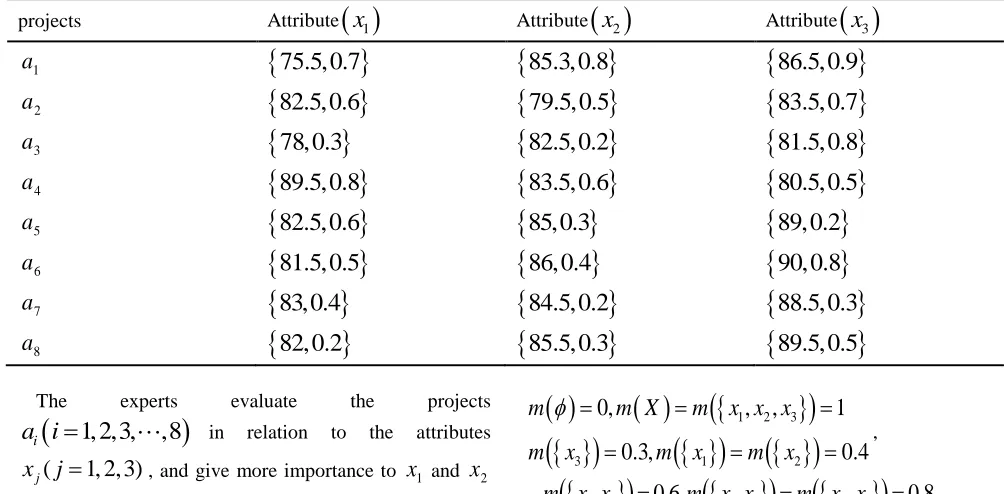
UMERICAL EXAMPLELet us suppose there is an investment company, which wants to invest a sum of money to eight possible projects. The investment company must take a decision according to the following three attributes: x1 is the risk analysis; x2 is the growth analysis; x3 is the environmental impact analysis. The eight possible alternatives are to be evaluated using the normal distribution interval numbers by the experts under the attributes, as shown in the following table.
Table 1: The attribute values of each attribute with respect to eight enterprises given by experts.
projects Attribute
x
1 Attribute
x
2 Attribute
x
31
a
75.5,0.7
85.3, 0.8
86.5,0.9
2
a
82.5,0.6
79.5,0.5
83.5,0.7
3
a
78, 0.3
82.5,0.2
81.5, 0.8
4
a
89.5, 0.8
83.5,0.6
80.5, 0.5
5
a
82.5,0.6
85,0.3
89, 0.2
6
a
81.5, 0.5
86, 0.4
90, 0.8
7
a
83,0.4
84.5,0.2
88.5, 0.3
8
a
82, 0.2
85.5, 0.3
89.5, 0.5
The experts evaluate the projects
1, 2,3,
,8
ia i
in relation to the attributes(
1, 2, 3)
j
x
j
, and give more importance tox
1 andx
2than to
x
3, but, on the other hand, the experts give some advantage to the enterprises that are good both inx
3and in either ofx
1 andx
2. Let
1 2 3
3 1 2
0,
, ,
1
0.3,
0.4
m
m X
m x x x
m x
m x
m x
,
m x x
1,
2
0.6,
m x x
1,
3
m x x
2,
3
0.8
1 1 1 2 2 2 3 3 1 2 3 1 2 3 1 286.5, 0.9 ,
85.3, 0.8
75.5, 0.7 ,
83.5, 0.7
82.5, 0.6 ,
79.5, 0.5
82.5, 0.2 ,
81.5, 0.8
a a a a a a a a
x
x
x
x
x
x
x
x
3 4 4 4 5 5 5 6 6 6 7 7 3 1 2 3 1 2 3 1 2 3 1 278.0, 0.3 ,
89.5, 0.8
83.5, 0.6 ,
80.5, 0.5
89.0, 0.2 ,
85.0, 0.3
82.5, 0.6 ,
90.0, 0.8
86.0, 0.4 ,
81.5, 0.5
88.5, 0.3 ,
84.5, 0.2
a a a a a a a a a a a a
x
x
x
x
x
x
x
x
x
x
x
x
7 8 8 8 3 1 2 383.0, 0.4 ,
89.5, 0.5
85.5, 0.3 ,
82.0, 0.2
a a a a
x
x
x
x
Step 2.
With the NDINCOA operator (5), we calculate the overall evaluation information corresponding to each project.
1 1 1
2 2 2
3 3 3
4 4 4
5 5 5
1 1 2 3
2 1 2 3
3 1 2 3
4 1 2 3
5 1 2
, , 83.7, 0.5025 ;
, , 82.2, 0.3796 ;
, , 81.2, 0.3353 ;
, , 84.7, 0.3960 ;
, ,
a a a
a a a
a a a
a a a
a a a
z NDINCOA x x x
z NDINCOA x x x
z NDINCOA x x x
z NDINCOA x x x
z NDINCOA x x
6 6 6
7 7 7
8 8 8
3
6 1 2 3
7 1 2 3
8 1 2 3
85.7, 0.2012 ;
, , 86.3, 0.3280 ;
, , 85.4, 0.1565 ;
, , 86, 0.21587 .
a a a
a a a
a a a
x
z NDINCOA x x x
z NDINCOA x x x
z NDINCOA x x x
Step 3.
We rank the above the normal distribution interval numbers by using the method presented in Definition 3:
1 2 3
4 5 6
0.9574; 1.1538; 1.5596;
1.0123; 1.7323; 1.1726.
Q z Q z Q z
Q z Q z Q z
Step 4.
The ranking of the alternatives can be gained:6 8 5 7 4 1
z
z
z
z
z
z
2 3
z
z
,a
6is the best one.V.
C
ONCLUSIONIn this paper, we have developed the normal distribution interval number Choquet ordered averaging (NDINCOA) operator, which is used to discuss the correlative normal distribution interval numbers. Furthermore, we have developed an approach to multiple attribute decision making with correlative weights which the attribute values are given in terms of normal distribution interval numbers based on the NDINCOA operator. Finally, an illustrative
A
CKNOWLEDGEMENTSThis research was supported by the Humanities and Social Sciences Foundation of Ministry of Education of the People’s Republic of China under Grant No. 14XJCZH002, and the construction plan of scientific research innovation team for colleges and universities in Sichuan Province (15TD0004).
R
EFERENCES[1] Z.S. Xu, Uncertain Multiple Attribute Decision Making: Methods and Applications. Beijing: Tsinghua University Press, (2004).
[2] R. Yager and Z.S. Xu, The continuous ordered weighted geometric operator and its application to decision making. Fuzzy Sets and Systems. 157(10) (2006): 1393-1402.
[3] G. W. Wei, New method of grey relational analysis to multiple attribute decision making with intervals. Systems Engineering and Electronics. 28(9) (2006): 1358-1359.
[4] G. W. Wei, Y. Wei, Model of Grey Relational Analysis for Interval Multiple Attribute Decision Making with Preference Information on Alternatives. Chinese Journal of Management Science. 16(1) (2008): 158-162.
[5] Q. Zhang, Z.P. Fang, A Ranking Approach with Possibilities for Multiple Attribute Decision Making Problems with Intervals. Control and Decision. 14(6) (1999): 703-706.
[6] L. Liu, Y.X. Chen and Z.H. Ge, Probability measure of interval-number based on normal distribution and multi-attribute decision making. Systems Engineering and Electronics. 30(4) (2008): 652-654.
[7] X.F. Wang, M.S. Xiao, Approach of group decision making based on normal distribution interval number with incomplete information. Control and Decision. 25(10) (2010): 1494-1498. [8] X.F. Wang, X.J. Yang, Dynamic stochastic multiple attribute
decision making method with incomplete certain information. Systems Engineering-Theory & Practice. 30(2) (2010): 332-338. [9] G. Choquet,Theory of capacities. Ann. Inst. Fourier. 5 (1953),
131-295
[10] Z.S. Xu, Z.D. Sun, Priority method for a kind of multi-attribute decision-making problems. Journal of Management Sciences. 5(3) (2002): 35-39.
[11] G. W. Wei, X.F. Zhao, H.J. Wang and R. Lin, GRA model for selecting an ERP system in trapezoidal intuitionistic fuzzy setting, Information: An International Interdisciplinary Journal 13(4)(2010) 1143-1148.
[12] G. W. Wei, A novel efficient approach for interval-valued intuitionistic fuzzy multiple attribute decision making with incomplete weight information, Information: An International Interdisciplinary Journal 14(1) (2011) 97-102.
[13] G. W. Wei, R. Lin, X.F. Zhao and H.J. Wang, TOPSIS-based linear-programming methodology for multiple attribute decision making with incomplete weight information in intuitionistic fuzzy setting, Information: An International Interdisciplinary Journal 13(5) (2010) 1721-1726.
[14] G. W. Wei, Grey relational analysis method for 2-tuple linguistic multiple attribute group decision making with incomplete weight information, Expert Systems with Applications 38 (5) (2011) 4824-4828.
[15] G. W. Wei, A method for multiple attribute group decision making based on the ET-WG and ET-OWG operators with 2-tuple linguistic information, Expert Systems with Applications 37(12)(2010) 7895-7900.
[16] G. W. Wei, FIOWHM operator and its application to multiple attribute group decision making, Expert Systems with Applications 38(4)(2011) 2984-2989.
Copyright © 2015 IJECCE, All right reserved
A
UTHOR'
SP
ROFILEGui-Wu Wei
has an M.Sc. and a Ph.D. degree in applied mathematics from South West Petroleum University, Business Administration from school of Economics and Management at South West Jiaotong University, China, respectively. From May 2010 to April 2012, he was a Postdoctoral Researcher with the School of Economics and Management, Tsinghua University, Beijing, China. He is a Professor in the School of Business at Sichuan Normal University. He has published more than 90 papers in journals, books and conference proceedings including journals such as Decision Support Systems, Expert Systems with Applications, Applied Soft Computing, Knowledge and Information Systems, Computers & Industrial Engineering, Knowledge-based Systems, International Journal of Uncertainty, Fuzziness and Knowledge-Based Systems, International Journal of Computational Intelligence Systems and Information: An International Interdisciplinary Journal. He has published 1 book. He has participated in several scientific committees and serves as a reviewer in a wide range of journals including Computers & Industrial Engineering, International Journal of Information Technology and Decision Making, Knowledge- based Systems, Information Sciences, International Journal of Computational Intelligence Systems and European Journal of Operational Research. He is currently interested in Aggregation Operators, Decision Making and Computing with Words.