Copyright © 2016 IJECCE, All right reserved
Implementation of Agent Based Secured
Communication Protocol in Intelligent Agent System
for Smart Grid
Mr. Sridhar H.S.
Dr. M. Siddappa
Dr. G.C. Bhanu Prakash
Abstract – The Electrical science journey starts with the Edison's first generating power station by 1882, and that system could transmit the electricity just up to one square mile. In any case, with the presentation of alternating current (AC) by Tesla, the world come to understand that power could be transmitted to larger distance with more effectively and efficiently. So the research kept continued, bringing about a more complex obviously more dependable and efficient power grid. Much the same as "SMART" once utilized for telephones having more propelled components and easy to use, the word smart is not new for the power grid; it has been utilized for the most recent couple of years. The power grid additionally began to catch the consideration of its researchers; why not to make our current power grid as insightful as to streamline the use of intelligent as to optimize the usage of energy, more consumer friendly, self-healing nature and much more. Keeping in mind the end goal to have all the propelled highlights in the grid, it must be altered utilizing more intelligent systems, advanced signal processing, fast communication of data, and automatic meter reading etc. and so on to call it as a "SMART GRID". In this paper we are taking the Implementation of Agent based secured communication protocol in Intelligent Agent System for Smart Grid.
Keywords – Smart Grid, Intelligent Agent System, Data
Security Protocol.
I.
I
NTRODUCTIONSmart grids are electric networks whose participants have a particular level of “smartness" and can exchange data amongst one another. Smart grids field is versatile and current research area, e.g. how data is exchanged inside the network, integration of renewable energies; how smart grids are often wont to scale back prices for optimization of energy consumption and distribution [1]. Many test grids exist already are in development, this permits communication between utilities and consumers using broadband access over the electric grid.
Agents are intelligent substances placed in some environment to make decisions and act flexibly and autonomously taking into account their inherent intelligence along with their past encounters. An intensive study and literature survey of intelligent agents as well as smart grids, relating the utilizations of agents in smart grids need to do. Agents seemed, by all accounts, to be the intelligent entities most appropriate for the control, monitoring, power market exercises and the effective utilization of electricity. They give a commercial center to electric vehicles and system reconfiguration. They enable self-healing during faults in the network, based on their distributed, self-contained characteristics. An agent-based model has been proposed in this paper.
Supervisory control and data Acquisition (SCADA) system are used for the management and communication in power grid [2]. SCADA system used some signaling protocols to keep up and management the operation of power grid hardware. We are designing Intelligent Agent Systems (IAS) for Smart grid has several benefits over the SCADA system due to its distributed management nature. IAS is used in power grid so as to make the power grid a lot of stable and reliable. The disturbance identification, power network restoration [3], secondary voltage management and visualization of power grid are made possible by using IAS. Power grid is taken into account as a complex adaptive System (CAS) that to realize real-time improvement and management, agent-based mostly distributed control is that the best suited choice. Design of agent-based intelligent power grid will improve the efficiency and security during a geographically distributed system. Agents work in collaboration to discover the outages and react consequently to permit the micro-grid to work autonomously in islanding. In such things agents based smart grids load management control to visualize the prioritized list of loads and secure the crucial loads by putting its internal generator into operation. Integration of distributed power generation by the renewable energy sources is formed possible by the implementation of intelligent agents. Location of the faults within the grid is set by agents. Multi-agent based smart grids are going to be ready to perform risk-based contingency analysis. Intelligent agents can be enforced in smart grid at every hierarchical level of power flow from generation to the consumer end as well as the distributed generation to a device level. With combination of intelligent and fast sensors and intelligent electronic devices, such as distributed control intelligent agent based system provides the real-time operation and management of a fully automated power system which would be able to exhibit the following characteristics
Modeled as a various leveled system for competing and cooperating adaptive agents
Computations are made in a parallel and distributed way
Controlling local operations repeatedly in understanding with the global optimization criteria
Monitored by local smart sensors
Communication of necessary data is made possible over the power transmission lines
Copyright © 2016 IJECCE, All right reserved In this paper we are designing wireless secured
communication protocol Agent in Intelligent Agent System for Smart Grid. This is more important than any other agent in IAS system because its need to provide the solid data security to information generated in smart grid network. The main goal of this paper is developing the wireless secured communication protocol Agent in Intelligent Agent System for Smart Grid with:
Design a standard, agent based architecture which is capable of auto-configuration.
Implement the designed architecture in order that it is vender and platform Independent.
Implement agents to provide data security for gather information from appliances.
II.
A
GENT SYSTEM FORS
MARTG
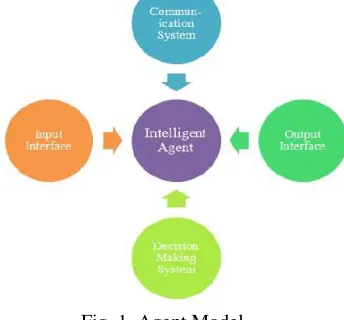
RIDA smart agent consists of four segments: Input Interface, Output Interface, Decision Making System and Communication System. They constitute sensors to monitor the node, some memory to store the data, a processor to make decisions on the basis of some predefined algorithms and two-way communication interfaces. Model of an intelligent agent is as shown in Fig.1.
Fig. 1. Agent Model
Without changing the power system infrastructure the most viable way to modify it as smart grid is to model it in control theory perception. Not thinking as the fact that, most difficult system on earth i.e. power system can only be monitored and controlled by intelligent agent based system. For smart grid, Agent System (AS) can be employed to model computational intelligence of a geographically dispersed but globally connected power grid. Hierarchically come close to better to transform the whole control architecture into intelligent agent system in which agents are considered as autonomous objects. Communication among these intelligent entities can be carried out via various communication media like power line carrier, optical fiber, or microwaves. Every team of agents in an exacting local area tries to solve the problem locally and minimizing the impact this on the system as a whole. Agents are supposed to be in interaction with each other to have complete knowledge about each other for better collaboration [4]. Agent based model of smart grid
can practically assess the impact of theoretical dynamics on the power grid [5].
When electrical loads are classified according to their importance they are categorized as critical and non critical load. Those loads for which supply of electricity is obligatory to be continued in any circumstances are the critical loads. When a load can be switched off or can be shifted in case of peak demands or due to any other reason than this load can be regarded as non critical load. Critical loads have high priority and non critical loads have low priority in the power grid. Smart grid based on agent will represent two classes of agents, one representing non critical load like, energy balance management, energy market issue, energy pricing and energy scheduling while the other one focus on the issues related critical lode like fault handling, reliability, network security, efficiency etc .
III.
T
YPICAL OFA
GENTS INS
MARTG
RIDA
PPLICATIONSThere are different types of agents depending upon their functionality in power systems applications which are described below
A.
Distributed Energy Resource (DER) Agent
A Distributed Energy Resource (DER) agent finds its application in smart grids. In a case when the power from the main distribution circuit is not enough to supply the critical load, then the consumer agent communicates with the DER agents to purchase power from the renewable energy resources. Furthermore, in case of islanding mode of the circuit DER agent takes initiative to supply power to the local critical load.
B.
Consumer Agent
These agents play a very important role by providing interfaces with power consumers at the end-use site. On the basis of interfaces provided by consumer agents flow of power is monitored which results in proper modeling of demand and response of power. If the power required by the load is not enough then this agent starts a conciliation process with the DER agent to buy the power in order to meet the demand and supply necessities.
C.
Prevention Control Agent
The task of these agents is to assess the states that could cause the failure of the power due to accidents. They prepare a report on the basis of their analysis about the future condition of the network due to any changes in the environment and report them to their administrator agents who are in charge for taking decision about how to craft reconfiguration of the network to avoid the failure. These agents estimate the states of the system on the basis of future environmental situation predictions.
D.
Intelligent Response Control Agent
Copyright © 2016 IJECCE, All right reserved power level, and devices not operating properly. They act
as supervisor agents for device agents.
E.
Device Agent
Individual devices in the power grid, such as, circuit breakers, generators, relays voltage regulators and transformers etc are controlled by Device Agents.
IV.
I
NTELLIGENTA
GENTS
YSTEMS FORC
OMMUNICATION INS
MARTG
RIDAt the point when moving from a conventional energy flow system to a bidirectional flow grid system, where Distributed Energy Resources (DERs) turn into a balancing element in total energy production, new difficulties emerge for the network administrators. Similarly as with the unidirectional grid system, grid operators must ensure power conveyance for every consumer in the grid system. The power delivery must be adjusted continuously as for the load of the end-point. For the most part, there is an adjusting market for overseeing such target [6].
With need of bidirectional electric grid system, handling grid becomes more complicated since micro-grids are able to deliver electric energy back to the system. This is done through small grid as PV, the discharging of EV, private wind turbines, and so forth. Information about generation and utilization toward the end-end point is in this manner profitable the communication between the home and grid services is a critical element to consider in the future when the residential home users are cooperating with the Utilities. By and large, the insignificant effect the smart grids have on private market today is not exceptionally basic as far as information delivery. In any case, when the private business sector turns into a collaborating part of the electrical network, the system turns into a mission basic system in connection to its operation. Agents will play very important role in communicating with other node and controlling also.
Fig. 2. Layers of IAS in Smart Grid
The Agent system of power grid is grouped into cognitive and reactive agents. A cognitive agent is a keen specialist with complete base information that includes all the data and knows how to do its task and to handle interaction with different agents. Then again reactive agent is not as a matter of course wise but rather can react to stimuli with quick speed. From the Fig.2 it is clear that Agent system in power grid usually has three layers: Deliberative Layer, Coordination Layer and Reactive Layer [7].
Reactive Layer performs urgent self healing actions on the basis of pre-programmed information. This layer is distributed at every neighboring subsystem and interfaces
with the middle layer. Coordination Layer checks that which triggering event from the reactive layer is more urgent on the basis of pre defined priorities. A triggering event is allowed to reach the top layer only if it exceeds the stipulated threshold. This layer also analyses the commands to the top layer and decomposes them into actual control signals in order to make them compatible for the agents of the bottom layer. Deliberative Layer prepares higher level commands, such consistency assessment with the help of the information provided by the coordination layer. Middle layer in Agent System makes the communication between the bottom and the top layer compatible for both layers. Reactive Layer contains many agents that locally control the system behavior and make short period planning, while in deliberative layer system is analyzed from a wide area point of view and can plan for a longer period of time. Example, a generation agent may decide, based on its local view, to trip the generator. However, if reconfiguration agents in the deliberative layer based on the global view decide to block the tripping actions, then the action of generation agent at the reactive layer will be reserved. Coordination Layer continuously updates and stores the current state of the power system. Agents on different layers and on same layer can communicate with each other. Communications among the agents can be implemented through an end-to-end link with potential access through the secured wireless communication [8].
V.
I
NTELLIGENTA
GENTS
YSTEMSAs mentioned earlier, an Intelligent Agent Systems contains many agents. These agents share common or distinct goals, react to the information received from their environment and other agents, perform computations and assist other agents in achieving their tasks in pursuit of achieving the overall goal of the Intelligent Agent Systems. The key difference between single and multi-agent systems is that for an multi-agent in a multi-multi-agent system other agents are a part of the environment. Since multi-agent systems consist of several multi-agents they enjoy following properties of individual agents:
Autonomy: Agents are capable of operating without any supervision of humans. They also have certain level of control over their actions and internal state. Social ability: Agents interact and communicate with other agents and humans via some kind of agent communication language.
Pro-activeness: Agents can perform actions and take initiatives according to the goals that have been assigned to them. This characteristic is termed as goal-directed or goal-oriented behavior.
Reactivity: Agents respond to the changes in their environment in a timely fashion
Copyright © 2016 IJECCE, All right reserved
Data Collection: An agent may contain enough data that would correspond to its knowledge about the environment, which in turn would help it in decision making towards its goals.
A List of other Agents and their capabilities: A multi-agent system should contain an multi-agent that helps all other agents share their location and capabilities with other agents.
Computational components: Agents should contain computational components that would help them in computing required results.
Protocols: Agents should contain a list of well defined protocols that define methods of communication with different entities (humans or other agents) belonging to the system. Learning Module: Agents must contain a learning module that would keep updating its data collection according to the performance of its computational component, changing environment and condition of fellow agents.
VI.
I
NTELLIGENTA
GENTS
YSTEM FORS
MARTG
RIDI
MPLEMENTATION USING INZ
EUSIntelligent Agent System for Smart Grid application development in Zeus involves following steps [9]
Specification
Application Analysis
Application Design
Application Realization
A.
Specification
In this step, specifications regarding exemplary agents belonging to the Intelligent Agent System for Smart Grid system are defined and their abilities will be specified in accordance with Zeus implementation
Control Agent: Control Agent will control the distinctive parts of the smart grid, for example, voltage control agent will screen the voltage level from the main grid and fault control unit will keep up the status of the circuit breaker. It will be in charge of telling every single another agent of these parameters.
User Agent: User agent will provide facility to monitor voltage, current, active and reactive power consumptions at all critical and non-critical loads and control on/off status of loads. Its actions will depend on information from the control agent and the DER agent. Its value can be changed after a user agent initializes. We can define a different value for each user in the Intelligent Agent System for Smart Grid system.
Database Agent: Database Agent is the same as Utility Agents automatically generated by ZEUS. As described earlier they keep track of all available agents and their capabilities.
DER Agent: DER Agent will control the operation of DERs. Its actions will also be based on outputs from the control and the user agents. The DER agent and the user agent will always be exchanging messages at regular intervals in order to operate loads at minimal.
Database Agent: Database Agent is the same as Utility Agents automatically generated by ZEUS. As described
earlier they keep track of all available agents and their capabilities.
Monitor Agent: Monitor agent will monitor the specified normal condition in the smart grid if there is any changes above the acceptable level it will be communicated to allotted control agent.
Protocol Agent: Protocol agent will be responsible for communication within the smart grid. Their responsibilities are to crate the packet, maintain the time of communication depending upon the protocol designed etc.
Security Agent: Security Agent will select the security level required for each data generated in Smart Grid. Depending on data type we can classify them as time critical and non time critical data. Agent will select the key length based on the data type so that time critical data will not get delayed.
In this agents first three agents are generalized for any application in smart grid and reaming are the specific for the application in the smart grid which we will call as application specific agents in smart grid. Combining all this Agents it will become Intelligent Agent System for Smart Grid
B.
Application Analysis
Zeus uses the role modeling technique to formalize the agents’ roles, position and set of responsibilities that simplify understanding and modeling the problem at hand. Role Models have been divided into domains having specified features that can be compared to the desired system. These domains are represented graphically as diagrams showing each constituent’s containments, multiplicity, inheritance and interaction with other constituents. Role Models comprise two kinds of diagrams: a Role Modeling Diagram and a Collaborative Diagram. The former depicts all notations mentioned above; and the latter only depicts the interaction. Finally all roles are described in the form of Social Responsibilities and Domain Responsibilities
C.
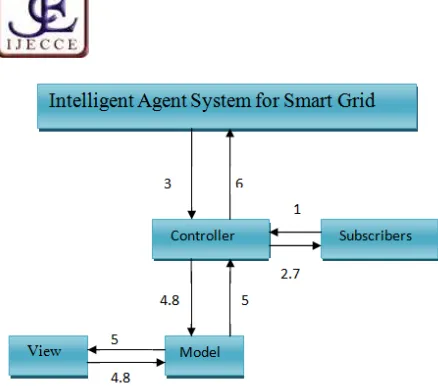
Collaborative Diagram for Intelligent Agent
System for Smart Grid Agents
Copyright © 2016 IJECCE, All right reserved Fig. 3. Collaborative Diagram for Intelligent Agent
System for Smart Grid Agents
D.
Role Modeling Diagram for Intelligent Agent
System for Smart Grid Agents
Fig. 4 below shows the role modeling diagram for the complete Intelligent Agent System for Smart Grid system. The Task Agents (including a control agent, a user agent and a DER agent) are shown in the Task Agents block. The figure shows the roles of task agents in the system. As explained earlier the task agents build an information management domain. The control agent is the controller that sends information to the subscribers, the user agent and the DER agent both of which continuously share information with each other. The figure shows the full Multiplicity among the two subscribers and half Multiplicity among the controller and the subscribers.
Fig. 4. Role modeling diagram for Intelligent Agent System for Smart Grid
E.
Listing Agent Responsibilities
Agents have Social or Domain Specific responsibilities. Social responsibilities define how Agents interact with other agents and Domain Specific responsibilities involve
application specific responsibilities. Thus the roles played by each agent can be identified as:
PROTOCOL AGENT – Social Responsibilities
Origin Responsibility
Protocol Agent
To receive and process data from Agents
Protocol Agent
To provide network locations of named agents
PROTOCOL AGENT – Domain Responsibilities Origin Responsibility
Protocol Agent
To send data or command from source agent to destination Agent
Protocol Agent
To prepare the data packets to sand
Security Agent – Social Responsibilities Origin Responsibility
Security Agent
To receive and process communication messages
Security Agent – Domain Responsibilities Origin Responsibility
Security Agent
To maintain types of massages like critical data or Noncritical data
Security Agent
To select encryption key length based on type of security needed.
F.
Problem Design
In this step, each responsibility is mapped to the problem that it attempts to solve. Past tried and tested solutions are applied to solve these problems. We present the some of the problem design for each of the role in Tables below.
Responsibility: To receive and process communication messages
Origin: Security Agent
Problem: Data before sanding it need to encrypt Solution: Design ZEUS Agents to initialize the
encryption
Responsibility: To maintain types of message like critical data or Noncritical data
Origin: Security agent
Problem: Data need differentiate the critical and non critical data
Solution: Data from the node itself give information about the type of data. In the data base node type is need to maintained
Responsibility: To select encryption key length based on type of security needed.
Origin: Security Agent
Problem: To handle the critical data and non critical data timely and securely encryption key length need to decide
Solution: At the time of encryption and decryption predefined key length is assigned Based on data types
VII.
S
ECUREDP
ROTOCOLCopyright © 2016 IJECCE, All right reserved strongest security by improved 802.11i based
authentication and TKIP for data encryption. We will use NS2 to simulate the network, but it is well known that NS2 doesn’t implement any security features. We won’t implement the security things in NS2 either, because security is a subtle thing related to many aspects, which is much different from other kinds of network protocols. Instead, we only want to model the process of the security features and explore their influence on the voice performance [11].
Both the authentication and encryption will influence the performance of the system. For authentication, it will add some extra time on setting up the call at the beginning, also it will influence the performance by adding more traffic into the network for the authentication handshake. On the other hand, for data encryption, it does not add any extra message into the network, but it has influence on the performance due to the encryption/decryption delay and the increasing size per packet [8].
VIII.
T
EMPORARYK
EYI
NTEGRATIONP
ROTOCOL(TKIP)
TKIP was developed to address the vulnerabilities associated with WEP and is used in Wi-Fi Protected Access (WPA). TKIP was developed to provide backwards compatibility with WEP to prevent the need to replace all hardware that only supported WEP at the time. TKIP can be constructed by utilizing the IV, RC4 algorithm, and the ICV that WEP already used. TKIP essentially consists of three algorithms: a cryptographic message integrity algorithm, an enhancement to the IV, and a key mixing algorithm [9]. The largest change with TKIP is that it creates a new key for each packet significantly reducing the possibility of guessing a key. Additionally, the encryption scheme provides a hash to prevent packet modification and replaces the flawed IV system by enforcing a longer packet counter and replay protection. The message integrity check was designed with the intent of overcoming WEP’s vulnerable ICV by creating a non-linear hash to prevent packet modification. Designers eventually settled on the Michael algorithm because of its relatively low computational overhead. Additionally, TKIP provides for logging, disabling, and de-authentication when a station incorrectly attempts to guess the Michael algorithm in too short of time. This ensures that new keys are generated in these instances making it very difficult to guess the ICV.
As mentioned earlier, TKIP also addresses replay attacks by adding a TKIP Sequence Counter (TSC) which prevents reuse of an IV. This is the second algorithm associated with TKIP in which a 48-bit counter is employed to ensure a unique IV for each packet. This algorithm also helps prevent denial of service (DoS) attacks by ensuring that the receiver does not update the TSC until the MIC has been verified after each packet.
The final key mixing algorithm protects the Temporal Encryption Key (TEK). This is the key that is used by management algorithms to exchange keys for each authentication[10]. This key rotation helps increase
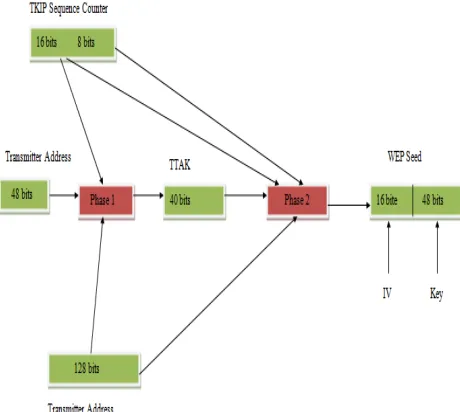
security. The TEK is used by the key mixing algorithm to combine the TEK, TSC, and transmitter address (TA) into a 128-bit WEP seed that is unique for each packet. The algorithm further avoids known keys in the RC4 process that are known to be weak. For Non critical data and critical data, the key mixing algorithm is broken down into two parts. During phase 1 the TKIP mixed Transmit Address and Key (TTAK) are generated by the combination of the TSC, TA, and TEK components. The process was intended to have a low computational overhead; however, it still takes some time to complete because of the multiple processes occurring simultaneously. During phase 2 the TTAK is combined with a full TEK and TSC to generate the 128-bit WEP seed [9].
Fig. 5. TKIP Key Mixing for critical data
With the generation of the WEP seed complete, the TKIP packet can be encapsulated with a process that is similar to the WEP encapsulation process with a few additional steps. Fig. 5 illustrates those steps. Once the WEP seed is generated the data to be sent is run through the Michael algorithm to create the MIC key. This combination of data is combined with the CRC-32 algorithm to create the ICV which is appended to the data [12]. As the WEP seed is run through the RC4 algorithm and the key stream is generated it is combined with the data to create the final packet.
IX.
R
ESULTS ANDA
NALYSISCopyright © 2016 IJECCE, All right reserved will use two different configurations to explore them
separately.
X.
N
ONC
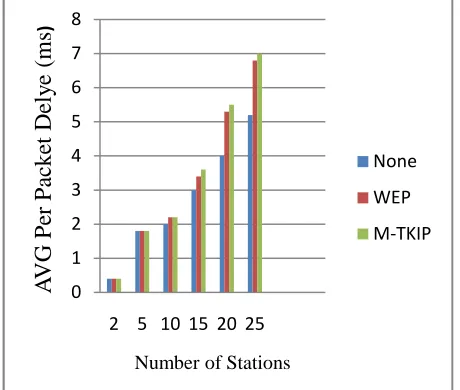
RITICAL DATAThis configuration is used to test how the encryption overhead (extended packet length) affects the delay and drop rate. In this simulation, each station set up a connectional to the AP at random starting point, then continue to send out packets until the simulation ends. The calculation of per-packet delay and drop rate is done only for the data packets sent out after a specific period, say, all the stations have set up the connections.
Fig. 6. Per Packet Delay for Smart Grid Non Critical data calls
Fig. 7. Drop Rate for Smart Grid Non critical data
From Fig. 6 and 7, we can see when the number of stations is small (say, less than 10), adding security features, no matter WEP or TKIP, does not influence the voice performance. However, when the network is getting more and more crowded (say, more than 15 stations), adding security features will increase the packet delay and drop rate rapidly, thus decrease the voice performance. For example, for 1 or 5 stations, there is no difference for the three schemes in packet delay and drop rate. For 10 stations, packet delay will increase a little when adding security features, but drop rate almost keeps the same.
However, for 15 and 20 stations, both packet delay and drop rate increases rapidly when adding any security features. Furthermore, we can see generally TKIP is worse than WEP due to its larger packet size.
XI.
C
ONCLUSIONSIn this paper an Intelligent Agent System has been developed for a smart grid with standard development techniques and agent communication protocols. Details about the designing and developing a multi-agent system using Zeus agent building toolkit were described, including implementation of external programming. The IAS system development process using Zeus agent building toolkit requires: specification, application analysis, application design, and application realization. These steps generate agents’ codes capable of reacting to external changes in their environment.
Development of distributed time-critical applications for automation of the smart grid poses significant challenges in choosing optimal communication strategies and adherence to prescribed performance requirements. The main strength of the proposed system is that it enables the actual IAS application code to be tested on the basis of accurate simulation of the specific target communications network.
It is envisaged that the smart grid of the future will need to employ a large number of applications of this type, as well as many that are less time-critical, which will share the underlying communication infrastructure. Accurate modeling of data communications and the use of the actual application code provide a high degree of confidence in the performance data obtained before deployment on the target system.
R
EFERENCES[1] SmartHouse/SmartGrid. official website, July
2010.http://www.smarthouse-smartgrid.eu.
[2] D. Bailey and E. Wright, “Practical SCADA for Industry”. News, Oxford, UK, 2003
[3] X. Feng, S. Misra, G. Xue, and D. Y ang, “Smart grid-The new and improved power grid: A survey,” IEEE Commun. Surveys Tuts., no. 4, pp. 994–980, 2012.
[4] Russell, Stuart J.; Norvig, Peter, “Artificial Intelligence: A Modern Approach”, (2nd ed.), Upper Saddle River, New Jersey: Prentice Hall, ISBN 0-13-790395-2, chapter 2.
[5] Pattanasomporn, M., Feroze, H., Rahman, S., “Multi Agent Systems in a Distributed Smart Grid: Design and Implementation”, In Proc. IEEE Power Systems Conference and Exposition, March 2009, pp.1-8
[6] L. Eschenauer and V. D. Gligor. “A Key-Management Scheme for Distributed Sensor Networks”. In Proceedings of the 9th ACM Conference on Computer and Communications Security (CCS). ACM Press, 2002.
[7] M. Shahidehpour, Y. Wang, "Communication and Control in Electric Power Systems: Applications of Parallel and Distributed Processing", New Jersey: John Wiley & Sons, 2003, Ch. 1 & Ch. 10, pp 349-389.
[8] A. Raniwala and T. Chiueh, “Architecture and algorithms for an IEEE 802.11-based multi-channel wireless mesh network,” in Proc. 2005 IEEE INFOCOM.
[9] Zeus agent development toolkit.
http://labs.bt.com/projects/agents/zeus/
[10] Sankar, Krishna, Sundaralingam, Sri, Balinsky, Andrew, Miller, Darrin. Cisco Wireless LAN Security: Expert Guidance for 0
1 2 3 4 5 6 7 8
2 5 10 15 20 25
A
V
G
P
er
P
ac
ke
t
D
el
y
e
(m
s
)
Number of Stations
None
WEP
M-TKIP
0 0.5 1 1.5 2
2 5 10 15 20 25
A
v
e
ra
g
e
P
a
ck
e
t
D
ro
o
p
R
a
te
%
Number of Station
None
WEP
Copyright © 2016 IJECCE, All right reserved
Securing Your 802.11 Networks. Cisco Press, Indianapolis, IN 2005.
[11] Guha, R.V., and Lenat, D.B.: “Enabling Agents to Work Together”, Communication. ACM, 1994, 37, (7), pp. 127-142 [12] V. C. Gungor and F. C. Lambert, “A survey on communication
networks for electric system automation,” Comput. Netw., vol. 50, no. 7, pp. 877–897, May 2006.
A
UTHORS'
P
ROFILESMr. Sridhar H.S. is working as an Assistant professor , Dept. of
Electrical and Electronics Engg Siddaganga Institute of Technology Tumkur, India.He did his B.E. and M.Tech from Vishveswaraiah Technical University, Belgaum, Karnataka, and pursuing PhD Vishveswaraiah Technical University, Belgaum, Karnataka,
Dr. M. Siddappa is working as an Professor and Head in Department of
computer science & Engg., SSIT Tumkur, Karnataka, India. He has received PhD in computer science from MJR University, Tamilnadu. He has published many research papers in international journals and presented several research papers in international conferences.
Dr. G.C.Bhanu Prakash is working as an Professor in Department of