DETERMINATION RESULT OF LEAD IN ANIMALS AND ENVIRONMENTAL SAMPLES
Ts.Javzandolgor1*, Ch.Buyantogtokh1, S.Bolorchuluun1, B.Bilguun1, Ya.Ganbold1
Hirotaka Naitou2, KosukeToshiki3
1Institute of Veterinary Medicine, MULS, Zaisan-17024, Ulaanbaatar, Mongolia 2University of Shizuoka School of Food &Nutritional Sciences
Department of Environmental and Life Sciences 3University of Miyazaki Faculty of Regional Innovation
*Corresponding author: [email protected]
ABSTRACT
Due to negligent use and disposal of lead containing sources including acid and alkali batteries with lead conductor, vehicle accumulators in last years, environment has been polluted greatly and it becomes the cause of animal poisoning. Heavy metals are dangerous because of their persistence and toxicity. Soil behaves as a sink of heavy metals by aerial deposition of particles emitted by human activities. The aims of this work were to identify the levels of lead in accumulator processing plant and city areas and animals. A total of 60 blood samples were collected in the vicinity of Ulaanbaatar and measured lead concentrations using equipment LeadCare II. Detection limit of LeadCare II for blood lead concentration ranges between 3.3 and 65 µg/dl. Measurements were made in three replicates using the samples, which were diluted by 10 to 100 fold and about 180 units of analysis was carried out.
According to our study lead concentration in blood from livestock populations in the vicinity of Khonkhor lake, Nalaikh district is greater up to 52.9 ppm and the concentration in the soil around the factories is 30 fold higher.
High lead content were found in soil and livestock animal blood samples of accumulator processing plant, which have correlated positively between them. But lead concentration in the blood sample from animals, which in areas might be free from lead pollution, was higher than acceptable level. In further studies on contamination resources are required.
KEY WORDS: heavy metal, soil, blood, cow, sheep
INTRODUCTION
With regard to increasing open pit mining activities in our country, water, soil and plants of those areas are being polluted by various chemicals causing changes in the ecological system and spread of new diseases among people and livestock in the vicinity
[1; 9]. According to WWF Mongolia Program Office, lead content in the soil of Ulaanbaatar city was 95.7 mg/kg in 1993, 108.2 mg/kg in 1995 and 124.8 mg/kg in 1997 and it is increasing year after year [18]. Besides it, disordered disposal of acid and 1Institute of Veterinary Medicine, Mongolian University of Life Sciences, Ulaanbaatar, Mongolia
18 Ts.Javzandolgor et al. Mong.J.Agric.Sci. (2017) Vol.21 (02) DOI: https://doi.org/10.5564/mjas.v21i02.900
alkali batteries with lead conductor and vehicle accumulators in last years has been main source for lead poisoning in animals [2; 3; 4]. Lead is called as nervous poison, affects adversely nervous system, kidney, haematogenic and reproductive system as well as dangerous for retardation of growth and brain development [5; 6]. It has been an urgent issue to study impacts of heavy metal on livestock living environment and human body as well as to develop
preventive method by determining it in biological samples based on the above information.
The present study aimed to determine and compare lead distribution level from 20 to 100 kilometer radius surrounding Ulaanbaatar city. To achieve our goal, we have taken animal blood and soil samples from 5 points and determined the lead concentration.
METHODS AND METARIALS
We took samples choosing 5 points within 20-100 km radius from 4 directions (south, north, east and west) of Ulaanbaatar city in August 2015. A total of 60 blood samples were taken including test and analysis samples from 10 heads of sheep and 10 cows of herder E.B who resides in the vicinity of Khonkhor lake, 11th khoroo, Bayanzurkh district (around the accumulator processing plant), 10 heads of sheep of herder Ts, 6th bag, Zuunmod soum, Tuv aimag (8 km from Tuv aimag center) as well as 10 heads of sheep of herder D, 4th bag, Batsumber soum, Tuv aimag, 10 heads of sheep of herder B.K, 4th bag, Erdene soum and 10 heads of sheep of herder B, 1st bag, Ugtaaltsaidam soum where there is
no existing monitoring and plant operation. Lead concentrations in a of 60 blood samples was determined using LeadCare II of Magellan Diagnostics, USA which reveals lead amount in 3.3-65 µg/dl limit of detection. Measurements were made in three replicates using the sample been diluted 10-100 fold and about 180 units of analysis was carried out. 10 gram soil sample was collected from 24 points at 50 meter distance around the accumulator processing plant, prepared the samples for analysis by grinding and screening on 10 mm sieve and soil lead amount was determined by Total Reflection X-ray fluorescence Analysis.
RESULTS
To analyze the samples from animals, they categorized into sheep’s and cows’, quantitative data of analyses were not compared to those in various livestock kinds, but compared to lead concentrations in blood of ruminants, followed by final conclusion. Absence of quantitative data with research baseline value determined by normal level of lead in both sheep and cow blood in Mongolia does not allow summarizing and comparing in direct values of
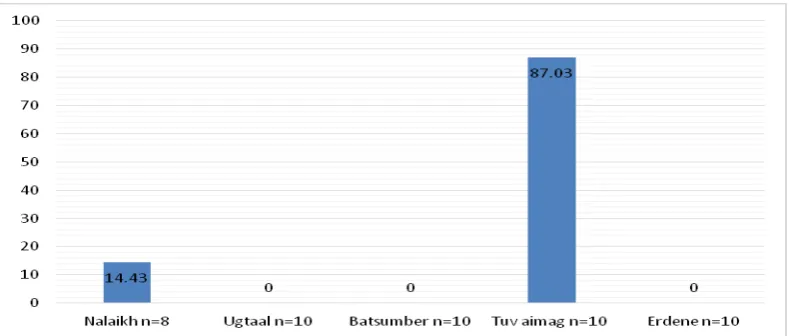
analytic results. We selected points within 20-100 km radius from 4 directions of Ulaanbaatar in August 2016. According to the Figure 1. Lead contained in blood of sheep in 6th bag, Tuv aimag which is a settled place was higher up to (22.5 ppm) 87.03 ppm compared to accepted highest amount in ruminant while blood lead amount of sheep in the vicinity of accumulator processing factory was up to 14.43 ppm.
According to the Figure 2. lead content in the cow blood is higher up to 52.9 ppm compared to acceptable highest content (22.5 ppm) in blood of ruminants. According to general results of the analysis both lead content in livestock blood around the accumulator processing plant and lead content in
the livestock blood away from the plant and central road is higher that acceptable lead content and it has been defined that lead content in livestock blood in the vicinity of the plant is 1.7 times higher than non – industrial area.
Figure 2. Lead content in the blood of cow /around the plant/, ppm
Sampling point, Soil lead Pb content (ppm) Figure 3. Lead content in the soil around the accumulator processing plant (ppm)
Soil lead content should not exceed 100 ppm according to national standard in Mongolia, whereas our analysis of soil sample taken from 13th point in
the vicinity of accumulator processing plant revealed that lead content is up to 3338 ppm or higher by 30 times.
I.Khatanbaatar et al. Mong.J.Agric.Sci. (2017) Vol.21 (02) DOI: https://doi.org/10.5564/mjas.v21i02.899
ACKNOWLEDGMENTS
Funding this work was provided by the ALFABET (Erasmus Mundus Action-2) project and the project IGA FTA 20165013, Czech University of Life
Sciences Prague, the Czech Republic, EU in cooperation with IVM in UB, Mongolia.
REFERENCES
1. Anon (2014) The Molecular
Epidemiology/Genotyping Reports. World Reference Laboratory for Food-and-Mouth Disease, www.wrlfmd.org
2. Baatar T (1983) Prevalence of ruminant's hydatid
disease in Mongolia, Research report of Institute of Veterinary Medicine, Ulaanbaatar, Mongolia, 18-19.
3. Batsukh Z, Battsetseg G (2014) One health and
biosafety - need of harmonization in Mongolia. Mongolian Journal of Agricultural Sciences, 13(02):146-152.
4. Boldbaatar B, Imaoka K, Sentsui H (2012)
Serosurveillance of Some Flaviviruses in Mongolian Horses. Journal of Infectious Disease
Research, 5(48):54–55.
5. Boldbaatar B, Inoue S, Noguchi A, Kaku Y,
Okutani A, Yamada A (2013) Determination of Rabies nucleoprotein antibody titer in serum of experimental animals produced using recombinant plasmid. Journal of Infectious Disease Research, 6(55):33.
6. Bekhochir J, Sugar S, Batchuluun D,
Sodnomdarjaa R, Tserendorj Sh (2013) Emerging and re-emerging viral diseases in Mongolian animals. Journal of Infectious Disease Research, 6(55):33.
7. Burmaa Kh, Davaa G, Darmaa M (2012a)
Endemic Area of Anthrax. Mongolian Journal of Infectious Disease Research, 5(48):46.
8. Burmaa Kh, Davaa G, Darmaa M (2012b)
Determination of the anthrax tendency through the index. Mongolian Journal of Infectious Disease Research, 5(48):45.
9. Burenbaatar B, Bakheit MA, Plutzer J,
Suzuki N, Igarashi I, Ongerth J, Karanis P (2008)
Prevalence and genotyping of Cryptosporidium
species from farm animals in Mongolia. Parasitology Research, 102(5):901-905. DOI: 10.1007/s00436-007-0847-6
10.Chinchuluun B, Sako Y, Khatanbaatar
I, Bayarmaa B, Lkhagvatseren S, Battsetseg G, Yanagida T, Itoh S, Temuulen D, Budke CM, Ito A, Batsukh Z (2014) A survey of seropositivity to antigen B, an immunodiagnostic antigen for human cystic echinococcosis, in domestic animals in Mongolia. Parasitology
International, 63 (2):324-326. DOI:
10.1016/j.parint.2013.12.002
11.Cote K, Welkos SL (2015) Anthrax Toxins in
Context of Bacillus anthracis Spores and Spore
Germination. Toxins, 2015 August, 7(8):3167-78. DOI: 10.3390/toxins7083167
12.Cullinane A, Newton JR (2013) Equine
influenza—a global perspective. Veterinary
Microbiology, 167(1-2):205–214.
DOI: 10.1016/j.vetmic.2013.03.029
13.Daly JM, Lai AC, Binns MM, Chambers TM,
Barrandeguy M, Mumford JA (1996) Antigenic and genetic evolution of equine H3N8 influenza A viruses. Journal of General Virology, 77
(Pt4):661–71.
http://dx.doi.org/10.1099/0022-1317-77-4-661
14.Davis LE, DeBiasi R, Goade DE, Haaland KY,
Harrington JA, Harner JB, Pergam SA, King MK, DeMasters BK, Tyler KL (2006) West Nile virus neuroinvasive disease. Annals of Neurology, 60(3):286-300. http://onlinelibrary.wiley.com/doi/10.1002/ana.2 0959/abstract;jsessionid=3B8B0AE2104F9145F E690C15C2000534.f03t03
15.Dixon TC, Meselson M, Guillemin J, Hanna PC
(1999) Anthrax. The New England Journal of
Medicine, 341(11):815-826.
DOI:10.1056/NEJM199909093411107
16.Eckert J, Gemmell M, Meslin FX, Pawlowski Z
(2001) WHO/OIE Manual of echinococcosis in humans and animals: a public health problem of global concern. Organization for Animal Health and World Health Organization. http://apps.who.int/iris/handle/10665/42427
17.Enkhbaatar L, Tsegmid B (2009) Equine
Influenza Epizootics and Solar Activity. Mongolian Journal of Infectious Disease Research, 3(28):16-17
18.Enkhtuya J, Myagmarsuren P, Davaasuren B,
Javkhlan G, Tuvshintulga B, Batsukh Z, Kusumoto A, Battsetseg B, Kawamoto K (2010) Surveillance of Bacillus anthracis natural infection in Mongolia nomadic animals. Mongolian Journal of Infectious Disease Research, 4(35):12-13
20 Ts.Javzandolgor et al. Mong.J.Agric.Sci. (2017) Vol.21 (02) DOI: https://doi.org/10.5564/mjas.v21i02.900
DISCUSSION
According to statistics from National Center for Public Health, lead is absorbed in the blood and impairs nerve cell as enters body [15]. It is an element which almost does not go out from the body in other words it accumulates [7; 17]. Further, as it enters human and livestock body 90% goes out through digestive organs and 30-50% of lead entered children and newborn young animals is absorbed. Semi-biological decomposition of lead is approximately 4 years, about 90% remains in the bone and remaining percent is accumulated in brain, kidney and livers [7; 12]. If affects mental and reproductive functions and is accumulated in massive organ or muscle and nervous system. Also it accumulates in and intoxicates kidney, livers and muscles as well as dangerous to impact fetus [8; 13;
14]. According to scientists’ research one car emits
2.5 kg lead averagely and half of it is accumulated around the road (roadside). Lead content up to 255-500 ppm has been revealed grass along the road under high auto transportation activity [15; 16]. By research of V.Rajagapaphy and F.Xavier, scientists of Animal Products Management Faculty, Veterinary College of India, it is noted that
acceptable lead content in the blood of ruminant is 5-22,5 (mg/dl) [10; 11]. On the contrary, by research results carried out under Mongolian condition, lead content in the blood of cow and sheep is 3 times high compared to the results of the above researchers and it proves impacts and high risks of lead on animals and livestock in our country. It is necessary to perform more advanced study via increasing both the area and the numbers of livestock populations involved in the study and collecting greater numbers of samples. Currently there are no any quantitative parameters comparable to our results and those parameters obtained in the present study can be used as the baseline parameters and Mongolia. However, the necessity of detailed study to obtain both healthy and affected animal parameters, because above values are not normal physiological parameters. In case of choosing areas of soil sampling, lead is detected at various levels in almost all parts of areas; the lead content is higher from west to center and from north to south, while it is lower toward east direction. Therefore, it reveals soil sampling should be based on the relevant protocol [6].
CONCLUSION
We have determined lead level distribution in the five points within 20 - 100 km of radius of city and plant areas. High lead content were found in soil and livestock animal blood samples of accumulator processing plant, which have correlated positively between them. But lead concentration in the blood
sample from animals, which in areas might be free from lead pollution was higher than acceptable level. These animals might have consumed garbage contaminated with lead, and further studies on contamination resources are required.
CONFLICT OF INTERESTS
The authors declare no conflict of interests regarding the study described in the paper.
REFERENCES
1. Baigalmaa, R., Erdenetsogt, N., Bolortuya, D.,
(2008). Assessing potential impacts during the,
water and plant analysis. Ecological and Food
Safety, 39-44
2. Buyantogtokh, Ch., Javzandolgor, Ts.,
Byambajav, Ts., (2015), World Climatic Changes and Its Impacts on Health of Grazing Cattle and
Food Safety, Veterinary Science and
Technological Journal, Mongolia, 68-71.
3. Dey, S., Dwivedi, S.K., Swarup, D., (1996). Lead
concentration in blood, milk and feed of lactating
buffaloes after acute poisoning. Vet.Record. 138,
336-336.
4. Dwivedi, S.K., Swarup, D., Dey, S., Patra, R.C.,
(2001). Lead poisoning in in cattle and buffalo near primary lead-zinc smelter in India.
Vet.Hum.Toxicol., 43, 93-94.
We would like to say thank to our research team and special thanks to whom joined this study Professor Jeongsoo Yu, Erdenedalai B.,
Ts.Javzandolgor et al. Mong.J.Agric.Sci. (2017) Vol.21 (02) DOI: https://doi.org/10.5564/mjas.v21i02.900
5. Garg, K., Totawat, K.L., (2005). Heavy metal
accumulation, movement and distribution in soil profiles near zinc smelter effluent stream.
J.Indian Soc.Soil Sci., 53, 114-144.
6. Hirotaka, N., Kosuke, T., Javzandolgor, Ts.,
Buyantogtokh, Ch., (2015). Effect on livestock caused by heavy metal pollution on the
motorization in Mongolia. Asian Automotive
Environmental Forum-8. Japan
7. Hauser, G., Vienna, A., Wolfsperger, M.,
Goessler, W., (1999). Milk Consumption, smoking and lead concentration in human hair.
Coll.Antropol. 23, 433-436.
8. Li-wefan, Z., Ping, L., Zhou M., Ping, Y.W.,
(1995). Influences of heavy metal pollution of the
environment on the health of sheep. Chinese
J.Vet.Sci.tech., 25, 15-17.
9. Mahaffey, K.R., Environmental lead toxicity:
nutrition as component of intervention, (1990).
Enviro. Health Perspect., 89, 75-78.
10.Rajaganapathy, V., Xavier, F., Sreekumar, D.,
Mandal, P.K., (2011). Heavy Metal
Contamination in Soil, Water and Fodder and Their Presence in Livestock and Products.
Journal of Environmental Science and
technology, 234-237.
11.Swarup, D., Patra, R.C., Naresh, R., Kumar, P.,
Shekhar, P., (2005). Blood lead levels in lactating cows reared around polluted localities; transfer of
lead into milk. Sci. Total Environ., 347, 106-110.
12.Teresa, M., Vasconcelos S.D., Tavares, M.,
(1997). Trace element concentrations in blood and hair of young apprentices of a
technical-professional school. Sci.Total Environ., 205,
189-199.
13.Znamirowska, A., Zin M., Budzynski, M.,
(2005). Studies of the accumulation of heavy
metals in the horses tissues. Vet.Bull., 75,
635-635. 14.ftp://ftp.fao.org/docrep/fao/010/A0701E/A0701E 00.pdf 15.http://www.mongolmed.mn/article/2106 16. https://www.drgreene.com/articles/lead-poisoning/ 17.www.eco.nw.ru/lib/data/06/1/110106.htm 18.http://mongolnews.mn/xer
Ts.Javzandolgor et al. Mong.J.Agric.Sci. (2017) Vol.21 (02) DOI: https://doi.org/10.5564/mjas.v21i02.900
5. Garg, K., Totawat, K.L., (2005). Heavy metal
accumulation, movement and distribution in soil profiles near zinc smelter effluent stream.
J.Indian Soc.Soil Sci., 53, 114-144.
6. Hirotaka, N., Kosuke, T., Javzandolgor, Ts.,
Buyantogtokh, Ch., (2015). Effect on livestock caused by heavy metal pollution on the
motorization in Mongolia. Asian Automotive
Environmental Forum-8. Japan
7. Hauser, G., Vienna, A., Wolfsperger, M.,
Goessler, W., (1999). Milk Consumption, smoking and lead concentration in human hair.
Coll.Antropol. 23, 433-436.
8. Li-wefan, Z., Ping, L., Zhou M., Ping, Y.W.,
(1995). Influences of heavy metal pollution of the
environment on the health of sheep. Chinese
J.Vet.Sci.tech., 25, 15-17.
9. Mahaffey, K.R., Environmental lead toxicity:
nutrition as component of intervention, (1990).
Enviro. Health Perspect., 89, 75-78.
10.Rajaganapathy, V., Xavier, F., Sreekumar, D.,
Mandal, P.K., (2011). Heavy Metal
Contamination in Soil, Water and Fodder and Their Presence in Livestock and Products.
Journal of Environmental Science and
technology, 234-237.
11.Swarup, D., Patra, R.C., Naresh, R., Kumar, P.,
Shekhar, P., (2005). Blood lead levels in lactating cows reared around polluted localities; transfer of
lead into milk. Sci. Total Environ., 347, 106-110.
12.Teresa, M., Vasconcelos S.D., Tavares, M.,
(1997). Trace element concentrations in blood and hair of young apprentices of a
technical-professional school. Sci.Total Environ., 205,
189-199.
13.Znamirowska, A., Zin M., Budzynski, M.,
(2005). Studies of the accumulation of heavy
metals in the horses tissues. Vet.Bull., 75,
635-635. 14.ftp://ftp.fao.org/docrep/fao/010/A0701E/A0701E 00.pdf 15.http://www.mongolmed.mn/article/2106 16. https://www.drgreene.com/articles/lead-poisoning/ 17.www.eco.nw.ru/lib/data/06/1/110106.htm 18.http://mongolnews.mn/xer
Ts.Javzandolgor et al. Mong.J.Agric.Sci. (2017) Vol.21 (02) DOI: https://doi.org/10.5564/mjas.v21i02.900
5. Garg, K., Totawat, K.L., (2005). Heavy metal
accumulation, movement and distribution in soil profiles near zinc smelter effluent stream.
J.Indian Soc.Soil Sci., 53, 114-144.
6. Hirotaka, N., Kosuke, T., Javzandolgor, Ts.,
Buyantogtokh, Ch., (2015). Effect on livestock caused by heavy metal pollution on the
motorization in Mongolia. Asian Automotive
Environmental Forum-8. Japan
7. Hauser, G., Vienna, A., Wolfsperger, M.,
Goessler, W., (1999). Milk Consumption, smoking and lead concentration in human hair.
Coll.Antropol. 23, 433-436.
8. Li-wefan, Z., Ping, L., Zhou M., Ping, Y.W.,
(1995). Influences of heavy metal pollution of the
environment on the health of sheep. Chinese
J.Vet.Sci.tech., 25, 15-17.
9. Mahaffey, K.R., Environmental lead toxicity:
nutrition as component of intervention, (1990).
Enviro. Health Perspect., 89, 75-78.
10.Rajaganapathy, V., Xavier, F., Sreekumar, D.,
Mandal, P.K., (2011). Heavy Metal
Contamination in Soil, Water and Fodder and Their Presence in Livestock and Products.
Journal of Environmental Science and
technology, 234-237.
11.Swarup, D., Patra, R.C., Naresh, R., Kumar, P.,
Shekhar, P., (2005). Blood lead levels in lactating cows reared around polluted localities; transfer of
lead into milk. Sci. Total Environ., 347, 106-110.
12.Teresa, M., Vasconcelos S.D., Tavares, M.,
(1997). Trace element concentrations in blood and hair of young apprentices of a
technical-professional school. Sci.Total Environ., 205,
189-199.
13.Znamirowska, A., Zin M., Budzynski, M.,
(2005). Studies of the accumulation of heavy
metals in the horses tissues. Vet.Bull., 75,
635-635. 14.ftp://ftp.fao.org/docrep/fao/010/A0701E/A0701E 00.pdf 15.http://www.mongolmed.mn/article/2106 16. https://www.drgreene.com/articles/lead-poisoning/ 17.www.eco.nw.ru/lib/data/06/1/110106.htm 18.http://mongolnews.mn/xer 21 Ts.Javzandolgor et al. Mong.J.Agric.Sci. (2017) Vol.21 (02)
DISCUSSION
According to statistics from National Center for Public Health, lead is absorbed in the blood and impairs nerve cell as enters body [15]. It is an element which almost does not go out from the body in other words it accumulates [7; 17]. Further, as it enters human and livestock body 90% goes out through digestive organs and 30-50% of lead entered children and newborn young animals is absorbed. Semi-biological decomposition of lead is approximately 4 years, about 90% remains in the bone and remaining percent is accumulated in brain, kidney and livers [7; 12]. If affects mental and reproductive functions and is accumulated in massive organ or muscle and nervous system. Also it accumulates in and intoxicates kidney, livers and muscles as well as dangerous to impact fetus [8; 13;
14]. According to scientists’ research one car emits
2.5 kg lead averagely and half of it is accumulated around the road (roadside). Lead content up to 255-500 ppm has been revealed grass along the road under high auto transportation activity [15; 16]. By research of V.Rajagapaphy and F.Xavier, scientists of Animal Products Management Faculty, Veterinary College of India, it is noted that
acceptable lead content in the blood of ruminant is 5-22,5 (mg/dl) [10; 11]. On the contrary, by research results carried out under Mongolian condition, lead content in the blood of cow and sheep is 3 times high compared to the results of the above researchers and it proves impacts and high risks of lead on animals and livestock in our country. It is necessary to perform more advanced study via increasing both the area and the numbers of livestock populations involved in the study and collecting greater numbers of samples. Currently there are no any quantitative parameters comparable to our results and those parameters obtained in the present study can be used as the baseline parameters and Mongolia. However, the necessity of detailed study to obtain both healthy and affected animal parameters, because above values are not normal physiological parameters. In case of choosing areas of soil sampling, lead is detected at various levels in almost all parts of areas; the lead content is higher from west to center and from north to south, while it is lower toward east direction. Therefore, it reveals soil sampling should be based on the relevant protocol [6].
CONCLUSION
We have determined lead level distribution in the five points within 20 - 100 km of radius of city and plant areas. High lead content were found in soil and livestock animal blood samples of accumulator processing plant, which have correlated positively between them. But lead concentration in the blood
sample from animals, which in areas might be free from lead pollution was higher than acceptable level. These animals might have consumed garbage contaminated with lead, and further studies on contamination resources are required.
CONFLICT OF INTERESTS
The authors declare no conflict of interests regarding the study described in the paper.
REFERENCES
1. Baigalmaa, R., Erdenetsogt, N., Bolortuya, D.,
(2008). Assessing potential impacts during the,
water and plant analysis. Ecological and Food
Safety, 39-44
2. Buyantogtokh, Ch., Javzandolgor, Ts.,
Byambajav, Ts., (2015), World Climatic Changes and Its Impacts on Health of Grazing Cattle and
Food Safety, Veterinary Science and
Technological Journal, Mongolia, 68-71.
3. Dey, S., Dwivedi, S.K., Swarup, D., (1996). Lead
concentration in blood, milk and feed of lactating
buffaloes after acute poisoning. Vet.Record. 138,
336-336.
4. Dwivedi, S.K., Swarup, D., Dey, S., Patra, R.C.,
(2001). Lead poisoning in in cattle and buffalo near primary lead-zinc smelter in India.
Vet.Hum.Toxicol., 43, 93-94.
Ts.Javzandolgor et al. Mong.J.Agric.Sci. (2017) Vol.21 (02) DOI: https://doi.org/10.5564/mjas.v21i02.900
DISCUSSION
According to statistics from National Center for Public Health, lead is absorbed in the blood and impairs nerve cell as enters body [15]. It is an element which almost does not go out from the body in other words it accumulates [7; 17]. Further, as it enters human and livestock body 90% goes out through digestive organs and 30-50% of lead entered children and newborn young animals is absorbed. Semi-biological decomposition of lead is approximately 4 years, about 90% remains in the bone and remaining percent is accumulated in brain, kidney and livers [7; 12]. If affects mental and reproductive functions and is accumulated in massive organ or muscle and nervous system. Also it accumulates in and intoxicates kidney, livers and muscles as well as dangerous to impact fetus [8; 13;
14]. According to scientists’ research one car emits
2.5 kg lead averagely and half of it is accumulated around the road (roadside). Lead content up to 255-500 ppm has been revealed grass along the road under high auto transportation activity [15; 16]. By research of V.Rajagapaphy and F.Xavier, scientists of Animal Products Management Faculty, Veterinary College of India, it is noted that
acceptable lead content in the blood of ruminant is 5-22,5 (mg/dl) [10; 11]. On the contrary, by research results carried out under Mongolian condition, lead content in the blood of cow and sheep is 3 times high compared to the results of the above researchers and it proves impacts and high risks of lead on animals and livestock in our country. It is necessary to perform more advanced study via increasing both the area and the numbers of livestock populations involved in the study and collecting greater numbers of samples. Currently there are no any quantitative parameters comparable to our results and those parameters obtained in the present study can be used as the baseline parameters and Mongolia. However, the necessity of detailed study to obtain both healthy and affected animal parameters, because above values are not normal physiological parameters. In case of choosing areas of soil sampling, lead is detected at various levels in almost all parts of areas; the lead content is higher from west to center and from north to south, while it is lower toward east direction. Therefore, it reveals soil sampling should be based on the relevant protocol [6].
CONCLUSION
We have determined lead level distribution in the five points within 20 - 100 km of radius of city and plant areas. High lead content were found in soil and livestock animal blood samples of accumulator processing plant, which have correlated positively between them. But lead concentration in the blood
sample from animals, which in areas might be free from lead pollution was higher than acceptable level. These animals might have consumed garbage contaminated with lead, and further studies on contamination resources are required.
CONFLICT OF INTERESTS
The authors declare no conflict of interests regarding the study described in the paper.
REFERENCES
1. Baigalmaa, R., Erdenetsogt, N., Bolortuya, D.,
(2008). Assessing potential impacts during the,
water and plant analysis. Ecological and Food
Safety, 39-44
2. Buyantogtokh, Ch., Javzandolgor, Ts.,
Byambajav, Ts., (2015), World Climatic Changes and Its Impacts on Health of Grazing Cattle and
Food Safety, Veterinary Science and
Technological Journal, Mongolia, 68-71.
3. Dey, S., Dwivedi, S.K., Swarup, D., (1996). Lead
concentration in blood, milk and feed of lactating
buffaloes after acute poisoning. Vet.Record. 138,
336-336.
4. Dwivedi, S.K., Swarup, D., Dey, S., Patra, R.C.,
(2001). Lead poisoning in in cattle and buffalo near primary lead-zinc smelter in India.