This is an open access journal, and articles are distributed under the terms of the Creative Commons Attribution-Non Commercial-ShareAlike 4.0 License, which allows others to remix, tweak, and build upon the work non-commercially, as long as appropriate credit is given and the new creations are licensed under the identical terms.
© 2019 Journal of Advanced Pharmacy Education & Research | Published by SPER Publication 143
Content and language integrated competence of students at
non-linguistic universities
Marina Georgiyevna Sergeeva
1*, Anna Alexandrovna Sirotova
2, Vera Viktorovna Kolchina
3, Galina
Viktorovna Brega
4, Vitaliy Viktorovich Kaftan
4, Nina Nikolaevna Kulakova
4, Elena Vyacheslavovna
Luchina
51 Research Institute of the Federal Penitentiary Service of Russia, Moscow, Russia, 2Mytishchi Branch of Bauman Moscow State Technical University, Mytishchi, Russia, 3Ural
State University of Economics, Ekaterinburg, Russia, 4Financial University under the Government of the Russian Federation, Moscow, Russia, 5Moscow City Teacher Training
University, Moscow, Russia.
Correspondence:Marina Georgiyevna Sergeeva, Research Institute of the Federal Penitentiary Service of Russia, Moscow, Russia. Email: [email protected].
ABSTRACT
Modern Russia has almost completely integrated into the global economy and education. The mentioned conditions open competition in all fields. To attain the new goals set by the state, it is necessary to establish or modernize institutions of professional education, as well as their inner processes. In this regard, the Russian system of higher education has been entrusted with the task to prepare a highly qualified and competitive graduate who meets the requirements of the market economy. The basic methods of this study were as follows: the content and language integrated approach including the basics and principles of content and language, integrated learning, the socio-constructivist approach to language learning, and the competency-based approach implemented in the Russian higher education. Regarding globalization and a trend to increasing academic mobility, highly qualified specialists who speak a foreign language within their professional field can be prepared if vocational education aims to form the content and language integrated competence of future specialists. Since there is a strong need for new approaches to teaching foreign languages at non-linguistic universities, the authors of the article have addressed efficient foreign methods including content and language integrated learning.
Keywords: Competence, content, language integrated learning, non-linguistic university, formation technology
Introduction
Being the basis of any country's competitiveness, the economic and social modernization of society is supported by professional education since an effective education system significantly speeds up and improves such modernization processes. Education is considered a main filed of focus, which creates and promotes
knowledge and skill and improves human resource attitude and
performance.[1] The educational systems of all countries in the
world are in search of new models, approaches, and concepts and
the complexity of today’s constructive problems determine the
educational attitudes and priorities.[2] In this regard, the skilled
labor force becomes the key component of the strategy for developing human resources under the formation of an innovative economy in the Russian Federation. The system of professional education plays an important role in its development and ensures a higher quality of human resources and conditions for further capitalization.
Teaching a foreign language in the system of higher education also requires new features including the commitment to world trends, the use of new educational technologies with the further possibility of self-education, and a clear intercultural focus. The professional competence of future specialists includes competencies related to the ability to carry out the intercultural Access this article online
Website: www.japer.in E-ISSN: 2249-3379
How to cite this article:Marina Georgiyevna Sergeeva, Anna Alexandrovna Sirotova, Vera Viktorovna Kolchina, Galina Viktorovna Brega, Vitaliy Viktorovich Kaftan, Nina Nikolaevna Kulakova, Elena Vyacheslavovna Luchina.
Content and language integrated competence of students at non-linguistic universities. J Adv Pharm Edu Res 2019;9(2):143-148.
Journal of Advanced Pharmacy Education & Research | Apr-Jun 2019 | Vol 9 | Issue communication in a foreign language, information skills obtained
in the process of learning a foreign language, reflexive competencies, a tendency towards knowledge and self-improvement throughout life. The main personality traits that are formed today include tolerance of other cultures, creativity, openness to everything new, sociability, mobility, critical thinking, and the ability to represent one's country in professional intercultural communication conducted in a foreign language. Consequently, higher education should respond to modern educational challenges and create pedagogical conditions
for the formation of a new kind of competence.[3]
Effective vocational-oriented education in the field of a foreign language helps to form the necessary competencies for lifelong learning. According to the Russian Education Development Strategy for the Period Until 2020, one of the main goals of internationalizing Russian education is to introduce educational programs in English and support projects aimed at renewing English teaching at Russian universities. The sample program "Foreign language for non-linguistic universities and faculties" edited by S.G. Ter-Minasova and E.N. Solovova stated that foreign language learning has an interdisciplinary and integrative basis.[4]
Nowadays, in Russia, a new concept of teaching a foreign language at non-linguistic universities is emerging, which is based on the principles of internationalization and professional orientation with the aim of providing a graduate capable of intercultural communication and professional interaction in a foreign language environment, i.e. content and language integrated learning whose expected result can be a well-formed content and language integrated competence of future specialists.
Literature Review
Currently, there are many Russian and foreign studies on content and language integration. The term "content and language
integrated learning" was introduced by D. Marsh in the late 20th
century, which regarded foreign language learning as a tool for studying other disciplines. The modern interpretation of content and language integrated learning refers to the educational approach when disciplines or their separate sections are taught in
a foreign language, thus pursuing a dual purpose – studying any
given discipline and learning a foreign language. The foundations and principles of content and language integrated learning were laid by D. Marsh, D. Coyle, and P. Mehisto. This educational approach was further developed by the following scholars: P.
Hood, T. Ting,[5] V. Pavón, M. Frigols-Martín, D. Greddol, D.
Wolff, M.A. Hansen-Pauli, C. Dalton-Paffer, O. Meyer, etc.
Russian scholars [6-9] have also been interested in bilingual
education and the development of bilingualism. A great number of Soviet scientific studies (B.V. Belyaev, L.S. Vygotsky, N.I. Zhinkin, A.A. Leontev, L.V. Shcherba, A.I. Yatsikevichyus) have been concerned with the interaction of thinking and speech in a
foreign language. Thus, L.L. Salekhova [9] has been among the
most notable modern researchers of bilingualism in education, whose works utilized the notion of "content and language integrated learning". Some scholars studied the implementation
of bilingual principles in the higher education system. For
instance, I.E. Bryksina [8] developed a model of bicultural
language training in higher education and proposed technology of vocational-oriented education ensuring the formation of bilingual competence and its use in a non-linguistic university. E.M.
Egoshina [10] conducted a bilingual comparison of the Russian and
English languages in the formation of professional foreign
language competence. S.A. Tarusina [7] studied bilingual
education in the conditions of a national non-linguistic university. The integration of a foreign language and mathematical speech was covered in the scientific works by L.L. Salekhova, T.G. Rybalko, N.K. Tuktamyshov and R.R. Zaripova. N.I. Batrova's thesis also modeled the process of learning information and communication competencies based on bilingualism. E.S. Pavlova described the possibility of using content and language integrated learning in teaching chemistry on a bilingual basis.
K.S. Grigorieva [11] investigated the formation of foreign language
competence in professional communication among future engineers in the field of aviation.
Proposed Methodology
The main methods of this study were as follows: the content and language integrated approach including the basics and principles of content and language, integrated learning, the socio-constructivist approach to language learning and a competency-based approach implemented in Russian higher education.
The content and language integrated approach. Within the framework of this article, the content and language integration was defined as a combination of specialized content and language learning. It has been described by the following scholars: D. Marsh, D. Coyle, P. Mehisto, P. Hood, O. Meyer, M. Frigols-Martín, D. Greddol, D.
Wolff, M.A. Hansen-Pauli, C. Dalton-Paffer, etc.[12-17]
The competency-based approach. According to this approach, the results of education were recognized as meaningful outside the educational system. This approach had a thoroughly developed theoretical base presented by such scholars as V.I. Baidenko, V.A. Bolotov, E.F. Zeer, A.K. Markova, I.A. Zimnyaya, J. Raven, B. Oscarsson, G.K. Selevko, A.V. Khutorskoy, V.A. Dalinger, N.N. Koshel, Yu.V. Vardanyan, etc.
The socio-constructivist approach (L.S. Vygotsky, D. Jonassen, J. Piaget, etc.). Social constructivism is a type of cognitive constructivism that emphasizes the collective nature of learning. The socio-constructivist approach in education is characterized by the following key elements: mutual teaching, joint (collective) learning, situated learning, and anchored instruction.
The theoretical basis of this study was as follows:
– B. Bloom's taxonomy of thinking skills [18] developed by L.
Anderson and D. Kratvol [19] divides cognitive processes into two
categories of a lower and higher order and has six varieties: knowledge, comprehension, application, analysis, synthesis, evaluation. Such Russian scholars as M.E. Bershadskii, M.E. Guzeev, and L.S. Ilyushin also utilized this method;
• J. Cummins' theory of bilingualism [20] and the iceberg
language proficiency; the "double-iceberg" model [21] that
assumed the existence of common skills transferred from one language to another (common underlying proficiency);
• The theory about the inextricable link between language
and thought (L. Vygotsky, N.I. Zhinkin, A.A. Leontev, B.V. Belyaev);
• Modeling of a language-learning environment in
conformity with the socio-constructivist approach (D. Jonassen).
The experimental base of the study was provided by the Bauman Moscow State Technical University (Mytishchi Branch). The experiment comprised three stages (from 2016 to 2019) and was conducted at the Faculty of Forestry, Wood Processing Technologies, and Landscape Architecture among students in the specialty "Landscape Architecture". Besides the students, the educators of the Department of Linguistics holding practical classes in this area also participated in the experiment. Forty-five students took part in the ascertaining stage of the experiment; other forty-five students were involved in the formative and final stages of the experiment who were divided into the control and experimental groups. In total, ninety students and ten educators participated in the experiment.
The technology of forming the content and language integrated competence of graduates at a non-linguistic university comprised the following stages:
Motivational and value-based stage highlights the importance of professional communication in a foreign language for future professional activity. Students should understand the significance of forming content and language integrated competence for further professional activities. The need for future professional growth and development through foreign language communication in a certain professional field.
The cognitive and activity-based stage is the mastery of the corresponding content and foreign language competencies by students and the development of abilities to analyze the information obtained from a foreign language source and apply this knowledge in creative projects and oral presentations in a specific professional field.
The reflexive and transforming stage aimed to improve the self-esteem of students and make them more aware of their actions and the results achieved by using the self-reflection technique, as well as develop the learners’ autonomy to promote communicative and content competencies as well as to form and develop cognitive and intercultural competencies.
To evaluate the initial level of content and language integrated competence, the researchers used the following types of measurements: a lexical and grammatical test to determine the same communicative competence of the experimental and control groups; an audiovisual test on the four basic skills (speaking, listening, reading, and writing) to evaluate the initial level of communicative competence; the expert assessment of content and language integrated competence in accordance with the above-mentioned criteria; the evaluation of the content and language integrated competence of educators at non-linguistic
universities and efficiency factors assessing the pedagogical activity.
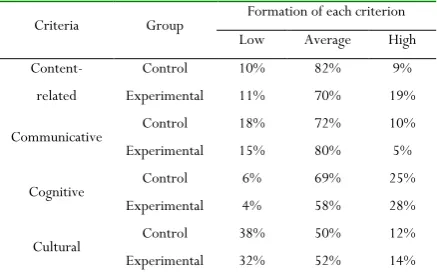
While considering the initial level of content and language integrated competence, the researchers found that the control and experimental groups had the average and low levels. The statistical analysis demonstrated that there were no significant differences between these two groups before the experiment (Table 1). The researchers also determined a generally high level of content and language integrated competence among the educators and revealed a correlation between the initial level of content and language integrated competence and pedagogical efficiency of educators and the development of content and language integrated competence among the students.
Table 1:The initial level of content and language integrated competence before the experiment
Criteria Group Formation of each criterion Low Average High
Content-related
Control 10% 82% 9%
Experimental 11% 70% 19%
Communicative Control 18% 72% 10% Experimental 15% 80% 5%
Cognitive Control 6% 69% 25% Experimental 4% 58% 28%
Cultural Control 38% 50% 12% Experimental 32% 52% 14%
Result Analysis
Regarding globalization and a trend to increasing academic mobility, highly qualified specialists who speak a foreign language within their professional field can be prepared if vocational
education aimed to form the content and language integrated
competence of future specialists. When writing about content and language integrated competence, it refers to an integral professional personality characteristic including the mastery of basic professional content and foreign language competencies needed for successful functioning in the labor market.
The analysis of competence classifications according to various
criteria let the authors define the structure and essence of content
and language integrated competence as a set of four competencies:
communicative, content-related, cognitive, and intercultural. Thus, the content and language integrated competence of graduates at non-linguistic universities were determined as the mastery of a set of
basic communicative, professional content and additional (cognitive and intercultural) competencies for an effective activity in a certain professional field.
Basic (communicative) competence is one's ability and willingness to apply basic linguistic knowledge and foreign language communicative skills according to basic interpersonal
communicative skills. Professional (content-related) competence is
one's ability to apply the knowledge of professional disciplines in
educational and professional communication. Additional
Journal of Advanced Pharmacy Education & Research | Apr-Jun 2019 | Vol 9 | Issue
thinking skills of a higher order. Additional intercultural
competence is manifested in one's ability and willingness to demonstrate the knowledge of other cultures and intercultural skills.
At the forming stage of the experiment, the authors considered the components of content and language integrated competence for the second time and noted significant differences in the results provided by the control and experimental groups. The greatest difference was revealed in the content-related component (9% of students with a high level in the control group in contrast to 74% of students with a high level in the experimental group). The results concerned with the development of the cognitive component were roughly the same (45% and 48% of students with a high level, 55% and 52% of students with an average level, no students with a low level), which indicated that both groups achieved equally positive results in the formation of mental skills at this stage. Different indicators of the communicative competence were explained by the high communicative potential of education organized in accordance with the proposed model. The control group (32%) was characterized by a low level of this competence due to the lack of the culturological component in the traditional approach, which was successfully overcome in the experimental group using the model under the test.
At the final stage of the experiment, the researchers decided to carry out measurements according to the criteria of content and language integrated competence (like a pedagogical experiment), analyze speech skills, and trace the dynamics of the content and language integrated competence of educators and their pedagogical proficiency at the end of the experiment. The authors also needed to find correlations between them. The dynamics of content and language integrated competence were as follows: the number of students with a low level decreased from 36% to 4%, while the number of students with a high level increased from 28% to 65% in the experimental group. In the context of assessing speech skills, the overall results showed that the average scores in the experimental group were as follows: speaking and listening (5 points), writing (4.5 points), reading (7.5 points), with an overall growth rate from 44 points to 69 points.
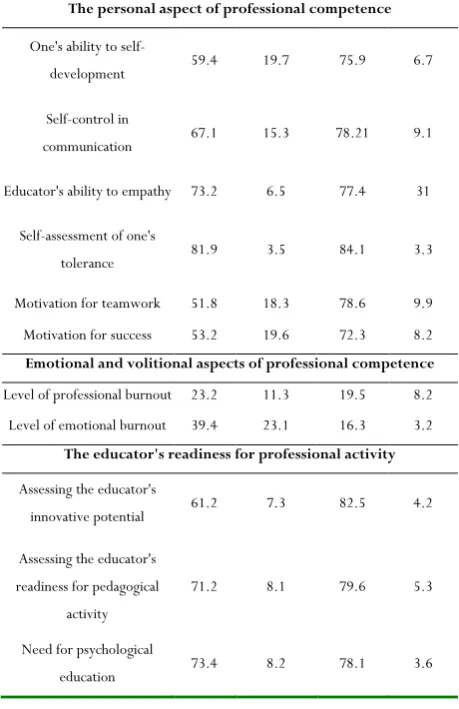
While analyzing the changing content and language integrated competence of educators, it was important to note a significant increase in the content-related component and the steady formation of general components of content and language integrated competence, whose indicators could be characterized as "high" with a slight deviation. The most significant indicators of pedagogical proficiency increased compared to the ascertaining stage of the experiment. At the same time, the range of deviation decreased remaining within the limit of 10-15% compared to the average indicator (Table 2).
Table 2:Comparative analysis of the pedagogical proficiency of educators at the ascertaining and control
stages of the experiment
Criteria Ascertaining stage Control stage
Indicator Deviation Indicator Deviation
The personal aspect of professional competence
One's ability to
self-development 59.4 19.7 75.9 6.7
Self-control in
communication 67.1 15.3 78.21 9.1
Educator's ability to empathy 73.2 6.5 77.4 31
Self-assessment of one's
tolerance 81.9 3.5 84.1 3.3
Motivation for teamwork 51.8 18.3 78.6 9.9
Motivation for success 53.2 19.6 72.3 8.2
Emotional and volitional aspects of professional competence
Level of professional burnout 23.2 11.3 19.5 8.2
Level of emotional burnout 39.4 23.1 16.3 3.2
The educator's readiness for professional activity
Assessing the educator's
innovative potential 61.2 7.3 82.5 4.2
Assessing the educator's readiness for pedagogical
activity
71.2 8.1 79.6 5.3
Need for psychological
education 73.4 8.2 78.1 3.6
In the late 20th century, European universities began to offer
foreign students and citizens of their countries’ educational programs in English. However, the researchers analyzed their practical experience and found that it is not enough to simply translate existing programs into English.
There is an objective need to develop a new technology of foreign language teaching. One of the effective approaches to teaching students’ content-related knowledge in a foreign language is the content and language integrated approach. It is based on the integration of content and language learning in the process of professional training in higher education and is recommended by the European Commission. This approach provides the opportunity to simultaneously study a foreign language and a certain discipline. Furthermore, no additional learning hours are needed to study a foreign language, which contributes to the intensification of vocational education at university.
Consequently, there is an objective need to implement the experience of teaching content-related knowledge in a foreign language into Russian universities based on the content and language integrated approach.
Conclusion
article have addressed efficient foreign methods including content and language integrated learning.
Throughout the study, the authors identified such peculiarities of content and language integrated learning as the integration of content and language, a foreign language as the study subject, and a means of teaching some disciplines, a special cognitive environment where the study of some disciplines and a foreign language is a unified process.
After the control analysis of content and language integrated
competence and four types of speech activity, the final stage of the
experiment confirmed the effectiveness of the proposed model since no students in the experimental group had a low level of content and language integrated competence and the level of its formation increased by 10% compared to the control group. At the same time, statistical methods demonstrated certain differences between the control and experimental group. The indicators of the educator's content and language integrated competence also showed a significant increase in the content-related component and a steady "high" level of content and
language integrated competence in general. Most significant
indicators of pedagogical proficiency increased compared to the ascertaining stage of the experiment. At the same time, the range of deviation decreased remaining within the limit of 10-15% compared to the average indicator.
Since the above-mentioned difference was expressed in a positive trend to increase the share of well-formed content and language integrated competence, it could be concluded that the tested model had a positive effect on the formation of content and language integrated competence among graduates of non-linguistic universities.
References
1. Dahmarde, H. Khodabakhshi, M. Mahmoodi Rad, Gh.
Birjand teaching hospital nurses’ attitudes towards personal development plan. Pharmacophore, 2018; 9(3): 25-29.
2. Saltanati, A. Zhando, A. Dusembinova, A. Galiya, S. Aigul,
M. Preparation of Future Teachers for Primary Schools to
Develop the Schoolchildren’s Health Culture. Örgütsel
Davranış Araştırmaları Dergisi Journal of Organizational
Behavior Research. 2019; 4 (1): 33–42.
3. Burenkova D.Yu., Gudkova S.A. Instrumenty prakticheskoi
realizatsii CLIL- tekhnologii v vuze [Tools for implementing CLIL technologies in higher education]. Vektor nauki TGU. Seriya: Pedagogika, psikhologiya 2015; 4(23): 50-56.
4. Krylov E.G. Integrativnoe bilingvalnoe obuchenie
inostrannomu yazyku i inzhenernym distsiplinam v tekhnicheskom vuze [Integrated bilingual education of a foreign language and engineering disciplines at a technical university]: a thesis for a Doctor's degree in Pedagogical
Sciences: 13.00.02; Uralskii gosudarstvennyi
pedagogicheskii universitet] 2016; 450.
5. Ting Y.L.T. CLIL not only Immersion but Also Much More
than the Sum of its Parts. English Language Teaching Journal 2011; 65(3): 314-317.
6. Khalyapina L.P. Lingvodidakticheskii kharakter skhodstv i
razlichii professionalno-orientirovannogo i
integrirovannogo obucheniya inostrannym yazykam [The linguo-didactic character of similarities and differences common to content and language integrated learning]. Yazyk i kultura. The collection of articles from the 28th International scientific conference. Editor-in-chief: S.K. Gural. Tomsk 2018; 412-419.
7. Almazova N.I., Baranova T.A., Vdovina E.K., Galskova
N.D., Krylov E.G., Minakova L.Yu., Obdalova O.A., Rybushkina S.V., Salekhova L.L., Serova T.S., Sidorenko T.V., Shulgina E.M. Lingvodidakticheskaya kharakteristika
otlichitelnykh osobennostei
professionalno-orientirovannogo obucheniya inostrannym yazykam i integrirovannogo predmetno-yazykovogo obucheniya [The linguo-didactic character of peculiar features common to vocational-oriented foreign language teaching and content and language integrated learning]. In book: Integrirovannoe obuchenie inostrannym yazykam i professionalnym distsiplinam. Opyt rossiiskikh vuzov [Content and language integrated learning], Collective monograph. Saint Petersburg 2018; 53-73.
8. Vdovina E.K., Popova N.V., Kogan M.S.
Predmetno-yazykovoe integrirovannoe obuchenie (CLIL) kak metodologiya aktualizatsii mezhdistsiplinarnykh svyazei v tekhnicheskom vuze [Content and language integrated learning as methods of updating interdisciplinary links at technical universities]. Vestnik Tambovskogo universiteta. Seriya: Gumanitarnye nauki 2018; 23(173): 29-42.
9. Salekhova L.L. Didakticheskaya model bilingvalnogo
obucheniya matematike v vysshei shkole [The didactic model of bilingual mathematics teaching in higher education]: a thesis for a Doctor's degree in Pedagogical Sciences: 13.00.01, 13.00.02; Tatar. gos. gumanitar.-ped. un-t. Kazan 2008; 447.
10. Zaripova R.R. Modelirovanie obucheniya na inostrannom
yazyke v vuze na osnove integrirovannogo predmetno-yazykovogo podkhoda [Modelling foreign language teaching at university based on content and language integrated learning]. An extended abstract of a thesis for a Candidate's degree in Pedagogical Sciences, Yoshkar-Ola 2016; 196.
11. Grigorieva K.S. Formirovanie u studentov tekhnicheskogo
vuza inoyazychnoi kompetentsii v sfere professionalnoi kommunikatsii na osnove tekhnologii CLIL [Forming foreign language competence in the sphere of professional communication of non-linguistic students based on CLIL technologies]: a thesis for a Candidate's degree in Pedagogical Sciences. Kazan 2016; 160.
12. Marsh D., Maljers A., Hartiala A.K. Profiling European
CLIL Classrooms – Languages Open Doors. Jyväskylä:
University of Jyväskylä 2001; 15-55.
13. Coyle D. CLIL: Content and Language Integrated Learning
[Do Coyle, Philip Hood, David Marsh] Publisher: Cambridge University Press 2010; 184.
14. Hutchinson T. English for Specific Purposes: A
Journal of Advanced Pharmacy Education & Research | Apr-Jun 2019 | Vol 9 | Issue
15. Dudley-Evans T., St. John, M. Developments in English for
Specific Purposes: A multi-disciplinary approach. Cambridge University Press, Cambridge 1998; 301.
16. Hymes D. On Communicative Competence. In J. B. Pride
and J. Holmes (eds.), Sociolinguistics. Harmondsworth: Penguin 1972; 269-293.
17. Scrivener J. Learning Teaching: A Guidebook for English
Language Teachers. 2nd ed. Oxford: Macmillan, 2005; 416.
18. Bloom B.S. Taxonomy of Educational Objectives. Boston,
MA: Pearson Education 1984; 131.
19. Mehisto P., Marsh D., Frigols M.J. Uncovering CLIL:
Content and Language. Oxford: Macmillan Education 2008; 238.
20. Krathwohl D.R. A revision of Bloom's Taxonomy: An
overview. Theory into Practice 2002; 41(4): 212-218.
21. Bentley K. The TKT Course: CLIL Module. Cambridge