Q
uantized
F
eedback
C
ontrol
O
ver
P
acket Dropout
C
ommunication
C
hannels
Fang Jin1, Qing-Quan Liu1,2
1School of Information Science and Engineering, Shenyang Ligong University
Shenyang, 110159, China e-mail: [email protected]
2College of Information Science and Engineering, Northeastern University
Shenyang, 110004, China
Abstract. This paper investigates quantized feedback control problems for linear time-invariant control systems, where the sensors and controllers are geographically separated and connected via noisy, bandwidth-limited digital communication channels. The packet dropout process of the channel is modeled as a time-homogeneous Markov process. An adaptive differ-ential coding strategy and a predictive control policy are implemented to achieve the minimum data rate of the channel for mean square stabilization of the unstable plant. In particular, it is shown that a sufficient condition on mean square stabilization of the system with disturbances is that the data rate is more than the lower bound given in our results. The sufficient condition decomposes into two terms: a condition on the data rate and a condition on the transition probabilities of the Markov chain. An illustrative example is given to demonstrate the effectiveness of the proposed method.
Keywords:quantized feedback control, data rates, mean square stabilization, networked control systems.
1. Introduction
Networked control systems (NCSs) operate sub-ject to communication constraints, which arise from the characteristics of practical channels, such as data rate limits, random time delays and packet dropout. Feedback control under communication constraints has been the focus of much recent research [28].
Issues of the type discussed are motivated by sev-eral pieces of work in the recent literature. The re-search on the interplay among coding, estimation, and control was initiated by [1]. A high-water mark in the study of quantized feedback using data rate limited feedback channels is known as the data rate theorem that states the larger the magnitude of the unstable poles, the larger the required data rate through the feedback loop. The intuitively appealing result was proved [2-5], indicating that it quantifies a fundamen-tal relationship between unstable physical systems and the rate at which information must be processed in order to stably control them. When the feedback channel capacity is near the data rate limit, control de-signs typically exhibit chaotic instabilities. This result was generalized to different notions of stabilization and system models, and was also extended to multi-dimensional systems [6-8]. The research on Gaussian linear systems was addressed in [9-11]. Information
rive necessary and sufficient conditions for robust sta-bilization of uncertain linear systems, Markov jump linear systems and unstructured uncertain systems [12-16]. The decentralized control schemes were ad-dressed in [17]. The result on continuous-time linear Gaussian systems was derived in [18]. The result on time-varying communication channel was derived in [19]. A switched-adaptive quantization technique us-ingµ-law quantizers was addressed in [29]. Liu et al. [30] investigates quantized control problems for lin-ear time-invariant systems over a noiseless communi-cation network. The survey papers [20] and [21] gave a historical and technical account of the various for-mulations.
Hespanha et al. [22] addressed stabilization of systems over communication networks of infinite bandwidth subject to packet losses. Sinopoli et al. [23] modeled the packet dropout rate above which the mean state estimation error covariance will diverge. Elia et al. [24] extended the results and addressed the mean square stability of an SISO plant. You et al. [25] investigated the minimum data rate for mean square stabilization of linear systems over a lossy digital channel, where the packet dropout process is modeled as a Markov chain.
unstable plant if the data rate is more than the lower bound given in our results. The sufficient condition decomposes into two terms: a condition on the data rate and a condition on the transition probabilities of the Markov chain. Our work here differs in that we employ an adaptive differential coding strategy and a predictive control policy to stabilize the unstable plant, and present sufficient conditions on the data rate for mean square stabilization, which is less con-servative than those of the literature.
The rest of the paper is organized as follows. In Section 2, the problem formulation is presented. Sec-tion 3 deals with quantized feedback control problems for the scalar systems, and then extends the results to the vector systems. The results of numerical simula-tion are presented in Secsimula-tion 4. Conclusions are stated in Section 5.
2. Problem Formulation
We consider in this paper stabilization of discrete-time linear discrete-time-invariant (LTI) systems where the sensors and controller are geographically separated and connected via a bandwidth-limited and stochas-tic dropout digital communication channel. The plant is described by the state equation
X(k+1)=AX(k)+BU(k)+FW(k) (1)
whereX(k)∈Rnis the measurable state,U(k)∈Rlis
the control input, andW(k)∈Rg is the disturbance.
A, B, and F are known constant matrices with ap-propriate dimensions. Here,X(0) andW(k),∀k∈N are mutually independent random variables satisfying
EkX(0)k2< φ
0<∞and supk∈NEkW(k)k2< φW <∞.
Assume that the plant is unstable but the pair (A,B) is stabilizable.
The information of plant states is transmitted via a noisy digital communication channel which is mem-oryless. Our model of the channel neglects channel propagation delays and focuses on the unreliability of the connection. As in [24] and [25], assume that the sensors and controller are connected via a lossy forward digital channel, and a reception/dropout ac-knowledgement is transmitted over an additional per-fect (without packet losses and transmission errors) feedback channel. The packet dropout process in the forward channel is modeled as a time-homogenous Markov process{γk}k≥0. Here, we set γk =1 when
the packet has been successfully delivered to the de-coder, and setγk=0 corresponding to the dropout of
the packet. The Markov chain has a transition proba-bility matrix defined by
(P(γk+1=j|γk=i))i,j∈s= "
1−q q p 1−p
# (2)
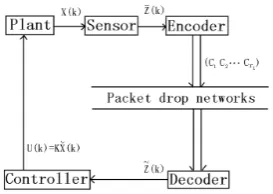
Figure 1. Networked control systems
wheres={0,1}is the state space of the Markov chain. Notice that the failure ratep=P(γk+1=0|γk=1) and
the recovery rateq=P(γk+1=1|γk=0). Let 0<p,q<
1 such that the Markov chain is ergodic (see [25]). Then, we may setγ0=1 due to the ergodic prop-erty of the Markov chain. Let{Td}d≥0denote the
sto-chastic time sequence and letT0=1. Then we define
Td=inf{k:k≥Td−1, γk=1}+1.
Let ¯Td:=Td−Td−1denote the time duration between
two successive packet reception times. As in [25], ¯Td
is an independent and identically distributive (IID) random variable with the distribution expressed as
P( ¯Td=i)= (
1−p, wheni=1
pq(1−q)i−2, wheni>1. (3)
If system matrix A has only real eigenvalues each with geometric multiplicity one, let H be the unitary matrix that diagonalizes A=H0ΛH where
Λ =diag[λ1,· · ·, λn] andλidenotes theith eigenvalue
of A (i =1,· · ·,n). Otherwise, for general matrix A, we have Λ =diag[J1,· · ·,Jm] where each Ji(i=
1,· · ·,m) is a Jordan block of dimension (geometric multiplicity)ni. Clearlyn1+· · ·+nm=n. It is derived
in [9] that there are the same results for the two cases above. Thus, we can restrict our attention to the first case. Considering this case avoids extraneous com-plexity and makes our conclusions most transparent.
The coding technique presented in this paper is an adaptive differential coding strategy which was in-troduced in [26]. Let ˆX(k) denote the decoder’s esti-mate ofX(k) on the basis of the channel output. Difine
¯
X(k)=HX(k),
˜
X(k)=HXˆ(k).
Then, the system (1) may be rewritten as
¯
A control law of the form
U(k)=KX˘(k) (4)
is implemented where
˘
X(k) :=
( ˆ
X(k), ifγk=1
`
X(k), ifγk=0.
Here we define
`
X(k) :=(A+BK) ˘X(k−1), ~
X(k) :=HX`(k).
Let ˘X(0)=Xˆ(0) (since γ0=1). Here, `X(k) denotes the centroid of the uncertain region ofX(k) andX~(k) denotes the centroid of the uncertain region of ¯X(k). Define
Z(k) :=X(k)−X`(k),
¯
Z(k) :=X¯(k)−X~(k).
Clearly, ¯Z(k)=HZ(k). Then, ¯Z(k) will be quantized, coded and transmitted via a noisy digital channel. Let
˜
Z(k) denote the quantization value of ¯Z(k) and let ˆ
Z(k) :=H0Z˜(k). Then we may define
¯
V(k) :=Z¯(k)−Z˜(k), V(k) :=H0V¯(k)
where ¯V(k) denotes the quantization error with zero mean.
Let ¯Z(k) :=[¯z1(k) ¯z2(k)· · ·¯zn(k)]0. Similar to that
in [27], the quantization scheme is presented. Given a positive integerMiand a nonnegative real number
∆i(k) (i=1,· · ·,n), define the quantizerq:R→Zwith
sensitivity∆i(k) and saturation value Mi by the
for-mula
q(¯zi(k))=
M+, if ¯zi(k)>(Mi+1/2)∆ i(t) M−, if ¯zi(k)≤ −(Mi+1/2)∆i(t) b¯zi(k)
∆i(t)+
1
2c, if ¯zi(k)>−(Mi+1/2)∆i(t)
and ¯zi(k)≤(Mi+1/2)∆i(t)
(5) wherebz¯c:=max{k∈Z:=k<¯z,z¯∈R}. The indexes
M+ and M− will be employed if the quantizer
sat-urates. The scheme to be used here is based on the hypothesis that it is possible to change the sensitiv-ity (but not the saturation value) of the quantizer on the basis of available quantized measurements. The quantizer may counteract disturbances by switching repeatedly between “zooming out" and “zooming in" (see [27]).
Based on the quantization scheme given above, we can construct a code with codeword length ri
(i=1,· · ·,n). Let (c1c2· · ·cri) denote the codeword
corresponding to ¯zi(k). Namely, ¯zi(k) is quantized, en-coded, and transformed into theri bits for transmis-sion. Then we may computecj∈ {0,1}(j=1,· · ·,ri−1)
(c1c2· · ·cri−1)=arg max(c1c2···cri−1) Pri−1
j=1cj2j−1 (6)
subject to
Pri−1
j=1cj2j−1≤ |b ¯ zi(k) ∆i(k)+
1 2c|.
Furthermore, we set cri =0 when ¯zi(k)≥0 and set
cri =1 when ¯zi(k)<0. This implies that
ri=log2Mi+1.
Then the data rate of the channel is given by
R=Pn
i=1ri(bits/sample).
Since the packet acknowledgement is transmitted over a perfect feedback channel, the encoder and de-coder have across to ˘X(k) such that they may update their estimator and scaling in the same manner. The value of ˆZ(k) may be computed on the basis of the channel output at the decoder. Notice that
ˆ
X(k)=X`(k)+Zˆ(k).
Thus, ˆX(k) may be obtained at the decoder whenγk=
1.
As in [21], [25], etc, the system (1) is said to be mean square stabilization if for any initial stateX(0), there exists a control policy such that the states of the closed-loop system are uniformly bounded in the mean square sense
lim sup
k→∞ EkX(k)k
2<∞. (7)
The main problem is to present conditions on the data rate of the channel in relation to the transition proba-bility matrix such that there exists a quantization, cod-ing and control scheme to stabilize the system (1) in the mean sense (7) over a noisy digital channel with limited data rates.
3. Quantized Feedback Control Over Packet Dropout Channels
This section first deals with stabilization prob-lems for the scalar system of the form
where|λ| ≥1 andb,0. Herew(k) is the disturbance withE[w2(k)]=φw. Considering this case avoids
ex-traneous complexity, and makes our conclusions most transparent. Next, we extend the results to the vector systems.
In this case, let ˆx(k) denote the decoder’s estimate ofx(k). A control law of the form
u(k)=Kx˘(k) (9)
is implemented where
˘
x(k) :=
( ˆ
x(k), ifγk=1 `
x(k), ifγk=0
where `x(k) :=(λ+bK) ˘x(k−1). Then, letz(k) :=x(k)− `
x(k) be quantized, encoded and transmitted over noisy digital channels. Let ˆz(k) denote the quantization value ofz(k), and letv(k) denote the quantization er-ror with zero mean. Namely,
ˆ
z(k)= ∆(k)q(z(k)), z(k)=ˆz(k)+v(k).
This implies that
ˆ
x(k)=x`(k)+zˆ(k).
It means that the estimate ofx(k) is obtained on the basis of the channel output at the decoder.
Now, we present a sufficient condition for mean square stabilization of the system (8). The main task here is to discuss the effect of the disturbance on stabi-lization of the unstable plant over a noisy, bandwidth-limited digital channel. The conclusion is summa-rized below:
Theorem 3.1: Consider the system (8). Assume that the packet dropout process of the forward chan-nel is a time-homogeneous Markov process with the transition probability matrix (2). A control law of the form (9) is implemented subject to|λ+bK|<1. Then, there exists a quantization scheme of the form (5), a coding scheme of the form (6), and a control scheme of the form (9) to stabilize the system (8) in the mean square sense (7) if the following conditions hold:
• The probabilityqof the channel recovering from packet dropping satisfies the following inequality:
q>1−λ12;
• The data rateRsatisfies the following inequality:
R>max{(1+1q) log2|λ|, log2|λ|
+1
2log2[(1+ p(λ
2−1)
1−(1−q)λ2]}(bits/sample).
Proof:Consider the closed-loop scalar system
x(k+1)=λx(k)+bKx˘(k)+w(k)
which we can also write as
x(k+1)=λ(x(k)−x˘(k))+(λ+bK) ˘x(k)+w(k).
Notice that
`
x(k+1)=(λ+bK) ˘x(k), x(k+1)=x`(k+1)+z(k+1).
Then,
z(k+1)=
(
λv(k)+w(k), when γ(k)=1
λz(k)+w(k), when γ(k)=0. (10)
This implies
z(Td)=λv(Td−1)+w(Td−1)
and
z(Td−1)=
ΣT¯d−2
i=0 λ ¯
Td−2−iw(T
d−1+i)
+λT¯d−1z(T
d−1),when ¯Td>1 z(Td−1), when ¯Td=1.
It follows in each duration ¯Td(i.e.,k∈[Td−1,Td]) that
E[z2(Td)]=λ2E[v2(Td−1)]+φw (11)
and
E[z2(Td−1)]=
λ2( ¯Td−1)E[z2(T
d−1)]
+ΣT¯d−2
i=0 λ2( ¯Td−2−i)φw,when ¯Td>1 E[z2(T
d−1)], when ¯Td=1.
(12) It follows from the quantization scheme (5) that
R=1
2log2
E[z2(Td−1)] E[v2(Td−1)].
It means that
E[z2(Td−1)]=22RE[v2(Td−1)]. (13)
By summing (11), (12) and (13), we obtain that
E[z2(Td)]=λ 2 ¯Td
22R E[z 2(T
d−1)]+ Φ( ¯Td) (14)
where
Φ( ¯Td) :=
λ2
22RΣ
¯ Td−2
It follows immediately that
E[z2(Td)]=λ
2( ¯T1+T¯2+···+T¯d)
22nR E[z 2(T
0)]+Φ¯(d)
where
¯
Φ(d) := Φ( ¯Td)+λ22 ¯2RTdΦ( ¯Td−1)+λ 2( ¯Td+Td¯−1)
24R Φ( ¯Td−2)
+· · ·+λ2( ¯Td2+2(dTd¯−−11)R+···+T¯2)Φ( ¯T1).
By the strong law of large numbers, we see that
1
dΣ d
i=1Ti¯ =ETd¯ =1+
1
q.
Whendis large enough, it follows that
E[z2(T d)]=(λ
1+1q
2R )2dE[z2(T0)]+Φ¯(d). (15)
Notice that ¯Φ(d) is still a function of ¯T1, ¯T2,· · ·, and ¯
Td. Then, we may compute the expectation of ¯Φ(d) over ¯T1, ¯T2,· · ·and ¯Td. Here, we define
Φ1:=EΦ( ¯T1)=EΦ( ¯T2)=· · ·=EΦ( ¯Td)
=
(λ2
22R
p
1−λ2(1−q)+1)φw, whenq>1−λ12
∞, whenq≤1−λ12
and
Φ2:=Eλ
2 ¯T1
22R =Eλ 2 ¯T2
22R =· · ·=Eλ 2 ¯Td
22R
=
λ2
22R(
p(λ2−1)
1−λ2(1−q)+1), whenq>1−λ12
∞, whenq≤1− 1
λ2
Thus, it follows that
EΦ¯(d) = Φ1+ Φ2Φ1+ Φ22Φ1+· · ·+ Φd−12 Φ1
=1−Φd2
1−Φ2Φ1.
If the data rateRsatisfies the following condition:
R>log2|λ|+12log2[(1+1−(1−q)p(λ2−1)λ2] (bits/sample), (16) then,Φ2<1 holds. This implies that
lim
d→∞EΦ¯(d)=
Φ1
1−Φ2 <∞.
Furthermore, if the data rateRsatisfies the following condition:
R>(1+1
q) log2|λ|(bits/sample), (17)
then, λ1+ 1 q
2R <1 holds. By summing (15), (16), and (17), we see that, if the data rate Rsatisfies the fol-lowing condition:
R> max{(1+1
q) log2|λ|, log2|λ|
+21log2[(1+1−(1−q)p(λ2−1)λ2]}(bits/sample)
andq>1−λ12 holds, then
lim
k→∞E[z
2(k)]=lim d→∞E[z
2(T
d)]= Φ1
1−Φ2<∞.
Furthermore, notice that
x(k)=x`(k)+z(k),
x(k+1)=x`(k+1)+z(k+1).
Then, we may rewrite the system (8) as
`
x(k+1)=λx`(k)+bKx˘(k)+λz(k)−z(k+1)+w(k).
Substitute (10) into the equality above, and obtain
`
x(k+1)=
(
(λ+bK) `x(k), whenγk=0
(λ+bK) `x(k)+(λ+bK)ˆz(k), whenγk=1.
This implies
`
x(Td)=(λ+bK) `x(Td−1)+(λ+bK)ˆz(Td−1),
`
x(Td−1)=(λ+bK)T¯d−1x`(Td−1).
Thus,
`
x(Td)=(λ+bK)T¯dx`(Td−1)+(λ+bK)ˆz(Td−1).
Notice that
|λ+bK|<1
and
lim
k→∞E[ˆz
2(k)]=lim d→∞E[ˆz
2(T
d−1)]<lim k→∞E[z
2(k)]<∞.
Clearly, it holds that
lim
k→∞E[ `x
2(k)]=lim d→∞E[ `x
2(Td)]<∞.
Thus, it follows that
lim
k→∞Ekx(k)k 2= lim
k→∞E[ `x
2(k)]+lim k→∞E[z
2(k)]<∞.
0.8 0.85 0.9 0.95 1 0
0.5 1 1.5 2 2.5 3 3.5 4 4.5
q
Rmin1 Rmin2
Figure 2. Curves ofRmin1andRmin2when
1>q>1−|λ1|2
• It is shown in Theorem 3.1 that not only the data rateRbut also the probabilityqof the channel recovering from packet dropping is needed to be large enough to guarantee mean square stabilization of the unstable plant. • In comparison with [25], the condition in
Theorem 3.1 is similar to that of [25]. Namely, the conditions:
q>1− 1 |λ|2
and
R>log2 |λ|+12log2[1+1−(1−q)|p(|λ|2−1)λ|2] (bits/sample)
are satisfied to guarantee mean square stabilization of the system (8). Our result differs from [25] in that the data rateRfor mean square stabilization satisfies an additional condition:
R>(1+1
q) log2|λ|(bits/sample).
Namely, in Theorem 3.1, the data rate satisfies the condition:
R>max{(1+1
q) log2|λ|, log2|λ|
+21log2[1+1−(1−q)|p(|λ|2−1)λ|2]}(bits/sample)
where we define
Rmin1:=(1+1q) log2|λ|,
Rmin2:=log2|λ|+12log2[1+ p(|λ|
2−1)
1−(1−q)|λ|2].
For example, letλ=2.2 andp=0.85. Then, the curves ofRmin1andRmin2corresponding
toqare given by Fig.2. It means that for some special cases, the conditionR>Rmin2may not be sufficient to guarantee mean square stabilization of the system.
Now, we deal with quantized feedback control problems for the vector system, and extend the results above to the more general case. Then, we present the following result:
Theorem 3.2: Consider the system (1). Assume that the packet dropout process of the forward chan-nel is a time-homogeneous Markov process with the transition probability matrix (2). A control law of the form (4) is implemented subject to the condition that all eigenvalues of A+BKlie inside the unit circle. DefineΞ:={i:|λi|>1}. Then, there exists a
quantiza-tion scheme of the form (5), a coding scheme of the form (6), and a control scheme of the form (4) to sta-bilize the system (1) in the mean square sense (7) if the following conditions hold:
• The probabilityqof the channel recovering from packet dropping satisfies the following inequality:
q>maxi∈Ξ{1−λ12 i };
• The data rateRsatisfies the following inequality:
R> max{(1+1q)Pi∈Ξlog2|λi|, Pi∈Ξ[log2|λi|
+21log2(1+1−(1−q)|p(|λi|2−1)λi|2)]}(bits/sample).
Proof:Consider the closed-loop system
X(k+1)=AX(k)+BKX˘(k)+FW(k)
which we can also write as
X(k+1)=A(X(k)−X˘(k))+(A+BK) ˘X(k)+FW(k).
Notice that
`
X(k+1)=(A+BK) ˘X(k), X(k+1)=X`(k+1)+Z(k+1).
Then,
Z(k+1)=
(
AV(k)+FW(k), whenγk=1
AZ(k)+FW(k), whenγk=0 (18)
which is equivalent to
¯
Z(k+1)=
(
ΛV¯(k)+HFW(k), whenγk=1
This implies that
¯
Z(Td)= ΛV¯(Td−1)+HFW(Td−1),
¯
Z(Td−1)=
ΣT¯d−2
j=0 Λ ¯
Td−j−2HFW(Td−1+j)
+ΛT¯d−1Z¯(Td−1),when ¯Td>1 ¯
Z(Td−1), when ¯Td=1.
Here, we defineΣW:=EW(k)W(k)0and define ¯φi:=
(HFΣWF0H0)iiwhere (·)i jdenotes an entry of a
ma-trix (i,j = 1,· · ·,n). In each duration ¯Td(i.e., k∈ [Td−1,Td]), we have
EkZ¯(Td)k2 =tr[ΣZ(T¯ d)]
=tr[Λ2Σ¯
V(Td−1)]+tr[HFΣWF
0H0]
and
tr[ΣZ(T¯ d−1)]=
ΣT¯d−2
j=0 tr[Λ2( ¯Td−2−j)HFΣWF0H0]
+tr[Λ2( ¯Td−1)Σ¯
Z(Td−1)],when ¯Td>1 tr[ΣZ(T¯ d−1)], when ¯Td=1
which are equivalent to
E[¯z2
i(Td)]=λ2iE[¯v2i(Td−1)]+φ¯i (20)
and
E[¯z2
i(Td−1)]=
λ2( ¯Td−1)
i E[¯z2i(Td−1)]
+ΣT¯d−2
j=0 λ 2( ¯Td−2−j)
i φ¯i,when ¯Td>1 E[¯z2
i(Td−1)], when ¯Td=1.
(21) Here we quantize, encode each ¯zi(Td−1), and transmit the information of each ¯zi(Td−1) by the data rateri (bits/sample). Then, it follows from the quantization (5) that the data ratericorresponding to ¯
zi(Td−1) is given by
ri=12log2 E[¯z2
i(Td−1)]
E[¯v2
i(Td−1)] (bits/sample).
Namely,
E[¯z2
i(Td−1)]=22riE[¯v2i(Td−1)]. (22)
By summing (20), (21), and (22), we obtain that
E[z2 i(Td)]=
λ2 ¯iTd
22ri E[z 2
i(Td−1)]+ Ψ( ¯Td)
where
Ψ( ¯Td) := λ2 i
22riΣ
¯ Td−2
j=0 λ 2( ¯Td−2−j)
i φ¯i+φ¯i, when ¯Td>1
¯
φi, when ¯Td=1.
The equality above is similar to (14). Using the same techniques as in the proof of Theorem 3.1, we can show that, there exists a quantization scheme of the form (5), a coding scheme of the form (6), and a con-trol scheme of the form (4) such that
limk→∞EkZ(k)k2<∞ (23)
holds if the data rateRsatisfies the following condi-tion:
R> max{(1+1 q)
P
i∈Ξlog2|λi|, Pi∈Ξ[log2|λi|
+21log2(1+1−(1−q)|p(|λi|2−1)λi|2)]}(bits/sample)
andq>maxi∈Ξ{1−λ12 i
}holds whereΞ:={i:|λi|>1}.
Furthermore, notice that
X(k)=X`(k)+Z(k).
Then, we can also rewrite the system (1) as
`
X(k+1)=AX`(k)+BKX˘(k)+AZ(k)−Z(k+1)+FW(k).
Substitute (18) into the equality above and obtain
`
X(k+1)=
(
(A+BK) `X(k), whenγk=0
(A+BK) `X(k)+(A+BK) ˆZ(k), whenγk=1.
This implies that
`
X(Td)=(A+BK) `X(Td−1)+(A+BK) ˆZ(Td−1),
`
X(Td−1)=(A+BK)T¯d−1X`(Td−1).
Thus, it holds that
`
X(Td)=(A+BK)T¯dX`(Td−1)+(A+BK) ˆZ(Td−1).
Since
lim
d→∞EkZˆ(Td−1)k 2< lim
k→∞EkZ(k)k 2<∞
holds and all eigenvalues ofA+BKlie inside the unit circle, it holds that
lim
k→∞EkX`(k)k 2=lim
d→∞EkX`(Td)k 2<∞.
Thus, it follows that
lim
k→∞EkX(k)k 2=lim
k→∞EkX`(k)k 2+lim
k→∞EkZ(k)k 2<∞.
0 2 4 6 8 10 −150
−100 −50 0 50 100
Time (s)
X1 X2 X3
Figure 3. The system state responses with the disturbances whenq=0.85
0 2 4 6 8 10
−150 −100 −50 0 50 100
Time (s)
X1 X2 X3
Figure 4. The system state responses with the disturbances whenq=0.95
• Notice that [25] considered noise free vector systems, but did not consider vector systems with the disturbances. However, the case with the disturbances is a more general and interesting case, which also faces some difficult challenges (such as how to allocate bits to each unstable state variable in this case).
• It is shown in Theorem 3.2 that the stable part does not play any role on the condition on the data rate for stabilization, which is similar to those of [11], [20], [21], etc.
4. Numerical Example
We consider a class of networked control prob-lems which arises in the coordinated motion control of autonomous and semiautonomous mobile agents, e.g., unmanned air vehicles (UAVs), unmanned ground vehicles (UGVs), and unmanned underwater vehicles (UUVs). Here, we present a numerical example to illustrate the effectiveness of the proposed adaptive differential coding strategy and the predictive control law. Three of the states of an unmanned air vehicle
0 2 4 6 8 10
−800 −600 −400 −200 0 200 400 600
Time (s)
X1 X2 X3
Figure 5. The system state responses with the disturbances whenq=0.45
0 2 4 6 8 10
−200 −150 −100 −50 0 50 100 150
Time (s)
X1 X2 X3
Figure 6. The system state responses with the different initial conditionX(0) when
q=0.85
evolve in discrete-time according to
X(k+1)=
2.2312 1.5423 1.2351 0.2142 2.3225 1.2112 0.7815 0.2526 3.1721 X(k)
+
2.1223 3.4411 1.5335
u(k)+W(k).
The feedback gain is given by K =[1.0485 0.1339 2.3538]. Let X(0)=[50 30 −50]0. The
pro-posed predictive control law (4) with the quantization scheme (5) subject to the minimum data rate limita-tion on the basis of the condilimita-tion in Theorem 3.2 is employed.
Letp=0.85,R=240 (bits/s), andφW=1. If we
setq=0.85, we may obtain the corresponding simu-lation given in Fig.3. It is shown that the system with disturbances may be stabilizable in the mean square sense (7) if both the data rate and the probability q
perfor-mance obtained. On the contrary, if we setq=0.45, we may obtain the corresponding simulation given in Fig.5. It is shown that the system is not stabilizable if the probabilityqis smaller than max{1− 1
λ2 i }. We may also set X(0)=[100 −100 −50]0, p=
0.85,R=240 (bits/s), andφW=1. Here, we consider
the case with the different initial conditionX(0), and obtain the corresponding simulation given in Fig.6. It states that the initial condition has no effect on stabi-lization of the system.
5. Conclusion
In this paper, we considered quantized feedback control problems, and presented sufficient conditions for mean square stabilization of linear time-invariant systems over noisy, bandwidth-limited digital com-munication channels. An adaptive differential coding strategy was employed, which benefits from many advantages, such as minimum bit rate transmission, good stability performance, etc. It was shown that our results are less conservative than those of the liter-ature. The simulation results have illustrated the ef-fectiveness of the quantization, coding and control scheme.
References
[1] W.S. Wong, R.W. Brockett. Systems with finite communication bandwidth constraints II: Stabiliza-tion with limited informaStabiliza-tion feedback, IEEE Trans-actions on Automatic Control, Vol.44, No.5, 1999, 1049-1053.
[2] J. Baillieul.Feedback designs for controlling device arrays with communication channel bandwidth con-straints, in ARO Workshop on Smart Structures, Penn-sylvania State Univ,Aug. 1999.
[3] J. Baillieul. Feedback designs in information based control, Stochastic Theory and Control Proceedings of a Workshop Held in Lawrence, Kansas, B. Pasik-Duncan, Ed. New York: Springer-Verlag,2001, 35-57. [4] J. Baillieul. Data-rate requirements for nonlinear feedback control, Proc. 6th IFAC Symp. Nonlinear Control Syst., Stuttgart, Germany,2004, 1277-1282. [5] K. Li, J. Baillieul. Robust quantization for
digi-tal finite communication bandwidth (DFCB) control,
IEEE Transactions on Automatic Control, Vol.49, No.9, 2004, 1573-1584.
[6] G.N. Nair, R.J. Evans. Stabilizability of stochastic linear systems with finite feedback data rates, SIAM J. Control Optim., Vol.43, No.2, 2004, 413-436. [7] N. Elia, S. Mitter.Stabilization of linear systems with
limited information,IEEE Transactions on Automatic Control, Vol.46, No.9, 2001, 1384-1400.
[8] N. Elia.When Bode meets Shannon: Control-oriented feedback communication schemes, IEEE Transac-tions on Automatic Control, Vol.49, No.9, 2004, 1477-1488.
[9] S. Tatikonda, S. Mitter. Control under communi-cation constraints, IEEE Transactions on Automatic Control, Vol.49, No.7, 2004, 1056-1068.
[10] S. Tatikonda, S. Mitter.Control over noisy channels,
IEEE Transactions on Automatic Control, Vol.49, No.7, 2004, 1196-1201.
[11] S. Tatikonda, A. Sahai, S. Mitter.Stochastic linear control over a communication channel, IEEE Trans-actions on Automatic Control, Vol.49, No.9, 2004, 1549-1561.
[12] N.C. Martins, M.A. Dahleh, N. Elia.Feedback sta-bilization of uncertain systems in the presence of a direct link, IEEE Transactions on Automatic Control, Vol.51, No.3, 2006, 438-447.
[13] N.C. Martins, M.A. Dahleh.Feedback control in the presence of noisy channels: ‘Bode-like’ fundamen-tal limitations of performance, IEEE Transactions on Automatic Control, Vol.53, No.7, 2008, 1604-1615. [14] G.N. Nair, S. Dey, R.J. Evans.Infimum data rates for
stabilizing Markov jump linear systems, Proc. IEEE Conf. Decision and Control, 2003, 1176-1181. [15] A. Sahai, S. Mitter. The necessity and sufficiency
of anytime capacity for stabilization of a linear sys-tem over a noisy communication link Part I: Scalar systems, IEEE Transactions on Automatic Control, Vol.52, No.8, 2006, 3369-3395.
[16] J.Q. Sun, S.M. Djouadi. Robust stabilization over communication channels in the presence of unstruc-tured uncertainty, IEEE Transactions on Automatic Control, Vol.54, No.4, 2009, 830-834.
[17] S. Yu¨ksel, T. Basar. Communication constraints for decentralized stabilizability with time-invariant policies, IEEE Transactions on Automatic Control, Vol.52, No.6, 2007, 1060-1066.
[18] C.D. Charalambous, A. Farhadi, S.Z. Denic. Con-trol of continuous-time linear Gaussian systems over additive Gaussian wireless fading channels: A separa-tion principle, IEEE Transactions on Automatic Con-trol, Vol.53, No.4, 2008, 1013-1019.
[19] P. Minero, M. Franceschetti, S. Dey, G.N. Nair. Data rate theorem for stabilization over time-varying feedback channels, IEEE Transactions on Automatic Control, Vol.54, No.2, 2009, 243-255.
[20] J. Baillieul, P. Antsaklis. Control and communica-tion challanges in networked real time systems, Pro-ceedings of IEEE Special Iss. Emerg. Technol. Netw. Control Syst, USA: IEEE,2007, 9-28.
[21] G.N. Nair, F. Fagnani, S. Zampieri, R.J. Evans. Feedback control under data rate constraints: An overview, Proceedings of IEEE Special Iss. Emerg. Technol. Netw. Control Syst, USA: IEEE, 2007, 108-137.
[22] J. Hespanha, P. Naghshtabrizi, and Y. Xu.A survey of recent results in networked control systems, Pro-ceedings of IEEE Special Iss. Emerg. Technol. Netw. Control Syst, USA: IEEE, 2007, 138-162.
Control, Vol.49, No.9, 2007, 1453-1464.
[24] N. Elia, J.N. Eisenbeis.Limitations of linear control over packet drop networks, IEEE Trans. Automat. Control, Vol.56, No.4, 2011, 826-841.
[25] K. You, L. Xie. Minimum data rate for mean square stabilizability of linear systems with Markov-ian packet losses, IEEE Trans. Automat. Control, Vol.56, No.4, 2011, 772-785.
[26] F. Gomez-Estern, C. Canudas-de-Wit, F. Rubio, and J. Fornes. Adaptive delta-modulation coding for networked controlled systems, American Control Conference, New York, USA, 2007.
[27] D. Liberzon, D. Nesˇic´.Input-to-state stabilization of linear systems with quantized state measurements,
IEEE Transactions on Automatic Control, Vol.52, No.5, 2007, 767-781.
[28] P. Orlowski.System degradation factor for networked control systems, Information Technology And Con-trol, Vol.37, No.3, 2008, 233-244.
[29] Z. Peric, J. Nikolic, A. Mosic, S. Panic.A switched-adaptive quantization technique usingµ-law quantiz-ers, Information Technology And Control, Vol.39, No.4, 2010, 317-320.
[30] Q.Q. Liu, G.H. Yang.Quantized feedback control for networked control systems under information limita-tion, Information Technology And Control, Vol.40, No.3, 2011, 218-226.