Wojciech Gawron
1, Beata Wikiera
2, Ewa Koziorowska-Gawron
3,
Sławomir Budrewicz
3, Magdalena Koszewicz
3, Anna Noczyńska
2Quantitative Evaluation of Visual-Oculomotor
and Vestibulo-Oculomotor Reflexes in Patients
with Type 1 Diabetes Related to the Chosen Parameters
Characterizing Diabetes
Ilościowa ocena odruchów wzrokowo-okoruchowych
i przedsionkowo-okoruchowych u pacjentów z cukrzycą typu 1
w odniesieniu do wybranych parametrów charakteryzujących cukrzycę
1 University of Wroclaw, Faculty of Medicine, ENT Department, Wroclaw Medical University, Poland 2 University of Wroclaw Faculty of Medicine, Department of Endocrinology for Children and Adolescents,
Wroclaw Medical University, Poland
3 University of Wroclaw, Faculty of Medicine, Department of Neurology, Wroclaw Medical University, Poland
Abstract
Background. The condition of the vestibular organ in children and young adults with type 1 diabetes mellitus is not often evaluated. Diabetic neuropathy may affect up to 90% of patients. The problem is serious and current.
Objectives. The authors aimed to analyze quantitatively the alteration of visual-oculomotor and vestibulo-oculo-motor reflexes in patients with type 1 diabetes related to the chosen parameters characterizing diabetes. They also tried to answer the question whether an otoneurological test exists that reflects the presence of central diabetic neuropathy.
Material and Methods. The group examined consisted of 59 patients aged from 7 to 33 years (20 years on av.) with type 1 diabetes mellitus. The control group consisted of 33 healthy subjects. A detailed medical history was collected and a neurological examination was done and then a videonystagmography was performed in all cases.
Results. In a smooth pursuit test, the phase value was of significantly higher value in diabetic patients than in the control group. In a saccadic test, diabetic patients were much less precise than healthy subjects. The difference was statistically significant. The results were analyzed according to the chosen parameters characterizing diabe-tes. Considering the duration of the disease, in smooth pursuit tests, the phase value was much worse in diabetic patients than in the control group. No significant correlations were present in either optokinetic tests or in the evaluation of SPV in caloric tests. The accuracy values of the saccadic test were clearly correlated with the duration of diabetes. As the compensation and the way of treatment of diabetes were taken into consideration, no significant correlation was found within the subgroups. On the contrary, the presence of hypoglycemic incidents and compli-cations influenced the worsening of oculomotor response in saccadic tests.
Conclusions. Diabetes mellitus type 1 provokes different, probably dispersed disturbances within the vestibular organ. The disturbances within the vestibular organ in diabetes mellitus type 1 have a sub-clinical course and refer mostly to its central part. The disturbances depend mostly on the duration of the disease and especially the presence of hypoglycemic incidents as well to the method of treatment to a certain extent. The saccadic test seems to be the most useful in characterizing disturbances in the central parts of the vestibular organ in relation to parameters character-izing diabetes. Perhaps it would be reasonable to search for selected otoneurological tests that could help to monitor neuropathic disturbances in the group of patients with type 1 diabetes (Adv Clin Exp Med 2011, 20, 2, 177–182).
Key words: type 1 diabetes, nystagmography, vertigo, saccades.
Streszczenie
Wprowadzenie. Stan czynnościowy narządu przedsionkowego u młodych osób chorych na cukrzycę nie jest często poddawany ocenie. Biorąc pod uwagę, że neuropatia cukrzycowa może dotyczyć nawet 90% pacjentów, problem jest poważny i aktualny.
Adv Clin Exp Med 2011, 20, 2, 177–182 ISSN 1230-025X
OrIGINAl PAPErS
The condition of the central and peripheral part of the vestibular organ in children and young adults with type 1 diabetes mellitus is not often evaluated [1–3]. Considering that diabetic neuropathy may affect up to 90% of patients, if one also considers sub-clinical disturbances, the problem is serious and current [4, 5]. Some authors have shown de-creased nerve conduction velocity in diabetic pa-tients as compared to healthy subjects [6, 7]. A few years ago, the authors of the present study showed that the metabolic disturbances present in type 1 di-abetes may cause functional lesions localized mostly in the central structures of the vestibular organ [3]. The extent of this impairment depended mostly on the duration of the disease and the presence of hy-poglycemic incidents. It was less correlated to the compensation of the disease. The analysis mostly relied on a qualitative evaluation.
In this report, the authors aim to analyze quantitatively the alteration of visual-oculomotor and vestibulo-oculomotor reflexes in patients with type 1 diabetes related to the chosen parameters characterizing diabetes. They also tried to answer the question whether an otoneurological test or tests exist that reflect the presence of central dia-betic neuropathy.
Material and Methods
The group examined consisted of 59 children and young adults (32 females and 27 males) aged from 7 to 33 years (mean age 20 years; SD 4.87)
diagnosed with type 1 diabetes mellitus. Patients with events which had a potential influence on the results were excluded from the tests. All the patients had intensive insulin therapy, in 28 cases with the use of an infusion pump. The disease had lasted from 0.5 to 21 years (7.02 years on average, SD 4.6). Diabetic patients were divided into sub-groups according to parameters characterizing the disease such as duration of the disease, compensa-tion of the disease (blood concentracompensa-tion of glycat-ed hemoglobin), way of treatment (pump or pen), presence and character of hypoglycemic incidents and presence of diabetic complications (retinopa-thy, nephropathy or polineuropathy). The control group consisted of 33 healthy subjects (15 males and 17 females) aged from 7 to 40 years (mean age 19.2 years; SD 4.6). All the patients or their parents agreed to take part in the study. The method was accepted by the local ethics committee.
A detailed medical history was collected in each case. All the patients underwent a precise neurological examination to exclude any focal dis-turbances within the central nervous system. Then a physical ENT examination, pure tone audiom-etry and tympanomaudiom-etry were done. Vestibular organ condition was evaluated in two steps. First a medical history was collected and then a video-nystagmographic examination (VNG) with the use of a computed two-canal videonystagmpgrapher, produced by Hortmann Co., was performed. Vid-eonystagmographic registration consisted of the presence of spontaneous nystagmus with eyes open and without fixation in a sitting position. Smooth
Cel pracy. Ilościowa ocena jakości odruchów wzrokowo-okoruchowych i przedsionkowo-okoruchowych u pacjen-tów chorych na cukrzycę typu 1 w odniesieniu do wybranych parametrów charakteryzujących cukrzycę. Autorzy starali się także odpowiedzieć na pytanie, czy istnieje test otoneurologiczny, który pozwala wykryć ośrodkową neu-ropatię cukrzycową.
Materiał i metody. Badana grupa składała się z 59 pacjentów w wieku 7–33 lat (średnio 20 lat) z rozpoznaną cukrzycą typu 1. Grupa kontrolna składała się z 33 pacjentów. W każdym przypadku zebrano szczegółowy wywiad, wszystkich chorych skonsultowano neurologicznie oraz przeprowadzono badanie videonystagmograficzne.
Wyniki. W teście łagodnego śledzenia wartość fazy była znacznie wyższa u pacjentów z cukrzycą w porównaniu do grupy kontrolnej. W teście sakkad pacjenci chorzy na cukrzycę śledzili bodziec z dużo mniejszą precyzją niż osoby zdrowe, różnice były statystycznie istotne. Wyniki zostały przeanalizowane w odniesieniu do wybranych parametrów charakteryzujących cukrzycę. Biorąc pod uwagę czas trwania choroby, w teście łagodnego śledzenia, wartości fazy były znacznie gorsze u pacjentów z cukrzycą niż w grupie kontrolnej. Nie wykazano żadnych istotnych korelacji w teście optokinetycznym oraz w ocenie wartości prędkości fazy wolnej w próbach kalorycznych. Wartości testu sakkad były wyraźnie skorelowane z czasem trwania cukrzycy. Biorąc pod uwagę wyrównanie oraz sposób leczenia cukrzycy nie wykazano żadnych istotnych korelacji w poszczególnych podgrupach. Występowanie incy-dentów hipoglikemii oraz powikłań cukrzycy wyraźnie wpływało na pogorszenie odpowiedzi okoruchowej w teście sakkad.
Wnioski. Cukrzyca typu 1 powoduje zróżnicowane, prawdopodobnie rozsiane zaburzenia w obrębie narządu przed-sionkowego. Zaburzenia te mają przebieg subkliniczny i dotyczą głównie jego części ośrodkowej. Zaburzenia zależą głównie od czasu trwania choroby, a szczególnie obecności incydentów hipoglikemii, jak również w pewnym stop-niu od sposobu leczenia. Test sakkad wydaje się najbardziej użytecznym narzędziem charakteryzującym zaburzenia w części ośrodkowej narządu przedsionkowego w odniesieniu do parametrów charakteryzujących cukrzycę. Być może uzasadnione byłoby dalsze poszukiwanie wybranych testów otoneurologicznych, które mogłyby pomóc monitorować zaburzenia neuropatyczne w grupie pacjentów z cukrzycą typu 1 (Adv Clin Exp Med 2011, 20, 2, 177–182).
pursuit – lighting point moving sinusoidally with a frequency of 0.4°/sec and with an amplitude of 15° to the right and left. The parameters of inter-est were gain (%) and phase. Saccades – a visual point that moved abruptly and unpredictably 5°, 10°, 15° or 30°to the right or left. The parameter of interest was accuracy (%). Evaluation of opto-kinetic nystagmus to the right and left with black and white stripes that nearly filled the subject’s en-tire visual field with the speed of 20°, 40°and60°/ sec. The parameter of interest was symmetry (the percent of asymmetry) calculated according to the gain value. Caloric stimulation according to the Fitzgerald-Hallpike procedure, with water of tem-perature 44°C and 30°C. Such parameters as canal paresis (CP), directional preponderance (DP) and slow phase velocity (SPV) were analyzed.
For statistical analysis the computer program SPSS was applied. Statistical significance was con-sidered for values less than 0.05 (p < 0.05).
Results
None of the diabetic patients or subjects from the control group complained about hearing loss. Only 5 patients (8.3%) complained about vertigo and/or balance disorders. The physical ENT exam-ination did not reveal any substantial pathology. Pure tone audiometry for air and bone response was proper in all cases.
There was a tympanogram type A in all the cases with mono or bilateral lack of stapedial mus-cle reflex, in 9 cases (15.0%).
As for the VNG results 15 (25.0%) diabetic patients had spontaneous nystagmus with eyes
open and 1 (1.66%) patient without fixation. None of the patients from the control group had spon-taneous nystagmus. Improper values of CP were present in 3 (5.0%) of the diabetic patients and impaired DP in 7 (11.6%) patients. All the subjects from the control group had proper values of those parameters.
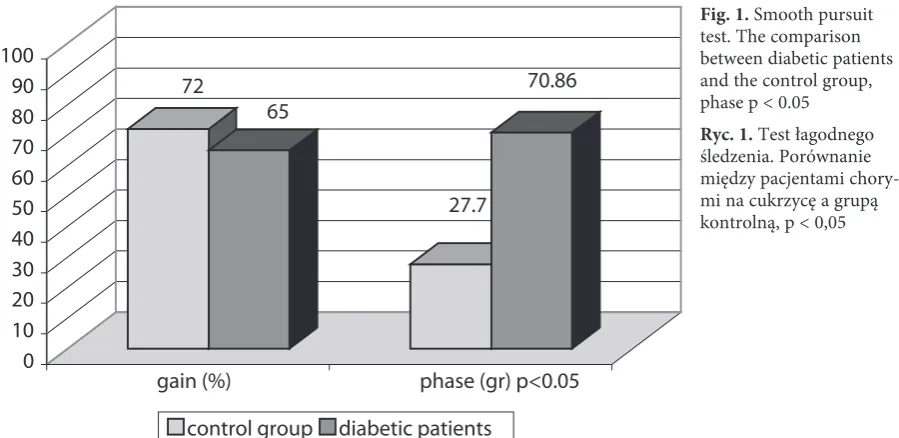
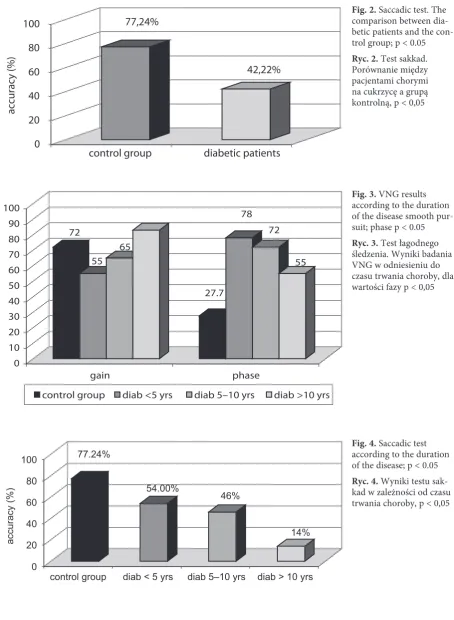
In smooth pursuit tests the phase value was of a significantly higher value in diabetic patients than in the control group (Figure 1). Though the extent of asymmetry in optokinesis was clearly more ex-pressed in patients with diabetes, the results were not statistically significant. In saccadic tests, dia-betic patients were much less precise than healthy subjects and the difference was statistically cant (Figure 2). Similar but not statistically signifi-cant differences were present when slow phase ve-locity values were compared between the groups. The results were analyzed according to the chosen parameters characterizing diabetes. Considering the duration of the disease, in the smooth pursuit test, the phase value was much worse in diabetic patients than in the control group (Figure 3). No significant correlations in relation to the duration of the disease were present in optokinetic tests or in the evaluation of SPV. The accuracy values of the saccadic test were clearly correlated with the duration of diabetes (Figure 4).
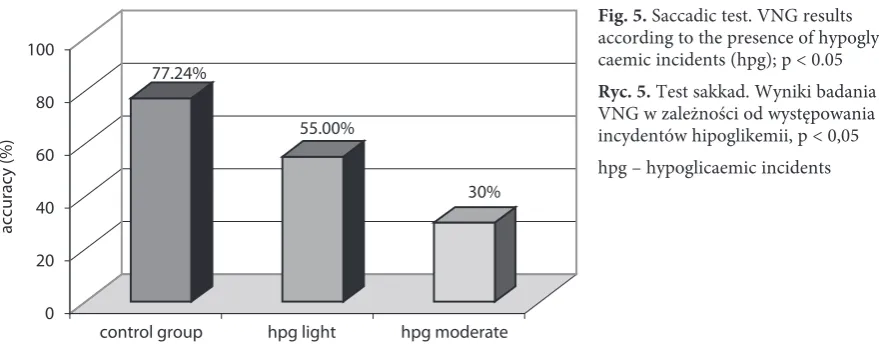
As the compensation and the method of treat-ment of diabetes were taken into consideration, no significant correlation was found within the sub-groups. On the contrary, the presence of hypogly-cemic incidents and complications influenced the worsening of the oculomotor response in saccadic tests, being statistically significant for the first of them (Figure 5).
Fig. 1. Smooth pursuit test. The comparison between diabetic patients and the control group, phase p < 0.05
Ryc. 1. Test łagodnego śledzenia. Porównanie między pacjentami chory-mi na cukrzycę a grupą kontrolną, p < 0,05
72
65
27.7
70.86
0 10 20 30 40 50 60 70 80 90 100
gain (%) phase (gr) p<0.05
Discussion
The proper development of the balance organ is possible due to the simultaneous co-operation of the vestibular, visual and hearing organs together with the cerebellum. The merging of sensory
in-formation depends on the proper function of the paths that unite them and this process is strictly connected with the myelinization of the neural tracks [8, 9]. Up to the 4th year of life, balance is
maintained mostly thanks to the proper function of the visual organ. It is estimated that the balance
77,24%
42,22%
0 20 40 60 80 100
accurac
y (%)
control group diabetic patients
72
55 65
27.7 78
72
55
0 10 20 30 40 50 60 70 80 90 100
gain phase
control group diab <5 yrs diab 5–10 yrs diab >10 yrs
77.24%
54.00%
46%
14%
0 20 40 60 80 100
control group diab < 5 yrs diab 5–10 yrs diab > 10 yrs
accuracy (%
)
control group diab <5 yrs diab 5-10 yrs diab >10 yrs
Fig. 2. Saccadic test. The comparison between dia-betic patients and the con-trol group; p < 0.05
Ryc. 2. Test sakkad. Porównanie między pacjentami chorymi na cukrzycę a grupą kontrolną, p < 0,05
Fig. 3. VNG results according to the duration of the disease smooth pur-suit; phase p < 0.05
Ryc. 3. Test łagodnego śledzenia. Wyniki badania VNG w odniesieniu do czasu trwania choroby, dla wartości fazy p < 0,05
Fig. 4. Saccadic test according to the duration of the disease; p < 0.05
organ in children over 7 functions in the same way as in adults [10].
Diabetes mellitus type 1 is a serious and, so far, incurable disease that affects mostly children and adolescents and potentially provokes severe complications, including in the central nervous system. Neuropathy is one of the well-known diabetic complications and Shagan [11] suggests some patients may develop central nervous sys-tem degeneration or central neuropathy. rieskie-Nielsen et al. [12] have found advanced degenera-tive changes in the cerebellum that could provoke encephalopathy. There are many tests that may diagnose peripheral neuropathy, but the presence and diagnosis of central neuropathy is still a mat-ter of speculation [13–15]. The vestibular organ, and especially its central part, is spread out within different parts of the CNS. Its proper function de-pends on many individual anatomical and func-tional compartments that co-operate together. The cerebellum plays a crucial role in the syn-chronization of saccades with planning and learn-ing in the temporal cortex, as was proved, among others, in investigations with the use of functional nuclear magnetic resonance [16, 17]. So it may be assumed that even small disturbances provoked by diabetes, not detectable in a routine neurologi-cal examination, may handicap equilibrium and complex relations present in the vestibular organ. The authors have already shown that metabolic disturbances present in type 1 diabetes cause some functional alteration of vestibulo-oculomotor and especially visual-oculomotor reflexes [3]. But at present, the matter of their interest was to find out whether any tests exist that could quantitatively reflect the presence of diabetic central neuropathy and in this way, with the use of otoneurological tools, to detect diabetic complications before they become apparent clinically.
Having experience from previous studies, the authors of the current study planned the investiga-tion in order to call atteninvestiga-tion to so-called central
tests, with an attempt to make a quantitative evalu-ation of the results. In most of the tests, the results reflected substantial changes within the vestibular organ of diabetic patients compared to healthy ones. The results were statistically significant only in saccadic tests also as the patients were divided into subgroups according to different criteria characterizing diabetes. As it was shown in pre-vious studies, the disturbances depended mostly on the duration of the disease and the presence of hypoglycemic incidents. According to Jaspan et al. [18], hypoglycemic incidents have the greatest in-fluence on neuropathic symptoms. reports about vestibular organ condition in type 1 diabetes are sparse and not precise. Most of the authors evalu-ate hearing organ condition and perform a battery of otoneurological tests that reflect some distur-bances but do not provide any information on the dynamic and co-relations of the results [1, 2].
The authors think that a quantitative evalu-ation of saccadic tests provides important and reliable information on the functional condition of the central part of the vestibular organ and could become one of the helpful additional tools in the estimation of diabetic patients’ condition. As a consequence, it could be helpful in treatment planning and treatment results monitoring. As a second part of this investigation, the authors have planned to check the dynamic of otoneurological results in this group of patients in order to see if the disturbances are progressive or reversible. This information could help to work out the defined set of otoneurological tests that perhaps could reflect diabetic central neuropathy.
The authors concluded that diabetes mellitus type 1 provokes different, probably dispersed dis-turbances within the vestibular organ; the distur-bances within the vestibular organ in type 1 diabe-tes mellitus have a sub-clinical course. They refer mostly to its central part, despite the lack of any CNS impairment in physical neurological exami-nations. The disturbances depend mostly on the
77.24%
55.00%
30%
0 20 40 60 80 100
control group hpg light hpg moderate
accurac
y (%)
control group hpg light hpg moderate
Fig. 5. Saccadic test. VNG results according to the presence of hypogly-caemic incidents (hpg); p < 0.05
duration of the disease and especially the presence of hypoglycemic incidents as well as to the meth-od of treatment to a certain extent. The saccadic test seems to be the most useful in characterizing disturbances in the central parts of the vestibular
organ in relation to the parameters characterizing diabetes. Perhaps it would be reasonable to search for selected otoneurological tests that could help monitor neuropathic disturbances in the group of patients with type 1 diabetes.
References
Klagenberg KF, Zeigelboim BS, Jurkiewicz AL, Martins-Bassetto J:
[1] Vestibulocochlear manifestations in patients with type I diabetes mellitus. rev Bras Otorhinolaryngol (Engl Ed) 2007, 73, 353–358.
Jauregui-Renaud K, Dominguez-Rubio B, Ibarra-Olmos A, Gonzales-Barcena D:
[2] Otoneurologic abnormalities
in insulin-dependent diabetes rev Invest Clin 1998, 50, 137–138.
Gawron W, Pośpiech L, Orendorz-Frączkowska K, Noczyńska A:
[3] Are there any disturbances in vestibular organ of children and young adults with type 1 diabetes? Diabetologia 2002, 5, 728–734.
Brownlee M, Vlassara H, Cerami A:
[4] Advanced glycosylation endproducts in tissue and the biochemical basis of complications. N Engl J Med 1988, 318, 1315–1321.
Vinik AI, Liuzze FJ, Holland MT, Stansberry KB, Le Beau JM, Colen LB:
[5] Diabetic neuropathies. Diabetes Care 1992, 15, 1926–1975.
Bertora P, Valla P, Dezuanni E, Osio M, Mantica D, Bevilacqua M, Norbiato G, Caccia MR, Mangoni A: [6]
Prevalence of subclinical neuropathy in diabetic patients: assessment by study of conduction velocity distribution within motor and sensory nerve fibres. J Neurol 1998, 245, 81–86.
Cummins KL, Dorfman LJ:
[7] Nerve conduction velocity distributions: studies of normal and diabetic human nerves. Ann Neurol 1981, 9, 67–75 8.
Kubiczkowa J, Kubiczek-Jagielska M:
[8] Posturografia w ocenie sprawności układu równowagi. Bibl. Prospera Meniere’a 1999, 3, 4, 5–57.
Nolan L, Grigorenko A, Thorstensson A:
[9] Balance control: sex and age differences in 6- to 16-years-olds. Dev Med Child Neurol 2005, 7, 449–454.
Steindl R, Kunz K, Schrott-Fischer A, Scholtz AW:
[10] Effect of age and sex on maturation of sensory systems and
balance control. Dev Med Child Neurol 2006, 6, 477–482.
Shagan BP:
[11] Is diabetes a model for aging? Med Clin North Am 1976, 60(6), 1209–1211.
Rieske-Nielsen E, Lundback K:
[12] Pathological changes in the central and peripheral nervous system of young long-term diabetics. II. The spinal cord and the peripheral nerves. Diabetologia 1968, 4, 34–43.
Uzun N, Uluduz D, Mikla S, Aydin A:
[13] Evaluation of asymptomatic central neuropathy in type I diabetes mellitus. Electromyogr Clin Neurophysiol 2006, 3, 131–137.
Toth F, Varkonyu TT, Rovo L, Lengvel C, Legrady P, Czigner J, Kiss JG:
[14] Investigation of auditory brainstem
function in diabetic patients. Int Tinnitus J 2003, 2, 84–86.
Baba M, Ozaki I:
[15] Electrophysiological changes in diabetic neuropathy: from subclinical alterations to disabling abnormalities. Arch Physiol Biochem 2001, 3, 234–240.
Alvarez TL, Alkan Y, Gohrl S, Douglas Ward B, Biswal BB:
[16] Functional anatomy of predictive vergence and
sac-cade eye movements in humans: a functional MrI investigation. Vision res 2010, 10, 2163–2175.
Sailer U, Eqqert T, Straube A:
[17] Impaired temporal prediction and eye-hand coordination in patients with cerebel-lar lesions. Behav Brain res 2005, 5, 72–87.
Jaspan JB, Wollman RL, Bernstein L, Rubinstein AH:
[18] Hypoglcemic peripheral neuropathy in association with
insulinoma: implication o glucopenia rather than hypeinsulinism. Case report and literature review. Medicine 1982, 61, 33–44.
Address for correspondence:
Wojciech Gawron róży Wiatrów 16/10 53-023 Wrocław Poland
Tel.: +48 603672132 E-mail: [email protected] Conflict of interest: None declared received: 20.07.2010