University of Trento University IUAV of Venezia
Tao Liu
E
QUIVALENT
L
INEARIZATION
A
NALYSIS
M
ETHOD
FOR
B
ASE
-
ISOLATED
B
UILDINGS
Advisor: Prof. Enzo Siviero Università IUAV di Venezia, Venice, Italy
Co-Advisors: Prof. Qilin Zhang, Prof. Tobia Zordan Tongji University, Shanghai, China Prof. Bruno Briseghella Fuzhou University, Fuzhou, China
UNIVERSITY OF TRENTO
Department of Civil, Environmental and Mechanical Engineering
Final Examination 10 / April / 2014
Board of Examiners
Prof. Maurizio Piazza (Università degli Studi di Trento)
Prof. Andrea Prota (Università degli Studi di Napoli Federico II) Prof. Carmelo Gentile (Politecnico di Milano)
SUMMARY
Base isolation system, as one of the most popular means to mitigate the seismic risks, often exhibits strong nonlinearity. To simplify the procedure of structural de-sign, bilinear force-deformation behavior is recommended for isolation systems in most modern structural codes. Although base isolation system can be analyzed through nonlinear time history method, solving of a system with a large number of degrees of freedom may require an exorbitant amount of time. As a substitute, the equivalent linearization method is frequently used. Apparently, under given earth-quake ground motions, the accuracy of equivalent linearization analysis method is significantly related to the estimation of equivalent linear properties. How to improve the estimation accuracy of this approximate method constitutes a subject of wide and deep interest among researchers around the world.
In this research, the equivalent linearization analysis method for base-isolated buildings was investigated. The literature survey on related aspects of base-isolated buildings was carried out firstly. Then, the estimation accuracy of fifteen equivalent linearization methods selected from the literatures was evaluated when subjected to twelve earthquake ground motions. After that, from simplicity to complexity, the base-isolated buildings were modeled using single-degree-of-freedom (SDOF) systems and multi-degree-of-freedom (MDOF) systems, respectively. For both considered systems, more comprehensive parametric analyses were performed with varying the parameters selected from the isolation system and the superstructure. Accordingly, improved equivalent linearization methods were derived for SDOF and MDOF systems to improve the prediction accuracy of the maximum displacement of isolation systems.
SOMMARIO
L’isolamento alla base, ormai divenuto una delle tecniche piu’ utilizzate per la riduzione del rischio sismico, e’ caratterizzato da un comportamento non lineare. Al fine di semplificare la procedura di calcolo, quasi tutte le piu’ attuali normative propongono di utilizzare un modello forza-deformazione bi-lineare.
Nonostante le strutture isolate alla base possano essere analizzate attraverso analisi non lineari al passo, tali calcolazioni sono generalmente molto onerose dal punto di vista computazionale per sistemi a molti gradi di liberta’. In alternativa a cio’ viene spesso utilizzato un metodo lineare equivalente. L’accuratezza del metodo lineare equivalente e’, definita una certa azione sismica di input, significativamente legata alla stima delle proprieta’ lineari equivalenti. La precisione delle analisi basate su questo metodo e come aumentarla rappresenta un interessante tema di ricerca per gli studiosi in tutto il mondo.
In questa ricerca si analizza il metodo lineare equivalente per l’analisi di strutture isolate alla base e si arriva a formulare un proprio modello. Nella prima parte della tesi viene riportato lo stato dell’arte sui metodi di analisi delle strutture isolate alla base e si analizza l’accuratezza di 15 diversi metodi di linearizzazione selezionati fra quelli presenti in letteratura sotto l’azione di 12 segnali sismici diversi.
Successivamente si effettua un analisi parametrica andando a studiare l’influenza nella risposta dei parametri piu’ importanti che caratterizzano il sistema di isolamento e la sovrastruttura e modellando la struttura sia come un sistema ad un solo grado di liberta’ (SDOF) che a molti gradi di liberta’ (MDOF). In base ai risultati ottenuti si propongono dei nuovi modelli lineari equivalenti in grado di cogliere piu’ accuratamente per SDOF e MDOF lo spostamento massimo del sistema di isolamento.
Utilizzando i modelli lineari equivalenti proposti, si analizza poi l’influenza dei vari tipi di analisi (analisi statica lineare, analisi spettrale, analisi dinamica lineare e non lineare) sui risultati ottenuti concludendo che anche adottando un’analisi linaere il metodo esposto sembra essere in grado di minimizzare gli errori rispetto a quelli contenuti nelle normative.
DEDICATION
ACKNOWLEDGEMENTS
Grateful thanks to Prof. Enzo Siviero and Prof. Qilin Zhang for their deep insights and supports
during my study in Italy.
Grateful thanks to Prof. Tobia Zordan and Prof. Bruno Briseghella for their great kindest helps and advices not only in my studies but also in my livings,
to make this research work possible.
CONTENTS
CHAPTER 1
1. INTRODUCTION ... 1
1.1.BACKGROUND ... 1
1.2.OBJECTIVES OF THE RESEARCH ... 8
1.3.LAYOUT OF THE THESIS ... 9
CHAPTER 2 2. STATE-OF-ART ... 13
2.1.SEISMIC ISOLATION SYSTEMS ... 13
2.2.EFFICIENCY OF BASE ISOLATION SYSTEM ... 20
2.3.EQUIVALENT LINEARIZATION METHODS ... 27
2.3.1 Equivalent Linearization Methods Based on Secant Stiffness ... 28
2.3.2 Equivalent Linearization Methods not Based on Secant Stiffness ... 34
2.3.3 Comparison Between Different Equivalent Linearization Methods ... 37
2.4.MODELING OF VISCOUS DAMPING IN BASE-ISOLATED BUILDINGS ... 40
2.5.LATERAL FORCE DISTRIBUTIONS IN BASE-ISOLATED BUILDINGS ... 46
CHAPTER 3 3. EVALUATION OF EQUIVALENT LINEARIZATION METHODS ... 55
3.1.EQUIVALENT LINEARIZATION METHODS CONSIDERED ... 55
3.2.EARTHQUAKE GROUND MOTIONS ... 59
3.3.ASSESSMENT PROCEDURE... 61
3.4.RESULTS OF PARAMETRIC STUDY... 64
3.4.1 Estimation Accuracy of the First Grouped Methods ... 64
3.4.2 Estimation Accuracy of the SecondGrouped Methods ... 72
3.4.3 Discussions ... 79
3.5.SUMMARY ... 81
CHAPTER 4 4. IMPROVED EQUIVALENT DAMPING FOR SDOF SYSTEMS ... 83
4.1.PARAMETRIC ANALYSIS OF SDOFSYSTEMS ... 83
4.1.3 Estimation accuracy of B&P method for SDOF systems ... 96
4.1.4 Discussion ... 104
4.2.OPTIMIZATION ANALYSIS OF SDOFSYSTEMS ... 105
4.2.1 Optimization Procedure ... 105
4.2.2 Optimization Results ... 109
4.3.REGRESSION ANALYSIS OF SDOFSYSTEMS ... 114
4.4.VALIDATION OF THE PROPOSED METHOD ... 137
4.5.SUMMARY ... 143
CHAPTER 5 5. IMPROVED EQUIVALENT DAMPING FOR MDOF SYSTEMS ... 145
5.1.PARAMETRIC ANALYSES OF MDOFSYSTEMS ... 145
5.1.1 Parameter Variation and Assessment Procedure ... 145
5.1.2 Accuracy of R&H method ... 150
5.1.3 Accuracy of Liu method ... 153
5.2.OPTIMIZATION ANALYSES OF MDOFSYSTEMS ... 157
5.3.REGRESSION ANALYSES OF MDOFSYSTEMS ... 159
5.4.SUMMARY ... 165
CHAPTER 6 6. STRUCTURAL ANALYSES OF BASE-ISOLATED BUILDINGS ... 167
6.1.INTRODUCTION ... 167
6.2.ANALYSIS PROCEDURES ... 171
6.2.1 Equivalent Static Linear Analysis ... 171
6.2.2 Linear Dynamic Analysis ... 174
6.2.3 Nonlinear Dynamic Analysis ... 174
6.3.SEISMIC INPUT CHARACTERIZATION ... 175
6.3.1 Acceleration Response Spectrum ... 175
6.3.2 Natural Acceleration Time-histories ... 176
6.4.INVESTIGATED MULTI-STOREY BASE-ISOLATED BUILDINGS ... 183
6.5.RESULTS COMPARISON ... 184
6.5.1 Base Displacement ... 184
6.5.2 Storey Shear Force ... 187
6.6.SUMMARY ... 190
CONCLUSIONS ... 191
CHAPTER 1
1. INTRODUCTION
Base isolation systems, as one of most effective methods to mitigate the seismic hazards, have been widely used in practical projects. Due to the existence of the strong nonlinearity, structural design of base-isolated buildings is often performed using nonlinear time history analysis. However, this method requires precise finite element models of the base-isolated buildings and an exorbitant amount of solving time. Furthermore, in the initial stage of structural design, many structural configura-tions are not well-defined. Therefore, approximate analysis methods of base-isolated buildings are generally performed for the sake of simplicity. One of the best known approximate methods is the equivalent linear analysis method based on equivalent linearization of isolation systems.
1.1. Background
Earthquake, which is considered to be one of the most destructive natural disasters, has caused great loss of life and severe damage to property in recent years.
On 12 May 2008, the great Wenchuan earthquake (Myiamoto, 2008) with a magni-tude of 8.0 (Ms) occurred in Sichuan province of China, killing an estimated 68000 people. According to the state media, almost 80% of buildings were destroyed in the quake and the direct economic loss from the disasters is 841.5 billion RMB (US$122.7 billion), as seen in Fig. 1.
In central Italy, the 2009 L'Aquila earthquake (Myiamoto, 2009) occurred on 6 April 2009 and was rated 6.3 on the moment magnitude scale. The earthquake caused significant damage to more than 10000 buildings in the L'Aquila area, as presented in Fig. 2. 308 people were killed in this earthquake and the total cost including fi-nancial losses and reconstruction efforts, is expected to exceed US$16 billion.
land. Many buildings had been damaged; it was estimated that more than 30% of the brick and stone buildings in the Central Business District (CBD) had either col-lapsed or sustained major damage (see Fig. 3).
On 11 March 2011, an Earthquake of Magnitude (Mw) 9.0 (Myiamoto, 2011b) oc-curred off the Pacific Coast of Tohoku, Japan. This is the fourth largest earthquake in the world and the largest in Japan since instrumental recordings began in 1900. According to National Police Agency of Japan, there were 15870 deaths and 3203 missing, as well as 129426 buildings totally collapsed, with a further 265240 build-ings 'half collapsed', and another 727054 buildbuild-ings partially damaged (see Fig. 4). The earthquake and tsunami caused over US$200 billion damage in Japan and re-sulted in a nuclear accident with explosions and leaks in three reactors at the Fuku-shima I (Daiichi) Nuclear Power station.
Nowadays, although earthquake engineering makes great progress, seismic design of structures is still a challenge for structural designers and earthquake engineers, especially when considering structures subjected to great earthquakes or buildings built before with inadequate seismic resistance. People have been very active in finding new ways to protect buildings against earthquakes.
Fig. 2 Structural damage caused by L'Aquila earthquake (Myiamoto, 2009)
Fig. 4 Structural damage caused by Tohoku earthquake (Myiamoto, 2011b)
Base isolation has been proved to be one of the most successful techniques to mitigate the risk to life and property from strong earthquakes, which shifts the fun-damental natural period of a structure to the long period range, e.g., two to four seconds, by placing horizontally flexible isolation devices at the base of the struc-ture to physically decouple it from the ground.
The first record of seismic isolation is an 1870 U.S. Patent filed in San Francisco for a double concave rolling ball bearing, described as an “Earthquake-proof building” (Touaillon, 1870). Although the concept of seismic isolation dates back more than one hundred years, it has only been practiced in the world for the last three dec-ades.
Fig. 5 Goals of base-isolation systems
A base-isolated building can be achieved in both design of new buildings and retro-fit of existing buildings by inserting seismic isolation devices between building and foundation. In general, seismic isolation devices are supposed to provide a single or a combination of the following functions:
· vertical-load carrying capability combined with increased lateral flexibility and high vertical rigidity;
· energy dissipation, hysteretic or viscous;
· re-centering capability;
· lateral restraint (sufficient elastic stiffness) under non-seismic service lateral loads.
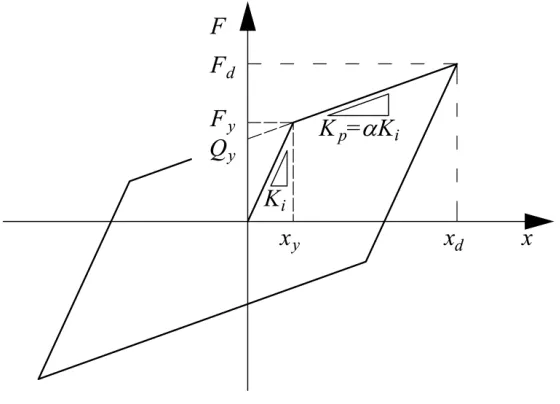
Fig. 6 Bilinear hysteretic model
For a bilinear hysteretic system, the equation of motion under earthquake excitation is given by:
gM x t +C x t + F x t ,x t = M x t
(1)where
x t
,x t
, andx t
are the acceleration, velocity, and displacement, re-spectively, of the system relative to the ground;C
is the damping coefficient;
F x t ,x t
is the restoring force;M
is the mass of the system; and
x t
g
is the ground acceleration.Of course, the motion equations can be solved exactly through nonlinear time his-tory method. However, solving of a system with a large number of degrees of free-dom may require an exorbitant amount of time when time history analysis methods are used. Also, the enormous amount of output results from such a system may be so detailed that it is impractical for engineers to summarize. Furthermore, in the ini-tial stage of structural design, many structural configurations are not well-defined, such as the arrangement and the hysteretic properties of seismic isolation bearings. Thus, there will always be a need for good approximate methods of analysis of nonlinear systems (Guyader & Iwan, 2006).
elas-tic structure whose stiffness and damping characteriselas-tics are selected such that the maximum displacement responses of the two systems are approximately equal, as shown in Fig. 7.
Fig. 7 Equivalent linearization of bilinear hysteretic behavior
Replacing the bilinear system with a viscously damped elastic system, the differen-tial equation of motion may be expressed as:
eq eq
eq eq eq
gM x
t + C x
t + K x
t = M x
t
(2)where
x
eq
t
,x
eq
t
, andx
eq
t
are the acceleration, velocity, and displacement, respectively, of the equivalent linear system relative to the ground;C
eq is the equivalent damping coefficient;K
eqis the equivalent stiffness.Ideally, if no seismic energy is transmitted, the superstructure remains literally unaf-fected by a seismic attack. Conversely, the isolators must be capable of undergoing the movements imposed by the ground shaking, while maintaining their ability to carry gravity loads from the superstructure to the ground. So, the maximum defor-mation of the isolator is considered to be a very important indictor in structural de-sign of base-isolated buildings.
According to different treatments in estimating equivalent period and equivalent vis-cous damping ratio, several analytical or empirical formulas used in equivalent lin-ear elastic analysis were developed in the past decades, which will be further de-scribed in the art of state. Most of them are the functions of the strain hardening ratio and the displacement ductility ratio. However, the estimation accuracy of these various equivalent linearization methods is strongly related to different assumptions when they are derived or fitted. Although many researchers have contributed a sig-nificant number of works, there are still many aspects need to be investigated in or-der to gain better equivalent linearization method used for analysis of base-isolated buildings.
To simplify structural design of base-isolated buildings, equivalent linearization analysis method is often proposed by many modern codes. However, in order to model the behavior of isolation system as being equivalent linear, several require-ments must be met.
Therefore, in modern codes, equivalent linearization of seismic isolation system cannot always be applied. If equivalent linearization analysis method is conducted, nonlinear properties of seismic isolation system must be adjusted to satisfy the lim-ited conditions, which will be very inconvenient. In addition, the selected isolation bearings may be unavailable on the market. Thus, the code-recommended equiva-lent linearization method makes simplified analysis of base-isolated buildings only applicable in very limited cases.
1.2. Objectives of the Research
To extend the application scope of equivalent linearization analysis method for base-isolated buildings, a large amount of work has been performed, such as par-ametric analyses, optimization analyses and regression analyses. Meanwhile, a large number of parameters are considered separately.
Specifically, the main contributions of this study are presented as follows:
2) More comprehensive parametric study is performed for base-isolated buildings characterized by SDOF systems. The influence of different parameters, such as strain hardening ratio, initial period and ductility ratio, on the estimation accuracy of maximum displacement response is identified.
3) According to optimization analysis and regression analysis, an improved equiva-lent linearization method is proposed for SDOF bilinear systems in order to obtain more accurate results.
4) Similarly, the equivalent linearization method recommended in structural specifi-cations and the method proposed for SDOF systems are further examined based on MDOF base-isolated systems. Specifically, the effect of the ratio between the equivalent period and superstructure period on the prediction accuracy of the max-imum displacement response is investigated.
5) Accordingly, for MDOF base-isolated systems, the equivalent linearization meth-od used for SDOF systems is improved by taking into account the influence of the ratio between the equivalent period and superstructure period.
6) Based on the code-recommended linearization method and the proposed meth-ods for SDOF and MDOF systems, different methmeth-ods, including equivalent linear static analysis, response spectral analysis, and linear and nonlinear time history analyses are used for analysis of MDOF base-isolated buildings. Evaluations on the accuracy of different equivalent linear analysis methods are given.
1.3. Layout of the Thesis
This research seeks to examine the equivalent linearization of base-isolated build-ings with bilinear hysteretic isolators and to propose more accurate equivalent line-arization method used for simplified design of base-isolated buildings. Both SDOF and MDOF systems are considered to simulate the base-isolated buildings. Based upon the improved equivalent linearization models, the detailed procedures to per-form linear static analysis and response spectral analysis, which provide a simple way to design base-isolated structures, are described and the results are compared with linear and nonlinear time history analysis.
Chapter 1 gives the background and objectives of the research. The background shows several great earthquakes in recent years and explains the need for seismic upgrading of structures using base isolation system. Then, the concept of equiva-lent linearization technique is briefly introduced.
Chapter 2 provides a literature review of the major previous works conducted in seismic isolation. The review includes many aspects involved in the present study, such as the isolator devices, the effectiveness of base isolation system, equivalent linearization methods, modeling of superstructure damping in base-isolated struc-tures, the lateral force distribution along the height of base-isolated buildings, and so on.
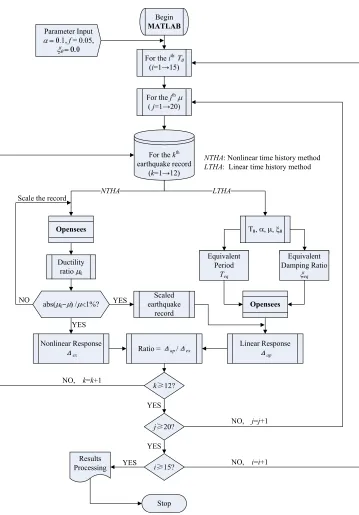
Chapter 3 evaluates fifteen equivalent linearization methods based on bilinear SDOF system when subjected to twelve ground motions. Using a program specifi-cally developed in MATLAB and OpenSees, a large number of parametric analyses are performed. The accuracy of various methods to estimate the maximum dis-placement response is investigated.
Chapter 4 derives an improved equivalent linearization method for general bilinear SDOF systems. In a wider parameter space, parametric analyses are performed again for equivalent linearization methods selected from Chapter 3. Successively, optimization analyses and regression analyses are carried out to derive an im-proved formula used to estimate the equivalent damping ratio. In addition, the pro-posed method (Liu I method) is validated using another twelve recorded ground mo-tions.
Chapter 5 investigates the accuracy of equivalent linearization methods applied to base-isolated structures characterized by MDOF systems. Both the method rec-ommended in codes (R&H method) and Liu I method are considered. Similar to the previous Chapter, an improved method for MDOF systems (Liu II method) is pro-posed through correcting Liu I method.
CHAPTER 2
2. STATE-OF-ART
A comprehensive literature survey helps not only to deepen the basic knowledge on the studied subject but also to emphasize advantages and disadvantages of previ-ous experiences, so to give researchers space for further improvements. To provide a unitary framework, a detailed literature survey about the topic of seismic base iso-lation system is presented.
First of all, different isolation devices are briefly introduced as well as the efficiency of seismic isolation to mitigate the damage of structures. Then, the past efforts to achieve equivalent linearization methods are reviewed. After that, the modelling methods of viscous damping in the superstructure of base-isolated buildings are summarized. Finally, different methods to estimate lateral force distributions along the height of multi-storey base-isolated buildings are presented.
2.1. Seismic Isolation Systems
earlier and current base-isolation devices (proposed or implemented) was given, and aspects for future research in the area of base islation were also included.
As the volume of information on seismic isolation has grown exponentially over the past 10-15 years, the attempts at a comprehensive review have diminished. Yet, several focused reviews have emerged. Kunde and Jangid (Kunde & Jangid, 2003) prepared a comprehensive review of research and application of seismic isolation to bridges, including analytical, experimental and parametric studies. Symans et al. (Symans et al., 2003) reviewed the development and application of seismic isolation and damping systems for wood frame structures, which are uniquely challenging to isolate due to the inherent flexibility of the framing system and relatively light mass. In different countries, such as USA (Wiles, 2008), Europe (Martelli & Forni, 1998), Japan (Pan et al., 2005), China (Pan et al., 2012) and New Zealand (Robinson, 1995), detailed review of base isolation system could be also found.
Regarding the isolation devices, they can be classified into two basic types: elas-tomeric bearings and sliding bearings. The elaselas-tomeric bearings with low horizontal stiffness shift fundamental time period of the structure to avoid resonance with the excitations. The sliding isolation system is based on the concept of sliding friction.
1) Elastomeric Base Isolation Systems
The first category of elastomeric bearings (i.e., the laminated rubber bearings), as shown in Fig. 8, is most commonly used base isolation system. Laminated rubber bearings can be categorized as: (1) low-damping natural rubber; and (2) high-damping rubber.
Fig. 8 Laminated rubber bearings and its force-deformation behavior
To achieve a higher level of damping, carbon black and other fillers can be added to the raw rubber during the mixing process to produce high-damping rubber bearings (HDRBs) (Naeim & Kelly, 1999). The equivalent damping ratio of high-damping rubber bearings can range from 10% to 20% at 100% shear strain. Although the range of shear modulus for high-damping rubber is similar to that for low-damping rubber, the fillers increase the hardness and thus the shear modulus of the rubber so that it can be difficult to achieve low shear modulus and high levels of damping simultaneously.
shaking table tests of seismically isolated bridge decks. In these proposed models, the fractional derivative of the relative displacement is used rather than the relative velocity term of the equation of motion. In recent, Bhuiyan et al. (Bhuiyan et al., 2009) developed an elasto-viscoplastic rheology model of HDRBs for seismic analysis on the basis of experimental observations. In their model, the Maxwell model is extended by adding a nonlinear elastic spring and an elasto-plastic model (spring-slider) in parallel. Based on the comparison between the simulations and the experimental results, the proposed model is able to predict the nonlinear viscos-ity in loading and unloading of the HDR bearings in addition to other inelastic be-havior.
The second category of elastomeric bearings is lead-rubber bearings (LRB) (Robin-son, 1977; Robin(Robin-son, 1982), as presented in Fig. 9. This kind of isolator bearing was first introduced and used in New Zealand in the late 1970s. Therefore, they are also referred as N-Z systems. The lead-rubber bearings behave essentially as hys-teretic damper device and widely studied in the past (Kelly et al., 1972; Kelly et al., 1977; Skinner et al., 1975).
Fig. 9 Lead-rubber bearing and its force-deformation behavior
LRB system provides the combined features of vertical load support, horizontal flexibility, restoring force and damping in a single unit. To provide an additional means of energy dissipation, a central lead core is added. The lead-plug deforms plastically under shear deformation, enhancing the energy dissipation capabilities compared to the low-damping natural rubber bearing.
cy-clic loading at plastic strains. More important, lead is readily available at high purity of 99.9 per cent required for its predictable mechanical properties.
Due to plastic deformation of the lead core, the energy dissipation mechanism is primary hysteretic. A Bouc-Wen or rate independent plasticity model (Nagarajaiah et al., 1991) is typically used for analytically modelling the shear force-horizontal de-formation response of LRBs. Under bi-directional loading, the bearing model is cou-pled in the two orthogonal horizontal directions through a circular yield surface.
However, the Bouc-Wen based hysteretic models do not account for the effect of heating in the lead-core with repeated cycling that leads to degradation in the char-acteristic strength. To account for the effects of heating in LRBs, many theoretical models have been developed and experimentally verified (Kalpakidis & Constantinou, 2009a; Kalpakidis & Constantinou, 2009b). But, thermo-mechanical models (Kalpakidis et al, 2010) that account for heating and strength degradation in LRBs have not been widely implemented for the analysis and design of LRB sys-tems. Ozdemir and Dicleli (Ozdemir & Dicleli, 2012) investigated the effect of lead core heating and associated strength deterioration on the seismic response of bridges isolated with LRBs as a function of the characteristics of the isolator and near fault ground motions with forward rupture directivity effect.
The vertical force-deformation behavior is typically assumed to be linear with stiff-ness equal to the compressive stiffstiff-ness of the bearing, though multi-linear models are possible. A model that includes the influence of vertical load on the effective horizontal stiffness and lead-core yield strength was developed by Ryan et al. (Ryan et al., 2005) and has been implemented in OpenSees (Mazzoni et al., 2007). In order to account for the second-order effects due to vertical load at large horizon-tal displacement, many models have been developed (Iizuka, 2000; Yamamoto et al., 2009; Kikuchi et al., 2010) and are capable of exhibiting zero or negative tan-gential horizontal stiffness(Sanchez et al., 2012). However, these models have not been widely adopted due to the extensive experimental data required to calibrate the model parameters.
2) Sliding Base Isolation Systems
sitivity to the frequency content of earthquake excitation, because of the tendency of sliding system to reduce and spread the earthquake energy over a wide range of frequencies. In addition, since the frictional force is proportional to the mass of the structure, the center of mass and the center of resistance of the sliding support co-incide, thus the torsion effects produced by the asymmetric building can be dimin-ished.
(a) Pure Friction System
The simplest sliding isolation system, used popularly for bridges in particular, is the pure friction (P-F) system based on the mechanism of sliding friction (Westermo & Udwadia, 1983), as shown in Fig. 10. The use of layer of sand or roller in the foun-dation of the building is the example of P-F base isolator. Under normal conditions of ambient vibrations, and small magnitude earthquakes, P-F system acts like a fixed base system due to the static frictional force. However, for large earthquakes, the static value of frictional force is overcome, and sliding occurs with reduced dy-namic resistance thereby reducing the accelerations transferred to the structures. The horizontal frictional force at the bearing interface offers resistance to the motion, and dissipates energy. The coefficient of friction of P-F system varies significantly with the nature of friction surface. Coulomb’s frictional model is often used to model the limiting frictional force. It should be noted that in this model the frictional coeffi-cient is independent of the sliding velocity.
Fig. 10 Lead-rubber bearing and its force-deformation behavior
(b) Friction Pendulum System
sys-tem, friction pendulum system (FPS) is developed (Zayas et al., 1987; Zayas et al., 1990), as shown in Fig. 11.
The concept of FPS is marked by sliding of an articulated slider on spherical con-cave chrome surface. The slider is faced with a bearing material which results in development of friction force while concave surface produces restoring force. FPS is activated only when the inertia forces caused by earthquakes overcome the static value of friction and coefficient of friction depends upon the velocity attained. The FPS develops a lateral force equal to the combination of the mobilized frictional force, and the restoring force that develops because of the rising of the structure along the spherical concave surface (Matsagar & Jangid, 2003). In practice struc-tural design, rigid-plastic model is often used to represent the characteristics of FPS (Liu et al., 2014c).
Fig. 11 Friction pendulum bearing and its force-deformation behavior
As discussed by Constantinou et al. (Constantinou et al., 1990), the coefficient of friction is strongly related to the sliding velocity and normal pressure, so it is both velocity and pressure dependent. In addition, the variation of normal force also has significant influence on the response behavior of FPS (Almazán et al., 1998; Briseghella et al., 2013).
In the past years, many research efforts were made to develop refined models for FPS. Eröz and DesRoches (Eröz & DesRoches, 2008) presented a new model for the FPS that can represent the variation of the normal force and friction coefficient, bi-directional coupling and large deformation effects during nonlinear dynamic analyses. The influence of various parameters had been highlighted via nonlinear time-history analyses of a multi-span continuous bridge.
ics may lead, in the case of impulsive motions, to discrepancies in global response quantities, relative to the ‘actual’ response, as large as 30 per cent. These discrep-ancies increased up to 50 per cent for local response quantities such as normal iso-lator forces.
2.2. Efficiency of Base Isolation System
There had been several analytical studies in the past to demonstrate the effective-ness of seismic isolation for earthquake-resistant design of buildings, which could be involved to structural response or cost effectiveness.
Shatnawi et al. (Shatnawi et al., 2008) studied the response of the rubber-steel bearing isolation system. The structural responses were computed using two mate-rial models. These are: a hyperviscoelastic matemate-rial model (Al-Shatnawi, 2001) that is linked with ABAQUS as a user defined material model (UMAT), and another large strain hyperelastic material model that exists within the ABAQUS software (i.e., Ogden type). Structural response of the rubber bearings were found to have good agreement with those obtained when using the hyperelastic Ogden model of ABAQUS. Moreover, the non-linear seismic responses of a fixed-base and base-isolated steel frame structures were analyzed. The results showed a great efficiency of using the rubber bearing isolation in uncoupling both structures from the seismic ground motion helping both of them to sustain the earthquake excitation. This is ob-served by elongating the period of the structure and reducing the horizontal accel-erations, lateral-forces and the relative horizontal roof displacement. However, bet-ter results were observed for the high-rise structures, because their period was longer than the period of the low-rise structures which reduced the effect of the earthquake excitation on this type of structures. In addition, it had been proved that the used material model was more effective to capture the behavior of the base-isolated structures expressing a notable reduction in acceleration and an increase in the structural resistance to earthquake excitations.
retrofit-ted structural system was obtained numerically by solving the governing equations of motion under different earthquakes and compared with the corresponding con-ventional structure without any retrofit measures. The results showed that the seis-mic response of the retrofitted structures reduced significantly in comparison with the conventional structures depicting effectiveness of the retrofitting done through the base isolation technique. That study also distinctively elaborated on the meth-ods of construction in retrofitting works involving base isolation.
Lee et al. (Lee et al., 2008) investigated the statistics of peak elastic and inelastic responses of structures with tuned mass dampers (TMD) or base isolation devices (BID) under seismic excitations, and assessed the cost-effectiveness of structures with an option of installing these devices in mitigating seismic risk. For the assess-ment, a structure was modelled as a two-freedom system; one degree-of-freedom represented a main structure and the other represented an auxiliary sys-tem (i.e., TMD or BID). The hysteretic behavior of the main structure and auxiliary system was approximated by the Bouc-Wen model. A parametric study of linear and nonlinear responses of the system was carried out by using 381 ground motion records, and the ratios of the maximum displacement and ductility demand of the system with auxiliary devices to those without were considered as a measure of ef-fectiveness of TMD/BID. The linear and nonlinear responses were also incorporated for assessing possible damage states and damage costs in the lifecycle cost analy-sis. The analysis results indicated that TMD reduced peak structural responses by as much as 10%-15%, depending on the mass ratio, and was effective for struc-tures with longer vibration periods. The effectiveness of TMD decreased as the seismic excitation level increased and its installation could have a negative impact on the structure. The results for BID systems showed that BID significantly reduced peak structural responses by as much as 70%-80% and was particularly beneficial for structures with shorter vibration periods. This effectiveness decreased as the seismic excitation level increased, since the degradation of structures leaded to the elongation of the vibration period. It was also indicated that bilinear base isolators, although slightly less effective than linear ones, can be useful for practical applica-tions, since peak displacement demands in isolators were reduced. Furthermore, the lifecycle cost analysis results illustrated that TMD reduced the expected lifecycle cost by about up to 2.5% in terms of the initial construction cost, whereas BID re-duced it by about up to 16%.
structural system was analyzed using equivalent static, linear dynamic and time his-tory procedures, including a "beyond the code requirement” investigation of the structural members at MCE hazard with FEMA recommended acceptance criteria per the selected performance objectives. A comparative study was performed showing the effectiveness of the current code based analysis and design proce-dures. Overall, the seismically isolated structure met and surpassed the perform-ance objectives while achieving an 80% reduction in the base shear (relative to the fixed-base building model), significant decreased in the story drift (83%) and floor accelerations (90%).
Alhana and Altun (Alhana & Altun, 2009) carried out bi-directional non-linear time history analyses of a 4-story base isolated benchmark building under near-fault and far-fault earthquakes. This building was designed according to UBC97 and the iso-lation system was composed of high damping rubber bearings with the bi-linear force-displacement behavior. Design displacements were estimated using UBC97 parameters. Results showed that UBC97 predicted isolator displacements success-fully. A major improvement in the superstructure performance was achieved as the floor accelerations, inter-story drifts and base shear can be significantly reduced al-together.
Sayani and Ryan (Sayani & Ryan, 2009) developed a response index for rapid pro-totyping of response as a function of system characteristics. Based on response history analysis to a suite of motions, constant ductility spectra were generated for fixed-base and isolated buildings. Both superstructure force (base shear) and de-formation demands in base-isolated buildings were lower than in fixed-base build-ings responding with identical deformation ductility. When evaluated for a life safety performance objective, the superstructure design base shear of an isolated building was competitive with that of a fixed-base building with identical ductility, and the iso-lated building generally had improved response. Isoiso-lated buildings can meet a moderate ductility immediate-occupancy objective at low design strengths, whereas comparable ductility fixed-base buildings failed to meet the objective.
the seismic response of protected and unprotected buildings subjected to strong seismic actions. The simulation results advocated the efficiency of using passive seismic protection devices with hysteretic characteristics, which included in the same element both the elastic and the dissipative properties necessary to reduce the structural seismic response. The base isolation systems can provide an impor-tant reduction of accelerations transmitted to the structure, such that the structural elements remained in the elastic field.
Tulei et al. (Tulei et al., 2010) analyzed the possibility of implementing modern solu-tions for the seismic rehabilitation of buildings in Romania. A 5-storey reinforced concrete framed structure located in Bucharest was upgraded in accordance to the present Romanian codes. In order to draw conclusions regarding the influence of the site conditions on the structural response, the building was considered in differ-ent seismic zones from Romania, for which the response spectrum had the same PGA values, but different corner periods. The efficiency of two solutions based on passive control devices was analyzed, namely base isolation with lead-rubber elas-tomeric bearings and in structure linear viscous dampers. The analyses results showed the use of viscous dampers significantly reduced the relative lateral dis-placements, but leaded to lesser reductions of the base shear forces. However, the base isolation system can reduce the base shear force with 84-86% and it was con-sidered to be the most efficient solution for ensuring the building seismic safety.
Wu (Wu, 2010) examined the dynamic characteristics of an eccentric five-storey benchmark model isolated with laminated rubber bearings and lead core rubber bearings using a shaker table and four different ground motions. Important differ-ences between the two isolator types were identified. The laminated rubber bear-ings were found to be similar to lead core rubber bearbear-ings in protecting torsional de-formation of the model but were more effective than lead core rubber bearings in reducing model relative displacement. Lead core rubber bearings rendered a smaller torsional angle and absolute deformation of the base isolation system, a more stable structural system. Therefore, base isolation can greatly reduce tor-sional as well as translational response of building structures.
ground motions. Results showed that in base-isolated structures large reduction was observed in acceleration values, base shear forces and relative storey dis-placements with respect to conventional structures. As a result of decreasing rela-tive storey displacements, the accelerations acting on superstructure were damped at base level and the internal forces in superstructures were reduced. On the other hand, the displacements and periods of base-isolated structures were increased comparing with fixed-base structures.
Branco and Guerreiro (Branco & Guerreiro, 2011) presented a comparative study of the performance of different seismic retrofitting techniques, implemented in a model of an existing masonry building. The first part of the study considered the testing of different methodologies to strengthen the building floors, to enable them to behave as stiff diaphragms. In the second stage, the seismic protection of the building was studied with these different solutions: insertion of concrete walls, the use of a base isolation solution, and the implementation of viscous dampers. Based upon the ob-served results, the solution that presented the best response, considering the measured displacements, was the solution with concrete walls, although the results were very close to those from the viscous dampers. The base isolation system pre-sented higher absolute displacements, but was the one that conducted the smallest relative displacements. According to the tensile stresses evaluation, the best results were reached by the base isolation system, followed by the concrete walls.
Bedrinana (Bedrinana, 2011) evaluated the cost-effectiveness as well as the seis-mic safety of a base-isolated building located in Peru. A methodology to evaluate quantitatively the seismic risk and the cost-effectiveness of a base-isolated building during its lifetime was presented. The process started with the hazard analysis and the earthquake ground motion generation in the studied area. Lima area was con-sidered in that study. Series of artificial earthquake ground motions were generated by a stochastic method in the studied area. Then a preliminary seismic design of the target building was carried out according to the Peruvian seismic code. To get the response distribution of the target building, several dynamic nonlinear analyses were performed by using the generated artificial motions as input waves. By assum-ing a structural response distribution, the seismic risk analysis was performed in terms of three structural parameters such as: inter-storey drift ratio (IDR), floor ac-celeration (FA) and the structural damage index (DI). The damage of the target building was evaluated by using damage index. Results showed that the total dam-age in conventional building was considerably larger than isolated building. The ex-pected value of the total damage index in 50 years, with 10% of exceedance prob-ability, for the fixed building had a value of about 2.47 times larger than isolated one. Although the initial total structural cost in the isolated building was larger than that in fixed one, the total structural cost in isolated building was much smaller for long time interval. So, base isolated building was cheaper than fixed building during the lifetime of the target building when large damage was expected.
with the support of critical components, results showed the effectiveness of base isolation system in terms of lessening structural responses under seismic loading.
In another work of Islam et al. (Islam et al., 2010), the design of base isolators for a building along with its structural and economic feasibility was addressed. Linear static as well as dynamic (time history and response spectrum) analyses had been carried out for both isolated and non-isolated buildings. Similar analyses had also been repeated for buildings with different heights but similar plan areas. That study revealed that for low-to-medium rise buildings, isolation system can reduce seismic force along with some savings in structural cost of the building, though incorporating base isolators increase the overall price and installation cost. A meticulous review indicated that savings may be in the order of 5%-10% of the total structural cost of the respective building.
Briseghella et al. (Briseghella et al., 2012) investigated the application of base isola-tion system to an old R.C. buildings built in the 70’s and 80’s, which was damaged by the L’Aquila earthquake occurred in Italy. Different kinds of analysis (response spectral, pushover and nonlinear dynamic analysis) were performed by Midas/Gen according to Eurocode8. Results had been compared among the original building and buildings retrofitted by different interventions. Although both “column cut” and “Lift up” strategies can reduce the seismic vulnerability of existing building, the later exhibited better performance than the former. In addition, the “column cut” tech-nique generally implies a reduction of the free floor height and strength of structural elements in elevation, so stairs and elevators need special design. But the “Lift up” system has not the disadvantages above and preserves the architectural and func-tional character of the construction. So, “Lift up” technique is more attractive and should be widely applied in the retrofitting of existing building. Furthermore, from the economic point of view, “column cut” technique and “Lift up” system were equivalent in the presented case.
structural repairs to the damaged structural members of the superstructure, as well as with estimated expenses of the downtime period and content damage. The re-sults had shown that base isolation was, in general, not economically feasible for lower ground motion intensities, whereas it could be of great benefit in the case of moderate and high intensities. A simple rough cost estimation study, based on the obtained plastic hinge patterns, showed that the inclusion of the downtime period costs and content damage costs might be important parameters, which could make such an isolation system viable also for lower ground motion intensities. The other benefits brought by seismic isolation, such as savings on the building design costs, reductions in the threat to employees’ lives, were not included in that study.
2.3. Equivalent Linearization Methods
Equivalent linearization of the nonlinear system greatly simplifies the problem and provides an approximate estimate of the response of a structure equipped with hys-teretic devices. This approach is reflected in current design and analysis guidelines for structures incorporating passive energy dissipation systems (FEMA, 1997; AASHTO, 2002; BSSC, 2003; CEN, 2004; D.M., 2008). It must be clearly under-stood, however, that this equivalent linearization for structures incorporating hyster-etic devices should be used only for preliminary design and for estimating the dy-namic response. The addition of this equivalent viscous damping will always cause a reduction of the dynamic response of a single-degree-of-freedom (SDOF) system for any seismic input signal. Because of the nonlinear nature of actual hysteretic devices, the results obtained with the linear system with equivalent viscous damp-ing may be non-conservative.
2.3.1 Equivalent Linearization Methods Based on Secant Stiffness
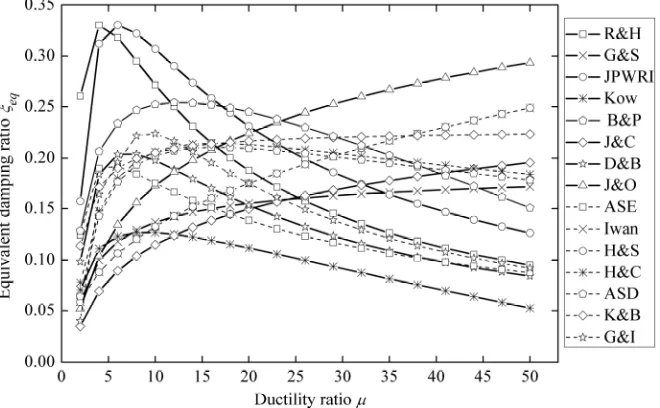
The first group of equivalent linearization methods considered in this research com-prises those proposed by Rosenblueth and Herrera (Rosenblueth & Herrera, 1964), Gulkan and Sozen (Gulkan & Sozen, 1974), JPWRI (JPWRI, 1992), Kowalsky (Kowalsky, 1995), Blandon and Priestley (Blandon & Priestley 2005), Jara and Casas (Jara & Casas, 2006), Dicleli and Buddaram (Dicleli & Buddaram, 2007), and Jara et al. (Jara et al., 2012). Here, for the purpose of brevity, they are abbreviated as R&H, G&S, JPWRI, Kow, B&P, J&C, D&B, and J&O method.
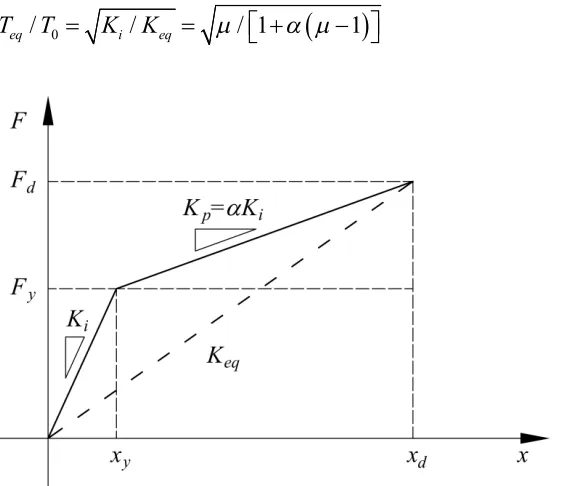
Based on harmonic loading, Rosenblueth and Herrera firstly proposed the secant stiffness at maximum deformation as the basis for selecting the period ratio. Con-sidering the idealized bilinear hysteresis model, equivalent stiffness can be deter-mined based upon the concept of secant stiffness, as shown in Fig. 12, namely:
=
d eqd
F
K
x
(3)where
d i y p d y
F
K x
K
x
x
(4)Therefore,
1
i y p d y y p y
eq i
d d i d
K x
K
x
x
x
K
x
K
K
x
x
K
x
(5)
Let denote = xd / xy and = Kp / Ki, and substitute them in the above expression, that is:
1
1
1
1
1
eq i i
K
K
K
(6)0
2
/
2
/
eq eq
i
T
M K
T
M K
(7)
Finally, period ratio can be given as:
0
/
/
/ 1
1
eq i eq
T
T
K
K
(8)Fig. 12 The concept of secant stiffness
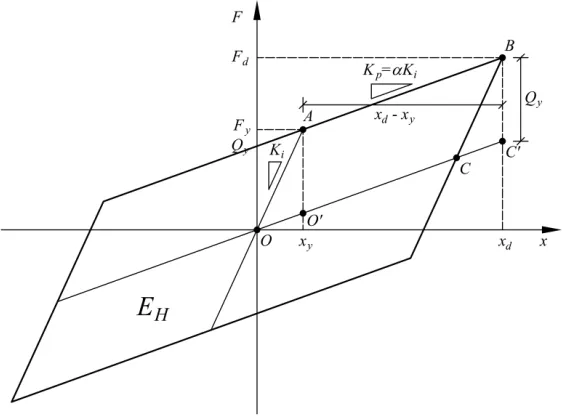
Hysteretic damping ratio of bilinear system can be determined through equating the energy dissipated by one cycle of the bilinear model with the energy dissipated by one cycle of harmonic response of linear elastic system at resonance. Considering symmetric steady-state response of bilinear systems, the hysteresis energy dissi-pated by one cycle (i.e., the area of enclosed by hysteresis loop, see Fig. 13) can be expressed as:
' '
4
OABC4
O4
4
H
S
S
ABCQ
yx
d yx
y iK
px
dx
yFig. 13 Hysteresis energy dissipated by one cycle of the bilinear model
For linear elastic systems with a damping ratio and a secant stiffness K, the damping energy dissipated by one cycle of harmonic response is defined by the area of the ellipse shown in Fig. 14.
22
2
D
x
dK
dK
dE
x
x
(10)Fig. 14 Damping energy dissipated by one cycle of harmonic response
2 2 2
4 4
2 2 2 /
1 / / 1
y i p d y d y i
H hyst
eq
eq d e
p i
q d d y
x K K x x K K x x K
E
K
K x K x x x
(11)
Considering = xd / xy, = Kp / Ki and Ki / Keq = / [1+(-1)], the hysteretic damp-ing ratio hyst can be rewritten as:
2 1
1
1
1
hyst
(12)If the inherent viscous damping ratio of bilinear systems 0 is considered, the equivalent viscous damping ratio can be finally expressed as:
0 0
2 1
1
1
1
eq hyst (13)
This method is also referred to as geometric stiffness method, which has been adopt by many structural codes, such as AASHTO (AASHTO, 2002), Eurocode8 (CEN, 2004) and the new Italian code (D.M., 2008).
Gulkan and Sozen (Gulkan & Sozen, 1974) found that a reduction in stiffness and an increase in energy dissipation capacity are two basic characteristics of rein-forced concrete structures to mitigate the structural response when subjected to strong ground motions. Both can be related to the maximum displacement. They concluded that the maximum dynamic response of reinforced concrete structures, as represented by SDOF systems, can be approximated by linear response analy-sis using a reduced stiffness and a substitute viscous damping ratio. Based on Takeda hysteretic model (Takeda et al., 1970) and a series of experimental in-vestigations on reinforced concrete frames, they proposed a simpler and more con-venient empirical equation for computing equivalent viscous damping, which is ex-pressed as:
0
0.2 1 1/
eq
(14)which is set to be 70 per cent of the maximum design displacement, to compute the period ratio and equivalent viscous damping ratio. Substituting 0.7 for in Eq. (8) and Eq. (12), the equivalent linear properties can be rewritten as:
0
0.7
/
1
0.7
1
eq
T
T
(15)
0
2 1
0.7
1
0.7
1
0.7
1
eq (16)
Assuming the energy absorbed in a single cycle of the inelastic systems and of the equivalent linear systems is the same, Kowalsky (Kowalsky, 1995) derived an equa-tion for the equivalent viscous damping ratio based on the secant stiffness and Ta-keda hysteretic model (TaTa-keda et al., 1970). The equivalent viscous damping ratio is given by:
0
1
1
1
neq (17)
where n is stiffness degradation factor, with a suggested value of 0 for steel struc-tures and 0.5 for RC strucstruc-tures. In this study, the value of 0.5 is considered.
Blandon and Priestley (Blandon & Priestley, 2005) found that in general Jacobsen’s approach in combination with secant stiffness at maximum displacement overesti-mates the equivalent viscous damping and proposed modified design equations for equivalent viscous damping used in direct displacement-based design method:
For elasto-plastic hysteretic model:
20.5
0.904
1
1
1
1
0.85
eq 0 eqT
(18)
40.5
1.230
1
1
1
0.1
1
0.85
eq 0 eqT
(19)Jara and Casas (Jara & Casas, 2006) proposed a simple empirical expression of equivalent viscous damping ratio to improve the displacement prediction of equiva-lent linearization methods when applied to bridges supported on LRBs. The pro-vided formulas for computing the equivalent viscous damping ratio is expressed as:
0
0.05
eq
ln
(20)They concluded that, using the proposed model, the displacement prediction of the equivalent linear elastic analysis could be improved and a lower scattering of results could be obtained over the whole range of the ductility. However, they also sug-gested that more research is needed to determine the equivalent linearization pa-rameters and the influence of the earthquake characteristics.
Dicleli and Buddaram (Dicleli & Buddaram, 2007) evaluated the equivalent linear elastic analysis for seismic-isolated structures represented by SDOF systems and found that the equation of equivalent viscous damping ratio used in the design of seismic-isolated structures must incorporate the equivalent period of the structure and the frequency characteristics of ground motion in order to acquire a more accu-rate estimation of seismic response quantities. Modifying the existing equation for estimating the equivalent viscous damping ratio, a new equation was proposed to yield more reasonable estimates of the actual nonlinear responses, which can be expressed as:
0
0
2 1
1
0.41
1
1
1
eq eqT
T
(21)analy-damping ratio derived from the particular characteristics of bridges supported on bi-linear hysteretic bearings, as shown below:
0
0.30
eq
ln
(22)where the coefficient = 0.065 for earthquakes recorded on firm soils and = 0.085 for earthquakes recorded on soft soils. In the present research, the average value = 0.075 is considered.
2.3.2 Equivalent Linearization Methods not Based on Secant Stiffness
Under earthquake loading, most of the time the displacement of the systems would be much smaller than the maximum response, thus the equivalent viscous damping ratio computed using the equal energy dissipation principle would lead to an under-estimation of the peak response. Iwan and Gates (Iwan & Gates, 1979) proposed the average stiffness and energy (ASE) damping model, as expressed in Eqs. (23) - (24), to improve the accuracy of equivalent linearization method.
0
/
1
1
1
eqT
T
ln
(23)
2 2
0
0 2
6 1
1
1
3
1
2
2
1
1
1
eqln
(24)
In another work of Iwan (Iwan, 1980), various approximate methods were evaluated and the equivalent viscous damping ratio was found to be overestimated for most of the considered ductility range. Then empirical equations to estimate the period ratio and equivalent damping ratio were derived as follows:
0.9390
/
1 0.121
1
eq
T
T
(25)
0.3710
0.0587
1
The relationship between period ratio and equivalent viscous damping ratio was represented by: 0.3952 0 0
0.1352
1
eq eqT
T
(27)Hwang and Sheng (Hwang & Sheng, 1993) examined equivalent stiffness and equivalent viscous damping ratio of seismically isolated bridges. To improve the prediction of Iwan (Iwan, 1980) model, the data obtained by Iwan and Gates (Iwan & Gates, 1979) were used to fit an assumed function for the relationship between the equivalent period ratio and ductility ratio. The proposed formula was presumed to be an exponential function rather than a power function of ductility ratio, which is expressed in Eq. (28). However, the formula used for computation of the equivalent damping ratio is kept the same as Eq. (25).
1.1370
/
1
1 0.13
1
eq
T
T
ln
(28)Hwang and Chiou (Hwang & Chiou, 1996) proposed an equivalent linearization model for the analysis of base-isolated bridges with LRBs, which was derived in a modified form from AASHTO guide specifications for seismic isolation through an identification method. A total of 15 ductility ratios up to 50 and a stiffness ratio of 0.15 were assigned in that study. The provided formulas for computing period ratio and equivalent viscous damping ratio are respectively expressed as:
0 2
1
/
1 0.737
1
1
eqT
T
(29)
0.58 0
2 1
1
6 10
1
1
eq (30)
0
2 1
1
1
1
1
1
eqln
ln
(31)Kwan and Billington (Kwan & Billington, 2003) proposed the relations between equivalent period Teq and equivalent damping ratio eq for the equivalent lineariza-tion approach. Results from the simulalineariza-tions indicated that neither the secant stiff-ness method nor existing empirical methods were adequate in accounting for the influence of hysteretic behavior on the equivalent linear system parameters. Opti-mal Teq and eq values from extensive time history analyses of SDOF systems with six types of hysteretic behavior and a period range of 0.1 s to 1.5 s were used to derive the new relations, which are presented as follows:
1
0
/
0.8
Ceq
T
T
(32)2 2 2 0 2 0 0
2
1
0.55
eq eq eqT
T
C
T
T
(33)For elastoplastic, moderately and slightly degrading hysteretic systems, values of C1 and C2 are set to be 0.5 and 0.56 respectively according to their research.
In order to have the measure of goodness of the optimal equivalent linear parame-ters according to some sense of engineering acceptability, Guyader and Iwan (Guyader & Iwan, 2004) introduced an improved capacity spectrum method solution procedure that had been adopted as one of the three solution procedures to be presented in FEMA-440 (FEMA, 2005). In that study, the optimal pair of Teq and eq was taken as the values that maximize the probability that the percentage error be-tween the actual nonlinear systems and their equivalent linear counterparts was within the range -10% to +20%. Several hysteretic systems including bilinear, stiff-ness degrading, strength degrading and pinching models were considered. The proposed empirical equations were shown in Eq. (34).
For < 4.0:
2
30
/
1 0.1262
1
0.0224
1
eq
2
30
0.05073
1
0.01083
1
eq
(34b)
For 4.0 ≤ ≤ 6.5
: