Research on Interference Optimization Mechanism of
Wireless Routing Signal Transmission Based on Fuzzy
Comprehensive Evaluation Method
https://doi.org/10.3991/ijoe.v13i03.6866Xinchun Wang*
North China University of Science and Technology, Tangshan, China
Haishan Zhang
North China University of Science and Technology, Tangshan, China
Mi Li
North China University of Science and Technology, Tangshan, China
Ying Li
North China University of Science and Technology, Tangshan, China
Abstract—Inherently dynamic in nature, wireless sensor network transmits data less efficient and reliable, and thus the conventional routing protocol is in-applicable to the new type of wireless sensor network. Such being the case, this paper first analyzes this problem and proposes a routing interference optimiza-tion mechanism FCE based on distributed fuzzy comprehensive evaluaoptimiza-tion. The fuzzy principle is introduced to the priority calculation of the node. In doing so, the fuzzy linear transformation principle and the maximum membership princi-ple are used to classify the dynamic nature of candidate nodes and to select well-performed candidates from the optimal candidate nodes. In spite of the few number of those candidates, they are qualified to compete for the right of next-hop forwarding, such that the routing interference will become less probable and the data forwarding is rendered more efficient. Finally, through a simula-tion test, our method is verified effective.
Keywords—comprehensive evaluation; signal transmission; interference opti-mization; forwarding efficiency.
1
Introduction
objective, dynamics becomes one of the essential characteristics of wireless sensor network, exerting strong effects on the network data transmission [1-4]. The routing protocol based on traditional routing tables fails to meet the requirements of wireless sensor networks of a large number, mostly due to the incapability to response well to the dynamic changes of network topology [5-6]. To this end, some dynamic routing mechanisms are proposed to replace the traditional method of routing table update, in which the network can be routed through the location information of the nodes with-out resource consumption. In this way, the rwith-outing protocol is applicable to wireless sensor networks of strong dynamic nature. Nevertheless, under such routing condi-tions, the competition between multiple candidate nodes will have a great impact on the transmission of the network. In some networks where nodes are densely distribut-ed, it is likely that network congestion is caused by node conflict, which significantly affects the transmission of the network and may lead to a large number of packet loss failures [7-10].
In order to solve the above problems, several new routing protocols are proposed, which can prioritize the forwarding area of the nodes. They play certain roles in re-ducing the number of candidate nodes and buffering the effect of routing interference [11]. However, higher demands arise for these protocols to push through the limita-tions of performance and serve for unevenly distributed network nodes. An example of the necessity of protocol modification is when the maximum competition response interval is fixed, the probability of interference caused by node competition in the corresponding densely distributed area will increase rapidly, whilst such phenomenon rarely appears in sparsely distributed areas. Therefore, the requirements for network load balance cannot be satisfied, and the network service performance is affected accordingly. As a comparison, CCMR protocol is a good problem-solver, with the sifting mechanism of low interference probability. In this protocol, the system analyz-es the correlation between forwarding and candidate nodanalyz-es, and then orders the priori-ty of candidate nodes at the number range of (0. 1). By sending several rounds of forwarding requests REQ, the CCMR protocol sets limits to the cost range of nodes, and finally selects the candidates that meet the forwarding cost requirements [12]. Actually, the drawback of this solution is the complex computation of network node density parameters. Therefore, it is necessary to continue the research and analysis of competition-induced interference between candidate nodes.
2
Descriptions and analysis of routing conflicts
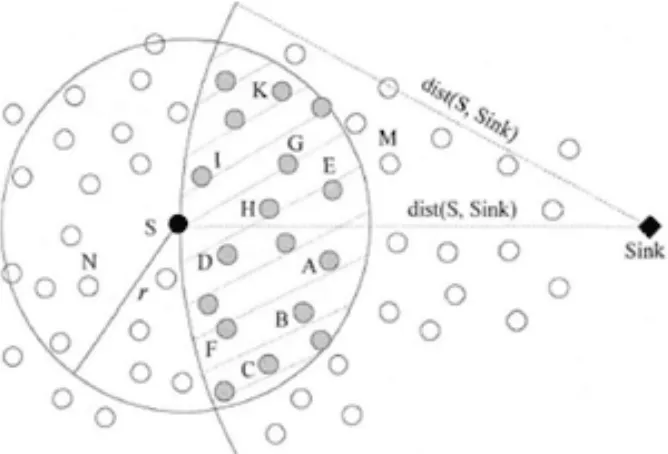
Fig. 1. The diagram of stateless forwarding
During data transmission through the stateless geography forwarding protocol, the order of time slot numbers is mainly related to the priority. The higher the priority level is, the smaller the node’s order number is [14-15]. Below is a case analysis. In Figure 2-a, node A has the highest priority level at time slot No.3. At the beginning of the competition, each candidate node is waiting for their exclusive slots. In this case, the candidate nodes with smaller order number are the earliest to send CTS. In this figure, after node A sends information in the No.3 time slot, the rest of the nodes will quit transmitting data upon receiving the forwarding signal, which indicates the com-petition of channels is completed successfully. Afterwards, node S will either forward data to node A, or restore itself to the initial state and repeat the above steps until the new round of data transmission is finished with the base station as the termination [16-17].
Fig. 2. Channel access based on competition windows
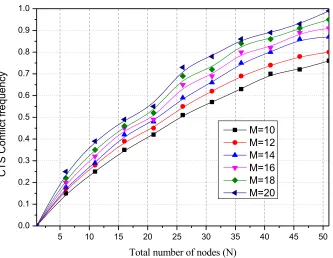
5 10 15 20 25 30 35 40 45 50
0.0 0.1 0.2 0.3 0.4 0.5 0.6 0.7 0.8 0.9 1.0
C
TS
C
onf
lic
t f
re
quenc
y
Total number of nodes (N)
M=10 M=12 M=14 M=16 M=18 M=20
3
Details of FCE design
3.1 Principles of FCE
In order to solve the above problems, this paper proposes a mechanism of FCE. When FCE is used to allocate nodes, it is the number of candidate nodes rather than CTS competition windows that need to change, optimize and be selected. In this con-text, FCE mechanism provides an effective way to address the issue of traffic inter-ference, selecting next-hop nodes of better performance. The fuzzy technology is the major foundation of node selection through FCE mechanism. Through the fuzzy comprehensive evaluation of the candidate node, those that are selected out will be more suitable to the next-hop competition. In this way, the CTS interference probabil-ity will be reduced effectively, and the forwarding efficiency will be improved re-markably [19]. In addition, this mechanism is also easy to adjust fuzzy evaluation parameters and the number of candidate nodes participating in the competition, thus effectively avoiding the influence of node density on node selection.
3.2 The establishment of membership function
Membership function should be established before nodes are selected through this mechanism. During the multi-hop forwarding, the relay node factor will significantly affect the performance of data transmission.
FCE mechanism determines the priority of candidate nodes based on influencing factors. The corresponding factor set as follows:
U = {the expected forwarding distance of a node in one hop (u1), node residual en-ergy (u2)}
Equation (1) expresses the connotation of factor u1 and u2, where F and C denote the current node and the candidate node, respectively, and dist (F, Sin k) is the dis-tance between the sending node and the base station. The analysis shows that the u1 balances the one-hop forwarding distance, whose evaluation level may strongly im-pact on the reliability and sometimes the real-time property of information transmis-sion. The same as the remaining energy, the value of the second factor can be used to evaluate the effect of nodes on network load.
[
]
1
2 Re
( ,Sin ) ( ,Sin ) C K
main
u dist F k dist C k P
u E
!
" = #
$ %
=
$& (1)
The comment expression of candidate nodes are as follows:
V={ excellent (v1), intermediate (v2), poor (v3) }
and !2={Av1(u2), Av2(u2), Av3(u2)}. Factor membership function of the specific
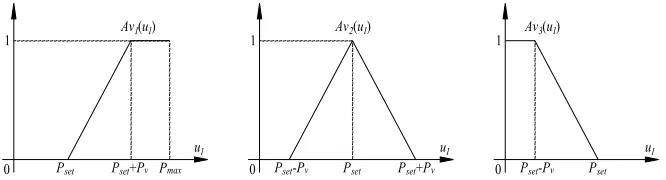
circum-stances shown in Figure 4, the corresponding mathematical expression see (2).
1
0
Av1(u1)
u1 Pmax Pset+Pv Pset
1
0
Av2(u1)
u1 Pset-Pv Pset Pset+Pv
1
0 Av3(u1)
u1 Pset-Pv Pset
Fig. 4. The membership function of factor u1
1
1
1 1 1
1
0
( ) ( )
1 ( )
set set
v set set v
v
set v max
u P u P
A u P u P P
P
P P u P
! " # $ #
=% " " + #
# + " "
& (2)
1 1 1 2 1 1 1 1
0 ( )
( ) ( )
( )
(( ) ( )
0 ( )
set v
set v
set v set
v v
set v
set set v
v
set v max
u P P
u P P P P u P
P A u
P P u P u P P
P
P P u P
! " #
$ " "
$ " ! !
$
=% + "
$ ! ! +
$ $
+ ! !
& (3)
1 1
3 1 1
1
1 ( )
( ) ( )
0
set v
set
v set v set
v
set max
u P P
P u
A u P P u P
P
P u P
! " #
$ #
$
=% # " "
$
$ " "
& (4)
max max
max
3 ( )
3 2 3 3 2 set set v set set P
P P P
P P P P ! " # $$ =% $ &
$' (5)
Pmax represents the maximum theoretical value of factor u1: yet we let it be the maximum communication radius of a node; Pset represents the corresponding dynamic adjustment variable; the random variable will change with the change of Pset. All nodes obey uniform distribution within a certain distance, but Pv is the mean square
1
( )
D u
of the random variable1
u
.determined by adjusting the value of Pset, and the membership evaluation results can be further determined accordingly.
3.3 Fuzzy comprehensive evaluation method
When the node is determined by the fuzzy comprehensive evaluation method, if it receives the BRTS from another node and then calculates to be qualified as the candi-date node of the node, node A can undergo fuzzy comprehensive evaluation and iden-tify the competition priority Pcts according to the evaluation result. Below is the cor-responding procedures:
1.The candidate node A extracts the length information in the BRTS frame, and then determines the corresponding packet rate of the node according to Equation 1-3. On this basis, the value of factor u1 is determined: with which we calculate the cor-responding residual energy of node A and determine the value of factor u2 accord-ingly.
2.The fuzzy evaluation parameter Pset is then extracted from this frame and under-takes configuration of Av1(ui), Av2(ui), Av3(ui) according to the ui(i=1, 2) related membership function.
3.Afterwards, the single factor u1 is evaluated according to the membership function, and the corresponding evaluation set !i can be determined by Equation 6:
1 2 3
( ( )
( )
( ))
i
A u
v iA u
v iA u
v i!
=
(6)On this basis, we define the node’s comprehensive evaluation matrix, whose expres-sion is shown in Equation 7
1 1 2 1 3 1
1 2 2 2 3 2
( ),
( ),
( )
( ),
( ),
( )
v v v
v v v
A u A u A u
R
A u A u A u
!
"
=
#
$
%
&
(7)
4.The fuzzy comprehensive evaluation set Q is determined by Equation 5, and the factor weight fuzzy subset W={w1, w2}. The corresponding fuzzy evaluation model
M(!, ") and the influence of different factors on forwarding performance are de-termined by weighted average.
2 2 2
1 2 3 1 2 3
1 1 1
{ i v ( ),i i v ( ),i i v ( )} { , , }i
i i i
Q W R w A u w A u w A u q q q
= = =
= ! =
"
!"
!"
! =(8) 5.According to the principle of maximum membership, there are mainly three class evaluation results in Q. If j=1, q1 will be the highest class among them, which means it corresponds to class v1.
1 1 set
1 2 1 set
1 2 3
(1, ) ( 1) ( )
(1, ) ( 2) ( 1) ( )
(1, ) 3
v slot
CTS v v slot
v v v slot
Rand N T j u P
P N Rand N T j j u P
N N Rand N T j
! =
" #
=% + ! = = $
# + + ! =
&
!
! !
(9)
Where Rand(1, Nv1) backs off to a random integer between 1 and Nv1: Tslot is the length of a time slot; Nv1, Nv2, Nv3 are the number of time slots, and satisfy equation 10.
1 2 3 slot
(NvNvNv )!T "DIFS (10)
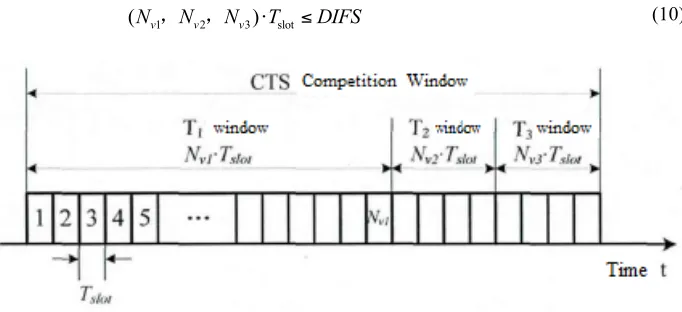
Fig. 5. Time slot distribution principle
Figure 5 is the specific flow of time slot distribution, in whose mechanism the CTS competition window is divided into three parts: T1, T2, T3. Candidate nodes that meet the level requirements can be assigned corresponding time slots, some of which will be able to participate in the following competition of forwarding right. Meanwhile, the rest of the nodes will be assigned the time slots in window T2 and window T3. By node forwarding in T2 and T3, the monitoring work can be implemented, determining parameter setting.
4
Simulation experiment and performance analysis
4.1 Simulation environment settings
Table 1. Parameter settings of the model Parameter Instructions Numerical
BN Noise 30kHz
R Rate 19.2kbps
Pn Noise base -115dBm
Pt Send power 0dBm
d0 Reference range 1m
N Loss 10
Xa Standard deviation 3
Table 2. Parameter settings of energy consumption Running state Duration time(ms) Working current(mA)
Seng 1byte(0dBm) 0.416(TTX) 20(ITX)
Receive 1byte 0.416(TRX) 15(IRX)
Monitor 0.35(TCS) 15(ICX)
4.2 Simulation result analysis
500 600 700 800 900 1000 1100 1200
0 3 6 9 12 15 18 21 24 27 30
C
TS
C
onf
lic
t f
re
quenc
y
Total number of nodes (N)
FCE CAGIF OGF SIF
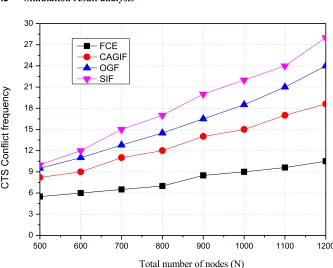
In this paper, we first test the number of route interferences of the four protocols. Figure 6 is the times of route interferences for each protocol to successfully transmit a data package network. The more the time is, the greater the interference is. According to the comparison results, the number of route interference under the other three pro-tocols is much higher than that under the FCE protocol. What is more, as the nodes are distributed denser, the corresponding interference degree becomes higher. It can be seen from the comparison results that the CTS interference probability of the FCE mechanism is significantly smaller than others, and that the increment in interference degree is insignificant when the network nodes are denser. This is mainly because the advantages of distributed fuzzy comprehensive evaluation and those of priority com-petition are combined with each other, together contributing to the reduction in inter-ference occurrence probability and to the improvement of routing efficiency.
500 600 700 800 900 1000 1100 1200
0 1 2 3 4 5 6 7 8 9 10
Total number of nodes (N)
The av
er
age t
ra
ns
m
is
si
on ener
gy
c
ons
um
pt
ion (
J)
FCE CAGIF OGF SIF
Fig. 7. Average transmission energy consumption
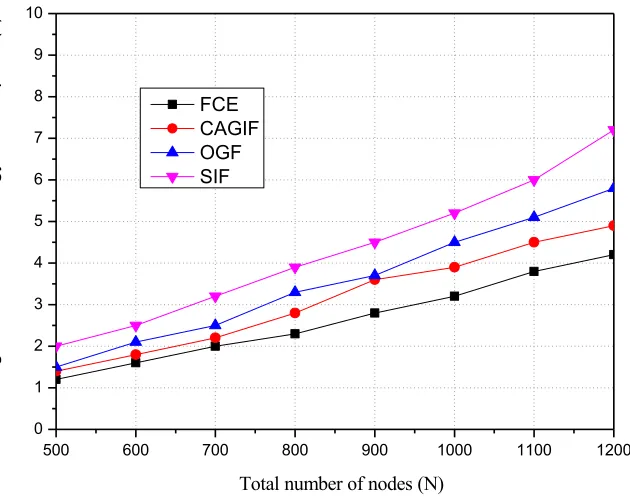
By analyzing Figure 6-7, it can be found that when the network node density is large, the interference level of every protocol maintains at a high level, which incurs larger competition-related energy consumption. Such being the case, FCE protocol effectively optimizes routing competition, providing an efficacious way to reduce energy consumption.
5
Conclusion
This paper is largely aimed at solving the problem of routing interference, for which it proposes a route interference optimization mechanism FCE based on distrib-uted fuzzy comprehensive evaluation. As to this mechanism, the fuzzy comprehensive evaluation technique is used to select candidate nodes, with the advantage of node selection optimization by balancing node forwarding distance, communication quality and other related factors. In this way, great reduction is achieved in the number of candidate nodes, route interference and energy consumption. The way to select nodes under this mechanism is to endow priorities for multiple candidate nodes and to choose nodes of better comprehensive performance from the candidate nodes accord-ing to some influencaccord-ing factors. In this way, not only can the competition-induced route interference is reduced, but the energy consumed during node competition be-comes less. The computational load of this mechanism is not great, as all candidate nodes are processed through fuzzy comprehensive evaluation distribution. The low demand for computational ability also helps increase the scalability of protocols.
6
References
[1]Muruganathan, S. D., Ma, D. C. F., Bhasin, R. I., Fapojuwo, A. (2005). A centralized en-ergy-efficient routing protocol for wireless sensor networks. IEEE Communications Maga-zine, 43(3), S8-13. https://doi.org/10.1109/MCOM.2005.1404592
[2]Chen, G., Li, C., Ye, M., Wu, J. (2009). An unequal cluster-based routing protocol in wire-less sensor networks. Wireless Networks, 15(2), 193-207. https://doi.org/10.1007/s11276-007-0035-8
[3]Nasser, N., Chen, Y. (2007). Seem: secure and energy-efficient multipath routing protocol for wireless sensor networks. Computer Communications, 30(11–12), 2401-2412.
https://doi.org/10.1016/j.comcom.2007.04.014
[4]Tsai, M. J., Yang, H. Y., Liu, B. H., Huang, W. Q. (2009). Virtual-coordinate-based deliv-ery-guaranteed routing protocol in wireless sensor networks. IEEE/ACM Transactions on Networking, 17(4), 1228-1241. https://doi.org/10.1109/TNET.2008.2008002
[5]Liu, M., Cao, J., Chen, G., Wang, X. (2009). An energy-aware routing protocol in wireless sensor networks. Sensors, 9(1), 445-462. https://doi.org/10.3390/s90100445
[6]Lu, Y. M., Wong, V. W. S. (2006). An energy-efficient multipath routing protocol for wireless sensor networks. International Journal of Communication Systems, 20(7), 1-5.
https://doi.org/10.1109/vtcf.2006.505
[7]Ahmed, A. A., Fisal, N. (2008). A real-time routing protocol with load distribution in wire-less sensor networks. Computer Communications, 31(14), 3190-3203.
[8]Sanchez, J. A., Ruiz, P. M., Liu, J., Stojmenovic, I. (2007). Bandwidth-efficient geograph-ic multgeograph-icast routing protocol for wireless sensor networks. IEEE Sensors Journal, 7(5), 627-636. https://doi.org/10.1109/JSEN.2007.894149
[9]Yu, J., Qi, Y., Wang, G., Gu, X. (2012). A cluster-based routing protocol for wireless sen-sor networks with nonuniform node distribution. AEU - International Journal of Electron-ics and Communications, 66(1), 54–61. https://doi.org/10.1016/j.aeue.2011.05.002
[10]Chiang, S. S., Huang, C. H., Chang, K. C. (2007). A minimum hop routing protocol for home security systems using wireless sensor networks. IEEE Transactions on Consumer Electronics, 53(4), 1483-1489. https://doi.org/10.1109/TCE.2007.4429241
[11]Wei, C., Zhi, C., Fan, P., Letaief, K. B. (2009). Asor: an energy efficient multi-hop oppor-tunistic routing protocol for wireless sensor networks over rayleigh fading channels. IEEE Transactions on Wireless Communications, 8(5), 2452-2463. https://doi.org/10.1109/ TWC.2009.071388
[12]Zabin, F., Misra, S., Woungang, I., Rashvand, H. F., Ma, N. W., Ali, M. A. (2008). Reep: data-centric, energy-efficient and reliable routing protocol for wireless sensor networks. Iet Communications, 2(8), 995-1008. https://doi.org/10.1049/iet-com:20070424
[13]Tunca, C., Isik, S., Donmez, M. Y., Ersoy, C. (2015). Ring routing: an energy-efficient routing protocol for wireless sensor networks with a mobile sink. IEEE Transactions on Mobile Computing, 14(9), 1947-1960. https://doi.org/10.1109/TMC.2014.2366776
[14]Shi, L., Zhang, B., Mouftah, H. T., Ma, J. (2011). Ddrp: an efficient data-driven routing protocol for wireless sensor networks with mobile sinks. International Journal of Commu-nication Systems, 26(10), 1341-1355.
[15]Jin, R. C., Gao, T., Song, J. Y., Zou, J. Y., Wang, L. D. (2013). Passive cluster-based mul-tipath routing protocol for wireless sensor networks. Wireless Networks, 19(8), 1851-1866.
https://doi.org/10.1007/s11276-013-0570-4
[16]Alrajeh, N. A., Khan, S., Lloret, J., Loo, J. (2013). Secure routing protocol using cross-layer design and energy harvesting in wireless sensor networks. International Journal of Distributed Sensor Networks, 2013(1), 893-900. https://doi.org/10.1155/2013/374796
[17]Xia, L., Chen, X., Guan, X. (2005). A new gradient-based routing protocol in wireless sen-sor networks. Lecture Notes in Computer Science, 5(4), 318-325.
https://doi.org/10.1007/11535409_45
[18]Abdul, W., Sungwon, L., Dongkyun, K. (2012). A reliable and energy!efficient routing protocol for underwater wireless sensor networks. International Journal of Communica-tion Systems, 27(10), 2048-2062.
[19]Jung, S. G., Kang, B., Yeoum, S., Choo, H. (2016). Trail-using ant behavior based energy-efficient routing protocol in wireless sensor networks. International Journal of Distributed Sensor Networks, 2016(4), 1-9. https://doi.org/10.1155/2016/7350427
7
Authors
Haishan Zhang is with Modern echnology and Education Centre, North China University of Science and Technology, Tangshan 063009, China. He was born in Hebei, China, in 1981. He works in School of North China University of Science and Technology, and received the Master's degree in 2011 from North China University of Science and Technology. His field of interest is wireless sensor networks, image pro-cessing ([email protected]).
Mi Li is with College of Life Science, North China University of Science and Technology, Tangshan 063009, China. She was born in Hebei, China, in 1987. She works in School of North China University of Science and Technology, and received the Master's degree in 2012 from North China University of Science and Technology. Her field of interest is operation and optimization ([email protected]).
Ying Li is with College of Science, North China University of Science and Tech-nology, Tangshan 063009, China. She was born in Hebei, China, in 1979. She works in School of North China University of Science and Technology, and received the Master's degree in 2011 from North China University of Science and Technology. Her field of interest is operation and optimization ([email protected]).