R E V I E W
Open Access
What determines a leaf's shape?
Jeremy Dkhar
*and Ashwani Pareek
Abstract
The independent origin and evolution of leaves as small, simple microphylls or larger, more complex megaphylls in plants has shaped and influenced the natural composition of the environment. Significant contributions have come from megaphyllous leaves, characterized usually as flat, thin lamina entrenched with photosynthetic organelles and stomata, which serve as the basis of primary productivity. During the course of evolution, the megaphylls have attained complexity not only in size or venation patterns but also in shape. This has fascinated scientists worldwide, and research has progressed tremendously in understanding the concept of leaf shape determination. Here, we review these studies and discuss the various factors that contributed towards shaping the leaf; initiated as a small bulge on the periphery of the shoot apical meristem (SAM) followed by asymmetric outgrowth, expansion and maturation until final shape is achieved. We found that the underlying factors governing these processes are inherently genetic:PIN1andKNOX1are indicators of leaf initiation,HD-ZIPIII,KANADI, andYABBYspecify leaf outgrowth whileANGUSTIFOLIA3andGROWTH-REGULATING FACTOR5control leaf expansion and maturation; besides, recent research has identified new players such asAPUM23, known to specify leaf polarity. In addition to genetic control, environmental factors also play an important role during the final adjustment of leaf shape. This immense amount of information available will serve as the basis for studying and understanding innovative leaf morphologiesviz.the pitchers of the carnivorous plantNepentheswhich have evolved to provide additional
support to the plant survival in its nutrient-deficient habitat. In hindsight, formation of the pitcher tube inNepenthes might involve the recruitment of similar genetic mechanisms that occur during sympetaly inPetunia.
Keywords:Leaf shape, Auxin, Polarity specification, Environmental factors,Nepenthes, Morphological novelty
Introduction
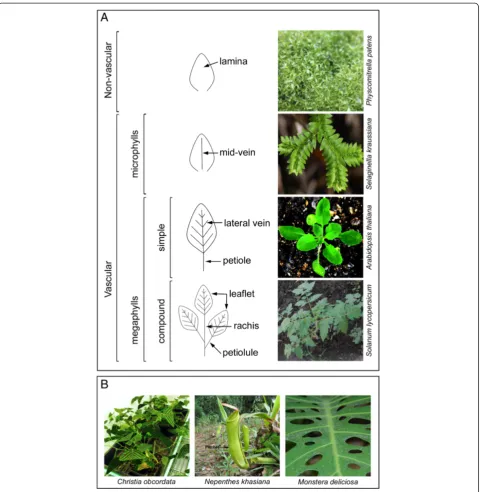
In comparison to the vibrant colors of the flower, the ‘leaf’ has nothing special to offer as most are green-colored attributed to the presence of chlorophyll. But their attractiveness lies in their varying shapes and sizes; from the uncommon butterfly-shaped leaf of Christia obcordatato the extensively studied ovate-shaped leaf of
Arabidopsis thaliana (Figure 1A and B). This variation,
arising due to several factors, offers great functional sig-nificance that influences plant success [1]. In the case of leaf size, the explanation has been straightforward; it decreases with increasing altitude, decreasing rainfall, and soil nutrient content [2,3]. Moreover, smaller-sized leaves are better adapted to hot or dry environments [4]. However, in case of leaf shape, environmental influences viz.light, temperature, and so on have been difficult to ex-plain [2]. Nonetheless, these factors and most importantly
light, play special roles in the final adjustment of leaf shape [5]. But the tremendous variations observed in leaves are mostly attributed to their genetic control - the control of gene regulatory networks (GRNs) and signaling pathways that make a leaf, from a small bulge on the SAM, into a fully developed lateral outgrowth with diverse shapes. Although poorly understood, herbivory is another factor contributing to leaf shape variation [6]. Due to con-tinued interest in this area of research, a review on the fac-tors that determine a leaf its shape is called for. And though a similar review is available in the literature, this [5] was published almost a decade ago. Therefore, a revisit on the topic is warranted and we intend to comprehen-sively cover all aspects of leaf shape development that span across vascular plants with a focus on angiosperms. Our aim is to summarize these development events and the underlying mechanisms that govern them, and high-lights recent advances culminating with a discussion on directions for future research. In fact, the present review lay more emphasis on the genetic control with a brief * Correspondence:[email protected]
Stress Physiology and Molecular Biology Laboratory, School of Life Sciences, Jawaharlal Nehru University, New Delhi 110067, India
© 2014 Dkhar and Pareek; licensee BioMed Central. This is an Open Access article distributed under the terms of the Creative Commons Attribution License (http://creativecommons.org/licenses/by/4.0), which permits unrestricted use, distribution, and reproduction in any medium, provided the original work is properly credited. The Creative Commons Public Domain Dedication waiver (http://creativecommons.org/publicdomain/zero/1.0/) applies to the data made available in this article, unless otherwise stated.
overview on the environmental components. This remark-able information garnered may open up avenues for a probable shift from model to non-model plant species showing morphological novelties, for example, pitchers of the carnivorous plantNepenthes, modified from an other-wise unexceptional leaf (leaf base) through the formation of tendrils (Figure 1B). A note on this interesting plant
genus with unusual leaf form is also presented and dis-cussed at the concluding section.
Review
Definition, origin, and evolution of a leaf
From a layman’s perspective,‘leaf’ is a flattened, green-colored structure laterally attached to the stem. This
Figure 1Diversity in leaf forms across land plants. (A)Selected representatives of the different types of leaf forms found in non-vascular and vascular model plant speciesviz. Physcomitrella patens(non-vascular),Selaginella kraussiana(microphyll),Arabidopsis thaliana(simple megaphyll), andSolanum lycopersicum(compound megaphyll).(B)Selected representatives of uncommon and innovative leaf morphology found in vascular non-model plant speciesviz. Christia obcordata(butterfly-shaped leaf),Nepenthes khasiana, andMonstera deliciosa(modified leaf). Contributors of photographs used in the figure can be found in the Acknowledgements section.
Dkhar and PareekEvoDevo2014,5:47 Page 2 of 19
perception may be too simple considering the remark-able diversity that leaves exhibit. As a prerequisite to their review on angiosperm leaf shape, Nicotraet al. [1] defined a leaf as a ‘vascular asymmetric appendicular structure initiated at the shoot apical meristem’. This definition is applicable to all vascular plants, but does not hold true for bryophytes (mosses, liverworts, and hornworts) as they lack a well-defined system of vascular tissue [1]. In fact, the leaf-like structures of bryophytes share no homology with leaves of vascular plants. But for an organ to be considered a leaf, other basic, but delicate, morphological connections that include the dorsiventrality of the leaf and distinctive meristem distribution in relation to their symmetrical arrangement on the axis may be taken into consideration [7]. Dorsiventrality or the dis-tinctness of the upper and lower surfaces of the leaf is evi-dent in all land plants; prominent in vascular plants but to a lesser extent in bryophytes, observed mainly in the mid-rib region referred to as ‘costa’. Besides this attribute of dorsiventrality, leaves become determinate, planar, and laminar structures. Considering all these views, we de-scribed a leaf as a determinate laminar structure with dis-tinct adaxial and abaxial surfaces, formed, developed, and arranged in a particular manner on the flanks of an inde-terminate SAM.
Vascularization, however, is an important anatomical characteristic that defines the two leaf types observed in vascular plants: microphylls (single vasculature) and mega-phylls (complex vasculature, Figure 1A). But vasculature is not the only distinguishing feature; size (small or large) and leaf gaps (absence or presence) also differentiate the two leaf types with complexity more pronounced in phyllous leaves [8-11]. Examples of microphylls and mega-phylls are evident in lycophytes (extant clubmosses, spikemosses, and quillworts) and euphyllophytes (compris-ing the extant ferns, horsetails, and seed plants), res-pectively. These contrasting morphological characteristics displayed correlates with an independent origin and evolu-tion of the microphyllous and megaphyllous leaves. The two leaf types are believed to have evolved independently from simple leafless vascular plants around 480 and 360 million years ago [12]. The microphyllous leaf emerged during Late Silurian/Early Devonian era while the mega-phyllous leaf evolved during the late Devonian period [12,13]; the latter event is linked with a 90% drop in atmos-pheric CO2 that corresponds with a 100-fold increase in stomatal density to avoid lethal overheating [14]. Three hypotheses have been proposed for the origin of the micro-phylls, but Bower’s [15]‘Enation theory’is the most plaus-ible as it is supported by an evolutionary series of related Devonian taxa,Sawdonia (andDiscalis),Asteroxylon, and
Drepanophycus ([16] and references therein). For
mega-phyll evolution, Zimmermann’s telome theory has been widely accepted as the leading explanation which involves
‘overtopping, planation and webbing’- three fundamental steps that transform a telome into a laminated leaf blade [17]. This theory of megaphyll evolution is similar in con-cept to‘evolutionary tinkering’, a phenomenon that involve changes in already existing organs/forms. Furthermore, the evolution of the megaphylls occurred at least twice, once in ferns and horsetails and the other in seed plants that in-clude the gymnosperms and angiosperms [18]. Among angiosperms, dissected or compound leaf form found in
Cardamine hirsuta, pea, tomato, and so on have evolved
independently from simple leaves [19].
Interestingly, the independent evolution of microphylls and megaphylls does not correspond with unique mech-anisms of leaf formation; rather, common developmental mechanisms could underlie microphyll and megaphyll formation [20]. This proposition was also corroborated by a recent finding that suggests a common GRN for protonema and root hair development in Physcomitrella
patens (bryophyte) and Arabidopsis thaliana,
respect-ively [21]. Earlier, mutational and gene silencing work on four distantly related speciesviz. Aquilegia caerulea,
Sola-num lycopersicum and S. tuberosum, Cardamine hirsuta,
and Pisum sativum, showed that a common underlying
mechanism involving NAM/CUC3 genes promoted com-pound leaf development [22]. Therefore, the remarkable diversity in leaf form is a result of the common regulatory networks recruited and remodeled during the course of land plant evolution. We begin our review with the gen-etic basis of leaf shape determination.
Genetic basis of leaf shape: genetic interactions, gene expression patterns, microRNAs, and active hormonal regulations
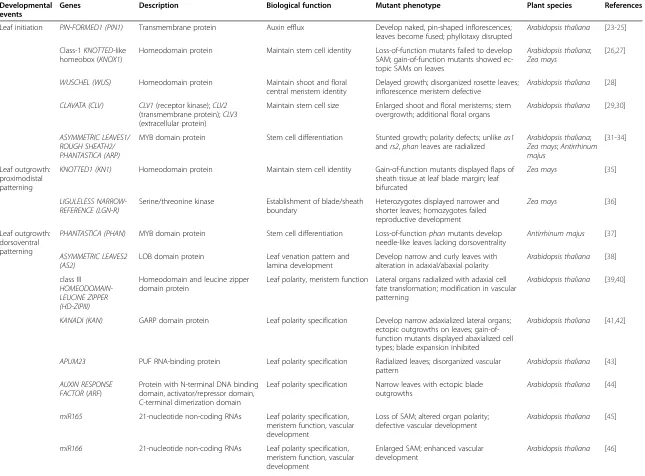
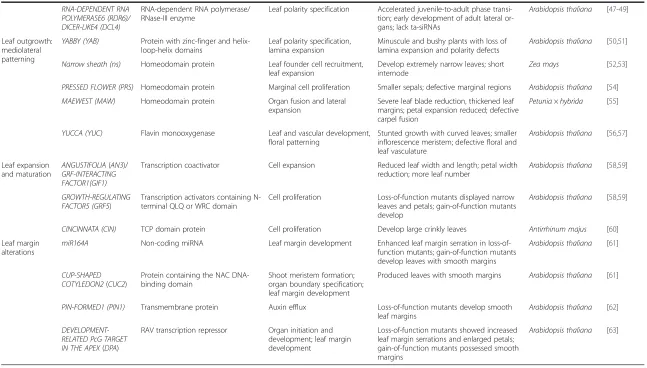
Attainment of the final sizes and shapes of the plant leaf involves three major developmental events: begins with leaf initiation, followed by leaf outgrowth, and ends with leaf expansion and maturation. We highlight below the underlying genetic mechanisms that control these events. As a complement to the text, a list of all the participating genes, their functions, and mutant phenotypes is summa-rized in Table 1.
Leaf initiation:KNOXrepression and auxin accumulation Studies on model plant species have revolutionized our understanding on the early events of leaf initiation (Figure 2A-E). The findings showed that leaf initiation begins with the recruitment of founder cells, approxi-mately 100 in numbers forNicotiana tobacum[64] and
Gossypium barbadense [65], at the flanks of the SAM.
In eudicots, subpopulations of cells are recruited for leaf initiation while in monocots recruitment of founder cells can occur all along the circumference of the SAM [66,67]. The initiation of microphyll primordia in S. kraussianaalso occurs at the periphery of the SAM [68];
Dkhar and PareekEvoDevo2014,5:47 Page 3 of 19
Table 1 Genes involved in major developmental events of the leaf
Developmental events
Genes Description Biological function Mutant phenotype Plant species References
Leaf initiation PIN-FORMED1 (PIN1) Transmembrane protein Auxin efflux Develop naked, pin-shaped inflorescences; leaves become fused; phyllotaxy disrupted
Arabidopsis thaliana [23-25]
Class-1KNOTTED-like homeobox (KNOX1)
Homeodomain protein Maintain stem cell identity Loss-of-function mutants failed to develop SAM; gain-of-function mutants showed ec-topic SAMs on leaves
Arabidopsis thaliana; Zea mays
[26,27]
WUSCHEL (WUS) Homeodomain protein Maintain shoot and floral central meristem identity
Delayed growth; disorganized rosette leaves; inflorescence meristem defective
Arabidopsis thaliana [28]
CLAVATA (CLV) CLV1(receptor kinase);CLV2 (transmembrane protein);CLV3 (extracellular protein)
Maintain stem cell size Enlarged shoot and floral meristems; stem overgrowth; additional floral organs
Arabidopsis thaliana [29,30]
ASYMMETRIC LEAVES1/ ROUGH SHEATH2/ PHANTASTICA (ARP)
MYB domain protein Stem cell differentiation Stunted growth; polarity defects; unlikeas1 andrs2,phanleaves are radialized
Arabidopsis thaliana; Zea mays;Antirrhinum majus
[31-34]
Leaf outgrowth: proximodistal patterning
KNOTTED1 (KN1) Homeodomain protein Maintain stem cell identity Gain-of-function mutants displayed flaps of sheath tissue at leaf blade margin; leaf bifurcated
Zea mays [35]
LIGULELESS NARROW-REFERENCE (LGN-R)
Serine/threonine kinase Establishment of blade/sheath boundary
Heterozygotes displayed narrower and shorter leaves; homozygotes failed reproductive development
Zea mays [36]
Leaf outgrowth: dorsoventral patterning
PHANTASTICA (PHAN) MYB domain protein Stem cell differentiation Loss-of-functionphanmutants develop needle-like leaves lacking dorsoventrality
Antirrhinum majus [37]
ASYMMETRIC LEAVES2 (AS2)
LOB domain protein Leaf venation pattern and lamina development
Develop narrow and curly leaves with alteration in adaxial/abaxial polarity
Arabidopsis thaliana [38]
class III HOMEODOMAIN-LEUCINE ZIPPER (HD-ZIPIII)
Homeodomain and leucine zipper domain protein
Leaf polarity, meristem function Lateral organs radialized with adaxial cell fate transformation; modification in vascular patterning
Arabidopsis thaliana [39,40]
KANADI (KAN) GARP domain protein Leaf polarity specification Develop narrow adaxialized lateral organs; ectopic outgrowths on leaves; gain-of-function mutants displayed abaxialized cell types; blade expansion inhibited
Arabidopsis thaliana [41,42]
APUM23 PUF RNA-binding protein Leaf polarity specification Radialized leaves; disorganized vascular pattern
Arabidopsis thaliana [43]
AUXIN RESPONSE FACTOR(ARF)
Protein with N-terminal DNA binding domain, activator/repressor domain, C-terminal dimerization domain
Leaf polarity specification Narrow leaves with ectopic blade outgrowths
Arabidopsis thaliana [44]
miR165 21-nucleotide non-coding RNAs Leaf polarity specification, meristem function, vascular development
Loss of SAM; altered organ polarity; defective vascular development
Arabidopsis thaliana [45]
miR166 21-nucleotide non-coding RNAs Leaf polarity specification, meristem function, vascular development
Enlarged SAM; enhanced vascular development
Arabidopsis thaliana [46]
Dkhar
and
Pareek
EvoDevo
2014,
5
:47
Page
4
o
f
1
9
http://ww
w.evodevoj
ournal.com/co
Table 1 Genes involved in major developmental events of the leaf(Continued)
RNA-DEPENDENT RNA POLYMERASE6 (RDR6)/ DICER-LIKE4 (DCL4)
RNA-dependent RNA polymerase/ RNase-III enzyme
Leaf polarity specification Accelerated juvenile-to-adult phase transi-tion; early development of adult lateral or-gans; lack ta-siRNAs
Arabidopsis thaliana [47-49]
Leaf outgrowth: mediolateral patterning
YABBY (YAB) Protein with zinc-finger and helix-loop-helix domains
Leaf polarity specification, lamina expansion
Minuscule and bushy plants with loss of lamina expansion and polarity defects
Arabidopsis thaliana [50,51]
Narrow sheath (ns) Homeodomain protein Leaf founder cell recruitment, leaf expansion
Develop extremely narrow leaves; short internode
Zea mays [52,53]
PRESSED FLOWER (PRS) Homeodomain protein Marginal cell proliferation Smaller sepals; defective marginal regions Arabidopsis thaliana [54]
MAEWEST (MAW) Homeodomain protein Organ fusion and lateral expansion
Severe leaf blade reduction, thickened leaf margins; petal expansion reduced; defective carpel fusion
Petunia × hybrida [55]
YUCCA (YUC) Flavin monooxygenase Leaf and vascular development, floral patterning
Stunted growth with curved leaves; smaller inflorescence meristem; defective floral and leaf vasculature
Arabidopsis thaliana [56,57]
Leaf expansion and maturation
ANGUSTIFOLIA(AN3)/ GRF-INTERACTING FACTOR1(GIF1)
Transcription coactivator Cell expansion Reduced leaf width and length; petal width reduction; more leaf number
Arabidopsis thaliana [58,59]
GROWTH-REGULATING FACTOR5 (GRF5)
Transcription activators containing N-terminal QLQ or WRC domain
Cell proliferation Loss-of-function mutants displayed narrow leaves and petals; gain-of-function mutants develop
Arabidopsis thaliana [58,59]
CINCINNATA (CIN) TCP domain protein Cell proliferation Develop large crinkly leaves Antirrhinum majus [60]
Leaf margin alterations
miR164A Non-coding miRNA Leaf margin development Enhanced leaf margin serration in loss-of-function mutants; gain-of-loss-of-function mutants develop leaves with smooth margins
Arabidopsis thaliana [61]
CUP-SHAPED COTYLEDON2(CUC2)
Protein containing the NAC DNA-binding domain
Shoot meristem formation; organ boundary specification; leaf margin development
Produced leaves with smooth margins Arabidopsis thaliana [61]
PIN-FORMED1 (PIN1) Transmembrane protein Auxin efflux Loss-of-function mutants develop smooth leaf margins
Arabidopsis thaliana [62]
DEVELOPMENT-RELATED PcG TARGET IN THE APEX(DPA)
RAV transcription repressor Organ initiation and development; leaf margin development
Loss-of-function mutants showed increased leaf margin serrations and enlarged petals; gain-of-function mutants possessed smooth margins
Arabidopsis thaliana [63]
Dkhar
and
Pareek
EvoDevo
2014,
5
:47
Page
5
o
f
1
9
http://ww
w.evodevoj
ournal.com/co
Figure 2Diagram illustrating stages of leaf initiation in selected model plant speciesviz.(A)Arabidopsis thaliana;(B)caulescent
Streptocarpussp. (simple leaf eudicots);(C)Solanum lycopersicum(compound leaf eudicot);(D)Zea mays(simple leaf monocot); and(E) Selaginella kraussiana(microphyll). Black arrowhead indicates PIN1 polarization; white arrowhead denotes auxin maxima; blue arrow shows the direction of auxin flow; black arrow represents upregulation; blunt end indicates repression; red arrow depicts downregulation; yellow dots represent auxin; square bracket indicates leaf founder cells recruitment sites. Illustrations are adapted from Byrneet al.[31] forA. thaliana; Nishii
et al.[84] forStreptocarpussp. (caulescent); Koltai and Bird [85] forS. lycopersicum; Timmermanset al.[33] and Tsiantiset al.[32] forZ. mays; Harrisonet al.[20] and Sanders and Langdale [83] forS. kraussiana. L1, L2 = tunica; L3 = corpus.
Dkhar and PareekEvoDevo2014,5:47 Page 6 of 19
however, fewer founder cells (12 to 16) are recruited [69]. But what drives leaf initiation at the periphery of the SAM is yet to be fully ascertained, despite the fact that it corre-sponds with the concurrent repression of class-1 KNOT-TED-like homeobox (KNOX) genes [26,70,71] and local auxin accumulation mediated predominantly by the auxin efflux carrier PIN-FORMED1 (PIN1) [23-25] (Figure 2A-D). In Arabidopsis thaliana (henceforth referred to as Arabidopsis), the transmembrane protein PIN1 is strongly expressed in epidermal cells of the SAM and its apical polarization results in the creation of an auxin gradient with maxima directed towards sites of incipient leaf prim-ordia [23-25,72-75] (Figure 2A). This in turn acts as an auxin sink that is transported basally to promote forma-tion of provascular tissues, creating a field of auxin deple-tion around the incipient and bulging primordia [76,77]. The change in auxin transport corresponds with strong PIN1 expression in the central vasculature of developing leaf primordia [25]. In other plant species, for example, maize, the expression pattern of PIN1 is identical to Ara-bidopsis, although ZmPIN1 localization is also observed in the corpus (L3) of SAM [78]. InC. hirsuta, PIN1 facili-tate leaflet formation through high auxin activity in the margin of the leaf rachis [79]. These observations suggest that the distribution of auxin maxima, either in the meri-stem flank or leaf margin, determine where leaf/leaflet primordia originate. Besides auxin concentration and flow, the control of PIN1 localization and expression has also been attributed to mechanical stresses, occurring due to tight interactions between growing cells [80]. Recently, a membrane-bound protein BIG is thought to affect PIN1 protein level by regulating its transcription [81]. However, the exclusive role of PIN1 in leaf initiation is still debatable owing to the normal development of pin1mutant leaves during early vegetative growth in Arabidopsis [23,24]. In an attempt to understand this surprising development, Guenot et al. [82] investigated other plasma-membrane localized PIN proteins (PIN2, PIN3, PIN4, and PIN7) to uncover if they could compensate for the loss of PIN1 during rosette leaves formation in Arabidopsis. Surpris-ingly, none of these proteins were expressed in the SAM, suggesting that other auxin transporters, auxin synthesis, and auxin-independent mechanisms of leaf initiation in Arabidopsis exist [82]. Recent evidences from S. kraussi-ana suggest that the underlying molecular mechanisms for polar auxin transport (PAT) are likely to be conserved across all vascular plants [83]; however, auxin does not promote leaf initiation inS. kraussiana[83]. This finding implies that an auxin-independent mechanism for leaf ini-tiation in S. kraussiana exists that remained conserved throughout vascular plants evolution and recruited during early vegetative growth in Arabidopsis.
Another critical event occurring at the SAM prior to the initiation of leaf primordia is the downregulation of
KNOX1 genes (Figure 2A-E). KNOX1 proteins function
in the maintenance of stem cell identity - mutational studies have shown that Arabidopsis and maize plants with loss-of-function mutations in KNOX1 genes failed to maintain SAM [26,27] - and repression of these genes changes the indeterminacy state of stem cells to deter-minate ones. This organogenic switch is controlled by the relative amount of two phytohormones: cytokinin (CK) and gibberellin (GA), responsible for cell division and cell elongation, respectively [86]. High CK to low GA ratio promotes indeterminacy of SAM while low CK to high GA ratio facilitates determinacy. In Arabidopsis, the high CK to low GA ratio is achieved through KNOX1 proteins via upregulation of cytokinin biosyn-thesis genesisopentenyl transferase7 (IPT7) [87,88] and repression of GA20-oxidase gene [89]. In maize, GA level is reduced by a direct upregulation of the GA catabolism
gene ga2ox1 [90] (Figure 2D). Similarly, GA2ox2 mRNA
level in Arabidopsis leaves increased in response to higher levels of cytokinin and KNOX1 expression [87]. Another KNOX-independent genetic pathway involving WUSCHEL (WUS) and CLAVATA (CLV), which acts in the central zone of meristem, control stem cell fate by direct regula-tion of cytokinin-inducible response regulators [28-30,91] (Figure 2A-E).
The low CK to high GA ratio is attained through dif-ferent pathways of KNOX1 downregulation. One of the pathways is mediated by auxin through polar transport at sites of incipient leaf primordia thereby repressing
KNOX1 [92] and CK signaling [93,94] (Figure 2A-D).
Another pathway involves MYB transcription factors encoded by the ARP genes. ASYMMETRIC LEAVES1 (AS1) of Arabidopsis [31], rough sheath2 (rs2) of maize [32,33], and PHANTASTICA (PHAN) of Antirrhinum [34] (hence the name ARP) are explicitly expressed in lateral organs founder cells and negatively regulate re-spective KNOX1 gene expression (Figure 2A, D). This requires the interaction of AS1 and RS2 with HIRA, a chromatin-remodeling factor that could alter local chro-matin organization at the KNOX1loci [95]. It becomes evident that the ARP/KNOX regulatory module is mu-tually exclusive, common in most simple leaved species with the exception of Streptocarpus, wherein KNOX1 and ARP are co-expressed in leaf primordia [84,96] (Figure 2B). Co-expression of ARP/KNOX module is also observed in most compound leaved species and their expression pattern varies from one species to an-other [85,97] (Figure 2C). Interestingly, the ARP/KNOX module inSelaginella is either mutually exclusive (leaves and stem) or overlapping (meristem) [20] (Figure 2E). This co-expression might facilitate shoot bifurcation in Selagin-ella[20], delays maturation of the compound leaf to allow leaflet formation [98], and promotes macrocotyledon growth and meristem development inStreptocarpus[84].
Dkhar and PareekEvoDevo2014,5:47 Page 7 of 19
Recent evidence has suggested another mode of KNOX repression involving an epigenetic interaction between Arabidopsis AS1-ASYMMETRIC LEAVES 2 (AS2) com-plex and POLYCOMB REPRESSIVE COMPLEX (PRC) 2 to stably silence the stem cell regulators [99]. The AS2 gene encodes an AS2/LOB domain-containing protein comprising a cysteine repeat motif and a leucine-zipper-like sequence in its amino-terminal half [100]. Hence, the multiple levels of regulation may explain the crucial role
thatKNOX1 genes play in leaf development because
mis-expressions have resulted in adverse phenotypes [101], thereby reducing plant success.
Leaf outgrowth: change in division pattern along three axes
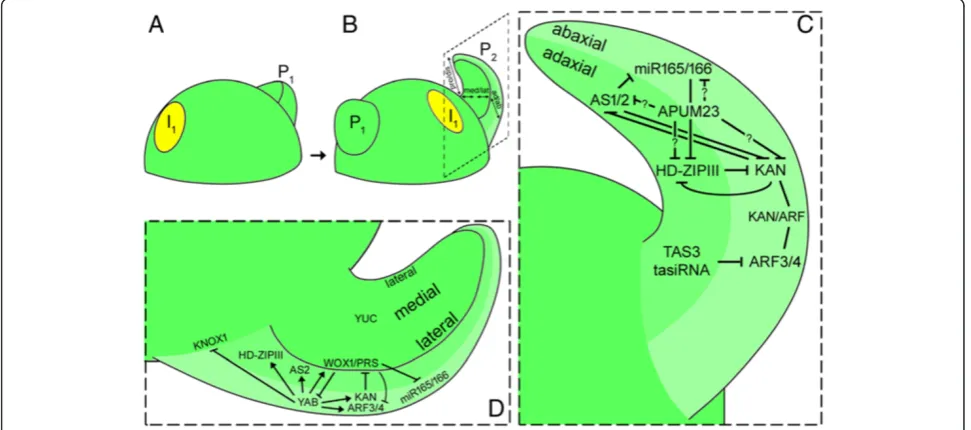
At the phenotypic level, leaf initiation is recognized by the appearance of a bulge at sites on the periphery of the SAM where KNOX1 repression and auxin maxima occur (Figure 3A). Immediately after primordial initiation, determinate cells are induced to change division pattern along three axes: proximal/distal, adaxial/abaxial, and medial/lateral (Figure 3B). Each axis is discussed below.
Proximal/distal patterning: so much yet so little known The proximal/distal axis is established with the initiation of leaf primordia [35,102]. Its determination was thought to be independent of dorsalizing function, as needle-like leaves of phan mutants having no lateral outgrowth retained their proximodistal axis [37]. However, evidences from mutants of KANADI and YABBY gene family
(regulators of adaxial/abaxial polarity) displaying shorter leaf length have suggested otherwise [103]. Ramirezet al. [35] showed that gain-of-functionknotted1(kn1-DL) mu-tants produced flaps of sheath-like tissue along the maize leaf margins caused by the misexpression ofkn1in these regions. This finding highlights the probable role of KN1 in proximal/distal polarity, creating a juxtaposition of proximal (kn1expressing) and distal cells (blade) in kn1-DLmutants [35]. Recently, Moon et al. [36] identified a new mutation in maize,Liguleless narrow-Reference( Lgn-R), mapped to a grass-specific kinase. HomozygousLgn-R mutants displayed reduced leaf width and length, are sig-nificantly shorter in height and lack reproductive organs as compared to wild type, suggestive of its role in prox-imal/distal patterning [36]. Although no definite genetic marker(s) has been found associated with proximodistal axis, these studies have paved the way towards identifying genes specifying proximal/distal axis in leaf development.
Adaxial/abaxial patterning: class IIIHD-ZIPs, microRNAs, KANADI, and auxin interacting factors
Experiments to establish the mechanism of adaxial/abax-ial polarity in leaf development started around 60 years ago through surgical incisions separating incipient primor-dia from the apical meristem [104,105]. Resulting potato leaves were mostly centric and abaxialized caused either by cessation of apical growth or elimination of its effect [104]. Laser-based techniques to ablate tomato leaf prim-ordia yielded similar results, producing plants (65%) with partial or complete loss of lateral leaflets and removal of
Figure 3Diagram illustrating leaf outgrowth in Arabidopsis. (A)Leaf primordium initiation;(B)leaf outgrowth;(C)adaxial/abaxial patterning (magnified view of inlet in B depicts the underlying genetic mechanisms controlling adaxial/abaxial patterning);(D)medial/lateral patterning (magnified view of inlet in B shows the underlying genetic mechanisms controlling mediolateral patterning). Illustrations are adapted from references mentioned in the text. P1: plastochron 1; P2: plastochron 2; I1: incipient site showing auxin maxima (yellow circle). Pro/dis: proximal/ distal; med/lat: medial/lateral; ad/ab: adaxial/abaxial.
Dkhar and PareekEvoDevo2014,5:47 Page 8 of 19
the L1 layer of the SAM eliminated dorsoventral polarity [106]. These results suggest that a signal emanating from the SAM is required for normal adaxial/abaxial patterning and draw attention to the L1 layer playing a role in the es-tablishment of the adaxial domain of leaf primordia. Simi-lar phenotypes were observed in loss-of-function phan mutants ofAntirrhinum majus, identifyingPHANas a de-terminant for maintaining the adaxial identity [37]. They demonstrated a relationship between adaxial/abaxial po-larity and lamina outgrowth, and hypothesized that the juxtaposition of adaxial and abaxial identity promotes lamina outgrowth. Although PHAN and its orthologues (referred asARPgene family) are uniformly expressed in young leaf primordia of respective species, their roles in adaxial specification are not strictly conserved. Abaxializa-tion due to knockdown ofPHANorthologues is observed in certain lineages viz.LePHANin tomato [107], but not in maize (RS2) [33] or Arabidopsis (AS1) [31]. Surpris-ingly, overexpression of AS2 in Arabidopsis resulted in plants with narrower curly leaves displaying dramatic alteration in the identity of both adaxial and abaxial epi-dermal cells and the abaxial side showed mostly adaxial features [38]. Furthermore, mutants of the indeterminate gametophyte1(ig1) gene in maize, sharing sequence simi-larity withAS2 of Arabidopsis, produced leaves with de-fective adaxial/abaxial specification [108]. These studies highlight the role of AS2 in maintaining adaxial identity.
The adaxial/abaxial axis is also established at leaf initi-ation, and represents an important axis that require proper establishment for proper lamina outgrowth. In Arabidopsis,PHABULOSA(PHB),PHAVOLUTA (PHV),
andREVOLUTA(REV), members of the class III
HOME-ODOMAIN-LEUCINE ZIPPER (HD-ZIPIII) gene family,
play vital roles in adaxial/abaxial polarity specification, and are expressed in the adaxial domain of developing leaf primordia to specify adaxial cell fate [39,109] (Figure 3C). Arabidopsis plants with dominant mutations in phb and phvdeveloped rod-shaped or trumpet-shaped leaves with adaxial characters around their circumference [39] while gain-of-function alleles of rev resulted in adaxialized lateral organs mediated by microRNAs - miR165 and miR166 [40]. In fact, expression of HD-ZIPIII genes in the abaxial domain are repressed by miR165/166 [45,46]. Ec-topic/constitutive overexpression ofMiR165 and miR166 produced contrasting phenotypes with comparable reduc-tion in transcript levels of HD-ZIP III genes [45,46]. In rice, four out of five class III HD-ZIP genes, OSHB1to OSHB4, control adaxial/abaxial patterning and are similar in gene structure and expression patterns to Arabidopsis
HD-ZIPIII genes. Mutations in the miR166-binding sites
of theseOSHBgenes, particularlyOSHB1andOSHB3, re-sulted in leaf polarity defects with varying degree of sever-ity [110]. These studies suggested a conserved functional role ofHD-ZIPIIIgenes in Arabidopsis, rice, maize (rolled
leaf1(rld1) andleafbladeless1(lbl1) [111]) and most likely across angiosperms [112].
Abaxial identity in leaves requires the function of
KANADIgene family, encoding nuclear-localized
GARP-domain transcription factors, which are expressed in the abaxial domain of leaf primordia (Figure 3C). In Arabi-dopsis - of which fourKAN(1-4) genes are present - loss-of-function kan1mutants showed apparent disruption in adaxial/abaxial cell gradient as compared to wild type whereas transgenic seedlings, withKAN1fused to a con-stitutive CAMV 35S promoter, developed elongated and pointed cotyledons with no subsequent leaves production [41]. Similar results were obtained when KAN1, KAN2, andKAN3genes were ectopically expressed using the 35S promoter, but severe alteration in leaf polarity occurred in
kan1 kan2double mutants [42].kan1 kan2plants develop
narrow cotyledons and leaves with ectopic outgrowths on their abaxial side, and displayed adaxialized lateral organs, particularly petals and carpels [42]. Eshedet al.[103] ex-tended their study on the triple mutants ofKAN(1-3) and observed that mutant leaves, although radialized initially, maintained some level of polarity during development. Interestingly, the expression pattern of the PHB gene in
the kan1 kan2 kan3 background was altered, expressing
throughout the developing leaf with a maximum level at the adaxial domain indicating thatKANgenes antagonis-tically regulate HD-ZIPIIIgenes [103] (Figure 3C). A re-cent study corroborated this finding, indicating thatKAN andHD-ZIPIIIhave opposing effects on genes that are in-volved in auxin biosynthesis and transport, for example, TAA1, NPH3-like genes, and so on, while PIN4 is re-pressed byKAN[113]. This finding highlights the import-ance of the adaxial/abaxial pathway in patterning auxin synthesis, transport, and signaling. Since this antagonistic effect arises during cotyledon formation; it is assumed that similar responses could occur during leaf development [113].APUM23, encoding PUF RNA-binding protein fam-ily, has been identified as a new player of leaf polarity spe-cification in Arabidopsis [43] (Figure 3C). Mutation in
APUM23increases the severity ofkan1 kan2mutant leaf
phenotypes, displaying enhanced reduction in blade ex-pansion. Moreover, RT-PCR revealed overexpression of the twoKANgenes as well asPHB, REV, AS1, andAS2 in the triple mutant as compared to wild type [43]. These evidences suggest that APUM23 act to indirectly regulate the expression of major adaxial/abaxial leaf po-larity genes [43].
The other gene family known to specify abaxial cell fate is the AUXIN RESPONSE FACTOR (ARF) family, which function by binding to auxin response elements on promoters of auxin response genes and transduce auxin signal during plant growth and development. Evi-dence that points to their role in adaxial/abaxial polarity emerged from mutational studies and expression pattern
Dkhar and PareekEvoDevo2014,5:47 Page 9 of 19
of ETT (also known as ARF3) and ARF4 in Arabidopsis [44]. Severe polarity defects were observed inett-1 arf4-1 andett-1 arf4-2double mutant plants resulting in abaxia-lized leaves similar tokan1 kan2mutants [44], suggesting a key relationship betweenKANandARF. Evidently, a dir-ect interaction between ETT and KANADI (KAN1 and KAN4) was reported, and their overlapping expression pattern suggests common regulatory function in polarity establishment and organogenesis [114] (Figure 3C). In turn, bothETTandARF4were earlier shown as targets of TAS3derivedtrans-acting siRNAs (ta-siRNAs) and dis-played marked upregulated expression in siRNA- and miRNA-defective mutants [115] (Figure 3C). In Arabi-dopsis, loss-of-function mutations in key TAS3 ta-siRNA biogenesis genes, encoding RNA-DEPENDENT RNA POLYMERASE6 (RDR6) and DICER-LIKE4 (DCL4), resulted in plants with accelerated juvenile-to-adult phase transition and early development of adult lateral organs characteristics as compared to wild type [47,48]. But when a ta-siRNA-insensitive ETT, generated by introducing si-lent mutations into target sites, orETTwere expressed in
ardr6-15mutant background, defects in leaf morphology
was observed [49]. The transgenic plants displayed nar-row, highly twisted, curly and irregularly shaped leaves or in severe cases, the appearance of deeply lobed leaves with ectopic radial leaf primordia on the abaxial surface [49]. These results specifyTAS3ta-siRNAs as negative regula-tors of abaxial cell fate through the regulation ofETTand ARF4[49], thereby identifying small RNAs as key players of adaxial/abaxial polarity specification.
Medial/lateral patterning: role ofYABBYandWOXgene family
Proper establishment and juxtaposition of the adaxial and abaxial domain is required for lamina outgrowth, which initiates at the adaxial/abaxial boundary and de-velop along an axis referred to as the medial/lateral axis (Figure 3B and D). As lamina outgrowth involves cell division followed by cell elongation and differentiation, the adaxial/abaxial boundary formed in early developing leaf primordia represents another leaf meristematic zone called plate meristem or blastozone [116,117]. The mor-phogenetic capacity of the blastozone ensures formation of the lamina and other structures such as lobes and leaflets; improper or loss of lamina outgrowth is a conse-quence of defective leaf adaxial/abaxial polarity as evident from mutant analyses mentioned above. Although initially thought to be a major component of abaxial cell fate spe-cification because of its expression pattern and gain-of-function alleles [118], theYABBYgene family is a primary player of medial/lateral specification (Figure 3D). In Arabi-dopsis, six members of theYABBYgene family have been identified [119] and are known to encode transcription factors with a zinc-finger and a helix-loop-helix motif.
These include FILAMENTOUS FLOWER (FIL),YABBY2 (YAB2), YAB3, and YAB5, which are expressed in leaf primordia, and CRABS CLAW (CRC) and INNER NO
OUTER (INO) that are localized to the floral organs.
Double mutants offil and yab3genes displayed partially radialized leaves but maintained adaxial/abaxial polarity to a larger extent as both adaxial and abaxial surface cell types can be easily distinguished [50]. Sarojam et al.[51] extended their investigation to all four vegetative YABBY genes and found that the severity of polarity defects and loss of lamina outgrowth were more pronounced in triple mutantfil-8 yab3-2 yab5-1(yab135) and quadruple
mu-tant fil-8 yab2-1 yab3-2 yab5-1 (yab1235) plants as
compared to the double mutants, though initial polarity establishment remained intact. These results indicated that the lack of lamina outgrowth and polarity mainten-ance is associated with the loss of YABBY function. The
YABBYgenes are regulated by players involved in
adax-ial/abaxial polarity specification viz. KANADI,
HD-ZIPIII, AS [103,111,120] (Figure 3D). This was also
verified by a recent study that identified KAN1 and ARF4 as positively regulated targets of FIL/YAB3 and vice versa [121] (Figure 3D).
Analyses on genes of theWUSCHEL(WUS)-RELATED
HOMEOBOX (WOX) family shed further light on the
mechanism of lateral organ outgrowth through evidences that emerged from preliminary studies on narrow sheath (ns1) and ns2, two duplicated genes of the WOX family found in maize. Thensmutant plants displayed extremely narrow leaves, but their length were not compromised as compared to wild type plants [52], suggesting an uncon-nected relationship between the medial/lateral and proxi-modistal axes. In situ hybridization revealed that the expression of thens1andns2genes in maize occurs in the lateral domains of shoot meristem and the margins of young lateral organ primordia [53], thereby hinting at their involvement in promoting lamina outgrowth. In Ara-bidopsis, localization of the lateral-axis dependent gene
PRESSED FLOWER (PRS) specified similar pattern of
expression as thensgenes, spatiotemporally expressed in the margins of sepals, petal, stamens, and developing leaves [54]. Furthermore, gain-of-function mutants of the PRSgene resulted in epidermal outgrowths on sepal mar-gins while loss-of-function mutant displayed defects in the marginal regions of sepal, indicating thatPRS is essential for the proliferation of marginal cells [54]. Isolation and characterization of MAEWEST (MAW) gene, which en-codes a member of WOX family, in Petunia×hybrida highlighted its role in lamina outgrowth specification [55].
Double mutants of MAW and CHORIPETALA
SU-ZANNE (CHSU) resulted in severely defective lamina
outgrowth displaying mostly abaxialized cell types at the leaf margins. WOX1, an Arabidopsis MAW ortholog, mutants showed no apparent abnormal phenotype, but
Dkhar and PareekEvoDevo2014,5:47 Page 10 of 19
when crossed with prs mutants, resulting F2 popula-tions displayed narrow leaf lamina and thickened leaf margins similar in phenotype to maw mutants, indica-tive of their redundant roles in promoting lateral lamina outgrowth [55,112].WOX1is expressed in the leaf meri-stem (plate merimeri-stem), overlapping with PRS [54,122]. Based on the expression levels ofPRSandWOX1genes
in YABBY gene family mutants (fil yab3 and fil yab3
yab5) andkan1 kan2mutants backgrounds,WOX1was shown to be upregulated by YABBY genes while PRS remained unaffected and KAN represses both genes in the abaxial domain of leaf primordia [123] (Figure 3D).
During leaf morphogenesis, free auxin is systematically reallocated from the tip of the leaf (site of initial synthe-sis) to the expanding leaf blade margins, finally ending in the midvein of the lamina [124]. This pattern of free auxin synthesis facilitates leaf blade outgrowth. Several lines of evidence support this notion, for example, broad exogenous application of IAA across one side of the developing leaf primordium ofSolanum lycopersicum re-sulted in ectopic lamina outgrowth with maintained compoundness and asymmetry [125]. Similarly, at sites where ectopic auxin accumulation appeared - indicated through PIN1 expressions - as in the hypocotyls ofkan1 kan2 kan4triple mutants, ectopic leaf-like organs devel-oped [126]. Furthermore, formation of ectopic bulges at the sides of developing leaf primordium of yabby quad-ruple mutants corresponds to sites where secondary PIN1 convergence points occurred [51]. More convin-cing results emerged from studies of YUCCA (YUC) gene family encoding flavin monooxygenase-like en-zymes involved in local auxin biosynthesis. Mutations in four (yuc1246) of the 11 ArabidopsisYUCgenes caused severe defects on plant stature and leaf development (narrow leaves), besides other developmental processes such as vascular and floral patterning [56,57]. When mu-tated YUC124 genes were constructed in as2 rev and
kan1 kan2 backgrounds (polarity defective mutants),
se-verely defective phenotypes with extremely narrow leaves was observed [127]. Interestingly, the pentuple mutants lack the finger-shaped protrusions evident inas2 revand kan1 kan2mutants formed as a result of ectopic juxtapos-ition of the leaf adaxial and abaxial domains [103,128]. Wanget al.[127] showed that these protrusions represent hydathodes-like structures, thereby suggesting that yuc genes, in response to adaxial-abaxial juxtaposition, pro-mote leaf margin development and blade outgrowth via local auxin accumulation [112].
Leaf expansion and maturation
Once the establishment of leaf polarity along the three-dimensional axes is achieved, leaf begins to expand until it acquires its final size and shape. Prior to cell expansion, cells divide and grow, that is, proliferate. Proliferation
occurs early during leaf development and spreads through-out the leaf primordia [129,130]. At this stage, cells undergo successive mitotic cell cycle exemplified by ex-pression pattern of CYC1 [129] and the presence of cells with variable C-DNA content [131]. Genes that are exclu-sively expressed at this phase includes members of A- and B-type cyclin family, known to control the activity of cyclin-dependent kinases (CDKs) and other downstream transcriptional complexes [132]. Once cell proliferation ceases, cells immediately switch to expansion mode via endoreduplication. It may be mentioned here that certain species such as Aquilegia vulgaris, Lactuca serriola, and
Oryza sativa show little or no endoreduplication event,
despite their small genome size [131]. Initiation of endore-duplication is indicated by the emergence of cells with 8C and 16C DNA content [132]. At this stage, cell cycling pat-tern partition the leaf into three regions: the proliferative cells containing basal region, the distal region that com-prises expanding cells and the boundary that separates the basal/distal region termed the cell cycle arrest front. The progression of the cell cycle arrest front during the transi-tion phase is an abrupt process [133,134], and the timing of its appearance is an important factor for determining the final size of the lateral organ [130]. When expansion terminates, cells become mature. Maturation is indicated by the increasing levels of KRP proteins that inhibit cell cycle progression, and stable DNA distribution and cell number [132].
Previous genetic analyses have identified key regulatory components of cell proliferation. Interaction between the transcription coactivator ANGUSTIFOLIA3 (AN3) and transcription factor GROWTH-REGULATING FACTOR5 (GRF5) has been shown to regulate leaf size and shape; mutation in these genes resulted in plants with narrow-leaf and decreased cell number [58,59]. More recent evidence has emerged that linked cell proliferation and adaxial/abax-ial patterning as well. Mutational studies of the AN3 and AS2genes showed thatan3enhances leaf polarity defects inas1andas2mutants [135]. But the narrow-leaf pheno-type ofan3is a consequence of a growth defect rather than a polarity defect, which implies that AN3 act at a specific developmental phase to regulate cell proliferation and po-larity specification [135]. Besides GRFs, CYTOKININ
RE-SPONSE FACTOR2 (CRF2), CONSTANS-LIKE5 (COL5),
HECATE1(HEC1), andARABIDOPSIS RESPONSE
REGU-LATOR4 (ARR4) were identified as prominent
transcrip-tion factors that are regulated by AN3 through binding to SWITCH/SUCROSE NONFERMENTING (SWI/SNF) chromatin remodeling complexes [136]. Other regula-tors of cell proliferation includeCINCINNATA(CIN), a member of the TCP gene family which contains the bHLH motif that permits DNA binding and protein-protein interactions [137].CINmutants ofA. majus dis-played enhanced cell proliferation at the leaf margins
Dkhar and PareekEvoDevo2014,5:47 Page 11 of 19
producing large crinkled leaves [60]. Overexpression of TCP4, aCIN-like TCP gene, disrupted normal leaf mor-phogenesis resulting in small cup-shaped leaves due to early onset of maturation and decreased cell prolifera-tion [138].
In an attempt to understand how leaf size and shape varies among plants, Kuchen et al. [139] devised an ex-perimentally validated model to help define the evolution and development of diverse organ shapes. The model cor-rectly matches the observed growth dynamics and shape changes of leaf 1 in Arabidopsis. To account for leaf shape other than leaf 1, the authors varied the effects of two fac-tors, among the many specified: PGRAD, defined to ex-press as a linear gradient along the proximodistal axis, and LAM, defined to express everywhere. Varying the effects of PGRAD at the distal end and the strength of promotion by LAM resulted in the generation of diverse morpho-space resembling some of the botanically described leaf shapes (for example, obcordata, ovate, and elliptic). The underlying genes that may explain these patterns include
LEAFY PETIOLEandYABBYgenes as candidates of LAM
factor while CUC genes may underlie PGRAD factor [139]. This model, which also accurately predicts the growth patterns of Antirrhinum leaves [139], provides a framework for the experimental testing of the control of organ shape in diverse plant species.
Leaf margin alterations:mir164A,CUC2, PIN1, andDPA4 are key players
Growth and development in all three axes transforms the small bulging leaf initials on the periphery of the SAM into a flattened structure of varying sizes and shape. If leaf development were to stop here, we might expect leaf margins of the same type. But the character-istic nature of the leaf margin and the underlying mech-anisms that exist confers additional complexity resulting in leaves of diverse marginal leaf shapes. Leaf margins are of different types: entire, serrate or lobed; it was until 2006 that the molecular mechanisms of leaf margin serra-tion in Arabidopsis could be elucidated. In Arabidopsis, serration in leaves become more pronounced as the plant develop, with early rosette leaves showing less serration as compared to the ones that developed later ([61] and refer-ences therein), and this has been shown to be controlled
by mir164A, CUC2, PIN1, and DPA4 [61,63,140,141]
(Figure 4). Knock-out mutations in mir164a resulted in plants with deeper serrations as compared to wild type plants, caused as a result of a disruption in themiR164 -dependent regulation of CUC2, a member of the NAC gene family [61]. In mir164a cuc2double mutant plants, leaf serration is lost suggesting thatCUC2play a key role in the development of serrated leaf margins in Arabi-dopsis, and the degree of serration depends on the bal-ance between the co-expressed MIR164A and CUC2
genes [61]. Contrary to the findings of Nikovics et al. [140], Kawamura et al. [140] showed that CUC2 pro-motes teeth outgrowth rather than suppressing the sinus growth.
Serration initiates at sites where auxin maxima occurs, as evidenced by expression of the auxin response sensor
DR5::GFP, with concurrent repression of CUC2 [141].
Eliminating this interspersed distribution through exogen-ous application of auxin and continuexogen-ousCUC2expression at the marginal domain resulted in leaves with smooth margins. Furthermore, based on PIN1 localization incuc2 mutants, Bilsboroughet al. [141] showed thatCUC2 ex-pression is required to induce PIN1 convergence points in the leaf margins. These results show the existence of a PIN1-mediated feedback regulatory loop between CUC2 and auxin [141] (Figure 4). Loss ofPIN1function resulted in plants with smooth margins [62]. In another recent study, it was shown that DEVELOPMENT-RELATED
PcG TARGET IN THE APEX (DPA) genes contributed
to the late-stage development of leaf margin serration in Arabidopsis [63]. T-DNA insertedDPA4lines displayed enhanced leaf margin serrations while35S::DPA4 over-expressor lines lacked serrated leaf margins. In situ hybridization and qRT-PCR analysis indicated thatCUC2 expression in35S::DPA4lines were strongly downregulated hinting at an additive role byDPA4in repressingCUC2 ex-pression and thereby confirming the crucial role ofCUC2 in leaf margin serrations formation in Arabidopsis [63] (Figure 4). Besides CUC2,CUC3 was also shown to pro-mote Arabidopsis leaf serration, but acts later in develop-ment mainly for teeth growth maintenance [142]. Earlier, ectopicKNAT1expression transformed simple Arabidopsis leaves into lobed leaves, and lobing was shown to initiate at sites where leaf margin serration develop [143]. Double transgenic Arabidopsis lines ectopically overexpressing
Figure 4Diagram illustrating leaf margin development in Arabidopsis.Magnified view of inlet shows the underlying genetic mechanisms controlling this process. Illustrations are adapted from Nikovicset al.[61], Bilsboroughet al.[141], and Engelhornet al.[63]. P1: plastochron 1; P2: plastochron 2; I1: incipient site showing auxin maxima (yellow circle).
Dkhar and PareekEvoDevo2014,5:47 Page 12 of 19
KNAT1andPALMATE-LIKE PENTAFOLIATA1(PALM1), a Cys(2)His(2) zinc finger transcription factor involved in compound leaf development inM. truncata, displayed nor-mal leaves suggesting a PALM1-mediated repression of
KNAT1 via regulation of downstream targets [144]. Leaf
margin serration is apparent in compound-leafed species as well, such asM. truncata; here, serration is confined to the distal part of leaflets. As was reported in Arabidopsis [141], leaf distal margin development in M. truncatula requires the auxin efflux protein MtPIN10 [145]. Plants with mutated PIN10 gene exhibited complete loss of serration [145]. In a recent study, insertion mutation in
the MtPHAN gene resulted in plants with deeper
serra-tions as compared to wild type, suggesting that MtPHAN also play key roles in leaf margin development [146]. When
bothmtphan mtpin10genes were mutated, the compound
leaves displayed smooth margins [146], confirming the cru-cial role of PIN10 in distal leaf margin development ofM.
truncata. Genetic evidences from simple and compound
leaved-species identify transmembrane PIN proteins as crucial players of leaf margin development.
Environmental basis of leaf shape: biotic and abiotic components
Our understanding on the genetic basis of leaf shape di-versity has come from the enormous amount of research conducted on model plant species. In the process, evi-dences that point to the role of environmental cues on leaf shape determination emerged. For example, thephan mutants ofAntirrhinum majusanalyzed for dorsiventral-ity specification displayed varying phenotypes when grown at different temperatures [37]. At 17°C, leaves are needle-like, reverting to normal types at higher temperature (25°C), suggesting that PHAN expression respond differ-ently and reveal the sensitivity of other gene components towards temperature changes [37]. This observation sug-gests that external factors play a role in shaping lateral or-gans. An overview on some of the environmental factors controlling leaf shape development is presented below.
Role of temperature and light in leaf shape diversity Because of their fluctuating tendency, temperature and light regimes could adversely affect leaf growth processes and leaf shape [147]. Royeret al.[148] studied the effect of temperature gradient on leaf shape plasticity in Acer
rubrumgrown at two gardens with contrasting climates
(Rhode Island and Florida, USA). Plants at Rhode Island garden, with mean annual temperature (MAT) of 9.8°C, displayed highly dissected leaves with more number of teeth as compared to plants grown at Florida garden (MAT = 20.0°C). This observation was corroborated by another study that spans 92 globally distributed and cli-matically diverse sites, and reported that plants found in colder climates develop larger, higher number of teeth
and highly dissected leaves [149]. These results showed the apparent impact of environmental change on leaf shape variations.
But among all the causative environmental factors, which includes elevated CO2[150] and gravity [5], light forms an important physical component that has tre-mendous impact on leaf shape [5,67]. Differences in light intensity resulted in plants with varying leaf forms: low in-tensity induces petiole elongation with reduced blade ex-pansion whereas high intensity promoted blade exex-pansion but inhibits the elongation of the leaf petiole [5]. More convincing results appeared from a study that showed how light affect leaf initiation and positioning [151]. In dark conditions, tomato seedlings ceased to initiate proper leaf development, but reassumed growth when transferred into light conditions [151], a response comparable to pea [152]. Moreover, the dark-grown seedlings displayed slender leaves as compared to light-grown seedlings. Based on the results that emerge through the use of norflurazon, a photosynthesis inhibitor, cessation of leaf initiation in tomato seedlings is independent of photo-synthesis. Yoshida et al. [151] extended their study on tomato aurea mutants that lack proper phytochrome photoreceptor and found retarded leaf formation and ir-regular phyllotaxy in the mutants. These results suggest that light acts as a morphogenic signal that requires sig-naling molecule (auxin and cytokinin) to transduce its effect during leaf development.
In naturally limiting light conditions such as the understorey tropical rainforests, fascinating leaf vari-ation exists. Plants of the genusMonsteradevelop holes in adult leaves, referred as leaf fenestration (Figure 1B). The display of leaf fenestration in adult leaves is intri-guing and often rare, which lack convincing evolution-ary explanation. In an attempt to reveal the basis of this morphological peculiarity, Muir [153] designed a model to test the hypothesis that leaf fenestration might offer adaptive significance for survival in the dark under-storey tropical rainforests. Muir [153] used the model to compare between fenestrated (top) and entire (bottom) juvenile leaves where leaf area and mean daily leaf photosynthesis are same in both leaf shapes. Although the fenestrated leaf utilized less sunlight, intercepted as sunflecks (brief, intermittent, and unpredictable periods of direct light), as compared to entire leaves, the average carbon gain worked out is same. However, variance in canopy growth rate is lower in the fenestrated leaf. The model demonstrated that fenestration can reduce the variance in plant growth thereby increasing plant fit-ness, and this was shown to depend on the stochastic sources of light (sunfleck) for carbon gain [153]. It can be assumed that the tropical rainforest habitat imposed a selective pressure that drives the development of leaf fenestration.
Dkhar and PareekEvoDevo2014,5:47 Page 13 of 19
Leaf shape variations as a response to herbivory
Selection as a means that coerced the evolution of leaf size and shape has unexpected participation from the animal kingdom, particularly vertebrates and insects, through herbivory [6]. It was proposed that some of the variations seen in plants, for example, highly divided and dissected leaves, heteroblasty and interspecific differ-ences in leaf form, may have evolved as a response to herbivory, to reduce the feeding efficiency or recognition by herbivores [6]. The theory was tested on the highly variable rosette leaves ofCapsella bursa-pastorisfor feed-ing preferences by adult flea beetles, Spodoptera caterpil-lars, and adult vine weevils [154]. Field and laboratory data for flea beetles, showing preferences for deeply lobed leaves, disprove the theory while Spodoptera caterpillars displayed no preference at all. The adult vine weevils, however, preferred undivided over divided leaves [154]. A similar experiment was conducted onIpomoea hederacea, a plant with two genotypes showing either heart-shaped leaves (genotype 1) or both heart-shaped and three-lobed leaves (genotype 2), to study the effect of leaf shape on in-sect consumption and performance [155]. Interestingly, the heart-shaped genotypes suffered less damage from foraging by Spodoptera exigua (beet armyworms) as compared to lobed-shaped genotypes, but showed no significant effect between juvenile and adult heart-shaped leaves [155]. The above results suggest that herbivory as a means towards leaf shape determination lacked convin-cing and corroborative results, and this may be attributed to several additional factors that could influence the ex-perimental outcome.
Conclusions
We conclude and recapitulate that leaf development and the diverse forms it attained is governed by complex genetic interactions, changes in gene expression pat-terns, participation of microRNAs, and active hormonal regulations, some of which are reprocessed during devel-opment or the specification of leaf types. Moreover, the effects of environmental factors in shaping lateral organs are also evident and probably act at a later stage of development for final adjustment. This evidence has expanded our knowledge on the mechanism of leaf de-velopment and shape determination; however, our un-derstanding is limited to a few model plant species. In spite of tremendous progress in the field, gaps still exist. The findings that auxin does not promote leaf initiation
in S. kraussiana nor does it affect leaf development in
young pin1 mutants of Arabidopsis indicate the exist-ence of an auxin-independent mechanism. In a remark-able finding and one that downplayed the role of auxin in apical dominance, Masonet al. [156] identified sugar as the crucial regulator of axillary bud outgrowth in plants. As a complement to this finding and an indication
that sugar may play a role in leaf development, transcrip-tion factors that regulate genes involved in sugar signaling were highly expressed in the basal zone of maize leaf, a re-gion where cell division and cell-fate specification occur [157]. Future research in these directions should hold promise in enhancing our knowledge of the initial events of leaf development. Following the recent discovery of APUM23 as a new regulator of leaf polarity specification, questions have arisen concerning their direct targets (among the known leaf polarity genes). But some of the old questions have remained unresolved, for example, what are the markers that specify proximodistal patterning or what is the nature of the SAM-derived signal required for normal adaxial/abaxial patterning? These and many more have eluded clarification. In addition, major break-throughs in this field have come from research on plants with megaphyllous leaves. While certain studies have indi-cated conservation among genes involved in the initiation of megaphylls and microphylls (for example, KNOX, ARP) [20], some have suggested distinct functions (for example, role of class III HD-ZIPs in adaxial/abaxial polarity) [68]. To have a better understanding on the concept of leaf de-velopment across land plants, more research into micro-phyll development is indeed required.
Finally, taking into consideration the enormous amount of leaf shape diversity that plants exhibit, a shift into non-model plant species showing morphological novelties may be envisaged. One such example is the carnivorous plant genusNepenthes, a remarkable botanical entity that is of significant interest in the context of plant adaptation. Nepenthes, especially N. khasiana (Figure 1B), typically grow in nutrient-deficient soil (particularly nitrogen) and in order to survive have developed specialized organs called pitchers, modified through a process of epiascidia-tion that involves in-rolling of the adaxial leaf surface followed by marginal fusion [158,159]. These pitchers have the ability to attract and capture insects, digest them, and ultimately absorb the nutrients. We understand why
Nepenthes develop pitchers, but how it does remains a
mystery? But with the advent of new high-throughput se-quencing technologies, this mystery may be unfolded. So what valuable insight could a study on leaf development inNepenthesoffer? First, it would significantly contribute towards understanding the evolution of plant develop-ment, especially those that are adaptive in nature. Second, it would provide additional insights into the evolutionary origins of leaflike structures, and third, help in under-standing how evolution works so as to develop strategies that will enable engineering and improvement of crop plants. Furthermore, the notion that Nepenthes pitchers are more specialized in carnivory as compared to other carnivorous plants [160] further justify this proposal. The origin of the pitcher is analogous to that of the leaf (par-ticularly the megaphylls); the latter evolved in correlation
Dkhar and PareekEvoDevo2014,5:47 Page 14 of 19
with a drop in atmospheric CO2 [14] and the former is presumably linked with soil N2reduction, although the as-sociation has not been proved yet. This phenomenon of carnivory is considered an‘opportunity to uncover macro-evolutionary patterns and processes that may be general-ized to other structural phenomena in angiosperms’[159]. We now know that simple leaves are determinate append-ages; whether pitchers represent determinate morpho-logical structures as well or are modifications that occur at later stages of development is a notion to fathom on. It is a known fact that auxin plays an important role in leaf development; how it controls pitcher development is an-other interesting aspect that can be looked at? Based on the available information, it may be assumed that forma-tion of the pitcher tube involves the recruitment of a gen-etic mechanism similar to the one that occur during petal fusion (sympetaly) inPetunia, a process known to involve MAW and CHSU [55]. This assumption stems out from the observation that lateral leaf outgrowth is also severely affected in maw cshu mutants displaying extremely nar-row leaves [55]. In line with these investigations, similar genetic analysis can be performed and tested, which re-quires the availability of the genome or transcriptome se-quence of Nepenthes for gene mining. In recent years, reports on the genome sequences of some carnivorous plants have been made available [161,162]; these resources may offer additional insights on the evolution of morpho-logical novelties.
Abbreviations
AN3:Angustifolia3; APUM23: Arabidopsis pumilio23; ARF: Auxin response factor; ARF3: Auxin response factor3; ARF4: Auxin response factor4; ARP: Asymmetric leaves1/roughsheath2/phantastica; ARR: Arabidopsis response regulator; AS1: Asymmetric leaves1; AS2: Asymmetric leaves2; BP: Brevipedicellus; CDKs: Cyclin-dependent kinases; CIN: Cincinnata; CK: Cytokinin; CLV: Clavata; CRC: Crabs claw; CSHU: Choripetala suzanne; CUC2: Cup shaped cotyledon2; CUC3: Cup shaped cotyledon3; CYC1: Cyclin1; DCL4: Dicer-like4; DPA4: Development-related PcG target in the apex4; ETT: Ettin; FIL: Filamentous flower; GA: Gibberellin; ga2ox1: GA2-oxidase1; ga2ox2: GA2-oxidase2; GA20ox: GA20-oxidase; GARP: Glutamic acid-rich protein; GRF5: Growth-regulating factor5; GRN: Gene regulatory network; HD-ZIPIII: Class III homeodomain-leucine zipper; HIRA: Histone regulator A; IAA: Indole-3-acetic acid; ig: Indeterminate gametophyte; INO: Inner no outer; IPT7: Isopentenyl transferase 7; KNOX1: Class-1 knotted-like homeobox; KN1: Knotted1; KNAT1: Knotted-like from arabidopsis thaliana1; KAN: Kanadi; KAN1: Kanadi1; KAN2: Kanadi2; KAN3: Kanadi 3; KRP: Kip related proteins; L1: Layer 1 of shoot apical meristem;LePHAN:Lycopersicum esculentum
PHANTASTICA; Lgn-R: Liguleless narrow-reference; LOB: Lateral organ boundaries; MAT: Mean annual temperature; MAW: Maewest; mir164A: microRNA164A; miR165: microRNA165; miR166: microRNA166; NAC: NAM No apical meristem; ATAF: Arabidopsis transcription activation factor; CUC: Cup-shaped cotyledon; NPH3: Non-phototropic hypocotyl 3; ns1: Narrow sheath1; ns2: Narrow sheath2; OSHB:Oryza sativahomeobox; OSHB1:Oryza sativahomeobox1; OSHB3:Oryza sativahomeobox3; OSHB4:Oryza sativahomeobox4; PALM1: Palmate-like pentafoliata1; PHAN: Phantastica; PHB: Phabulosa; PHV: Phavoluta; PIN: Pin-formed; PIN1: Pin-formed1; PIN2: Pin-formed2; PIN3: Pin-formed3; PIN4: Pin-formed4; PIN7: Pin-formed7; PRC2: Polycomb repressive complex2; PRS: Pressed flower; PUF: Pumilio/fem-3 mRNA binding factor; RDR6: RNA-dependent RNA polymerase6; REV: Revoluta; RS2: Roughsheath2; SAM: Shoot apical meristem; siRNA: Small interfering RNA; STM: Shoot meristemless; TAA1: Tryptophan aminotransferase of arabidopsis 1; TAS3:Trans-acting small interfering RNA
precursor RNA; tasi-RNA:Trans-acting small interfering RNA; TCP:
Teosinte-like1: cycloidea and proliferating cell factor1; WOX: Wuschel-related homeobox; WOX1: Wuschel-related homeobox 1; WUS: Wuschel; YAB: Yabby; YAB2: Yabby2; YAB3: Yabby3; YAB5: Yabby5; YUC: Yucca; YUC124: Yucca1/ yucca2/yucca4; YUC1246: Yucca1/yucca2/yucca4/yucca6; ZmPIN1:Zea mays
pin-formed1.
Competing interests
The authors declare that they have no competing interests.
Authors’contributions
JD and AP conceptualized and designed the review. JD wrote the manuscript and prepared the figures. Both authors read and approved the final manuscript.
Acknowledgement
The authors acknowledge two anonymous reviewers for critical reading and suggestions to improve the manuscript. Financial assistance to JD from the Department of Science & Technology, Government of India under the DST INSPIRE Faculty Scheme (IFA12-LSPA-07) is acknowledged. Authors are grateful to Mr. Christopher Muir, Indiana University; Dr. Hamidou Sakhanokho, USDA; Dr. Pedro Cardoso, University of Helsinki; and Mr. Thomas Tam of Prof. Liam Dolan Lab, University of Oxford for providing the photographs ofMonstera deliciosa,Christia obcordata,Selaginella kraussiana, andPhyscometrilla patens, respectively. Authors would like to thank Prof. SK Sopory, Vice-Chancellor, Jawaharlal Nehru University, New Delhi for the valuable comments made on the earlier version of the manuscript. Authors would also like to extend their gratitude towards the Department of Biotechnology, Government of India for their continuous financial support to the SPMB Laboratory.
Received: 18 September 2014 Accepted: 8 December 2014 Published: 22 December 2014
References
1. Nicotra AB, Leigh A, Boyce K, Jones CS, Niklas KJ, Royer DL, Tsukaya H:The evolution and functional significance of leaf shape in the angiosperms. Funct Plant Biol2011,38:535–552.
2. McDonald PG, Fonseca CR, Overton JM, Westoby M:Leaf-size divergence along rainfall and soil-nutrient gradients: is the method of size reduction common among clades?Funct Ecol2003,17:50–57.
3. Nicotra AB:Leaf size and shape.Prometheus Wiki2011, [http://
prometheuswiki.publish.csiro.au/tiki-index.php?page=Leaf+size+and+shape] 4. Scoffoni C, Rawls M, McKown A, Cochard H, Sack L:Decline of leaf
hydraulic conductance with dehydration: relationship to leaf size and venation architecture.Plant Physiol2011,156:832–843.
5. Tsukaya H:Leaf shape: genetic control and environmental factors.Int J Dev Biol2005,49:547–555.
6. Brown VK, Lawton JH:Herbivory and the evolution of leaf size and shape. Philos Trans R Soc Lond B1991,333:265–272.
7. Kaplan DR, Groff PA:Developmental themes in vascular plants: functional and evolutionary significance.InExperimental and Molecular Approaches to Plant Biosystematics.Edited by Hoch PC, Stephenson AJ. St. Louis, MO: Missouri Botanical Garden; 1995:111–145.
8. Gifford EM, Foster AS:Morphology and Evolution of Vascular Plants.3rd edition. New York: WH Freeman; 1989.
9. Stewart WN, Rothwell GW:Paleobotany and the Evolution of Plants.2nd edition. Cambridge: Cambridge University Press; 1993.
10. Kaplan DR:The science of plant morphology: definition, history and role in modern biology.Am J Bot2001,88:1711–1741.
11. Tomescu AMF:Megaphylls, microphylls and the evolution of leaf development.Trends Plant Sci2009,14:5–12.
12. Kenrick P, Crane PR:The origin and early evolution of plants on land. Nature1997,389:33–39.
13. Gensel PG, Andrews HN:Plant Life in the Devonian.New York: Praeger; 1984. 14. Beerling DJ, Osborne CP, Chaloner WG:Evolution of leaf-form in land
plants linked to atmospheric CO2decline in the Late Palaeozoic era. Nature2001,410:352–354.
15. Bower FO:Primitive Land Plants also known as the Archegoniatae.London: Macmillan; 1935.
Dkhar and PareekEvoDevo2014,5:47 Page 15 of 19