R E S E A R C H
Open Access
Diversity of transposable elements and repeats in
a 600 kb region of the fly
Calliphora vicina
Bárbara Negre
1,2*and Pat Simpson
1Abstract
Background:Transposable elements (TEs) are a very dynamic component of eukaryotic genomes with important implications (e.g., in evolution) and applications (e.g., as transgenic tools). They also represent a major challenge for the assembly and annotation of genomic sequences. However, they are still largely unknown in non-model species. Results:Here, we have annotated the repeats and transposable elements present in a 600 kb genomic region of the blowflyCalliphora vicina(Diptera: Calliphoridae) which contains most of theachaete-scutegene complex of this species. This is the largest genomic region to be sequenced and analyzed in higher flies outside theDrosophila genus. We find that the repeat content spans at least 24% of the sequence. It includes 318 insertions classified as 3 LTR retrotransposons, 21 LINEs, 14 cut-and-paste DNA transposons, 4 helitrons and 33 unclassified repeats.
Conclusions:This is the most detailed description of TEs and repeats in the Calliphoridae to date. This contribution not only adds to our knowledge about TE evolution but will also help in the annotation of repeats on Dipteran whole genome sequences.
Keywords:Calliphora vicina, Diptera, Helitrons, Horizontal transfer, Repeats, Retrotransposons, Transposable elements, Transposons
Background
Transposable elements (TEs) are a common feature in eukaryotic genomes and constitute a major player in many of the processes that shape the genome and control gene expression [1,2]. TEs can occupy a significant but highly variable portion of the genome. For example, at least 46% of the initial sequence of the human genome was recognized as TEs, and this percentage is probably higher than 50% when other repeats are considered [3]. Amongst species of Diptera sequenced to date the repeat content of euchromatic regions varies from only 6% in
Drosophila melanogaster[4] to 16% inAnopheles gambiae
[5], 28% in Culex quinquefasciatus[6] and 47% inAedes aegypti[7]. TEs and other repeats pose a big challenge for the assembly and annotation of genomic sequences. Although many programs have been developed for the detection of TEs, most are difficult to use and their
performance has not been properly tested [8]. They mostly rely on similarity to annotated elements or on the detection of known structures. The availability of well-annotated elements is thus of great help for their automatic detection and annotation.
Detailed description of TEs is not only important for genome annotation but also essential for understanding genome structure, function and evolution. The presence of TEs can affect gene structure and gene expression in several ways: from local effects on the expression of adjacent genes, to global effects such as the generation of large chromosome rearrangements or transpositions [2,9]. TEs are also important contributors to evolution-ary adaptation [10]. Furthermore they contain historical information about the genome, and can be used as a sort of paleontological record. They provide a tool with which to solve evolutionary relationships and classification of species [11-14]. Moreover, TEs have a direct application for transgenesis where they can be used as insertion vec-tors. Knowledge of the TE repertoire of a target species has important implications for vector choice, as it will influence the stability of the transgenes. These methods are not only * Correspondence: [email protected]
1
Department of Zoology, University of Cambridge, Downing Street, Cambridge CB2 3EJ, UK
2
Current address: EMBL/CRG Systems Biology Research Unit, Centre for Genomic Regulation (CRG), and Universitat Pompeu Fabra (UPF), Dr Aiguader 88, Barcelona 08003, Spain
valuable research tools but are also being developed for the control of pest species in the wild [15].
TEs are divided into two main classes according to their structure and mechanism of transposition [16]. Class I elements, also called retrotransposons, transpose by reverse transcription of an RNA intermediate (DNA-RNA-DNA) mediated by a retrotranscriptase, whereas Class II elements transpose directly from DNA to DNA. Within each of these classes, TEs are further subdivided mainly on the basis of the structural features of their sequences [17,18]. Class I elements are divided into two main types: with or without Long Terminal Repeats (LTR elements and non-LTR elements), such as LINEs and SINEs. Class II elements include cut-and-paste DNA transposons, rolling-circle DNA transposons (Helitrons) and self-synthesizing DNA transposons (Polintons). Cut-and-paste DNA transposons are characterized by the presence of Terminal Inverted Repeats (TIRs) flanking a transposase that catalyses the transposition reaction. Helitrons have been classified as Class II-DNA transposons that use a“rolling circle” (RC) mode of transposition [19].
The Calliphoridae is a monophyletic family of calyptrate Muscomorpha (Diptera). These flies are of economic importance as a cause of myiasis in humans and animals, and as vectors of pathogens causing dysentery and other diseases. The larvae of most species are scavengers of car-rion and dung, and fulfil an important ecological function in the decomposition of animal remains. They are among the first colonizers of cadavers, making them particularly useful for forensic entomology, predominantly to establish a minimum time since death, or minimum post-mortem interval [20]. This method usually relies on morphological identification of samples collected on corpses. Distinguishing between closely related taxa, such asCalliphora vicinaand
Calliphora vomitoria, can be a difficult process with major implications for post-mortem interval estimation. Mitochondrial sequences, like COI and COII, have been used for species identification but in some cases an overlap between intra- and inter-specific variability renders this method unreliable [20]. Measures to develop a TE-based simple and efficient marker system for the identification of forensically important carrion flies are currently being developed [21]. However, the retrotransposon landscape of carrion fly genomes remains largely unknown.
Here we provide an inventory and classification of the TEs and other repeats found in 6 BAC clones covering most of the Achaete-Scute Complex ofC. vicina. These sequences include the genesachaete (ac),scute (sc) and
lethal of scute (l’sc) which are highly regulated and surrounded by large regulatory regions. It is a 600 kb euchromatic region of the 750 Mb C. vicina genome. We have identified 318 insertions classified as 75 different repeats; 42 of which are TEs and 33 are unclassified repeats. Elements which are complete or present at high copy
number are described in some detail. We also discuss probable cases of horizontal transfer.
Results
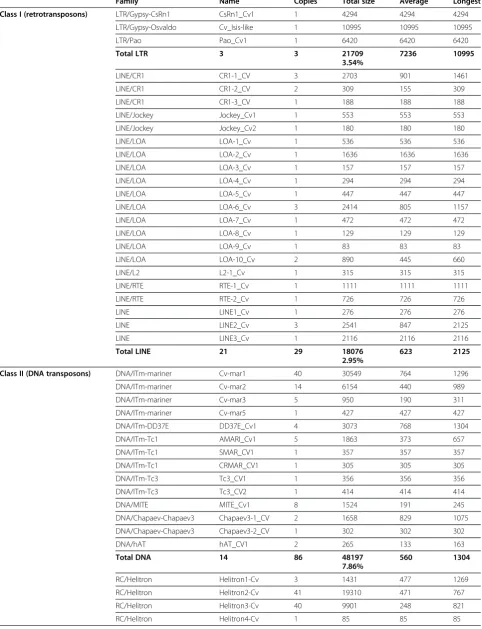
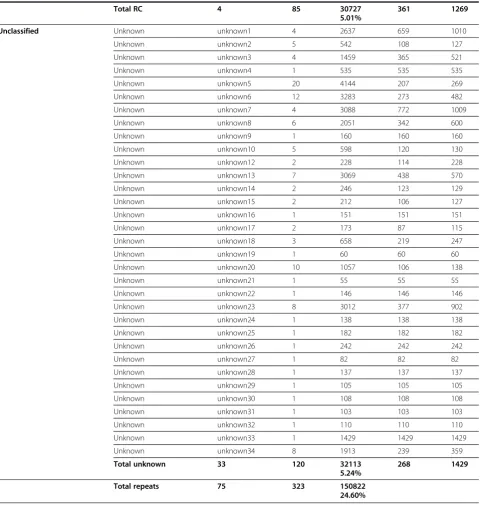
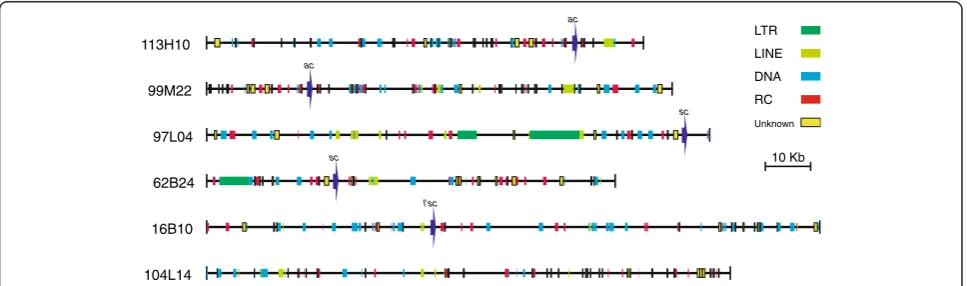
We have analysed a 613,063 bp genomic region within which we have identified a total of 318 TE insertions and repeats (Table 1, Table 2, Figure 1, Additional file 1, Additional file 2). The repeats have been classified and are described below.
Class I–RNA-mediated TEs
LTR retroposons
LTR elements are characterized by the presence of direct long terminal repeats (LTRs) that range from a few hundred base pairs to more than five kilobases long [17]. Between the LTRs there are generally only one or two open reading frames (ORFs) that encode a polymerase (pol) pro-tein and a propro-tein related to the retroviral group-associated antigen (gag) protein. The pol protein contains reverse transcriptase (RT), ribonuclease H (RNaseH), protease (PR) and integrase (IN) domains that are important for the process of retrotransposition. The gag protein binds nucleic acids or forms a nucleocapside shell. Some LTR retrotransposons also have an env (envelope)-like domain that encodes a transmembrane receptor-binding protein that allows the transmission of retroviruses.
We have identified three LTR retrotransposon elements, each with one insertion. These elements are recent insertions; all three are full length, have identical or almost identical LTRs and at least two of the three insertions are polymorphic (see below).
Isis-like This is the largest identified repeat with 10,995 bp (Figure 2, Additional file 3: Figure S1). It is closely related to the Isis TE recently described in Drosophila buzzatii [22]. It belongs to the Osvaldo lineage of the Gypsy family. The LTRs of Isis-like are 2577 and 2574 bp long and there are 4 bp Target Site Duplications (TSD: CGTG) and two ORFs. The first ORF encodes a 531-amino acid (aa) gag protein with a 40% identity (and 70% similarity) with Isis. It contains a RING finger domain which is absent in Isis but present in Osvaldo (also from the same family). The second ORF encodes a 1,137-aa pol protein, which has 60% identity (and 85% similarity) with the Isis pol protein. However, Isis-like lacks the env domain and the LTR of both elements are very different (742vs.2574 bp long). This is a recent insertion, less than 25,000 years old, and is poly-morphic as it is present in only one of the two sequenced alleles covering this region.
Table 1 Transposable elements and other repeats identified inC. vicina
Family Name Copies Total size Average Longest
Class I (retrotransposons) LTR/Gypsy-CsRn1 CsRn1_Cv1 1 4294 4294 4294
LTR/Gypsy-Osvaldo Cv_Isis-like 1 10995 10995 10995
LTR/Pao Pao_Cv1 1 6420 6420 6420
Total LTR 3 3 21709 7236 10995
3.54%
LINE/CR1 CR1-1_CV 3 2703 901 1461
LINE/CR1 CR1-2_CV 2 309 155 309
LINE/CR1 CR1-3_CV 1 188 188 188
LINE/Jockey Jockey_Cv1 1 553 553 553
LINE/Jockey Jockey_Cv2 1 180 180 180
LINE/LOA LOA-1_Cv 1 536 536 536
LINE/LOA LOA-2_Cv 1 1636 1636 1636
LINE/LOA LOA-3_Cv 1 157 157 157
LINE/LOA LOA-4_Cv 1 294 294 294
LINE/LOA LOA-5_Cv 1 447 447 447
LINE/LOA LOA-6_Cv 3 2414 805 1157
LINE/LOA LOA-7_Cv 1 472 472 472
LINE/LOA LOA-8_Cv 1 129 129 129
LINE/LOA LOA-9_Cv 1 83 83 83
LINE/LOA LOA-10_Cv 2 890 445 660
LINE/L2 L2-1_Cv 1 315 315 315
LINE/RTE RTE-1_Cv 1 1111 1111 1111
LINE/RTE RTE-2_Cv 1 726 726 726
LINE LINE1_Cv 1 276 276 276
LINE LINE2_Cv 3 2541 847 2125
LINE LINE3_Cv 1 2116 2116 2116
Total LINE 21 29 18076 623 2125
2.95%
Class II (DNA transposons) DNA/ITm-mariner Cv-mar1 40 30549 764 1296
DNA/ITm-mariner Cv-mar2 14 6154 440 989
DNA/ITm-mariner Cv-mar3 5 950 190 311
DNA/ITm-mariner Cv-mar5 1 427 427 427
DNA/ITm-DD37E DD37E_Cv1 4 3073 768 1304
DNA/ITm-Tc1 AMARI_Cv1 5 1863 373 657
DNA/ITm-Tc1 SMAR_CV1 1 357 357 357
DNA/ITm-Tc1 CRMAR_CV1 1 305 305 305
DNA/ITm-Tc3 Tc3_CV1 1 356 356 356
DNA/ITm-Tc3 Tc3_CV2 1 414 414 414
DNA/MITE MITE_Cv1 8 1524 191 245
DNA/Chapaev-Chapaev3 Chapaev3-1_CV 2 1658 829 1075
DNA/Chapaev-Chapaev3 Chapaev3-2_CV 1 302 302 302
DNA/hAT hAT_CV1 2 265 133 163
Total DNA 14 86 48197 560 1304
7.86%
RC/Helitron Helitron1-Cv 3 1431 477 1269
RC/Helitron Helitron2-Cv 41 19310 471 767
RC/Helitron Helitron3-Cv 40 9901 248 821
CsRn1 lineage of the Gypsy family [23]. This lineage is characterized by the presence of a PBS complementary to tRNA-Trp, a CHCC gag motif and the GPY motif in the 30 of the Integrase protein, all of which are present in this element. However, it seems to present a 6 bp TSD (CAAGTG) instead of the 4 bp TSD typical of the group. We have estimated this insertion to be 350,000
years old, which makes it the oldest of the three LTR elements.
Pao_Cv1 The last LTR element identified belongs to the Pao family, and is related to the Ninja-I element. Pao_Cv1 is 6420 bp long, has 355 bp long LTRs, and one ORF coding for a 1881 aa protein (Figure 2, Additional file Table 1 Transposable elements and other repeats identified inC. vicina(Continued)
Total RC 4 85 30727 361 1269
5.01%
Unclassified Unknown unknown1 4 2637 659 1010
Unknown unknown2 5 542 108 127
Unknown unknown3 4 1459 365 521
Unknown unknown4 1 535 535 535
Unknown unknown5 20 4144 207 269
Unknown unknown6 12 3283 273 482
Unknown unknown7 4 3088 772 1009
Unknown unknown8 6 2051 342 600
Unknown unknown9 1 160 160 160
Unknown unknown10 5 598 120 130
Unknown unknown12 2 228 114 228
Unknown unknown13 7 3069 438 570
Unknown unknown14 2 246 123 129
Unknown unknown15 2 212 106 127
Unknown unknown16 1 151 151 151
Unknown unknown17 2 173 87 115
Unknown unknown18 3 658 219 247
Unknown unknown19 1 60 60 60
Unknown unknown20 10 1057 106 138
Unknown unknown21 1 55 55 55
Unknown unknown22 1 146 146 146
Unknown unknown23 8 3012 377 902
Unknown unknown24 1 138 138 138
Unknown unknown25 1 182 182 182
Unknown unknown26 1 242 242 242
Unknown unknown27 1 82 82 82
Unknown unknown28 1 137 137 137
Unknown unknown29 1 105 105 105
Unknown unknown30 1 108 108 108
Unknown unknown31 1 103 103 103
Unknown unknown32 1 110 110 110
Unknown unknown33 1 1429 1429 1429
Unknown unknown34 8 1913 239 359
Total unknown 33 120 32113 268 1429
5.24%
Total repeats 75 323 150822
5: Figure S3). It has 5 bp TSDs (GCGGG). It is inserted inside a mariner element. This insertion is polymorphic and furthermore the two LTRs are completely identical which indicates that it is very young (less than 88,000 years old).
Non-LTR retroposons (LINEs)
A total of 29 insertions have been classified as 21 different LINE elements, most of which are short and degraded fragments. The insertions average 745 bp in size and ten of them are smaller than 500 bp, whereas size typically ranges from 1 to 7 kb for this group [24]. The absence of canonical sequences for comparison makes it difficult to classify them properly. This is particularly acute for the LAO elements, from which we have found many very short fragments (for eight out of ten putative elements the longest fragment is smaller than 1 kb, the smallest being 83 bp only) (Table 1). We cannot exclude the possibility that some of the insertions we have defined as separate elements are in reality different regions of the same element. The size and degraded nature of these elements suggests they are all old insertions. Overall the identified LINEs span 18 kb of the sequenced region (2.9%).
Class II–DNA transposons
Cut-and-paste DNA transposons
Cut-and-paste DNA transposons are characterized by 10 to 200 bp terminal inverted repeats (TIRs) flanking one or more ORFs encoding a transposase. We have identified 14 different cut-and-paste DNA elements with a total of 89 insertions spanning 7.86% of the sequenced region. One element belongs to the MITE family, two to the Chapaenov family, one to the hAT family, and the remaining 10 to the IS630-Tc1-mariner (ITm) superfamily. The most common elements belong to the Mariner family of the ITm superfamily.
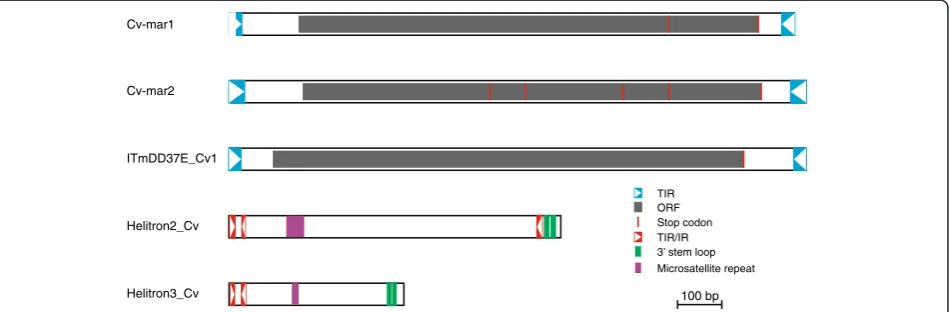
Cv-mar1 The most frequent transposon isCv-mar1with 41 different insertions that span overall more than 30 kb. All insertions are partially degraded and range from 320 to 1296 bp, the consensus sequence is 1,275 bp long (Figure 3, Additional file 6: Figure S4). This element shows 78% identity at the nucleotide level with the Desmar1 mariner element from the Hessian flyMayetiola destructor[25-27] (Additional file 7: Figure S5). Its TIRs have been identi-fied by similarity to those of Desmar1 [25], with which they show 3 nucleotide (nt) substitutions and 1 nt inser-tion. However, the 50TIR of Cv-mar1 is incomplete and the 30TIR is present in only a single copy of the element (the fragment of the consensus sequence derived from a single element is delimited by a blue dash in Additional file 6: Figure S4). Although none of the annotated ele-ments displays a complete transposase, we were able to derive a“complete” copy from the consensus sequence. In position 993 (shown in red) the consensus sequence has a T that results in a stop codon in the transposase, however a third of the sequences have an A at this pos-ition, which would result in an arginine (R) residue. The next stop codon is in the same position as that of the Desmar1 element (Additional file 8: Figure S6). If we consider this longer transposase it is 345 aa long. Table 2 Total repeat content inC. vicinaBAC sequences
Repeats
BAC Length Number Total bp % of sequence
113H10 96426 61 23570 24.44
99 M22 102758 78 28879 28.10
97 L04 111044 38 38432 34.61
62B24 90178 44 28013 31.06
16B10 135393 66 27144 20.05
104 L14 115595 68 19608 16.96
Total BACs 651394 355 165646 25.43
Total region* 613063 317 149226 24.34
(*without repeated alleles).
Unknown
LINE LTR
DNA RC
ac
113H10
sc
97L04
ac
99M22
sc
62B24
l’sc
16B10
104L14
10 Kb
Cv-mar2 In the region analysed there are 14 copies of
Cv-mar2which span a total of 6 kb. The average insertion is 440 bp long, with the longest being 989 bp. Although none of the insertions is full length we were able to derive a consensus full length sequence which is 1299 bp long (Figure 3, Additional file 9: Figure S7), individual copies are 77% to 91% identical to the consensus. It has 35 bp TIRs and a 344 aa transposase. However, this consensus element would be non-functional as the TIRs have five mismatches and the transposase has four stop codons and commences with a leucine instead of a methionine. This element is very similar to the Mariner1_DYa from
Drosophila yakuba[28]. The consensus obtained has a
78% identity at the nucleotide level with Mariner1_DYa and the two transposases show 73% identity at the amino acid level (Additional file 10: Figure S8 and Additional file 11: Figure S9).
DD37E_Cv1 The DD37E_Cv1 element belongs to the ITm-DD37E family [26]. This family was first discovered in mosquitos and is characterized by a unique DD37E catalytic domain. The full-length copy of this element is 1298 bp long with a 354 aa ORF and 27 bp ITRs
(Figure 3, Additional file 12: Figure S10). At both ends of the insertion we find the TA sequence, the canonical dinucleotide target site duplication of the family [29]. Three additional copies are fragmented, highly degraded and in two cases enclose other nested repeats. This element has been present in theC. vicina genome for a long time (presence of degraded insertions). The identification of a full-length copy suggests this element has also been active recently inCalliphora.
Rolling circle (RC) transposons - Helitrons
Helitrons have been classified as class II-DNA transposons that use a“rolling circle”mode of transposition [19]. They encode proteins similar to helicases, ssDNA-binding proteins and replication initiation proteins [4,19]. Helitrons lack inverted repeats but are characterized by much-conserved termini and hairpin structures close to the 30end. As with other TEs, the Helitrons present both autonomous and non-autonomous elements. DINE-1
and mini-me elements from Drosophila, which show
some unique characteristics, are now classified as non-autonomous Helitrons [30,31]. They lack coding capacity, do not have these characteristic termini, but
PolyA ORF
RNase H
PBS PTT
CsRn1_Cv1
1 Kb Pao_Cv1
Isis-like
LTR RING finger Retrotranscriptase Integrase Nucleocapside
Protease Pao Peptidase
Figure 2Structure of the LTR elements.Diagram showing the structural features of the three LTR elements identified in this study. All features are drawn to scale (except PBS and PPT). See legend for colour code. Full sequences of these elements can be found in Additional file 3: Figure S1, Additional file 4: Figure S2, and Additional file 5: Figure S3, respectively.
ORF
Cv-mar2
100 bp Helitron3_Cv
Cv-mar1
TIR
ITmDD37E_Cv1
Helitron2_Cv
TIR/IR Stop codon
3’ stem loop Microsatellite repeat
have subterminal inverted repeats and the hairpin structures at the 30region [30]. Four different elements of the Helitron family are present in our sample. Two of them show a high copy number, with 40 and 41 insertions, re-spectively. Helitrons cover 5.01% of the analysed sequence.
Helitron2_Cv Was identified by similarity to the 50region of the Arylphorin subunit from C. vicina (X63340). RepeatMasker indicated it is related toHelitron-1N1_Dvir
andmini-meelements [32]. We have annotated 41 copies
of this element, from 136 to 767 bp long. The consensus sequence is 750 bp long (Figure 3, Additional file 13: Figure S11). Eight copies are full length and show a 95% to 97% identity with the consensus. Helitron2_Cv shows the structural features of non-autonomous DINE1-like
Helitrons: 11 bp subTIRs, partial inverted repeats next to the 50 subTIRs, GTCY-rich protosatellites and short hairpin stem-loops (with 9 bp stems) next to the 30end of the element. It is closely related to the autonomous and non-autonomous elements Helitron-1-Dvir and Helitron-1N1_DvirofD. virilis[32].Helitron2_Cvshows a 65% and 70% identity in the 50region (up to protosatellite repeat) and 30end (last 100 bp), respectively, with the D. virilis
elements. Copies of this element represent 3% of the sequenced region. Given the level of divergence of the full length insertion, autonomous copies of this element probably exist in theC. vicinagenome.
Helitron3_Cv This is also a DINE1-like Helitron. We have identified 40 copies that range from 71 to 821 bp. They can be divided into two subtypes, whose consensus sequences are 395 and 396 bp long. The consensus of the two subtypes differs in one nucleotide indel and 54 nucleotide substitutions, half of which are located in the region just after the protosatellite repeat. All features typical ofDINE1-likeHelitrons are present except the 30 subTIR (Figure 3, Additional file 14: Figure S12). The protosatellite repeat (GTCT)2 is expanded in 3 of the
insertions: one has 4 repeats, another 5 repeats and the third 108 repeats.
Unclassified repeats
These repeats have been mainly identified by similarity within and between BAC sequences and with other published Calliphora sequences (blastn – non-redundant nucleotide NCBI database). They are mostly short and with no obvious structure or similarity with known elements. Overall these repeats span 5.24% of the analysed region.
Unknown 5
This repeat was first identified by blastn to the non-redundant NCBI database, as it is present in intergenic or intronic regions of two different alleles of the Xdh gene ofC. vicina(M30316, M30488). We have annotated
20 insertions of this element in the region we analysed. The consensus sequence is 275 bp long (Additional file 15: Figure S13). The 50region of the element is rich in polyA and polyT tracts, whereas the 30region of the element is highly conserved between copies (red region in Additional file 15: Figure S13). However, no structural features or internal repeats could be recognized.
Unknown 6
A short fragment of this element was first identified by RepeatMasker as a fragment of a Helitron. However, in this sequence, which is present 12 times in theC. vicina
sequences, we could not identify any of the features of a Helitron and thus it remains unclassified. The consensus sequence of this element is 488 bp long (Additional file 16: Figure S14). From nucleotide 1 to 465 the sequence is palindromic (with 92% identity).
Unknown 20
This element was first identified byblastnwith similarity
to a Lucilia cuprina intronic sequence (M89990). There
are 10 insertions of this sequence present in the region
of C. vicina that was analysed. The consensus sequence
is 140 bp long (Additional file 17: Figure S15). No struc-tural features or internal repeats were identified which could help classify this repeat.
Candidates of horizontal transfer
Four of the analysed repeats show a remarkable similarity with elements from other species. To assess the possibility of horizontal transfer we have taken a closer look at these elements and checked their distribution on available sequences (NCBI and Insect genome sequences – see Methods). These elements are the LTR element Isis, the DNA cut-and-paste elements Cv-mar1 and Cv-mar2, and the HelitronHelitron2_Cv.
The elementsIsis fromD. buzzatiiandIsis-like fromC. vicina have 40% and 60% identity in their ORFs, however they differ in the presence of the RING (present only in
Isis-like) and env (present only in Isis) domains. The sequence (and length) of their LTRs is also very different. Of the sequenced genomes, onlyD. mojavensispresents an
Isis element. We have found no evidence of Isis-like. The limited distribution of these elements suggests that they ar-rived by horizontal transfer to theD. buzzatii-D. mojavensis
ancestor (after the split of D. virilis) and to C. vicina
(or its ancestors).
TheCv-mar1element shows 70% to 80% identity with
multiple Mariner elements described in different insect species [33-35] besides Desmar1 [25]. The whole genome sequences of Mayetiola, Rhodnius prolixus (Hemiptera),
Solenopsis invicta (Hymenoptera) and Anopheles gambiae
800 bp long) with 80% identity. The broad distribution of this element suggests it is mainly vertically transmitted.
The Mariner elementCv-mar2is present inD. yakuba
(Mariner1_Ya) with which it shows 78% identity over its whole length. We have also found several hits with 80% identity in the ants Camponeatus floridanus and
Harpegnathos saltator(Hymenoptera), covering 80% and
60% of the length of the element, respectively. We found no evidence of this element in other species. Its high similarity and limited distribution suggest its transmission by horizontal transfer between Diptera and Hymenoptera which diverged approx. 300 Myr ago.
The Helitron2_Cv is similar to Helitron-1N1_Dvir
from D. virilis. They have 50% identity over the whole element, and 65% to 70% identity at the 50 and 30end, respectively. Multiple hits with 60% to 90% identity around sequenced genes of Lucilia, Musca and other species show that this element is very common within the Muscomorpha. No hits were found in the whole genome sequences withHelitron2_Cv. UsingHelitron-1N1_Dviras query, we find multiple hits in Drosophila species but nothing outside the Drosophilagenus. This suggests that this element is vertically transmitted, the absence of hits in other insect is probably due to evolution of the sequence of this element.
Discussion
We have analysed a small (600 kb) region of theCalliphora
genome. It contains most of the Achaete-Scute complex: with the genesac,scandl’sc. The low gene density in this region is due to the presence of large regulatory regions (Negre and Simpson, submitted). It is euchromatic in na-ture although we do not know its position in the chromo-some or whether it is representative of the genome in terms of TE content and diversity but there are no reasons that would indicate otherwise. The discussion that follows is only a first approximation to the repeat landscape of this fly species,C. vicina, which has a big genome with 750 Mb (Spencer Johnston personal communication).
Fraction of genomic DNA occupied by repeats
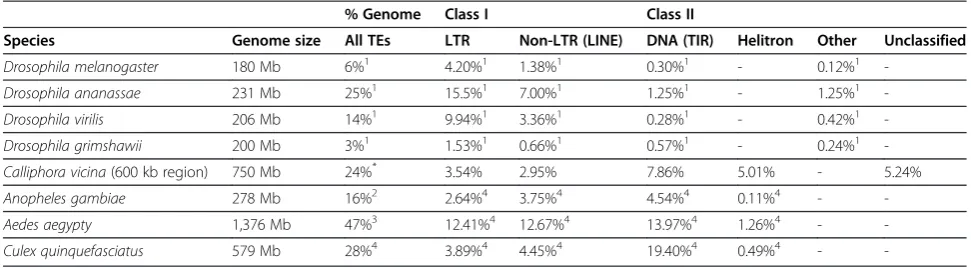
Repeats span 24% of the region analysed (600 kb). This percentage is relatively high but not unusual for fly genomes. Larger genomes usually show a higher proportion of repeats; however, repeat content is not proportional to genome size and is highly variable between dipteran genomes (Table 3). For example, there are several species whose genome is around 200 Mb with a repeat content ranging from 3% to 25%.
Repeat content is also variable within genomes, being most abundant in heterochromatin and pericentromeric regions. Unfortunately, we have no information about the position within the chromosome of the region we analysed. InD. melanogaster it is close to the tip of the
X chromosome, however chromosomes are very dynamic in terms of gene order, so we do not expect the position to be necessarily conserved.
Abundance of the different classes of repeats
If we look at the distribution of repeats in Dipterans, the abundance of the different classes appears to be constant within lineages independently of total repeat content, but very divergent between lineages (Table 3). In D.
melanogasterLTRs are the most abundant TEs, followed
by non-LTR and then TIR elements [36] (there is no information about Helitrons). The same pattern is observed in the other 11 Drosophila species that have been sequenced [37]. The pattern changes in mosquitos where TIR elements are the most abundant, followed by non-LTR, LTRs and finally Helitrons with less than 1% (Table 3). As in Drosophilidae, all mosquitos show the same pattern, although inAnophelesandAedesthe quantity of TIR, non-LTR and non-LTR elements is very similar, whereas in Culex
TIR elements represent more than half of the repeat content. InCalliphorawe see again a completely different pattern. As in mosquitoes TIR elements are the most frequent but they are now followed by Helitrons. LTR and non-LTR elements (in this order) are the least frequent in
C. vicina(Table 3). It is noteworthy that if we consider the unclassified repeats inCalliphorathis would be the second most frequent class of repeats.
Age of TE insertions
Nested elements
New vs. old insertions
All LTR insertions found in this sample are recent in origin. All three insertions are full length and at least two of them are polymorphic. We have found no fragments or degraded copies. This is a very different picture to that found in all other TE classes where none (non-LTR elements) or only a few (DNA and RC elements) insertions are full-length. In all these classes most inser-tions are fragmented and highly degraded. A similar trend was found in D. melanogaster. LTR families appear to be transposing in theD. melanogastergenome at higher rates than TEs from other orders leading to the observation that LTR elements, as a group, tend to be younger [38]. Recent analyses suggest that this trend is due to a higher intrinsic rate of transposition of LTR elements and not to a recent increase of transposition [39].
Role of horizontal transfer
The mobile nature of TEs makes them prone to horizontal transfer. It is thought to be an essential step in TE life cycle, which allows them to escape vertical extinction [40,41].
Four TEs showed a remarkable similarity with elements from other species. Although we could not compare the rates of synonymous mutations between the TEs and orthologous genes, we have checked the distribution of these elements in sequenced insect species to detect possible instances of horizontal transfer.
The broad distribution of the Mariner elementCv-mar1
and the Helitron Helitron2_Cv shows they are vertically transmitted. We cannot rule out completely horizontal transfer inCv-mar1, but its detection would require a much thorough analysis (which is out of the scope of this study).
The elementsIsis andCv-mar2do seem to have under-gone horizontal transfer.Isismoved between Calliphoridae and Drosophilidae which diverged approximately 100 Myr ago, and Cv-mar2 between Diptera and Hymenoptera which diverged approximately 300 Myr ago.
Overall two of the 43 identified TEs show evidence of horizontal transfer. One is an LTR and the other a DNA
transposon, the two classes more often involved in transfer events [40].
Conclusions
This is the first detailed description of TEs in carrion flies. Although the analysis includes only a small region of the genome it gives an overview of the classes of TEs present and their abundance. Moreover, the description of these TEs and repeats can help in the annotation of repeat sequences in other Dipteran genomes,e.g., those currently being sequenced.
Methods
Sequences analysed
We have analysed the sequences of six overlapping BAC clones, in a region which contains most of the Achaete-Scute Complex (AS-C) of Calliphora vicina (cloning and sequencing of this region is described in Negre and Simpson, submitted). The clones comprise a total of 651,394 base pairs (bp), of which 38,331 bp correspond to identical alleles in two overlapping clones (see Table 2). Thus we have analysed 613,063 bp of unique sequence.
Identification of repetitive elements
Several tools were used for the identification and classification of repeats: RepeatMasker was run against theDrosophiladatabase and all hits were considered, for protein-based RepeatMasker (A.F.A. Smit, R. Hubley and P. Green, RepeatMasker at http://repeatmasker.org) all hits were also considered; blastn and blastp were run against NCBI non-redundant databases [42] and hits longer than 100 bp with identities over 60% were further analysed. LTR-Finder [43] was used to identify LTR elements and some of their structural features such as PBS and PPT sequences. The online program Palindromes (http://mobyle.pasteur.fr) was used to aid in the identifica-tion of TIRs. All hits were compared between methods and manually inspected. Most repeats are identified by more than one method. Non-overlapping hits smaller than 50 bp Table 3 Repeat content in dipteran genomes
% Genome Class I Class II
Species Genome size All TEs LTR Non-LTR (LINE) DNA (TIR) Helitron Other Unclassified
Drosophila melanogaster 180 Mb 6%1 4.20%1 1.38%1 0.30%1 - 0.12%1
-Drosophila ananassae 231 Mb 25%1 15.5%1 7.00%1 1.25%1 - 1.25%1
-Drosophila virilis 206 Mb 14%1 9.94%1 3.36%1 0.28%1 - 0.42%1
-Drosophila grimshawii 200 Mb 3%1 1.53%1 0.66%1 0.57%1 - 0.24%1
-Calliphora vicina(600 kb region) 750 Mb 24%* 3.54% 2.95% 7.86% 5.01% - 5.24%
Anopheles gambiae 278 Mb 16%2 2.64%4 3.75%4 4.54%4 0.11%4 -
-Aedes aegypty 1,376 Mb 47%3 12.41%4 12.67%4 13.97%4 1.26%4 -
-Culex quinquefasciatus 579 Mb 28%4 3.89%4 4.45%4 19.40%4 0.49%4 -
-*
% of TEs based on the 600 kb region analysed in this study, data from other species comes from whole genome sequences. References:1
Drosophila 12 genomes consortium 2007; [37]2
Holt,et al.[5];3
Nene,et al.[7];4
were discarded. The best match was used for repeat classification. Annotated repeats were added to a local database to help in the identification of further copies of the same repeats. Comparison between Calliphora
sequences (with blast2sequences-blastn) allowed the identification of many short unclassified repeats which are found recurrently in theCalliphora genome. Some of the elements we have annotated are also present in GeneBank sequences (in intronic and intergenic regions), but these were all unannotated. Consensus sequences were obtained by ClustalW [44,45] or Tcoffee [46,47] alignment and manually corrected with the aid of Bioedit.
Divergence time of TE insertions
The age of TE insertions (t) has been calculated as in [4]; t = K/v, where K is the average divergence of TE copies from the consensus and v the neutral substitution rate. We have used the neutral substitution rate for Drosophila
(v=0.016 substitutions/Myr) [48]. For LTR elements we have used t = K/2v, where K stands for the divergence between the two LTRs of one insertion [4].
Identification of similar elements in other species
Distribution of similar elements in other species was assessed by similarity searches (blastn) against: (1) the non-redundant NCBI database and (2) insect whole genome sequences (flybase) [42,49]. Only hits with >60% identity over half the length of the query sequence were considered.
Additional files
Additional file 1:Detailed inventory of identified repeats in each BAC sequence.
Additional file 2:Sequences of annotated repeats in fasta.
Additional file 3: Figure S1.Cv_Isis-like. Full nucleotide sequence of the Isis-like element ofC. vicinaand protein translation of the two ORFs. Nucleotides in red are LTRs, in bold and underlined PBS and PPT sequences. Amino acids: RING finger domain in green, Nucleocapside CCHC domain in red, retrotranscriptase in blue and Integrase in pink.
Additional file 4: Figure S2.CsRn1_Cv1. Full nucleotide sequence of the CsRn1_Cv1element ofC. vicinaand protein translation of the two ORFs. Nucleotides in red are LTRs, in bold and underlined PBS and PPT sequences. Amino acids: Nucleocapside CCHC domain in red, protease in pink, retrotranscriptase in blue, RNase domain in green, and Integrase in pink.
Additional file 5: Figure S3.Pao_Cv1. Full nucleotide sequence of the Pao_Cv1element ofC. vicinaand protein translation of its ORF. Nucleotides in red are LTRs, in bold and underlined PBS and PPT sequences. Amino acids: RING finger domain in light green, retrotranscriptase in blue, Pao peptidase in dark green and Integrase in pink.
Additional file 6: Figure S4.Cv-mar1consensus sequence. Consensus sequence of theCv-mar1element and amino acid sequence of its transposase. At position 993 (shown in red) the consensus sequence has a T that gives a stop codon in the transposase; a third of the sequences have an A at this position, which would result in an arginine (R) residue. Underlined nucleotides correspond to the TIRs; the 50TIR is incomplete. The blue dash close to the end of the sequence delimits a fragment found in one insertion only (see text for details).
Additional file 7: Figure S5.ClustalW2 alignment of Cv-mar1 and Desmar1.
Additional file 8: Figure S6.ClustalW2 alignment of Cv-mar1 and Desmar1 transposases.
Additional file 9: Figure S7.Cv-mar2consensus sequence. Consensus sequence of theCv-mar2element and amino acid sequence of its putative transposase. Underlined nucleotides correspond to the inferred TIRs (35 bp long); there are 5 nucleotide changes between the two TIRs of the consensus sequence.
Additional file 10: Figure S8.ClustalW2 alignment of Cv-mar2 and Mariner1_DYa.
Additional file 11: Figure S9.ClustalW2 alignment of Cv-mar2 and Mariner1_DYa transposases.
Additional file 12: Figure S10.ITmDD37E_Cv1. Full nucleotide sequence of the DD37E element ofC. vicinaand aminoacid sequence of its transposase. Underlined nucleotides are the TIRs, and bold and underlined amino acids the catalytic domain.
Additional file 13: Figure S11.Helitron2_Cvconsensus sequence. Consensus sequence ofHelitron2_Cvshowing the main structural features: 50and 30subTIRs and IR are underlined, 30stem loop in red and microsatellite repeat in blue.
Additional file 14: Figure S12.Helitron3_Cvconsensus sequence. Alignment of the consensus sequence of the two subtypes of Helitron3_Cv(3a and 3b). The main structural features are highlighted: 50 subTIR and IR underlined, 30stem loop in red and microsatellite repeat in blue. This element lacks the 30subTIR.
Additional file 15: Figure S13.Unknown5 consensus sequence. Consensus sequence of the Unknown 5 elements. The highly conserved region of the element is shown in red.
Additional file 16: Figure S14.Unknown6 consensus sequence. Consensus sequence of the Unknown 6 elements. The palindromic region is underlined.
Additional file 17: Figure S15.Unknown 20 consensus sequence. Consensus sequence of the unknown 20 elements. No structural features were identified.
Abbreviations
Env:Envelope; IN: Integrase; IR: Inverted repeat; ITm: IS360-Tc1-mariner superfamily; LTR: Long terminal repeat; ORF: Open reading frame; PBS: Primer binding site; PR: Protease; PPT: Polypurine tract; RC: Rolling circle;
RNaseH: Ribonuclease H; RT: Reverse transcriptase; TE: Transposable element; TIRs: Terminal inverted repeats; TSD: Target site duplication.
Competing interests
The authors declare that they have no competing interests.
Authors’contributions
BN conceived and designed the study, performed the analysis and drafted the manuscript. PS conceived the study and helped to draft the manuscript. All authors read and approved the final manuscript.
Acknowledgements
We would like to thank Pr. Spencer Johnston for the estimate of the Calliphora vicinagenome size, Sung Ly and Carol McKimmie for technical assistance and Josefa González and two anonymous reviewers for comments on the manuscript. This work was supported by the Wellcome Trust grant 29156.
Received: 19 December 2012 Accepted: 5 March 2013 Published: 3 April 2013
References
1. Kidwell MG, Lisch DR:Transposable elements and host genome evolution.Trends Ecol Evol2000,15:95–99.
3. Lander ES, Linton LM, Birren B, Nusbaum C, Zody MC, Baldwin J, Devon K, Dewar K, Doyle M, FitzHugh W, Funke R, Gage D, Harris K, Heaford A, Howland J, Kann L, Lehoczky J, LeVine R, McEwan P, McKernan K, Meldrim J, Mesirov JP, Miranda C, Morris W, Naylor J, Raymond C, Rosetti M, Santos R, Sheridan A, Sougnez C,et al:Initial sequencing and analysis of the human genome.Nature2001,409:860–921.
4. Kapitonov VV, Jurka J:Molecular paleontology of transposable elements in the Drosophila melanogaster genome.Proc Natl Acad Sci U S A2003,100:6569–6574. 5. Holt RA, Subramanian GM, Halpern A, Sutton GG, Charlab R, Nusskern DR,
Wincker P, Clark AG, Ribeiro JM, Wides R, Salzberg SL, Loftus B, Yandell M, Majoros WH, Rusch DB, Lai Z, Kraft CL, Abril JF, Anthouard V, Arensburger P, Atkinson PW, Baden H, de Berardinis V, Baldwin D, Benes V, Biedler J, Blass C, Bolanos R, Boscus D, Barnstead M,et al:The genome sequence of the malaria mosquito Anopheles gambiae.Science2002,298:129–149. 6. Arensburger P, Megy K, Waterhouse RM, Abrudan J, Amedeo P, Antelo B,
Bartholomay L, Bidwell S, Caler E, Camara F, Campbell CL, Campbell KS, Casola C, Castro MT, Chandramouliswaran I, Chapman SB, Christley S, Costas J, Eisenstadt E, Feschotte C, Fraser-Liggett C, Guigo R, Haas B, Hammond M, Hansson BS, Hemingway J, Hill SR, Howarth C, Ignell R, Kennedy RC,et al: Sequencing of Culex quinquefasciatus establishes a platform for mosquito comparative genomics.Science2010,330:86–88. 7. Nene V, Wortman JR, Lawson D, Haas B, Kodira C, Tu ZJ, Loftus B, Xi Z,
Megy K, Grabherr M, Ren Q, Zdobnov EM, Lobo NF, Campbell KS, Brown SE, Bonaldo MF, Zhu J, Sinkins SP, Hogenkamp DG, Amedeo P, Arensburger P, Atkinson PW, Bidwell S, Biedler J, Birney E, Bruggner RV, Costas J, Coy MR, Crabtree J, Crawford M,et al:Genome sequence of Aedes aegypti, a major arbovirus vector.Science2007,316:1718–1723.
8. Lerat E:Identifying repeats and transposable elements in sequenced genomes: how to find your way through the dense forest of programs. Heredity2010,104:520–533.
9. Oliver KR, Greene WK:Transposable elements: powerful facilitators of evolution.BioEssays2009,31:703–714.
10. Gonzalez J, Petrov DA:The adaptive role of transposable elements in the Drosophila genome.Gene2009,448:124–133.
11. Kumar A, Hirochika H:Applications of retrotransposons as genetic tools in plant biology.Trends Plant Sci2001,6:127–134.
12. Hamon P, Duroy PO, Dubreuil-Tranchant C, Mafra D’Almeida Costa P, Duret C, Razafinarivo NJ, Couturon E, Hamon S, de Kochko A, Poncet V, Guyot R: Two novel Ty1-copia retrotransposons isolated from coffee trees can effectively reveal evolutionary relationships in the Coffea genus (Rubiaceae).Mol Genet Genomics2011,285:447–460.
13. D’Onofrio C, Lorenzis G, Giordani T, Natali L, Cavallini A, Scalabrelli G: Retrotransposon-based molecular markers for grapevine species and cultivars identification.Tree Genetics & Genomes2010,6:451–466. 14. Mansour A:Utilization of genomic retrotransposons as cladistic markers.
J Cell Molec Biol2008,7:17–28.
15. Scolari F, Siciliano P, Gabrieli P, Gomulski LM, Bonomi A, Gasperi G, Malacrida AR:Safe and fit genetically modified insects for pest control: from lab to field applications.Genetica2011,139:41–52.
16. Finnegan DJ:Transposable elements.Curr Opin Genet Dev1992,2:861–867. 17. Wicker T, Sabot F, Hua-Van A, Bennetzen JL, Capy P, Chalhoub B, Flavell A,
Leroy P, Morgante M, Panaud O, Paux E, SanMiguel P, Schulman AH:A unified classification system for eukaryotic transposable elements.Nat Rev Genet2007,8:973–982.
18. Kapitonov VV, Jurka J:A universal classification of eukaryotic transposable elements implemented in Repbase.Nat Rev Genet2008, 9:411–412. Author reply 414.
19. Kapitonov VV, Jurka J:Rolling-circle transposons in eukaryotes.Proc Natl Acad Sci U S A2001,98:8714–8719.
20. Amendt J, Krettek R, Zehner R:Forensic entomology.Die Naturwissenschaften2004,91:51–65.
21. Thompson ML, Gauna AE, Williams ML, Ray DA:Multiple chicken repeat 1 lineages in the genomes of oestroid flies.Gene2009,448:40–45. 22. Garcia Guerreiro MP, Fontdevila A:Molecular characterization and
genomic distribution of Isis: a new retrotransposon of Drosophila buzzatii.Mol Genet Genomics2007,277:83–95.
23. Tubio JM, Naveira H, Costas J:Structural and evolutionary analyses of the Ty3/gypsy group of LTR retrotransposons in the genome of Anopheles gambiae.Mol Biol Evol2005,22:29–39.
24. Kidwell MG:Transposable elements and the evolution of genome size in eukaryotes.Genetica2002,115:49–63.
25. Russell VW, Shukle RH:Molecular and cytological analysis of a mariner transposon from Hessian fly.J Hered1997,88:72–76.
26. Shao H, Tu Z:Expanding the diversity of the IS630-Tc1-mariner superfamily: discovery of a unique DD37E transposon and reclassification of the DD37D and DD39D transposons.Genetics2001, 159:1103–1115.
27. Behura SK, Shukle RH, Stuart JJ:Assessment of structural variation and molecular mapping of insertion sites of Desmar-like elements in the Hessian fly genome.Insect Mol Biol2010,19:707–715.
28. Jurka J:Mariner-type families from fruit fly.Repbase Reports2009,9:477. 29. Biedler JK, Shao H, Tu Z:Evolution and horizontal transfer of a DD37E
DNA transposon in mosquitoes.Genetics2007,177:2553–2558.
30. Yang HP, Barbash DA:Abundant and species-specific DINE-1 transposable elements in 12 Drosophila genomes.Genome Biol2008,9:R39.
31. Kapitonov VV, Jurka J:Helitrons on a roll: eukaryotic rolling-circle transposons.Trends in genetics: TIG2007,23:521–529.
32. Kapitonov VV, Jurka J:Helitrons in fruitflies.Repbase Reports2007,7:127–132. 33. Rezende-Teixeira P, Siviero F, Andrade A, Santelli RV, Machado-Santelli GM: Mariner-like elements in Rhynchosciara americana (Sciaridae) genome: molecular and cytological aspects.Genetica2008,133:137–145. 34. Rezende-Teixeira P, Lauand C, Siviero F, Machado-Santelli GM:Normal
and defective mariner-like elements in Rhynchosciara species (Sciaridae, Diptera).Genet Mol Res2010,9(2):849–857.
35. Haine ER, Kabat P, Cook JM:Diverse Mariner-like elements in fig wasps. Insect Mol Biol2007,16(6):743–752.
36. Bergman CM, Quesneville H, Anxolabehere D, Ashburner M:Recurrent insertion and duplication generate networks of transposable element sequences in the Drosophila melanogaster genome.Genome Biol2006,7:R112.
37. Drosophila 12 genomes Consortium:Evolution of genes and genomes on the Drosophila phylogeny.Nature2007,450:203–218.
38. Bergman CM, Bensasson D:Recent LTR retrotransposon insertion contrasts with waves of non-LTR insertion since speciation in Drosophila melanogaster.Proc Natl Acad Sci U S A2007,104:11340–11345.
39. Petrov DA, Fiston-Lavier AS, Lipatov M, Lenkov K, Gonzalez J:Population genomics of transposable elements in Drosophila melanogaster.Mol Biol Evol2011,28:1633–1644.
40. Loreto ELS, Carareto CMA, Capy P:Revisiting horizontal transfer of transposable elements in Drosophila.Heredity2008,100:545–554. 41. Schaack S, Gilbert C, Feschotte C:Promiscuous DNA: horizontal transfer of
tranposable elements and why it matters for eukaryotic evolution.TREE 2010,25:537–546.
42. Altschul SF, Gish W, Miller W, Myers EW, Lipman DJ:Basic local alignment search tool.J Mol Biol1990,215:403–410.
43. Xu Z, Wang H:LTR_FINDER: an efficient tool for the prediction of full-length LTR retrotransposons.Nucleic Acids Res2007,35:W265–W268.
44. Larkin MA, Blackshields G, Brown NP, Chenna R, McGettigan PA, McWilliam H, Valentin F, Wallace IM, Wilm A, Lopez R, Thompson JD, Gibson TJ, Higgins DG:Clustal W and Clustal X version 2.0.Bioinformatics2007, 23:2947–2948.
45. Goujon M, McWilliam H, Li W, Valentin F, Squizzato S, Paern J, Lopez R:A new bioinformatics analysis tools framework at EMBL-EBI.Nucleic Acids Res2010,38:W695–W699.
46. Di Tommaso P, Moretti S, Xenarios I, Orobitg M, Montanyola A, Chang JM, Taly JF, Notredame C:T-Coffee: a web server for the multiple sequence alignment of protein and RNA sequences using structural information and homology extension.Nucleic Acids Res2011,39:W13–W17. 47. Notredame C, Higgins DG, Heringa J:T-Coffee: a novel method for fast
and accurate multiple sequence alignment.J Mol Biol2000,302:205–217. 48. Li W-H:Molecular Evolution.Sunderland, MA: Sinauer; 1997.
49. McQuilton P, St Pierre SE, Thurmond J, The FlyBase Consortium:FlyBase 101–the basics of navigating FlyBase.Nucleic Acids Res2012, 40(Database issue):D706–D714.
doi:10.1186/1759-8753-4-13
Cite this article as:Negre and Simpson:Diversity of transposable elements and repeats in a 600 kb region of the flyCalliphora vicina.