Teaching Power Electronics and Digital Electronics
using Personal Learning Environments
From Traditional Learning to Remote Experiential Learning
https://doi.org/10.3991/ijoe.v13i08.6840
Mourad Gourmaj!!", Ahmed Naddami, Ahmed Fahli, Driss Nehari
Hassan 1st University, Settat, Morocco [email protected]
Abstract—Practical works have a fundamental role in the curriculum of any scientist, engineer, and technician. It helps learners to face the real world and put in practice what they have learned to judge their operability. Moreover, due to some limiting factors and due to the growth number of learners, universities and institutes have become inapt to give efficient learning. Distance education presents a future key to reduce these restrictions.
Currently, remote experiments together with web-based courses approach significantly contribute to many aspects of education for learners. In this con-text, the main question addressed is how we ensure that an educational system evolves to better serve the needs of learners? The present work proposes a solu-tion based on student’s Personal Learning Environments. Personal Learning Environments are educational platforms that help learners take control and manage their own learning process, learning modules with remote experiments, for reaching a specific goal. In order to response these criteria we use the Learn-ing Management System Moodle, the e-portfolio Mahara, the Remote Laborato-ry Management System iLab Shared Architecture with additional tools and plug-ins to implement the learning by doing environment.
Keywords—Learning by doing, remote experiment, Personal Learning Envi-ronments, Remote Laboratory Management System, e-portfolio.
1
Introduction
Methodologies and/or styles of education are changing almost at the same rate with the development of technologies and the increasing popularity of the Internet. Not only that, but new tools and resources are now available to facilitate the students ac-cess to knowledge. Hence, the urge to integrate those technologies into the education-al process is increasing. Remote sessions/ remote laboratories which are based on the development of Internet technologies, implementation of information and telecom-munication technologies. They have been considered as an increasingly popular inno-vation in engineering education. Moreover, remote labs have had an enormous impact on engineering as they help both students and teachers to access real experiments on real hardware at anytime they want and from anywhere through the Internet. Over the last decade, and due to many factors, more web-based laboratories have been inte-grated into educational process; and many institutes have explored the WWW to transfer their theoretical works and the activities of their laboratories towards distrib-uted contexts [3]-[4].
A remote laboratory presents high-quality features and it is an easy way to perform experiments; the thing that distinguishes it from other simulated laboratories which do not use real equipment. Remote labs as a new concept and a new way of teaching urged many scientists and institutes to take their adoption into consideration and put them as a purpose of their works. The overall objectives of remote labs are:
• Digitalization of the educational process thought the implementation of new tech-nologies and computer to manipulate and visualize a novel educational process; • Reduce the number of hours that students have to spend in the laboratories by
of-fering a self-paced learning;
• Offer practical experiments and pragmatic learning with real systems, using an equipment connected to the internet.
The focus of this contribution is to present a PLE based on LMS Moodle [32], RLMS iLab Shared Architecture (ISA) [9]- [10], Mahara e-portfolio[33] and other open source tools for enhancing laboratories/learning in engineering education and particularly in the field of electrical engineering. To reach that, a remote laboratory platform was developed. It is a remote control of electrical engineering instruments that allows their control in an interactive and easy way. The rest of this paper is struc-tured as follows. Firstly, general background about PLEs is described in part 2. Some pedagogical concepts are analyzed and reported in part 3. The discussion and descrip-tions about the physical setup is addressed in part 4. The students’ personal environ-ment is described in part 5. Finally, part 6 highlights our conclusions, remarks, and future work.
2
Personal Learning Environments
In the last decade, information and internet technologies have been included in the educational process mainly to enhance the quality of the classroom. The use of LMS/CMS has allowed learners to complement face to face teaching, as well as to teach full-online courses [11]. Furthermore, the recent development of Web 2.0 tech-nologies enables learners, in higher education, to mash up the learning resources, services, and communities according to their choices. Thus, web 2.0 technologies allow learners to use Wikis, RSS feeds, podcasts, YouTube, and social bookmarking tools. These technologies offer learners the easy way to engage in inquiry, creation of the learning content, to share educational resources and create collaborative knowledge [12].
3
Pedagogical Concepts
Laboratory activities for teaching practical skills in sciences and technologies are fundamentally a form of experiential learning [14]. Experiential learning is a funda-mental paradigm within the theoretical tradition of adult education in Europe, North America and Australia. Experiential learning or ‘Learning by doing’ is a constructiv-ist pedagogy approach; it is a process of learning and acquiring skills and expertise using experience in order to increase knowledge as a teaching pedagogy [15]. Follow-ing the constructivist learnFollow-ing theory as a constructive, situated and collaborative, process in which human develops, generates understanding knowledge and meaning of a domain by sharing, engaging their ideas and experiences from the interaction between them in practical idea [16]. In this sense and according to the mentioned information above, the use of remote laboratories for teaching and learning to acquire skills is based on the principle that learning and teaching is best achieved over experi-ence. Learners learn by actively interacting and experiencing remotely with their environment through realistic experience as opposed to theoretical learning; this ac-tive involvement enhances learners’ learning.
David Kolb’s theory in the experiential learning built upon the earlier works of John Dewey and others. Kolb Professor of Organizational Behavior at the Weather-head School of Management Case Western Reserve University, defines learning “Learning is the process whereby knowledge is created as the transformation of expe-rience”, so, knowledge results from the combination and interaction between theory and experience. It is based on the paradigm of constructivism theory [17].
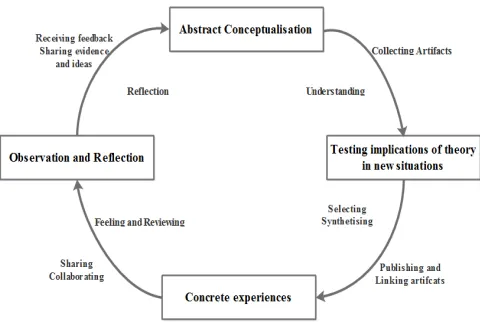
Kolb's learning theory paradigm (known as the Kolb’s Experiential Learning Cy-cle) sets out four distinct learning styles, which are schematized on a four-stage learn-ing cycle. Kolb suggested, that any form of learnlearn-ing to be complete and effective requires that learner traces all the foundation of his learning flowing the cycle of four phases (Figure 1): Concrete Experience, Reflective Observation , Abstract Conceptu-alization ,and Active Experimentation
According to Kolb theory paradigm, an effective learning is achieved when a learner progresses over a cycle of four stages. In the Kolbian Cycle, the process be-gins having a concrete experience which means doing something in which the learner is assigned an experience (a new experience or a reinterpretation of existing experi-ence), which is followed by a reflective observation on that experience. In this stage, the learner takes time-out from ‘experiencing and doing’, he asks various question related to the experience and reflects what has been accomplished and experienced. The Reflective Observation is then followed by the Abstract Conceptualization stage, in which the learner tries to form and conceptualize theory concepts about what they have done, and what is already known about an experience. In other words, the learn-er tries to genlearn-eralize a theoretical model of what is practiced. Finally, the learnlearn-er car-ries on to apply the generalized model to a new experience and situation [18].
The last stage ‘Active Experimentation’ leads to start another cycle to generate an-other concrete experience and new learning which is then followed by new reflection, observation and, based on them, reformulates the principle and again applies it. As shown in the figure1 and as described above, the Kolbian model is visualized as a cyclic process that repeats itself but each time on a more refined or sophisticated level due to the additional knowledge gained from the previous circle. According to Kolb in which views learning as an integrated process can be characterized as an iterative cycle. Each stage is an auxiliary and complement into the next. Thus, the learner is able to enter the learning cycle at any point and follows it through its logical se-quence.
Using Kolb's paradigm of experiential learning to design and structure learners' web-based learning activities also helps us understand critical issues of remote student engagement, achievement, and satisfaction. Likewise, in [19] authors have conducted the following criteria about the assurance factors that impact student engagement, achievement, and satisfaction during online learning experiences:
• Knowledge is constructed.
• Students are responsible for their own learning. • Higher-order learning requires reflection. • Learning is unique to the individual. • Learning is experiential.
• Learning is both social and private.
4
Physical Setup
The system includes a mixture of works divided into hardware and software. The hardware involves a working test that can be digitally controlled by computer and embedded controller. The software consists of a graphical user interface that allows users to control the test stations in a manner which closely resembles controlling the equipment in the real laboratory [20] - [21].
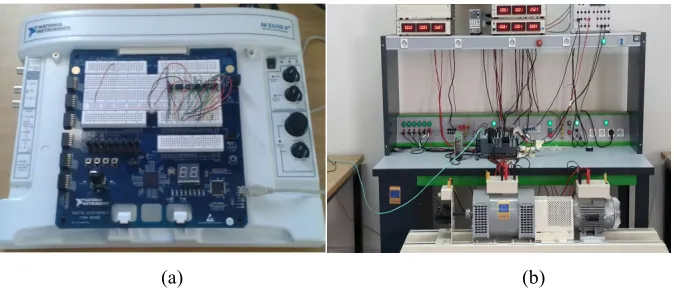
The first laboratory in electrical machine which consists of a real-time system to control remotely a synchronous machine includes several experiments such as (Figure 2 (b)):
• Real-time determination of the parameters of Open Circuit Characteristics (OCC); • Real-time determination of the parameters of Short-Circuit Characteristics (SCC); • Load test on synchronous machine;
• Synchronous reactance Xs.
The second laboratory in digital electronics includes several tests and experiments such as (Figure 2 (a)) [35]:
• Combinational logic circuits based experiments; • Sequential electronics based experiments.
(a) (b) Fig. 2. Physical infrastructure
5
Student’s Personal Learning Environment
5.1 LMS Moodle
participate in online activities as: online discussions, communication with students or instructors, assessments, online project/collaborative work, which replace part of face-to-face teaching and learning activities.
5.2 RLMS ISA
The ISA is a remote laboratory management system developed by the CECI at the MIT. The ISA provides a common framework on which laboratory instrumentation can be integrated to create remote laboratories that allow students to conduct and run laboratory equipments remotely through the internet, also designed to use online labs to scale a large number of users geographically dispersed through the world. ISA, based on Web Services, provides a three-tiered architecture software framework de-signed for enabling institutes easily sharing different remote laboratories across the world. This architecture consists of a Lab Clients, Service Broker middleware, and Lab Servers. The service broker is the heart and the component responsible for providing generic functionalities such as managing, scheduling, data storage. It also provides all management resources and experiments [22].
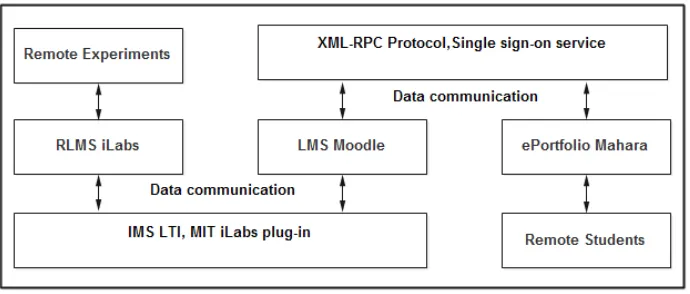
The idea to integrate remote laboratories, deployed into RLMS ISA, into LMS Moodle gives students and teachers the easy way to meet and where students find more educational resources [29]. Thus, this linkage in a single environment provides an integral environment to students and use learning content and remote experiment using the same credentials. The integration tool is called Lab Manager which connects the LMS Moodle with the RLMS ISA. So, students are able to perform a remote ex-periment with a single sign on directly from Moodle connect to RLMS ISA platform, more details about the tools are available in : https://github.com/gateway4labs/ rlms_ilabs/.
5.3 E-Portfolio
Modern technologies have widely changed the way in which learners in higher ed-ucation learn and experience, particularly in terms of access and use. A concept of current interest that foster the personalization, collaboration, and creativity of learners – is so-called e-portfolio [23] [24]. The e-portfolio is a paradigm, based on the Infor-mation and Communications Technology (ICT), in which learners are able to store all resources and knowledge in electronic form [25]. An e-portfolio, as one application of PLE, is a digitized collection of artifacts for teachers, learners, and institutes. Fur-thermore, learners can build their own e-portfolios following defined goals and objec-tives; they manage and control themselves to be more autonomous in the learning process and to promote decisions-making with the teacher’s guidance [24]- [25].
learning cycle that illustrates the process of continuous learning based around dia-logue and collaborative activity with others. The Kolbian cycle includes learner-centered learning and the learners have to become more active and responsible for their own learning. The e-portfolio system is perfectly adapted to support the Kolb's Experiential Learning Model because it has to do with planning, sharing, learning by doing, reviewing, and reflecting on previous evidence.
They are various solutions to implement e-portfolios, in this work we are using the Mahara open source which can be easily combined with the LMS Moodle already used as to deliver theoretical courses for our learners. The combination, or the integra-tion, of Moodle and Mahara, is officially called “Mahoodle” [31]; this integration is usually to create a complete and compressive learning environment using single sign-on as well the transfer of csign-ontent (Figure 3).
Fig. 3. Data integration (ISA & Moodle, Moodle and Mahara)
In order the foster the active learning, the e-portfolio presents a powerful tool that allows learners and teachers, to product and manages virtual space for personal, aca-demic and professional purposes.
e-portfolio as a tool for Assessment. Assessment, alternative assessment, is a
fundamental component of the educational process for any level and curricula. [13] defines that an alternative assessment is : “any method of finding out what a student knows or can do that is intended to show growth and inform instruction and is not a standardized or traditional test”. In this regard, the alternative assessment its more focused on learner’s knowledge, performance, growth and skill development. In fact, a teacher needs to assess this process and identify learners knowledge, abilities, and achievements behind a course or module. In recent years e-portfolios have been used in higher education as an assessment tool by many educators and universities. It al-lows the teacher to better track the progress of learners and their achievements for specific or different goals [26].
• Solution of the exercises and reflection /questions, ideas, and about some specific goals;
• Measurements, equipments /procedures, results, and discussion about remote ex-periments as well lab report;
• Collaborative or personal project about digital systems and power electronics; • Many online experiments, virtual experiments, was embedded into Moodle;
learn-ers in this case are able to compare between realistic and virtual data as well link-ing the theory and the practice.
A set of large variety of question types can be used by teachers to evaluate student learning, for summative assessment, at the end of an instructional unit. The questions include: multiple choices, unique choice, true-false, and short answer questions. Thus, summative assessments are often high stakes, which contains midterm and final exam. Furthermore, learners can submit any digital content to her/his teachers directly using Moodle.
Learning by doing using e-portfolio. By creating and designing their own
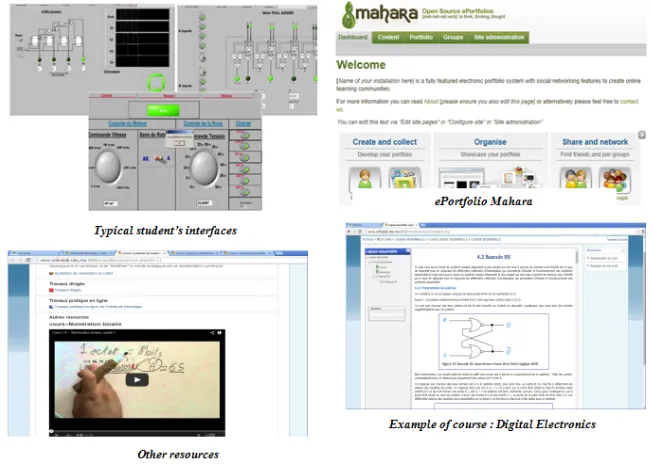
e-portfolios system, learners can demonstrate authentic learning. Moreover, they can exhibit their works, projects, links and resources about specific goals or aims. For example, learners perform an experience of digital electronics (such as: 4 binary counter) or electrical machine (such as: determination of the synchronous reactance experiment). In this sense, learners are able to discuss and analyze graphical diagrams and chronograms as well as they see the behavior of circuits. Likewise, they use the synchronous and asynchronous communication offered to discuss and analyze the results, thoughts of these experiments also about what has been done and experienced. All the learners are requested to write up a lab report (achievements, measurements thoughts, and ideas, etc) for each experiment performed and submit it using Moodle. Learners submit their lab report to specific folders which could be accessed by their teachers. After providing comments and remarks, learners share their lab reports with other learners using e-portfolios. In this way, learners become authors/designers and publishers of the e-content with a minimum level of guidance. In fact, this collection of structural knowledge, social interaction, social constructivist approach, foster the learners creativity to work towards valuable education goals. Furthermore, It is im-portant to note that these criteria allow the student to better understand and identify their gaps in a specific goal during the learning by doing (Figure 4).
e-portfolios as a Gateway between university and company. The courses in the
21st-century technology skills and demonstrate their competencies and store their works, internships, personals and collaborative projects/realizations in the aforemen-tioned fields that may not be demonstrated on a traditional résumé or during an inter-view. In this way, supervisors in the company are able to access from any Internet-enabled computer to student’s e-portfolio and see what the student has acquired dur-ing his/her 3 years study in this field. Besides, durdur-ing the traineeship the student can still work, and update her/her e-portfolio with new knowledge, skills, and competen-cies. Generally speaking, the e-portfolio will allows student as a trainee to:
• Reflect on theory and practical knowledge acquired through the new experience in the company;
• Capture and record the relevant experiences, artifacts, and skills that reflect profes-sional growth during the traineeship;
• Show commitment, individual endeavor, and creativity during the traineeship.
Fig. 4. Student’s learning environment
6
Conclusion and future works
learning by experience using a personal learning approach. Furthermore, this educa-tional method that calls for reflection, analysis and planning can directly involves the learners by actively encouraging them to do something in order to observe and under-stand what is happening and experiencing.
Through our experience by using and combining ISA and Mahoodle platforms, Moodle and Mahara, we can conclude that this combination is a good tool to link learners and teachers and vice versa. The e-portfolio has the potential as an effective tool in learning by doing to enhance the creativity, communication, collaboration and learning process among students. Thus, it may be used to support lifelong learning activities through embedding and storing tools electronically for professional skills and needs.
Regarding future work, ongoing efforts are focused on analyzing and examining of the students’ attitudes towards the use of e-portfolio's as a teaching tool in higher education.
7
References
[1]A. J. Feisel, Lyle D.; Rosa, “The role of the laboratory in electrolyte therapy” Can. J. Med. Technol., vol. 16, no. 1, pp. 1–4, 1954.
[2]R. Millar and I. Abrahams, “Practical work!: Making it more effective,” vol. 91, no. Sep-tember, pp. 59–64, 2009.
[3]A. Mohtar, “A Remote Laboratory for Testing Microelectronic Circuits on Silicon Wafers under a Microscope,” University of South Australia, 2009.
[4]M. S. T. Abuelela, “Laboratory as a Service (LaaS): a Paradigm for Developing and Im-plementing Modular Remote Laboratories,” National University of Distance Education, 2013.
[5]E. Sancristobal, M. Castro, J. Harward et al., “Integration view of web labs and learning management systems,” in Education Engineering (EDUCON), 2010 IEEE. IEEE, 2010, pp. 1409–1417.
[6]P. Orduna, E. Sancristobal, M. Emaldi, M. Castro, D. Lopez-De-Ipina, and J. Garcia-Zubia, “Modelling remote laboratories integrations in e-learning tools through remote la-boratories federation protocols,” Proc. - Front. Educ. Conf. FIE, pp. 1–6, 2012.
[7]R. Puerto, L. M. Jimenez, O. R. C. Fernandez, and R. Neco, “Remote control laboratory using MATLAB and Simulink: Application to a DC motor model,” Comput. Appl. Eng. Educ., vol. 18, no. 4, pp. 694–702, Dec. 2010. https://doi.org/10.1002/cae.20274
[8]C. Patterson, M. Stephens, V. Chiang, A. M. Price, F. Work, and E. Snelgrove-clarke, “The significance of personal learning environments (PLEs) in nursing education: Extend-ing current conceptualizations,” NEDT, vol. 48, pp. 99–105, 2016.
[9]Kimberly DeLong, V. Judson Harward, Philip Bailey, James Hardison, Gordon Kohse, Yakov Ostrocsky “Three Online Neutron Beam Experiments Based on the iLabShared Ar-chitecture”, Education Engineering (EDUCON), Madrid, pp.145 – 150, 14-16 April 2010. [10]Hardison, J., DeLong, K., Bailey, P., Harward, V.J., "Deploying Interactive Remote Labs
Using the iLab Shared Architecture," Frontiers in Education (FIE) Conference, Saratoga Springs, New York, October 22-25, 2008. ILab https://doi.org/10.1109/FIE.2008.4720536
[12]Isaksson E, N. A, L. P, and W. F, “Towards a Reference Architecture for Smart and Per-sonal Learning Environments,” in Innovations in Smart Learning, Springer Singapore, 2016, pp. 79–88.
[13]O. L. Colin D. Milligan, Phillip Beauvoir, Mark W. Johnson, Paul Sharples, Scott Wilson, “Developing a Reference Model to Describe the Personal Learning Environment,” in First European Conference on Technology Enhanced Learning, 2006, pp. 506–511.
[14]M. Abdulwahed, “Towards Enhancing Laboratory Education by the Development and Evaluation of the ‘Trilab’ -- a Triple Access Mode (Virtual, Hands-On and Remote) La-boratory,” 2010.
[15]J. M. Applefield, R. Huber, and M. Moallem, “Constructivism in Practice and Theory: Toward a Better Understanding,” High Sch. J., vol. 84, no. 2, pp. 35–53, 2001.
[16]L. Harasim, Learning Theory and Online Technologies. 2012.
[17]D. A. Kolb, Experiential learning: experience as the source of learning and development. 1984.
[18]L. Ngoyi, “enefits and Challenges Associated with Using Virtual Laboratories and Solu-tions to Overcome Them,” Virginia State University, 2013.
[19]J. Dunlap, J. Dobrovolny, and D. Young, “Preparing e-Learning Designers Using Kolb’s Model of Experiential Learning,” J. Online Educ., vol. 4, no. 4, 2008.
[20]Naddami, A., Fahli, A., Gourmaj, M. and Moussetad, M. (2014), Determination of the synchronous machine's parameters using the iLab Shared Architecture ", IJOE, Vol 10, No 3 .
[21]Naddami, A., Fahli, A., Gourmaj, M. Pester, A. and Oros, R. (2014), Importance of a net-work of online labs in magrebian countries Proceedings of the IEEE , REV14 Conference, pp.77-78, Porto 26-28 February, 2014
[22]Harward, V.J., et al (2008), "The iLab Shared Architecture: A Web Services Infrastructure to Build Communities of Internet Accessible Laboratories," Proceedings of the IEEE, vol.96, no.6, pp.931-950. https://doi.org/10.1109/JPROC.2008.921607
[23]L. Valdez, O. Malley, and J. Michael, “Performance and Portfolio Assessment for Lan-guage Minority Students,” 1992.
[24]C. P. C. Terkowsky, D. May, T. Haertel, “Integrating Remote Labs into Personal Learning Environments-Experiential Learning with Tele-Operated Experiments and E-Portfolios,” Int. J. Online Eng., vol. 9, no. 1, pp. 12–20, 2013. https://doi.org/10.3991/ijoe.v9i1.2364
[25]Ruhizan M.Y, Norazah. M. N, and Bekri. R, “Vocational Education Readiness In Malaysia On The Use Of E-Portfolios,” J. Tech. Educ. Train., vol. 6, no. 1, pp. 57–71.
[26]E. Ntuli and J. Keengwe, “Electronic portfolios in teacher education: A case study of early childhood teacher candidates,” Early Child. Educ. J., vol. 27, no. 2, pp. 21–22, 2009.
https://doi.org/10.1007/s10643-009-0327-y
[27]K. S. Mazlan, L. Khoo, M. Sui, and Z. Jano, “Designing an Eportfolio Conceptual Frame-work to Enhance Written Communication Skills among Undergraduate Students,” Asian Soc. Sci., vol. 11, no. 17, pp. 35–47, 2015. https://doi.org/10.5539/ass.v11n17p35
[28]B. Wuetherick and J. Dickinson, “Why ePortfolios ? Student Perceptions of ePortfolio Use in Continuing Education Learning Environments,” Int. J. ePortfolio, vol. 5, no. 1, pp. 39– 53, 2015.
[31]Mahoodle. (2017, January 20). [Online]. Available: https://docs.moodle.org/29/en/Mahoodle
[32]Moodle. (2017, January 20). [Online]. Available: https://moodle.org [33]Mahara. (2017, January 20). [Online]. Available: https://mahara.org/
[34]Stephen Downes. (2016, October 13). [Online]. Available: http://www.downes.ca/post/
[35]Online laboratory in Digital Electronics using NI ELVIS II+, Naddami.A, Fahli.A, Gour-maj.M, Moussetad.M, Proceedings of the IEEE , IMCL14 Conference, pp. 120 - 124, 2014
8
Authors
Mourad Gourmaj (corresponding author) is with the MATIC Laboratory,
De-partment of Electrical Engineering, The Polydisciplinary Faculty in Khouribga, Has-san 1st University-Settat 26000, Morocco (e-mail: [email protected]).
Ahmed Naddami is with the MATIC Laboratory, Department of Electrical
Engi-neering, The Polydisciplinary Faculty in Khouribga, Hassan 1st University-Settat 26000, Morocco (e-mail: [email protected]).
Ahmed Fahli is with the MATIC Laboratory, Hassan 1st University-Settat 26000,
Morocco (e-mail:[email protected]).