Evaluate Technical Process for Vietnamese Rubber Plants
Author’s Details: (1)
Thi Thu Hoai Pham-University of Economic and Technical Industries (2)
Thi Thu Hien Phan, PhD-University of Economic and Technical Industries
Correspondence: Thi Thu Hien Phan No. 296/61/12 Linh Nam Street, Hoang Mai District, Hanoi, Vietnam. E: [email protected]; T: +(84) 0914 915 926
Abstract:
The paper presents the current status of the technical process of planting rubber trees in Vietnam. We have analyzed the technical process for rubber trees from the selection of rubber seedlings, the time of planting rubber trees appropriately, density, method of fertilizing, pests and diseases, the exploitation and preservation and processing. Latex. From the above situations, we offer solutions for sustainable development of rubber trees in Vietnam
Keywords: Technical process, rubber tree, Vietnam
1. Introduction
Rubber trees (Heavea brasiliensis Muell.Arg) originating from the Amazon basin (South America), were successfully introduced into Vietnam since 1897. Rubber trees are grown in the South East region (46.4 %), mainly Binh Phuoc, Binh Duong, Tay Ninh, and Vung Tau provinces.
Rubber is an industrial tree with great economic value, contributing significantly to the development of the national economy. In addition, rubber is also considered an agro-forestry plant, thus contributing to protecting the environment, settling social security, creating stable jobs for farmers, especially farmers in remote areas. far.
Rubber trees are highly effective in hilly land, bringing income to producers, contributing to the economic development of the whole country. The economic value of rubber trees has changed the face of the countryside and the lives of farmers. Therefore, rubber trees have been developed spontaneously by people on many unsuitable areas of topography, soil and unfavorable climate conditions for planting rubber trees. Spontaneous development does not follow planning; have not strictly followed the technical process but some stages have been ignored such as lack of windbreaker belt; some households exploiting rubber in the way of "squeezing out" makes rubber trees grow poorly; not attaching importance to using breeds suitable to stormy areas, using rubber varieties of different types and origins; Inadequate and inadequate fertilization, rubber care has not been focused such as pruning, creating canopy, pest control ... Vietnam is located in the tropical monsoon climate and divided into two The season is clear.
The rainy season is from September to March next year. The average rainfall is 1,600 - 2,800 mm / year, the rainy period is concentrated in September, October, and November. The dry season is from April to August with an average temperature of 24 - 250C, the highest temperature in three months in June, July, and August. Average temperature increases gradually from North to South, from West to East. Radiation balance reaches 70 - 80 kcal / cm2. The average number of sunshine hours is about 1,700 - 2,000 hours.
With the climate and weather characteristics of Vietnam, the above is quite suitable for the development of rubber plantation: Temperature 25 - 300C; there is no hoarfrost in winter; the average annual rainfall is over 1,500mm; There are few strong winds on level 8. These are the first criteria in agricultural production to affirm that rubber trees can grow and develop in accordance with ecological conditions in Vietnam.
2.1. Rubber varieties
Breeding is the leading factor in agricultural production; it plays an important role in resistance to storms and winds, resistance to pests and diseases, thus determining the productivity and quality of rubber latex.
The rubber varieties used before 1990 are mainly GT1 varieties (> 50% area), PB235, PB86 ... these varieties have high latex yield but are resistant to wind storms and are vulnerable to deep sick. In addition, households that grow smallholder rubber mainly get unidentified seeds (H Hop 23, H Phuc 6) from private establishments with unclear seed supply so rubber trees grow and develop. Poor, pests and diseases, low latex yield.
From 2015 onwards, thanks to scientific and technical progress, many new rubber varieties have been selected from Vietnam Rubber Research Institute with high latex yield and quality, good tolerance, high growth areas. In the whole country, gradually replacing rubber varieties with low productivity, the area of using rubber varieties across the country increased, mainly using the same as RRIM600; RRIM712; RRIC100; RRIC121 ... has good resistance to storms and wind, so the productivity and quality of latex are increasing.
In order to improve productivity and quality of rubber latex while being able to withstand storms and pests, work-related solutions should be implemented as follows:
- Using rubber seed from reputable establishments (should get rubber from the facilities of Vietnam Rubber Research Institute.
- Follow the recommendations of the structure of the Ministry of Rubber Research Institute of Viet Nam using the varieties suitable to each ecological region, as follows:
+ Use 60% of the area, each of <20 areas: RRIM 600, RRIM 712, RRIC 121, RRIV 1.
+ Use 30% of the area, each of <10 areas: RRIV 1, RRIV 103, RRIV 106, RRIV 124, IAN 873, GT1.
+ Using 10% of the area, planting up to 10ha each resembles the series of clones RRIV 100 (RRIV 101 to 125) and the range of RRIV 200 (RRIV 201-21) in addition to the above mentioned RRIV lines.
- Using rubber varieties that are resistant to storms and windstorms (creating a rubbery stem with many original stems) to limit the possibility of breakage.
2.2. Part time
The planting time of rubber trees greatly affects the survival rate, resistance to pests and diseases, and affects the productivity and quality of rubber latex. The planting of rubber trees at the same time with the planting of other forest trees, the time of the beginning of the rainy season (the time of planting bare trees from September 15 to October 15, the planting of pots and poles from January 15 - February 15). Ceiling tum planting form is mainly because of favorable transportation, cheaper price than tum gourd.
As recommended by the Vietnam Rubber Research Institute, rubber planting time in the North Central region is from February 1 to April 15 and it is recommended to grow pots. In order to improve the survival rate of rubber trees, saving the cost of rubber growing areas across the country needs to strictly implement rubber planting and planting when the weather is favorable, gaining enough moisture and planting in the right time. and need to finish planting in a period of 1 month (September 15 - October 15) and should plant pots for low temperature mountainous areas.
2.3. Density, distance, and planting
rubber growing areas in our country is not high. Planting rubber with an unreasonable density will make plants grow poorly, prone to pests and diseases, low latex yield and quality.
In fact, rubber growing areas in our country have not complied with the density and planting distance on the basis of land class (soil quality). Smallholder rubber plantations and both rubber plantations are grown at a density of 555 trees/ha (6m x 3 m), 800 trees/ha (5m x 2.5m) and mainly 666 trees/ha (6m x 2.5m)
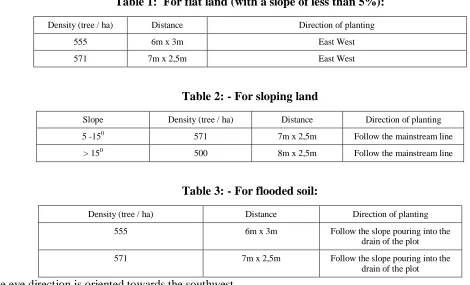
Therefore, when designing new rubber trees, it is necessary to base on the land class and fertilizer regime, rubber tree care regime in accordance with the technical process of the unit. Density, distance, and rubber plantation should follow the recommendations of the Vietnam Rubber Research Institute as follows:
Table 1: For flat land (with a slope of less than 5%):
Density (tree / ha) Distance Direction of planting
555 6m x 3m East West
571 7m x 2,5m East West
Table 2: - For sloping land
Slope Density (tree / ha) Distance Direction of planting
5 -150 571 7m x 2,5m Follow the mainstream line
> 150 500 8m x 2,5m Follow the mainstream line
Table 3: - For flooded soil:
Density (tree / ha) Distance Direction of planting
555 6m x 3m Follow the slope pouring into the
drain of the plot
571 7m x 2,5m Follow the slope pouring into the
drain of the plot
- The eye direction is oriented towards the southwest.
2.4. Fertilizer
Fertilizer is one of the important factors affecting the yield and quality of rubber latex, adequate and balanced fertilizer will achieve maximum latex yield and provide good quality latex.
Fertilization should be based on soil type, each stage of rubber tree development, thereby determining the dosage and type of fertilizer accordingly.
In fact, the application of fertilizer on rubber trees in the rubber growing households in Vietnam does not follow the proper procedures for fertilizer types, fertilizer rates, number of fertilizing times, the timing of fertilizer application and application.
- Type of fertilizer: Most of rubber growing areas do not use manure fertilizing, mainly using fused phosphate, thus greatly affecting the ability of root development, not improving quality soil fertility, does not promote effective inorganic fertilizer.
the procedure (only apply 1-2 times while the procedure recommends 2-3 times of fertilizing in the year). Therefore, the plants do not absorb all the fertilizer but do not promote effecting of fertilizer just wastes fertilizer.
Solutions to improve the efficiency of fertilizer application and fertilizer application for rubber trees need to follow the fertilizer process as follows:
- Using specialized fertilizers for rubber trees or perennial industrial plants.
- Applying the right dose according to the instructions; fully implement the number of fertilizing times (2-3 times a year); apply at the right time (apply fertilizer when the soil is moist enough, do not apply fertilizer at the time of heavy rain or in the rainy season; for areas affected by the damage, the final fertilizer application must be completed before October every year).
- Basal fertilizing needs to use organic fertilizers in combination with inorganic fertilizers to improve soil fertility, especially for poor soil areas.
- Construction of multi-purpose pits using fertilizer and green press.
2.5. Planting forest belts to prevent wind
Windbreak forest belts play an important role in resisting wind and storms of rubber trees. In rubber plantations, when planting new rubber trees, they plant windbreak forest belts with trees such as Golden Melaleuca, Acacia hybrid, Eucalyptus ... For smallholder rubber, there is almost no windbreak forest belt. Because the rubber plantation area of each small household is only a few hectares, most households have an area of 30ha. Therefore, in order to make the most of the land fund, households do not plant windbreak forest belts, so when there is a storm of wind, rubber trees break down very large.
The solution for planting windbreak forest belt is very necessary for the rubber plantation area (the terrain is close to the sea, often affected by many storms), when designing the forest belt, the following criteria must be ensured:
- Avoid the harmful wind direction: The direction of these types of wind depends on the terrain of each region, each locality, namely the northeast monsoon, Lao wind, storm, and wind terrain, so the process of designing Windbreak forest belts should be based on the actual situation to determine the correct wind direction. When arranging main forest belts, make sure the wind angle is greater than 600 and not less than 450, preferably 900 (perpendicular to the wind direction).
- Structure of forest belt with many layers: It is recommended to design the forest belt with 2-3 canopy layers, but every floor is sparse, the holes are evenly distributed on the vertical section of the forest belt, the wind coefficient is <0.5).
- Structure of tree species: It is recommended to plant 2-3 trees. Selecting trees to plant windbreak forest belts must be woody plants, perennial trees, evergreen with thick foliage, solid stems, developed root systems that are deep, wide, resistant to many harsh conditions Using trees for wind breaking forest belts for rubber trees, having economic value such as Casuarina, Eucalyptus willow and Acacia auriculiformis.
- The width of the forest belt: The larger the width of the forest belt, the greater the scope of the windbreak but to ensure the production area and the ability of windbreak of the forest belt, it is recommended to plant forest belts with a width of 10 to 20m.
- Density and planting methods: The density of planting forest belts depends on the species selected for planting forest belts. For Casuarina, Eucalyptus and Acacia auriculiformis, the planting density is 2500 trees - 3300 trees/ha. Planting in a mixed manner on the goods.
- In addition, it is possible to use rubber trees planted in the windbreak forest belt, select rubber trees that are resistant to good windstorms.
2.6. Pruning buds create a canopy
Pruning shoots create a canopy for rubber plantations in the period of basic construction has a great meaning to the growth and development ability of rubber trees, especially affecting resistance to storms and winds.
In fact, the rubber plantation areas mostly do not do this work, so the branches and branches develop well to consume all nutrients, limiting the ability of the scion development to lead to low latex yield. Besides, without pruning, creating canopy before the rainy and storm season is one of the reasons that cause a lot of breakage due to the heavy stem stems resistant to poor stormy winds.
Therefore, in the process of caring for rubber, it is necessary to carry out the pruning of controlled buds in the first years of basic construction, creating canopy at a height of 2.5 - 3m. The gardens are not branched at a height of 3m or more from the 3rd year, then cut the tops to create a canopy. In the North Central region, it is necessary to cut the canopy tops in the spring crop. Before in the rainy season, pruning and cleaning of the garden should be conducted to limit breaks and pests.
2.7. Intercropping, original cabinets
Intercropping in rubber trees is a form of taking advantage of cultivated areas, planting short-term crops to increase income on the land area.
Rubber plantations all intercrop rubber trees in the first 2 years of the basic construction period. Many crops are used intercropping like legumes, pineapples, and a few intercropped with cassava. However, the gap of intercropping in rubber gardens has not complied with the techniques, there is no suitable method of care and fertilization, so the efficiency of intercropping is not high, especially the intercropping of cassava has caused soil degradation, no provide enough nutrition for rubber trees.
Solution for intercropping, original cabinets in rubber trees effectively:
- Selecting short-term non-competitive crops with rubber trees, preferably legumes (increasing the protein content of the soil), pineapples, can use bare-grown plants in the first 2 years.
- Intercropping trees are not hosts of the main diseases causing damage to rubber trees. Do not use cassava to intercrop.
- Must fertilize intercropped plants and when harvest needs to use excess plants legumes, vegetables to the original cabinet for rubber trees.
- Do not intercrop in rubber gardens with slope> 150
- Need to establish legume coverage from the first year and establish the legume cover date after stopping intercropping. The rubber growing areas affected by the northeast monsoon and Laos wind, the original cabinet work can be done up to the third year.
2.8. Pests and diseases on rubber trees
The prevention of pests and diseases on rubber areas in Vietnam has not been paid attention to, improper use of drugs, improper concentration and improper spraying of drugs, spraying of chemicals when pests cause rubber damage in the Severe diseases have caused pests and diseases to be drug-free and do not eradicate root pests and diseases. Besides, without pruning, creating weeds, cleaning weeds, plant residues in rubber gardens are also one of the causes of pests and diseases on rubber trees. In addition, rubber growing areas only use chemical drugs that cause environmental pollution and do not promote effective prevention effects after rubber diseases.
Measures to effectively control pests and diseases on rubber trees are to use integrated control measures (IPM), implement uniformity in the following stages: Land planning, breeding, and the seasonal selection and reasonable farming regime.
Rubber plantation land:
- Restricting planning, planting rubber trees in the highlands, where the climate is cold, the high air humidity in the rainy and winter months.
- The process of reclamation needs to cleanly destroy plants and forest trees, this is one of the sources of fungal diseases and termites that are harmful to rubber after planting.
- The flat areas, often flooded, must design a garden with a good drainage system, especially the gardens at the bottom of the hill.
Use of varieties:
- Rubber cultivars must have clear origins.
- Do not buy seeds from epidemic areas, nurseries have diseases.
- Need to treat the disease when putting rubber into cultivation.
- No monoculture of a clonal strain on a large area.
Planting season:
The most appropriate planting season is from September 1 to October 15 every year. Avoid planting late through November and December when the tree has not been restored to its roots and it has been cold or harmful. It should not be planted from January to August, this is the time when many pests and diseases cause damage to seedlings and drought, rubber cannot develop.
Farming regime:
- Ensure reasonable planting density, suitable for varieties, should not be planted thick.
- Fertilizing balanced and reasonable.
- Regularly weeding, cutting shrubs and clearing rubber tree gardens to limit the occurrence and damage of fungal diseases.
- Ensure basic construction time, do not open the shaving mouth too early when the tree is not enough size to shave. Do not open the shaving mouth too low, especially in the rainy season.
Using plant protection drugs to control pests when necessary, properly implementing 4 principles of pesticide use (right medicine, right concentration, right time, right method).
Harvesting latex is the final result of the process of planting and caring for rubber trees, which is the result of farmers' achievements after the care process. Through this work, we evaluated the productivity and quality of rubber varieties.
Rubber latex exploitation and harvesting should be based on the growth and development ability of rubber trees to determine the time to start tapping and to have appropriate tapping regimes to ensure the correct time of stay. Basic construction gardens before being put into exploitation by each type of land.
The situation of latex exploitation in rubber growing areas in our country is inadequate:
Firstly, it is often put into the exploitation of latex too early, the basic construction time is not enough and the diameter of the trunk is 1.0m less than 50cm from the ground, thus affecting the vitality of the rubber tree leading to low latex yield and quality.
Secondly, the high rate of rubber latex is too thick, according to the Rubber Research Institute's recommendation, the rate of tapping d3 (three days of shaving once) while in the rubber growing areas, the high-speed d2 (two days shaved once). Use of pus stimulants early when rubber trees are small.
Thirdly, the technique of shaving is not correct as of the process of scraping into the wood, not designing the specific shaving mouth together with the thick tapping rate, so the regenerating shells have not been developed yet. Important causes of ulcerative streak disease.
Therefore, in order to improve productivity and quality of rubber latex, it is necessary to strictly follow rubber harvesting and tending techniques in the business period as follows:
- Rubber trees reach the standard of shaving opening when the stem surface is 1,0m above the ground surface, 50cm or more, the shell thickness at the height is 1.0m above the ground from 6mm upwards.
- The rubber lot with basic construction from 70% of the trees to reach the standard of shaving is put into tapping.
- When the shaving is re-opened on the regenerated shell, the shell thickness must be from 8mm or more or regenerated shell over 10 years.
- Exploiting latex properly with technical standards, using stimulants in accordance with regulations.
- Perform the d3 shaving speed (once every three days). The high cycle of 10m / 12 (one month with 12 months, then shaving 10 months).
- Shave pus when plants have stable foliage. Take a break when the tree starts to have bird's feet and leave the garden when there are 30% of plants papillae.
- Stop shaving when the average air temperature for 3 consecutive days is 150C and shave again when the temperature is above 150C.
- Shaving depth of the statue level from 1 to 3 mm for both face upside down and face up. Avoid shallow scraping (scrape up to 1.3mm above the statue), scrape close (shaving 1mm below the statue), scrape off (shaving wood).
3. Conclusion
comply with the technical process of rubber trees, especially using unqualified rubber varieties, fertilizer is imbalanced and incomplete. , do not implement some care methods and improper exploitation regime, making rubber trees on the school grow poorly, productivity and quality are low.
Therefore, in order to develop sustainably and increasingly improve the economic efficiency of rubber trees in the coming time, it is necessary to implement integrated and synchronous solutions as follows:
Firstly, organize technical training for people planting rubber trees. Propagating and disseminating scientific and technological information to rubber growing areas should comply with rubber tree technical process as recommended by the Vietnam Rubber Research Institute and comply with Circular No. 58/2009 / TT-BNNPTNT.
Secondly, the State should have a mechanism to support and encourage the development of rubber trees and have a stable market for rubber products, implement agricultural insurance for rubber trees so that farmers can be assured of their investment. develop rubber trees in a sustainable and effective way.
References:
i. Vietnam Rubber Industry Group (2012). Technical process of rubber trees.
ii. Ministry of Agriculture and Rural Development (2009). Circular 58/2009 / TT-BNNPTNT dated September 9, 2009, Guiding the planting of rubber trees on forestry land.