TRANS Asian Research Journals
http://www.tarj.in 8
P u b l i s h e d b y : T R A N S A s i a n R e s e a r c h J o u r n a l s
TAJMMR:
T R A N S
A s i a n J o u r n a l o f
M a r k e t i n g & M a n a g e m e n t
R e s e a r c h
( A D o u b l e B l i n d R e f e r e e d & R e v i e we d I n t e r n a t i o n a l J o u r n a l )
SECURING DNS USING ECC
Preeti Thareja*; Mrs. Neeru Arora**
*Student,
Manav Rachna College of Engineering, Faridabad, India.
**Lecturer,
Manav Rachna College of Engineering, Faridabad, India.
ABSTRACT
The paper presents the concept of securing Domain Name System, DNS. Digital Signatures being very secure helps in providing good security to DNS. Software like BIND, OpenDNSSEC, Secure64 etc. involve signing of DNS using cryptographic algorithms (e.g., RSA, DSA etc.)[1]. Also, ECDSA is one way that provides same level of security, as provided by RSA for low power and portable devices[2]. So, proposing a new ECDSA implementation that can be used in securing DNS.
KEYWORDS: DNS; Cryptography; ECC; ECDSA; ECDLP.
____________________________________________________________________________
I. INTRODUCTION
A. DOMAIN NAME SYSTEM
DNS, Domain Name System is a protocol that resolves hostnames to IP Addresses. Since, human can easily grasp hostnames but to learn IP Addresses in a large amount is a difficult task for human, which is therefore, is performed by DNS[3].
TRANS Asian Research Journals
http://www.tarj.in 9
B. ELLIPTIC CURVE CRYPTOGRAPHY
1) Definition: Elliptic Curve Cryptography (ECC) is a kind of public key cryptography, based on the concept of elliptic curves. Elliptic curves are basically cubic equations of two variables, with coefficients. ECC uses only those elliptic curves, wherein the variables and coefficients are restricted to elements of a finite field[4].
In prime curves over Fp, the cubic equation has variables and coefficients in the set of integers
from 0 to p-1, where p is prime number. Prime curves are good for software applications since it doesn’t require any operations of bits[5].
Using the concept of Elliptic Curves over Fp as described in [5] to secure DNS.
2) Elliptic Curve Discrete Logarithm Problem (ECDLP): The ECDLP is the basis for the security[5].
Given a point R = k*P, where R and P are known, then there is no way to find out what the value of ‘k‘is. Since, there is no point subtraction or point division, to resolve k = R/P.
Also, computing k requires roughly 2n/2 operations. If the key size is 192 bits, then 296 operations are to be done which would take millions of years.
This thing where the multiplicand can’t be found even when the original and destination points are known is the whole basis of the security behind the ECDSA algorithm, and the principle is called a trap door function or ECDLP.
II. DNS SECURITY
A. NEED OF SECURITY
Since DNS is an open source system, there can be fakers who can change the information served by the DNS to the clients. This attack is known as DNS Spoofing. The Scenario is as follows: when the client sends a request to the DNS server to know the IP Address, it sends its ID with the Query. By identifying that ID, an Attacker can send malicious data to the client or redirect the client to an unwanted site[4].
TRANS Asian Research Journals
http://www.tarj.in 10
The Idea behind it is that every node in Domain Name Space has a Public Key and each message from DNS Servers is signed using Private Key. Since DNS is Public, Authenticated DNS root Public Keys are known to all, which are used to generate Certificates/Signatures to combine the identity information of Top Level Domain. So, in Domain Name Space each parent signs the Public Keys of all its Children in the DNS tree[6].
B. SECURING DNS WITH ECC
Securing DNS means providing- Data Authentication (Origin is authentic) and Data Integrity (Information is not modified). Confidentiality is not required since DNS is public.
The public key algorithms used for authentication in DNSSEC are MD5/RSA (Rivest Shamir Adelman Algorithm) and DSA (Digital Signature Algorithm). The digital signatures generated with public key algorithms have the advantage that anyone having the public key can verify them. Also, ECDSA is growing in industry[5] for security purpose.
With the technology growing faster everyone accesses internet through mobile phones whether it is used to check E-Mails or visiting any secure sites, ECC (Elliptic Curve Cryptography) can be implemented. ECC provides same level of Security as RSA with benefits of small key sizes, faster computation, and memory and energy savings[7].
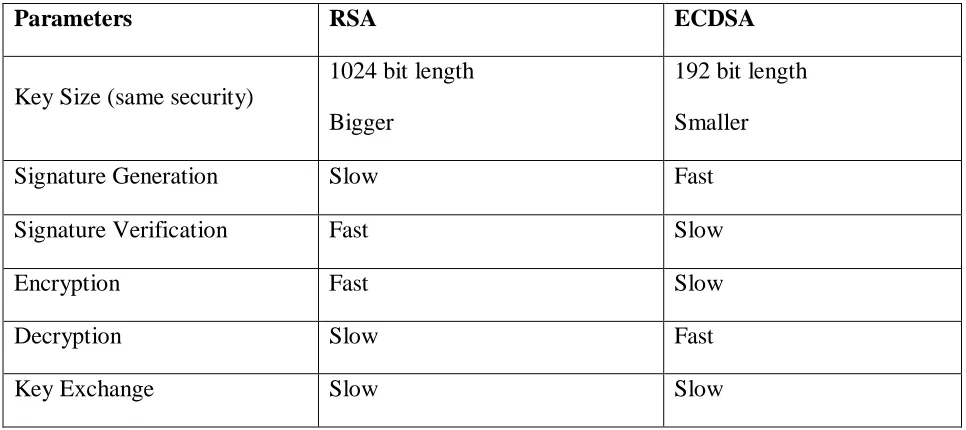
1. SMALL KEY SIZE AND FASTER COMPUTATION: The security level of 160-bit ECC and 1024-bit RSA is same[8]. RSA operations are based on modular exponentiations of large integers and security is based on factoring these large integers. On the other hand, ECC operations are based on groups of points over elliptic curves and security is based on discrete logarithm problem (ECDLP). This allows ECC to have the same level of security with smaller key sizes and higher computational efficiency.
TRANS Asian Research Journals
http://www.tarj.in 11
TABLE 1 RSA VS. ECDSA
Parameters RSA ECDSA
Key Size (same security)
1024 bit length
Bigger
192 bit length
Smaller
Signature Generation Slow Fast
Signature Verification Fast Slow
Encryption Fast Slow
Decryption Slow Fast
Key Exchange Slow Slow
III. ECDSA IMPLEMENTATION OVERVIEW
The key parameters are the same as recommended by NIST but there is a change in signing and verifying process.
A. KEY PARAMETERS
For the ECDSA implementation, there are some predefined parameters used, as follows:
1. Select a prime number (p) of large size.
2. Choose constants (a and b) such that (4a3+27b2) modulo p is not equal to 0.
3. Generate elliptic curve points Ep (a, b), where Ep (a, b) is a generalized term for elliptic curve points (x, y).
4. Choose generator point (G) of order n, where order is number of points in the elliptic curve.
5. Select d such that 1 < d < n-1. This is used as private key.
These parameters are recommended by NIST for federal government use and includes elliptic curves of various bit lengths (e.g., 192, 224, 256, 384, 521 etc.)[9].
6. Generate public key Q such that Q = d.G, where ‘.’ Is point multiplication for ECDSA
TRANS Asian Research Journals
http://www.tarj.in 12
B. SIGNATURE GENERATION
1. Select a random number k to be used only once, that is, for every new signature generation of a message, a new k is selected, such that 1 < k < n-1.
2. Generate (r, s) component of signature such that
a.k.G = (x, y)
r = x modulo n
if r = 0 then repeat 2 again
b.Calculate hash of message (M) whose signature is to be generated, i.e., e = h (M).
c.s = d(r*k – e)-1modulo n // changed
C. SIGNATURE VERIFICATION
1. Calculate u1 = e*r-1 modulo n // changed
2. Calculate u2 = (r*s)-1 modulo n // changed
3. Calculate T = u1.G + u2.Q = (x1, y1), where ‘.’ is point multiplication and ‘+’ is point
addition and can be calculated using elliptic curve arithmetic.
4. Calculate v = x1 modulo n
5. If v = r, signature is valid.
The above proposed algorithm is a variant of the algorithms as described in [10], providing less complexity in signing.
There is software that provides security to DNS, such as:
1. OpenDNSSEC is a DNS zone signer[11].
2. Secure64 is a complete DNS and DNSSEC appliance for security purpose and is
automatic[12].
3. BIND is for zone signing[13].
TRANS Asian Research Journals
http://www.tarj.in 13
D. COMPARISON OF ALGORITHMS
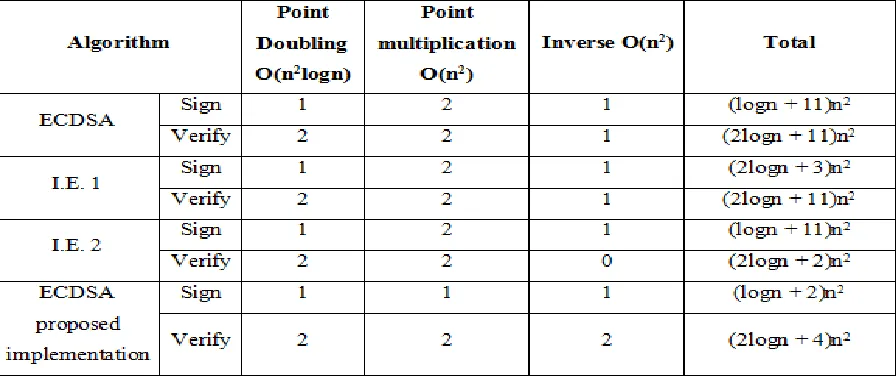
The complexity comparison of four ECDSAs is shown in table 2[10]. The four ECDSA are:-
1. Original ECDSA
2. ECDSA by Hu Junru[10] (I.E. 1)
3. ECDSA by Hu Junru[10] (I.E. 2)
4. ECDSA proposed implementation
TABLE 2 ALGORITHM COMPLEXITY COMPARISON
IV. CONCLUSION
There are various security measures adopted in DNS using public key cryptography, which includes RSA and DSA. With the technology growing day by day, there is a need of same level of security with smaller key sizes. Now, everyone uses mobile to retrieve data from internet and mobile being small and portable device needs security with less power consumption. This can be done with the help of ECC by implementing ECDSA in DNS.
REFERENCES
[1] Features of OpenDNSSEC [Online]. Available: http://www.opendnssec.org/features/
[2] Neetesh Saxena, Narendra S. Chaudhari, Secure Encryption with Digital Signature
Approach for Short Message Service, 978-1-4673-4805-8/12/$31.00©2012 IEEE.
[3] Suranjith Ariyapperuma and Chris J. Mitchell, Security vulnerabilities in DNS and
TRANS Asian Research Journals
http://www.tarj.in 14
[4] Aqeel Khalique Kuldip Singh Sandeep Sood, Implementation of Elliptic Curve Digital
Signature Algorithm, International Journal of Computer Applications (0975 – 8887), Volume 2 – No.2, May 2010.
[5] ECC Tutorial. [Online]. Available: http://certicom.com/index.php/ecc-tutorial
[6] Antonio Lioy, Fabio Maino, Marius Marian, Daniele Mazzocchi (May 22-25, 2000). DNS
Security. Terena Networking Conference in Italy.
[7] Vivek Kapoor, Vivek Sonny Abraham, Ramesh Singh, Elliptic Curve Cryptography, May
20-26, 2008. ACM Ubiquity, Volume 9, Issue 20.
[8] Nils Gura, Arun Patel, Arvinderpal Wander, Hans Eberle, Sheueling Chang Shantz,
Comparing Elliptic Curve Cryptography and RSA on 8-bit CPUs.
[9] Recommended Elliptic Curves For Federal Government Use, July 1999. [Online].
Available: http://csrc.nist.gov
[10] Hu Junru, The Improved Elliptic Curve Digital Signature Algorithm, 2011 International Conference on Electronic & Mechanical Engineering and Information Technology.
[11] Domain Name Security Extnsions (DNSSEC). [Online]. Available:
https://www.menandmice.com/resources/articles/dnssec/
[12] Joe Gersch and Dan Massey, Deploying DNS Security (DNSSEC) in Large-Scale
Operational Environments, Cybersecurity Applications & Technology Conference For Homeland Security.
[13] BIND, Internet Systems Consortium. [Online]. Available:
http://www.isc.org/products/BIND/
[14] Ramaswamy Chandramouli and Scott Rose, Challenges in securing the domain name
system, US National Institute of Standards and Technology, The IEEE Computer Society, 2006.
[15] Giuseppe Ateniese , Stefan Mangard , A New Approach to DNS Security (DNSSEC).
[16] D. Sravana Kumar, CH. Suneetha, A. ChandrasekhAR (January 2012), Encryption of Data
using Elliptic Curve over Finite Fields, International Journal of Distributed and Parallel Systems (IJDPS) Vol.3, No.1.
[17] Development of Core ECC Standards by ANSI, Certicom’s Bulletin of Security and
TRANS Asian Research Journals
http://www.tarj.in 15
[18] Ghanmy Nabil, Khlif Naziha,, Fourati Lamia, Kamoun Lotfi, Hardware implementation of
Elliptic Curve Digital Signature Algorithm (ECDSA) on Koblitz Curves, 8th IEEE, IET International Symposium on Communication Systems, Networks and Digital Signal Processing.
[19] Kadjo Tanon Lambert, Oumtanaga Souleymane, Kone Tiemoman, Abba Brice, and Tety
Pierre, Deployment of DNSSEC: Problems and Outlines.
[20] M.Prabu, Dr. R.Shanmugalakshmi, A Comparative Analysis of Signature Schemes in a
New Approach to Variant on ECDSA, 2009 International Conference on Information and Multimedia Technology.
[21] Muhammad Yasir Malik, Efficient Implementation of Elliptic Curve Cryptography Using
Low-power Digital Signal Processor.
[22] Sachin Kumar Sinha, Avinash Kant Singh, Amaresh Sharma, Security System for DNS
using Cryptography.
[23] Tarun Narayan Shankar, G. Sahoo(April / May 2009), Cryptography with Elliptic Curves,
International Journal Of Computer Science And Applications Vol. 2, No. 1.