ISSN 0975-928X
Research Note
Genetic variability, heritability, correlation and path analysis in snake
gourd (Trichosanthes cucumerina L.)
N. Deepa Devi*, S. Mariappan, T. Arumugam and C.R. Anandakumar
Tamil Nadu Agricultural University, Coimbatore- 641003
E-mail: [email protected]
(Received: 03 June 2016; Revised: 29 May 2017; Accepted: 07 June 2017)
Abstract
The present investigation was conducted to magnitude the genetic variability, heritability and genetic advance in snake gourd for identifying desirable parents. Fifty genotypes were evaluated for eleven characters through RBD during the year 2011–12. The phenotypic coefficient of variance (PCV) was slightly higher than their corresponding genotypic coefficient of variance (GCV) for all characters. Highest GCV and PCV values were observed for characters like fruit length, fruit weight and number of fruits per plant. Moderate phenotypic coefficient of variation and genotypic coefficient of variation for yield, fruit girth and number of seeds per fruit indicated the presence of high genetic variability for these traits in the material. High heritability along with high genetic advance observed for fruit length, yield, fruit girth and number of fruits per plant. Fruit yield had significant positive genotypic and phenotypic correlation with number of fruits per plant, fruit girth and vine length. Path coefficient analysis showed that fruit weight had maximum direct effect followed by number of fruits per plant. For selecting high yielding genotypes emphasis should be given on number of fruits per plant, fruit length, fruit weight, fruit girth and vine length.
Key words
Snake Gourd, Trichosanthes cucumerina L., genetic variability, correlation, path analysis
Snake gourd (Trichosanthes cucumerina L.) belongs to the family Cucurbitaceae and it’s an important summer vegetable but it may grow throughout the year except extreme winter. It is a good source of minerals, fiber and nutrients to make the food wholesome and healthy (Ahmed et al., 2000). Its medicinal value is also high. It is one of the few vegetables which fetches more yield per unit area but the average yield of the crop is low. A large number of local lines are cultivated in the country but there is no recommended cultivar. No serious attempts have so far been made to upgrade the productivity of the snake gourd and it can be increased to a greater extent through varietal improvement. For developing superior varieties, it is necessary to improve the yield and yield contributing components in snake gourd. Yield is a complex character and is associated with some yield contributing characters, which are relatively and simple inherited (Rao et al., 1990). The assessment of variability present in any crop species is the essential pre-requite for formulating an effective breeding programme.
The existing variability can be used for further improvement to enhance the yield level of the cultivars following appropriate breeding strategies (Patil et al., 2012). The heritability is also influenced by environment, the information on heritability alone may not help in pin pointing characters for enforcing selection. Nevertheless, the heritability estimates in conjunction with predicted genetic advance will be more reliable (Johnson et al., 1955). Heritability gives the information on the magnitude of quantitative characters, while genetic advance will be helpful in
calculating suitable selection procedures. The present investigation aims to assess the variability together with the relative contribution of different yield attributes to yield and their interrelationship by estimating phenotypic coefficient of variation (PCV), genotypic coefficient of variation (GCV), heritability, genetic advance, correlation and path analysis in snake gourd. Selection based on these characters may be helpful in planning efficient breeding programme.
ISSN 0975-928X
statistical procedures were used for the analysis of variance, genotypic coefficients of variation (Burton and De Vane, 1952), heritability (Lush 1940), correlation (Johnson et al., 1955) and path analysis (Dewey and Lu, 1959).
Genotypic and Phenotypic Coefficient of
Variation: The snake gourd genotypes exhibited
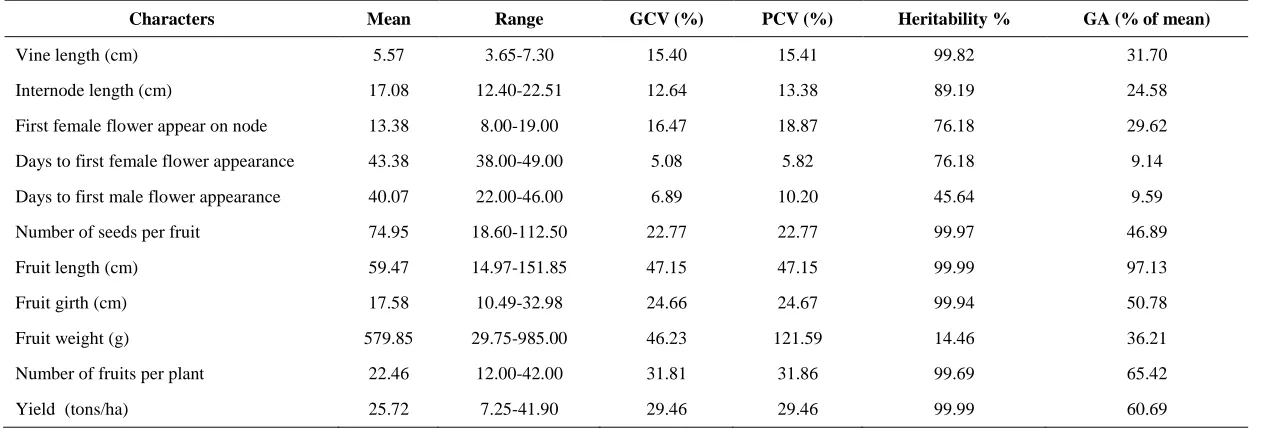
significant differences for all the eleven characters under study presented in Table 1. Variability of a character was measured by range and genotypic coefficient of variation (GCV). In most of the cases, little difference between genotypic and phenotypic coefficient of variations were observed, it indicating that the environment had less influence on the expression of most of the characters. The highest GCV was found for fruit length (47.15) followed by fruit weight (46.23), number of fruits per plant (31.81), yield (29.46) and number of seeds per fruit (22.77). This high genetic variability can be exploited by selection (Burton and De Vane, 1952). The above results are in conformation with the results reported by Saha
et al. (1992) where greater GCV were found for
fruit weight, fruit length and fruitgirthin pumpkin. These observations also have partial agreement with Varghese and Rajan (1993) and Rahman et al. (2002).
The highest phenotypic coefficient of variation was found for fruit weight (121.58), Fruit length (47.15), number of fruits per plant (31.86) and yield (29.46). The lowest phenotypic coefficient of variation was observed in days to first female flower appearance (5.82) and days to first male flower appearance (10.20). This result was in conformity with the findings of Rahman et al., 2002.
Heritability and Genetic advance:A character can
be improved only if it is highly heritable. Heritability estimates (broad sense) is used for determination of proportion of the total genetic variation. The heritability was high for fruit length (99.99%) and fruit yield (99.99%) followed by number of seeds per fruit (99.97%), number of fruits per plant (99.69%), fruit girth (99.94%), vine length (99.82%). The similar result obtained by Rahman et al., 2002 and Khan et al., 2016 in snake gourd. The fruit weight showed less estimates (14.46%). Miah et al. (2000) reported the highest heritability in average fruit weight and the lowest in fruit girth in bitter gourd. Genetic advance in percentage of mean was maximum for fruit length (97.13) followed by number of fruits per plant (65.42), yield (60.69) and fruit girth (50.78). While it was minimum in days to first female flower appearance (9.14).
The heritability estimates provide the basis for selection on phenotypic performance. The traits,
viz., fruit length, number of fruits per plant, yield,
fruit girth recorded moderate heritability and genetic advance. It indicating that these are simply inherited traits governed by a few major genes or additive gene effects, even if they are under polygenic control and these traits could be improved through selection (Chauhan and Nanda, 1983). Khan et al., 2016 reported similar results for fruit yield per plant, number of fruits per plant, fruit weight, days to first male flower appearance in teasel gourd. Islam et al., 1993 also observed similar results for vine length, fruit weight, number of fruits per plant and fruit yield in cucumber.
Correlation: In general, genotypic correlation
coefficient was higher than phenotypic correlation coefficient, which indicated the making effects of the environment, which in turn modified the expression of a character thereby reducing the phenotypic expression (Rahman et al., 2002 and Khan et al., 2016). Fruit yield had significant positive genotypic and phenotypic correlation with number of fruits per plant, fruit girth and vine length but none of the character showed significant negative phenotypic and genotypic correlation (Table 2). Vine length had significant positive genotypic and phenotypic correlation with yield. Inter nodal length had significant negative genotypic correlation with fruit weight. First female flower appear on node (earliness) and days to first female flower appearance had significant positive genotypic and phenotypic correlation with days to first male flower appearance and number of seeds per fruit. Days to first male flower appearance had significant positive genotypic correlation with number of seeds per fruit. Number of seeds per fruit character showed significant negative phenotypic and genotypic correlation with number of fruits per plant. Fruit length had significant negative phenotypic and genotypic correlation with fruit girth and number of fruits per plant. Fruit girth had significantly positive phenotypic and genotypic correlation with number of fruits per plant and yield. Number of fruits per plant had significantly positive phenotypic and genotypic correlation with yield. Islam et al., 1993 found significant positive phenotypic and genotypic correlation of number of fruits per plant and average fruit weight with fruit yield in cucumber and Rahman et al. (2002) in snake gourd.
Path Coefficient Analysis: Association of
ISSN 0975-928X
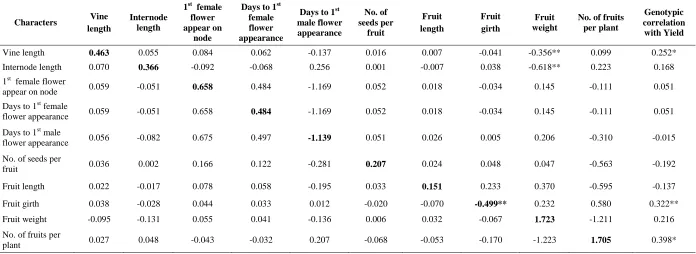
(1.7047). Rahman et al., 2002 found that number of fruits per plant (0.989) followed by fruit weight (0.231) had maximum direct contribution on yield of snake gourd. On the other hand, Miah et al., 2000 found that average fruit weight had maximum direct contribution (1.699) on yield of bitter gourd and Saha et al., 1992 found positive direct effect for number of fruits per plant, fruit weight and fruit length on fruit yield in pumpkin. This direct effect of fruit weight was diluted mainly due to high positive indirect effect on fruit yield via fruit girth. Consequently, such anomalous situation suggests nullifying the undesirable indirect effect.
The residual effect of 0.35 indicated the adequacy of the traits chosen for the path analysis. Results from the present finding indicated that, the characters viz., number of fruits per plant, fruit length, stem length, fruit breadth and fruit weight had high to moderate heritability and genetic advance. These characters also showed moderate to high positive and negative direct effects and indirect effect on fruit yield. Therefore, emphasis should be given on these characters for improvement of fruit yield of snake gourd through breeding programme.
References
Ahmed, M.S., Rasul, M.G., Bashar, M.K. and Mian, A.S.M. 2000. Variability and heterosis in snake gourd. (Trichosanthes anguina L.). Bangladesh J. Pl. Breed. Genet.,13: 27-32.
Burton, G.W. and De Vane, E.W. 1952. Quantitative inheritance in grasses. Proceeding of 6th International Grassland Congress.1: 277-283. Chauhan, J.S. and Nanda, J.S. 1983. Genetic variability
for Physio-chemical characters or rice grain in segregating Oryza sativa L. Oryza, 20: 209-215. Dewey, D.R. and Lu, K.U. 1959. A correlation and path
coefficient analysis of components of crested wheat grass seed productio. Agron. J., 51: 515-519.
Islam, M.S., Khan, S., Khanam, D., Malek, M.A. and Mosiul Hoque, A.M.M. 1993. Genetic variability and path analysis in cucumber (Cucumis sativus
L.) Bang. J. Pl. Breed. Genet., 6: 45-51.
Johnson, H.W., Robinson, H.F. and Comstock, R.E. 1955. Estimation of Genetic variability and environmental variability in soybean. J. Agron.,
47: 314-318.
Khan, A.S.M.M.R., Eyasmin, R., Rashid, M.H., Ishtiaque, S. and Chaki, K. 2016. Variability, heritability, character association, path analysis and morphological diversity in snake gourd.
Agriculture and Natural Resources, 50(6): 483– 489
Lush, J.L. 1940. Intra – sire correlation and regression of offspring on dams as a methods of estimating heritability of characters. Proceeding of American Social Animal Produces. 33: 293-301. Miah, M.A., Rahman, M.M., Uddin, M.S., Rahman,
A.K.M.M. and Ullah, M.H. 2000. Genetic association in bitter gourd (Momordica charantia
L.). Bangla. J. Sci Techol., 2: 21-25.
Patil, P.R., Surve, V.H. and Mehta, H.D. 2012. Line x Tester analysis in Rice (Oryza sativa L.) Madras Agric. J., 99: 210-213.
Rahman, M.A., Hossain, M.D., Islam, M.S., Biswas, D.K. and Ahiduzzaman, M. 2002. Genetic variability, heritability and path analysis in snake gourd (Trichosanthes anguina L.). Pak. J. Bio. Sci., 5(3): 284-286.
Rao, D.S.R.M., Singh, H., Singh, B., Khola, O.P.S. and Faroda, A.S. 1990. Correlation and path coefficient analysis of seed yield and its components in sesame (Sesamum indicum L.).
Haryana Agric. Univ. J. Res., 20: 25-30. Saha, S.R., Mitra, B.N., Hossain, A.E., Jalaluddin, M.
and Mosiul Hoque, A.M.M. 1992. Genetic Variability, character association and path coefficient analysis in pumpkin (Cucurbita moschata L.). Bangla. Hort.,20: 50-62.
Varghese, P. and Rajan, S. 1993. Genetic variability and heritability studies in Snake Gourd (Trichosanthes anguina L.). J. Trop. Agric., 31: 13-17.
ISSN 0975-928X
Table 1. Estimates of genetic parameters for some economic characters in snake gourd
Characters Mean Range GCV (%) PCV (%) Heritability % GA (% of mean)
Vine length (cm) 5.57 3.65-7.30 15.40 15.41 99.82 31.70
Internode length (cm) 17.08 12.40-22.51 12.64 13.38 89.19 24.58
First female flower appear on node 13.38 8.00-19.00 16.47 18.87 76.18 29.62
Days to first female flower appearance 43.38 38.00-49.00 5.08 5.82 76.18 9.14
Days to first male flower appearance 40.07 22.00-46.00 6.89 10.20 45.64 9.59
Number of seeds per fruit 74.95 18.60-112.50 22.77 22.77 99.97 46.89
Fruit length (cm) 59.47 14.97-151.85 47.15 47.15 99.99 97.13
Fruit girth (cm) 17.58 10.49-32.98 24.66 24.67 99.94 50.78
Fruit weight (g) 579.85 29.75-985.00 46.23 121.59 14.46 36.21
Number of fruits per plant 22.46 12.00-42.00 31.81 31.86 99.69 65.42
ISSN 0975-928X
Table 2. Genotypic (G) and phenotypic (P) correlation among important characters in snake gourd genotypes
Character Internode
length
1st female flower appear on
node
Days to 1st female flower appearance
Days to 1st male flower appearance
No. of seeds
per fruit Fruit length Fruit girth Fruit weight
No. of fruits
per plant Yield
Vine length G 0.151 0.127 0.127 0.12 0.079 0.048 0.082 -0.207 0.058 0.252*
P 0.141 0.111 0.111 0.083 0.079 0.048 0.082 -0.080 0.058 0.252*
Internode length
G -0.14 -0.14 -0.224 0.005 -0.047 -0.076 -0.359** 0.131 0.168
P -0.115 -0.115 -0.072 0.005 -0.045 -0.071 -0.112 0.121 0.159
1st female flower appear
on node
G 1.000 1.027** 0.252* 0.119 0.067 0.084 -0.065 0.051
P 1.000 0.682** 0.222* 0.104 0.057 -0.035 -0.053 0.044
Days to 1st female flower
appearance
G 1.027** 0.252* 0.119 0.067 0.084 -0.065 0.051
P 0.682** 0.222* 0.104 0.057 -0.035 -0.053 0.044
Days to 1st male flower appearance
G 0.247* 0.171 -0.01 0.119 -0.182 -0.015
P 0.167 0.115 -0.008 0.006 -0.121 -0.01
No. of seeds per fruit
G 0.157 -0.096 0.027 -0.330* -0.192
P 0.157 -0.096 0.014 -0.330* -0.192
Fruit length
G -0.466** 0.215 -0.349** 0.137
P -0.466** 0.082 -0.349** 0.137
Fruit girth
G 0.135 0.340** 0.322*
P 0.051 0.340** 0.322*
Fruit weight
G -0.710** 0.216
P -0.269* 0.082
No. of fruits per plant
G 0.398**
P 0.397**
ISSN 0975-928X
Table 3. Direct (bold) and indirect effects of different yield attributes on yield of snake gourd
Characters Vine length
Internode length
1st female flower appear on
node
Days to 1st female flower appearance
Days to 1st male flower appearance
No. of seeds per
fruit
Fruit length
Fruit girth
Fruit weight
No. of fruits per plant
Genotypic correlation
with Yield
Vine length 0.463 0.055 0.084 0.062 -0.137 0.016 0.007 -0.041 -0.356** 0.099 0.252*
Internode length 0.070 0.366 -0.092 -0.068 0.256 0.001 -0.007 0.038 -0.618** 0.223 0.168
1st female flower
appear on node 0.059 -0.051 0.658 0.484 -1.169 0.052 0.018 -0.034 0.145 -0.111 0.051
Days to 1st female
flower appearance 0.059 -0.051 0.658 0.484 -1.169 0.052 0.018 -0.034 0.145 -0.111 0.051
Days to 1st male
flower appearance 0.056 -0.082 0.675 0.497 -1.139 0.051 0.026 0.005 0.206 -0.310 -0.015
No. of seeds per
fruit 0.036 0.002 0.166 0.122 -0.281 0.207 0.024 0.048 0.047 -0.563 -0.192
Fruit length 0.022 -0.017 0.078 0.058 -0.195 0.033 0.151 0.233 0.370 -0.595 -0.137
Fruit girth 0.038 -0.028 0.044 0.033 0.012 -0.020 -0.070 -0.499** 0.232 0.580 0.322**
Fruit weight -0.095 -0.131 0.055 0.041 -0.136 0.006 0.032 -0.067 1.723 -1.211 0.216
No. of fruits per
plant 0.027 0.048 -0.043 -0.032 0.207 -0.068 -0.053 -0.170 -1.223 1.705 0.398*