
ISSN 0975-928X
Research Article
Combining ability analysis for yield and its components in bread wheat
H.N. Patel
Agricultural Research Station, S.D. Agricultural University, Ladol-382840, Gujarat, India
E-mail: [email protected]
(Received: 29 Oct 2015; Revised: 02 May 2017; Accepted: 21 May 2017)
Abstract
Combining ability was analyzed using a half diallel of nine parents in bread wheat revealed the importance of both additive as well as non-additive genetic variances for control of various traits viz. days to heading, days to maturity, plant height, tillers per plant, flag leaf area, peduncle length, spike length, number of spikelets per spike, number of grains per spike, grain yield per spike, 1000 grain weight, biological yield per plant and grain yield per plant. However, the ratio of σ2gca/ σ2
sca revealed preponderance of non-additive gene actions in almost all the traits like number of grains per spike, grain yield per spike, 1000 grain weight, biological yield per plant, grain yield per plant, tillers per plant, flag leaf area, peduncle length, spike length and number of spikelets per spike. Parents, GW 404, MP 4010 and GW 366 were the good general combiners, whereas crosses GW 366 x GW 11, Raj 4037 x GW 496 and GW 322 x GW 404 were found to be best specific combiners for grain yield per plant and some of the yield contributing traits viz. tillers per plant, spike length, number of grain per spike and biological yield per plant. However on the basis of per se performance and significant sca effects for grain yield per plant and some of its important components, hybrids GW 366 x GW 11, GW 322 x GW 404 and HI 1544 x MP 4010 were considered to be most promising for further exploitation in breeding programmes.
Key words
Wheat, general combining ability, specific combining ability
Introduction
Wheat was one of the first domesticated food crops and for 8000 years has been the basic staple food of the major civilizations of Europe, West Asia and North Africa. Today, wheat is grown on more land area than any other commercial crop and continues to be the most important food grain source for humans. Its production leads all crops, including rice, maize and potatoes.
It is the leading grain crop of the temperate climates of the India, and produces wheat on an area of 30.37 m ha with production of 90.78 million metric tones and productivity of 29.89 q/ha.(FAO, 2016). In India it stands at second position just after rice which contributes nearly one third of total food grain production. At global level, India ranks second largest wheat producing nation with 13.4 per cent global wheat production after China which contributes 17.7 per cent to the world wheat production. The other wheat producing countries are Russian Federation, United States of America and Canada and these five countries together contribute more than half of the global wheat production. The future scope of hybrid technology in Wheat depends on the male sterility system, floral biology, level of combining ability, heterosis and its exploitation of commercial level that may be useful in breaking yield barriers and enhancing the productivity in major wheat belt of country (Singh et al. 2010).
The increase in yield potential has always been of fundamental importance in wheat breeding programmes. Genetic analysis of wheat yield improvement had shown that grain yield is
determined by component traits, and is a highly complex character (Blum, 1988). The analysis showed that genes for yield per se do not exist (Grafius, 1959). Therefore, knowledge about combining ability is important in selecting suitable parents for hybridization, understanding of inheritance of quantitative traits and also in identifying the promising crosses, are of paramount importance in formulating an efficient breeding programme. Keeping in view, present investigation was carried out to obtain more precise estimates of combining ability for grain yield and its contributing traits in bread wheat (Triticum aestivum L. em. Thell.).
Material and Methods
ISSN 0975-928X
leaf area (cm2), peduncle length (cm), spike length (cm), number of spikelets per spike, number of grains per spike, grain yield per spike (g), 1000 grain weight (g), biological yield per plant (g), harvest index (%) and grain yield per plant (g). In case of maturity traits (days to heading & days to maturity), the data was recorded on the whole plot basis. The mean of each plot used for statistical analysis. The data were first subjected to the usual analysis followed for a randomized block design for individual environment as suggested by Panse and Sukhatme, 1985. The combining ability analysis was done following Griffing’s method 2, Model I (1956).
Results and Discussion
Significant differences were observed among the treatments (parents and their F1s) revealing existence of variability for all the traits. Analysis of variance for combining ability (Table 1) revealed that mean squares due to GCA as well as SCA were significant for all the traits, indicating the importance of both additive and non-additive gene effects in the inheritance of characters. However, the ratio of σ2gca/ σ2sca was recorded below unity showed preponderance of non-additive type of gene actions for all the characters. Similar results were earlier reported by Kumar et al. (2011) and Singh et al. (2010).
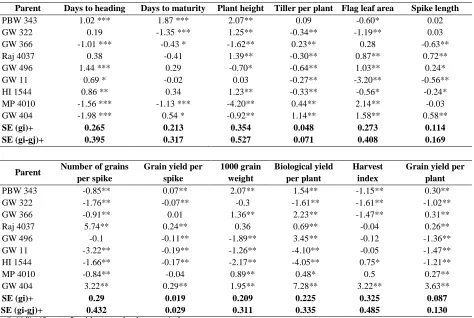
The estimates of GCA effects for grain yield per plant and other contributing traits are presented in table 2. The parent classified as good, average and poor combiners on the basis of estimates of combining ability effects for various characters. It was observed that none of the parents was good general combiner for all the characters.
However, the parent GW 404 was found to be good general combiners for grain yield per plant and most of the yield attributing traits viz., days to heading, number of tillers per plant, flag leaf area per plant, number of grains per plant, grain yield per spike, 1000 grain weight, biological yield per plant and harvest index; MP 4010 for days to maturity, plant height and tillers per plant, flag leaf area per plant, 1000 grain weight, biological yield per plant; Raj 4037 for grain yield per plant, number of grains per spike, grain yield per spike, spike length, biological yield per plant and grain yield per spike; GW 366 for 1000 grain weight, biological yield per plant and grain yield per plant.
PBW 343 for grain yield per plant, biological yield per plant, 1000 grain weight and grain yield per spike were found to be good general combiners. In general it is evident from the table that the parents which were good general combiners for grain yield per plant were also good general combiners for some of its yield contributing traits like days to heading, days to maturity, plant height, tillers per plant, flag leaf area, spike length, number of grains
per spike, 1000 grain weight and biological yield per plant. From the result it is observed that the use of parent MP 4010, Raj 4037 and GW 404 in future breeding programme would be more useful for augmenting genes for high grain yield in bread wheat, as they are found to be good general combiners for grain yield per plant and some of the important yield components. It was interesting to note that parent Raj 4063 exhibited superior performance for grain yield per plant.
Best parent having desirable GCA effects for grain yield per plant are presented in table 2. It was revealed that the GCA effect and per se performance were positively correlated in most of the best parents. Though, such pattern was not prevailed in all the cases. Perusal of table 2 revealed that the parents, who showed desirable, GCA effects for grain yield per plant, also exhibited desirable GCA effects for one or more yield attributing traits. The parents GW 404, GW 366 and Raj 4037 emerged as good general combiners for grain yield and some associated traits. Earlier, Gothwal (2006), Kumar et al. (2011), Rajora (1999) and Singh and Chaudhary (2008) provided similar information on combining ability in wheat. In all such cases where GCA effect was more pronounced for particular trait indicating preponderance of additive gene action, so these genotypes should be involved in crosses to improve the specific trait in future breeding programme.
In self-pollinated crops like wheat, SCA effects are not much important as they are mostly related to non-additive gene effects excepting those arising from complementary gene action or linkage effects they cannot be fixed in the pure line or the end product inbred line. Jinks and Jones (1958) emphasized that the superiority of the hybrids might not indicate their ability to yield transgressive segregants, rather SCA would provide satisfactory criteria. However, if a cross combination exhibiting high SCA as well as high per se performance having at least one parent as good general combiner for a specific trait, it is expected to throw desirable transgressive segregants in later generations (Kumar et al., 2011).
ISSN 0975-928X
yield per plant, and grain yield per plant; GW 11 x GW 404 for number of spikelets per spike, number of grains per spike and 1000 grain weight; HI 1544 x MP 4010 for plant height and number of grains per spike; GW 496 x GW 11 for 1000 grain weight; GW 496 x GW 404 for number of grains per spike; Raj 4037 x GW 11 for tillers per plant; HI 1544 x MP 4010 and MP 4010 x GW 404 for plant height. The crosses GW 366 x GW 11, Raj 4037 x GW 496 and GW 322 x GW 404 emerged as good specific cross combinations for grain yield per plant. The parents GW 366, Raj 4037, MP 4010 and GW 404 involved in these crosses were good general combiners for grain yield and one or two yield contributing traits
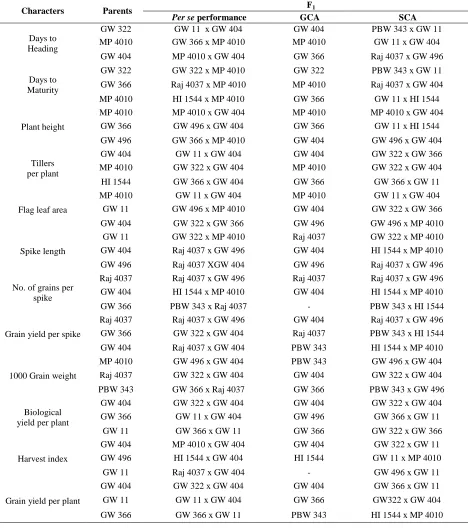
The information regarding three best performing parents, best general combiners, best performing hybrids (Table 3) revealed that parent with good per se performance were in general, good specific combinations for different traits. In many cases, it was observed that at least one good general combining parent was involved in heterotic hybrids having desirable sca effects. This suggests that information on gca effects of the parents should be considered along with sca effects and per se performance of hybrid for predicting the value of any hybrid.
It is desirable to search out parental lines with high gca effects and low sensitivity to environmental variation in a crop improvement programme with respect to combining ability effects. From the present study following broad inferences could be drawn.
(i) In general, the crosses showing desirable sca effect for seed yield per plant also had high sca effects for some of its yield contributing characters viz., number of tillers, number of spikelets, number of grains per spike and biological yield per plant.
(ii) Best performing parents were mostly good general combiners for majority of the characters.
(iii)The crosses exhibiting desirable sca effects did not always involve parents with high gca effects, thereby suggesting the importance of intrallelic interaction.
It is clear from above discussion, that on the basis of SCA effects and per se performance the crosses, GW 366 x GW 11, Raj 4037 x GW 496 and GW 322 x GW 404 emerged as good specific cross combinations for grain yield per plant. An overall appraisal revealed that the cross Raj 4037 x GW 496 emerged as good specific cross combinations for grain yield per plant. These crosses were the results of good x good, poor x poor and good x poor general combiners. These crosses hold great promise in improving the grain yield in future breeding programme of bread wheat.
References
Blum, A. 1988. Plant Breeding for Stress Environments. CRC Press Inc., Florida, USA.
Desai, S.A., Lohithaswa, H.C., Hanchinal, R.R., Patie, B.N., Kalappanavar and Math, K.K. 2005. Combining ability for quantitative traits in bread wheat (Triticumaestivum L.). Indian J. Genet.,
65: 311-312.
FAO. 2016. Statistical database. www.fao.org
Gothwal, D.K. 2006. Genetic studies on high temperature tolerance at post anthesis in wheat (Triticum aestivum L. em. Thell). Unpubl. Ph.D. Thesis, RAU, Bikaner, Campus, Jobner.
Grafius, J.E. 1959. Heterosis in barley. AgronomyJ., 51: 551-554.
Griffing, B. 1956. The concept of general and specific combining ability in relation to diallel crossing system. Australian J. Biol. Sci., 9: 463-493.
Jinks, J.L. and Jones, R.M. 1958. Estimation of components of heterosis. Genet.,43: 223-234. Joshi, S.K., Sharma, S.N., Singhania, D.L. and Sain,
R.S. 2003. Genetic analysis of yield and its components traits in spring wheat. Acta Agronomica Hungarica, 51: 139-147.
Kumar, A., Mishra, V., Vyas, R.P. and Singh, V. 2011. Heterosis and Combining ability analysis in bread wheat. J. Pl. Breed. Crop Sci.,3(10): 297-17.
Rajora, M.P. 1999. Combining ability over environments in wheat. Madras Agric. J., 86: 516-519.
Singh, G.P. and Chaudhary, H.B. 2008. Genetic analysis of lower plant height, peduncle length and other moisture stress tolerance traits in bread wheat (Triticum aestivum L.emend. Fiori & Paol). J. Wheat Res., 2: 29-30.
ISSN 0975-928X
Table 1. ANOVA for combining ability for various characters in F1 in wheat
Characters Source of variation
GCA SCA Error GCA/SCAvariance
(df = 8) (df = 36) (df =88)
Days to heading 15.82** 2.82** 0.94 0.66
Days to maturity 10.04** 1.84** 0.60 0.64
Plant height 44.04** 11.60** 1.67 0.36
Tillers per plant 3.13** 0.49** 0.03 0.56
Flag leaf area 28.52** 24.22** 0.99 0.10
Spike length 2.26** 1.58** 0.17 0.12
Number of grains spike-1 82.62** 63.88** 1.12 0.11
Grain yield spike-1 0.31** 0.12** 0.01 0.22
1000 grain weight 29.11** 10.05** 0.58 0.25
Biological yield plant-1 146.21** 50.94** 0.68 0.24
Harvest index 23.01** 7.07** 1.41 0.32
Grain yield per plant 26.71** 6.27** 0.10 0.36
*, ** Significant at 5 and 1 per cent levels, respectively
Table 2. Estimates of GCA effects for grain yield per plant & other contributing traits in normal environments
Parent Days to heading Days to maturity Plant height Tiller per plant Flag leaf area Spike length
PBW 343 1.02 *** 1.87 *** 2.07** 0.09 -0.60* 0.02
GW 322 0.19 -1.35 *** 1.25** -0.34** -1.19** 0.03
GW 366 -1.01 *** -0.43 * -1.62** 0.23** 0.28 -0.63**
Raj 4037 0.38 -0.41 1.39** -0.30** 0.87** 0.72**
GW 496 1.44 *** 0.29 -0.70* -0.64** 1.03** 0.24*
GW 11 0.69 * -0.02 0.03 -0.27** -3.20** -0.56**
HI 1544 0.86 ** 0.34 1.23** -0.33** -0.56* -0.24*
MP 4010 -1.56 *** -1.13 *** -4.20** 0.44** 2.14** -0.03
GW 404 -1.98 *** 0.54 * -0.92** 1.14** 1.58** 0.58**
SE (gi)+ 0.265 0.213 0.354 0.048 0.273 0.114 SE (gi-gj)+ 0.395 0.317 0.527 0.071 0.408 0.169
Parent Number of grains per spike
Grain yield per spike
1000 grain weight
Biological yield per plant
Harvest index
Grain yield per plant
PBW 343 -0.85** 0.07** 2.07** 1.54** -1.15** 0.30**
GW 322 -1.76** -0.07** -0.3 -1.61** -1.61** -1.02**
GW 366 -0.91** 0.01 1.36** 2.23** -1.47** 0.31**
Raj 4037 5.74** 0.24** 0.36 0.69** -0.04 0.26**
GW 496 -0.1 -0.11** -1.89** 3.45** -0.12 -1.36**
GW 11 -3.22** -0.19** -1.26** -4.10** -0.05 -1.47**
HI 1544 -1.66** -0.17** -2.17** -4.05** 0.75* -1.21**
MP 4010 -0.84** -0.04 0.89** 0.48* 0.5 0.27**
GW 404 3.22** 0.29** 1.95** 7.28** 3.22** 3.63**
SE (gi)+ 0.29 0.019 0.209 0.225 0.325 0.087 SE (gi-gj)+ 0.432 0.029 0.311 0.335 0.485 0.130
ISSN 0975-928X
Table 3. Best three parents, F1s selected on the basis of their per se performance, GCA and SCA effects for
various characters in wheat
Characters Parents F1
Per se performance GCA SCA
Days to Heading
GW 322 GW 11 x GW 404 GW 404 PBW 343 x GW 11
MP 4010 GW 366 x MP 4010 MP 4010 GW 11 x GW 404
GW 404 MP 4010 x GW 404 GW 366 Raj 4037 x GW 496
Days to Maturity
GW 322 GW 322 x MP 4010 GW 322 PBW 343 x GW 11
GW 366 Raj 4037 x MP 4010 MP 4010 Raj 4037 x GW 404
MP 4010 HI 1544 x MP 4010 GW 366 GW 11 x HI 1544
Plant height
MP 4010 MP 4010 x GW 404 MP 4010 MP 4010 x GW 404
GW 366 GW 496 x GW 404 GW 366 GW 11 x HI 1544
GW 496 GW 366 x MP 4010 GW 404 GW 496 x GW 404
Tillers per plant
GW 404 GW 11 x GW 404 GW 404 GW 322 x GW 366
MP 4010 GW 322 x GW 404 MP 4010 GW 322 x GW 404
HI 1544 GW 366 x GW 404 GW 366 GW 366 x GW 11
Flag leaf area
MP 4010 GW 11 x GW 404 MP 4010 GW 11 x GW 404
GW 11 GW 496 x MP 4010 GW 404 GW 322 x GW 366
GW 404 GW 322 x GW 366 GW 496 GW 496 x MP 4010
Spike length
GW 11 GW 322 x MP 4010 Raj 4037 GW 322 x MP 4010
GW 404 Raj 4037 x GW 496 GW 404 HI 1544 x MP 4010
GW 496 Raj 4037 XGW 404 GW 496 Raj 4037 x GW 496
No. of grains per spike
Raj 4037 Raj 4037 x GW 496 Raj 4037 Raj 4037 x GW 496
GW 404 HI 1544 x MP 4010 GW 404 HI 1544 x MP 4010
GW 366 PBW 343 x Raj 4037 - PBW 343 x HI 1544
Grain yield per spike
Raj 4037 Raj 4037 x GW 496 GW 404 Raj 4037 x GW 496
GW 366 GW 322 x GW 404 Raj 4037 PBW 343 x HI 1544
GW 404 Raj 4037 x GW 404 PBW 343 HI 1544 x MP 4010
1000 Grain weight
MP 4010 GW 496 x GW 404 PBW 343 GW 496 x GW 404
Raj 4037 GW 322 x GW 404 GW 404 GW 322 x GW 404
PBW 343 GW 366 x Raj 4037 GW 366 PBW 343 x GW 496
Biological yield per plant
GW 404 GW 322 x GW 404 GW 404 GW 322 x GW 404
GW 366 GW 11 x GW 404 GW 496 GW 366 x GW 11
GW 11 GW 366 x GW 11 GW 366 GW 322 x GW 366
Harvest index
GW 404 MP 4010 x GW 404 GW 404 GW 322 x GW 11
GW 496 HI 1544 x GW 404 HI 1544 GW 11 x MP 4010
GW 11 Raj 4037 x GW 404 - GW 496 x GW 11
Grain yield per plant
GW 404 GW 322 x GW 404 GW 404 GW 366 x GW 11
GW 11 GW 11 x GW 404 GW 366 GW322 x GW 404
![Novel synthesis of Pyrimido[4,5- e] [1,3,4] thiadiazines](data:image/gif;base64,R0lGODlhAQABAIAAAP///wAAACH5BAEAAAAALAAAAAABAAEAAAICRAEAOw==)