Controlling of a 3-Phased Asynchronous Motor
over Profibus Network
C. Yılmaz and Y. Korkmaz
Department of Electrical-Electronic Engineering, Faculty of Technology, Gazi University, Ankara, Turkey Email: {cemal, ykorkmaz}@gazi.edu.tr
Y. Sönmez and L. Bulut
Department of Electrical, Gazi University, Ankara, Turkey Email: {ysonmez, lbulut}@gazi.edu.tr
M. Fatih Işık
Department of Electrical-Electronic Engineering, Faculty of Engineering, Hitit University, Çorum, Turkey Email: [email protected]
Abstract—In this study, Profibus is used in remote-controlling of an Asynchronous Motor (AM) which is an industrial automation network. Therefore, the asynchronous motor torque and speed control are examined. In controlling the AM, the feedback data and control signals are conducted through a network. In this design, a real time control system has been used and thus, the desired working conditions can be remote-controlled. The used Profibus network provides a high-speed data transfer. This characteristic is important in applications that require sensitive control and the control mistakes stemming from network delay have been minimized. In this study moreover, the designed system has provided a control that is independent from the AM hardware.
Index Terms—asynchronous motor, industrial automation network, remote control, Profibus
I. INTRODUCTION
In today’s world, asynchronous motors (AM) are used much more commonly to meet the electro-mechanical energy needs. The disadvantage of the AM when compared to Direct Current (DC) motors is that they require complex control and transformation algorithms. The reason for this is that the machine has a nonlinear structure. The developments in power electronics have made the semi-conductor circuit elements with high current and high voltage available as reliable and economically beneficial. Thus in a very wide power range, it is possible to produce frequency and voltage adjustable systems which are needed for the speed and moment control of the AM. Nowadays, AM’s are controlled by microprocessor-controlled power electronics circuits. Using of automation systems are considered to be one of the methods used to increase the speed and quality of production in industry. The network is an important
Manuscript received December 10, 2014; revised May 11, 2015.
component in automation systems. Many different network structures are used in these systems [1].
The importance of sensors and controllers is greater in intelligent control systems because of the flowing of data are provided between the sensors and controllers. Devices being in the field of automation can be connected directly to the system. The connection method must be replaced when the number of devices increases. In order to fulfill this task, the network structures should be used instead of direct connection. Communication between devices connected to network each other is provided in such a network structure and this communication is controlled by master station. Data communication has been done effectively via network structure [2]-[4]. CAN, WORLD FIP and IEC 61158 protocols are used in Automation networks [5].
Real-time data transmission conditions are important in industrial automation. These conditions affect the transmitted data structure and the transmitting time. The transmitting time is an important problem in automation systems. Transmitting time must be reduced, because it affects adversely the operation of the system. The elapsed time during the data transmission is called network delay and must be taken into account in system design [6], [7]
Profibus has an important advantage in data transmission and so it uses in various endustrial applications such as image transmission and robotics [8]-[10]. Furthermore, in Profibus network systems, various control methods like PID, Fuzzy Logic and Genetic Algorithm are implemented easily [11], [12]. Profibus-DP network is the fastest model of Profibus series. This model has been used in real-time data transmission effectively [13], [14]. In [8], Protocols of CAN, Profibus-DP, Profibus-FMS and Modbus are compared and this study brings out the yield of industrial automation network [8].
been done via with Profibus network. The System consists of Master PLC (Programmable Logic Controllers), 3-phased asynchronous motor, driver and Profibus network that contain the physical structure and protocols that provide the communication among the software. The control of asynchronous motor has been designed as having feedbacks. Profibus network provides high-speed data transfer. This characteristic is important in reducing network delay [15]. In this study, reduction of network delay has to be made precise control.
In this study, for the speed and moment control of the AM, the AM is run in the desired speed value by entering the desired speed value or the frequency when the moment is stable by using frequency converter over the Profibus network structure. The speed, voltage and current info of the AM are obtained over the network as real time and assessed, then sent back to the motor over the same network, thus controlling it.
II. INDUSTRIAL AUTOMATION NETWORKS
Profibus (Process Field Bus) has a wide usage area in automation systems. Profibus has a variety in terms of communication like FMS (Fieldbus Message Specification), PA (Process Automation) and DP (Decentralized Periphery) [16], [17].
Profibus can be used in high-speed critical timed applications, in complex communication systems, and in communication of different devices among themselves without using a special interface. The hardware that is used in network connections is among the factors that define many characteristics of the network from the type of the network to the speed of it. At this point, an important element that has to be considered is the formation of automation network that is in accordance with the system hardware. Profibus, with the OSI (Open System Interconnection) reference model, which has a protocol structure in accordance with ISO 7498, has gained a fast and effective data transmitting property thanks to this structure.
The media Access protocol used in Profibus network uses the 2nd Layer of the OSI reference model. This protocol regulates the data security and data transmitting. Profibus uses FDL (Fieldbus Data Link) in layer 2nd when a station receives permission for data transmitting, Profibus defines the MAC (Medium Access Control) transmitting procedure. In such applications MAC should give transmitting right only to one station for a definite period.
Profibus automation network is formed from segments and this network can be expanded by connecting the segments with each other by using repeaters. A segment is formed from 32 network components. An important element in limiting, and thus determining the length of the network, is the number of segments that form the automation network is the cable used in data transmitting, in other words the data transmitting technology. And the speed of the network is limited with the device that has the least speed value. So, in order to keep the transmitting speed high, limiting the number of the segments (limiting the length of the network) is not sufficient, but it is
necessary to consider the speed of all of the network components. As a consequence, the data transmitting technology, the length of the network (the number of the segments) and the speed of the network components define the network data transmitting speed [18].
AM is run at the desired speed value by using PLC and frequency converter over Profibus network structure by entering frequency or speed set value while the moment is stable in controlling the speed and moment of data transmitting of the AM. AM is run in a stable mode by producing control signal according to the difference between feedback speed value and set speed value. The connection of the AM to the Profibus network structure is performed by frequency converter (Fig. 1) [15], [19].
Figure 1. The block scheme of the profibus based AM control
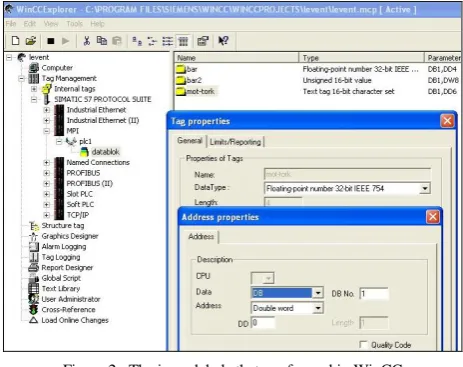
The moment is controlled via the voltage applied to the machines and the speed is controlled via the frequency applied. The data obtained over Profibus network were obtained in the WinCC program parallel to the addresses used in PLC software. A graphical vision was obtained with the interface sent to inner labels. Addresses of temporary memory fields formed for frequency, moment, current, voltage and power values and the inner labels are shown in Fig. 2 [20].
Figure 2. The inner labels that are formed in WinCC
engine is the input parameters. Input parameters are transmitted to the frequency converter via the network. Speed value is measured by the encoder. The speed is measured and compared with the input parameter. The error value is determined as a result of this transaction. Depending on the error value a new control signal is produced. Thus, the error is reduced. These transactions are carried out with the desired control again.
Figure 3. Simatic manager hardware image
III. EXPERIMENTS
The frequency, moment, current, voltage and power values that were received in empty and full load conditions of the AM can be monitored in the interface as graphics that is prepared in WinCC program.
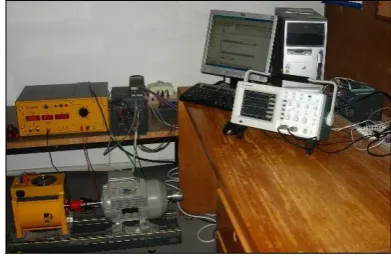
Experimental studies were performed in medium shown in Fig. 4 [20]. In the experiments, an AM with 3-phased squirrel cage, power 3kW, 1420rpm, star 400V, 6.4A and power factor 0.82 was used. The feedback info during the work was obtained with an encoder that is connected to the AM axle. The Encoder (the Signal Producer) is an electro-mechanic device that produces a digital electric signal in return of the movement of the axle. In this study an incremental 2500 pulse HTL (High Transistor Logic) encoder was used. The connection of the AM to the Profibus network structure is performed by Micromaster 440 frequency converter. [15], [19]. 314C-2DP was used as the master station [20], [21]. The moment is controlled via the voltage applied to the motor, and the speed is controlled via the frequency applied. A change is made in the voltage and frequency curve. In the application methods like vector-moment, V/f linear, V/f (stable flux), parabolic are used. In this study, frequency, moment, current, voltage and power curves in the loaded and unloaded states for 500rpm and 1500rpm were obtained. In the application in which speed value was entered, the relationship among parameters was assessed in different load and speed conditions. The frequency converter used presents different moment control choices. Here the type and value of the load are important. Therefore, a working method according to the characteristics of the load can be defined. The data obtained over Profibus network were obtained in the WinCC program parallel to the addresses used in PLC software. A graphical vision was obtained with the interface sent to inner labels [20]. Necessary system adjustments were performed according to the data type that were be obtained over the network. For example the speed value was received as a whole number, but the moment data was received as decimal number. For this
reason according to the data type to be received, the necessary adjustments were performed and an effective data transmitting was ensured.
Figure 4. The experiment set
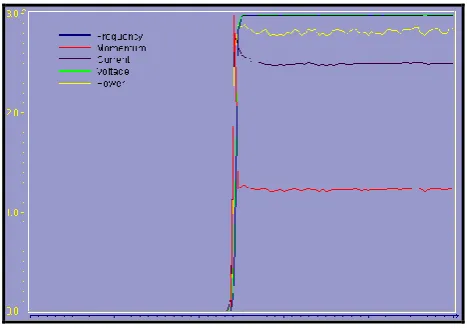
In Fig. 5, the AM that worked in no-load position was aimed to reach 500rpm reference speed in a slope in 0.5s and the necessary parameters were entered to Micromaster. According to the application results the real speed reference speed was reached in the desired time. In the graphics 500rpm was reached with a 16.6Hz. Frequency value in 5% overvalue, and this overvalue is corrected by the feedback. When the moment is considered, the AM produces 14 Nm when initializing, and then produces a moment to compensate its losses and continues its stable work. As the time for reaching the reference speed decreases and the motor load increases, the initial moment of the motor will increase. To reach the reference speed in the desired time the motor should produce maximum moment during the initial start.
Figure 5. The without load 500rpm frequency-moment-current-voltage-power curves of the AM
In Fig. 6, it was observed that the time for reaching the reference speed of the AM that runs with 20Nm; in other words, the initial start slope duration is adjusted as 0.5s; and the AM reached 500rpm and continued its stable work.
current; and since it is unloaded, no increase in power value is observed.
Figure 6. The 20N, 500rpm frequency-moment-current-voltage-power curves of the AM
Figure 7. The without load 1500rpm frequency-moment-current-voltage-power curves of the AM
Figure 8. The 20N, 1500rpm frequency-moment-current-voltage-power curves of the AM
In Fig. 8, it was aimed that the loaded AM will reach 1500rpm reference speed in determined time, and the necessary parameters are entered by the driver. According to the obtained application results, the motor reached to the reference speed at 0.5s. The voltage increased due to the increasing frequency; and depending on the increasing load, the power also increased at the same rate.
Profibus network structure consists of a network delay. This delay varies depending on the density of the network traffic. Profibus network delay is occurred between 5-8ms [15]. In this study, start-up time of the motor consists of network delay. Results obtained from the experiments are presented in Table I.
TABLE I. EXPERIMENTAL RESULT
Experiment Load rpm Time (s) Delay (ms)
1 No 500 0.5 s 5-8 ms
2 20Nm 500 0.5 s 5-8 ms
3 No 1500 0.5 s 5-8 ms
4 20Nm 1500 0.5 s 5-8 ms
IV. CONCLUSION
In this study, a speed and moment control of AM has been performed by using industrial automation network. Profibus is used as an industrial automation network. Value of the controlled electrical machines was followed by the program interface. This study was used as the interface program WinCC. The control algorithm is designed to feed back. Feedback information is transmitted over the network. Machine control signal is also sent over the network.
This study has shown that the control and monitoring of an AM or tens of field elements by using Profibus has been performed with high performance. This situation has been realized with the data obtained from experimental study. The high performance in the control has been obtained via the fast data transfer of the Profibus network. The system has many advantages over classical automation systems in terms of speed, flexibility, easy breakdown determination etc.
ACKNOWLEDGMENT
The authors owes thanks to Gazi University, Scientific Research Projects Unit which made the performance of this study possible by granting finance with the Project coded 07/2007-05.
REFERENCES
[1] C. Yılmaz, O. Gürdal, and İ. Koşalay, “Network induced delay of asynchronous motor connected to profibus-dp networks using fuzzy logic control algorithm,” Expert Systems with Applications, vol. 37, no. 4, pp. 3248-3255, 2010.
[2] K. C. Lee, S. Lee, and M. H. Lee, “Remote fuzzy logic control of networked control system via Profibus-dp,” IEEE Transactions on Industrial Electronics, vol. 50, no. 4, pp. 784-792, 2003.
[3] K. C. Lee and S. Lee, “Remote controller design of networked control system using genetic algorithm,” in Proc. IEEE
International Industrial Electronics Symposium, Pusan, South
Korea, Jun. 12-16, 2001, pp. 1845-1850.
[4] S. Lee, K. C. Lee, M. C. Han, and J. S. Yoon, “On-Line fuzzy performance management of profibus networks,” Computers in Industry, vol. 46, no. 2, pp. 123-137, 2001.
[5] Digital Data Communications for Measurement and Control - Fieldbus for Use in Industrial Control Systems-Part 4, IEC 61158-4, 1999.
[6] A. Willing and A. Wolisz, “Ring stability of the profibus token-passing protocol over error-prone links,” IEEE Transaction on Industrial Electronics, vol. 48, no. 5, pp. 1025-1033, 2001. [7] S. Lee, S. H. Lee, K. C. Lee, J. W. Choi, and M. H. Lee,
computer integrated manufacturing,” International J. Adv. Manufacture Technology, vol. 18, no. 10, pp. 764-770, 2001. [8] M. D. R. Benito, J. M. Fuertes, E. Kahoraho, and A. N. Perez,
“Performance evaluation of four fieldbuses,” in Proc. IEEE International Emerging Technologies and Factory Automation Conference, 1999, pp. 881-890.
[9] J. S. Blanes, P. V. M. Sempere, and B. M. A. Montava, “Optimization of the capacity of profibus for the transmission of images and control traffic,” in Proc. IEEE International Factory Communication Systems Workshop, 2002, pp. 133-140.
[10] A. Valera, J. Salt, V. Casanova, and S. Ferrus, “Control of industrial robot with a fieldbus,” in Proc. IEEE International Emerging Technologies and Factory Automation Conference, 1999, pp. 1235-1241.
[11] C. Mo-Yuen and T. Yodyium, “Network-Based control systems: A tutorial,” in Proc. IEEE Industrial Electronics Society Conference, 2001, pp. 1593-1602.
[12] K. C. Lee, S. Kang, and S. Lee, “On-Line fuzzy performance management of profibus networks,” in Proc. IEEE Industrial Electronics Society Conference, 2000, pp. 548-553.
[13] S. Saad-Bouzefrane and F. Cottet, “A performance analysis of distributed hard real-time applications,” in Proc. IEEE Int. Workshop Factory Commun. Syst. Conference, 1997, pp. 167-176. [14] C. Meicheng, F. Yanjun, and X. Jun, “Implementation of fully integrated automation with profibus,” in Proc. IEEE Industrial Electronics Society Conference, 2005, pp. 412-415.
[15] C. Yılmaz, O. Gürdal, and H. H. Sayan, “Investigation of the network delay on profibus-dp based network,” Electronics and Electrical Engineering, vol. 7, pp. 23-26, 2008.
[16] Profibus Standard, European Standard EN 50 170, CENELEC, 1996.
[17] Profibus Standard Part 1 and 2, DIN 19 245, German Institute of Normalization, 1995.
[18] Data Communication Techniques (Turkish), İstanbul,
Turkey: Papatya Press, 2000.
[19] N. Öztürk, C. Yılmaz, and A. Kahraman, “Remote control of an induction machine with industrial automation network and the performance analysis,” Pamukkale J. Eng. Sci., vol. 13, pp. 195-201, 2007.
[20] L. Bulut, “3-Phase induction motors torque and speed control via profibus network,” MSc, Gazi University, Ankara, Turkey, 2008. [21] E. Tovar and F. Vasques, “Real-Time fieldbus communications
using profibus networks,” IEEE Transactions on Industrial Electronics, vol. 46, pp. 1241-1251, 1999.
Cemal Yılmaz received the B.Sc. degree from
Gazi University, Turkey, in 1997, M.S. degree from the Gazi University in 2001, and Ph.D. degree from Gazi University in 2007 all in electrical engineering. He is currently an Associate Professor at Gazi University. His research interests include power system modeling and analysis, smart building and renewable energy systems.
Yılmaz Korkmaz received the B.Sc. degree
from Gazi University, Turkey, in 1979, M.S. degree from the Gazi University in 1993, and Ph.D. degree from Gazi University in 2005 all in electrical engineering. He is currently an Associate Professor at Gazi University. His research interests include electrical machines and drives.
Yusuf Sönmez received the B.S. degree in
electrical education from Gazi University, Faculty of Technical Education, Ankara, Turkey, in 2002 and the M.Sc. degree in electrical education Gazi University, Institute of Science and Technology, in 2004 and Ph.D. degree in electrical education at Gazi University, Institute of Science and Technology, Ankara, Turkey in 2008, He is currently working as a Assoc. Prof. at Gazi University, Gazi Vocational College. His research interests include power quality, power electronics, electrical machines and drives, intelligent control, machine learning algorithms and engineering technology education.
Mehmet Fatih Işik, received the B.S. degree
in electrical education from Gazi University, Ankara, Turkey in 1999, the M.S. degree in electrical education from Gazi University, Ankara, Turkey, in 2002, and the Ph.D. degree in electrical education from Gazi University, Ankara, in 2009. Currently, he is an Assistant Professor of Electrical and Electronic at Hitit University, Çorum, Turkey. He is the Director of the Electrical and Electronic Department in the Hitit University. His fields of interest include automatic control, electrical machinery, training sets and robotics.
Levent Bulut received the B.Sc. degree from
Gazi University, Turkey, in 1998 and M.S. degree from the Gazi University in 2008. He is currently a technician at Gazi University. His research interests include power system modeling and analysis and renewable energy systems.
Kaplan