Vol.8 (2018) No. 4-2
ISSN: 2088-5334
Augmented Reality to Promote Guided Discovery Learning for STEM
Learning
Nazatul Aini Abd Majid
1and Nurfaizah Abd Majid
2 1Faculty of Information Science and Technology, UKM, 43600 UKM, Bangi Selangor, Malaysia E-mail: [email protected]
2
SMK Taman Nusa Jaya, 81550 GelangPatah, Johor, Malaysia E-mail:[email protected]
Abstract—Augmented reality is one of the technologies that will impact teaching and learning. When augmented reality is applied in
an educational setting, it can provide a superior learning environment because educators can add specific virtual information to enrich the existing learning materials or to create new learning materials that integrate the environment. Therefore, discussions on augmented reality applications for learning can be vastly found in the literature. Each application utilizes the resources available by using approaches appropriate for the learning outcome in question. The key problem with achieving learning outcome in analyzing group one elements in a periodic table is that some students have difficulties in visualizing an atom and what more to relate them with reactivity. The objective of this paper aims to design and develop a learning application that supports science, technology, engineering, and mathematics (STEM) education based on guided discovery learning to assist the students through questions based on exposure to various evidence via augmented reality. This application incorporates the use of a 3D model of atoms and video of real experiments. Action research is used to solve an existing problem in a selected school. The application was evaluated by 25 students aged 16 years in a secondary school in Malaysia and has proven to be useful to improve the students’ marks in tests conducted at the end of the application usage. The students can get many benefits from using the augmented reality based application because it supports Education 4.0 like flexibility in teaching and learning where learning is freed for the limitation of time, place, and pace of study.
Keywords— augmented reality; inquiry-based learning; periodic table; chemistry; STEM education.
I. INTRODUCTION
Among the most significant steps in developing mobile augmented reality, (AR) application is to mix the elements of reality in such a way that the reality is added with digital information to be viewed on a mobile phone screen. Unlike virtual reality, AR does not immerse the user entirely inside a synthetic environment, but instead, it combines the virtual objects via superimposing with real life to allow the user to see the real world while using the digital application [1]. For mobile AR, the composition between the virtual and real object is viewed using the mobile phone screen using the phone camera when an input is detected. To name a few, the input can be an image target [2],[3] an object target [4] or location [5],[6]. The interaction in the AR environment can also be added with speech [7],[8] gesture [9] or a combination of both [10].
Based on the fact that AR can be used to combine virtual and real information. It is not only adequate for demonstration of spatial and temporal concepts [11], but it can also be used in other implementation such as to support
the identification of halal products [12], support the translation of printed texts [13], support assembly tasks [14] and also works best as the solution to replace the conventional approach in learning [15]. The utilization of AR in learning as reported in [15], for instance, has effectively resulted in enhancing the enjoyment during the lesson while at the same time raising the level of engagement among the students [16]-[18]. As an example, in learning computer organization, mobile AR is applied to acquire knowledge on complex materials such as central processing unit (CPU) [19], but the contextual relationships among virtual and real objects need to be considered deliberately to support the understanding of complex phenomena.
information over real objects in order to ensure the beneficial interaction of users with the content that leads to active learning. Some existing approaches addressed the problem [21]-[23]. However, at current, there are still minimal studies conducted in regards to learning group one element in a periodic table using a learning theory.
Form four students in Malaysia learn the topic of the periodic table in chemistry subject in Topic 4.3 that specifically analyze group one elements which include lithium (Li), sodium (Na) and potassium (K). In retrospect, the topic is interesting but the experiment to investigate the chemical properties of the metal in the topic cannot be done by students because of the reactivity of the metals. Unfortunately, this situation contributes to failure in exams related to this topic as the students find it difficult to relate the chemical properties of group one elements, which cause them to be weak in explaining the reactivity of the elements. The above circumstances together with wrong interpretation about the structure of an atom have led to difficulty in raising the students’ engagement in gaining knowledge on the topic. Regrettably, all these cause the decrease in the students’ test score.
Due to the awareness of situation mentioned above, some approaches have been developed to enhance the learning process of the periodic table, including using educational games [24], QR code [25] and AR [26]. For instance, the usage of card games as educational games to learn periodic table received positive feedbacks regarding facilitating the students’ learning about the periodic table. More advanced development to the approaches was also done by adding more multimedia element to the periodic table, whereby audio had been added to the periodic table via the usage of QR code [25]. However, there are drawbacks in learning using QR code because it lacks an immersive environment. Based on these evolutions in applications advancement, the use of AR is seen as a viable option because the periodic table can now be mixed with 3D models to give immersive experience by surrounding the learning object with digital information. Remarkably, based on a study by [26], the implementation of AR has changed the attitude of students positively, which resulted in the improvement in their grades.
AR does not only provide an immersive experience, but it also has the potential to facilitate complex learning. However, in order to attain that, the goal to facilitate the complex learning can only be achieved if only the platform that supports the learning is understood and carried out totally [22]. As demonstrated in a research conducted by [27] in learning the basic principles of electricity, an AR-based application was proven to be a useful learning tool by using it as a simulator to support discovery learning.
To ensure that students gain adequate information on specific subjects, the discovery of new knowledge is the ultimate goal in using an AR application, but how to design a mobile app that expertly guides the students to obtain discovery learning should be investigated. Therefore, the objective of this study is to develop a new MAR application based on guided discovery learning for a periodic table. The aim of this research is to demonstrate that the usage of MAR is effective in improving students’ performance in learning chemistry topics, specifically the group one element in the periodic table by using guided discovery learning.
II. MATERIAL AND METHOD
The research design of this study uses the approach of action research as explained below:
A. Steps in Action Research
The main steps involved in the action research according to the Somekh model [28].
1) Problem Identification: At current, the students' existing knowledge of the atom is inconsistent with the theory. Most of the students imagine that the atom is a rounded particle whereas, in fact, the shape of the atom is something that has a nucleus and an electron-filled gas. In cases such as this, teachers are in the position to correct the misunderstandings about the atom. Apart from the knowledge on the shape, the student should understand that reactivity of group one (alkali metal) is influenced by atomic size. However, the students are found to be unable to elaborate the reactivity of group one elements with atomic size, as the students cannot imagine the electron arrangement diagram for the group one elements. In order to do so, the students should first draw the arrangement of elements, which normally consume the time taken during a class. Other than that, it was also observed that the students were not able to memorize the observation of the metal reacts with water. This is because they did not experiment themselves. Furthermore, the reaction was so fast that the resulting flame color could not be carefully observed. In summary, the problems faced by the students in the current situation are; it is hard to relate between the chemical properties of group one elements with electron arrangement and difficult to describe the reactivity of this group.
2) Data Collection: The study was conducted at SMK Taman Nusa Jaya consisting of 25 students aged 16 years as participants of this research. There were altogether 6 male students and 19 female students of form four who study the subject of Pure Chemistry in their class. A pre-test was conducted on the students who had problems in answering questions related to group one reactivity. In action research, data can be collected using four methods, which are observation, interview, pre-test, and questionnaire. In this research, students were given a pre-test in order to identify the main understanding of the students towards the main topic. Before the pre-test, all of the students involved had learned the topics in order to provide an unbiased evaluation of their understanding of the subject.
3) Data Analysis: The collected data from the pre-test were evaluated based on the scores achieved by students. The analysis aims to identify the current understanding of the students toward the selected topic. The analysis helped to make the problem clearer based on the identified evidence.
the electron arrangement diagram of the Li, Na and K atoms directly in front of their eyes. Other than that, they can also scale the 3D models of the electron by merely using the touchscreen of the mobile phone to react with the 3D models. Unlike the conventional method of teaching through books and notes, now the students can see the experiments of each metal independently by viewing experimental videos repeatedly according to their demand. By allowing them to do so, eventually, the students could feel and understand through the experimental videos. The students could now conclude that group one metal reactivity increases as the group decreases. Lastly, to assess the level of understanding of the students on the subject, the AR Kimia Kit also provides interactive questions to be answered by the students. The design of the AR Kimia Kit is further explained in Section B.
5) Implement Action Plan: This step discusses about implementing teaching and learning using MAR application, namely the AR Kimia Kit. In the first activity, the students were divided into a group of three people. The students were then required to use the YES phone (phone provided to public schools in Malaysia) to scan the provided learning object. The steps in using the application are given below:
Install a downloadable application from https://ar-kimia-kit.en.aptoide.com. After the installation, click the icon in Figure 1.
Fig. 1 Icon for the AR Kimia Kit in a mobile phone
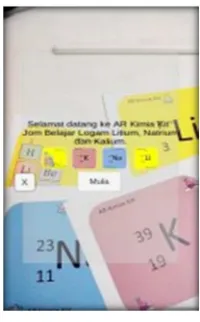
After clicking the icon, the first user interface of the application is as appeared in Figure 2. Click the Mula button to start the activity.
Fig. 2 The first screen for the AR Kimia Kit
The learning objects, which are the targets, are printed because it will be used as markers for the second activity. These markers are called as periodic table cards as shown in Figure 3.
In the second activity, students are required to answer questions in the AR Kimia Kit quickly. As shown in Figure 3, a group of students was trying to get answers by scanning associate markers to get digital information. If the students give a wrong answer, a hint will be given. The students can only proceed to the next question if they answer the given question correctly.
Fig. 3 A group of students tried to answer a series of questions using periodic table cards
6) Data Collection (Identify Changes): After the students have used the application, a post-test was given to the students. The results from the post-test were collected in order to identify the changes of scores before and after using the application.
7) Analysis and Evaluation: The data collected from the pre-test and post-test were then analyzed. This stage is important in order to identify whether the selected action works to improve the current situation. The frequencies of students who obtain grade A, B, C, D and E for both tests were compared between the two cases. Both results reflect the impact of using the proposed mobile application and were used to plan the next action plan.
8) Next Cycle: Based on the analysis and evaluation of the results, the next cycle involves the improvement of teaching and learning approach. The teaching plan might be added according to the appropriate judgment of the situation, for example adding the extra module in order to ensure the students to obtain a better understanding of the subject and at the same time improve their results.
B. The Design of AR Kimia Kit
By doing so, the application provides support to the students who need to seek information from more than one resource. Therefore, the learning process is eventually guided by using a series of questions whereby the students are exposed to various evidence using AR since each target adds virtual information such as 3D model, images, or videos. For more assistance in the learning process, also, the hints are given as scaffolding if the selected answer is not yet correct. In short, the AR Kimia Kit application is designed based on guided discovery learning, where the learning process is guided with the help of questions that allows students to be exposed to various evidence while utilizing the AR application.
The primary architecture of the MAR application for guided discovery learning is illustrated in Figure 4, which consists of four main steps. The first step is to read the questions where the students will start the discovery learning by firstly understanding the question given in the initial page. Two options are provided to answer the given question. In order to answer the question, the student needs to proceed to the second step. The second step is about using AR to expose to various evidence. In this step, the students are required to use some cards as targets (T1, T2, …, TN) for the application to overlay virtual information (V1, V2, …, VN). The evidence in this step is crucial in allowing the students to select the correct answer for the current question. After that, the next step, which is step three, is to select the best answers based on the conclusions gathered from all of the collected evidence. However, in cases where the selected answers are incorrect, the students will be guided through step 4 for scaffolding where hints for the questions will be given.
Fig. 4 Architecture of the MAR for guided discovery learning
Since the aim of this study is to provide the MAR guided discovery learning for students to learn reactivity of group one in the periodic table, three parts of learning materials have been designed for the AR Kimia Kit. Part I as an
introduction in using a single target, Part II for core topics using multiple targets and Part III for exercises. The key components for Part I are illustrated in Figure 5. In the introduction phase demonstrated in this figure, questions are organized for a single target only which intends to introduce to the students the main idea for group one in a periodic table.
Fig. 5 Introduction part using a single target with the image
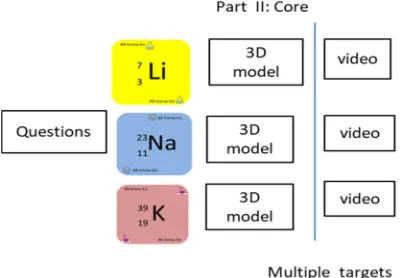
After the introduction phase, the main elements in-group one that is Li, Na, and K, are used as targets in the second part as shown in Figure 6. During this phase, for the same question that requires a comparison between the three said elements, the visualization of complex material such as a 3D model of an atom or real lab experiments is going to be observed to which the analyses are expected to be made based on more than one targets.
Fig. 6 Core material part using multiple targets with 3D models and videos
In addition, in the exercise part for the AR Kimia Kit, as shown in Figure 7, multi-targets for the three elements are used as options for answers. During this process, the student should scan the selected target to be checked by the application. An image of a right arrow is displayed if a student selects the correct target. On the other hand, an image of a wrong arrow is shown for an incorrect answer.
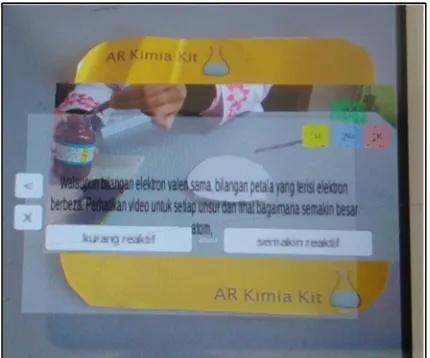
The AR Kimia Kit was developed for the Android platform using the Vuforia Augmented Reality (https://developer.vuforia.com) combined with Unity 3D (http://unity3d.com/). Vuforia was chosen to be used in this application as it provides a library for AR and place to upload associate markers related to the periodic table. The user interfaces for Part I (Introduction) is shown in Figure 8(a). During this part, the single target is used where an image that explains the three elements in-group one is overlaid on top of the card. Figure 8(b) demonstrates the user interface for Part II (Core Materials). Based on the previous explanation, this user interface uses multiple targets for 3D models. As can be seen in the figure, the students can observe evidence from two cards. The videos for real experiment are overlaid on top of the card based on multiple targets as shown in Figure 9.
(a) (b)
Fig. 8 User interface for (a) Part I (Introduction) using single target for image and (b) Part II (Core Materials) using multiple targets for 3D model
Fig. 9 User interface for Part II (Core Materials) using multiple targets (Lithium) for experiment video
III.RESULT AND DISCUSSION
A. Pre-Test and Post-Test
Pre-test and post-test were conducted in this application to assess the effectiveness of the AR Kimia Kit. The results for
the tests are shown in Table 1. It can be observed that there is an increase of frequency for grade A, B and C. For example, in grade A score, there are 10 students who managed to obtain A for the post-test compared to only one student who scored A in the previous test during the pre-test session. As seen in the table, there is also a decrease for grade E, from 16 students during the pre-test to only one student at the post-test stage.
TABLEI
RESULTS FOR THE PRE-TEST AND POST-TEST
Grade Frequency
Pre-test Post-test
A (100 %-80%) 1 10
B (79%-65%) 1 4
C (64% - 50%) 3 9
D (49%-40%) 4 1
E (39% - 0%) 16 1
Figure 10 shows that the average student score has increased from 4.25 to 8.08. Every student was found to perform better after using the application although all of the students who participated in this experiment have already learned the topic in their class before using the application. It is also observed that one student (student H in Figure 10) who only obtain grade E even after the post-test at least showed improvements and managed to gain an increase regarding accumulated marks from 18 to 36. By using the AR Kimia Kit application, the students have to make efforts to learn the virtual information related to each element in group one of the periodic table in order to give correct answers. This leads to knowledge discovery and in the fortunate event may help students in knowledge retention.
Visualizing the 3D model of each atom allows the students to gain more understanding about the chemical properties for group one metals. The improvement regarding scores shows that complex materials can eventually be learned by using a MAR application based on guided discovery learning. This application considers the differences in electron management for each element by designing the application with multiple targets. The results show that the consideration of the analytic learning with the use of some questions can help to guide the students in problem solving. This also supports the finding that MAR is effective to be used in this situation because it provides an immersive experience that combines real and virtual data to help the learners visualize difficult material conditions [7].
B. Satisfaction Factor
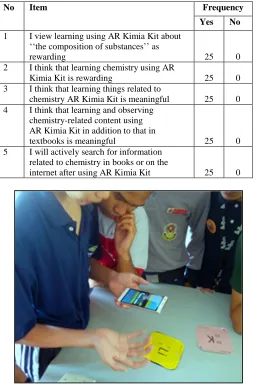
The satisfaction level of the students in this experiment was positive. As shown in Table 2, 100 percent of students provided the answer “Yes” on all of the items in the questionnaire given to them. This shows that students were satisfied in using the AR Kimia Kit in which they hope it can be applied to other subtopics. After the completion of the experiment, the students also asked their teacher to allow them to do the exercise on the topic given using the AR Kimia Kit at home, which subsequently leads to flexibility learning where learning is freed for the limitation of time, place, and pace of study. This also supports the finding that AR helps to encourage positive learning and enhance the student’s motivation towards gaining knowledge [28]-[29]. As can be seen in Figure 11, a group of students was engaged in a discussion while solving a problem. Discussion as such can encourage students to learn and experience various ways of learning.
TABLEII
SATISFACTION FACTOR IN USING ARKIMIA KIT FOR 25 STUDENTS
No Item Frequency
Yes No
1 I view learning using AR Kimia Kit about ‘‘the composition of substances’’ as
rewarding 25 0 2 I think that learning chemistry using AR
Kimia Kit is rewarding 25 0 3 I think that learning things related to
chemistry AR Kimia Kit is meaningful 25 0 4 I think that learning and observing
chemistry-related content using AR Kimia Kit in addition to that in
textbooks is meaningful 25 0 5 I will actively search for information
related to chemistry in books or on the
internet after using AR Kimia Kit 25 0
Fig. 11 Discussion among the students
IV.CONCLUSION
A guided discovery application based on MAR was designed in this research to provide an interactive learning environment for STEM learning in subjects such as chemistry. Analyzing group one elements in a periodic table
can now be learned via mobile application based on AR that supports multiple pieces of evidence. This AR Kimia Kit application is seen as an essential role in assisting the teacher in engaging students in learning hard materials in chemistry. The combination of virtual and real data can spark the excitement of the students to stay focus allowing them to engage in discovering knowledge by answering a series of questions given in the application. This application has shown positive responses from the students and has improved their scores on the topic. This demonstrates another example of the positive impact of MAR based applications. Educators are keen to look forward towards a future that increases AR usage in the education in the hope that this technology can enrich the learning environment. It is indeed a challenge for all educators to transform their learning materials that suit the current generation who prefer visualization in order to understand the topic of study.
ACKNOWLEDGMENT
We would like to thank FRGS/1/2017/ICT04/UKM/1 and GUP-2015-008 supported by Ministry of Higher Education of Malaysia for financial support.
REFERENCES
[1] R. T. Azuma, “A Survey of Augmented Reality,” Presence Teleoperators Virtual Environ., vol. 6, no. 4, pp. 355–385, 1997. [2] N. C. Hashim, N. A. A. Majid, H. Arshad, S. S. M. Nizam, and H. M.
Putra, “Mobile augmented reality application for early Arabic language education-: ARabic,” in 2017 8th International Conference on Information Technology (ICIT), 2017, pp. 761–766.
[3] N. A. Abd Majid and N. K. Husain, “Mobile learning application based on augmented reality for science subject: Isains,” ARPN J. Eng.
Appl. Sci., vol. 9, no. 9, pp. 1455-1460, 2014.
[4] N. A. Abd Majid, H. Mohammed, and R. Sulaiman, “The use of augmented reality application in a large-enrolment class for increasing students’ attention,” Aust. J. Basic Appl. Sci., vol. 9, no. 9, pp. 1–6, 2015.
[5] P.-H. E. Liu and M.-K. Tsai, “Using augmented-reality-based mobile learning material in EFL English composition: An exploratory case study,” Br. J. Educ. Technol., vol. 44, no. 1, pp. E1–E4, Jan. 2013. [6] R. Li, B. Zhang, S. S. Sundar, and H. B.-L. Duh, “Interacting with
Augmented Reality: How Does Location-Based AR Enhance Learning?,” Springer, Berlin, Heidelberg, 2013, pp. 616–623. [7] M. R. Mirzaei, S. Ghorshi, and M. Mortazavi, “Combining
Augmented Reality and Speech Technologies to Help Deaf and Hard of Hearing People,” in 2012 14th Symposium on Virtual and Augmented Reality, 2012, pp. 174–181.
[8] N. Che Hashim, N. A. Abd Majid, H. Arshad, and W. Khalid Obeidy, “User Satisfaction for an Augmented Reality Application to Support Productive Vocabulary Using Speech Recognition,” Adv. Multimed., vol. 2018, pp. 1–10, Jun. 2018.
[9] L. X. Ng, S. W. Oon, S. K. Ong, and A. Y. C. Nee, “GARDE: a gesture-based augmented reality design evaluation system,” Int. J. Interact. Des. Manuf., vol. 5, no. 2, pp. 85–94, Jun. 2011.
[10] R. Z. Abidin, H. Arshad, and S. A. A. Shukri, “Adaptive multimodal interaction in mobile augmented reality: A conceptual framework,” 2017, vol. 1891, p. 020150.
[11] M. Billinghurst and A. Duenser, “Augmented Reality in the Classroom,” Computer (Long.Beach.Calif)., vol. 45, no. 7, pp. 56–63, Jul. 2012.
[12] H. Arshad, S. A. Ahmad Shukri, W. K. Obeidy, and R. Z. Abidin, “An Interactive Application for Halal Products Identification based on Augmented Reality,” Int. J. Adv. Sci. Eng. Inf. Technol., vol. 7, no. 1, p. 139, Feb. 2017.
[14] M. J. Sadik and M. C. Lam, “Stereoscopic Vision Mobile Augmented Reality System Architecture in Assembly Tasks,” J. Eng. Appl. Sci., vol. 12, no. 8, pp. 2098–2105, 2015.
[15] M. Akçayır and G. Akçayır, “Advantages and challenges associated with augmented reality for education: A systematic review of the literature,” Educ. Res. Rev., vol. 20, pp. 1–11, Feb. 2017.
[16] M. B. Ibáñez, Á. Di Serio, D. Villarán, and C. Delgado Kloos, “Experimenting with electromagnetism using augmented reality: Impact on flow student experience and educational effectiveness,” Comput. Educ., vol. 71, pp. 1–13, Feb. 2014.
[17] A. Mohd Yusof, E. G. S. Daniel, W. Y. Low, and K. Ab. Aziz, “Teachers’ perception of mobile edutainment for special needs learners: the Malaysian case,” Int. J. Incl. Educ., vol. 18, no. 12, pp. 1237–1246, Dec. 2014.
[18] S.-J. Lu and Y.-C. Liu, “Integrating augmented reality technology to enhance children’s learning in marine education,” Environ. Educ. Res., vol. 21, no. 4, pp. 525–541, May 2015.
[19] N. A. Abd Majid, H. Mohammed, and R. Sulaiman, “Students’ Perception of Mobile Augmented Reality Applications in Learning Computer Organization,” Procedia - Soc. Behav. Sci., vol. 176, pp. 111–116, Feb. 2015.
[20] P. Chen, X. Liu, W. Cheng, and R. Huang, “A review of using Augmented Reality in Education from 2011 to 2016,” Springer, Singapore, pp. 13–18, 2017.
[21] Y.-W. Huang, C.-H.Wang, and Y.-H. Chen, “Discovery Augmented Reality Mobile Gaming Scheme for Understanding Color Fundamentals,” in European Conference on Games Based Learning, 2017, pp. 944–947.
[22] D. L. Johnson, “Facilitating Complex Learning by Mobile Augmented Reality Learning Environments -ch18- Reshaping Learning - Frontiers of Learning Technology in a Global Context,” New Front. Educ. Reserach, pp. 1–450, 2013.
[23] M. Specht, “Mobile Augmented Reality for Learning,” J. Res. Cent. Educ. Technol., vol. 7, no. 1, 2011.
[24] E. Bayir, “Developing and Playing Chemistry Games To Learn about Elements, Compounds, and the Periodic Table: Elemental Periodica, Compoundica, and Groupica,” J. Chem. Educ., vol. 91, no. 4, pp. 531–535, Apr. 2014.
[25] V. D. B. Bonifácio, “QR-Coded Audio Periodic Table of the Elements: A Mobile-Learning Tool,” J. Chem. Educ., vol. 89, no. 4, pp. 552–554, Mar. 2012.
[26] R.-C. Chang and L.-Y. Chung, “Integrating Augmented Reality Technology into Subject Teaching: The Implementation of an Elementary Science Curriculum,” Springer, Singapore, 2018, pp. 187–195.
[27] M.-B. Ibanez, A. Di-Serio, D. Villaran-Molina, and C. Delgado-Kloos, “Augmented Reality-Based Simulators as Discovery Learning Tools: An Empirical Study,” IEEE Trans. Educ., vol. 58, no. 3, pp. 208–213, Aug. 2015.
[28] B. Somekh, “Action research and collaborative school development,” in R. McBride (Ed.) The In-service Training of Teachers: some issues and perspectives. Brighton: Falmer Press. 1989.
[29] N. A. Abd Majid, “Application of Mobile Augmented Reality in a Computer Science Course,” Springer, Cham, pp. 516–525, 2013. [30] N. Saforrudin, H. Badioze Zaman, and A. Ahmad, “Technical Skills