INTERNATIONAL JOURNAL FOR MATHEMATICS TEACHING AND LEARNING 2019, Vol. 20.2, 131-148
Investigating the Relationship between Argumentation and Proof
from a Representational Perspective
Hilal Gulkilik
Gazi University [email protected]
Hatice Aydan Kaplan
Gazi University [email protected]
Nida Emul
Amasya University [email protected]
The purpose of this qualitative study was to analyze the relationship between argumentation and proof in terms of verbal, visual, and algebraic representations of mathematical concepts. We conducted task-based interviews based on geometric locus problems with six undergraduate mathematics teachers while they were working in pairs. We identified the mathematical arguments that the pairs produced in argumentation and proving by using Toulmin’s model. We examined the role of representations in the relationship between these processes by performing an analysis considering the referential system and the structure dimensions. Data analysis revealed that students could transform the abductive and inductive arguments to deductive arguments in proofs if they could produce and utilize algebraic representations by relating them to visual and verbal representations in the warrants and backings.
Representations have a crucial role in learning and teaching mathematics because objects cannot be accessed directly in mathematics, in contrast to other fields of scientific knowledge (Duval, 2006). “The essence of mathematics consists in working with representations” (Hoffman, 2006, p. 279) and students must understand each of the representations of mathematical objects and relate these representations to each other during the main mathematical activities (Even, 1998; Goldin, 2003; Lesh, Post, & Behr, 1987). Two of these main activities are argumentation and proving (Dreyfus, Nardi, & Leikin, 2012; Stylianides, 2007).
between these processes (Boero, Douek, Morselli, & Pedemonte, 2010; Garuti, Boero, & Lemut, 1998) state that using the activities engaged in the argumentation process can help students understand and construct the mathematical proof. They offer the notion of cognitive unity to analyze the complex relationship between argumentation and proof when students engage in solving open mathematical problems. Boero, Garuti, Lemut, and Mariotti (1996) describe this unity in the following terms:
During the production of the conjecture, the student progressively works out his/her statement through an intensive argumentative activity functionally intermingled with the justification of the plausibility of his/her choices. During the subsequent statement proving stage, the student links up with this process in a coherent way, organising some of the justifications (‘arguments’) produced during the construction of the statement according to a logical chain. (p. 113)
In this regard, there is cognitive unity when there is correspondence between the arguments used in producing a conjecture and the arguments within the constructed proof (Garuti et al., 1998).
The cognitive unity framework may be a powerful tool “to foresee and analyze some difficulties that students might have in the construction of proof” (Pedemonte, 2007, p. 25) because it accepts a “possible distance” without a “rigid dichotomy” between argumentation and proof (Mariotti, 2006, p. 184). From this perspective, proving is a kind of problem- solving in which students produce, experience, or explore different arguments and then organize them in a logical manner to construct a mathematical proof (Hanna & de Villers, 2012). They use different heuristics during the exploratory phase of the solving process and the results generated in this phase lead them to state a conjecture (Durand-Guerrier, Boero, Douek, Epp, & Tanguay, 2012). They try to produce arguments to support or reject this conjecture in this phase (Mariotti, 2006). In the stage of proof construction, they are expected to prove these conjectures by linking the previous arguments deductively (Boero, et al., 2010). Pedemonte and Balacheff (2016) state that students need to use axioms, definitions, or theorems as warrants in proving a conjecture but they use different informal arguments that do not belong to mathematical theory in producing the conjecture. Therefore, analyzing the relationship between argumentation and proof in educational contexts “has yielded useful insights into why students have difficulty basing their proofs on informal arguments, as well as what types of informal arguments are likely to serve as a good basis for a proof” (Zazkis, Weber, & Mejía-Ramos, 2016, p. 159).
We take this perspective and analyze the role of verbal, visual, and algebraic representations that students use in generating conjectures and looking for their proof while solving an open geometric problem. These three main representations attract educators’ and researchers’ attention (Kaput, 1998) because of their pervasive use in mathematical situations. We use Pedemonte’s (2007) theoretical constructs, which help us to compare the argumentation and proof from a cognitive perspective with the referential system and the structure. The overarching research question is “What is the role of representations in the relationship between constructing a conjecture and proving it?”
The Referential System and Structure
argumentative conjecturing and proving processes, it can be said that there is continuity between these processes in terms of the referential system. Hence, the cognitive unity analysis deals with the referential system (Pedemonte, 2008). Pedemonte (2007) points out that referential system analysis is not sufficient to understand all continuity between two processes. According to her, even if there is cognitive unity between argumentation and proof, there may be a gap between the reasoning types. Therefore, she offers a cognitive analysis that includes not only the referential system but also the “logical cognitive connection between statements,” called structural continuity (p. 29). It is continuity in terms of deductive, inductive, and abductive statements between the two processes (Pedemonte, 2008). In other words, we can refer to continuity in the referential system when the argumentation and proof have the same content and we can talk about structural continuity when the two processes have the same logical statement (Pedemonte, 2007). For example, there is continuity in terms of the referential system “if some words, drawing and theorems used in the proof have been used in the argumentation process” (Martinez & Pedemonte, 2014, p. 126). On the other hand, there is structural continuity “if some abductive activities generated in the argumentation process are present also in the proving process” (Pedemonte, 2008, p. 386). Because we deal with abductive, inductive, or deductive steps generated during argumentation supporting a conjecture and its proof, we will clarify these reasoning types as used in this paper.
Types of Reasoning
It is clear that students make inferences or draw conclusions while exploring a mathematical conjecture and producing its proof. While deductive reasoning is required in proving, inductive and abductive reasoning play an important role in generating conjectures (Conner, Singletary, Smith, Wagner, & Francisco, 2014; Pedemonte, 2007).
Pedemonte and Reid (2011) indicate that when students try to prove a mathematical statement, they “come up with an idea” in conjecturing which leads them to generate abductive reasoning (p. 282). Students make an inference that leads them to produce a claim based on their observation (Pedemonte, 2007, with reference to Peirce (1960)). Magnani (2001) states that abduction is a kind of reasoning “in which explanatory hypotheses are formed and evaluated” (p. 18). It is “initially influenced by prior knowledge and experiences” and it has “unpredictable sources” such as “surprising facts, flashes, intelligent guesses, [and] spontaneous conjectures” (Rivera, 2017, pp. 555-556). As an example, we can think about a geometry problem asking students to compare two polygons. The polygons are similar but students do not know this fact. They are expected to explore and verify this relationship. Students may state that the two polygons are similar based on the observation that the corresponding sides of the polygons are proportional. This observation then produces a reasoning process that includes justifying that all pairs of corresponding angles are congruent to prove that the two polygons are similar. In this case, students “first come across a result and then have to guess or hypothesize which particular rule and case afforded (or might afford) such a result” (Conner et al., 2014, p. 187).
p. 558). In the polygon problem, students may prefer to draw conclusions from particular polygons like pentagons, hexagons, and regular or concave polygons to produce a generalization about the similarity of two polygons. In this situation, students move from the specific cases into a generalization (Reid & Knipping, 2010) to prove that two polygons are similar.
The other kind of reasoning students use during conjecturing and proving is deductive reasoning. It is the process “in which a conclusion follows necessarily from given premises so that it cannot be false when the premises are true” (Borwein, 2012, p. 70). In our example, students may analyze the polygons to show that their corresponding angles are congruent and the measures of their corresponding sides are proportional. They may use the properties of geometric transformations (dilation, translation, rotation, and reflection) and their composition to compare the polygons. Students utilize the generalized true principles to draw a specific conclusion and, as Peirce (1956) states, this type of reasoning ensures the certainty of the conclusion.
Research on the relationship between argumentation and proof has shown that students should have the benefit of experiencing the openness of exploration during argumentation and that open-ended problems are effective tools to engage them in this process (Durand-Guerrier et al., 2012). We designed our study to examine the role of representations during the solving of geometric locus problems, with a specific focus on representations’ roles in argumentation and proof. Geometric locus problems require students to relate their geometry and algebra knowledge, make assumptions, and verify these assumptions. At the same time, students should be able to relate the process of argumentation in which they create conjectures to the process of proving, which includes verification of these conjectures (Boero, et al., 2007; Hanna & deVillers, 2012). Because students need representations to manipulate symbols and to promote reasoning (Kaput, 1991), choosing the appropriate representation plays an important role in the proving process (Furinghetti & Morselli, 2009; Gholamazad, Liljedahl, & Zazkis, 2003). Selden and Selden (2003) state that the inability to select appropriate representations is one of the difficulties that university students face in proving. Another difficulty they encounter in mathematical reasoning is constructing the connections among representations of mathematical objects (Adu-Gyamfi, Bossé, & Chandler, 2017). Students are expected to construct verbal-symbolic proofs based on visual-graphical arguments, which is not an easy task for them (Alcock & Weber, 2010; Zazkis et al., 2016).
Students need several abilities including the use of verbal, visual, and algebraic representations of mathematical concepts in both argumentation and proving while they are solving geometric locus problems. Experimental studies (Boero et al., 1996; Garuti et al., 1998; Pedemonte, 2007) show that if there is a large content or structural distance between the mathematical arguments in conjecturing and proving, students have difficulties producing a proof. We believe that it is important to investigate how cognitive unity or break depends on students’ engagement with different representations of mathematical ideas used in the construction of a proof. Characterizing the representational activities in the relationship between argumentation and proof can extend the previous literature and help mathematics educators design instructional environments that support students’ proving processes by focusing on these activities.
contribute to the related literature by examining how students transpose their argumentation using geometry into proofs using algebra from a representational point of view. In this way, we can elaborate on the reasons that previous research has presented for the continuity/discontinuity in the referential system and structure. We will use Toulmin’s model (1958/2003) to form the mapping of students’ arguments developed both in argumentation that supports a conjecture and in the construction of its proof. It is an efficient tool to perform referential system and structure analysis (Pedemonte, 2007).
Toulmin (2003) describes three basic components as the core of an argument: the data, claim, and warrant. He defines a claim as a “conclusion whose merits we are seeking to establish” and data as “the facts we appeal to as a foundation for the claim” (p. 90). The third basic component is the warrant, which relates the data to the claim and describes the way the data supports the claim. There are also three auxiliary components in the model: the qualifier, rebuttal, and backing. A qualifier indicates “the strength conferred by the warrant” (p. 94). The rebuttal of an argument constitutes “circumstances in which the general authority of the warrant would have to be set aside,” (p. 94), whereas the backing means “other assurances without which the warrants themselves would possess neither authority nor currency” (p. 96).
Martinez and Pedemonte (2014) indicate that researchers should take warrants and backings into consideration to implement referential system analysis. We analyzed the warrants and backings of students generated during argumentation and proving in terms of representations in this study. In the meantime, our cognitive analysis included a structural analysis of the relationship between the two processes. From the structural view, Pedemonte (2007) connects each of abductive, inductive, and deductive reasoning to Toulmin’s model. In abductive reasoning, students state a claim based on observations and look for some data or a warrant to justify this claim. In inductive reasoning, students produce a claim by generalizing the particular cases and using them as warrants. In deductive reasoning, they use some data and principles/rule(s) that lead them to produce a claim.
Method
This qualitative study was a part of a project that examined the argumentation process of undergraduate mathematics teachers (henceforward “students”) at a public university in Turkey. The students solved different geometric locus problems in Euclidean plane geometry within the scope of the project. In geometry, a locus is defined as “the geometrical figure occupied by a series of points (or lines) that fulfill a given condition” (Aldrich, 1921, p. 201). Therefore, students need to have proper concept images about fundamental geometric concepts and verbal, visual, and algebraic representational competence to handle these problems (Gulkilik, 2008). We focus on the concept of locus because we think it provides representational diversity for examining the relationship between students’ conjecturing and proving processes. While solving geometric locus problems, students need to use algebraic relations to prove the conjecture that they produced by using visual or verbal statements during argumentation.
Participants
their educational background in terms of completed undergraduate courses, and (iii) their willingness to volunteer for the study. Participants were in the eighth semester of their undergraduate studies. They had taken several geometry courses, such as elementary, analytic, or differential geometry, in which they engaged with plane geometry problems including concepts such as line segment, line, circle, angle, curve, or slope. They had also completed courses on the fundamentals of mathematics and discrete mathematics. Therefore, they have learned to comprehend and construct mathematical arguments, to read and understand written proofs, and to construct their own proofs by using the rules of inference. Students worked in pairs during the interviews. Hence, we were able to better observe the argumentation and proof processes that they produced during collaborative problem-solving.
Research Context and Data Collection
We conducted three semi-structured task-based interviews (Goldin, 2000) with the students during a one-month period. We met with the students once a week and asked them to solve three or four problems according to their performance during each interview session. At the end of the data collection process, each pair had managed to solve 10 locus problems in total. The interview sessions lasted about two hours.
Students had access to a notebook computer with GeoGebra installed in addition to tools such as paper, pencil, graph paper, compass, and ruler during the sessions. They were familiar with GeoGebra from the computer based mathematics education courses that they had previously completed. They were free to use GeoGebra and/or other tools. A video camera recorded the participants’ utterances and activities while a screen recording software has recorded their engagement with GeoGebra. In this study, we will focus on one of the geometric locus problems for a detailed analysis of the role of representations in the relationship between argumentation and proof. The problem is “find the locus of points equidistant from three non-collinear given points in the plane.” We chose to focus on this problem because it was one of the problems for which students provided a proof in which they used quite a few distinct representations of mathematical objects1.
At least two researchers were present during the interviews. There was no intervention while they formulated a common argument to convince each other and prove the mathematical conjectures that they reached during the argumentation.
Data Analysis
We conducted the data analysis in two phases, in which we analyzed students’ videos, written productions, and GeoGebra files. First, we identified reasoning episodes to analyze students’ mathematical arguments while they were solving the problem. We focused on the situations in which pairs stated a claim based on data in both conjecturing and proving processes. We used Toulmin’s model to diagram each mathematical argument. We identified the claim the participants stated, the data they used as a foundation to produce the claim, and the warrants they generated to show how they related the claim and the data. We focused on the claim, data, and warrant including the backing rather than the rebuttal or qualifier. Although rebuttals and qualifiers are important components in mathematical arguments (Inglis, Mejia-Ramos, & Simpson, 2007), we thought that examining the claim, data, and
1 One has to prove two statements to determine a geometric locus: if a point satisfies the condition, then it is a
warrant was enough to understand the relationship between argumentation and proof (Pedemonte, 2008). Additionally, we analyzed participants’ mathematical arguments according to the reasoning types in order to examine the continuity between argumentation and reasoning processes from the structural perspective. For example, if students stated that the geometric locus was the circumcenter of a triangle by drawing and examining different kinds of triangles (equilateral, acute, isosceles) in conjecturing we coded this instance as inductive reasoning in argumentation (cf. Case 3). In this phase, we met regularly for coding/category development discussions over a three-month period. We developed the codes and categories together during the meetings in which we provided regular feedback to rearrange the categories and to clarify the codes.
In the second phase of the analysis, we determined the ways students used representations in different components of the argument. We analyzed students’ warrants and backings in detail to answer the question of how students use representations while relating argumentation and proof in terms of the referential system. In this context, we examined which kinds of representations they used in their warrants and backings while exploring and justifying their claims and how they related the different representations to each other in the argumentation and proving process. For example, students used quite a few GeoGebra drawings to make a claim during the problem-solving. When they examined these specific drawings by dragging in an inductive reasoning episode, we coded the way students related the data and claim as a warrant based on visual/graphical representations. Similarly, when students utilized mathematical formulas or equations in proving we decided that their reasoning was developed by using a warrant based on algebraic representations. We coded data separately during the second phase of analysis. To ensure reliability within the study, we presented, discussed, and negotiated our own codes and categories until a consensus was reached. For example, a long discussion was held until an agreement was reached on whether participants used information as data or as a warrant.
Findings
We present a detailed description of three solutions to the problem in this section. These solutions show how students exploited representations as they were conjecturing and proving. We selected these cases because they maximized diversity to show the role of representations in the relationship between argumentation and proof. The three analyses illuminate three different ways in which students’ representational engagement intervenes in this relationship. In the first case, students were able to use visual, verbal, and algebraic representations adaptively while converting the abductive/inductive steps in argumentation into deductive steps in proving. The second case presents an example in which students needed a conjecturing process based on visual and verbal representations before a proving process based on algebraic representations. In the third case, students were struggling to give meaning to algebraic representations in proving and this difficulty fed the structural continuity between the processes.
Case 1: Adaptive use of Representations to Convert the Abductive and Inductive Steps into Deductive Steps
The first pair, Asya and Sarp2, drew three nonlinear points on the paper after reading the problem. Sarp, drawing line segments at a certain distance to these points, said that the center
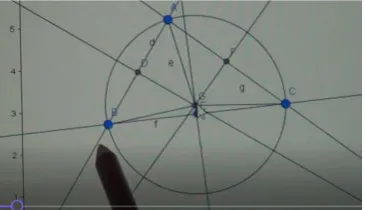
of the triangle’s circumscribed circle, whose vertices are the drawn three points, is a point at equal distance from these points. Asya visualized this abductive argument with a drawing on the paper (see Figure 1.a). They performed similar mathematical activities that included visual representations on GeoGebra (see Figure 1.b).
Figure 1.a. Visual representation Asya drew on the paper
Figure 1.b. Visual representation Sarp drew on GeoGebra
Figure 1. The visual representations Asya and Sarp used during exploring
Thinking that they confirmed one of the points providing the geometric locus, the pair began to investigate whether there were other points that provided the situation. They indicated that the other points they showed in the inner or outer region of the circle could not be the equal distance to these three points. Sarp, who named the three points as A, B, and C, put forward his ideas with the following sentences:
I think it is one point because no matter where else… For example, it is at equal distances to A and B, but it is different to C. I am thinking zone by zone, if we consider these lines as zones (shows the regions out of the ABC triangle formed by the lines, see Figure 1.b).
The actions, which Sarp performed on GeoGebra through inductive reasoning, triggered Asya’s development of a new abductive argument. The pair’s reasoning continued as follows:
Asya: If we think for A and B, the equidistant points are the ones on the line passing through D
(midpoint of A and B, see Figure 2). It is the same for A and C.
Sarp: So let us do this. We know that points at equal distance to A and B will pass through that line (draws the line passing through the midpoint of [AB] and the point G, the center of the circle that they have already drawn). We know that points at equal distance to A and
C will pass through there (draws the line passing through the midpoint of [AC] and point
G). It is same for B and C (draws the line passing through the midpoint of [BC] and point
G). There is only one intersection point, point G. It is a one-point geometric locus. The center of the circumscribed circle.
The new argument that the pair developed by abductive reasoning is modeled in Figure 3. This step is an abductive one because they stated that the geometric locus was the center of the circumscribed circle and sought a warrant for this claim. They drew the lines passing through the midpoint of the line segments connecting the two points and the center point (G) that they had already specified. When researchers asked students how they decided that the line passed through the point G, Sarp said, “we have drawn it because we have already known it.”
Figure 3. The mathematical argument Asya and Sarp produced abductively
The researchers then asked the students how they would prove the conjecture. At this phase, there was a dialogue among them as follows (see Figure 4):
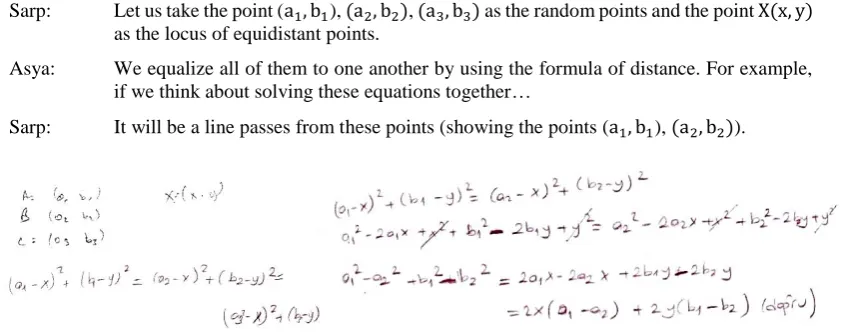
Sarp: Let us take the point (a1, b1), (a2, b2), (a3, b3) as the random points and the point X(x, y) as the locus of equidistant points.
Asya: We equalize all of them to one another by using the formula of distance. For example, if we think about solving these equations together…
Sarp: It will be a line passes from these points (showing the points (a1, b1), (a2, b2)).
Figure 4. The algebraic representations Asya and Sarp used to prove the conjecture
The students found the equation of the line that they had expressed verbally with the help of algebraic representations. Later, they said that they would find three different linear equations from the other equations and find an intersection point. Meanwhile, Sarp turned to his drawing, which he had previously done in GeoGebra, and used the following expressions to show the related perpendicular bisectors (see Figure 2):
Now, we found the points at equal distances to A and B, we found this line, when we solve the equation related with A and C, we will find that line. We will then intersect these three lines. It will be a point.
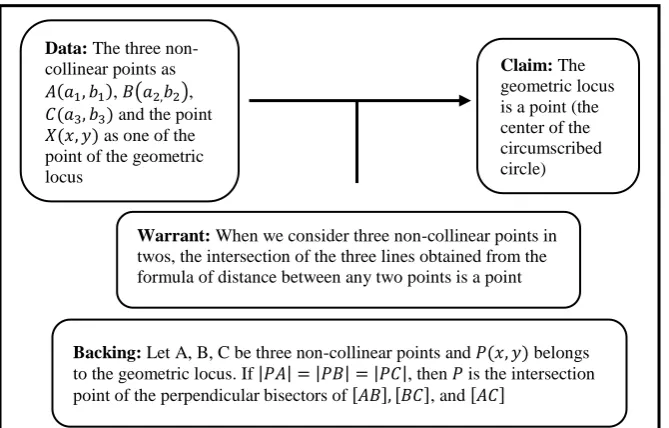
Data: The triangle whose vertices are the non-collinear three points and the circle passing through these points
Claim: The geometric locus is the center of the circumscribed circle
The mathematical argument that the students produced is modeled in Figure 5. It seems that there is continuity in the referential system between the process of argumentation with visual-verbal representations and the process of proving with algebraic representations. The students ensured this continuity because they were successfully associated the different representations with each other in the warrant and backing generated during proving. On the other hand, there was a structural break in the way of students’ reasoning between argumentation and proving. They adaptively transformed their abductive and inductive arguments in argumentation into a deductive structure in proof. This transformation was achieved because the students related the mathematical idea represented in algebraic expressions with their corresponding visual and verbal representations.
Figure 5. The mathematical argument Asya and Sarp produced in proving
Case 2: Need for Engagement with Visual/Verbal Representations before Using Algebraic Representations in Proving
The second pair, Akif and Sezin, firstly drew three non-collinear points on the paper as soon as they read the question. They drew a point in the middle of these points and said that it was a point satisfying the condition. The pair stated that they solved a similar problem before and they would prove the idea by determining the three points as certain points. They determined the drawn three non-collinear points as (1,2), (2,3), and (3,4) (without checking the collinearity of the points) and the point that they drew in the middle as (x, y). They tried to find the geometric locus by calculating the distance between the points (2,3), (3,4) and the point (x, y). They constructed an algebraic relationship between the points without engaging with visual forms of mathematical ideas (see Figure 6). When they got a line equation after the calculations, they hesitated to use the algebraic representations. In the meantime, the following dialogue between the pair has taken place:
Sezin: Since we took two points, a perpendicular bisector will come out. However, it says three points, equal distance to three points. What is it?
Akif: A point?
Sezin: In any case, it will be a point. Would this point be something special?
Data: The three non-collinear points as
𝐴(𝑎1, 𝑏1), 𝐵 𝑎2,𝑏2 ,
𝐶(𝑎3, 𝑏3) and the point
𝑋(𝑥, 𝑦) as one of the point of the geometric locus
Claim: The geometric locus is a point (the center of the circumscribed circle)
Warrant: When we consider three non-collinear points in twos, the intersection of the three lines obtained from the formula of distance between any two points is a point
Akif: I think it is just a point. Finding something like a shape is very difficult.
Sezin: But it says the geometric locus of the points.
Akif: Ok, the geometric locus of the points is a point?
Figure 6. The algebraic representations Sezin and Akif provided
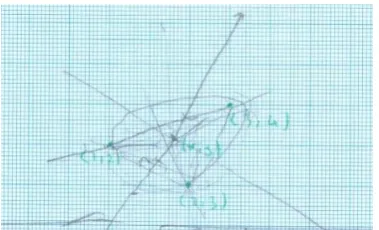
Although they knew that the line was the perpendicular bisector of the selected two points, they seemed to doubt the accuracy of the solution. The pair decided to go back to the visual representation that they had formed previously on the paper. The dialogue between the pair continued as follows (see Figure 7):
Sezin: We are sure that a line will come out between the two points. It will be the perpendicular bisector (draws one of the perpendicular bisectors).
Akif: Then, the perpendicular bisector of other points will be like this (draws the other two perpendicular bisectors).
Sezin: Well, the intersection of these lines…
Akif: A point.
Figure 7. The visual representation Sezin and Akif used
representations consistent with their perceptions and estimations in order to experience an efficient proving process. The ability to use representations by relating them to each other was one of the factors affecting the quality and continuity of deductive reasoning. The students could sustain the proving process successfully to the extent that they could link algebraic representations to visual and verbal representations.
Case 3: Using Algebraic Representations without Interpreting the Mathematical Notations and Symbols within
The third pair, Mine and Gaye, began to think about the different geometric figures that would satisfy the condition given in the problem. They stated that the intersection point of the diagonals of a square whose three vertices were the given points, the center of the circle passing through the given points, or the centroid of an equilateral triangle whose vertices were the given points would provide this geometric locus. After a while, they claimed that “the center of any regular polygon whose three vertices were the given points would satisfy this condition.” While confirming this expression, they showed the lengths of the line segments on the equilateral triangle and regular polygons they drew.
After the researchers asked how they would think if the given three points were not the vertices of a regular polygon, Mine said that they would think “only in mathematical terms” and stated that they would “find the distance between the points.” Then, the students drew a coordinate system and expressed that there was no problem in specifying these three non-collinear points as (0,0), (1,0), and (0,1). The pair, obtaining an equilateral triangle, began to consider how they could show that this point belonged to the geometric locus by placing a point in the inner (middle) region of this triangle. They started to think in an abductive manner and stated that the point in the middle might be the centroid of the triangle. Later on, the students indicated that this would not always be true as they found the coordinates of the centroid. When Mine stated that “we need to find something like an ellipse, hyperbola, ellipse that shares this property”, the pair had a dialogue as follows:
Gaye: Do any three points determine a triangle?
Mine: Any non-collinear three points determine a triangle.
Gaye: Each triangle has a centroid. Is not it equidistant from the three vertices of the triangle?
Mine: It is true for an equilateral triangle. The centroid is at an equal distance to three points in an equilateral triangle. Is there anything else? There is a point in the middle of each triangle. I mean within acute angled triangles, I could not think of obtuse angled triangles now. Is it like the center of the circumscribed circle? Let us begin with an equilateral triangle, it is something like the center of the circle. What if it is an isosceles triangle? Does any isosceles triangle have a circumscribed circle? Does every triangle have a circumscribed circle? Then, can the geometric locus be its center?
Gaye: You say geometric locus is a point?
Mine: A point that is the center of the circumscribed circle.
Gaye: Well, according to what it is a circumscribed circle? The problem gives us only points. Then it is the center of the circumscribed circle of the triangle formed by these three points.
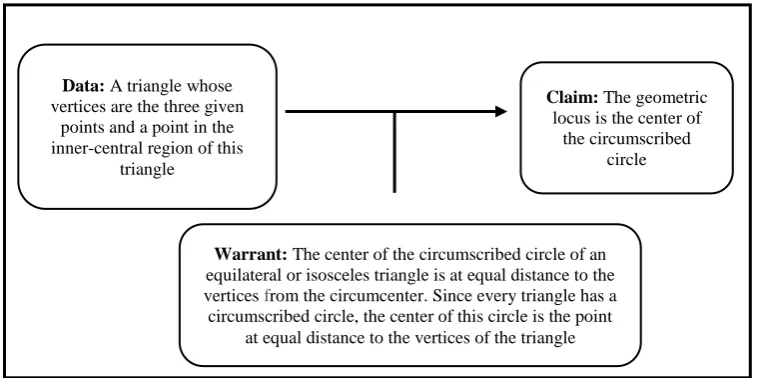
the pair produced with inductive reasoning based on the verbal and visual representations is illustrated in Figure 8 below.
Figure 8. The mathematical argument Mine and Gaye produced with inductive reasoning
Next, Gaye questioned whether a circle would always pass through three non-collinear points. In order to persuade Gaye, Mine drew a circle from the three points she determined randomly using the circle through 3 points tool in GeoGebra. Mine, who identified the center of this circle via midpoint or center tool, calculated the distances between the three points and the center one by one and showed from the algebraic window that they were equal to the same numerical value. The pair realized by dragging that this hypothesis was true even the points they got at the beginning changed. It is seen that with the help of inductive reasoning, the students confirmed their claims that the geometric locus is the center of the circle passing through three points. They preferred to use special cases involving visual representations in GeoGebra during the conjecturing process.
In the following section, the students were asked how they would prove the claim they stated. The pair indicated that they would get a new point with the coordinates (a, b) as the center and find the values of a and b from the distance formula if three coordinates were given. Then, they got A(0,1), B(1,0), C(−1,0), and M(a, b) points and used the MA = MB = MC equation. At the end of the solution process, they obtained two equations, a = b and a = −b. They found (a, b) = (0,0) from the two equations and showed that this point was the center of the circle passing through A, B, and C point in GeoGebra.
Although Mine and Gaye used algebraic representations while they were proving the idea that they developed in the argumentation process, they made an abductive proof. They looked for the data and warrant to prove their plausible hypothesis. They assumed that the center of the circle passing through the points A(0,1), B(1,0), C(−1,0) was M(a, b) and they found the coordinates of the point M considering the fact that MA , MB , MC were radius of that circle. Mine and Gaye were not aware that the point they obtained from the equations a = b, a = −b was the intersection point of the perpendicular bisectors. While answering the researchers’ question about what they obtained from MA = MB = MC , Gaye said:
Now here MA = MB and MB = MC , it is something that provides a point, because we said M is a point, an unknown point. However, the equation depends on a and b, it can be a line or something else.
Data: A triangle whose vertices are the three given
points and a point in the inner-central region of this
triangle
Claim: The geometric locus is the center of
the circumscribed circle
Warrant: The center of the circumscribed circle of an equilateral or isosceles triangle is at equal distance to the vertices from the circumcenter. Since every triangle has a circumscribed circle, the center of this circle is the point
The fact that they did not use the concept of perpendicular bisector in the argumentation process might be effective in this situation. The students used the representations of point, circle, the center of a circle, a circle passing through three points in both processes. They produced algebraic representations including the equations of perpendicular bisectors, a − b = 0 and a + b = 0 in proving. However, the students could not interpret these algebraic representations. They could not convert the abductive steps into deductive ones. It seems that students’ use of representations including formal items in proving is not sufficient to translate the structure of their argumentation into a deductive structure. Students must be able to understand the mathematical notations and symbols in the algebraic representations and associate them with visual and verbal forms in the process of proving.
Discussion of Findings
We focused on the role of representations in producing, developing, and proving conjectures while the students were solving an open geometric problem. We present our findings in cases that show how the students used representations in relating the processes of argumentation and proving.
When the argumentation process of Asya and Sarp was examined, it was seen that this pair used verbal and visual representations of mathematical concepts and ideas to construct conjectures by abductive and inductive reasoning. They were successful in converting the abductive and inductive structure of mathematical ideas including visual and verbal representations to a deductive structure including algebraic representations in proving. In their solution, there was continuity in the referential system but a structural break between the argumentation and proof. Martinez and Pedemonte (2014) indicate that the use of arithmetic and algebra together in the backings of students’ arguments during argumentation is important to provide a relationship between inductive argumentation in arithmetic and deductive proof in algebra. Similarly, our findings from Case 1 show that the students’ competence to construct a deductive proof for a locus problem depends on connecting different representations of mathematical concepts and ideas from geometry and algebra adaptively. In this context, the notion of representational fluency, the ability that students should have while working with mathematical representations, has been found useful to interpret the findings. Accordingly, students should be able to interact fluently with each of the different representations of the same mathematical concept and be able to switch between them when necessary (Zbiek, Heid, Blume, & Dick, 2007). In this respect, we assert that it is crucial for students to use geometry and algebra knowledge by interpreting each representation and establishing links between representations in relating argumentation and proving.
The visual representations are more than “a crutch” in these processes (Dreyfus, 1991, p. 46) and they “add meaning and conviction to the symbolic proof” (Arcavi, 2003, p. 221).
Looking at the problem-solving process of Mine and Gaye, we can say that the pair developed an argumentation process by abductive and inductive reasoning based on visual and verbal representations. When they were constructing the proof, we observed that they could not understand the mathematical notations and symbols in algebraic representations. They preferred to use algebraic representations as an abductive reasoning tool. As a result, the pair could not convert the previous abductive and inductive steps into a deductive structure in proving. They developed an abductive proof in the solution, so there was structural continuity between the processes. The use of algebraic representations without inferring the meaning impaired the students from making further progress in their mathematical arguments beyond the abductive or inductive statements. When the students in Case 2 and Case 3 tried to transform their reasoning into a deductive structure in proving, what they needed most was the ability to express their ideas in algebraic form. This difficulty for students has also been pointed out by Martinez and Pedemonte (2014), Pedemonte (2008), and Zazkis et al. (2016). Students’ inability to use algebraic representations in a productive way, comprehending what the mathematical notations and symbols mean, affected the process of proving. Pedemonte (2007) argues that the relationship between argumentation and proof should be examined from the perspective of both the referential system and the structure. The continuity in the structure is one of the difficulties faced by students in the field of geometry (Pedemonte, 2008). Our findings from Case 3 exemplify why we need a cognitive analysis that includes not only the referential system but also the structure. The solution of these students shows that the inability to utilize algebraic representations without a deep understanding maintains the structural continuity between the processes of argumentation and proving.
Conclusion
In this study, we analyzed the relationship between argumentation and proof developed by the students while they were solving a geometric locus problem. Our purpose was to characterize how they used verbal, visual, and algebraic representations in this relationship. The findings showed that the students created conjectures with abductive and inductive reasoning based on visual and verbal representations in the argumentation process while solving the problem. When they were asked to prove their conjectures, they continued to receive support from visual or verbal representations while developing abductive (Case 3) or deductive (Case 1 and 2) reasoning. Our results show that it is possible to reorganize the steps of argumentation with deductive reasoning in proving only by relating algebraic representations with visual and verbal representations (Case 1 and 2).
utilized in the warrants and backing of the arguments. Similarly, Arzarello and Sabena (2011) provide two control modalities that guide students’ argumentation and proof activities, which they call semiotic and theoretic control. Semiotic control is about selecting and implementing semiotic representations to handle the task, whereas theoretic control is about selecting and implementing mathematical theorems to support an argument. Our results offer insights on how semiotic control, which must exist between the two processes, influences theoretic control in solving a geometry problem.
It is not an easy task to make connections between geometry and algebra knowledge (Knuth, 2000; Noss, Healy, & Hoyles, 1997) or to relate argumentation to proving (Pedemonte, 2007, 2008; Zandieh, Roh, & Knapp, 2014). Our study elaborates these relationships by examining the role of different representations in argumentation and proof. It helps to clarify the proving process when there is a need for students to transform non-deductive mathematical arguments based on visual/graphical representations into a deductive proof based on algebraic representations. It shows that the ability to interpret notations and symbols in algebraic representations and make transformations by relating algebraic representations with visual and verbal forms characterizes the process of proving. Students can transform abductive and inductive arguments to deductive arguments if they can produce and use algebraic representations in the warrants and backings by relating visual and verbal representations in the process of proving. Therefore, teachers should pay attention to how students can utilize representations of mathematical entities in learning environments in exploring and conjecturing phases before proving.
Note: An earlier version of this research was presented at 27th International Conference on Educational Sciences, Antalya, Turkey, April 2018.
References
Abe, A. (2003). Abduction and analogy in chance discovery. In Y. Ohsawa & P. McBurney (Eds.), Chance discovery (pp. 231-248). Springer, Berlin, Heidelberg.
Adu-Gyamfi, K., Bossé, M. J., & Chandler, K. (2017). Student connections between algebraic and graphical polynomial representations in the context of a polynomial relation. International Journal of Science and Mathematics Education, 15(5), 915-938.
Alcock, L., & Weber, K. (2010). Undergraduates’ example use in proof production: Purposes and effectiveness.
Investigations in Mathematical Learning, 3(1), 1–22.
Aldrich, F. D. (1921). The teaching of locus problems in elementary geometry. The Mathematics Teacher, 14(4), 200-205.
Arcavi, A. (2003). The role of visual representations in the learning of mathematics. Educational Studies in Mathematics, 52(3), 215-241.
Arzarello, F., Olivero, F., Paola, D., & Robutti, O. (2002). A cognitive analysis of dragging practices in Cabri environments. ZDM,Zentralblatt für Didaktik der Mathematik, 34(3), 66-72.
Arzarello, F., & Sabena, C. (2011). Semiotic and theoretic control in argumentation and proof activities.
Educational Studies in Mathematics, 77(2-3), 189-206.
Boero, P., Douek, N., Morselli, F., & Pedemonte, B. (2010). Argumentation and proof: A contribution to theoretical perspectives and their classroom implementation. In M. M. F. Pinto & T. F. Kawasaki (Eds.), Proceedings of the 34th conference of the international group for the psychology of mathematics education (Vol. 1, pp. 179–204). Belo Horizonte: PME.
Boero, P., Garuti, R., & Lemut, E. (2007). Approaching theorems in grade VIII. In Boero, P. (Ed.), Theorems in school: From history, epistemology and cognition to classroom practice (pp. 249-264). Rotterdam: Sense Publishers.
Boero, P., Garuti, R., Lemut, E., & Mariotti, A. M. (1996). Challenging the traditional school approach to theorems: A hypothesis about the cognitive unity of theorems. In L. Puig & A. Gutiérrez (Eds.),
Borwein, J. M. (2012). Exploratory experimentation: Digitally-assisted discovery and proof. In G. Hanna & M. de Villiers (Eds.), Proof and proving in mathematics education—The 19th ICMI study, (New ICMI Study Series, Vol. 15, pp. 69-96). Dordrecht: Springer.
Conner, A., Singletary, L. M., Smith, R. C., Wagner, P. A., & Francisco, R. T. (2014). Identifying kinds of reasoning in collective argumentation. Mathematical Thinking and Learning, 16(3), 181-200.
Dreyfus, T. (1991). On the status of visual reasoning in mathematics and mathematics education. In F. Furinghetti (Ed.), Proceedings of the 15th Conference of the International Group for the Psychology of Mathematics Education (PME), (Vol.1, pp. 33–48). Assisi, Italy: Università di Genova.
Dreyfus, T., Nardi, E., & Leikin, R. (2012). Forms of proof and proving in the classroom. In G. Hanna and M. de Villiers (Eds.), Proof and proving in mathematics education—The 19th ICMI study (New ICMI Study Series, Vol. 15, pp. 191-213). Dordrecht: Springer.
Durand-Guerrier, V., Boero, P., Douek, N., Epp, S., & Tanguay, D. (2012). Argumentation and proof in the mathematics classroom. In G. Hanna & M. de Villiers (Eds.), Proof and proving in mathematics education—The 19th ICMI study (New ICMI Study Series, Vol. 15, pp. 349–367). Dordrecht: Springer. Duval, R. (2006). A cognitive analysis of problems of comprehension in a learning of
mathematics. Educational Studies in Mathematics, 61(1-2), 103-131.
Even, R. (1998). Factors involved in linking representations of functions. The Journal of Mathematical Behavior,17(1), 105–121.
Furinghetti, F., & Morselli, F. (2009). Every unsuccessful problem solver is unsuccessful in his or her own way: affective and cognitive factors in proving. Educational Studies in Mathematics, 70(1), 71-90. Garuti, R., Boero, P., & Lemut, E. (1998). Cognitive unity of theorems and difficulty of proof. Proceedings of
the international group for the psychology of mathematics education PME-XXII (Vol. 2, pp. 345–352). Stellenbosch: PME.
Gholamazad, S., Liljedahl, & P., Zazkis, R. (2003). One line proof: what can go wrong? In N. A. Pateman, B. J. Dougherty, & J. T. Zilliox (Eds.), Proceedings of PME 27 and PMENA (Vol. 2, pp. 429–435). Honolulu: University of Hawai’i.
Goldin, G. A. (2000). A scientific perspective on structured, task-based interviews in mathematics education research. In A. E. Kelly & R. A. Lesh (Eds.), Handbook of research design in mathematics and science education (pp. 517-545). Mahwah, NJ: Lawrence Erlbaum Associates.
Goldin, G.A. (2003). Representation in school mathematics: A unifying research perspective. In J. Kilpatrick, M.G. Martin, & S. Schifter (Eds.), A research companion to principles and standards for school mathematics (pp. 275–286). Reston, VA: National Council of Teachers of Mathematics.
Gulkilik, H. (2008). Öğretmen adaylarının bazı geometrik kavramlarla ilgili sahip oldukları kavram
imajlarının ve imaj gelişimlerinin incelenmesi üzerine fenomenografik bir çalışma (Unpublished master’s thesis). Gazi University, Ankara, Turkey.
Hanna, G. (2014). Mathematical proof, argumentation, and reasoning. In S. Lerman (Ed.), Encyclopedia of mathematics education (pp. 404-408). Dordrecht: Springer.
Hanna, G., & de Villiers, M. (2012). Aspects of proof in mathematics education. In G. Hanna & M. de Villiers (Eds.), Proof and proving in mathematics education: The ICMI study (pp. 1–10). New York: Springer. Hoffman, M. H. G. (2006). What is a “semiotic perspective”, and what could it be? Some comments on the
contributions to this special issue. Educational Studies in Mathematics, 61(1-2), 279–291
Inglis, M., Mejia-Ramos, J. P., & Simpson, A. (2007). Modelling mathematical argumentation: The importance of qualification. Educational Studies in Mathematics, 66(1), 3–21.
Kaput, J. (1991). Notations and representations as mediators of constructive processes. In E. von Glasersfeld (Ed.), Radical constructivism in mathematics education (pp. 53-74). Dordrecht, the Netherlands: Kluwer Academic Publishers.
Kaput, J. J. (1998). Representations, inscriptions, descriptions and learning: A kaleidoscope of windows. The Journal of Mathematical Behavior, 17(2), 265-281.
Knuth, E. J. (2000). Student understanding of the Cartesian connection: An exploratory study. Journal for Research in Mathematics Education, 31(4), 500–507.
Lesh, R., Post, T., & Behr, M. (1987). Rational number relations and proportions. In C. Janvier (Ed.), Problems of representation in the teaching and learning mathematics (pp. 41-58). Hillsdale, NJ: Lawrence Erlbaum Associates.
Magnani, L. (2001). Abduction, reason and science: Processes of discovery and explanation. New York: Kluwer Academic/Plenum Publisher.
Mariotti, M. A. (2006). Proof and proving in mathematics education. In A. Gutiérrez & P. Boero (Eds.),
Martinez, M. V., & Pedemonte, B. (2014). Relationship between inductive arithmetic argumentation and deductive algebraic proof. Educational Studies in Mathematics, 86(1), 125-149.
Noss, R., Healy, L., & Hoyles, C. (1997). The construction of mathematical meanings: Connecting the visual with the symbolic. Educational Studies in Mathematics, 33(2), 203-233.
Patton, M. Q. (2002). Qualitative research and evaluation methods. Thousand Oaks, CA: Sage Publications. Pedemonte, B. (2007). How can the relationship between argumentation and proof be analysed? Educational
Studies in Mathematics, 66(1), 23–41.
Pedemonte, B. (2008). Argumentation and algebraic proof. ZDM—The International Journal on Mathematics Education, 40(3), 385–400.
Pedemonte, B., & Balacheff, N. (2016). Establishing links between conceptions, argumentation and proof through the ck¢-enriched Toulmin model. Journal of Mathematical Behavior,41, 104–122.
Pedemonte, B., & Reid, D. (2011). The role of abduction in proving processes. Educational Studies in Mathematics, 76(3), 281–303.
Peirce, C. S. (1956). Sixth paper: Deduction, induction, and hypothesis. In M. R. Cohen (Ed.), Chance, love, and logic: Philosophical essays (pp. 131–153). New York, NY: G. Braziller. (Original work published 1878).
Prusak, N., Hershkowitz, R., & Schwarz, B. (2012). From visual reasoning to logical necessity through argumentative design. Educational Studies in Mathematics, 79(1), 19–40.
Reid, D. A., & Knipping, C. (2010). Proof in mathematics education: Research, learning, and teaching. Rotterdam: Sense Publishers.
Rivera F. (2017) Abduction and the emergence of necessary mathematical knowledge. In Magnani L., & Bertolotti T. (Eds.), Springer handbook of model-based science (pp.551-567). Springer Handbooks. Springer, Cham.
Selden, A., & Selden, J. (2013). Proof and problem solving at university level. The Mathematics Enthusiast, 10(1-2), 303-334.
Stylianides, A. J. (2007). Proof and proving in school mathematics. Journal for Research in Mathematics Education, 38(3), 289–321.
Stylianides, A. J., Bieda, K. N., & Morselli, F. (2016). Proof and argumentation in mathematics education research. In A. Gutiérrez, G. C. Leder, & P. Boero (Eds.), The second handbook of research on the psychology of mathematics education (pp. 315–351). Rotterdam: Sense Publishers.
Toulmin, S. E. (2003). The uses of argument (updated ed.). New York: Cambridge University Press. (First published in 1958).
Zandieh, M., Roh, K. H., & Knapp, J. (2014). Conceptual blending: Student reasoning when proving “conditional implies conditional” statements. The Journal of Mathematical Behavior, 33, 209-229. Zazkis, D., Weber, K., & Mejía-Ramos, J. P. (2016). Bridging the gap between graphical arguments and
verbal-symbolic proofs in a real analysis context. Educational Studies in Mathematics, 93(2), 155-173.