Improved Institutional Cookstoves: An Assessment of
the Efficiency in its Application in the agro and food
processing industry in Ghana
MK Commeh
1, *A. Agyei-Agyemang
2, E. Kwarteng
3, RN Tabi
4, E. Heijndermans
5, and F. Einzinger
61,4,6Technology Consultancy Centre, College of Engineering, Kwame Nkrumah University of Science and Technology,
Kumasi, Ghana.
2Department of Mechanical Engineering, College of Engineering, Kwame Nkrumah University of Science and Technology,
Kumasi, Ghana.
3,5SNV (Netherlands Development Organization), Ghana.
For nearly a century research institutions and development organisations across the world have been engaged in the development, testing and publishing of improved cookstoves for cooking. Three institutional cookstoves developed by the Technology Consultancy Centre of the College of Engineering, at Kwame Nkrumah University of Science and Technology, Kumasi, Ghana, and SNV Ghana, a Netherlands Development Organization, were constructed and studied to determine their power and efficiency using the water boiling test. The round bottom pot cookstove had the highest efficiency of 59.70% (tier 4) and a power of 8.8 kW, followed by the flat bottom pot cookstove with an efficiency of 47.40% (tier 4) and a power of 11.5 kW, and then the mobile cookstove that had an efficiency of 33.40% (tier 2.7) and a power of 11.3 kW. These institutional cookstoves which have been introduced into the agro and food processing industry in Ghana shows an improvement of about two to four times the efficiencies of the traditional ones generally used.
Keywords: Institutional cookstoves, energy audit, water boiling test, efficiency, power.
INTRODUCTION
Technology Consultancy Centre (TCC) is one of the two research centres of the College of Engineering in the Kwame Nkrumah University of Science and Technology. The Centre was founded in 1972 to collaborate with the university’s academic departments in providing support in the areas of research, development and transfer of technology to small and medium scale industries in Ghana (TCC, 2015). Global Alliance for Clean Cookstoves (GACC), a United Nations Foundation, has as its goal the adoption of clean and efficient cookstoves and fuels by the year 2020 by a million households (UNF, 2015). The Ghana Alliance for Clean Cookstoves and Fuels (GHACCO) were established to serve as a strong
stakeholder platform to spearhead a revolution in the cookstoves sector in Ghana (GACS, 2014).
SNV,a Netherlands Development Organization, has been operating in Ghana for the past 24 years. Their activities are mainly to provide support to the government of Ghana in terms of economic, institutional, social and environmental development as well as poverty reduction.
*Corresponding author: Anthony Agyei-Agyemang, Department of Mechanical Engineering, College of Engineering, Kwame Nkrumah University of Science and
Technology, Kumasi, Ghana. Email:
The Renewable Energy Sector (RES) of SNV Ghana, has as its aim the provision of access to sustainable, clean and reliable energy sources in the country (SNV, 2015) through capacity building and promotion of the various energy technologies in complimentarily to the Ghana’s RES strategy. It is the policy of the Ghana Government to improve the environment by cutting down on the excessive use and waste of energy, that causes more deforestation, by introducing more efficient methods of use of energy, especially, for the rural people.
Through the Renewable Energy Sector of SNV Ghana Capacity Building Strategies, the sector partnered TCC to develop improved institutional cookstoves. This study was carried out to determine the power and efficiency of the TCC institutional cookstoves using the Water boiling Test. Water Boiling Test (WBT) is a rough simulation of the cooking process that is intended to help stove designers understand how well energy is transferred from the fuel to the cooking pot. It can be performed on most stoves throughout the world. The test is not intended to replace other forms characterizing stoves. (Bailis et al., 2007)
The main objectives of the study was to assess the Thermal efficiency and power of institutional cookstoves, provide technical advice to stove manufacturers and entrepreneurs, and to quantify the performance of stoves to enable comparison. Institutional cookstove is a stove that takes 20 litres of water and above. If the water quantity is below twenty (20) litres, it is considered a domestic cookstove. Institutional stoves are stoves used to supply food and/or hot water to large groups of people in establishments such as schools, prisons, commercial eating places, refugee camps, school programmes, women in agro-food processing like gari roasting, fish smoking, local brewery, etc.
Institutions serve hundreds of people on a daily basis and the amount of fuel, mainly fuel wood, used to prepare such meals cannot be ignored. Most of them do not make efficient use of the fuel they buy due to their stove designs. Also, the health hazards such cookstove users are exposed to can be graver compared to household users since it involves far more than one person in such kitchens.
RESEARCH FINDINGS
The main source of fuel for cookstoves is biomass in its various forms: namely, firewood, briquettes, pellets, and charcoal. The use of these sources of fuel can have negative effects on the environment and health, in terms of forest degradation, outdoor air pollution and respiratory diseases. Clean cookstoves represent an ideal alternative to open fire stoves which cause household air pollution that claims the lives of about 2 million people annually and leaves millions more suffering from cancer, pneumonia,
heart and lung diseases. In addition to these illnesses, rudimentary cookstoves contribute to deforestation and diminish local air quality through toxic smoke emissions.
About 1.6 million deaths per year and 2.7% of global diseases can be attributed to indoor air pollution caused by the incomplete combustion of solid fuels in poorly ventilated places (Adkins et al., 2010). The risk of Acute Respiratory Infections (ARI), a leading cause of mortality in children under 5 years of age, mostly those in developing countries is increased in houses where unvented biomass stoves are used (McCracken and Smith, 1998).
About 2.8 billion people worldwide rely on solid fuels, including biomass (e.g., wood, dung, crop residues, charcoal) and coal, as their main source of energy, to solve their cooking and heating needs (Bonjour et al., 2013). Indoor air pollution, especially in kitchens in developing and middle income countries, is mainly due to particulate matter (PM) from inefficient cooking stoves. The solid fuels are usually burnt in, inefficient stoves causing high levels of household air pollution (HAP), which are considerably higher than the WHO recommended levels for particulate matter (PM) (WHO, 2006). HAP ranks very high in the Global Burden of Disease and was associated with 3.5 million annual deaths, and 4.3% of disability-adjusted life years (DALLY) in the year 2010 (Smith et al., 2014). The most vulnerable group affected by HAP are women and children (WHO, 2014. Economically, the precious time spent collecting biomass fuel and the cooking, using these fuels, can impact negatively on education and development (Karlsson, 2014). However, when better fuels are purchased, a disproportionate amount of household income is spent on purchasing it. In view of these facts, the lack of access to modern energy can therefore contribute to the trapping of poor households in a cycle of ill-health and poverty (WHO, 2014).
Improved cooking stoves, with high efficiency in energy utilization, have gone a long way to improve the living conditions of many people by reducing hazardous smoke from living area of most people. Smoke characterizes most cooking stoves in the rural areas. The energy efficiency of traditional cookstoves is rather very low, varying between 5-15 % (Khan et al., 1995). The traditional cookstove has several disadvantages including deforestation, high biomass collection time, indoor air pollution, negative health impact, and climate change. In Ghana, there has been an introduction of improved cookstoves in the communities with farely good acceptance for small scale cooking in homes. However, the introduction of improved cookstoves for large scale cooking, or institutional cookstoves, has been accepted by only a few institutions.
of a stove depended on several factors, including, skill of the user, type of fuel, stove design, fit of the cooking pan or pot on the stove, and the type of food and cooking being performed (DEA, 2009). All these factors need to be considered during the design of new stoves.
Improved cookstoves come with a lot of benefits. In the health sector, Acute Respiratory Infections and conjunctivitis in women and children under the age of five can be reduced significantly. The quality of life of women in rural areas and their families can also be improved since they have time to engage in productive economic activities and also save money instead of spending all their time searching for fuel or buying them at exorbitant prices. Biodiversity can also be improved since deforestation, soil erosion, watersheds, natural habitats and the ecosystem can be affected positively. In the industrial sector, jobs have been created and technological self-reliance has improved (McCracken and Smith, 1998; Agyei-Agyemang
et al., 2014).
INSTITUTIONAL STOVES
Traditional Stoves
The traditional institutional stove normally has efficiency of between 12 to 16%. Its safety level is very low in addition to serious health hazards due to the open flame causing indoor air pollution and heat radiation directly to the cook. The efficient institutional stoves are stoves that can contain water or food above twenty (20) litres for large groups of people in establishments such as schools, prisons, commercial eating places, and refugee camps among others. Its thermal efficiency is normally above 45% (Tier 4) using 75% less fuel wood in comparison to traditional stove. in addition to protecting users from intense heat radiation, smoke and naked fire or flame. The institutional efficient cookstove has a chimney through which smoke escape to the outside, without polluting the room.
Institutions serve hundreds of people on a daily basis and the amount of energy source, mainly fuel wood, used to prepare such meals cannot be ignored. Most of them do not make efficient use the fuel they buy due to their inefficient stove designs. Also, the health hazards such cookstove users are exposed to can be graver compared to household users since it involves far more than one person in such kitchens.
The stove can easily be adapted for use in agro-food processing to save the ecosystem. Institutions and commercial users are encouraged to accept and use these improved cookstoves in order to save time and resources as well as reduce the risk of health hazards associated with smoke, due to the better design and the use of chimneys.
Figures 1 and 2, show some traditional stoves for large scale cooking. There is a lot of waste of fuel in cooking on large scale due to poor stove design in the traditional stoves.
FIGURE 1: Traditional Institutional Cookstoves in a commercial Kitchen at Ayedease a student/residential settlement in a small town near Kwame Nkrumah University of Science and Technology (KNUST).
FIGURE 2: Traditional Cookstoves at Kumasi Senior High Technical School kitchen in Kumasi Ashanti Region of Ghana. Source: Michael
Commeh.
The TCC Improved Institutional Stoves
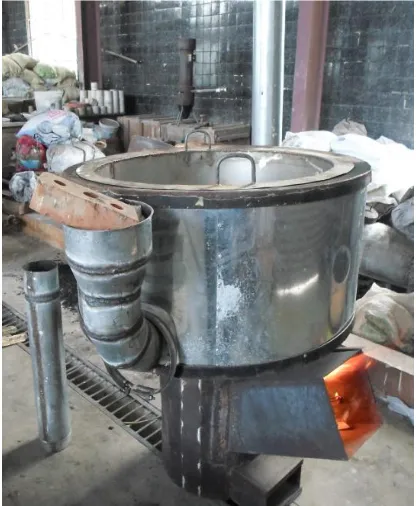
Figure 3 shows a photograph of the Flat Bottom Pot cookstove, while Figure 4 shows its sectional drawing. This stove is characterised by a massive brick work as insulation around the stove. Figure 5 shows the photograph of the Round Bottom Pot cookstove and Figure 6 its sectional drawing. The design of the Round Bottom Pot cookstove is very similar to the Flat Bottom Pot cookstove. Their insulation and chimneys are designed in the same way. The main difference is the integrated cooking pot that has a flat bottom in one and a round bottom in the other. The third institutional cookstove, which can be moved from one place to the other, is shown in in Figure 7. Its sectional drawing is shown in Figure 8.
FIGURE 3: Flat Bottom Pot Institutional Cookstove
FIGURE 4: Cross-sectional view of the Flat Bottom Pot Institutional Cookstove
FIGURE 5: Round Bottom Pot Institutional Cookstoves
FIGURE 6: Cross Sectional view of the Round Bottom Pot Institutional Cookstove
FIGURE 7: Mobile Institutional Cookstove
FIGURE 8: Cross-sectional view of the Mobile Institutional Cookstove
The mobile stove is very useful at functions like funerals, weddings and outdoor parties, which makes it very user-friendly. The other two stoves, the flat-bottom and the round-bottom stoves are mainly used in Boarding houses of Educational Institutions and Restaurants, where they are fixed permanently in the kitchens. The position of the firewood chambers where fuel is fed into the stoves, is not comfortable for users, since the user may have to virtually
stoop very low to regulate or manage fire intensity. On the other hand raising the chambers may also cause the height of the stove to be uncomfortably high for most women and make cooking on the stove quite unpleasant.
METHODOLOGY
The ISO water boiling test WBT 4.2.1 protocol was used to determine efficiency/fuel use and safety. Measurements were made and reported for each of the three WBT test phases: namely (1) high-power, cold-start; (2) high-power, hot-start; and (3) low-power, simmer.
Phases (1) and (2) were defined by the duration between fire ignition and the water boiling point.
Phase (1) began with the cookstove, pot, and water at ambient temperature.
Phase (2) followed immediately, with the cookstove hot, but the pot and water at ambient temperature.
Phase (3) was defined by a 45-minute time period with constant nominal water temperature maintained at a temperature of 3°C below the boiling point.
During the water boiling test of the stoves, initial readings and measurements of the weight of cooking container, water, and fuel wood were taken. 104.4 kg. of water was used. Fire was set in the stove and used to heat the water to its boiling point, while its temperature was measured every five (5) minutes. The water was allowed to boil for a period of time, after which the final readings and measurements were taken. The procedure was used to test all the three stoves and the data recorded. The power and efficiency of the stoves were then calculated using the recorded data.
RESULTSANDDISCUSSION
Since such institutions rely mostly on fuel wood for cooking, institutional stoves that utilise less fuel wood can minimise the pressure on the environment in terms of deforestation, reduce the time or man-hours and money spent on collecting or buying fuel wood respectively (Reddy, 2012).
Most improved designs of institutional stoves include a chimney to transport smoke out of the kitchen and also reduce emissions. Hence such stoves have the tendency to improve the quality of indoor air where they are used and also reduce exposure to heat (Commey, 2014).
𝑄𝑤 = 𝐶𝑤 × 𝑀𝑤 × ∆𝑇 EQUATION (1)
𝑄𝑒 = 𝑊𝑤 × 𝑉 EQUATION (2)
𝑄𝑡 = 𝑄𝑤 + 𝑄𝑒 EQUATION (3)
𝑃𝑜𝑤𝑒𝑟 = 𝑄𝑡
𝑡 EQUATION (4)
𝑤𝑎𝑡𝑡 = 𝑗𝑜𝑢𝑙𝑒𝑠
𝑠𝑒𝑐𝑜𝑛𝑑𝑠 EQUATION (5)
Where:
Qw = Useful Heat in Water Qe = Heat of Evaporated Water
Qt = Total Useful Heat Transferred to Water (Energy Output)
Cw = Specific Heat Capacity of Water Cw = 4.186 J/g°C
Mw = Weight of Water
Ww = Weight of Water Evaporated V = Specific Heat of Vaporation of Water V = 2,260 kJ/kg
ΔT = Change in Temperature of Water t = Time used for test
t = 145 mins = 8700s
For the efficiency calculations, Equations 6, 7. 8 and 9 were used.
𝐸𝑓𝑤 = 𝑆𝑤 × 𝑀𝑓𝑤 EQUATION (6)
𝐸𝑐 = 𝑆𝑐 × 𝑀𝑐 EQUATION (7)
𝑄𝑓𝑤 = 𝐸𝑓𝑤 − 𝐸𝑐 EQUATION (8)
𝐸𝑓𝑓𝑖𝑐𝑖𝑒𝑛𝑐𝑦 = 𝑄𝑡
𝑄𝑓𝑤 EQUATION (9)
Where:
Efw = Energy of Fuelwood Ec = Energy of Charcoal
Qfw = Total Energy produced by Fuelwood (Energy Input) Sw = Specific heat for combustion of wood
Sw = 16 MJ/kg
Sc = Specific heat for combustion of charcoal Sc = 35 MJ/kg
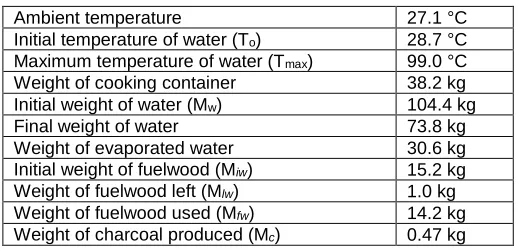
Table 1 shows the data collected during the test of the Flat Bottom Pot Institutional Stove.
TABLE1: Flat bottom pot institutional cookstove
Ambient temperature 27.1 °C
Initial temperature of water (To) 28.7 °C
Maximum temperature of water (Tmax) 99.0 °C
Weight of cooking container 38.2 kg
Initial weight of water (Mw) 104.4 kg
Final weight of water 73.8 kg
Weight of evaporated water 30.6 kg
Initial weight of fuelwood (Miw) 15.2 kg
Weight of fuelwood left (Mlw) 1.0 kg
Weight of fuelwood used (Mfw) 14.2 kg
Weight of charcoal produced (Mc) 0.47 kg
Table 2 shows the data collected during the test of the Round Bottom Pot Institutional Stove.
TABLE 2: Round Bottom Pot Institutional Cookstove
Ambient temperature 26.7 °C
Initial temperature of water (To) 27.8 °C
Maximum temperature of water (Tmax) 99.0 °C
Weight of cooking container 32.8 kg
Initial weight of water (Mw) 104.4 kg
Final weight of water 84.2 kg
Weight of evaporated water 20.2 kg
Initial weight of fuelwood (Miw) 13.0 kg
Weight of fuelwood left (Mlw) 1.0 kg
Weight of fuelwood used (Mfw) 12.0 kg
Weight of charcoal produced (Mc) 0.64 kg
Table 3 shows the data collected during the testing of the Mobile Institutional Cookstove.
TABLE 3: Mobile Institutional Cookstove
Ambient temperature 29.0 °C
Initial temperature of water (To) 28.6 °C
Maximum temperature of water (Tmax) 99.0 °C
Weight of cooking container 22.6 kg
Initial weight of water (Mw) 104.4 kg
Final weight of water 89.4 kg
Weight of evaporated water 15.0 kg
Initial weight of fuelwood (Miw) 16.0 kg
Weight of fuelwood left (Mlw) 2.4 kg
Weight of fuelwood used (Mfw) 12.89 kg
Weight of charcoal produced (Mc) 0.72 kg
After the calculation of the power and efficiencies of the cookstoves, the results were tabulated and compared. Table 4 shows the tabulated results of the power and efficiency calculations.
TABLE 4: Stove performance
Type of Stove Energy Input
(MJ)
Energy Output (MJ)
Power (kW)
Fuel Efficiency
(%)
Flat Bottom Pot Institutional Cookstove
210.75 99.88 11.5 47.40
Round Bottom Pot Institutional Cookstove
169.60 76.77 8.8 59.70
Mobile Institutional Cookstove
192.40 64.23 11.3 33.40
CONCLUSION AND RECOMMENDATION
In conclusion, the test results showed favourable results of high power output and thermal efficiencies.
followed by the flat bottom pot institutional cookstove with a thermal efficiency of 47.40%, also a tier 4, and the mobile institutional cookstove with an efficiency of 33.40%, a tier 2.7. The tier-rating is the rating given the thermal efficiency of stoves, developed by the international working group (IWA), with tier 1 as the lowest and tier 4 the highest rating. As far as the power output is concerned, the flat bottom pot cookstove had the highest, which was 11.5 kW, followed by the mobile cookstove which had a power of 11.3 kW and then the round bottom pot cookstove with a power of 8.8 kW.
It is recommended that further research be conducted on the mobile institutional stove to improve upon its efficiency and design. However, it is worth noting that to promote the mobility, the heavy insulation used in the other stoves cannot be used and therefore the compromise in the reduction in the efficiency. The thermal efficiency may be improved by adding heat exchangers underneath the cooking pot to increase surface area for effective heat transfer.
REFERENCES
Adkins E., Chen J., Winiecki J., Koinei P. and Modi V., (2010) “Testing institutional biomass cookstoves in rural Kenyan schools for the Millennium Villages Project”. Energy for Sustainable Development – 14:
186 - 193
Agyei-Agyemang A., Tawiah P. O. and Nyarko F., (2014) “Efficient Charcoal Stoves: Enhancing their Benefits to a Developing Country using an Improved Design Approach.,” International Journal of Engineering Trends and Technology – 15 (2), 94-100.
Bailis R, Ogle D, Maccarty N Still D. (2007). Input from, Kirk R. Smith, Rufus Edwards, Household Energy and Health Programme, Shell Foundation. The Water Boiling Test (WBT) Version 3.0. Available: https://ofenmacher.org/files/4314/0376/3573/WBT_V ersion_3.0_0.pdf Accessed: February 2, 2017. Bonjour, S.; Adair-Rohani, H.; Wolf, J.; Bruce, N.G.;
Mehta, S.; Prüss-Ustün, A.; Lahiff, M.; Rehfuess, E.A.; Mishra, V.; Smith, K.R. (3013). Solid fuel use for household cooking: Country and regional estimates for 1980–2010. Environ. Health Perspect.121, 784–790.
Commeh M. K., (2014) “Report on Construction and Management of Institutional Cookstoves at Kumasi Secondary Technical High School (KSTS) Kitchen”, Danish Energy Agency (DEA), (2009) CARE Denmark,
Pre-feasibility study for an improved cook stoves project in Northern Ghana.
Ghana Alliance for Clean Cookstoves (GACS). (2014)
Regional Workshop on development of National Action Plans.
International Society for Environmental Epidemiology (ISEE) (2005); Indoor air pollution from solid fuels and risk of low birth weight and stillbirth: report from a
symposium held at the Annual Conference of the International Society for Environmental Epidemiology (ISEE), September 2005, Johannesburg.
Karlsson, G. (2014) Where Energy is Women’s Business. Available online:http://www.energia.org/fileadmin/files/ media /pubs/karlsson_csdbook_lores.pdf (accessed on 7 July 2014).
Khan A. H. M. R., Eusuf M., Prasad K. K., Moeman E., Visser A. M. J. and Drisser L. A. J., (1995). The Development of Improved Cooking Stove Adapted To The Conditions in Bangladesh, Final Report of Collaborative Research Project between IFRD, BCSIR, Bangladesh and Eindhoven University of Technology, Eindhoven, the Netherlands.
McCracken J. P. and Smith K. R., (1998) “emissions and efficiency of improved wood burning cookstoves in Highland Guatemala”. Environmental International – 24 (7), pp 739 – 747.
Reddy S. B. N. (2012) Understanding Stoves. 1st Edition. Meta Meta. The Netherlands.
Regional wood energy development programme
(RWEDP) in Asia. (1993). Improved solid biomass burning cookstoves: A development manual.
Smith, K.; Bruce, N.G; Balakrishnan, K.; Adair-Rohani, H.; Balmes, J.; Chafe, Z.; Dherani, M.; Dean Hosgood, H.; Mehta, S.; Pope, D. (2014); et al. Millions dead:how do we know and what does it mean? Methods used in the comparative risk assessment of household air pollution.
Annu. Rev. Public Health, 35, 185–206.
SNV (Netherlands Development Organisation) (2015)
Ghana [Online] Available: www.snv.org/country,ghana Technology Consultancy Centre (TCC). Kwame Nkrumah
University of Science and Technology (2015) About Us
[Online] Available: www.tcc.knust.edu.gh/about
World Health Organization (WHO). Fuel for Life: Household Energy and Health; WHO: Geneva, Switzerland, 2006. Int. J. Environ. Res. Public Health
2014, 11 8248
Accepted 01 April, 2017.
Citation: MK Commeh, A. Agyei-Agyemang, E. Kwarteng, RN Tabi, E. Heijndermans, and F. Eiwinger (2017). Improved Institutional Cookstoves: An Assessment of the Efficiency in its Application in the agro and food processing industry in Ghana. World Journal of Mechanical Engineering. 3(1): 020-026.