ISSN 1392-2785 ENGINEERING ECONOMICS. 2008. No 1 (56) (&2120,&62)(1*,1((5,1*'(&,6,216
Impact of Consumer Package Communication on Consumer Decision Making
Process
Vitalija Butkevi
þ
ien
ơ
, Jurgita Stravinskien
ơ$XãUD5nj
telion
ơ
.DXQRWHFKQRORJLMRVXQLYHUVLWHWDV /DLVYơVDO/7.DXQDV
7KH FKDQJH RI WUDGLWLRQDO GLUHFW WUDGH IRUP WR VHOI VHUYLFHIRUPRIWUDGHKDVLQFUHDVHGWKHSURGXFWDVVRUWPHQW LQ PDQ\ JURXSV RI SURGXFWV 7KDW KDV GHWHUPLQHG WKH LQWHQVLILHG FRPSHWLWLRQ DPRQJ EUDQGV DQG WKH ZLGHU DSSOLFDWLRQ RI PDUNHWLQJ FRPPXQLFDWLRQ GHFLVLRQV %HFDXVHRISOHQW\RIEUDQGVLWKDVEHFRPHPRUHGLIILFXOWWR LGHQWLI\WKHPDQGPDNHWKHGHFLVLRQ7KHELJJHUDWWHQWLRQ LVDWWDFKHGWRFRQVXPHUSDFNDJHZKLFKLVLQWHJUDOSDUWRI SURGXFWDQGLWVEUDQGIRUWKHFRQVXPHU7KDWWUDQVIHUVWKH LQIRUPDWLRQ WR FRQVXPHU ZKHQ KH RU VKH LV DFWLYH LQ FRPPXQLFDWLRQ SURFHVV 3DFNDJH FRPPXQLFDWLQJ ZLWK FRQVXPHULQWKHVHOOLQJSODFHKDVEHFRPHHVVHQWLDOIDFWRU LQIOXHQFLQJ WKH FKRLFH RI FRQVXPHU 6FLHQWLILF UHVHDUFKHV KDYHSURYHGWKDWSDFNDJHGHFLVLRQVOHWWRDWWUDFWFRQVXPHU DWWHQWLRQ WUDQVIHU WKH GHVLUDEOH LQIRUPDWLRQ DERXW WKH SURGXFW SRVLWLRQ WKH SURGXFW LQ FRQVXPHU FRQVFLRXV GLIIHUHQWLDWHDQGLGHQWLI\LWDPRQJDQDORJLFDOSURGXFWV,Q WKDWZD\HOHPHQWVRISDFNDJHLQIOXHQFHFRQVXPHUGHFLVLRQ PDNLQJSURFHVVDQGFDQGHWHUPLQHWKHFKRLFHRIFRQVXPHU DQG WKH SDFNDJH LWVHOI FDQ EHFRPH WKH VXVWDLQHG FRPSHWLWLYHDGYDQWDJH7KXVGHVSLWHRISOHQW\RIVFLHQWLILF UHVHDUFKHVIRFXVHGRQVHSDUDWHIXQFWLRQVRISDFNDJHDQG LPSRUWDQFHRILWVGHFLVLRQVWKHSDFNDJHLVQRWDQDO\VHGDV D ZKROH SOD\LQJ WKH FRPPXQLFDWLRQ IXQFWLRQ 7KHUHIRUH WKLV DUWLFOH LV DLPLQJ WR SUHVHQW WKH WKHRUHWLFDO DQG HPSLULFDO VWXG\ ZKLFK OHWV YHULI\ DQG QDPH FRQVXPHU SDFNDJH IDFWRUV DQG WKHLU FRPPXQLFDWLRQ LPSRUWDQFH LQ WKHGHFLVLRQPDNLQJSURFHVV
7KH UHVXOW RI WKHRUHWLFDO VWXGLHV LV WKH WKHRUHWLFDO PRGHO RI FRQVXPHU SDFNDJH FRPPXQLFDWLRQ ZKLFK LOOXVWUDWHV WKH JHQHUDOL]HG FRPPXQLFDWLRQ RI WKH SDFNDJH FRPSRQHQWVDQGIHDWXUHVDQGOLQNEHWZHHQFRPPXQLFDWLRQ DQG GHFLVLRQ PDNLQJ SURFHVV 7KH PRGHO LV YHULILHG E\ HPSLULFDO UHVHDUFK ZKLOH HYDOXDWLQJ WKH LQIOXHQFH RI SDFNDJH FRPSRQHQWV DQG IHDWXUHV LQ VWDJHV RI FRQVXPHU GHFLVLRQPDNLQJSURFHVVDQGPLVVLQJIXQFWLRQVRISDFNDJH FRPPXQLFDWLRQ H[FOXGHG LQ WKH PRGHO 7KRVH IXQFWLRQV ZRXOGOLPLWWKHSRVVLELOLW\WRHVWLPDWHWKHWRWDOLPSRUWDQFH RIWKHSDFNDJHFRPSRQHQWVLQVWDJHVRIFRQVXPHUGHFLVLRQ PDNLQJSURFHVV
6HHNLQJ WR HQVXUH WKH UHVXOWV UHOLDELOLW\ SDFNDJHV RI SURGXFWV ZKLFK KDYH WKH ELJJHVW LQIOXHQFH RQ GHFLVLRQ PDNLQJ SURFHVV KDYH EHHQ FKRVHQ 7ZR PDLQ DVSHFWV RI SURGXFWV KDYH EHHQ VHOHFWHG LH D FRQVXPHU LV QRW LQYROYHG LQ GHFLVLRQPDNLQJSURFHVVRI WKHVH SURGXFWVE WKHDVVRUWPHQWRISURGXFWVLVZLGHDQGSDFNDJHVDUHYHU\ GLIIHUHQW 7KXV SURGXFWV RI FDVXDO GHPDQG DUH PLON VKDPSRRDQGFKHZLQJJXP
7KH UHVXOWV RI WKH HPSLULFDO UHVHDUFK DOORZ WR DIILUP WKDW WKHRUHWLFDO SDFNDJH FRPPXQLFDWLRQ PRGHO PXVW EH FRPSOHPHQWZLWKWKHLPSDFWRIWKHSDFNDJHIRUPDQGVL]H LQ WKH VWDJH RI QHHG SHUFHSWLRQ 7KDW OLQN KDV WR EH HVWDEOLVKHG LQ HYHU\ JURXS RISURGXFWV 7KH LPSDFW RI WKH SDFNDJH JUDSKLFV VSHFLDO RIIHUV DQG SDFNDJH HFRORJ\ FRPPXQLFDWLRQKDYHWREHPDUNHGDVOHVVVLJQLILFDQWRUQRW VLJQLILFDQW LQ WKH VWDJH RI DOWHUQDWLYHV¶ HYDOXDWLRQ LQ WKH PRGHO
3DFNDJH YHUEDO FRPSRQHQWV KDYH QRW LPSDFW RQ UHSHDWHGSXUFKDVHLHEHKDYLRXUDIWHUWKHSXUFKDVH:KLOH HYDOXDWLQJ SDFNDJH FRPPXQLFDWLRQ PRGHOV LW KDV HVWLPDWHG WKDW WKH LPSDFW RI QRQYHUEDO SDFNDJH FRPSRQHQWV FRPPXQLFDWLRQ IRU LPSXOVLYH SXUFKDVH SURGXFWV IRU GHFLVLRQ PDNLQJ LV ELJJHU WKDQ IRU QRW LPSXOVLYHSXUFKDVHSURGXFWV
Keywords: FRQVXPHUSDFNDJHFRPSRQHQWVRI SDFNDJHFRPPXQLFDWLRQFRQVXPHU GHFLVLRQPDNLQJSURFHVV
Introduction
The change of traditional direct trade form to self-service form of trade has increased the product assortment in many groups of products. That has determined the intensified competition among brands and the wider application of marketing communication decisions. Because of plenty of brands it has become more difficult to identify them and make the decision. The bigger attention is attached to consumer package, which is integral part of product and its brand for the consumer. That transfers the information to a consumer when he or she is active in communication process. Package, communicating with consumer in the selling place, has become essential factor influencing the choice of a consumer.
Scientific researchers related with the package topic are integrating these directions:
1. 7KH REMHFW RI VFLHQWLILF UHVHDUFKHV LV D FRQVXPHU. The approach of consumer to the package exterior, various package components presentation decisions are identified in these researches. Also the link of consumer motivation concerning product purchase and package evaluation is estimated (Ampero, Vila (2006), Lee, Lye (2003), Klevas (2005), Kanajan (2001), Silayoi, Speece (2004), Carl (1995).
2. 7KH REMHFW RI VFLHQWLILF UHVHDUFKHV LV GHFLVLRQV RI
DQG WKH LPSDFW RI SDFNDJH HOHPHQWV LQ HYDOXDWLQJ SURGXFWV(Kauppinen (22204), Jakupov, Kacalov (2003), Larnanov, Skrilnikova (2000), Wansik, Ittersum (2003), Napolitano (2002), Bellas (2004), Lee, Lye (2003), Parlin (2003), Bone, France (2001), Makely (2004), Rentie, Brewer (2000), Fokes, Matta (2004), Gourville (2003), Mohan (2004), Kuster (2004), Ucherec (2004), Sensbach (200), Rochmanuk (2004), McSarthy, Shapiro, Perreault (1986), Wade (2005), Smith, Taylor (2004), Murazanov (2005), Arnold (2003), Ahmed (2006), Durand (2005). Mostly visual package elements ant their impact on consumer attention, product quality evaluation and brand choice are evaluated in these researches.
Scientific researches have proved that package decisions allow to attract consumer attention, transfer the desirable information about the product, position the product in consumer conscious, differentiate and identify it among analogical products. In that way elements of package influence consumer decision making process and can determine the choice of consumer and the package itself can become the sustained competitive advantage. Thus despite of plenty of scientific researches, focused on separate functions of package and importance of its decisions, the package is not analysed as a whole, playing the communication function. Thus the problem of the article is formulated as follows: factors of consumer package, which influence effective communication with consumer and influence consumer decision making.
Research aim - to verify factors of consumer package theoretically and name their communication importance in decision making process empirically.
Research object - consumer package factors and their importance for consumer decision making process.
Research methods:comparative analysis of scientific literature, periodical publications, analysis of internet databases, descriptive method and survey employing questionnaires.
Reasoning of consumer package importance
While choosing effective communication means, trade forms are playing a big role in products market. Rentie, Brewer (2000) affirm that 73 percent of purchase decisions are taking in a the selling place. Thus in many cases the consumers are evaluating different brands alternatives only in selling place. Purchase process is quite complicated and researches indicate that too. Those researches have estimated that the consumer spend about 20 minutes in the shop, inspecting 20 products a second. That means that the consumer has to decide from 24000 brands. There are only theoretical numbers, because in reality consumers are estimating only the part of these brands. Thus the importance of communication in selling place is increasing. That situation stimulates to spend less given for traditional advertising and a greater attention should be given to communication in purchase place. These tendencies indicate the increasing significance of product package as a brand communication and differentiation tool. The package becomes the most important and the last tool which can reach the consumer, transfer the information,
strength product positioning in consumer consciousness and influence the process of his/her decision making process.
The summary of Rentie and Brewer (2003), Jakupov, Kacalov (2003), Ampero, Vila (2006), Wade (2005), Voyles (2005) opinions allow to exclude these main reasons which determine the package importance:
x decrease of traditional promotion tools efficiency while communicating with consumer and increase of efficiency of the package as a communication tool;
x redistribution of marketing communication tools importance from traditional advertising to the communication in selling place;
x decrease of brands differentiation in consumer consciousness and increase of the importance of package a differentiation and identification tool;
x increase requirements for product quality and its preservation;
x increase requirements for product safety and consumer safety;
x increase requirements for presentation of
information about the product to customer;
x creation of product added value with the help of the package.
These reasons confirm the increase of package importance for producer and consumer. Also that indicates the importance of cognition of the package as the scientific research object. Basing on Ampero, Vila (2006), the package is accepted as one of the most effective marketing communication tool, because: a) it reaches almost all consumers of current product category; b) it communicates with a consumer in essential moment- when the decision of the purchase is accepted; c) consumers are actively involved in communication process, because they study the package, seeking to get the proper information.
The package is considered as an element of communication oriented to the message and to the behaviour in scientific literature (Rentie, Brewer, 2000). Lately, the package as the whole influences stages of consumer decision making process. The influence of the package can be stronger or weaker and it depends on consumer involvement level and time pressure. Thus the package, which is communicating with the consumer and influencing decision making process, is the important marketing communication tool, which is connected with promotion elements (Silayoi, Speece, 2004).
Verbal and non-verbal messages can be transferred to consumer with the help of the package. Visual elements of the package transfer non-verbal information and affect emotions. Verbal information, which is transferred with informational elements, affects cognitive orientation of a consumer. Thus the package as the element of communication, oriented to the message, transfers the comprehensive information about the product, helps to positioning it in consumer behaviour and influence decision making process.
Theoretical consumer package communication model
Strategical decisions of package communication
Components and features of consumer package Communication of package components and features
Factors influencing package communication
Consumer decision making process
Colour
Size
Materials Form
Imageries
Graphics
Smell
Product positioning
strategy
Time pre
ssure
Target market
Product
Promotio Place Price
Nonverbal package component
Consumer package
Package features Package component
Verbal package component
1. Perception of need
2. Search for information
3. Evaluation of alternatives
4.Decision making
5. Behaviour after purchase Influence
price Identify brand (3) Capture attention (1)
Exclude brand (3)
Influence quality Sugest associations
Create added value (5) Influence size
Inform about product/ its
i Simplicity of
Ecology of
Ergonomics of
Innovativeness of Name
Producer/ country
Instructions of Brand
Information
Special offers
Consume
r
inv
o
lv
e
m
e
nt le
ve
l
Type of
ch
oic
e
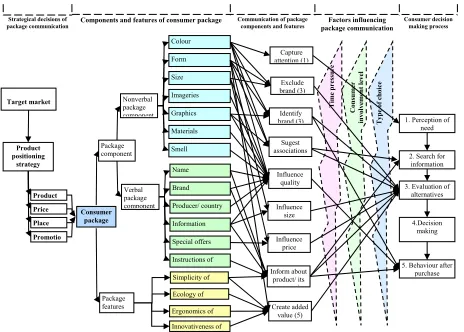
the package. Product positioning is implemented with the help of decisions of marketing mix elements. Those decisions involve closely connected parts: functions of the package and components of the package, basing on the fact that the package is communicating with the consumer through its features and components of verbal and non-verbal character.
Intermediaries of the package communication message are component of the package: colour, form, size, images, graphics, material, smell, name of the product, brand, country, information about product, special offers, instructions of usage, simplicity and ecology of the package, ergonomics, innovativeness. All these elements of the package play the function of communication. Their transferable messages involve the evaluation of the product in qualitative, quantitative, price view, the formation of the product cognitive and sensorial expectations, the impact to consumer emotions, mood and attention. The communication of the package components is attributed to the communication oriented to the message (Silayoi, Speece (2004). Communication oriented to the message is the background of the communication oriented to the behaviour. Thus components of the package which are communicating with verbal and non-verbal information are LQIOXHQFLQJ FRQVXPHU¶V SK\VLFDO UHVSRQVH 7KH SK\VLFDO UHVSRQVH RI WKH FRQVXPHU LV FRQVXPHU¶V EHKDYLRXU LQ decision making.
The scheme of consumer package communication impact to consumer decision making process is presented
in Figure 1.
While communicating the package is influencing stages of consumer decision making process. In the stage of need perception, the package, which is attracting consumer attention, determines not planned need in case of impulsive purchase. In the stage of information search the package becomes the source of information about the product. The stage of information search is very important in the case of high involvement in the decision making process and here the verbal package communication is the most important. Consumer is evaluating alternatives of product according established criteria in the stage of alternatives evaluation. The package impact is the biggest at this stage, because verbal and non-verbal package components are communicating the comprehensive information about the product. Stage of choice is frequently compared with the stage of alternatives evaluation, because the estimation of the best alternative determines the choice of consumer. Therefore the package LV LQIOXHQFLQJ WKH FKRLFH VWDJH WKURXJK DOWHUQDWLYHV¶ evaluation stage. At the stage of the behaviour purchase elements of package tell the consumer how to use the product properly, influence quality evaluation while using the product and help to identify the product during the repeated purchase.
Impact of package communication on decision making process is changing. Three main factors influence the level of package communication to consumer behaviour: time pressure, consumer involvement level and type of choice.
Jakupov, Kacalov (2003) affirm that the importance of factors, which influence decision making, decreases when the decision making process is limited. The same is happening with the package. That is the situation of low involvement in the purchase process. Low involvement means that the consumer needs little efforts in searching the information about brands and evaluating competitive brands. In the case of limited decision making, the decision to buy the product is taken in the selling place. One type of low involvement into purchase process is not planned purchase when the stage of preparation for purchase is not available in the process. Mostly this type is influenced by unexpected needs and absence of preferential brands.
The impact of the package is lesser in the case of the high involvement. According to Ampero, Vila (2006) opinion, the complex decision making type means that search for information has started before the choice. In order to take the decision, the consumer evaluates different brands and their features in advance. In this case the importance of the package is not big.
In the process of low iQYROYHPHQW FRQVXPHUV GRQ¶W search for comprehensive inIRUPDWLRQ GRQ¶W HYDOXDWH features properly and easily decide about the purchase. That is because of the low risk level- products are not expensive and have not big importance for the consumer. Thus the importance of the package in low involvement categories is more important than in a high involvement level. In the low involvement process the main role is played the visual content of the package which allows to evaluate the product quickly and easily and cause the emotional response. Thus in the the case of low involvement namely the package becomes the essential factor which influences product positioning, product purchase making process and loyalty to brand.
The time factor in this case is very important too. The package is important when the consumer has less time for decision making. If the consumer has more time for decision making, the impact of the package is decreasing.
Ampero, Vila (2006) exclude one more factor which influences the package impact on consumer decision making. The Authors affirm that the choice of the brand can be based on remembrances, stimulus or the combination of both. The choice which is based on remembrances is conditioned by induced remembrances. The choice based on stimulus means that the evaluation of brand and brand attributes is based on visual attributes and descriptions. In this case the evaluation is based on information which is presented in the selling places. Frequently that is the product package. The complex choice is based on remembrances and visual information. Thus the importance of the package is increasing when the choice is based on stimulus. Then the customer is influenced by the visual information in the package and other package attributes.
The result of theoretical studies is the theoretical consumer package communication model. It presents the generalized communication of the package components and features and indicates the link between communication and decision making process. Seeking to specify the model the empirical research of consumer package factors importance has been carried out.
Consumer package communication model: specification of theoretical model with results of empirical research
Methodology of empirical consumer package factors importance research
The model is verified with the help of the empirical research. The impact of the package components and features on the consumer decision making process is verified. Package communication functions, which are excluded in the model, are not verified during this research, because they would limit the possibility to estimate the total package components importance in the stages of consumer decision making.
There are three main factors, which influence package communication, in consumer package communication model. Time pressure is the situation factor and depends on particular conditions so it is difficult to define it in the research. Other two factors, i.e. involvement level and choice depend on the product category. The consumer segment can influence these factors too.
Seeking to ensure results reliability, packages of products, which have the biggest influence on decision making process, have been chosen. Two main aspects of products have been selected, i.e., a) consumer is not involved in decision making process of these products; b) the assortment of products is wide and packages are very different. Thus products of casual demand have chosen: milk, shampoo and chewing gum.
Seeking to ensure results reliability, the general population was women, because they make decisions in purchasing casual demand products. Fiedman (2006) has estimated that women influence almost 95 percent and take 85 percent of all purchase decisions.
Research problem - the importance of consumer SDFNDJH FRPSRQHQWV DQG IHDWXUHV LQIOXHQFLQJ ZRPHQ¶V casual demand products decision making process
Purpose of the research - estimate the importance of consumer package factors impact to consumer decision making process.
Objectives of the research:
xascertain the impact of casual demand products package communication to women purchasing behaviour;
x exclude importance of verbal and non-verbal package components to consumer choice;
x estimate the importance of consumer package components and features in every stage of decision making.
+\SRWKHVHVRIWKHUHVHDUFK
1.+\SRWKHVLV Non-verbal components of the package are the most important at the stage of need perception while the purchase is impulsive. Colour is the main non-verbal element of the package which is attracting the attention of women.
3.+\SRWKHVLVPackage features are the main and QRQYHUEDO LQIRUPDWLRQ LV OHVV LPSRUWDQW DW DOWHUQDWLYHV¶ evaluation stage.
4.+\SRWKHVLVErgonomics is the main important feature of the package for women in alternatives evaluation process. The high quality of the product is mostly correlating with essential package non-verbal elements: colour, form and material. The most important verbal elements are brand and producer.
5.+\SRWKHVLVThe evaluated product quality mostly influences the repeated product purchase. The impact of the package is not important for the repeated purchase.
The information presented in purposes of the research is collected using the quantitative research, because this research allows to evaluate importance of elements. Information sis collected from the primary data, because FRQVXPHUV¶ RSLQLRQ DQG WKHLU SUDFWLFH RI SDFNDJH FKRLFH are needed.
The descriptive research is used in collecting information about the importance of consumer package elements to consumer behaviour. 109 women have been surveyed and their priorities proportions have been evaluated, conclusions about general consumer behaviour tendencies have been made.
On has been collected with the help of survey method. Non-probability quota sampling has been chosen for the research because respondents have been divided into age groups, which correspond to the proportions of general population. Data have been collected in April, 2006.
Comparison of empirical research results with theoretical package communication model
109 women have been surveyed. The characteristics of the average respondent of the research: a woman, age is over 35 years old, having higher education, average incomes of family per month for one person- from 1000 to 2000 Lt.
The analysis of the research has made it possible to evaluate the empirical research with the theoretical model. Neither one hypothesis has proved in all groups of products. Thus empirical results are compared with theoretical model in every group separately.
Results of empirical research of milk package communication impact to decision making process are presented in Table 1.
Package features are not important in need perception and information search stages. That is why they have not valuated in the research (grey fields in the Table).
Summarized data of the research about milk package communication impact on decision making process allowed to evaluate the importance of the package elements in all stages. Basing on these data, the correctness of theoretical package model can be verified.
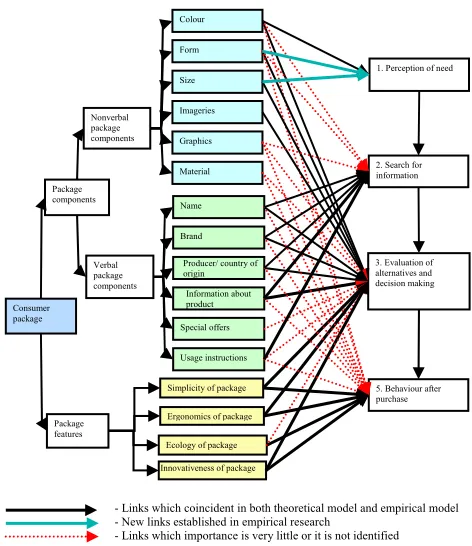
The comparison of theoretical package communication model with empirical milk package research data is presented in Figure 2.
According THE results of the research, not only communication of milk package colour but also package size, graphics and material is important at the stage of need perception. These are new links of package communication which are complementing the theoretical model.
Table 1
Relative importance of milk package components in decision making stages, %
Stages of decision making
Perce
ption of ne
ed
Search f
o
r
in
fo
rm
at
io
n
E
va
lua
ti
on of
al
te
rna
ti
ve
s an
d
d
ec
is
io
n
m
aki
n
g
Behav
iour af
ter
pur
chase
Colour 28% 5%
Form 15% 6%
Size 15% 6%
Imageries 5%
Graphics 20% 2%
Material 15% 20 %
6% 0%
Relative importance of
non-verbal package elements, % 93% 20% 29% 0%
Name 7% Brand 6% Producer/Country of origin 7%
Information about product 8%
Special offers 2%
Instructions of usage
7% 80%
4% 0%
Relative importance of package verbal components, %
7% 80% 34% 0%
Simplicity of package 14%
Ecology of package 1%
Ergonomics of package 16%
Innovativeness of package 6% 100%
Comp
onen
ts
and fe
ature
s of pac
kage
Relative importance of
package features, % 37% 100% TOTAL: 100% 100% 100% 100%
- Links which coincident in both theoretical model and empirical model - New links established in empirical research
- Links which importance is very little or it is not identified
Figure 2. The comparison of theoretical package communication model and the results of milk package empirical research
Simplicity of package
Ergonomics of package
Ecology of package
Innovativeness of package Colour
Size
Material Form
Imaginaries
Graphics
Consumer package
1. Perception of need
2. Search for information
3. Evaluation of alternatives and decision making
5. Behavior after purchase Nonverbal
package components
Package features Package components
Verbal package components
Name
Producer/ country of origin
Usage instructions Brand
Information about product
Results of the research have indicated that communication of the milk package non-verbal components at the stage of information search is not significant. The most important is information of verbal elements. Thus links of package non-verbal communication elements are not essential in the milk package communication model.
At the stage of alternatives evaluation and decision making the impact of component and features of the package are important according to the theoretical model. The empirical research has indicated that while choosing the milk graphics in the package, special offers and package ergonomics are not significant.
It is important to stress that theoretical package communication model is created basing on conscious and unconscious communication of package elements. While HYDOXDWLQJ UHVSRQGHQWV¶ UHSOLHV ZLWK WKH TXDQWLWDWLYH research, it is possible to estimate only the package information which respondents perceive consciously. Furthermore, women have been analysed while theoretical model is general and not depending on the segment. Thus limits of the research and chosen women segment could influence differences between the theoretical model and practical results of the research.
Parallel the impact of shampoo package communication to decision making process is evaluated and theoretical and practical results are compared (Table 2).
Table 2
Relative importance of shampoo package components in decision making stages, %
Stages of decision making
Perce
ption of ne
ed
Search f
o
r
in
fo
rm
at
io
n
E
va
lua
ti
on of
al
te
rna
ti
ve
s an
d
d
e
ci
sio
n
m
aki
n
g
Behav
iour af
ter
pur
chase
Colour 25% 6%
Form 33% 7%
Size 14% 7%
Imageries 6%
Graphics 13% 3%
Material 5% 30%
3% 0%
Relative importance of non-verbal package elements, %
90% 30% 33% 0%
Name 6% Brand 7% Producer/Country of origin 8%
Information about product 8%
Special offers 2%
Instructions of usage
10% 70%
4% 0%
Relative importance of package verbal components, %
10% 70% 35% 0%
Simplicity of package 11%
Ecology of package 1%
Ergonomics of package 13%
Innovativeness of package 7%
100%
Comp
onen
ts
and fe
ature
s of pac
kage
Relative importance of
package features, % 32% 100% TOTAL: 100% 100% 100% 100%
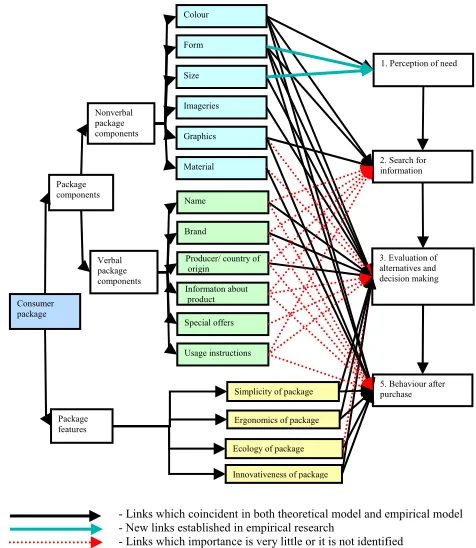
The importance of communication of shampoo package elements is similar to the milk package, but some priorities differing at need perception and alternatives evaluation stages. Detailed comparison of theoretical package communication model and research results is presented in Figure 3.
- Links which coincident in both theoretical model and empirical model - New links established in empirical research
- Links which importance is very little or it is not identified
Figure 3. The comparison of theoretical package communication model and results of shampoo package empirical research
According to the results of the research, colour, form and size are very important at the stage of need perception. Graphics and material of the package also communicatebut their importance is less than the average and not indicated in the model.
Communication of non-verbal components of the package is less important at the stage of information search as in case of milk. Here the most important source of information for women is information in shampoo package.
At the stage of alternatives the evaluation of the importance of elements is almost the same as in milk case. The impact of graphics, material, usage instructions and ecology of the package is low in case of shampoo.
The importance of factors which is influence behaviour after purchase is the same as in milk case. Thus links of verbal and non-verbal components of shampoo package are not important.
The impact of components and features of chewing gum package at the stage of need perception is presented in Table 3.
The impact of components and features of chewing gum package in decision making process differs from milk and shampoo package communication. It has estimated by the research that communication of impulsive products packages do not differ from impulsive products at stages of information search and behaviour after purchase.
Nonverbal package components
Consumer package
Package features Package components
Verbal package components
1. Perception of need
2. Search for information
3. Evaluation of alternatives and decision making
5. Behaviour after purchase Simplicity of package
Ergonomics of package
Ecology of package
Innovativeness of package Name
Producer/ country of origin
Usage instructions Brand
Information about product
Special offers Colour
Size
Material Form
Imageries
Nonverbal package components
Consumer package
Package features Package components
Verbal package components
1. Perception of need
2. Search for information
3. Evaluation of alternatives and decision making
5. Behaviour after purchase Simplicity of package
Ergonomics of package
Ecology of package
Innovativeness of package Name
Producer/ country of origin
Usage instructions Brand
Informaton about product
Special offers Colour
Size
Material Form
Imageries
Graphics Table 3
Relative importance of chewing gum package components in decision making stages, %
Stages of decision making
Perce
ption of ne
ed
Search f
o
r
in
fo
rm
at
io
n
E
va
lua
ti
on of
al
te
rna
ti
ve
s an
d
d
e
ci
sio
n
m
aki
n
g
Behav
iour af
ter
pur
chase
Colour 31% 8%
Form 19% 7%
Size 20% 8%
Imageries 6%
Graphics 14% 4%
Material 3%
72%
4% 40%
Relative importance of non-verbal package elements, %
90% 72% 36% 40%
Name 8%
Brand 8%
Producer/Country of origin
6%
Information about product 4%
Special offers 4%
Instructions of usage
10% 28%
0% 0%
Relative importance of package verbal components, %
10% 28% 29% 0%
Simplicity of package 11%
Ecology of package 2%
Ergonomics of package 17%
Innovativeness of package 7%
60%
Comp
onen
ts
and fe
ature
s of pac
kage
Relative importance of
package features, % 36% 60% TOTAL: 100% 100% 101% 100%
Detailed comparison of theoretical package communication model and research results, which allow to evaluate differences of communication of impulsive and no impulsive products package, is presented in Figure 4.
It has been estimated by the research that the package communication corresponds to shampoo package communication at the stage of need perception. Thus the theoretical communication model is complemented with links of package form and size and the stage of perception QHHG GRHVQ¶W GLIIHU IURP WKH QHHG RI QRW LPSXOVLYH products perception (when purchasing of products is not planned).
It has been estimated by the research that the importance of communication of impulsive purchasing SURGXFWV¶SDFNDJHLVRSSRVLWH+HUHWKHFRPPXQLFDWLRQRI non-verbal package components is the most important. The communication of verbal components is not significant at information search stage.
The distribution of the importance of communication RISDFNDJHFRPSRQHQWVDWVWDJHVRIDOWHUQDWLYHV¶HYDOXDWLRQ and decision making stages is the same like in cases of chewing gum and shampoo. The only difference is that information about the product is not much significant for impulsive purchasing products.
Not only features of chewing gum package but also non-verbal components are important at the stage of decision making. That link has not been estimated in the cases of shampoo and milk packages.
- Links which coincident in both theoretical model and empirical model - New links established in empirical research
- Links which importance is very little or it is not identified
Figure 4. The comparison of theoretical package communication model and results of chewing gum package empirical research
In summary we can affirm that theoretical model of package communication has to be complemented with the impact of package form and size in the need perception stage. This link has been established in every group of products. The impact of communication of package graphics, special offers and package ecology in alternatives evaluation stage have to be marked as not very significant or insignificant in the model. At the stage of behaviour after purchase, the communication of verbal components of the package is not significant if the impact of the package to the repeated purchase is evaluating.
While evaluating the models of package communication, it has been estimated that the importance of communication of non-verbal components of impulsive purchase products to decision making is bigger than that for products of impulsive purchase.
It is important to indicate that theoretical model of package communication is created basing on conscious and unconscious communication of package elements which have been excluded in scientific literature. While HYDOXDWLQJ UHVSRQGHQWV¶ UHSOLHV ZLWK WKH TXDQWLWDWLYH research, it is possible to estimate only the package information which respondents perceive consciously. Furthermore, women have been analysed while theoretical model is general and not depending on the segment. Thus limits of the research and chosen women segment could influence differences between the theoretical model and practical results of the research.
Conclusions
consciousness and influence the process of his/her decision making process. These reasons are revealed by the relevance of the package as the scientific research object:
x decrease of traditional promotion tools efficiency while communicating with consumer and increase of efficiency of the package as a communication tool;
x redistribution of marketing communication tools importance from traditional advertising to the communication in selling place;
x decrease of brands differentiation in consumer consciousness and increase of the package as differentiation and identification tool importance;
x to increase requirements for product quality and its preservation;
x to increase requirements for product safety and consumer safety;
x to increase requirements for presentation of information about the product to customer;
x creation of product added value with the help of the package.
2. Visual elements of the package transfer non-verbal informational and affect emotions. Verbal information, which is transferred with informational elements, affects cognitive orientation of consumer. Thus the package as the element of communication, oriented to the message, transfers the comprehensive information about the product, helps to positioning it in consumer behaviour and influence decision making process.
7KHUHVXOWRIWKHRUHWLFDOVWXGLHV±WKHRUHWLFDOPRGHO of consumer package communication illustrates the place of the package in marketing decisions and the communication of package components and features, indicating the link between this communication and decision making process.
4. The empirical research of the importance of consumer package factors allows to indicate the following aspects:
x the theoretical model has to be complemented with the impact of the package form and size in the stage of need perception. This link has been established in every group of products;
x the impact of communication of package graphics, special offers and package ecology in alternatives evaluation stage have to be marked as not very significant or insignificant in the model;
x at the stage of behaviour after purchase, the communication of verbal components of the package is not significant if the impact of the package to the repeated purchase is evaluated;
x the importance of communication of non-verbal components of impulsive purchase products to decision making is bigger than that for products of impulsive purchase.
References
1. Ahmed, A., Ahmed, N., Ahmed, S. Critical issues in packaged food business / A.Ahmed, N.Ahmed, S.Ahmed // British Food Journal, 2006, Vol.10.
2. Ampero, O., Vila, N. Consumer perceptions of product packaging / O.Ampero, N.Vila // Journal of Consumer Marketing, 2006, Vol.23, issues 2.
3. Arnold, C. Way outside the box. How the most in Volvative
packages were created. Marketing News, 2003, Vol.6.
4. Bellas, M.C. The new packaking marketing revolution. Beverage
World, 2004, Vol.123.
5. Bone, P.F., France, K.R. Package graphics and consumer product
beliefs / P.F. Bone, K.R. France // Journal Business and
Phychology, 2001, Vol.3.
6. Carl, K. Good package design helps increase consumer loyalty//
Marketing News, 1995, Vol.6, issues 19.
7. Durand, A. The evolving relevance of brand Packaking. Caribbean Business, 2005, Vol.6.
8. )RNHV 9 0DWWD 6K 7KH HIIHFW RI SDFNDJH VKDSH RQ FRQVXPHUVµ
judgements of product volume: attention as a mental contaminant / V.Fokes, Sh.Matta // Journal of Consumer Research, 2004, Vol.31. 9. )ULHGPDQ 0 :RPHQ ZLOO EX\ ZKDW \RXµUH VHOOLQJ (QWHUSULVH
Content Management, 2006, Vol.12.
10. Gourville, J. Special session summary. The consumer pshychology of rates. Advances in consumer research, 2003, Vol.30.
11. Jakupov, M., Kacalov, I. Kak sozdat effektyvnuju etiketku/
0-DNXSRY , .DFDORY 0DUNHWLQJ Y 5RVVLML L ]D UXEHåRP
Vol.6.
12. Kanajan, R.M. Sozdanije upakovki tovara. Marketing v Rossiji i za
UXEHåRP9RO
13. Kauppinen, H. Colors as non-verbal signs on packages. Swedish
6FKRRORI(FRQRPLFVDQG%XVLQHVV$Gministration. Helsinki, 2004.
14. Klevas, J. Organization of packaking rezources at a
product-developing company// International Journal of Physical Distribution & Logistics Management, 2005, Vol.2.
15. Kuster, M. Package perspectives. Marketing magazine, 2004,
Vol.109.
16. Larionov, B.G., Skrypnikova, M.H. Upakovka kak faktor
marketingovoj diejatelnosti / B.G.Larionov, M.H.Skrypnikova //
0DUNHWLQJY5RVVLMLL]DUXEHåRP9RO
17. Lee, S.G., Lye, S.W. Design for manual packing / S.G.Lee,
S.W.Lye // International Journal of Physical Distribution & Logistics Management, 2003, Vol.2.
18. Makely, W. Being the beauty, being the brand. GCI Marketing
news, 2004, Vol.1.
19. Mohan, A.M. Food and beverage trends yield sizable labeling
oportunities. Packaging digest, 2004, Vol.4.
20. Napolitano, R. Wrap products up in creativity, equity. Marketing News, 2002, Vol.11.
21. Parlin, S. Packaging. Colors that motivate. Beverage Industry, 2003, Vol.7 .
22. Rentie, R., Brewer, C. The verbal and visual components of package design / R.Rentie, C.Brewer // Journal of Product and Brand Management, 2000, Vol.9.
23. Rochmaniuk, N. Upakovki, kotoryje vybirajyt nas. Zerkalo reklamy, 2004, Vol.4.
24. Silayoi, P., Speece, M. Packaging and Purchase decisions:
Anexploratary study on the impact of involment level and time pressure / P.Silayoi, M.Speece // British Food Journal, 2004, Vol.8.
25. Smith, P.R., Taylor, H.J. Marketing comunications / P.R.Smith, H.J.Taylor// An integrated approach 4th ed. London, 2004, p.542-574.
26. Ucherec, M. An integrated approach of factors affecting the shelf life of products in modified atmosphere packaking (MAP). New York, 2004.
27. Voyles, B. 7 sure-fire ways to improve packaking. Multichannel Merchant, 2005, Vol.6.
28. Wade, G. Perfect package: Packaking can strenght brand identity and increase patient loyalty and compliance. Direct to consumer, 2005, Vol.10.
Vitalija, Butkeviþienơ, Jurgita Stravinskienơ$XãUD5njtelionơ
9DUWRWRMLãNRV SDNXRWơV NRPXQLNDFLMRV ƳWDND YDUWRWRMR VSUHQGLPǐ SURFHVXL
Santrauka
TradicinĊ tiesioginio pardavimo formą pakeitus savitarnos prekybos forma, daugelyje prekiǐ grupiǐ prekiǐ DVRUWLPHQWDV LãDXJR 7DL Oơmơ
intensyvơjanþią konkurenciją tarp prekơV åHQNOǐ ir platesnƳ marketingo komunikacijos sprendimǐ taikymą'ơl jǐ gausos, vartotojui tampa sunku identifikuoti prekơV åHQNOXV LU SULLPWL VSUHQGLPą 9LV GDXJLDX Gơmesio
VNLULDPD YDUWRWRMLãNDL SDNXRWHL NXUL YDUWRWRMR SRåLnjriu yra neatskiriama prekơV LU MRV åHQNOR GDOLV EHL SHUGXRGD LQIRUPDFLMą vartotojui jam, aktyviaiƳsitraukus Ƴ komunikacijos procesą3DNXRWơ, komunikuodama su vartotoju pardavimo vietoje, tapo esminiu veiksniu, daranþiu Ƴtaką YDUWRWRMRSDVLULQNLPXL
3DNXRWơVWHPDWLNDDWOLHNDPLPRNVOLQLDLW\ULPDLDSLPDãLDVNU\SWLV 0RNVOLQLDL W\ULPDL NXULǐ REMHNWDV \UD YDUWRWRMDV âLXRVH
W\ULPXRVH LGHQWLILNXRMDPDV YDUWRWRMR SRåLnjris Ƴ prekơV LãRUĊ, Ƴ
skirtingus pakuotơs sudedamǐjǐ pateikimo sprendimus, taip pat nustatomas vartotojo motyvacijos dơl prekơs pirkimo ir pakuotơs
YHUWLQLPR U\ã\V $PSHUR 9LOD /HH /\H .OHYDV .DQDMDQ6LOD\RL6SHHFH&DUO 0RNVOLQLDL W\ULPDL NXULǐ REMHNWDV \UD SDNXRWơV VSUHQGLPDL W\
tiriamos bendrosios pakuotơs savybơs ir pakuotơs elementǐ Ƴtaka
YHUWLQDQW SUHNHV .DXSSLQHQ -DNXSRY .DFDORY /DULRQRY 6NULSQLNRYD :DQVLN ,WWHUVXP 1DSROLWDQR%HOODV/HH/\H3DUOLQ %RQH )UDQFH 0DNHO\ 5HQWLH %UHZHU )RNHV 0DWWD *RXUYLOOH 0RKDQ .XVWHU 8FKHUHF5RFKPDQXN:DGH6PLWK 7D\ORU $UQROG $KPHG 'XUDQG âLXRVH W\ULPXRVH GDXJLDXVLDL YHUWLQDPL YL]XDOnjs pakuotơs elementai ir jǐ Ƴtaka vartotojo dơmesiui, prekơs kokybơs vertinimui bei prekơVåHQNORSDVLULQNLPXL
âLǐ tyrimǐ UH]XOWDWDL Ƴrodơ, kad pakuotơV VSUHQGLPDL OHLGåLD
patraukti vartotojo dơmesƳ, perduoti jam norimą informaciją apie prekĊ,
SR]LFLRQXRWL SUHNĊ vartotojo sąmonơje, diferencijuoti bei identifikuoti ją WDUS DQDORJLãNǐ prekiǐ 7RNLX Enjdu pakuotơs elementai veikia vartotojo sprendimo priơmimo procesą ir gali nulemti vartotojo pasirinkimą, o pati
pakuotơ JDOL WDSWL LOJDODLNLX NRQNXUHQFLQLX SUDQDãXPX QHSDLVDQW
moksliniǐ tyrimǐ gausos, orientuotos Ƴ atskiras pakuotơs funkcijas bei jos sprendimǐ UHLNãPĊ, pakuotơ nơra nagrinơjama kaip visuma, atliekanti komunikacijos funkciją 7RGơl formuluojama tokia straipsnio problema YDUWRWRMLãNRV SDNXRWơs veiksniai, lemiantys efektyvią komunikaciją su vartotoju bei darantys Ƴtaką vartotojo sprendimo priơPLPXL
Straipsnio tikslas – teorine studija Ƴvardyti ir empiriniu tyrimu
SDWLNULQWL YDUWRWRMLãNRV SDNXRWơs veiksnius bei Ƴvardyti jǐ komunikacijos
UHLNãPLQJXPą sprendimo priơPLPRSURFHVH
7\ULPR REMHNWDV ± YDUWRWRMLãNRV SDNXRWơs veiksniai ir jǐ UHLNãPLQJXPDVYDUWRWRMǐVSUHQGLPDPVSULLPWL
0RNVOLQơje literatnjroje pakuotơ yra vertinama kaip komunikacijos, orientuotos Ƴ åLQXWĊ, ir komunikacijos, orientuotos Ƴ elgseną, elementas
5HQWLH LU %UHZHU 3DVWDUXRMX DWYHMX SDNXRWơ kaip visuma veikia vartotojo sprendimo priơPLPR SURFHVR HWDSXV 3DNXRWơsƳtaka gali bnjti stipresnơ arba silpnesnơ priklausomai nuo vartotojo Ƴsitraukimo lygio, vartotojo prekơV SDVLULQNLPR WLSR EHL ODLNR VSDXGLPR 7DLJL SDNXRWơ,
komunikuodama su vartotoju bei veikdama jo sprendimo priơmimo
procesą, yra svarbi marketingo komunikacijos priemonơ JODXGåLDL
susijusi su rơPLPRHOHPHQWDLV6LOD\RLLU6SHHFH
3DNXRWH YDUWRWRMXL JDOL Enjti komunikuojamos tiek verbalinơs tiek ir neverbalinơVåLQXWơV3DNXRWơVYL]XDOLQLDLHOHPHQWDLSHUGXRGDQHYHUEDOLQĊ
informaciją bei veikia emocijas, o informaciniais elementais perduodama verbalinơ informacija, kuri veikia vartotojo kognityvinĊ orientaciją7DLJL
pakuotơ, kaip komunikacijos, orientuotos Ƴ åLQXWĊ, elementas vartotojui
SHUGXRGDLãVDPLą informaciją apie prekĊ, padeda jąSR]LFLRQXRWLYDUWRWRMR
sąmonơje ir tokiu bnjdu veikia sprendimo priơmimo procesą
.RPXQLNXRGDPD SDNXRWơ veikia vartotojo sprendimo priơmimo
SURFHVRHWDSXV3RUHLNLRVXYRNLPRHWDSHSDNXRWơ, patraukdama vartotojo dơmesƳ, lemia neplanuotą poreikio atsiradimą impulsyvaus pirkimo
DWYHMX ,QIRUPDFLMRV SDLHãNRV HWDSH SDNXRWơ tampa informacijos apie prekĊ ãDOWLQLX .DGDQJL LQIRUPDFLMRV SDLHãNRV HWDSDV \UD UHLNãPLQJDV DXNãWR Ƴsitraukimo Ƴ sprendimo priơmimo procesą DWYHMX GLGåLDXVLą UHLNãPĊ ãLDPH HWDSH WXUL YHUEDOLQơ pakuotơs komunikaciją $OWHUQDW\Yǐ
vertinimo etape vartotojas pagal nustatytus kriterijus vertina prekơs
SDVLULQNLPR DOWHUQDW\YDV 3DNXRWơs verbalinơs ir neverbalinơs sudedamosios ir savybơV NRPXQLNXRMD LãVDPLą informaciją apie prekĊ, todơl pakuotơsƳWDNDãLDPHHWDSH\UDGLGåLDXVLD3DVLULQNLPRHWDSDVGDåQDL
tapatinamas su alternatyvǐ vertinimo etapu, kadangi vartotojo pasirinkimą OHPLD JHULDXVLRV DOWHUQDW\YRV QXVWDW\PDV 7DLJL VSUHQGLPR SULơmimo etapą pakuotơ veikia per alternatyvǐ vertinimo etapą (OJVHQRV SR
pirkimo etape pakuotơs elementai komunikuoja vartotojui, kaip tinkamai vartoti prekĊ, veikia jos kokybơs vertinimą vartojant prekĊ bei padeda identifikuoti prekĊ SDNDUWRWLQLR SLUNLPR PHWX 3DNXRWơs komunikacijos
Ƴtaka sprendimǐ priơPLPR SURFHVXL NLQWD 7DL NDLS VWLSULDL SDNXRWơs komunikacija paveiks vartotojo elgsenąOHPLDWU\VSDJULQGLQLDLYHLNVQLDL
laiko spaudimas, vartotojo ƳVLWUDXNLPRO\JLVEHLSDVLULQNLPRWLSDV 3R WHRULQơV VWXGLMRV VXGDU\WDV WHRULQLV YDUWRWRMLãNRV SDNXRWơs komunikacijos modelis pateikia apibendrintą pakuotơs sudedamǐjǐ ir savybiǐ atliekamą komunikaciją EHL SDURGR U\ãƳ WDUS ãLRV NRPXQLNDFLMRV
ir sprendimo priơPLPR SURFHVR 6LHNLDQW ãƳ modelƳ patikslinti, atliktas
HPSLULQLVYDUWRWRMLãNRVSDNXRWơs veiksniǐUHLNãPLQJXPRW\ULPDV7\ULPR UH]XOWDWǐ WLNVOXPXL XåWLNULQWL YHUWLQWRV SUHNLǐ pakuotơs, turinþios
GLGåLDXVLą Ƴtaką sprendimo priơPLPRSURFHVXLW\SDVLULQNWRVSUHNơVDƳ
kuriǐ sprendimo priơmimo procesą YDUWRWRMDV \UD PDåDL ƳsitraukĊV E
kuriǐ\UDSODWXVDVRUWLPHQWDVLUU\ãNLDLVNLULDVLSDNXRWơV7DLJLSDVLULQNWRV
kasdieninơs paklausos prekơV SLHQDV ãDPSnjQDV LU NUDPWRPRML JXPD 6LHNLDQW XåWLNULQWL W\ULPR UH]XOWDWǐ patikimumą, tiriama visuma
SDVLULQNWRV PRWHU\V QHV MRV GDåQLDXVLDL SULLPD VSUHQGLPXV Gơl kasdieninơs paklausos prekiǐ SLUNLPR )ULHGPDQ W\ULPX QXVWDWơ,
NDGPRWHU\VYHLNLDSURFLUSULLPDSURFYLVǐ pirkimo sprendimǐ ,QIRUPDFLMDL DSLH YDUWRWRMLãNRV SDNXRWơs elementǐ UHLNãPLQJXPą
vartotojǐ HOJVHQDL ULQNWL QDXGRWDV DSUDãRPDVLV W\ULPDV 7\ULPR PHWX LãVLDLãNLQWRV PRWHUǐ nuomonơs, Ƴvertintos jǐ LãVNLUWǐ prioritetǐ SURSRUFLMRV EHL SDGDU\WRV LãYDdos apie bendras vartotojǐ elgsenos
WHQGHQFLMDV
6YDUEX SDå\Pơti, kad teorinis pakuotơs komunikacijos modelis
VXGDU\WDV UHPLDQWLV WHRULQLXRVH ãDOWLQLXRVH LãVNLUWD Vąmoninga ir
pasąmonine pakuotơs elementǐ NRPXQLNDFLMD .LHN\ELQLX W\ULPX
vertinant respondentǐ atsakymus, nustatyta tik respondentǐ sąmoningai
suvokiama pakuotơV NRPXQLNDFLMD %H WR W\ULPH EXYR WLULDPRV WLN
moterys, o teorinis modelis sudarytas bendras, nepriklausomai nuo
SDVLULQNWR VHJPHQWR 7DLJL VNLUWXPXV WDrp teorinio modelio ir praktinio tyrimǐUH]XOWDWǐ galơjo lemti ir tyrimo apribojimai bei pasirinktas moterǐ VHJPHQWDV $WOLNXV HPSLULQƳ YDUWRWRMLãNRV SDNXRWơs veiksniǐ UHLNãPLQJXPRW\ULPąSDGDU\WRVWRNLRVLãYDGRV
x teorinis pakuotơs komunikacijos modelis turi bnjti papildytas pakuotơs
IRUPRV LU G\GåLR Ƴtaka poreikio suvokimo etDSXL âLV U\ã\V QXVWDW\WDV
kiekvienoje tirtoje prekiǐ grupơje;
x NDLSPDåDLUHLNãPLQJDDUEDQHUHLNãPinga teoriniame modelyje turi bnjti
å\PLPD SDNXRWơs grafikos, specialiǐ pasinjlymǐ bei pakuotơs
HNRORJLãNXPRNRPXQLNDFLMRVƳtaka alternatyvǐ vertinimo etape;
x elgsenai po pirkimo, kai vertinama tik pakuotơsƳtaka pakartotiniam
pirkimui, pakuotơs verbaliniǐ sudedamǐjǐ komunikacija yra
QHUHLNãPLQJD
x impulsyvaus pirkimo prekơms neverbaliniǐ pakuotơs sudedamǐjǐ
komunikacijos svarba sprendimui priimti yra didesnơ nei ne
impulsyvaus pirkimo prekơPV
5DNWDåRGåLDL YDUWRWRMLãND SDNXRWơ SDNXRWơV VXGHGDPRVLRV NRPXQLNDFLMD YDUWRWRMǐ VSUHQGLPǐ SULơPLPR SURFHVDV
7KHDUWLFOHKDVEHHQUHYLHZHG