Absolute and Relative Evaluation of Socio-Economic Objects Based on Multiple
Criteria Decision Making Methods
Askoldas Podviezko, Valentinas Podvezko
Vilnius Gediminas Technical University Sauletekio av. 11, LT-12230, Vilnius, Lithuania
E-mail. [email protected]; [email protected]
http://dx.doi.org/10.5755/j01.ee.25.5.6624
The multiple criteria decision making (MCDM) methodology implies relative quantitative evaluation of several compared alternatives relative to the chosen objective of evaluation. There is a compulsory requirement for making an evaluation applying such methods: availability of other alternatives for making a comparison. Nevertheless, frequently other alternatives are not available when the evaluated object is unique, and no analogous objects are present. In such cases the use of MCDM methods is not possible. The new proposed in this paper methodology of the absolute evaluation allows evaluating unique objects and processes, thus providing new possibilities for application known MCDA methods. For example, the evaluation of the dynamics of attractiveness based on the absolute evaluation can be more useful than the relative one as the comparison is being made with invariable objects rather than with the ones which can substantially change over time. In addition, the absolute evaluation is the only possible solution in such cases, when other objects for comparison are not available. The presented in the paper approach therefore provides a wider range of possible solutions for a decision-maker. In the proposed methodology the method TOPSIS was used as the most appropriate MCDM method for such evaluations. Proves of distinct features of the method are provided. The results of the absolute MCDM evaluation are compared with the results of the relative MCDM evaluation.
Keywords: MCDM, TOPSIS, Financial Stability, Absolute Evaluation, Relative Evaluation, Commercial Banks.
Introduction
It was noticed by the authors that a strong limitation of the contemporary multiple criteria decision making (MCDM) methodology, which offers only the relative evaluation of the set of available alternatives, exists. A compulsory requirement for making an evaluation applying such methods is the availability of other alternatives for making a comparison. Consequently, promptness of evaluation could not be ensured because of the often present time lag required for the collection data representing peer objects. In addition, frequently other alternatives are not available when the evaluated object is unique, and no analogous objects are present. In such cases the use of MCDM methods is not possible. The new proposed methodology of the absolute evaluation allows evaluating unique objects and processes thus providing new possibilities for the application known as MCDA methods. In addition, it provides a possibility of the evaluation of dynamics of attractiveness of an object based on the absolute evaluation.
The mentioned methodology proposed in this paper has been embedded into the methodology of prompt quantitative evaluation of financial stability of commercial banks, which is still developed by the authors. Necessity of developing such a method appeared facing a problem that financial statements of banks appear not simultaneously for all banks registered in Lithuania. Therefore, promptness of the evaluation is ensured only if a single object can be evaluated. A method was proposed for the evaluation of a single alternative in (Ginevicius et al., 2012a). Normally,
in the classic MCDM methodology, which is designed to obtain the relative evaluation of alternatives, the result is provided in the form of ranking of alternatives by their attractiveness. The relative importance of all investigated alternatives is exposed in accordance with the values of the cumulative criterion of a MCDM method, which comprises all the values of the set of chosen criteria, characterising the investigated process. The result is sufficiently informative to a decision-maker in such cases, when a single best alternative must be chosen. In such cases it is sufficient for a decision-maker to have values of attractiveness expressed in ordinal numbers, and magnitudes of preference of one alternative over another are considered to be of a minor importance. In addition to the above types of solutions, the proposed in this paper altered application of the MCDM methodology could provide more precise and wider information about the attractiveness of evaluated objects, presenting it in various formats and solve more decision-making tasks. For example, the evaluation could be used to track dynamics of the level of attractiveness of each bank in terms of its financial stability. The major feature of the proposed method is the possibility of making absolute evaluation. It compares every alternative with the hypothetical best and worst alternatives, thus, serving as invariable benchmarks.
comparison with invariable reference objects. The absolute evaluation is the only possible solution in such cases when other objects are not available to make comparison. Demand for the evaluation of single objects by MCDM methods was mentioned in (Ginevicius, 2008). The proposed methodology of the absolute evaluation of alternatives by applying MCDM methods is an enhancement of the available methodology as it allows to monitor dynamics of the evaluation of the object, to make prompt evaluation if statistical data of other alternatives is not yet available, and to allow creating the hypothetical best and worst benchmark alternatives in every specific field where the methodology is applied. The hypothetical alternatives can be created in accordance with that field’s features and demands. For example, in banking the benchmarks for the regulatory capital ratio could be used as they are extensively developed in the field of financial stability of commercial banks.
The proposed methodology inherits advantages of MCDM methods. The advantages determine the choice of such methods for the evaluation of social and economic processes and objects (Tamosaitiene & Kaplinski, 2013; Kaplinski & Tupenaite, 2011). For example, choice in favour of the MCDM methodology for its application to finance, or more exactly, to the evaluation of financial stability of commercial banks, was made by the authors by considering all available appropriate methodologies: the ones applied by rating agencies, statistical methods, the sub-set of operational research (OR) methods, and multiple criteria decision making methods (Ginevicius & Podviezko, 2012).
Methodologies applied by rating agencies have the following shortcomings. Such methodologies are primarily based on the qualitative analysis, on judgment of one-two experts, are slowly reacting to changes in the market, focus on qualitative evaluation are declared features of rating agencies (Moody’s Investors Service, 2013; Cantor, 2001). As a consequence, ratings are among the worst indicators of financial crisis (Langohr & Langohr, 2008). Informal relationship with bank management as well as such facts that rating agencies are paid by financial institutions, and have formed oligopoly certainly do not contribute to the fairness of the evaluation. Ratings of financial intermediaries are bounded by such ceilings as ratings of countries, which do not relate to financial statements of the evaluated intermediaries (Ginevicius & Podviezko, 2011) and do not increase fairness of evaluation. The above contrasts with the feature of the quantitative evaluation to produce objective evaluation based on quantitative data.
Statistical methodologies can be applied only in such cases, when data has certain characteristics. Data must have normal distribution, the number of alternatives must be substantial, data must be stable over time, there must be no correlating data, good choices of sampling and cut-off points made (Barniv & McDonald, 1999). The outlined limitations make statistical methods impossible to apply in cases of scarce unstable data, and a small number of alternatives, etc. For the case of Lithuania commercial banks only recently started to be supervised on the subject of compliance of financial statements with International Financial Reporting Standards and International Accounting Standards, which increases consistency of data.
Nevertheless, the recent crisis has induced distortion in the data. There are only seven commercial banks possessing the licence issued by the Bank of Lithuania (the central bank of the country). There is no possibility to check such characteristics of data as distribution due to scarce data, and changes in accounting rules.
Gauging financial stability of commercial banks is a complex task, described by a considerable number of criteria of various dimensions. Multiple criteria decision making is an approach, which allows for decreasing the level of subjectivity and accelerating decision-making process. (Zopounidis, 1999) outlines the advantages of using MCDM methods in finance: criteria of various dimensions can be used, they can be mutually conflicting; usage of both quantitative and qualitative criteria is possible; decision-makers are involved to the process of evaluation, their decision has influence on the result of evaluation; evaluation problems are structured in a clear comprehensible for decision-makers manner thus increasing transparency of the process of evaluation; evaluation methodology is based on mathematical methods with strict logic; assumptions needed to formalise the problem in order to use the MCDM methodology of evaluation do not detach it from the real problem. In addition, after the set of criteria has been chosen, their weights are found, and the particular MCDM method (or methods) selected, the methodology of evaluation becomes uniform for the whole set of alternatives thus decreasing subjectivity of evaluation.
Choice of a MCDM method for applying the absolute evaluation is based on both particularities of data, and on qualities of the method. Criteria of evaluation for the case of evaluation of registered in Lithuania commercial banks were particular by existence of both maximising and minimising criteria, and by existence of considerable number of negative values of criteria. Use of the methods requiring transformation of minimising criteria is not desirable as data transformation introduces distortion. TOPSIS, PROMETHEE, and COPRAS methods do not require such a transformation. Qualities of the PROMETHEE method were described in (Brans & Mareschal, 2005; Tzeng & Huang, 2011; Podvezko & Podviezko, 2010; Ginevicius & Podviezko, 2012) while qualities of the COPRAS method were presented in (Zavadskas et al., 2012a,b; 2013; Podvezko, 2011; Sliogeriene et al., 2012; Antucheviciene et al., (2012; Razavi Hajiagha et al., 2013; Alimardani et al., 2013; Dadelo et al., 2013; Fouladgar et al., 2012a,b; Tamosaitiene & Gaudutis, 2013; Yazdani-Chamzini et al., 2012; Barysiene, 2012; Siozinyte & Antucheviciene, 2013). Qualities of the TOPSIS method described below determined choosing this method for the absolute evaluation. Results of the absolute evaluation of financial stability of eight registered in Lithuania commercial banks are finally compared with results of their relative evaluation.
Features and Properties of the TOPSIS Method
to an Ideal Solution) method allow explicitly interpret the absolute evaluation of the alternative, its deviation magnitude from the average attained at the best and the worst alternatives. Moreover, the empirical experience of the authors suggests that the TOPSIS method provides the most stable results when the input data is oscillating.
These and described further features of the TOPSIS method (Hwang & Yoon, 1981; Opricovic & Tzeng, 2004) determined choice of this method from the range of MCDM methods continuously used by the authors of this paper for evaluation of socio-economic objects (Ginevicius & Podvezko, 2007; Ginevicius & Podviezko, 2013; Ginevicius et al., 2012a,b; Staniunas et al., 2013) and such methods used in the literature (Simanaviciene et al., 2012; Palevicius et al., 2013) for the absolute evaluation methodology. Values of the cumulative criterion Cj∗ of the TOPSIS method fall in the interval of its possible values [0,1]. The cumulative criterion Cj∗ takes the value 1 for the best alternative, for which the best values of criteria are chosen, and takes value 0 for the worst alternative, for which the worst values of criteria are chosen. The most important quality of the method for choosing it for the absolute evaluation is that by taking all criteria values averages of corresponding best and worst values, the resulting cumulative criterion of the method TOPSIS Cj∗ takes value 0.5. This feature will be proved below in this paper.
Similarly to other multiple criteria methods the TOPSIS method uses index value matrix of statistical data or experts’ appraisal data R = ‖rij‖ characterising objects being evaluated and weights of criteria ωi, i = 1,2,…, m; j = 1,2,…, n., where m is the number of criteria, n is the number of evaluated objects or alternatives.
The method TOPSIS uses vector normalization (Hwang & Yoon, 1981; Opricovic & Tzeng, 2004) as is shown in formula (1):
2 1
( 1, , ; 1, , )
ij ij n ij j r
r i m j n
r
(1)
where r~ij is the normalized value of the i-th criterion for the j-th object.
The best alternative 𝑉∗ and the worst alternative 𝑉− are found by the formulas (2–3):
* * *
1 2
* { , , ..., m}
V V V V
1 2
{(max i ij / ), (min i ij/ )}
j
j r i I r iI (2)
* * *
1 1 2 2
{r , r ,...,m mr },
– – – –
1 2
{ , , ..., m}
V V V V
1 2
{(min i ij / ), (max i ij / )}
j r iI j r iI (3) 11 22
{ r, r,...,mrm},
where I1 is the set of indices of the maximising
criteria, I2 is the set of indices of minimising criteria,
*
i
r
and
r
i are the best and the worst values of the i-th criterion, correspondingly.The distance 𝐷𝑗∗ of every considered alternative to the ideal solution of the TOPSIS method and its distance 𝐷𝑗− to the worst solution of the method are calculated by the formulas (4-5):
* * 2
1
( – )
m
j i ij i
i
D r V
(4)– 2 1
( – )
m
j i ij i
i
D r V
(5)The cumulative criterion 𝐶𝑗∗ of the method TOPSIS is calculated by the formula (6):
*
* – ( 1, ..., )
j j
j j
D
C j n
D D
(6)
(0 ≤ 𝐶𝑗∗≤ 1)
In case if values of the j-th alternative take average values of the best and the worst corresponding values, or taking rij (ri*ri) / 2, then values of the cumulative criterion of the TOPSIS method 𝐶𝑗∗ equals to 0.5. In fact, the distance 𝐷𝑗∗
between this alternative and the best alternative V* (formula 7), and the distance 𝐷𝑗− between this alternative and the worst alternative (formula 8) are equal:
* * 2
1
( – )
m
j i ij i
i
D r V
* * 2 1 ( – ) 2 m i ii i i
i r r r
(7)* 2 1 ( ) , 2 m i i i i r r
and – 2 1 ( – ) mj i ij i
i
D r V
* 2 1 ( – ) 2 m i ii i i
i r r r
(8)* 2 1 ( ) 2 m i i i i r r
Therefore, 𝐶𝑗∗=0,5. Data and Variables
risk-weighted assets coefficients (RWA), which are provided by each bank in accordance with the framework proposed by the Bank for International Settlements called Basel II (Basel Committee on Banking Supervision, 2004) adopted in capital adequacy regulations by the Bank of Lithuania. The coefficients are found or derived from financial data contained in banks’ financial statements. In order to account differently riskiness of types of capital, different weighs were used for Tier I and Tier II groups of capital. Tier III capital is not found in financial statements of registered in Lithuania commercial banks. Frequently, Tier II capital is found to be zero in the financial statements. This means that capital in such cases consists only of the less-risky Tier 1 capital. Nevertheless, MCDM methods react to zero values of maximising criteria as if they are worst in the group, therefore the decision has been made to comprise both groups of capital to the single criterion CAPITAL, and to apply different weights to both groups of capital. Consequently, formula (9) represents the criteria of capital:
𝐶𝐴𝑃𝐼𝑇𝐴𝐿 =𝜔1𝑇𝑖𝑒𝑟1+𝜔2𝑇𝑖𝑒𝑟2
𝑅𝑊𝐴 (9)
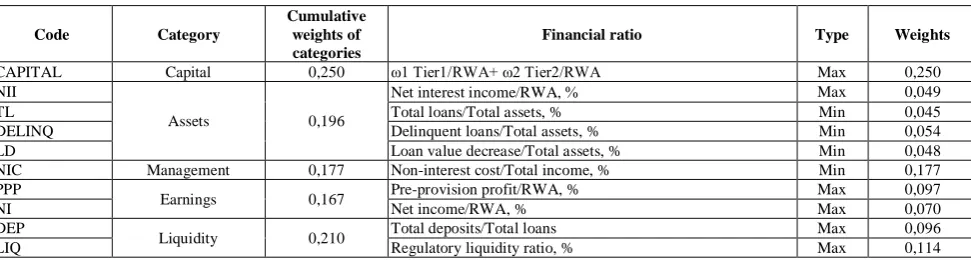
Assets category is represented by four ratios. The first ratio NII presents the magnitude of net interest income, divided by RWA. We believe that this is a better measure than that based on dividing interest income by total assets, since it corresponds to the risk-adjusted return on capital measurement. All the remaining ratios are common. The second (TL) is the ratio between loans, the most risky assets and total assets. The third ratio (DELINQ) is delinquent loans to total assets. And finally, the last ratio within the category (LD) is the decrease of value of assets divided by total assets.
Management category is represented by a single ratio NIC, expressing cost-efficiency of a bank. Since the aim of the research is to consider only quantitative financial criteria, we did not include the qualitative criteria to the analysis.
The category of earnings is represented by two ratios, which gauge pre-provision profits and net income, comparing them to risk-weighted assets. The first ratio PPP reveals the capability of a bank to generate cash, which could then serve as a remedy for various losses, while the second ratio NI expresses remaining profits after all deductions have been made.
Finally, the last liquidity category is represented by the ratio DEP between deposits and total loans, and the regulatory liquidity ratio (LIQ) imposed by the Bank of Lithuania. In the former ratio, we chose the deposits represented only by customer deposits and excluded more volatile inter-bank deposits. The latter ratio indicates the short-term liquidity position of a bank within a month term.
The ratios were chosen to represent depositor’s interest of the evaluation and are based on the concept that higher earnings, bigger capital ratios, cost-efficient management, better loan portfolio, and higher liquidity reduce a likehood of failure. Weights of criteria were determined by eliciting opinions from 13 experts in banking from Lithuania, USA, Singapore, Sweden, Switzerland, Luxemburg working at major commercial banks and universities. The experts at the time of conducting the survey occupied the following positions: executive vice-president and head of a risk-management division of top-four by assets size commercial banks registered in the USA, known in Lithuania expert in finance, two chairmen of the board, heads of divisions, analytics of registered in Lithuania commercial banks and of the Bank of Lithuania.
In order to verify concordance of opinions of the experts Kendall theory was applied (Kendall, 1955; Podvezko, 2007). Weights elicited from the experts were ranked in accordance with assigned weights; the concordance coefficient W=0,622 was obtained. The corresponding χ2 value 67,22 appeared to be smaller than the critical value 21,67 at 9 degrees of freedom and the level of significance α = 0,01. This means that the average elicited weights can be used for the research. Weights and criteria are presented in Table 1.
Table 1
List of criteria describing soundness and stability of commercial banks
Code Category
Cumulative weights of categories
Financial ratio Type Weights
CAPITAL Capital 0,250 ω1 Tier1/RWA+ ω2 Tier2/RWA Max 0,250 NII
Assets 0,196
Net interest income/RWA, Max 0,049 TL Total loans/Total assets, % Min 0,045 DELINQ Delinquent loans/Total assets, % Min 0,054 LD Loan value decrease/Total assets, % Min 0,048 NIC Management 0,177 Non-interest cost/Total income, % Min 0,177 PPP
Earnings 0,167 Pre-provision profit/RWA, % Max 0,097 NI Net income/RWA, % Max 0,070 DEP
Liquidity 0,210 Total deposits/Total loans Max 0,096 LIQ Regulatory liquidity ratio, % Max 0,114
Notes: ω1 and ω2 are average weights assigned by experts to Tier 1 and Tier 2 ratios (ω1 = 0,726 and ω2 = 0,274); RWA denote risk-weighted assets provided in annual statements.
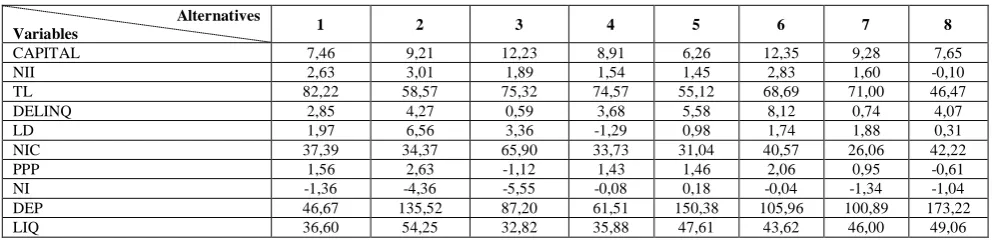
Values of criteria were obtained from financial statements of eight commercial banks registered in Lithuania and are presented in Ginevicius & Podviezko (2013) for 2007–2009 period, and in Table 2 for 2010.
The data contained in table 2 do not provide information on financial stability of banks in question in
positions. In particular, during financial crisis such evaluation would not explicitly reveal a drop of the level of financial stability in fact experienced by most of the banks. By the other hand, the absolute evaluation proposed in this paper uses hypothetical fixed objects as benchmarks. It offers the range of new possibilities: showing dynamics of
performance of objects, possibility of evaluation of a single object, and consequently promptness of evaluation in such cases when data of performance of peer objects is not yet available. Methods of creation of values of criteria of the hypothetical objects could be developed.
Table 2 Values of criteria of financial performance of commercial banks registered in Lithuania, 2010
Alternatives
Variables 1 2 3 4 5 6 7 8
CAPITAL 7,46 9,21 12,23 8,91 6,26 12,35 9,28 7,65 NII 2,63 3,01 1,89 1,54 1,45 2,83 1,60 -0,10 TL 82,22 58,57 75,32 74,57 55,12 68,69 71,00 46,47 DELINQ 2,85 4,27 0,59 3,68 5,58 8,12 0,74 4,07 LD 1,97 6,56 3,36 -1,29 0,98 1,74 1,88 0,31 NIC 37,39 34,37 65,90 33,73 31,04 40,57 26,06 42,22 PPP 1,56 2,63 -1,12 1,43 1,46 2,06 0,95 -0,61 NI -1,36 -4,36 -5,55 -0,08 0,18 -0,04 -1,34 -1,04 DEP 46,67 135,52 87,20 61,51 150,38 105,96 100,89 173,22 LIQ 36,60 54,25 32,82 35,88 47,61 43,62 46,00 49,06
Notes: Alternatives are: 1 – AB DnB NORD, 2 – UAB Medicinos Bankas, 3 – AB Parex bankas (now AB Citadele Bankas), 4 – AB SEB bankas, 5 – AB bankas SNORAS (liquidated in 2011), 6 – AB Swedbank, 7 – AB Siaulių bankas, 8 – AB Ukio bankas (liquidated in 2012).
Presently, the following methods for creating values of criteria of the hypothetical objects could be proposed. The values could be determined by experts, could be elicited from statistical information of performance of evaluated objects, or as a special case of the above, best and worst values of criteria over a period could be taken.
Values of criteria for hypothetical best and worst reference commercial banks for performing the absolute
evaluation were obtained in accordance with the third option listed above. They are presented in Table 3. The authors determined the values of the best and the worst hypothetical objects by taking the best and the worst values of criteria revealing performance of commercial banks registered in Lithuania over the period 2007–2010.
Table 3
Values of criteria for hypothetical best and worst reference commercial banks
Criteria CAPITAL NII TL DELINQ LD NIC PPP NI DEP LIQ
Type Max Max Min Min Min Min Max Max Max Max
Best 13,45 4,56 46,03 0,05 -1,29 21,87 3,78 2,92 173,22 60,31
Worst 5,63 -0,10 87,00 8,39 6,56 65,90 -1,12 -10,60 29,86 32,79
Comparing to the idea of the TOPSIS method, a pivot idea of the proposed method, the values of criteria of hypothetical best and worst alternatives can be determined in wider variety of ways. For example, the way values in Table 3 were obtained has an advantage over the technique proposed in the TOPSIS method. For creation of these values data of several years was used instead of data representing only compared alternatives as it is proposed in the TOPSIS method. Alternative ways of creating values of criteria of hypothetical best and worst alternatives can be developed by scientists, applicable for each particular task.
Absolute and Relative Evaluation of Commercial Banks Registered in Lithuania for 2010
Results of relative and absolute evaluation of commercial banks registered in Lithuania for 2010 based on the TOPSIS method is presented in Table 4. Relative cumulative criterion is denoted Cj̅̅̅∗, while absolute cumulative criterion is denoted C̅̅̅̅̅̅. The results of the j∗ absolute evaluation were obtained by comparing each commercial bank with two hypothetical banks with values of criteria outlined in Table 3. Each bank was treated as a solitary object; consequently data representing other banks to evaluate the bank was not required.
Table 4 Relative and absolute evaluation of commercial banks registered in Lithuania, 2010
Alternatives: 1 2 3 4 5 6 7 8
Cj∗
̅̅̅ (relative evaluation) 0,482 0,594 0,453 0,563 0,538 0,646 0,665 0,502 relative rank 7 3 8 4 5 2 1 6
Cj∗
̅̅̅
̅̅̅(absolute evaluation) 0,475 0,600 0,422 0,548 0,519 0,652 0,603 0,440
absolute rank 6 3 8 4 5 1 2 7
│C̅̅̅ − Cj∗ ̅̅̅̅̅̅j∗│ 0,007 0,006 0,031 0,015 0,019 0,006 0,062 0,062
The results presented in Table 4 demonstrated good correspondence between rankings obtained by the relative and the absolute methods, and between values of the relative cumulative criterion and the absolute cumulative criterion. Discrepancies observed in the results induce the necessity of investigation of the optimality of the choice of hypothetical objects. The discrepancies appeared since two different reference objects were used. In the relative method hypothetical objects proposed in the TOPSIS method were used, while for performing the absolute evaluation, the specially developed hypothetical reference objects.
Authors believe that the facility allowing evaluation of a single object without need to be in a possession of data representing other objects is a remarkable feature of the method. Besides the possibility to observe dynamics of the object, the methodology allows evaluating unique processes, objects, investment or innovation projects, enterprises, etc.. Deviations of the cumulative criterion of the TOPSIS method from the average point 0.5, which is the average of the cumulative criterion, attained at best and worst alternatives, are presented in Table 5. Negative values show performance worse than the average, while positive values show better than average performance.
Table 5
Comparison of the absolute evaluation of financial stability of commercial banks with the relative evaluation
Alternatives 1 2 3 4 5 6 7 8
Cj∗
̅̅̅
̅̅̅ −0,5 -0,025 0,100 -0,078 0,048 0,019 0,152 0,103 -0,060
Notes: Alternatives are: 1 – AB DnB NORD, 2 – UAB Medicinos Bankas, 3 – AB Parex bankas (now AB Citadele Bankas), 4 – AB SEB bankas, 5 – AB bankas SNORAS (liquidated in 2011), 6 – AB Swedbank, 7 – AB Siaulių bankas, 8 – AB Ukio bankas (liquidated in 2012)
Evaluation of financial stability of commercial banks by classic MCDA methodologies, which provide result of evaluation in the form of ranking, reveal relative stability positions of banks in the market. Such results could be regarded as an evaluation in general terms. Observation of deviations of the cumulative criterion of an MCDA method, the TOPSIS in our case, from the average between the cumulative criterion of the best hypothetical alternative and the cumulative criterion of the worst hypothetical alternative allow eliciting more information on financial stability of banks. First, it allows evaluating the absolute stability position of banks in the market. Second, dynamics of financial stability of each bank could be observed over the period of evaluation. Another feature of the proposed methodology is that the result of absolute evaluation could be obtained promptly even in such cases, when financial statements of other banks are not available to make the relative evaluation. For the purpose of sustaining financial stability results of the relative evaluation could be intended to be disseminated among depositors, as such results do not show global deterioration of financial stability of commercial banks. By the other hand, the results of the absolute evaluation could be used at the financial supervision entities.
Conclusions
The Multicriteria Decision Making (MCDM) methodology implies relative quantitative evaluation of several compared alternatives (objects). The result of such evaluation is often provided in the form of ranking of alternatives. Relative importance of all investigated alternatives is exposed in accordance with values of all chosen criteria, which characterise the investigated process. There are frequent cases though, when the absolute evaluation is more useful than the relative one. For example, the evaluation of dynamics of the level of attractiveness based on the relative evaluation in many cases has rather limited practical value as the comparison
References
Alimardani, M., Hashemkhani Zolfani, S., Aghdaie, M. H., & Tamosaitiene, J. (2013). A novel hybrid SWARA and VIKOR methodology for supplier selection in an agile environment. Technological and Economic Development of Economy, 19(3), 533–548. http://dx.doi.org/10.3846/20294913.2013.814606
Antucheviciene, J., Zavadskas, E. K., & Zakarevicius, A. (2012). Ranking redevelopment decisions of derelict buildings and analysis of ranking results. Journal of economic computation and economic cybernetics studies and research (ECECSR). Bucharest: Academy of Economic Studies, 46 (2), 37–62. http://www.ecocyb.ase.ro/22012/ Edmundas%20ZAVADSKAS %20_DA_.pdf
Barniv, R., & McDonald, J. B. (1999). Review of Categorical Models for Classification Issues in Accounting and Finance. Review of Quantitative Finance and Accounting, 13(1), 39–62. http://dx.doi.org/10.1023/A:1008348403869
Basel Committee on Banking Supervision. (2004). International convergence of capital measurement and capital standards : a revised framework. Basel: Bank for International Settlements.
Brans, J. P., & Mareschal, B. (2005). PROMETHEE methods. In J. Figueira, S. Greco, & M. Ehrogott (Eds.), Multiple Criteria Decision Analysis: State of the Art Surveys (pp. 163–186). Berlin, Heidelberg: Springer.
Barysiene, J. (2012). A multi-criteria evaluation of container terminal technologies applying the COPRAS-G method. Transport, 27(4), 364–372. http://dx.doi.org/ 10.3846/16484142.2012.750624
Brauers, W. K., Ginevicius, R., & Podviezko, A. (2012). Evaluation of performance of Lithuanian commercial banks by multi-objective optimization. In R. Ginevicius, A. V. Rutkauskas, J. Stankeviciene (Eds.), The 7th International Scientific Conference Business and Management’2012. Selected papers (pp. 1042–1049). Vilnius, Lithuania: Technika. Brauers, W. K., Ginevicius, R., & Podviezko, A. (2014). Development of a methodology of evaluation of financial stability of
commercial banks. Panoeconomicus, 61(3), 349–367. http://dx.doi.org/10.2298/PAN1403349B
Cantor, R. (2001). Moody’s investors service response to the consultative paper issued by the Basel. Journal of Banking & Finance, 25, 171–185. http://dx.doi.org/10.1016/S0378-4266(00)00121-7
Dadelo, S., Turskis, Z., Zavadskas, E. K., & Dadeliene, R. (2013). Integrated multi-criteria decision making model based on wisdom-of-crowds principle for selection of the group of elite security guards. Arch Budo, 9 (2), 135–147. http://www.archbudo.com/abstracted.php?level=5&ICID=1057752
Fouladgar, M. M., Yazdani-Chamzini, A., Lashgari, A., Zavadskas, E. K., & Turskis, Z. (2012a). Maintenance strategy selection using AHP and COPRAS under fuzzy environment. International Journal of Strategic Property Management 16(1), 85–104. http://dx.doi.org/10.3846/1648715X.2012.666657
Fouladgar, M. M., Yazdani-Chamzini, A., & Zavadskas, E. K. (2012b). Risk evaluation of tunneling projects. Archives of civil and mechanical engineering, 12 (1), 1–12. http://dx.doi.org/10.1016/j.acme.2012.03.008
Ginevicius, R. (2008). Normalization of quantities of various dimensions. Journal of Business Economics and Management 9(1), 79–86. http://dx.doi.org/10.3846/1611-1699.2008.9.79-86
Ginevicius, R., & Podvezko, V. 2007. Some problems of evaluating multicriteria decision methods. International Journal of Management and Decision Making 8 (5/6), 527–539. http://dx.doi.org/10.1504/IJMDM.2007.013415
Ginevicius, R., & Podviezko, A. (2011). A framework of evaluation of commercial banks. Intelektine ekonomika - Intellectual Economics 1(9), 37–53. http://www.mruni.eu/lt/mokslo_darbai/ie/archyvas/dwn.php?id=277536
Ginevicius, R., & Podviezko, A. (2012). Sprendimų paramos metodų taikymo ypatumai komercinių bankų finansinio stabilumo vertinime. Verslas: teorija ir praktika, 13(4), 314–323. http://dx.doi.org/10.3846/btp.2012.33
Ginevicius, R., & Podviezko, A. (2013). The evaluation of financial stability and soundness of Lithuanian banks. Ekonomska Istrazivanja - Economic Research, 26(2), 191–208. http://hrcak.srce.hr/file/152954
Ginevicius, R., Podvezko, V., & Podviezko, A. (2012a). Evaluation of isolated socio-economical processes by a multi-criteria decision aid method ESP. In The 7th international scientific conference business and management’2012. Selected papers (pp. 1083–1089). Vilnius, Lithuania.
Ginevicius, R., Podvezko, V., Novotny, M., & Komka, A. (2012b). Comprehensive Quantitative Evaluation of the Strategic Potential of an Enterprise. Economic Computation and Economic Cybernetics Studies and Research, 46(1), 65–84. http://www.ecocyb.ase.ro/2012pdf/Ginevicus%20%20Romualdas%20_T_.pdf
Hwang, C. L., & Yoon, K. (1981). Multiple Attribute Decision Making-Methods and Applications: A State of the Art Survey. Berlin, Heidelberg, New York: Springer Verlag. http://dx.doi.org/10.1007/978-3-642-48318-9
Kaplinski, O, & Tupenaite, L. (2011). Review of the multiple criteria decision making methods, intelligent and biometric systems applied in modern construction economics. Transformations in Business & Economics, 10 (1), 166–181. Kendall, M. (1955). Rank correlation methods. New York: Hafner Publishing House.
Langohr, H., & Langohr, P. (2008). The Rating Agencies and Their Credit Ratings: What They Are, How They Work, and Why They are Relevant. Chichester, England: John Wiley & Sons Ltd.
Opricovic, S., & Tzeng, G. H. (2004). Compromise solution by MCDM methods: A comparative analysis of VIKOR and TOPSIS. European Journal of Operational Research, 156, 445–455. http//dx.doi.org/10.1016/S0377-2217(03)00020-1. Palevicius, V., Paliulis, G. M., Venckauskaite, J., & Vengrys, B. (2013). Evaluation of the requirement for passenger car
parking spaces using multi-criteria methods. Journal of Civil Engineering and Management, 19(1), 49–58. http//dx.doi.org/ 10.3846/13923730.2012.727463
Podvezko, V. (2007). Determining the level of agreement of expert estimates. International Journal of Management and Decision Making, 8 (5/6), 586–600. http//dx.doi.org/10.1504/IJMDM.2007.013420
Podvezko, V. (2011). The Comparative analysis of MCDA methods SAW and COPRAS. Inzinerine Ekonomika - Engineering Economics, 22(2), 134–146. http://www.inzeko.ktu.lt/index.php/EE/article/view/310/829
Podvezko, V., & Podviezko, A. (2010). Dependence of multicriteria evaluation result on choice of preference functions and their parameters. Technological and Economic Development of Economy, 16(1), 143–158. http//dx.doi.org/ 10.3846/tede.2010.09
Podviezko, A. (2012). Augmenting multicriteria decision aid methods by graphical and analytical reporting tools. In Workshops on business informatics research, Lecture notes in business information processing (Vol. 106, pp. 236–251). Berlin, Heidelberg, Springer. http://dx.doi.org/10.1007/978-3-642-29231-6_19
Podviezko, A., & Ginevicius, R. (2010). Economic criteria characterising bank soundness and stability. In R. Ginevicius, A. V. Rutkauskas, & R. Pocs (Eds.), The 6th International Scientific Conference Business and Management’2010. Selected papers (pp. 1072–1079). Vilnius, Lithuania: Technika.
Razavi Hajiagha, S. H., Hashemi, S. S., & Zavadskas, E. K. (2013). A complex proportional assessment method for group decision making in an interval-valued intuitionistic fuzzy environment. Technological and Economic Development of Economy, 19(1), 22–37. http//dx.doi.org/10.3846/20294913.2012.762953
Simanaviciene, R., Liaudanskiene, R., & Ustinovichius, L. (2012). A New Synthesis Method of Structural, Technological and Safety Decisions (SyMAD-3). Journal of Civil Engineering and Management, 18(2), 265–276. http//dx.doi.org/ 10.3846/13923730.2012.666504
Sliogeriene, J., Kaklauskas, A., Streimikiene, D., & Bianchi, M. (2012). Multiple criteria decision support system for the assessment of energy generation technologies considering the dimension of values. International Journal of Strategic Property Management, 16(4), 370–391. http//dx.doi.org/10.3846/1648715X.2012.722132
Staniunas, M., Medineckiene, M., & Zavadskas, E. K. (2013). To modernize or not: ecological-economical assessment of multi-dwelling houses modernization. Archives of civil and mechanical engineering, 13 (1), 88–98. http//dx.doi.org/10. 1016/j.acme.2012.11.003
Siozinyte, E., & Antucheviciene, J. (2013). Solving the problems of daylighting and tradition continuity in a reconstructed vernacular building. Journal of Civil Engineering and Management, 19(6), 873–882. http//dx.doi.org/ 10.3846/ 13923730.2013.851113
Tamosaitiene, J., & Kaplinski, O. (2013). Strategic Environmental Assessment (SEA) of Socio-Economic Systems: a systematic review. Technological and Economic Development of Economy, 19(4), 661–674. http//dx.doi.org/10. 3846/20294 913.2013.862882
Tamosaitiene, J., & Gaudutis, E. (2013). Complex assessment of structural systems used for high-rise buildings. Journal of Civil Engineering and Management, 19(2), 305–317. http//dx.doi.org/10.3846/13923730.2013.772071
Tzeng, G. H., & Huang, J. J. (2011). Multiple attribute decision making: methods and appliations. Boca Raton, FL: CRC Press.
Yazdani-Chamzini, A., Yakhchali, S. H., & Zavadskas, E. K. (2012). Using a integrated MCDM model for mining method selection in presence of uncertainty. Ekonomska istraživanja = Economic research. Pula: Juraj Dobrila University of Pula, 25 (4), 869–904. http://hrcak.srce.hr/index.php?show=clanak&id_clanak_jezik=142727.
Zavadskas, E. K., Susinskas, S., Daniunas, A., & Turskis, Z. (2012a). Multiple criteria selection of pile-column construction technology. Journal of Civil Engineering and Management, 18(6), 834–842. http//dx.doi.org/10. 3846/13923 730.2012.744537
Zavadskas, E. K., Turskis, Z., Volvaciovas, R., & Kildiene, S. (2013) Multi-criteria assessment model of technologies. Studies in Informatics and Control, 22 (4), 249–258. http://sic.ici.ro/sic2013_4/index.html
Zavadskas, E. K., Susinskas, S., Daniunas, A., Turskis, Z., & Sivilevicius, H. (2012b). Multiple criteria selection of pile-column construction technology. Journal of civil engineering and management, 18 (6), 834–842. http//dx.doi.org/10.3846/13923 730.2012.744537
Zopounidis, C. (1999). Multicriteria decision aid in financial management. European Journal of Operational Research, 119, 404–415. http//dx.doi.org/10.1016/S0377-2217(99)00142-3