Electronic Journal of Plant Breeding, 3(1):606-611 (Mar 2012) ISSN 0975-928X
http://sites.google.com/site/ejplantbreeding 606
Research Article
Combining ability and Gene action for seed yield and its components in Bread
Wheat (
Triticum aestivum
) (L.) em. Thell]
M.K. Srivastava, Dhirendra Singh and Shweta Sharma
Department. Of Plant Breeding and Genetics, ND (P.G.) College, Shikohabad, Affiliated To Dr BRA University Agra Eemail [email protected]
(Received: 19 Aug 2011; Accepted: 29 Feb 2012)
Abstract:
A line x tester analysis involving 12 females and 4 males was carried out for 12 component traits in bread wheat. The variances due to specific combining ability (sca) were found to be considerably higher than that of general combining ability (gca) for all the characters indicating greater importance of non-additive type of gene action thus, the heterosis breeding may be useful. Variety WH542 and HD2285 was found to be good general combiners for most of the yield contributing traits like spike length, 1000 grain weight etc.and so the crosses involving these parents have fair chances to get better recombinants after judicious selection. Crosses like PBW459 x RAJ 3777, K9006xUP2425and HD2285x UP2425 are important because they potentially combine the most of the yield contributing traits`.
Key words: Bread wheat, combining ability, gene action, seed yield
Introduction
Wheat is the second most important crop in India after rice. To meet out the food requirement of increasing population, India will require producing about 109 mt. of wheat to fulfill daily requirement about 180g. of wheat per day per head. In the year 2008-09, we had produced of about 80.58 mt. of wheat from an area about 27.75 m ha with an annual wheat productivity growth rate of about 1% per annum. To meet the future goals, we either have to expand area under cultivated wheat or to improve productivity. The first option is not quite feasible as we are in a saturation level but there is a fair chance to improve our productivity.
Material and Methods
The experimental material consisted of 12 lines used as female parents and 4 testers. These were crossed in
L x T fashion and in this way their possible 48F1
were obtained. The F1 crosses were selfed and thus,
F2 generation was obtained. The F1 crosses were
made following hand emasculation and pollination. The final trial conducted with all 16 parents their
possible 48F1 and 48F2 cross combinations. These
were grown in randomized block design with three
replications. The plot size for F1s was double row of
2m length and for F2s 6row of 2m length. The inter
and intra row spacing was 25cm and 10cm, respectively. The double row of standard check PBW343 was also sown after each 5 plots. The observations were recorded on 10 and 30 competitive plants selected randomly from each plot for twelve
quantitative traits namely heading, maturity, grain filling period, plant height, flag leaf area, spike length, grains per spike, grain weight per spike,1000 grain weight, biological yield, harvest index and yield per plant. The mean values of each genotype were subjected to combining ability analysis by line x tester method as suggested by Kempthorne (1957).
Results and Discussion
The results indicated significant differences among the parents for general combining ability (gca) and crosses for specific combining ability (sca) effects for all the characters studied(Table1). Though the gca and sca components of variance were significant for all the characters under study, the variance due to sca was found to be considerably higher than that of gca for all the characters, indicating greater importance of non additive gene action and thus suggested heterosis breeding may be useful. Similar results have been reported by Cifei Aydogan Esra and Koksal Yagdi
(2010), Dhadhal et.al.(2008).
Electronic Journal of Plant Breeding, 3(1):606-611 (Mar 2012) ISSN 0975-928X
http://sites.google.com/site/ejplantbreeding 607
to get better recombinants for yield improvement. Genotype K9107 was found to be the promising general combiners for early maturity and dwarfness. Study further revealed that genotypes like UP2425, K9006, UP 2338 were also good general combiners for early maturity. Variety like PBW459, NW1012, PBW435, HUW206, UP2425 were promising general combiners for the traits like biological yield and harvest index.
Specific combining ability effects estimates revealed very wide range of variation for all the characters. Few crosses in each specific trait shortlisted on the basis of high specific combining ability effects (sca) (Table 3). Results revealed that the crosses showed highest values of sca effect for yield, also showed the high value of sca effects in most of the yield contributing traits indicating true to type relationship.
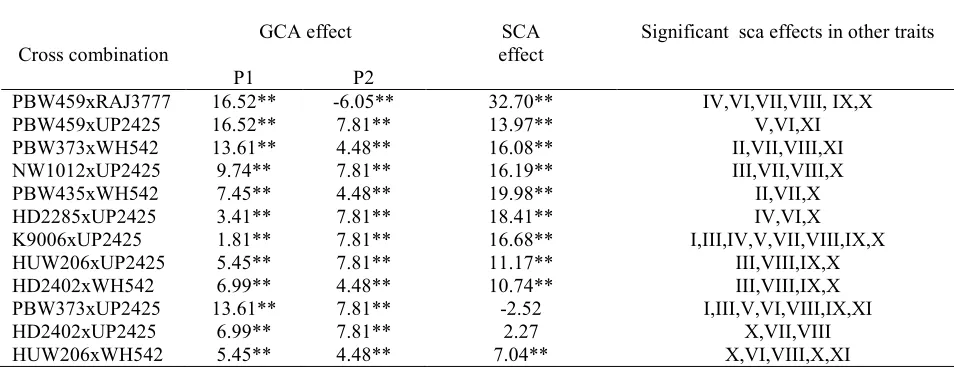
Twelve outstanding crosses shortlisted on the basis of highest yield per plant (Table 4) . Cross combinations like PBW459 x RAJ3777, K9006 x UP2425, HD2285 x UP2425 and NW1012 x UP2425 are the prominent crosses as these crosses efficiently combine most of the yield contributing traits. It genetically infers that yield advantage is due to non additive type of gene action and so heterosis breeding will be rewarding. Similar results have been reported by Cifei Aydogan Esra and Koksal Yagdi (2010), Subhaschandra et al.(2010). Shrma et al. (1992), Babu and Kumar (1995), Sharma and Tandan (1997).
References
Kempthorne, O.1957. An Introduction to genetic statistics. John Wiley and Sons Inc.New York
Sharma, S.C., Iqbal Singh and Singh, I. 1992. Combining ability analysis for some quantitative traits in wheat. Haryana Agric Univ, J. Res., 22:267-270
Babu, V. R. and Kumar, S.S. 1995. Combining ability analysis for wheat in normal and stress environments. Ann. Agric. Res., 16:23-27 Sharma, R.K. and Tandan, J. P. 1997. Combining ability
analysis in relation to heat stress for some morphological characters in wheat. Indian J. Agric. Res.,31(2):87-92
Dhadhal B.A., Dobariya, K.L., Ponkia, H.P. and Jivani, L.L. 2008. Gene action and combining ability over environments for grain yield and its attributes in bread wheat (T.aestivum). Internat. J. Agric. Sci. , 4(1):66-72.
Cifei, Esra Aydogan and Koksal Yagdi. 2010. The research of the combining ability of agronomic traits of bread wheat in F1 and F2 Generation, U.U. Ziraat Fakultesi Dergisi,Cilt 24,Sayi 2,85-92 (J.of Agricultural faculty of Uludag University). Subhaschandra, B., Lohithaswa, H.C., Desai, S.A.,
E le ct ro n ic J o u rn al o f P la n t B re ed in g , 3 (1 ): 6 0 6 -6 1 1 ( M ar 2 0 1 2 ) IS S N 0 9 7 5 -9 2 8 X h tt p :/ /s it es .g o o g le .c o m /s it e/ ej p la n tb re ed in g 6 0 8 T ab le 1 . A n al y si s o f v ar ia n ce f o r co m b in in g a b il it y f o r 1 2 y ie ld t ra it s in l in ex te st er a n a ly si s o f b re ad w h ea t cr o ss es S o u rc es G en e ra ti o n D F H
D (I)
Electronic Journal of Plant Breeding, 3(1):606-611 (Mar 2012) ISSN 0975-928X
http://sites.google.com/site/ejplantbreeding 610
Table 3. Promising crosses with desirable sca effect in F1 and F2 generations.
Trait Promising crosses having significant sca effect
Heading K9006xUP2425(-1.86 in F1 and -1.82 in F2)
NW1012XWH542(-1.75 in F1 and -1.07 in F2)
PBW343xWH542(-7.06in F1and-0.49in F2)
Maturity K9006x UP2338(-2.41in F1 and -5.88 in F2)
PBW373xWH542(-2.44xin F1 and -2.47in F2)
Plant height (cm) HD2285xWH542(-7.15in F1 and -8.06 in F2)
PBW343xWH542(-4.15 in F1 and-7.06 in F2)
HUW468xUP2425(-6.46in F1 and-3.92 in F2)
Grain filling period K9006xUP2425(4.17 in F1 and 6.52 in F2)
PBW373xUP2425(4.00in F1 and 2.94 in F2)
PBW443xUP2338(3.03in F1and 4.80 in F2)
Flag leaf area (cm2)
PBW443xWH542(11.76 in F1and 3.76 in F2)
PBW459xUP2425 (5.69 in F1 and 6.82 in F2)
Spike length (cm) HUW206x UP2425(1.43 in F1 and 1.01 in F2)
HUW468 xWH542 (0.99 in F1 and 0.85 in F2)
Grains per spike HD2402xUP2425 (14.04 in F1 and 20.01 in F2)
PBW373xWH542 (14.51 in F1 10.90 in F2)
PBW459xRAJ 3777 (11.96in F1 and 12.17 in F2)
Grain weight per spike (g)
K9006xUP2425 (1.05 in F1 and 0.54 in F2)
HUW468xWH542(0.96in F1 and 0.17 in F2)
K9107xUP2338(0.79in F1 and 0.58 in F2)
1000 grain weight (g)
HD2402xWH542 (11.97 in F1 and7.28 in F2)
HUW206xWH542(11.22 in F1and 6.48 in F2)
PBW435xRaj3777(6.38 in F1 and 7.87 in F2)
Biological yield (g) PBW459xRAJ3777 (70.38 in F1 and 23.67 in F2)
K9006xUP2425 (37.65 in F1 and 26.46 in F2)
NW1012xUP2425(45.82 in F1 and30.71 in F2)
Harvest index HUW206xWH542(10.63 in F1 and 65.42 in F2)
Yield per plant (g) PBW459xRAJ3777 (32.70 in F1 and 11.27 in F2
K9006xUP2425 (16.68 in F1 and 14.99 in F2)
Electronic Journal of Plant Breeding, 3(1):606-611 (Mar 2012) ISSN 0975-928X
http://sites.google.com/site/ejplantbreeding 611
Table 4 - Prominent crosses of breeding value for grain yield and their performance with respect to GCA and SCA Effects in bread wheat
Cross combination
GCA effect SCA
effect
Significant sca effects in other traits
P1 P2
PBW459xRAJ3777 16.52** -6.05** 32.70** IV,VI,VII,VIII, IX,X
PBW459xUP2425 16.52** 7.81** 13.97** V,VI,XI
PBW373xWH542 13.61** 4.48** 16.08** II,VII,VIII,XI
NW1012xUP2425 9.74** 7.81** 16.19** III,VII,VIII,X
PBW435xWH542 7.45** 4.48** 19.98** II,VII,X
HD2285xUP2425 3.41** 7.81** 18.41** IV,VI,X
K9006xUP2425 1.81** 7.81** 16.68** I,III,IV,V,VII,VIII,IX,X
HUW206xUP2425 5.45** 7.81** 11.17** III,VIII,IX,X
HD2402xWH542 6.99** 4.48** 10.74** III,VIII,IX,X
PBW373xUP2425 13.61** 7.81** -2.52 I,III,V,VI,VIII,IX,XI
HD2402xUP2425 6.99** 7.81** 2.27 X,VII,VIII
HUW206xWH542 5.45** 4.48** 7.04** X,VI,VIII,X,XI
Abbreviation:
I.Heading II. Maturity III.Grain filling period IV.Plant height (cm) V.Flag leaf area (cm2)
VI. Spike length (cm) VII. Grains per spike VIII.Grain weight per spike (g)
IX. 1000 grain weight (g) X. Biological yield (g) XI. Harvest index XII. Yield per plant (g)