ISSN 1392 – 2785 Inzinerine Ekonomika-Engineering Economics, 2010, 21(1) THE ECONOMIC CONDITIONS OF ENTERPRISE FUNCTIONING
The Evaluation of Social and Economic Development of the Region
Akvile Kilijoniene
1, Zaneta Simanaviciene
2, Arturas Simanavicius
21Klaipeda University
H. Manto str. 84, LT-92291, Klaipeda, Lithuania e-mail: [email protected]
2Kaunas University of Technology
K. Donelaicio str. 73, LT-44029, Kaunas, Lithuania
e-mail: [email protected], [email protected]
The subject of the article is the evaluation of social and economic development of the region in the content of the European Union. Without common approach as to evaluating progress and development based on integral indices and calculus as well as the authentic source of information, there is always room for subjectivity. Integration into the European Union accelerates the solution of the difficulties of regional policy in Lithuania. Pay attention to the regions is a constant part of the policy of European Union countries.
The article analyzes the concepts of a region. There are analysed the conceptions, which differ in the nature and role of the regions, dynamism and development of regionalization processes, level of economic integration. The conceptions are the following ones: social geography, administrative-territorial, institutional, geopolitical and economic. Furthermore, the evaluation analysis of regional development level and its application in different foreign countries, prosecuted by the researchers are introduced in this article.
It has been proven that regional policy in the EU level is necessary, as the European Union consists of 27 member states with 493 million people and the home market. It is evident, that there are economic and social differences in such a large territory within states and 268 regions, and the process of convergence is very slow and problematic. Thus, the article focuses on working out an effective evaluation method, which could be applied to achieve reliable results and would be effective in solving problems of regional development.
The evaluation of regions’ social and economic development is a part of a broader analysis, comprising the preparation of evaluation methodology of regional policy’s influence and application in the content of the EU, where the first stage includes the composition of optimal set of indicators of social and economic development of regions. It should allow to perform interregional comparisons in order to prove the effect the regional policy on the development of problem-orientated branches of a region. The prepared evaluation methodology is applied empirically evaluating social and economic development of the region in the context of NUTS 2 statistical regions of the European Union, situated in the territory of twelve new the EU member states.
Keywords: region, regional development, evaluation model.
Introduction
Relevance of the topic. After joining the European Union (hereafter the EU), Lithuania participates in the implementation of the EU regional policy, the base of which is financial support of Structural Funds. As Lithuania has already become a full member of the EU, the evaluation of regional development is the relevant issue for our country. Though the regional development of the EU member states, the EU promotion effectiveness of economic and social compaction, as well as the requirement to reform regional policy attain more and more attention of researchers lately, the evaluation process in the case of a specific country should be adapted individually, preparing the integrated model. The model should comprise the system of theanalysis indicators of regional development level, the purpose of which would be differentiation of regions by the level of social and economic development, identification of strong and weak aspects of the regions. The need and importance for Lithuania to prepare evaluation model and to substantiate it with the purpose to ensure objectivity and adaptability of the results while solving problems of regional development in Lithuania increased since 2004 after joining the European Union.
Objective of scientific research – to represent the evaluation model of social and economic development of the region and to put it in practice evaluating NUTS 2 statistical regions of the European Union, situated in the territory of twelve new the EU member states and analyze social and economic perspectives of Lithuania.
Methods. For the purpose to systematize realization trends of regional development substantiated in the theories of regional development, as well as to prepare evaluation method of social and economic development of the region substantiated academically, it was referred to systematic and comparative analysis of scientific literature, synthesis, methods of logical abstraction and inference generation. During the process of the model preparation it was referred to the evaluation method of the results of experts’ questioning (interview) in pursuance of scientific substantiation of selection of indicators, which characterize regions’ development level, as well as for the purpose to evaluate its scale, applying calculation system of total indexes. The following methods were applied for the research: systematic and comparative analysis of the documents, the method of data normalization when fixed
Akvile Kilijoniene, Zaneta Simanaviciene, Arturas Simanavicius. The Evaluation of Social and Economic Development of the Region
coefficients are entered (constituent dimensions) for the data, which exceed or do not exceed the average of the EU (or group of regions, where there is no appropriate indicator in the context of the EU), regression analysis, prediction, and inference generation.
Scientific problem. The first theorists’ trials to motivate the growth of regions’ economy, decrease of regional differences were the interpretation of upgrowth theories of neoclassical international trade and national economy. It was up for specific theories, starting with theorem of Heckscher-Ohlin-Samuelson (Heckscher, 1991; Ohlin, 1933; Samuelson, 1953; 1949; 1948), wherein convergence of the prices of international actions is detailed, applying static models of trade equilibrium. It also supplements theory of Ricardo (1817). To further continue, there are models of upgrowth theory of Harrod (1939) and Domar (1946), explicated by Solow (1956) and Swan (1956), wherein relational and absolute convergence is analyzed. Works of originators of regional science were mostly named as criticism and response to hypothesis of convergence and neoclassical economy, the main representatives of which were Weber (1929), Hoover (1937), Greenhut (1956), Isard (1956, 1960), Hotelling (1929), Devletoglou (1965), Eaton & Lipsey (1978) Christaller (1933), Losch (1954) and other.
Two major attitude trends of scientists and their works towards development of regional differences and necessity of regional policy are met in scientific literature: the theories of regional economy’s convergence and divergence. Representatives of theories of regional economy’s convergence Tiebout (1956a; 1956b) and North (1955; 1956), Borts & Stein (1964), Williamson (1965), who maintained that economic policy is meaningless, as free market can compensate differences of development itself. Representatives of regional convergence theories disprove the necessity of regional policy, therefore, in the models, prepared on the grounds of supply and demand, the ability of mechanism of free market to solve discontinuity problem of state’s regions naturally (without intrusion of state’s political means) is emphasized. Theories of regional economy’s divergation, the main representatives of which are Myrdal (1957), Kaldor (1970), Dixon & Thirlwall (1975), Perroux (1950), Hirschman (1958), Boudeville (1966), Friedmann (1966), affirm the increase of regional differences and argue that regional policy is necessary., Stating the obvious necessity of regional policy the theories of regional divergence, point out the promotion of the development of poor regions by improving production conditions and increasing the effectiveness of factors of production.
Other representatives of theories of regional development maintained problems’ solving of increase of regional differences through the promotion of regional development. They analyzed economic development as a process of structural changes inside the region and out of its boundaries. The main promotion trends of regional development are emphasized in the works of representatives of other regional development theories (Dawkins, 2003): development of investment into more efficient economic sectors, industry sector and new territorial methods of production, development of more effective exploiting of land in poorer regions and investment into internal factors (technology, innovations, geographical location and so forth).
However, for the purpose to evaluate consistent patterns of regional structure and economic development of the regions as well as peculiarities of regional policy formation, it is essential that the model of regional development could be applied to the specific theory. Lithuanian scientists started analyzing regional problems, as social economical system, balanced for regional development and its influence on country’s economy lately, only after the recovering of Independence. Problems and aspects of regional development and competitiveness in Lithuania were analyzed by Dumcius and Siupsinskas, (Dumsius, Siupsinskas, 2003a;2003b; Siupsinskas, 2004), Streimikiene (1999, 2001, 2002), Vaitiekunas (2001), Burneika & Bagociute (2002), Andriusaitiene (2007), Vidickiene & Melnikiene (2008), Vilpisauskas (2000), Maniokas (2002), Nakrosis (2004), Kazlauskaite & Buciuniene (2008, Pukeliene & Maksvytiene (2008), Rutkauskas (2008), Snieska & Bruneckiene (2009), Melnikas (2008a, 2008b), Damaskopoulos, Gatautis & Vitkauskaite (2008), Brock & Urbonavicius (2008), Brauers & Ginevicius (2009), Diskiene, Galiniene & Marcinskas (2008), Ginevicius & Podvezko (2009), Ciegis & other (2008, 2009), Banyte & Salickaite (2008), Lakstutiene (2008), etc.
Uneven development of the EU and growing gap among the regions is a well comprehended problem, though the methods of differences’ solving in regional development evaluation and evolution are far from being evident. To evaluate economic and social development within the regions is a particularly problematic aspect in the case of Lithuania: among the municipalities, where uneven development may be extremely high and economic models, appropriate only to large regions, may be difficult to be applied. Therefore, there is no accord formed in scientific literature concerning selection of indicators of social and economc development for interregional comparison and there was insufficient consideration on the analysis of evaluation problems of the evolution of the development level of quantitative and qualitative influence on regions and country.
Concepts of a region
ISSN 1392 – 2785 Inzinerine Ekonomika‐Engineering Economics, 2010 21(1), 68‐79
The variety of definitions of a region can also be attributed to region’s, as political and administrative managerial unit, novelty of the idea, different nature and role of regions, dynamism and development of regionalization processes, level of economic integration. Because of such reasons it is being competed for conceptions, which seem to be contradicting at a glimpse (see Figure 1). The definition of a social geography region, formulated by Burbulyte (2005), highlights a social context of a region, comprising social environment of a territory. The administrative-territorial conception of regions defines a legal base of fixing of region’s boundaries. This conception does not emphasize a different nature of regions, it just prescribes a formal legal base of regions’ formation: institutional conception of a region substantiates the institutional nature of regions. This is how a region is defined by the European
Assembly Institute of regions. Institutional conception of regions could be applied to many different institutions: lands of Germany, provinces of Holland, regions of France, etc (Macys, 2005). Geopolitical conception of a region is related to the processes of political integration. Economic conception of a region emerges from the essence of economic policy, the purpose of which is the allocation of investment to the regions. The significance of investment for regional development depends on region’s available resources – nature, tangible property, human resources and so forth, and specialization of economic activity, as the volumes of resources, structure, usability options differ in particular regions. Economic conception of a region may be applied not only to administrative-territorial regions, but it is based upon the conception of economic integration process and conditions of market demand and supply.
Figure 1. Concepts of a region Summarizing scientific and other regional literature, it
can be maintained that present-day authors give more of their attention to the development of regions and regional policy than the terminology of regions itself. Another conclusion can be also drawn – the conception of regions is interpreted rather freely, but there is no transgression for “classical” conceptions of regions. For the purpose to form and implement efficient regional policy, integrated point of view on the region, regional differences, identification of its significance and typifying of regions are necessary aspects.
Evaluation of regional evolution level and social and economic development
For the evaluation of regional evolution differences macro economic factors (unemployment level, incomes of inhabitants, gross domestic product) and components of economic development (basic and social infrastructure, potential and quality of labour force, technology, financial and physical resources) and so forth. Furthermore, economic development of the region can be evaluated by competitiveness factors of regions, what is especially common in the European Union countries. The main competitiveness factors are considered to be GDP per capita, which approximately corresponds to labour force efficiency in the region. Employment level (proportion between total quantity of employed people and quantity of employable age inhabitants) is designated as additional
competitiveness factor (Pinelli et all, 1998). The competitiveness is often considered to be a principal indicator of the economic policy being performed. However, certain features, common to the whole region, determining competitiveness of all regions’ companies, in regard to other regions, are designated as physical and social infrastructure of a region, skills of labour force, work efficiency of public institutions and so forth. It is essential to designate the main determining factors in the GDP regions, while evaluating regions’ development level by the competitiveness indicators:
- structure of economy, defined by employees’ appointment in different economy sectors (a higher GDP level per capita is noticed in the regions, with a bigger part of employees in industrial and service sectors);
- innovation level, measured by a number of licenses; - accessibility of a region, measured by the indicators
of transport infrastructure;
- skills of labour force, measured by a number of a partially high, average or low education of the employees (Bagdzeviciene, Matekoniene, 2000, 21). However, according to Dino Pinelli and like-minded persons (Pinelli et all, 1998), it is more appropriate to compare differences of countries than differences of interregional development by the competitiveness indicator, as many of the indicators are not statistically reliable.
-Akvile Kilijoniene, Zaneta Simanaviciene, Arturas Simanavicius. The Evaluation of Social and Economic Development of the Region
While analyzing economic development tendencies of different countries’ regions, the tendency of interdependence between industrial and country’s development level is perceived. The development level of every country in the world directly depends on the development level of manufacturing industry and its comparative general part of economy’s structure. The bigger part of manufacturing industry and more progressive its root structure is, the higher level of domestic product per capita is. The leading regions become such regions, in the territories of which manufacturing industry companies are operating, and the production of which conditionally belongs to the group No. 1 (Damasiene, Butkus, 2003). While analyzing the EU regions of the purpose No. 1 (NUTS 2 statistical regions, except Ireland’s NUTS 3), Pompili (1994) designated 5 essential indicators of regional development: employment structure in macro level (sectors of agriculture, industry, service); fund of human capital (education, special knowledge); development of industrial sector; geographical location, infrastructure of communication and network, and losses of development of local regional economy (Pompili, 1994).
EUROSTAT has also tried to compile the evaluation indicators’ set of regional development level, where 50 indicators were provided for the identification of regional development level. The indicators were grouped into global indicators of regional development (GDP for one economically active inhabitant, unemployment under the age and sex, level of long-term unemployment, net disposable income) and thematic indicators, also divided into subgroups of natural resources, human resources, infrastructure, and production sector’s efficiency. However, not all provided indicators are being registered and calculated in statistics departments, therefore there is no official solution regarding the composition of the most optimum evaluation indicators’ set of regional development level.
As the variety of evaluation indexes shows, indexes’ groups of general competitiveness, labour force, education and trainings, capital, land and infrastructure were distinguished often for the identification of regional development level. Some of them perhaps do not display the competitiveness of the region directly (e.g. indicator “achievements in education and trainings”); anyway, it reveals the possibilities. Therefore, it is recommended to apply universal indicators at a regional level.
While analyzing the indicators, which characterize development level, in some of the EU member states, it can be noticed, that actually the differentiation of regions is identified by GDP volume per capita and levels of unemployment and employment. Other indicators (density of population, indicator of business and industry structure, indicator of disfavour on agriculture, etc.) are used more seldom by the countries. In Latvia, expert evaluation is performed, while selecting problem-orientated regions. When this method is applied, regions are ranged by every indicator. A place of the region among other regions is designated in this way. Then experts give weighting coefficient from 1 to 3 to the indicators, considering the importance of the indicator in regional development.
Accordingly, it is necessary to perform a complex analysis of regional condition, seeking to substantiate the differentiation of social-economic development level of
regions and to identify regions of low development level in regard to the country’s average. After evaluating the experience of foreign countries and the works of scientists on this topic, it can be assumed, that generalized (universal) indicators are usually used for the evaluation of regions’ state. For the purpose of compiling the indicators set and to provide weighting coefficients, it is purposeful to perform the expert evaluation.
Evaluation model of social and economic development of the region
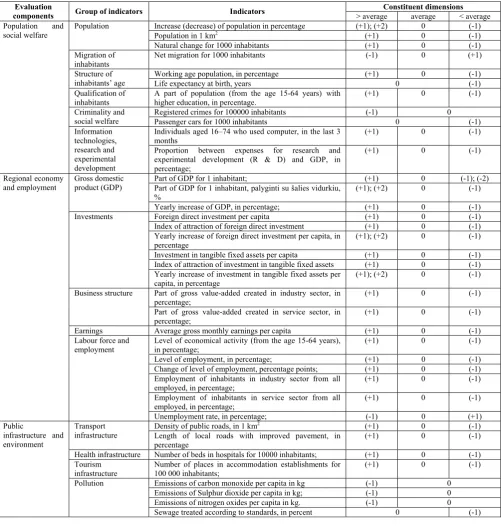
After the generalization of variety of indicators of development level in the scientific literature and experience of foreign countries, three main groups of indicators are distinguished in the article: they characterize social, economic, public infrastructure and environmental development of the region (see Table 1). During the process of expert evaluation the set of indicators, measuring level of development was composed after the evaluation of experts’ accord; they calculated the value of
Kendall’s concordance coefficient W that was closest to figure of one). They are of a significant importance for an interregional comparison.
Evaluation model and process scheme of social and economic development of the region also represented in the article. They prescribe the sequence of evaluation process performance and usage possibilities of research data analysis methods in order the social and economic development could be evaluated. These 4 stages are represented in Evaluation model of regional policy influence on social and economic development of the region (see Kilijoniene & Simanavieiene, 2008; 2009) Considering the formulated aim, the article is focused on the formation of the evaluation indicators set of social and economic development of regions and its practical application in the content of NUTS 2 statistical regions of the EU. Therefore, the research will comprise:
1. the normalization of the indicators of level of regional development and calculation of missing data; 2. the classification of regions according to the
development level;
3. Identification of differences of regional development; 4. the analysis of the tendencies of regional development.
ISSN 1392 – 2785 Inzinerine Ekonomika‐Engineering Economics, 2010 21(1), 68‐79
Table 1
Evaluation indicators’ set of level of social and economic development of regions
Constituent dimensions Evaluation
components Group of indicators Indicators > average average < average
Increase (decrease) of population in percentage (+1); (+2) 0 (-1)
Population in 1 km2 (+1) 0 (-1)
Population
Natural change for 1000 inhabitants (+1) 0 (-1) Migration of
inhabitants
Net migration for 1000 inhabitants (-1) 0 (+1)
Working age population, in percentage (+1) 0 (-1) Structure of
inhabitants’ age Life expectancy at birth, years 0 (-1) Qualification of
inhabitants
A part of population (from the age 15-64 years) with higher education, in percentage.
(+1) 0 (-1)
Registered crimes for 100000 inhabitants (-1) 0 Criminality and
social welfare Passenger cars for 1000 inhabitants 0 (-1) Individuals aged 16–74 who used computer, in the last 3
months (+1) 0 (-1)
Population and social welfare Information technologies, research and experimental development
Proportion between expenses for research and experimental development (R & D) and GDP, in percentage;
(+1) 0 (-1)
Part of GDP for 1 inhabitant; (+1) 0 (-1); (-2) Part of GDP for 1 inhabitant, palyginti su šalies vidurkiu,
%
(+1); (+2) 0 (-1) Gross domestic
product (GDP)
Yearly increase of GDP, in percentage; (+1) 0 (-1) Foreign direct investment per capita (+1) 0 (-1) Index of attraction of foreign direct investment (+1) 0 (-1) Yearly increase of foreign direct investment per capita, in
percentage
(+1); (+2) 0 (-1)
Investment in tangible fixed assets per capita (+1) 0 (-1) Index of attraction of investment in tangible fixed assets (+1) 0 (-1) Investments
Yearly increase of investment in tangible fixed assets per capita, in percentage
(+1); (+2) 0 (-1)
Part of gross value-added created in industry sector, in
percentage; (+1) 0 (-1)
Business structure
Part of gross value-added created in service sector, in percentage;
(+1) 0 (-1)
Earnings Average gross monthly earnings per capita (+1) 0 (-1) Level of economical activity (from the age 15-64 years),
in percentage;
(+1) 0 (-1)
Level of employment, in percentage; (+1) 0 (-1) Change of level of employment, percentage points; (+1) 0 (-1) Employment of inhabitants in industry sector from all
employed, in percentage;
(+1) 0 (-1)
Employment of inhabitants in service sector from all
employed, in percentage; (+1) 0 (-1)
Regional economy and employment
Labour force and employment
Unemployment rate, in percentage; (-1) 0 (+1)
Density of public roads, in 1 km2 (+1) 0 (-1)
Transport
infrastructure Length of local roads with improved pavement, in percentage
(+1) 0 (-1)
Health infrastructure Number of beds in hospitals for 10000 inhabitants; (+1) 0 (-1) Tourism
infrastructure
Number of places in accommodation establishments for 100 000 inhabitants;
(+1) 0 (-1)
Emissions of carbon monoxide per capita in kg (-1) 0 Emissions of Sulphur dioxide per capita in kg; (-1) 0 Emissions of nitrogen oxides per capita in kg. (-1) 0 Public
infrastructure and environment
Pollution
Sewage treated according to standards, in percent 0 (-1)
For the final evaluation total values of indexes of every group of indicators are compared where a region which is defined with higher index, in the context of comparative base is treated as the most developed region in social-economic sense. In order to achieve objective results, social and economic indicators not less than five-year old should be evaluated, comparing average values of yearly total indexes. When the normalization of indicators is accomplished and social and economic regional development level is evaluated, regional classification
according to factual average values of yearly indexes is performed. Since maximum possible index is (+35) and minimum index is (-37), taking number of collected scores
into consideration, regions are classified into leading, progressive, average, problem-orientated and depressive regions. Considering possible maximum and minimum evaluations of each evaluated year, weaker and stronger parts of a region are identified.
Akvile Kilijoniene, Zaneta Simanaviciene, Arturas Simanavicius. The Evaluation of Social and Economic Development of the Region
Evaluation of evolution development of NUTS2 statistical regions of the European Union, located in new countries
In accordance with prepared methodology, social and economic development of 50 NUTS 2 statistical regions of the European Union, situated in the territory of twelve new EU member states (Bulgaria, Czech Republic, Estonia, Hungary, Cyprus, Latvia, Lithuania, Poland, Malta, Romania, Slovenia and Slovakia), were analysed. Statistical factors of the year 1999-2007, reflecting social and economic development of regions, were analyzed in the research. The main data source was EUROSTAT (The Statistical Office of the European Communities).
While analyzing regional development of new member states of the EU, due to the objective reasons, such as change of regional structure in Bulgaria, Slovenia, lateness of regional statistics and so forth, it was impossible to find factors, referred in the evaluation methodology of social and economic development of some regions. Therefore, in the process of evaluation, NUTS 2 statistical regions, located in Bulgaria and Slovenia, were not analyzed. Consequently, for the purpose to obtain more objective results, Bulgaria and Slovenia were analyzed to the national extent, and the results of evaluation were compared with other NUTS 2 statistical regions.
While evaluating the development level of the EU regions, some indicators, referred in the methodology, which characterize the development of environmental infrastructure, were not included in the calculations. The static data of the period of time being analysed, reflecting this activity field of a great importance, and represented by EUROSTAT were noticeably out-of-date (2004) and sketchy, the regional structure of some states had changed. For the purpose to obtain the objective results, the research
is focused on social and economical dimension of regional development further on in the work. Therefore, indicators of the environmental quality and evaluation of local dynamics of its change and interaction between the strong and weak regional development are left out of the focus.
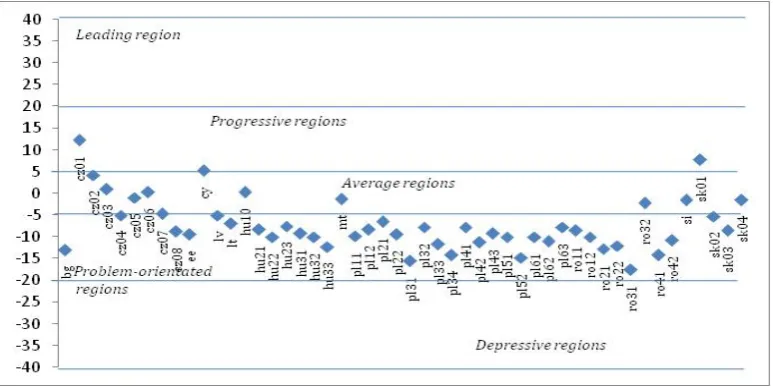
As it was discussed before, after the experts’ questioning, the normalization of factors of social and economic development regions was performed. Then average values of yearly indexes, which characterize the evaluated evolution of regional development level, were calculated. After the evaluation of the level of development of NUTS 2 statistical regions of the European Union, situated in the territory of twelve new EU member states, it was figured out, that only 7 out of 50 analysed regions’ development was evaluated positively. The best evaluation was for Bratislava region in Slovakia (on an average 7.8 points during the year), territories of Prague (12.3 points) and Central Bohemia (4.3 points) as well as Cyprus (5.3 points). During the process of evaluation it was discovered that the feeblest development belongs to development regions of South Muntenia (-17.5 points) and South-western Oltenia (-14.3 points) in Romania, Lublin (-15.5 points), provinces of Podlasie 13.8 points) and Opole (-14.8 points) in Poland, and Bulgaria (-13.0 points).
In the process of the evaluation of yearly results of development it can be stated, that the regions are developing rather equally, but the most problematic situation remains in the territory of Moravia-Silesia region in Czech Republic. The same situation is in most regions of Hungary, Romania and Polish counties, where indicators of social and economic development are getting worse every year. The majority of regions, being analysed (36 regions), are classified as problem-orientated regions (see Figure 1).
Figure 1. Groups of NUTS 2 statistical regions of new member states of the European Union according to development level
3 out of 50 regions are classified as progressive group of regions, like: territory of Prague in Czech Republic, Cyprus and region of Bratislava in Slovakia. 11 out of all analysed regions are ascribed to intermediate regions in the context of the EU: Central Bohemia, territories of South-western, North-eastern, South-eastern and Central Moravia
in Czech Republic, Latvia, Region of Central Hungary and Malta, Bucharest-Ilfov region in Romania and Slovenia. Lithuania (-7.0 points) and Estonia (-9.5 points) are classified as problem-orientated regions in the content of the EU. These countries are not distinguished for the evolution of development level in clear tendency, contrary
-ISSN 1392 – 2785 Inzinerine Ekonomika‐Engineering Economics, 2010 21(1), 68‐79
to the neighbours of Lithuania (Latvia and Estonia). The evaluation of the development level of Lithuania remained stable within the period of time being analyzed, on an average -7 points during the year (Estonia – (-9.5 points), Latvia – (-5 points). It is essential to note, that the yearly evaluation of development level of the neighbours of Lithuania is growing up every year.
The highest differences of development, the regions of which get into two or more groups of regional development (see Figure 1), are peculiar to Romania (average and problem-orientated), Czech Republic (progressive, average and orientated), Hungary (average and orientated) and Slovakia (progressive and problem-orientated).
Tendencies of social and economical development of Lithuania in the content of the European Union
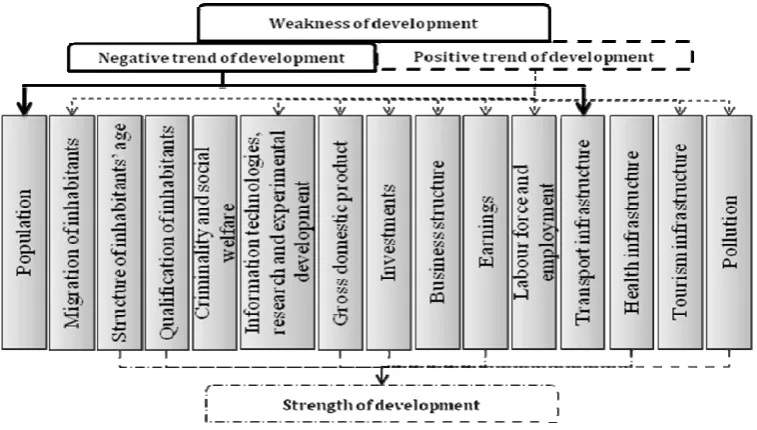
The tendencies of the economy development of one of NUTS 2 problem-orientated statistical regions, i.e. Lithuania, and its social and economic development in the context of the EU will be analyzed and evaluated further on in the article (see figure 2).
Lithuania exceeds the EU average, comparing volume’s growth of favourable structure of inhabitants’ age, proportion of educated inhabitants, gross domestic product, investment, average monthly revenue, and a number of beds in hospitals. This article is mostly focused on the weak places of development of Lithuania in the content of the EU, its dynamics and forecasting the change tendencies, by interpreting the functions of linear regression of indicators’ development and values of coefficient of determination.
Further on the tendencies of economy development of one of NUTS 2 problem-orientated statistical regions, i.e. Lithuania, and its social and economic development in the context of the EU will be analyzed and evaluated (see figure 2).
Figure 2. Evaluation of Lithuania‘s, as one of the EU NUTS 2 statistical region, development
Lithuania exceeds the EU average, comparing the volume growth of favourable structure of inhabitants’ age, proportion of educated inhabitants, gross domestic product, investment, average monthly revenue, and number of beds in hospitals. In this article it is mostly focused on the weak places of the development of Lithuania in the content of the EU, its dynamics and forecasting the change tendencies, by interpreting the functions of linear regression of indicators’ development and values of coefficient of determination.
At the end of 2006 the population in Lithuania was 127.2 thousand, or 3.6 percent less than the population at the end of 1999. Within the year 1999-2006 due to negative natural change the population has deceased by 88.2 thousand, due to negative net migration – 59.6 thousand. The analysis of these factors dynamics has revealed an obvious tendency of decreasing population, that is there is the average 17.5 thousand decrease of population in Lithuania every year. The principal
tendentious reason of population decrease – negative natural change of inhabitants (every year the averages number of the dead is 1250 bigger than the number of the born), which is determined mostly by increased death-rate and hardly controlled processes of migration.
Akvile Kilijoniene, Zaneta Simanaviciene, Arturas Simanavicius. The Evaluation of Social and Economic Development of the Region
set in Lisbon, without the additional intervention of regional policy (3 percent of GDP till 2010).
GDP level per capita is considered as one of the main factors, according to which the support of Structural Funds is allocated to the EU for the meantime. Every year GDP produced in Lithuania increases in 1629 million EUR on an average (part of GDP per capita increases in 492.5 EUR), however, increase of GDP level becomes slower 0.2 percent every year. Therefore, considering pace of growing and the fact that volume of Lithuania’s GDP is 50 percent lower than the average in the EU states, it is essential to fix the appropriate priorities of the promotion of the country’s development, seeking sequential and continuous economic development.
Within the period of time being analyzed volumes of investment were growing every year (yearly volume of material investment had increased in 496.9 million EUR on a n average, and the volume per capita – 127.9 EUR). Yearly increase of investment volume was sequential – about 2.4 percent per year. Evaluating the whole period of time being analyzed, intensity of development was growing every year, though the fact that Lithuania stays behind the average of the EU is obvious. The tendency partly shows business structures’ confidence on economy of Lithuania, but pace of development is rather lower, comparing with the regions in the context of the EU. This shows that Lithuania hasn’t established favourable conditions for investment jet and does not optimally exhaust the available potential of business companies while developing Lithuanian economy.
Positive tendency is typical for the development of all economic sectors in Lithuania. Though conditionally, the highest value-added is created in the sectors of service and industry, the highest development is characteristic to service sector, where value-added higher in 917.8 million EUR is produced. This tendency agrees with the practice of the development of advanced countries, when within the time the economy is developing, the third sector is more developed. However, service sector in Lithuania produces scarcely more than 62 percent of value-added, created within the economy sectors of the whole country, while the number in the EU countries is more than 70 percent on average. Since conditionally higher growth is common to service sector than any other sector, it is presumptive, that this difference in development should decrease in the future.
Decrease of unemployment (yearly 1.3 percent on average), increase of employment (yearly 0.5 percent on average) may seem as optimistic tendency of development of regional economy on the surface, but in consequence to the EU development, when there is a possibility to work within the EU countries legally, Lithuania has faced a serious problem of emigration. That is why dynamics of employment and unemployment level should not be evaluated unambiguously. On one hand, more and more inhabitants of Lithuania have possibility to work and earn, on the another hand, negative net migration shows a risk of leak of skilled labour force, which has a negative effect on economic development of the region. Despite employment was growing within the period of time being analyzed, Lithuania stays greatly behind the Lisbon employment aim
of 70%, which is supposed to achieve until the year of 2010.
An employment structure of inhabitants of Lithuania differs considerably from the average of the EU states: larger concentration of labour force is in the sectors of agriculture and industry. However, development of service sector has an influence on increasing number of employees within this sector. The analysis of structure dynamics of the employed has revealed that number of employees within a period of time being analysed has been increasing in service and slightly only in construction sectors. Clear future tendencies can be apparent considering the change in sectors of economic activity of the employed: increase of concentration of labour force in service sector for account of employees of agriculture sector. If this tendency remains in the future, Lithuania will approach the average situation of employment of the EU states according to the sectors of economic activity.
After the evaluation of transport infrastructure, it can be stated that Lithuania, as transient country, pays insufficient attention to the development of transport infrastructure and its development is negatively evaluated. However, taking into consideration the fact that the main finances of support (of Structural Funds and Cohesion Fund) are mostly used for reconstruction of local or regional roads and railway lines, this tendency should remain in the nearest future as well.
The evolution of tourism services and infrastructure is developed quite equally, more and more places in accommodation institutions are counted for 10000 inhabitants every year. In spite of this, the process of development is running rather slowly.
Conclusions
1. Regions of different level, type and class are noted in the states’ regional structure and various researches. Principles and criteria of regional selection also differ a lot. Only in these latter years there is an attempt to use preliminarily coordinated methodologies, especially in the EU and associated countries. After the evaluation of scientific literature, it can be assumed that a lot of different attitudes to a region exist. Anyway, in the context of the evaluation of regional differences’ evolution, it is reasonable to define a region as a territorial unit, which according to the chosen measure differs from the other units. 2. After the generalization of the variety of indicators of
the development level in the scientific literature and experience of foreign countries, three main groups of indicators are distinguished in the work. They characterize social and economic situation of a region in the strictest precision – these are the indicators defining the evolution of social and economic, public infrastructure and environmental development. 3. The analysis of the present situation in 50 NUTS 2
statistical regions of the European Union, situated in new member states, it was determined, that strong and obvious differences of development are typical for the EU, moreover, when new member states joined the EU, differences of national and regional level became even more sharper. In the structural
-ISSN 1392 – 2785 Inzinerine Ekonomika‐Engineering Economics, 2010 21(1), 68‐79
viewpoint, differences of particular regions show up, as people, living in different regions of Europe, have different income, and living standards in particular states also differ: there are unequal possibilities to find well paid job, etc… It is relevant for weaker regions of the expanded EU to intend regional policy means, the implementation of which is promoted by the support of Structural Funds.
4. In the context of the European Union Lithuania is referred to as a problem-orientated region and stays behind comparing factors, defining majority of development indicators. Recommended priority weaknesses of Lithuania development must be encouraged by the means of regional policy, i. e. population change, development of research and technologies, production sector, transport and tourism infrastructure.
References
Agnew, J. (2000). From the political economy of regions to regional political economy. Progress in Human Geography. 24(1), 101-110.
Andriusaitiene, D. (2007). Depresinių šalies regionų darbo rinkos plėtra. Daktaro disertacija. Vilnius: VGTU leidykla TECHNIKA Nr.: 1427. 184
Bagdzeviciene, R. & Matekoniene, J. (2000). Regioninės politikos formavimas Lietuvoje. Regionų plėtros problemos. Respublikinės konferencijos pranešimų medžiaga, Kaunas: Technologija, 19-22.
Banyte, J., & Salickaite, R. (2008). Successful diffusion and adoption of innovation as a means to increase competitiveness of enterprises. Inzinerine Ekonomika-Engineering Economics(1), 48-56.
Borts, G. & Stein, J. (1964). Economic growth in a free market. New York: Columbia University Press. Boudeville, J. R. (1966). Problems of regional economic planning. Edinburgh: Edinburgh University.
Brauers, W. K. M., & Ginevicius, R. (2009). Robustness in Regional Development Studies. The Case of Lithuania. Journal of Business Economics and Management, 10(2), 121-140.
Brock, G., & Urbonavicius, S. (2008). Regional FDI growth in Lithuania, 1996-2003. Transformations in Business & Economics, 7(1), 80-88.
Burbulyte, G. (2005). Regioniniai tyrimai visuomeninėje geografijoje: metodologinių požiūrių kaita. Geografija 41(2), Lietuvos mokslų akademija, Lietuvos mokslų akademijos leidykla, 51-58.
Burneika, D. & Bagociute, A. (2002). Regioninės politikos raida Baltijos šalyse 1990-2000 metais: lyginamieji aspektai. Iš
Geografijos metraštis [interaktyvus]. 35 t. [žiūrėta 2007 m. rugsėjo 2 d.], 211-221. Prieiga per internetą: <www.geo.lt/metrastis/ 35/PDF/211-221.pdf>ISSN 0132–3156.
Christaller, W. (1933). Die zentralen Orte in Süddeutschland, Jena: Gustaf Fisher. Translated by Carlisle W. BASKIN (1966), as Central Places in Southern Germany. Englewood Cliffs, New York: Prentice-Hall, p. 230.
Ciegis, R., Jurgaityte, R., Rakickas, A., & Kareivaite, R. (2008). The analysis of socio-economic progress and future perspectives in the new EU members. Transformations in Business & Economics, 7(2), 34-54.
Ciegis, R., Ramanauskiene, J., & Startiene, G. (2009). Theoretical Reasoning of the Use of Indicators and Indices for Sustainable Development Assessment. Inzinerine Ekonomika-Engineering Economics(3), 33-40.
Damasiene, V. & Butkus, M. (2003). Regiono įmonių veiklos vertinimo metodologiniai aspektai. Ekonomika ir vadyba – 2003. Tarptautinės mokslinės konferencijos pranešimų medžiaga 2 knyga Ekonomikos teorijos aktualijos ir praktikos realijos, Kaunas: Technologija, 40-42.
Damaskopoulos, T.; Gatautis, R. & Vitkauskaite, E. (2008). Extended and dynamic clustering of SMEs. Inzinerine Ekonomika-Engineering Economics(1), 11-21.
Dawkins, C. J. (2003). Regional Development Theory: Conceptual Foundations, Classic Works and Recent Developments.
Journal of Planning Literature, 18(2), 131-172. Sage Publications.
Devletoglou, N. E. (1965) Adissenting view of duopoly and spatial competition. Economica 32(126), 140-160.
Diskiene, D., Galiniene, B., & Marcinskas, A. (2008). A strategic management model for economic development.
Technological and Economic Development of Economy, 14(3), 375-387.
Dixon, R. J. & Thirlwall, A. P. (1975) A model of regional growth rate differences on Kaldorian lines. Oxford Economic Papers 27(2), p. 201–214.
Domar, E. (1946). Capital expansion, rate of growth, and employment. Econometrica 14(2), 137-147.
Dumcius, R. & Siupsinskas, S. (2003a). Lietuvos savivaldos institucijų pasiruošimo dalyvauti Europos Sąjungos regioninėje politikoje tyrimas. Šalies ataskaita. [interaktyvus]. Finansavo Atviros visuomenės institutas (Vengrija). Vilnius: Viešosios politikos ir vadybos institutas [žiūrėta 2008 m. vasario 2 d.]. Prieiga per internetą: <http:// www.lsa.lt/rysiai/tnaujienos/_Toc49270643>.
Dumcius, R. & Siupsinskas, S. (2003b). ES poveikis Lietuvos savivaldybėms regioninės plėtros srityje. Nacionalinė
Akvile Kilijoniene, Zaneta Simanaviciene, Arturas Simanavicius. The Evaluation of Social and Economic Development of the Region
<http://www.elibrary.lt/resursai/DB/Regionai/Tyrimai/1LSA_nacionaline_studija_ES%20poveikis_Lietuvos%20savi valdybems_2003.pdf>.
Eaton, B. C. & Lipsey R. G. (1978). Freedom of entry and the existence of pure profit. Economic Journal 88(351), 455-469. Eurostat (2007). General and regional statistics [interaktyvi duomenų bazė]. Liuksemburgas: Europos Bendrijos [žiūrėta
2007 m. lapkričio 29 d.]. Prieiga per internetą: <http://epp.eurostat.ec.europa.eu/ portal/page?_pageid=0,1136162,0_ 45572076&_dad=portal&_schema=PORTAL>.
Friedmann, J. (1966). Regional development policy: A case study of Venezuela. Cambridge, MA: MIT Press.
Ginevicius, R., & Podvezko, V. (2009). Evaluating the Changes in Economic and Social Development of Lithuanian Counties by Multiple Criteria Methods. Technological and Economic Development of Economy, 15(3), 418-436. Greenhut, M. L. (1956). Plant location in theory and in practice. Chapel Hill: University of North Carolina Press. Haukkala, H. (ed.) (1999). Dynamic aspects of the northen dimension. Working papers Nr. 4. Turku: Jean Monet Unit. Heckscher, E. F. (1991). The effect of foreign trade on the distribution of income. In Bertil Ohlin and Eli Heckscher
Heckscher – Ohlin Trade Theory, Harry Flam and M. June Flanders, eds., Cambridge, MA: MIT Press, 1991, 39-69. Hirschman, A. O. (1958). The strategy for economic development. New Haven, CT: Yale University Press.
Hoover, E. M. (1937). Location theory and the shoe and leather industry. Cambridge, MA: Harvard University Press. Hotelling, H. (1929). Stability in competition. Economic Journal 39(153) 41-57.
Isard, W. (1956). Location and space-economy. Cambridge, MA: MIT Press.
Isard, W. (1960). Methods of regional analysis: An introduction to regional science. Cambridge, MA: MIT Press. Kaldor, N. (1970). The case for regional policies. Scottish Journal of Political Economy 17(3), 337-348.
Kazlauskaite, R., & Buciuniene, I. (2008). The Role of Human Resources and Their Management in the Establishment of Sustainable Competitive Advantage. Inzinerine Ekonomika-Engineering Economics(5), 78-84.
Kilijoniene, A. & Simanaviciene, Z. (2008). Regioninės politikos įtaka regionų išsivystymo trūkumų raidai. Ekonomika ir vadyba: aktualijos ir perspektyvos: mokslo darbai. Šiaulių universitetas. Šiauliai. - 3(12), 141-152.
Kilijoniene, A. & Simanaviciene, Z. (2009). Evaluation model of regional policy's influence on social and economical development of the region. Economics and management = Ekonomika ir vadyba [elektroninis išteklius] Kaunas university of technology. Kaunas: Technologija.14, 825-831
Lakstutiene, A. (2008). Correlation of the indicators of the financial system and gross domestic product in European Union countries. Inzinerine Ekonomika-Engineering Economics (3), 7-18.
Lösch, A. (1954). The Economics of Location. Translated from the second revised edition by William H. WOGLOM with the assistance of Wolfgang 12 STOLPER. New Haven. Yale University Press. 520 p.
Macys, G. & Stunguriene, S. (2005) Ekonominės ir socialinės plėtros Lietuvos regionuose makroekonometrinis modelis bei jo taikymo problemos. [interaktyvus] Šiauliai: 5-oji E. Galvanausko tarptautinės mokslinės konferencijos „Ekonomika ir vadyba: aktualijos ir perspektyvos“ pranešimų medžiaga [žiūrėta 2007 m. lapkričio 29 d.]. Prieiga per internetą: <www.smf.su.lt/documents/konferencijos/ Galvanauskas%202005/2005%20m.%20leidinys/Macys_ Stunguriene.pdf>. Maniokas, K. (2002). Vidurio ir Rytų Europos valstybių įsijungimas į Europos Sąjungą: ES plėtra ir europeizacija.
Nepublikuota mokslų daktaro disertacija VU Tarptautinių santykių ir politikos mokslų institutas.
Melnikas, B. (2008a). Integral spaces in the European Union: Possible trends of the social, economic and technological integration in the Baltic region. Journal of Business Economics and Management, 9(1), 65-77.
Melnikas, B. (2008b). Integration Processes in the Baltic Region: the New Form of Regional Transformations in the European Union. Inzinerine Ekonomika-Engineering Economics(5), 54-64.
Myrdal, G. (1957). Economic theory and underdeveloped regions. London: Duckworth.
Nakrosis, V. (2004). Lietuvos prisitaikymas prie Europos Sąjungos sanglaudos politikos: institutcinė ir viešosios politikos kaita. Nepublikuota mokslų daktaro disertacija VU Tarptautinių santykių ir politikos mokslų institutas.
North, D. C. (1955). Location theory and regional economic growth. Journal of Political Economy 63(3), 165-168. North, D. C. (1956). Exports and regional economic growth: A reply. Journal of Political Economy 64(2), 243-258. Ohlin, B. (1933). Interregional and international trade. Cambridge, MA: Harvard University Press.
Paasi, A. (2002). Place and region: regional worlds and words. Progress in Human Geography. 26(6), 802-811. Perroux, F. (1950). Economic space: Theory and applications. Quarterly Journal of Economics 64(1), 89-104.
Pinelli, D; Giacometti, R; Lewney, R. & Fingleton, B. (1998) European Regional Competitiveness Indicators. Discussion Papers, 103, Department of Land economy, University of Cambridge.
Pompili, T. (1994), Structure and Performance of Less Developed Regions In the EC, Regional Studies, 28(7), 679-694. Pukeliene, V. & Maksvytiene, I. (2008). Economy Scale Impact on the Enterprise Competitive Advantages. Inzinerine
Ekonomika-Engineering Economics(2), 49-54.
-ISSN 1392 – 2785 Inzinerine Ekonomika‐Engineering Economics, 2010 21(1), 68‐79
Ricardo, D. (1817). On the principles of political economy and taxation. London: John Murray.
Rutkauskas, A. V. (2008). On the sustainability of regional competitiveness development considering risk. Technological and Economic Development of Economy, 14(1), 89-99.
Samuelson, P. A. (1948). International trade and the equalization of factor prices. Economic Journal 58(230), 163-84 Samuelson, P. A. (1949). International factor-price equalization once again. Economic Journal 59(234), 181-97.
Samuelson, P. A. (1953). Prices of factors and goods in general equilibrium. Review of Economic Studies 21(1) (October) 1-20.
Siupsinskas, S. (2004) Savivaldybės Lietuvos regioninės politikos kontekste [interaktyvus]. Kaunas: KTU Savivaldos mokymo centras, [žiūrėta 2004 m. balandžio 4 d.]. Prieiga per internet: http://smc.logincee.org/library_full.asp? LD_ID =6007&TargetLangCode=LT
Snieska, V., & Bruneckiene, J. (2009). Measurement of Lithuanian Regions by Regional Competitiveness Index.
Inzinerine Ekonomika-Engineering Economics(1), 45-57.
Solow, R. M. (1956). A contribution to the theory of economic growth. Quarterly Journal of Economics 70(1), 65-94. Streimikiene, D. (1999). Regioninės plėtros problemos Lietuvoje. Ekonomika ir vadyba 1999 m.: konferencijos pranešimų
medžiaga. Nr. 1. Kaunas: Technologija, 79-86.
Streimikiene, D. (2001). Regionų plėtros teorijos ir politika. Regionų plėtra – 2001: tarptautinės mokslinės konferencijos pranešimų medžiaga. Kaunas, Technologija.
Streimikiene, D. (2002). ES regioninės politikos įgyvendinimas Lietuvoje. Regionų plėtra – 2002: tarptautinės mokslinės konferencijos pranešimų medžiaga. Kaunas, Technologija.
Swan, T. W. (1956). Economic growth and capital accumulation. Economic Record 32(44), 334-361.
Tiebout, Ch. M. (1956a). Exports and regional economic growth. Journal of Political Economy 64(2), 160-164. Tiebout, Ch. M. (1956b). Exports and regional economic growth: Rejoinder. Journal of Political Economy 64(2), 169. Vaitiekunas, S. (2001). Lietuvos regionų problema Europos Sąjungos kontekste. Regionų plėtra – 2001: tarptautinės
mokslinės konferencijos pranešimų medžiaga. Kaunas: Technologija.
Vidickiene, D. & Melnikiene, R. (2008). Paramos teikimo Lietuvos kaimo regionams kriterijų vertinimas. Vadybos mokslas ir studijos – kaimo verslų ir jų infrastruktūros plėtrai = Management theory and studies for rural business and infrastructure development. Lietuvos žemės ūkio universitetas. Ekonomikos ir vadybos fakultetas. Akademija, 12(1), 168-174,
Vilpisauskas, R. (2000). Regioninė integracija: Baltijos šalių bendradrabiavimas integracijos į Europos Sąjungą
kontekste. Nepublikuota mokslų daktaro disertacija VU Tarptautinių santykių ir politikos mokslų institutas. Weber, A. (1929). Theory of the location of industries. Chicago: University of Chicago Press.
Williamson, J. G. (1965). Regional inequality and the process of national development: Adescription of the patterns.
Economic Development and Cultural Change 13(4), 158-200.
Гладкий, Ю. Н. & Чистобаев, А. И. (2002). Регионовидение: учебник. МаскваГардарики.
Akvilė Kilijonienė, Žaneta Simanavičienė, Artūras Simanavičius
Regiono socialinės ir ekonominės plėtros vertinimas
Santrauka
Lietuva dalyvauja įgyvendinant Europos Sąjungos (toliau - ES) regioninę politiką, kurios pagrindas - struktūrinių fondų finansinė parama. Šaliai tapus visateise ES nare, šios asociacijos regioninės politikos padariniųįvertinimas valstybei labai aktualus. Savo išsivystymo lygiu nuo ES vidurkio labai atsiliekančiai Lietuvai ES regioninė politika dažnai nurodoma kaip vienas iš akivaizdžiausių narystės ES pranašumų. Tačiau kadangi ES regioninės politikos įgyvendinimas daugiausia yra valstybių narių atsakomybė, šios politikos tikslųįgyvendinimo mastas labai priklauso nuo Lietuvos viešosios administracijos pasirengimo pasinaudoti ES struktūrinių fondų teikiama finansine parama.
Nors ES regioninių skirtumų problemos, regioninė politika, jos įtaka ES valstybių narių nacionalinėms viešosioms politikoms, ekonominės ir socialinės sanglaudos ES skatinimo efektyvumu, pastaruoju metu vis labiau domina tyrinėtojus, regionų augimo ir nuosmukio vertinimas ir tarpregioniniai palyginimai konkrečiai valstybei turėtų būti pritaikomi individualiai, parengiant integruotą metodiką, apimančią regionų išsivystymo lygio analizės rodiklių sistemą, skirtą diferencijuoti regionus pagal socialinį ir ekonominį išsivystymo lygį, nustatyti regionų teigiamus ir neigiamus aspektus. Nuo 2004 m. Lietuvai tapus visateise nare, iškilo poreikis parengti ir empiriniais tyrimais pagrįsti tokį regionų socialinės ir ekonominės plėtros vertinimo modelį, kuris užtikrintų rezultatų objektyvumą ir pritaikomumą, sprendžiant Lietuvos regionų plėtros problemas.
Tyrimo tikslas – pristatyti regionų socialinės ir ekonominės plėtros vertinimo modelį, jį pritaikyti praktikoje vertinant ES NUTS 2 lygio regionus, esančius naujosiose šalyse narėse, ir numatyti Lietuvos socialinės ekonominės plėtros perspektyvas.
Rengiant straipsnį taikyti tyrimo duomenų analizės metodai: sisteminė ir palyginamoji mokslinės literatūros ir dokumentų analizė, sintezė, loginio abstrahavimo, ekspertų apklausos (interviu) rezultatų vertinimo, duomenų normalizavimo, kai įvedami nustatyti koeficientai (sudedamosios dimensijos), duomenims viršijantiems ar neviršijantiems ES (arba regionų grupės, kai nėra atitinkamo rodiklio ES kontekstu) vidurkį, metodai ir regresinė analizė, prognozavimas, modeliavimas bei išvadų generavimas.
Akvile Kilijoniene, Zaneta Simanaviciene, Arturas Simanavicius. The Evaluation of Social and Economic Development of the Region
Weber (1929), Hoover (1937), Greenhut (1956), Isard (1956, 1960), Hotelling (1929), Devletoglou (1965), Eaton ir Lipsey (1978) Christaller (1933), Losch (1954) ir kt., daugiausia buvo įvardijami kaip kritika ir atsakas į konvergencijos hipotezę ir neoklasikinę ekonomiką.
Mokslinėje literatūroje pateikiamos dvi pagrindinės požiūrio į regioninių skirtumų raidą ir regioninės politikos būtinybę mokslininkų ir jų darbų
kryptys: regionų ekonomikos konvergencijų teorijų atstovai Tiebout (1956a; 1956b) ir North (1955; 1956), Borts ir Stein (1964), Williamson (1965) teigė, kad ekonominė politika yra nereikalinga, nes laisva rinka pati išlygina išsivystymo skirtumus; regionų ekonomikos divergencijos teorijų atstovai Myrdal (1957), Kaldor (1970), Dixon ir Thirlwall (1975), Perroux (1950), Hirschman (1958), Boudeville (1966), Friedmann (1966) teigė, kad regioninių
skirtumų daugėja. Taip jie argumentavo regioninės politikos poreikį. Kitų regionų plėtros teorijų atstovų darbuose (Dawkins, 2003) akcentuojamos pagrindinės regionų plėtros skatinimo kryptys: investicijos į našesnių ekonomikos sektorių, pramonės sektoriaus ir naujų teritorinių gamybos metodų
plėtrą, efektyvesnis žemės panaudojimas skurdesniuose regionuose ir investicijos į vidinių veiksnių (technologija, inovacijos, geografinė padėtis ir pan.) plėtrą.
Regiono, kaip socialinės ir ekonominės sistemos, subalansuotos regionų plėtros ir jos įtakos šalies ekonomikai ir regioninės politikos problematiką
Lietuvos mokslininkai pradėjo nagrinėti palyginti neseniai - atgavus Nepriklausomybę. Regionų plėtros problemas ir aspektus analizavo šie Lietuvos mokslininkai: Dumčius ir Šiupšinskas (2003a; 2003b), Šiupšinskas (2004), Štreimikienė (1999, 2001, 2002), Vaitiekūnas (2001), Burneika ir Bagočiutė
(2002), Andriušaitienė (2007), Vidickienė ir Melnikienė (2008), Vilpišauskas (2000), Maniokas (2002), Nakrošis (2004), Pukelienė ir Maksvytienė
(2008), Snieška ir Bruneckienė (2009), Melnikas (2008), Damaskopoulos, Gatautis ir Vitkauskaitė (2008) ir kt. ES išsivystymo netolygumai ir didėjantis atotrūkis tarp regionų yra gerai suvokiama problema, tačiau regionų plėtros įvertinimo ir išsivystymo skirtumų sprendimo būdai toli gražu nėra akivaizdūs. Ypač problematiška įvertinti ekonominę ir socialinę plėtrą regionų viduje – Lietuvos atveju – tarp savivaldybių, kur išsivystymo netolygumai gali būti ypač dideli, o ekonominiai modeliai, tinkami tik dideliems regionams, sunkiai pritaikomi. Taigi mokslinėje literatūroje nėra susiformavusi vieninga nuomonė dėl socialinės ir ekonominės plėtros rodiklių parinkimo tarpregioniniams palyginimams atlikti, taip pat atkreipta nepakankamai dėmesio regionų ir šalies išsivystymo lygio raidos įvertinimo problematikai tirti.
Straipsnis pradedamas nuo teorinės regiono koncepcijos. Analizė parodė, kad valstybių regioninėje sandaroje ir įvairiuose tyrimuose nurodomi labai
įvairių lygių, tipų ir rūšių regionai. Regionų išskyrimo principai ir kriterijai taip pat būna labai skirtingi. Tik pastaraisiais metais stengiamasi taikyti kiek galima suderintas metodikas, ypač ES ir asocijuotose šalyse. Įvertinus mokslinę literatūrą, galima teigti, kad egzistuoja daug požiūriųį regioną, jo teorinę
sampratą. Tačiau, vertinant regioninių skirtumų raidą, tikslinga regioną apibrėžti kaip teritorinį vienetą, kuris pagal pasirinktą vertinimo kriterijų skiriasi nuo kitų vienetų.
Apibendrinus išsivystymo lygio rodikliųįvairovę mokslinėje literatūroje ir užsienio šalių patirtį, išskirtos trys pagrindinės rodiklių grupės, kurios tiksliausiai apibūdina regiono socialinę ir ekonominę situaciją – tai socialinės ir ekonominės plėtros bei viešąją infrastruktūrą ir aplinkos kokybę įvertinantys rodikliai.
Įvertinus regionų socialinę ir ekonominę plėtrą, 50 ES NUTS 2 lygio regionams, esantiems naujosiose šalyse narėse, būdingi akivaizdūs išsivystymo skirtumai, o prisijungus naujoms valstybėms narėms, dar didesni nacionalinio ir regioninio lygmens skirtumai. Struktūriniu požiūriu atskirų regionų
skirtumai reiškiasi tuo, kad skirtinguose Europos regionuose gyvenantys asmenys turi labai skirtingas pajamas, skirtingas šalių pragyvenimo lygis, nevienodos galimybės susirasti gerai apmokamą darbą ir t. t. Padidėjusioje ES silpniems regionams svarbu numatyti regioninės politikos priemones, kuriųįgyvendinimą skatina struktūrinių fondų parama.
Lietuva ES kontekste yra problemiškas regionas ir atsilieka nuo ES vidurkio, (lyginami metodikoje numatyti socialinės ir ekonominės veiklos rezultatai). Situaciją švelnina tai, kad Lietuvoje palankesnė gyventojų amžiaus struktūra, išsilavinusių gyventojų dalis, bendrojo vidaus produkto, investicijų, vidutinių menesinių pajamų apimties augimo tempai ir lovų ligoninėse skaičiaus dinamika. Tyrimo metu taip pat nustatytos probleminės vystymosi sritys – tai gyventojų skaičiaus mažėjimas, mokslinių tyrimų ir technologijų sektoriaus, gamybinio sektoriaus, transporto ir turizmo infrastruktūros plėtros atsilikimas nuo ES vidurkio. Todėl straipnyje rekomenduojama regioninės politikos priemonėmis skatinti šių empirinio tyrimo metu nustatytų problematiškiausių Lietuvos socialinės ir ekonominės plėtros komponentų raidą.
Raktažodžiai: regionas, regionų plėtra, vertinimo modelis.
The article has been reviewed. Received in July, 2009; accepted in February, 2010.