DEMOGRAPHIC RESEARCH
VOLUME 34, ARTICLE 32, PAGES 899
−
926
PUBLISHED 1 JUNE 2016
http://www.demographic-research.org/Volumes/Vol34/32/ DOI: 10.4054/DemRes.2016.34.32
Research Article
Investigating the migrant mortality advantage at
the intersections of social stratification in
Switzerland: The role of vulnerability
Jonathan Zufferey
©2016 Jonathan Zufferey.
This open-access work is published under the terms of the Creative Commons Attribution NonCommercial License 2.0 Germany, which permits use, reproduction & distribution in any medium for non-commercial purposes, provided the original author(s) and source are given credit.
1 Introduction 900
2 Data and methods 902
2.1 Data 902
2.2 Classification trees and modelling strategy 904
3 Results 908
3.1 The explanatory analysis 908
3.2 The confirmatory analysis 912
4 Discussion 917
5 Acknowledgments 920
Investigating the migrant mortality advantage at the intersections of
social stratification in Switzerland:
The role of vulnerability
Jonathan Zufferey1
Abstract
BACKGROUND
Migrant mortality advantage has been widely studied in Western countries, but little attention has been paid to how social factors interact to increase or diminish risks of death. Socioeconomic factors are indeed widely used in regression models but mostly to define, ceteris paribus, whether migrants have a higher propensity to die than natives. OBJECTIVE
Using an inductive approach, the aim of this paper is to reassess the role of social factors. Focusing on migrant communities, the paper establishes at which intersection of the components of social stratification the migrant mortality advantage is mainly located.
METHODS
This study is based on census data linked with population registers (2001–2008) and focuses on individuals aged 25–64 years living in Switzerland. It uses model-based regression trees to first map the structure of mortality risks within the social stratification. In a second step, a confirmatory analysis supports the main outcomes. RESULTS
Inductive methods give substantial results, firstly in revealing interactions within the social structure. Secondly, the findings suggest that the mortality advantage is not located only among immigrants but encompasses a wide population with a foreign background. Thirdly, it demonstrates that the migrant mortality advantage is stronger in the most vulnerable profiles. The non-inclusion in previous research of the flatter mortality gradient among individuals with a foreign background tends to underestimate the strength of the differentials.
CONCLUSION
Selection and acculturation explanations are not sufficient to understand the migrant mortality advantage. Psychosocial factors related to the migration background may provide an alternative explanation.
1. Introduction
The migrant mortality advantage, also known as the migrant mortality paradox, has been widely studied in Western countries since it was observed for the first time about 30 years ago (Markides and Coreil 1986). The paradox is that mortality is lower among migrants than among natives, despite the lower socioeconomic status of the former compared to the latter. First studied in depth in the United States among the Hispanic populations (Markides and Eschbach 2005), the paradox has been revealed to be much more general, affecting almost all communities of immigrants in the country (Singh and Siahpush 2002). In Europe, researchers have found the same mortality advantage among diverse migrant populations (see, for example, Darmon and Khlat (2001) for France, Kohls (2010) for Germany, and Deboosere and Gadeyne (2005) for Belgium).
The greater longevity of migrants is challenging for scholars to decrypt. Many papers focus on establishing whether the observed mortality advantage is real; in other words, whether it can be explained by some direct or indirect factors, or can be accounted for by biases in data or measurement. There are in fact some important biases in selective migration, affecting both in-migration (the healthy migrant effect) and out-migration (Salmon bias) but they do not appear to be sufficient to explain the whole mortality advantage (Abraido-Lanza et al. 1999; Deboosere and Gadeyne 2005; Palloni and Arias 2004). A cultural interpretation arguing that migrants have better dietary habits, higher social support, and more favourable health behaviours is often added as a complementary explanation (Abraido-Lanza et al. 1999; Abraido-Lanza, Chao, and Flórez 2005; Markides and Coreil 1986).
various characteristics results in vulnerability that is deeper than the simple sum of the deficits produced by each social position would suggest. Although migrants experience an advantage in terms of mortality outcomes, translating this approach to health studies remains relevant and promises to provide new explanations of how social factors interact. There is a need to consider the constitutive dimensions of a social position simultaneously – or at least to test whether or not they are independent.
In most previous research, social factors are treated as having the same effect for every individual: they are not evaluated in terms of their social meaning but as controls. This may be the reason why Singh and Siahpush (2002) noticed that the usual social indicators weakly contribute to inequalities among ethnic groups living in the United States. So far, only a few American studies have been interested in the comparison of the socioeconomic gradient in mortality between the migrant population – namely the Hispanic groups – and natives. All these authors conclude that there is a flatter socioeconomic gradient among migrant communities (Goldman et al. 2006; Riosmena and Dennis 2012; Turra and Goldman 2007), which tends to confirm that socioeconomic position does not have the same meaning for all individuals.
Furthermore, migrants are too often seen as an explicit, clearly defined group sharing common practices and cultural habits, which are assumed to be healthier. This homogenization is inappropriate even for (apparently) well-defined groups such as Hispanics in the United States or Mediterranean groups in Europe, because migrants experience different life events and face different circumstances in both their origin and their destination country (Dubowitz, Bates, and Acevedo-Garcia 2010; Hunt, Schneider, and Comer 2004). Each migrant group has its own culturedepending on the region of origin, the migration trajectory, and the integration process. Culture is therefore not a unimodal or static variable, but has to be approached through several dimensions (Koehn et al. 2013).
For Acevedo-Garcia et al. (2012), the origin of inequalities in health can therefore be located at the intersection of different social fields, at the crossroads of cultural and structural factors. These factors are composed of gender, socioeconomic, demographic, contextual, historical, and political dimensions. This paper sets out to rethink these interrelations within the social structure. An intersectional perspective implies not only certain theoretical concerns but also a specific methodological approach. As mentioned previously, research in social sciences tends to address the inherent complexity of a social outcome through an additive approach to individual elements. Interaction effects, while obviously enabling us to go beyond a simply cumulative analysis, are used to test precise hypotheses. This paper proposes the use of the inductive method of classification trees to disentangle how social factors interact to modulate mortality risks.
foreign citizenship, Switzerland has one of the largest proportions of migrants in the world. Since World War II, most of the migratory flows have been of workers and their families, who responded to the need of the Swiss economy for a low-skilled workforce and who came first of all from Italy and Spain and later mainly from Portugal, Yugoslavia, and Turkey. In the past two decades the flows and also the intentions of migrants have diversified. More recent immigrants have increasingly entered high-skilled occupations, but also continue to meet the demand for labour in the lowest paid jobs. This diversification of origins and polarization of the labour force have made the migrant population much more heterogeneous.
Switzerland is therefore an ideal laboratory in which to highlight how the social determinants of longevity interact to produce better or worse outcomes. This paper does not focus on a unique and defined community but tries to encompass the whole migratory landscape. By classifying migrants according to their region of origin, length of stay, migratory status (first and second generation), and in terms of the integration process (naturalisation), this study attempts to understand the migratory conditions and pathways of a whole and highly diversified population.
2. Data and methods
2.1 Data
The study uses the data developed by the Swiss National Cohort (SNC), a longitudinal research platform based on the linkage of individual mortality data at the national level (Bopp et al. 2009). Probabilistic record linkage methods were used to assign to each death (1990–2008) a record in the population census (1990 and 2000). This enables the whole population living in Switzerland from the census until death (or emigration or survival) to be followed in a longitudinal perspective. Almost 94% of the deaths which occurred between 5th December 1990 (the day after the 1990 census) and the end of
sources. Therefore, of the 914,939 foreigners aged between 25 and 64 who were counted in the 2000 census, only the 799,287 also registered in the central alien register could be retained. This population, and all Swiss nationals (5,786,457 persons) were followed from the 1st of January 20012 to the 31st December 2008. Whereas the exact
exposure time is known for foreigners (controlled by emigration), we have to assume that all Swiss nationals who do not die are still in the country at the end of the studied period. As a whole, the population of interest lived 31,097,222 person-years and experienced 77,676 deaths. Table 1 shows a selection of characteristics for this cohort.
Table 1: Number of deaths and person-years for selected characteristics, SNC 2001‒2008
Age Deaths Person-years % person-years
25–29 1,756 3,279,214 10.5
30‒34 2,401 3,841,331 12.4
35‒39 3,796 4,531,685 14.6
40‒44 5,750 4,602,830 14.8
45‒49 8,436 4,181,374 13.4
50‒54 12,472 3,862,394 12.4
55‒59 18,696 3,669,536 11.8
60‒64 24,369 3,128,858 10.1
Sex
Male 49,677 15,490,773 49.8
Female 27,999 15,606,449 50.2
Education level
Compulsory 18,001 55,46,422 17.8 Upper secondary 43,268 17,409,466 56.0
Tertiary 14,753 7,225,072 23.2
Unknown 1,654 916,262 2.9
Nationality
Swiss citizenship 67'959 25'583'034 82.3 Foreign citizenship 9'717 5'514'188 17.7
Country of birth
Switzerland 61,219 23,321,198 75.0
Abroad 15,352 7,395,775 23.8
Unknown 1,105 380,250 1.2
2 The 2000 census occurred on the 5th of December. For convenience reasons, the follow-up began at the
The analysis only focuses on the population of adult working age. Individuals above 65 years were not taken into account because of the low quality of the data on the socioeconomic status of retired individuals in the 2000 census. Moreover, as Swiss immigration flows started growing after World War II, old immigrants are less numerous and less heterogeneous than the subsequent generations of immigrants.
This initial data frame is a person-years file with more than 30 million lines, which makes even the computation of simple statistics difficult. The data have therefore been aggregated according to each profile (a combination of all categorical variables), summing the number of deaths and person-years in order to arrive at a more reasonable data frame containing around 775,000 lines.
2.2 Classification trees and modelling strategy
The analytical strategy followed a two-step procedure. The first part was an exploratory and inductive approach that aims to uncover the main interacting structures. In the second part, classical regression models were used to support the major outcomes and provide inferential results.
To detect interactions within the social structure, an inductive method was used. Classification trees have the advantage of not postulating forms of relations between variables. Although they are not often used in the social sciences, classification trees are a data-driven process developed to class populations – to achieve more homogenous groups – according to a dependent variable (Ritschard 2013). The trees are grown by successive binary splits of the population according to the most discriminant variable. Working in an iterative way until no significant differences are observed in a node, the method creates a hierarchical structure (the trees) in which each node depends on previous splits.
A hypothetical example of attempting to determine how mortality drivers interact illustrates the procedure. After introducing the population of interest, the algorithm will estimate the most discriminant factor; let us say, sex. In the first node, the population will be split according to sex. Then, for each category, the algorithm assesses again the most discriminant variable and splits the sub-populations according to it; for example, having a job or not for men and getting married or not for women. This process continues for workingmen and for all other nodes as long as any differences are observed. The final result is a tree containing successive binary splits of the population.
inequalities in longevity reveals a conjunction of factors leading to vulnerability or, in the opposite case, having a protective effect against the risk of death. This methodology is distinct from standard regression models because it estimates not mean effects but specific effects. This kind of exploratory methodology is likely to have wide applicability in the social sciences and to enhance understanding of how social structure drives inequality.
Since the early work of Breiman and colleagues (Breiman et al. 1984), classification and regression trees (CART) have developed, and a wide range of methods exists today (Ritschard 2013). As mortality is mainly driven by the ageing process, early CART methods whose split criteria are based on the Chi square association (Kass 1980) or the change of deviance according to a Poisson distribution (Therneau and Atkinson 1997) are inappropriate, because age will systematically be the most important predictor and the resulting tree would have as many initial splits as age classes. The model-based recursive-partitioning framework (Hothorn, Hornik, and Zeileis 2006; Zeileis, Hothorn, and Hornik 2008) offers a good alternative, since it estimates models allowing for control variables – such as age. In consequence, it is not a black box from which an obscure data-mining algorithm extracts information, but is rather a theory-driven tool (Kopf, Augustin, and Strobl 2013). Built on parametric models such as from the exponential family, these trees distinguish modelling from partitioning variables. The procedure recursively applies the four following steps to a dataset (Zeileis, Hothorn, and Hornik 2008): 1) fit of a parametric model in regard to the set of modelling variables; 2) test of the parameter instability (Zeileis and Hornik 2007) using the partitioning variables; 3) if there is an instability, computation of the best partition – for categorical variables it tests all possible partitions for a binary split – and split of the data; 4) repetition of the procedure for each daughter node.
In this paper, mortality is approached using a Poisson rate model (Powers and Xie 1999) in which the counts of deaths for each profile follow a Poisson distribution weighted by the person-years. The modelled rate is the expectation of counts ( )
divided by the exposure ( ). The exposure is fixed to a coefficient of one and is known as an offset. Taking the logs, it gives the following loglinear regression model, with the k estimated parameters, and the independent variables:
ln( ) = + ln ( )
is applied both to the model-based recursive partitioning and the confirmatory analysis which tests afterward whether the interactions effects raised in the tree can be observed in the whole population. All statistical analyses were run in R (R Core Team 2015) and the tree grown with the Party package (Zeileis, Hothorn, and Hornik 2010).
The model-based trees consider two types of variable: partitioning and modelling. Fifteen partitioning variables were used here and are the dependent dimensions structured by the tree. Table 2 lists them and their numerical code for each category. To understand mortality differentials, demographic-, socioeconomic-, contextual-, and migration-related dimensions were considered. Several variables could be expressing the same idea with nuances, but this has no estimation consequences because they are used for splitting a dataset and not modelling it.
The migration dimensions considered here are chosen to explore the diversity inside this notion. The data used come from a census so the explanatory factors stay at the social stratification level; the constitutive dimensions of the migrant experiences in the host countries, i.e., social support and integration, cannot be taken into account in the analysis. The significant diversity among migrants, as discussed in the introduction, is accounted for as far as possible, rejecting the assumption of homogeneity (Dubowitz, Bates, and Acevedo-Garcia 2010; Hunt, Schneider, and Comer 2004). Previous research has approached migration from either an ethnic or an immigration point of view, and has generally tried to integrate assimilation theory into the understanding of health inequalities. This paper also aims to encompass these aspects. Indeed, the tree procedure is able to detect, for each position in the social stratification, which is the most discriminant sub-dimension. Consequently, the partition variables distinguish the origin by nationality; i.e., the country of birth from the immigration process. The process of integration into Switzerland could be approached either through length of stay (years after arrival or age at arrival) or by the acquisition of Swiss nationality. A synthetic binary variable distinguishes between Swiss natives and individuals with at least one characteristic of a foreign origin.
Table 2: Partition variables used in the classification tree analysis
DEMOGRAPHIC
Sex (sex) 1= male, 2=female
Marital status (marital) 1=single, 2=married, 3=widow, 4=divorced Living with a partner (partner) 1=no, 2=yes
SOCIOECONOMC
Highest completed education (educ) 1=compulsory, 2=upper secondary, 3=tertiary, 4=unknown
Employment status (employment) 1=full time, 2=part time, 3=in education, 4=job-seeking, 5=at home, 6= pensioner, 7=other inactive
Socio-professional category (SP) 1=top management and independent professions, 2=other self-employed, 3=professionals and senior management, 4=supervisors/low-level management and skilled labour, 5=unskilled employees and workers, 6=other employee, 7=not in paid employment
Education of partner (educ.part) 1=compulsory, 2=upper secondary, 3=tertiary, 4=unknown, 5=not living with a partner
CONTEXT
Language region (region) 1=German, 2=French, 3=Italian
Urbanisation (urban) 1=urban, 2=peri-urban, 3=single city, 4=rural
MIGRATION
Nationality by major group (nat2) 0=Swiss, 1=Italian, 2=Portuguese and Spanish, 3=Ex-Yugoslavian, 4=Turkish, 5=German, French, or Austrian, 6= other Northern countries, 7=other Southern countries Country of birth (natbirth) 1=Switzerland, 2=abroad, 3=unknown
Naturalisation (natu) 1=Swiss citizenship from birth, 2=naturalised Swiss, 3=foreigner
Foreign origin (foreign.origin) 1=Swiss citizen born in Switzerland (and not naturalized), 2=of foreign origin
Year of arrival* (year.arrival) 1=1995‒2000, 2=1990‒1994, 3=1973‒1989, 4=before 1973, 5=born in Switzerland, 6=Swiss citizenship Age at arrival* (age.arrival) 1=born in Switzerland, 2=before 12 years, 3=12‒17
years, 4=18‒44 years, 5=45‒59 years, 6=60 and more, 7=Swiss citizenship
Note: * Variable extracted from the central aliens register and available only for foreigners.
3. Results
3.1 The explanatory analysis
A classification tree, developed as discussed in the previous section, is presented in Figure 1. The nodes are coloured according to the mortality rate estimated on an age-standardized population: the darker the shade of red, the higher the mortality rate; the darker the shade of blue, the lower the mortality rate. This representation permits a good visualisation of how mortality is structured, with some niches of low risk and others of high vulnerability. Moreover, in each node the reader will find an estimation of the age-standardized mortality rate per thousand and, in the branches, the numerical code for the split categories (with reference to Table 2). Finally, each final leaf indicates the number of deaths, and the person-years lived by foreigners and Swiss citizens. This section presents only the main results, rather than enumerating each of the numerous splits. Interested readers can follow these in Figure 1. The interpretations are expanded and discussed in the conclusion, after the presentation of the confirmatory model.
Among the rest of the population, however, the most discriminant variable is sex. For women (on the right hand side of figure 1), the first split divides women who are active in the labour market or studying (rate 1.4‰) from those who are not (rate of 2.2‰). Then, for both situations, marital status emerges as the next splitting variable: as is well known, being married has a protective impact in terms of mortality. However, an accumulation of aggravating factors appears: women who are both inactive and unmarried have a substantial rate of mortality (4.5‰), whereas the risk is much lower for the active and unmarried (1.9‰), or the inactive but married (1.8‰), and for those who are both active and married (1.2‰). Marriage could be interpreted as a compensation factor for being excluded from the labour market3. As we anticipated in
our initial discussion introducing the intersectionality approach, individuals cumulating the two disadvantageshave an exacerbated risk of death that is not a simple addition of the two hazards.
Among the subsequent nodes of the other women, foreign origin finally appears several times and is always to the relative disadvantage of Swiss natives. Interestingly enough, the differentiating factor for inactive but married women is the level of education of their partner rather than their own level. To have a partner with a tertiary degree has a positive effect on inactive women (rate of 1.5‰ versus 1.9‰ for the others), indicating the powerful protective effect of marriage through the economic contribution of the ‘male breadwinner’, which is still effective today in 21st century
Switzerland.
The part of the tree referring to men is firstly split by activity in the labour market4. Active men present a much lower mortality rate (2.7‰) than those who do not
work (6.9‰). Among the latter, foreign origin is the most discriminant variable, meaning that inactive Swiss natives are more vulnerable (rate of 8.6‰) than foreigners in the same situation (rate of 4.3‰). Individuals of foreign origin are then split by the length of their stay. On the one hand, the oldest migrants (those who arrived before 1973) and foreigners born in Switzerland have a high rate of 6.9‰, while on the other hand all other foreign immigrants and Swiss with a migratory background (i.e., naturalized Swiss or Swiss born abroad) face lower risks (3.6‰). In the latter group, marriage has a significant protective effect (rate of 3.1‰ versus 5.4‰ for the unmarried). For other inactive persons with a foreign background, there are no further splits. Among Swiss natives who are inactive, the partner and her level of education is the most important dimension. Not living with a partner or living with a partner with only a compulsory level of education increases the mortality rate (10.1‰) in
3 This relation can also be interpreted in the opposite way, since there is no causality in the tree: being active
can compensate the risk of not being married.
4 There is a nuance in defining activity. For women, activity was defined by employment status (which
comparison to living with a partner having a higher degree (rate of 6.3‰). Then, in both subsequent nodes, a tertiary level of education reduces the mortality risks.
Men active in the labour market are differentiated according to their partner. Those who cohabit have a lower risk of dying (rate of 2.3‰) than those who do not (rate of 3.9‰). Workingmen living alone follow different logics according to their origin. Those of foreign origin are separated by the length of stay: the most recent flows – immigrants who arrived within the 10 years before the beginning of the observation – have a very low risk of death (rate of 1.4‰) in comparison to the others (rate of 2.9‰). The latter are furthermore split according to their marital status (marriage implying a lower risk of death). Swiss workingmen not living with a partner are mostly differentiated by socioeconomic position. Firstly, the socio-professional category marks the difference – unskilled workers and those in the “other” category are more vulnerable (rate of 6‰) than all the others (rate of 3.5‰). Secondly, the level of education appears to be determinant for both groups – a tertiary degree protecting against death.
Among active men sharing their life with a partner, the level of education is again the most discriminant variable. Individuals with a tertiary level of education (rate of 1.9‰) are then split by socio-professional category; as expected, the top managers, independent professionals, and senior managers have a lower rate (1.6‰) than all the others (2.1 ‰). Among those with lower levels of education (rate of 2.6‰) the first discriminant variable is foreign origin. Again, foreign individuals have a lower risk of death (rate of 2.1‰) than Swiss natives (rate of 2.8‰).
The description of the tree dynamics is long, and as specific effects are described it may be difficult for the reader to grasp the whole idea. But this analysis enables an understanding of how mortality is structured by demographic and socioeconomic factors. Through the construction process, conditional effects emerge and highlight the most discriminant factor for a sub-population. As the algorithm splits the population into two groups, the tree always displays dichotomist structures, although in fact the diversity inside each node may be important and the risks may follow, for example, linear or quadratic forms. Furthermore, since age was selected as a modelling variable it was not possible to compare the intersection between age and social stratification. The procedure was therefore repeated for sub-samples of different age groups5. In general,
the results confirm the same pattern. The differential impact of the first split – those receiving a pension versus those who do not – is even more pronounced for the younger age groups who are, by comparison, more vulnerable to disability.
5 A tree for the 65–79-year-old population has also been grown, but, as presented earlier, the SES status for
For the reasons suggested above, classification and regression trees remain at an exploratory level, and there is a need to build statistical models that are able to infer the preliminary pattern outlined here. The next subsection presents a confirmatory analysis of the most important results related to migratory background.
3.2 The confirmatory analysis
Here, the aim is to validate the main outlines of the classification tree with placed interactions in regression models, in order to move from the explanatory level to a confirmatory level. The classification tree was able to map the structure of the mortality risks within the social stratification, but not to propose an inferential model. It provided an overview of social dynamics; for example, as these affect the vulnerability of pensioners and those not engaged in the labour market. The explanatory findings also show diverging dynamics for men and women. Among men, socioeconomic position appears to be the main driver of inequality in longevity. For women, it is already known that mortality differentials are less pronounced. The tree pointed to only slight differences across the socioeconomic gradient or according to the level of education. However, we were able to observe an accumulation of risk factors for those who do not work and are not married.
Foreign origin, which is central to this research, emerged as one of the most important variables for men, and appears to act as compensation or protection both in the high risk profiles (being inactive or a pensioner) and in low social positions (low level of education or socio-professional category). The subsequent nodes following the split between foreign and native origin tend to concern the educational gradient for Swiss natives but not for individuals of foreign origin. For the latter, the year of arrival, expressing both integration and selection effects, seems to be determinant.
These results are of major interest in the research frame of this article because they demonstrate the shaping role of social stratification according to migratory background. To test for confirmation, a first quasipoisson generalized model of death rates was constructed including the most important variables (age, marital status, living with a partner and his/her level of education, ego level of education, socio-professional category, receiving a pension6, and migratory background) but no interactions. The
variable ‘migratory background’ was newly created to differentiate individuals by country of birth, citizenship, and length of stay7. Separate regressions were run for men
6 Pensioners are a sub-group of inactive persons within the socio-professional category. Therefore both
coefficients have to be taken into account.
7 The variable migratory background has the seven following categories: 1) Swiss from birth, 2) foreigner
and women. In a second model, an interaction was added between migratory background and inactivity (including individuals receiving a pension). This model also tested the social gradient through the level of education for individuals of foreign origin. A third and final model took into account the different dimensions of the migratory background (country of birth, citizenship, and year of arrival) in interaction with activity in the labour market.
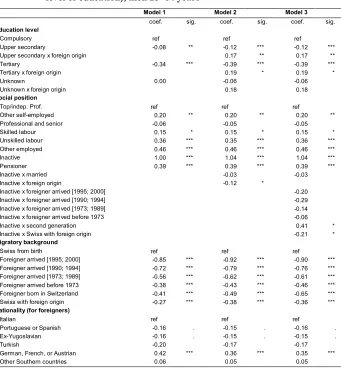
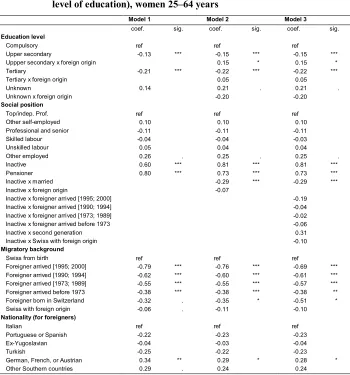
The results are presented in Tables 3 and 4 for men and women respectively. The first model shows what we usually see in research on migrants’ mortality paradox, with significant effects of the socioeconomic and demographic variables and each dimension modelled independently. It also demonstrates the differential mortality risk between migrants from Southern Europe and Northern countries, the first having a lower mortality. As observed in the tree, the most recent immigrants, and also older migrants and the naturalized Swiss – in a word, everyone with a migratory background – tend to have a lower risk of mortality than those who are Swiss from birth. The only exception concerns naturalised Swiss women. Although until 1992 women with a foreign nationality who married a Swiss partner automatically acquired Swiss citizenship, the Swiss naturalisation process is very selective according to socioeconomic and integration skills (Fibbi, Lerch, and Wanner 2007). A recent study has shown that naturalised women married to a Swiss partner have higher mortality risks than other naturalised individuals because of their lower selection (Zufferey 2014). Nonetheless, the mortality advantage is not located among immigrants only but has a wide scope, encompassing almost all individuals with a foreign background. A gradient according to the length of stay introduces differentials among foreigners. Those of foreign origin but born in Switzerland still have a relative advantage compared to Swiss natives. Swiss naturalised men have an advantage situated at the bottom of the gradient that is not marginal. In regard to the intensity of the coefficients, the reader should note the deep vulnerability affecting individuals who are not part of the labour market and the even more frail position of those receiving a pension.
The second model includes interactions, and goes a step further in considering the position of individuals of foreign origin within the social stratification. For men, this firstly confirms the greater advantage among the highest risk profiles, namely individuals who are not active in the labour market8. The model also highlights the
flatter social gradient among people of foreign origin, with only slight differences according to the level of education. Among women there is no significant advantage for the inactive of foreign origin, but there is a compensation effect of marriage. Being
before 1973, 6) Second-generation, 7) Swiss with foreign origin. The modality ‘Swiss with foreign origin’ encompasses the naturalized Swiss and the rare Swiss citizens born abroad.
8 Individuals receiving a pension are inactive and are therefore modelled in the same way as other inactive
married reduces the negative impact of inactivity (Falter 2009). Again, as seen among men, we can observe a flatter gradient for the level of education among those of foreign origin.
The third model adds an interaction between inactivity and the foreign-background subgroups. Again, for women, this interaction has no significant effect. Among men, an interesting pattern is observed. Foreign immigrants, in comparison with the Swiss from birth, have reduced mortality even when they are inactive, but most of the time this relation is not significant because of the small size of this population and the many parameters estimated. Swiss of foreign origin are also significantly less affected by inactivity; however, we can observe the opposite relationship for the second generation. Although the ‘migrant advantage’ needs to be defined very broadly (and as we have seen does not apply uniquely to recent migrants), the findings show that the second generation enjoys no greater protection from mortality risk if they are inactive. Second-generation immigrants lose a major part of their advantage when inactive, whereas the protection increases for the other immigrants in the second generation. This is probably due to both integration and selection effects.
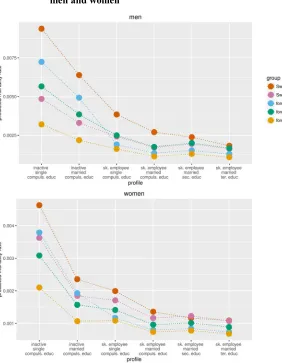
Figure 2 gives a synthetic representation of these results for men and women, with a prediction of the mortality rate for a selection of independent variables according to Model 3. It shows the estimated mortality rate for 5 groups of foreign origin9 according to different characteristics for socio-economic category, marital status, and level of education; all the other parameters are fixed10. The figure shows the high relative and
absolute advantage for immigrants in the most vulnerable profiles, namely among persons who do not play a part in the labour force. It also highlights, once again, the flatter gradient according to the level of education among individuals with a foreign background. Finally, Figure 2 illustrates the differentials among individuals of foreign origin. It appears that more recent migration flows have a lower mortality rate than older flows in each profile. Second generations shift in their relative position: those with risky profiles are closer to the position of Swiss natives but all the others are closer to that of the most recent migrants.
9 Here the foreign nationalities are considered all together (mean effect).
10 Age is fixed at 45, the partner has a compulsory level of education, and none of the profiles is receiving a
Table 3: Estimates from a quasipoisson generalized linear model of mortality (controlled for age, marital status, living with a partner, and partner level of education), men 25‒64 years
Model 1 Model 2 Model 3
coef. sig. coef. sig. coef. sig.
Education level
Compulsory ref ref ref
Upper secondary -0.08 ** -0.12 *** -0.12 ***
Upper secondary x foreign origin 0.17 ** 0.17 **
Tertiary -0.34 *** -0.39 *** -0.39 ***
Tertiary x foreign origin 0.19 * 0.19 *
Unknown 0.00 -0.06 -0.06
Unknown x foreign origin 0.18 0.18
Social position
Top/indep. Prof. ref ref ref
Other self-employed 0.20 ** 0.20 ** 0.20 **
Professional and senior -0.06 -0.05 -0.05
Skilled labour 0.15 * 0.15 * 0.15 *
Unskilled labour 0.36 *** 0.35 *** 0.36 ***
Other employed 0.46 *** 0.46 *** 0.46 ***
Inactive 1.00 *** 1.04 *** 1.04 ***
Pensioner 0.39 *** 0.39 *** 0.39 ***
Inactive x married -0.03 -0.03
Inactive x foreign origin -0.12 *
Inactive x foreigner arrived [1995; 2000] -0.20
Inactive x foreigner arrived [1990; 1994] -0.29
Inactive x foreigner arrived [1973; 1989] -0.14
Inactive x foreigner arrived before 1973 -0.06
Inactive x second generation 0.41 *
Inactive x Swiss with foreign origin -0.21 *
Migratory background
Swiss from birth ref ref ref
Foreigner arrived [1995; 2000] -0.85 *** -0.92 *** -0.90 ***
Foreigner arrived [1990; 1994] -0.72 *** -0.79 *** -0.76 ***
Foreigner arrived [1973; 1989] -0.56 *** -0.62 *** -0.61 ***
Foreigner arrived before 1973 -0.38 *** -0.43 *** -0.46 ***
Foreigner born in Switzerland -0.41 *** -0.49 *** -0.65 ***
Swiss with foreign origin -0.27 *** -0.38 *** -0.36 ***
Nationality (for foreigners)
Italian ref ref ref
Portuguese or Spanish -0.16 . -0.15 . -0.16 .
Ex-Yugoslavian -0.16 . -0.15 . -0.15 .
Turkish -0.20 -0.17 -0.17
German, French, or Austrian 0.42 *** 0.36 *** 0.35 ***
Other Southern countries 0.06 0.05 0.05
Table 4: Estimates from a quasipoisson generalized linear model of mortality (controlled for age, marital status, living with a partner, and partner level of education), women 25‒64 years
Model 1 Model 2 Model 3
coef. sig. coef. sig. coef. sig.
Education level
Compulsory ref ref ref
Upper secondary -0.13 *** -0.15 *** -0.15 ***
Uppper secondary x foreign origin 0.15 * 0.15 *
Tertiary -0.21 *** -0.22 *** -0.22 ***
Tertiary x foreign origin 0.05 0.05
Unknown 0.14 0.21 . 0.21 .
Unknown x foreign origin -0.20 -0.20
Social position
Top/indep. Prof. ref ref ref
Other self-employed 0.10 0.10 0.10
Professional and senior -0.11 -0.11 -0.11
Skilled labour -0.04 -0.04 -0.03
Unskilled labour 0.05 0.04 0.04
Other employed 0.26 . 0.25 . 0.25 .
Inactive 0.60 *** 0.81 *** 0.81 ***
Pensioner 0.80 *** 0.73 *** 0.73 ***
Inactive x married -0.29 *** -0.29 ***
Inactive x foreign origin -0.07
Inactive x foreigner arrived [1995; 2000] -0.19
Inactive x foreigner arrived [1990; 1994] -0.04
Inactive x foreigner arrived [1973; 1989] -0.02
Inactive x foreigner arrived before 1973 -0.06
Inactive x second generation 0.31
Inactive x Swiss with foreign origin -0.10
Migratory background
Swiss from birth ref ref ref
Foreigner arrived [1995; 2000] -0.79 *** -0.76 *** -0.69 *** Foreigner arrived [1990; 1994] -0.62 *** -0.60 *** -0.61 *** Foreigner arrived [1973; 1989] -0.55 *** -0.55 *** -0.57 ***
Foreigner arrived before 1973 -0.38 *** -0.38 *** -0.38 **
Foreigner born in Switzerland -0.32 . -0.35 * -0.51 *
Swiss with foreign origin -0.06 . -0.11 -0.10
Nationality (for foreigners)
Italian ref ref ref
Portuguese or Spanish -0.22 -0.23 -0.23
Ex-Yugoslavian -0.04 -0.03 -0.04
Turkish -0.25 -0.22 -0.23
German, French, or Austrian 0.34 ** 0.29 * 0.28 *
Other Southern countries 0.29 . 0.24 0.24
Figure 2: Predicted mortality rate for selected profiles, results from Model 3, men and women
4. Discussion
useful map of all the social dynamics at stake. In a second step, and in regard to the migrant mortality advantage, a confirmatory analysis added three significant results to the understanding of the factors shaping the migrant mortality paradox. First, the findings showed that the mortality advantage is not only located among foreigners but encompasses a wide population with a foreign background. Secondly, it has been demonstrated that the migrant mortality advantage is stronger in the most vulnerable profiles. Thirdly, and as a consequence, the socioeconomic gradient ‒ the shape of the inequalities according to social position ‒ is flatter among individuals with a foreign background.
Tracking the migrant mortality paradox among all individuals with a foreign background indicates that there is a need to widen the phenomenon’s definition. Most research in Europe has approached migration either through citizenship or through country of birth. The findings reported here demonstrate that these two spheres in the definition of migration do indeed overlap, but, more importantly, that each has its own rationale. Moreover, it confirms that among the three generally recognised factors – in-selection, out-in-selection, and negative acculturation process ‒ there is more than one explanation of the advantage. Being born in the country, second-generation immigrants are, by definition, excluded from the selection process, but still have lower mortality risks. Swiss people of foreign origin are either naturalised or are Swiss citizens born abroad and should, at least formally, have acquired Swiss cultural specificities. As discussed above, the Swiss naturalisation process is very selective and requires high acculturation and integration skills. Therefore, the explanation of the mortality paradox is not only a question of selection or the acculturation process, but needs to mobilize several factors.
The accentuation of the migrant mortality differentials in the most vulnerable profiles is the most important contribution of the inductive methodology used here. Scholars in mortality research and more generally in the social sciences tend to consider that an accumulation of risk factors acts additively, whereas the intersections of the social position are much more complex. The generalization of the use of regression models produces a simplification of the social realities that is appropriate, but which may also lead to misspecification in the understanding of our social world. Figure 2 gives a more faithful illustration, in which the relative and, even more, the absolute differentials among the categories of foreigner are significant for the more vulnerable profiles.
leads to greater homogeneity among those who undertake migration. So, for example, migration is less likely to concern individuals with a disability, or those affected by a rare, chronic, or genetic disease. Return migration acts as a second filter against immigrants getting into vulnerable situations. Some would prefer to stay in the host country to benefit from better health services, but for others, who lack job opportunities and have economic difficulties and/or possibly no support from relatives, return migration may appear as the better solution for immigrants in distress. Both in- and out-selections thus act to produce less vulnerability, and a homogenization of the healthiest, among the most vulnerable immigrants.
The role of selection in vulnerable profiles can also be analysed through the lens of the second generation. Because these individuals cannot benefit from selection, those who are inactive have a high mortality rate (very close to that of Swiss natives). As discussed earlier, this differential shifts among second generation immigrants active in the labour market, who have one of the lowest mortality rates (Figure 2). Therefore, the explanation must reside elsewhere than in selection. In a recent paper, Mackenbach (2012) has argued that psychosocial dimensions may interplay to explain the persistence of health inequalities in modern welfare states. For second-generation immigrants, such factors ‒ which are not strictly cultural but are linked with a migration background, for example, more hope or desire to succeed as suggested by Anson (2004) or Telles and Ortiz (2008) ‒ could be part of the explanation. Consistent with this idea, Bolzman, Fibbi, and Vial (2003) have demonstrated that second-generation Italian and Spanish immigrants in Switzerland experience more success at school and in the labour market than the children of Swiss manual workers, apparently because of a family culture of effort in migrants families that encourages the success of their young members.
flows that have characterized Switzerland. Again, besides the selections of the frailer, the flatter gradient among individuals with a foreign background may be related to psychosocial factors associated with migration, a ‘culture of migration’, such as hope and will to succeed, which may have more positive effects among individuals at the lowest levels of the social scale.
Previous research, for example, Schumacher and Vilpert (2011), has shown that social inequalities in mortality are structured by gender. This paper has also highlighted the fact that factors shaping mortality differ by sex. Among men, foreign background has a major influence in flattening the mortality gradient. By contrast, among women, foreign origin does not appear to be discriminant, for two reasons. First, the selection processes in immigration are typically stronger for men (Khlat and Darmon 2003). Second, the socioeconomic gradient is flatter among women so the influence of other factors becomes marginal.
The approach proposed in this paper has some important results but also some limitations. First, because of the poor data quality regarding the socioeconomic position of the population aged 65 and more, and because of the characteristics of older migrants in Switzerland, the elderly have been excluded from the analysis. Further research should test whether the patterns highlighted here also apply among the 65+ population. Secondly, the conditional structure of the trees means it stays at an explanatory level, since each node depends on the previous ones. Therefore, this kind of analysis could bring out patterns that are too close to the data (the populations and the time frame analysed).
As a concluding remark, inductive methods such as the classification tree developed here are very fruitful tools. The method enables mainstream assumptions to be disentangled, and highlights how social factors interact with each other. In the social sciences there is a need to widen discussion of the dynamics behind inequalities, and to find ways to analyse the intersection of social stratifications. The material presented in this paper is an illustration that the effects do not always act additively but interact with each other, and need to be approached and measured in that way.
5. Acknowledgments
References
Abraido-Lanza, A., Dohrenwend, B., Ng-Mak, D., and Turner, J. (1999). The Latino mortality paradox: a test of the salmon bias and healthy migrant hypotheses.
American Journal of Public Health 89(10): 1543–1548.
doi:10.2105/AJPH.89.10.1543.
Abraido-Lanza, A.F., Chao, M.T., and Flórez, K.R. (2005). Do healthy behaviors decline with greater acculturation? Implications for the Latino mortality paradox.
Social Science & Medicine 61(6): 1243–1255.
doi:10.1016/j.socscimed.2005.01.016.
Acevedo-Garcia, D., Sanchez-Vaznaugh, E.V., Viruell-Fuentes, E.A., and Almeida, J. (2012). Integrating social epidemiology into immigrant health research: A cross-national framework. Social Science & Medicine 75(12): 2060–2068.
doi:10.1016/j.socscimed.2012.04.040.
Anson, J. (2004). The migrant mortality advantage: a 70 month follow-up of the Brussels population. European Journal of Population 20(3): 191–218.
doi:10.1007/s10680-004-0883-1.
Bolzman, C., Fibbi, R., and Vial, M. (2003). Secondas-Secondos. Le processus d’intégration des jeunes adultes issus de la migration espagnole et italienne en
Suisse. Zurich: Seismo.
Bopp, M., Spoerri, A., Zwahlen, M., Gutzwiller, F., Paccaud, F., Braun-Fahrlaender, C., Rougemont, A., and Egger, M. (2009). Cohort Profile: The Swiss National Cohort ‒ a longitudinal study of 6.8 million people. International Journal of
Epidemiology 38(2): 379–384. doi:10.1093/ije/dyn042.
Bostean, G. (2013). Does selective migration explain the Hispanic Paradox? A comparative analysis of Mexicans in the US and Mexico. Journal of Immigrant
and Minority Health 15(3): 624–635.
Breiman, L., Friedman, J.H., Olshen, R.A., and Stone, C.J. (1984). Classification and
regression trees. Belmont: Wadsworth.
Crenshaw, K. (1991). Mapping the margins: Intersectionality, identity politics, and violence against women of color. Stanford Law Review 43(6): 1241–1299.
doi:10.2307/1229039.
Deboosere, P., and Gadeyne, S. (2005). Adult migrant mortality advantage in Belgium: evidence using census and register data. Population 60(5): 655–698.
doi:10.3917/pope.505.0655.
Dubowitz, T., Bates, L.M., and Acevedo-Garcia, D. (2010). The Latino Health Paradox: Looking at the intersection of sociology and health. In: Bird, C.E., Conrad, P. and Fremont, A.M. (eds.). Handbook of Medical Sociology. Nashville : Vanderbilt University Press: 106–123.
Falter, J.-M. (2009). Le divorce, facteur de pauvreté féminine. In: Oris, M. (ed.).
Transitions dans les parcours de vie et construction des inégalités. Lausanne:
Presses polytechniques et universitaires romandes: 297–314.
Fibbi, R., Lerch, M., and Wanner, P. (2007). Naturalisation and socio-economic characteristics of youth of immigrant descent in Switzerland. Journal of Ethnic
and Migration Studies 33(7): 1121–1144. doi:10.1080/13691830701541655.
Goldman, N., Kimbro, R.T., Turra, C.M., and Pebley, A.R. (2006). Socioeconomic gradients in health for white and Mexican-origin populations. American Journal
of Public Health 96(12): 2186–2193. doi:10.2105/AJPH.2005.062752.
Hothorn, T., Hornik, K., and Zeileis, A. (2006). Unbiased recursive partitioning: A conditional inference framework. Journal of Computational and Graphical
Statistics 15(3): 651–674. doi:10.1198/106186006X133933.
Hunt, L.M., Schneider, S., and Comer, B. (2004). Should acculturation be a variable in health research? A critical review of research on US Hispanics. Social Science &
Medicine 59(5): 973–986. doi:10.1016/j.socscimed.2003.12.009.
Kass, G.V. (1980). An exploratory technique for investigating large quantities of categorical data. Journal of the Royal Statistical Society. Series C 29(2): 119– 127. doi:10.2307/2986296.
Khlat, M., and Darmon, N. (2003). Is there a Mediterranean migrants mortality paradox in Europe? International Journal of Epidemiology 32(6): 1115–1118.
doi:10.1093/ije/dyg308.
Kohls, M. (2010). Selection, Social Status or Data Artefact: What Determines the Mortality of Migrants in Germany? In: Salzmann, T., Edmonston, B. and Raymer, J. (eds.). Demographic Aspects of Migration. Wiesbaden: VS Verlag für Sozialwissenschaften: 153–177. doi:10.1007/978-3-531-92563-9_6.
Kopf, J., Augustin, T., and Strobl, C. (2013). The Potential of Model-based Recursive Partitioning in the Social Sciences – Revisiting Ockham’s Razor. In: McArdle, J.J., and Ritschard, G. (eds.). Contemporary Issues in Exploratory Data Mining
in the Behavioral Sciences. London: Routledge: 75–94.
Mackenbach, J.P. (2012). The persistence of health inequalities in modern welfare states: the explanation of a paradox. Social Science & Medicine 75(4): 761–769.
doi:10.1016/j.socscimed.2012.02.031.
Markides, K.S., and Coreil, J. (1986). The health of Hispanics in the southwestern United States: an epidemiologic paradox. Public Health Reports 101(3): 253– 265.
Markides, K.S., and Eschbach, K. (2005). Aging, migration, and mortality: current status of research on the Hispanic paradox. The Journals of Gerontology Series
B: Psychological Sciences and Social Sciences 60: 68–75.
doi:10.1093/geronb/60.Special_Issue_2.S68.
Palloni, A., and Arias, E. (2004). Paradox lost: explaining the Hispanic adult mortality advantage. Demography 41(3): 385–415. doi:10.1353/dem.2004.0024.
Powers, D.A., and Xie, Y. (1999). Statistical methods for categorical data analysis. San Diego: Academic Press.
R Core Team (2015). R: A Language and Environment for Statistical Computing. Vienna: R Foundation for Statistical Computing.
Riosmena, F., and Dennis, J.A. (2012). A tale of three paradoxes: the weak socioeconomic gradients in health among Hispanic immigrants and their relation to the Hispanic Health Paradox and negative acculturation. In: Angel, J.L., Torres-Gil, F., and Markides, K.S. (eds.). Aging, Health, and Longevity in the
Mexican-Origin Population. New York: Springer: 95–110.
doi:10.1007/978-1-4614-1867-2_8.
Ritschard, G. (2013). CHAID and earlier supervised tree methods. In: McArdle, J.J., and Ritschard, G. (eds.). Contemporary Issues in Exploratory Data Mining in
Schumacher, R., and Vilpert, S. (2011). Gender differences in social mortality differentials in Switzerland (1990‒2005). Demographic Research 25(8): 285– 310. doi:10.4054/DemRes.2011.25.8.
Singh, G.K., and Siahpush, M. (2002). Ethnic-immigrant differentials in health behaviors, morbidity, and cause-specific mortality in the United States: An analysis of two national data bases. Human Biology 74(1): 83–109.
doi:10.1353/hub.2002.0011.
Spoerri, A., Zwahlen, M., Egger, M., and Bopp, M. (2010). The Swiss National Cohort: a unique database for national and international researchers. International
Journal of Public Health 55(4): 239–242. doi:10.1007/s00038-010-0160-5.
Telles, E.M., and Ortiz, V. (2008). Generations of exclusion: Mexican-Americans,
assimilation, and race. New York: Russell Sage Foundation.
Therneau, T.M., and Atkinson, E.J. (1997). An introduction to recursive partitioning
using the RPART routines. Rochester: Mayo Clinic, Section of Biostatistics.
Turra, C.M., and Goldman, N. (2007). Socioeconomic differences in mortality among US adults: insights into the Hispanic paradox. The Journals of Gerontology
Series B: Psychological Sciences and Social Sciences 62(3): 184–192.
doi:10.1093/geronb/62.3.S184.
Viruell-Fuentes, E.A., Miranda, P.Y., and Abdulrahim, S. (2012). More than culture: Structural racism, intersectionality theory, and immigrant health. Social Science
& Medicine 75(12): 2099–2106. doi:10.1016/j.socscimed.2011.12.037.
Zeileis, A., and Hornik, K. (2007). Generalized M-fluctuation tests for parameter instability. Statistica Neerlandica 61(4): 488–508. doi:10.1111/j.1467-9574.2007.00371.x.
Zeileis, A., Hothorn, T., and Hornik, K. (2008). Model-based recursive partitioning.
Journal of Computational and Graphical Statistics 17(2): 492–514.
doi:10.1198/106186008X319331.
Zeileis, A., Hothorn, T., and Hornik, K. (2010). Party with the mob: Model-Based Recursive Partitioning in R. R Package Version 0.9-9999.