Journal Homepage: www.jitecs.ub.ac.id
An Exploratory Study of Requirements Engineering
Practices in Indonesia – Part 1: Concepts and Problems
Tri A. Kurniawan1, Denny S. Rusdianto2, Adam H. Brata3, Faizatul Amalia4, Angga Santoso5, Dini I. N. R. P. Raharjo6
1,2,3,4,5,6Faculty of Computer Science, Universitas BrawijayaMalang, Indonesia 1 [email protected], 2 [email protected], 3 [email protected], 4 [email protected],
5 [email protected], 6 [email protected]
Received 17 May 2019; accepted 27 June 2019
Abstract. This paper provides the first part of statistical research findings of an exploratory study of the requirements engineering practices implemented in software development processes in Indonesia. This first part attempts to reveal facts regarding concepts and problems exist in such requirements engineering practices. We developed a comprehensive online questionnaire consisting of both closed- and open-ended questions in order to capture such facts. We invited 158 participant candidates representing industry and higher education institutions, however, 31 of them joined our web-based survey. Results show that most of participants confirm that requirements engineering must be properly performed in order to clearly define the valid product. They, however, encounter some difficulties in implementing requirements engineering concepts in practice due to a tight schedule, inappropriate skill of the analysts and inadequate tools used.
1
Introduction
Requirements engineering (RE) becomes a critical phase in a software development life cycle. It attempts to produce high quality software requirements specification documents, both software requirements (SRS-Software Requirements Specification) and interface requirements (IRS-Interface Requirements Specification). Both functional and nonfunctional requirements of a software system are completely described in a SRS document. Such valid and accurate specifications will be an important basis in designing a software that will be implemented using a certain programming language. In contrast, invalid and inaccurate software specifications will have a serious impact on such development which may produce a fail product. This has been an important problem in a software project since 1970s [1].
Tri A. Kurniawan et al. , Requirements Engineering Practice in Indonesia: ... 91
that client involvement and support from executives contributed significantly to the success of the project [6]. This study confirms that the role of RE is very important in order to determine the software system requirements based on information gathered from the clients.
There exist a few number of exploratory studies dealing with the RE practices in the software development (e.g. [7] [8] [9] [10]). Further, this study becomes more important as there is no such study in Indonesian software development. This research attempts to conduct an exploratory study of RE practices in software development in Indonesia by conducting an online survey. More specifically, this study aims to find out the following concerns in RE practice: (a) RE concepts understanding; (b) problems which are encountered; (c) efforts, processes and techniques which are used. We distributed a questionnairy to the selected agencies, both from industry and higher education, that are directly related to the software development processs. In addition, we conducted a limited focus group discussion with a software industry in Indonesia. Due to limited space, we, however, present the survey findings of the first two concerns in this paper (Part 1) and let the rest concern be discussed in the other paper (Part 2).
The rest of this paper is structured as follows. Section 2 briefly discusses the related works on survey of RE practices in software development. Section 3 presents research methodology including survey preparation, data collection and limitations. In Section 4, we describe the results of the survey. We discuss all findings in Section 5. Finally, Section 6 presents the conclusion and future work of this survey.
2
Related Work
3
Research Methodology
3.1 Survey Preparation
A survey is a systematic approach for collecting data from a sample of entities in order to contruct quantitative description of the bigger population of such entities [13]. This can be performed by asking people structured and predefined questions [14]. This study used an online questionnaire as the most common field study method [15]. We attempted to collect RE concepts understanding, problems which are encountered, as well as RE practices (i.e. efforts, processes and techniques) which are applied in software developments in Indonesia.
We developed a comprehensive online questionnaire consisting of 40 questions grouped as follows: participants profiles (4 items), organization profiles (10 items), RE concepts understanding profiles (7 items), RE practices profiles (12 items), and problems profiles (7 items). For objective purposes, we put questions related to participants and organization profiles at the end of the questionnaire [16]. In general, the questionnaire consisted of closed-ended questions with a set of descriptive particular answers per question. Some of them, however, were added with an ‘Other’ answer option followed by a written description allowing respondents to express their own answer. In particular, we provided the closed-ended questions for gathering the problem profiles with 5-point Likert scale to measure how often a problem in question happened. In such setting, each respondent indicated a range of ‘Very often’ to ‘Never’ which were then converted to a score on a scale from 1–5. Further, we provided an additional open-ended question to capture other problems a respondent encountered in practice.
In regard participants profiles, we asked them about their technical role, work experience in software development, field of formal education and education level. We also asked participants about their organization profiles: operational time, line of business, number of employees, major domain of application, application product type. Additional questions to this type included headquarters location, services scope, software developer size, project value per annum. The participants were asked about their RE concepts understanding profiles including understanding level, knowledge source, urgency of RE, responsible role in RE, RE objectives, urgency of specification document. Questions related to RE practices profiles were project activities distribution, RE efforts, software analyst role, specification document availability, type and standard, RE competency improvement, RE methods, elicitation techniques, documentation tool, requirements representation and modeling tool. According to problems profiles, the participants were asked about requirements pre- and post-traceability, user involvement, requirements volatile, lack of specification document, inappropriate tool used, as well as an.
Feedback, from a selected software company to improve the questions, was also taken into account to evaluate the preliminary draft of the survey. Initially, we also invited some software engineering experts to examine such draft, however, none responded. As such, we reviewed such a draft by our own approach.
3.2 Data Collection and Elaboration
The questionnaire was available online through a commercial survey software, i.e. SurveyMonkey1, for a period of one month during August to September 2018. Prior
to joining such online questionnaire, the participant candidates were contacted via
Tri A. Kurniawan et al. , Requirements Engineering Practice in Indonesia: ... 93
email for confirmation. Initially, we listed 159 software companies and 20 higher education institutions based on our assessment to their information (i.e. url, email, location, line of business) provided on their respective websites. Based on such list, we had 138 software companies and 20 higher education institutions committed via email to provide a relevant person to join the survey. Then, we personally sent emails to 158 persons for joining our survey through the given url. We defined such samples using a non-probabilistic approach since the target population was very specific and they were chosen based on their availability [17].
After 1-month surveying period, a total of 31 participants responded by joining our online questionnaire, while complete information were provided by 30 participants. It means that feedback rate of this study was approximately 19.6%. As this online survey was designed under non-probabilistic sampling and governed based on the incentive-free participation approach, such feedback rate was taken into account as a reasonable result. Further, we arranged a focus group discussion with a selected software company for elaborating the survey data.
The internal consistency of the questionnaire was tested using Cronbach Alpha assessment. This test was only carried out for the relevant questions in which scoring answer provided, i.e. problem profiles. Our Cronbach Alpha was 0.8 which was higher than minimal Cronbach Alpha 0.6 in exploratory research. It indicated our questionnaire was reliable.
3.3 Limitations
This survey successfully addressed our research questions by inviting a number of participants representing software companies and higher education institutions in Indonesia. We, however, need to explicitly state the limitations of this survey. First, the sample of this study was selected from software companies and higher education insititutions in which their organization size were classified as large, medium and small based on our own assessment according to the information provided on their website, respectively. It may contribute bias in selecting the sample of the survey. Secondly, each participant, who joined this survey, were recommended by the organization without any selection based on our certain criteria. This may not lead to a suitable person who has requirements engineering background.
4
Research Findings
4.1 Participants Profiles
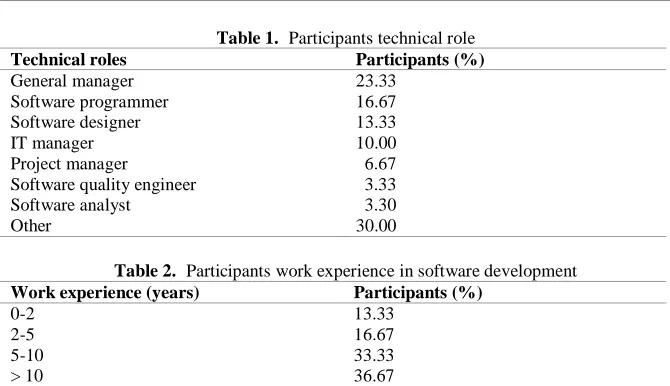
Table 1. Participants technical role
Technical roles Participants (%)
General manager 23.33
Software programmer 16.67
Software designer 13.33
IT manager 10.00
Project manager 6.67
Software quality engineer 3.33
Software analyst 3.30
Other 30.00
Table 2. Participants work experience in software development
Work experience (years) Participants (%)
0-2 13.33
2-5 16.67
5-10 33.33
> 10 36.67
Concerning the field of formal education (Table 3), the majority of the participants (36.67%) holds informatics engineering background. While, the other participants hold computer engineering (13.33%) and information system (13.33%). In term of the educational level (Table 4), the study indicates that 66.67 % of participants hold bachelor honours degree, while 26.67% hold master degree.
Table 3. Participants field of formal education
Field of formal education Participants (%)
Informatics engineering 36.67 Computer engineering 13.33 Information system 13.33 Software engineering 10.00 Business and management 10.00 Electrical engineering 3.33 Mathematic and natural science 3.33
Economic 0.00
Other 10.00
Table 4. Participants education level
Education level Participants (%)
Doctoral degree 0.00
Master degree 26.67
Bachelor honours degree 66.67
Associate degree 0.00
Senior high school 6.67
Other 0.00
4.2 Organization Profiles
Tri A. Kurniawan et al. , Requirements Engineering Practice in Indonesia: ... 95
Table 5. Organization line of business
Line of business Participants (%)
Information technology or software 83.33
Education 13.33
Banking 9.00
Manufacture 0.00
Telecommunication 0.00
Health 0.00
Other 3.33
Table 6. Organization major domain of developed application (multi-selections)
Major domain Participants (%)
Business 53.33
Education 40.00
Government 30.00
Management 26.67
Banking 23.33
Manufacture 16.67
Telecommunication 13.33
Health 10.00
Insurance 3.33
Defense 0.00
Other 33.33
Table 7. Organization application product type
Major domain Participants (%)
Customized product 43.33 Customized and generic product 36.67
Generic product 20.00
Other 3.33
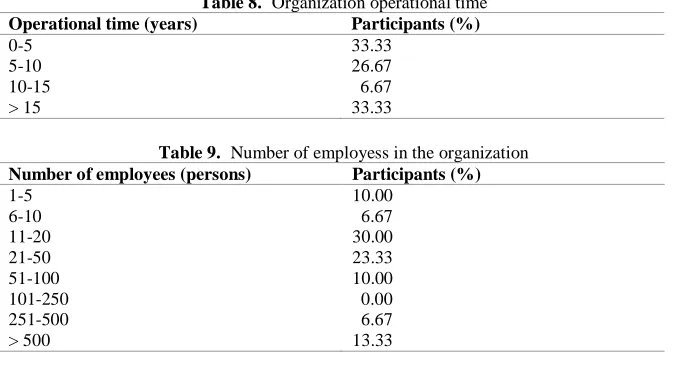
In term of operational time (0), we have interesting facts that most of the organizations are categorized as startup company, i.e. operational time around 0-10 years. Concerning the number of employees (Table 9), the top two options with the larger number of responses are: 11-20 employees (30%), 21-50 employees (23.33%). That is to say, the findings of this survey stem mainly from participants who work for small- and medium-sized enterprises.
Table 8. Organization operational time
Operational time (years) Participants (%)
0-5 33.33
5-10 26.67
10-15 6.67
> 15 33.33
Table 9. Number of employess in the organization
Number of employees (persons) Participants (%)
1-5 10.00
6-10 6.67
11-20 30.00
21-50 23.33
51-100 10.00
101-250 0.00
251-500 6.67
4.3 RE Concepts Findings
The following information depict facts related to RE concepts understanding of the participants. Concerning the understanding level (Table 10), the majority of participants (74.19%) understands RE concept and its applicability in the software development. While, Table 11 confirms that most of the participants get their RE concepts from their formal course (50%).
Table 10. Understanding level of RE concepts
Understanding level Participants (%)
Understand concept, and applicable 74.19 Understand concept, but not applicable 12.90 Know concept, but do not understand 9.68 Do not know at all 3.23
Other 0.00
Table 11. Knowledge source of RE concepts
Knowledge source Participants (%)
Formal course 50.00
Self-learning 30.00
Organization-funded training 13.33 Self-funded training 3.33
Other 3.33
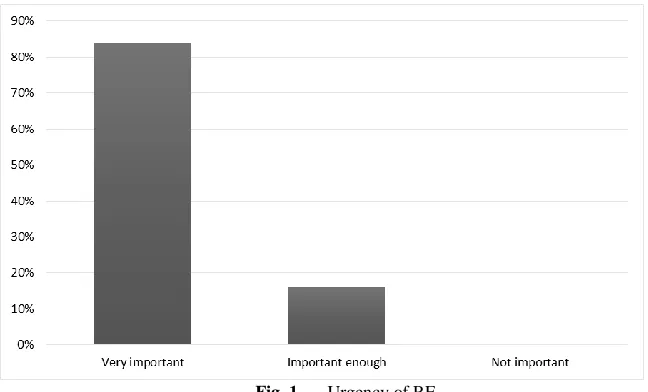
In regard the urgency of RE in a software project (Fig. 1), the majority of the participants (more than 80%) confirms that RE is very important to be implemented. Concerning the responsible role for performing RE (Fig. 2), software analyst (more than 85%) and project manager (more than 65%) are top two roles which are responsible. This fact comes from a question in which the participants were allowed to select more than one option.
Tri A. Kurniawan et al. , Requirements Engineering Practice in Indonesia: ... 97
Fig. 2. Responsible role for performing RE (multi-selections)
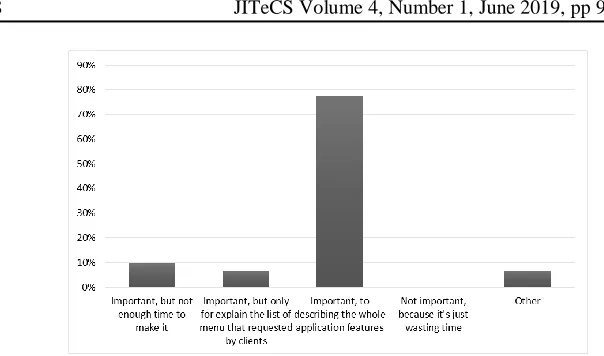
Regarding RE objectives (Fig. 3), application feature definition (more than 80%) and project proposal definition (almost 70%) are top two objectives which are undertood by the participants as the objective of RE in software development project. In term of the efforts for identifying the software features (Table 12), the majority of the participants (96.77%) understand that discussion with clients is required to do so, while benchmarking (70.97%) is the second effort which can be leveraged. Data in Fig. 3 and Table 12 come from questions in which the participants were allowed to select more than one option. Further, most of the participants (more than 80%) understand that specification document is important for describing the whole application features, as shown in Fig. 4.
Fig. 3. RE objectives in software development (multi-selections)
Table 12. Efforts for identifying the software features (multi-selections)
Efforts Participants (%)
Discussion with clients 96.77
Benchmarking 70.97
Read related documents 45.16 Self-identification 19.35
Fig. 4. Urgency of specification document in every software project
4.4 RE Problems Findings
The following information present problems encountered in practicing RE. In regard requirement pre-traceability (Table 13), i.e. requirements traceability to clients, most of the participants (41.94%) believe that such problem is often encountered in software development. While, concerning requirement post-traceability (Table 14), i.e. requirements post-traceability to design component, the majority of the participants (45.16%) often get such problem.
Table 13.Problems in requirements pre-traceability
Problems intensity Participants (%)
Very often 3.23
Often 41.94
Seldom 35.48
Rare 12.90
Never 6.45
Table 14. Problems in requirements post-traceability
Problems intensity Participants (%)
Very often 6.45
Often 45.16
Seldom 22.58
Rare 25.81
Never 0.00
In user involvement problems (Table 15), most of the participants (more than 38%) encounter less involvement. While, problem in requirements volatile (Fig. 5), most of the participants (more than 40%) often meet such problem.
Table 15. Problems in less user involvement
Problems intensity Participants (%)
Very often 19.35
Often 19.35
Seldom 25.81
Rare 35.48
Tri A. Kurniawan et al. , Requirements Engineering Practice in Indonesia: ... 99
Fig. 5. Problems in requirements volatile
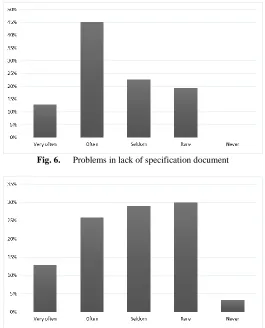
In regard problem in lack of specification document (Fig. 6), most of the participants (45%) often meet such problem. While, Fig. 7 confirms that most of the participants do not significantly have problem in RE tool since they already utilize such tool appropriately.
Fig. 6. Problems in lack of specification document
5
Discussion
The findings of the first part of this survey provide facts of the concepts and problems in practicing RE in software development in Indonesia. According to the survey, 74.19% of participants confirmed that they understand and are able to apply RE concepts in software development practices. Most of them (i.e. 50%) obtained their knowledge and skills in RE from formal course at university. Furthermore, based on these findings, it was conducted to find out the importance of developers making requirements engineering. As a result, it was verified that 83.87% stated that requirements engineering activities are very important stages in the software development phase especially for determining software features, defining project proposals as well as displaying interface software designs. This emphasizes that engineering needs greatly affect the success of software projects in accordance with user expectations. In addition, the majority of participants think that software analysts and project managers have a very important role and are required to have extensive knowledge about requirements engineering.
This paper also shows the purpose of requirements engineering is to be able to discuss with clients in gathering features of the software. Such features become a reference in preparing software requirements documents. The interesting thing of this findings is that limited time is an obstacle for participants to document software requirements. Some participants argued that the document was only used as a representation of the menu list desired by the client. According to the survey, 29.03% of participants said that not all projects had the required software requirements documents.
The survey findings show that participants were difficult to track requirements to client (pre-traceability), which was represented by 41.94% of participants. The traceability of a requirement to a component of the design (post-traceability) is also a difficult challenge. The user involvement in defining the objectives and features of the application is very important before the software is built. The findings of this survey revealed that 35.48% of client involvement in the requirements engineering process is very low. This findings occured since the client's active role is lacking in the process of requirements engineering. In addition, the lack of knowledge of the client about the developed software and solutions has an impact on the requirements that are constantly changing.
Based on the survey results, 45.16% of participants often found requirements changes, unclear, ambiguous, incomplete needs specifications and weak documentation to be a problem in managing software projects. This findings occur because in addition to the client's insufficient knowledge and experience of the development team when defining solutions based on the domain of problems that are lacking, the resulting needs cannot reach the expected goals. The involvement of all team members in the requirements engineering process is very important to obtain the same problem domain information.
Tri A. Kurniawan et al. , Requirements Engineering Practice in Indonesia: ... 101
in sufficient numbers is a dominant problem as well as inappropriateness in documenting all requirements. Finally, lack of documentation, requirements volatile, less skill and insufficient number of the analyst were well confirmed by the selected software company as the main problems in RE practices during our focus group discussion.
6
Conclusion and Future Work
This research makes some results in capturing the RE concepts understanding and problems which exist in software developement in Indonesia. In general, RE concepts have been proportionally understood by the participants. The participants develop their knowledge in RE through formal course at university. The specific role and documentation of RE are two important issues to take into account. Further, problems in RE implementation are obvious. These includes requirements traceability, user involvement, requirements volatile and tool supports.
Future research may be arranged for investigating relationships among the facts in RE implementation. This may potentially contribute in better understanding of RE practices in Indonesia in order to improve RE implementation.
Acknowledgments. The authors would like to thank all participants that participated
in this study for their invaluable contribution in completing our online questionnaire, as well as software executives at AdIns Indonesia who were involved in our focus group discussion. This study was supported by a grant No. 2000/UN10.36/PG/2018 from Faculty of Computer Science, Universitas Brawijaya, Indonesia.
References
[1] I. Sommerville and J. Ransom, “An empirical study of industrial requirements engineering process assessment and improvement,” ACM Transaction on Software Engineering and Methodology, vol. 14, no. 1, pp. 85-117, 2005.
[2] E. Kavakli and P. Loucopoulos, “Goal driven requirements engineering: evaluation of current methods,” in Proceedings of the 8th CAiSE, 2003.
[3] A. Azadegan, K. N. Papamichail and P. Sampaio, “Applying collaborative process design to user requirements elicitation: A case study,” Computers in Industry, vol. 64, no. 7, p. 798–812, 2013.
[4] R. Ali, F. Dalpiaz and P. Giorgini, “Reasoning with contextual requirements: Detecting inconsistency and conflicts,” Information and Software Technology, vol. 55, no. 1, pp. 35-57, 2013.
[5] S. Dey and S.-W. Lee, “REASSURE: Requirements elicitation for adaptive socio-technical systems using repertory grid,” Information and Software Technology, vol. 87, pp. 160-179, 2017.
[7] E. Sadraei, A. Aurum, G. Beydoun and B. Paech, “A field study of the requirements engineering practice in Australian software industry,” Requirements Engineering, vol. 12, no. 3, pp. 145-162, 2007.
[8] N. Juristo, A. Moreno and A. Silva, “Is the European industry moving toward solving requirements engineering problems?,” IEEE Software, vol. 19, no. 6, pp. 70-77, 2002.
[9] L. Karlsson, A. G. Dahlstedt, B. Regnell, J. N. och Dag and A. Persson, “Requirements engineering challenges in market-driven software development--An interview study with practitioners,” Information and Software Technology, vol. 49, no. 6, pp. 588-604, 2007.
[10] L. Liu, H. Zhang, F. Peng, W. Ma, Y. Shan, J. Xu and T. Burda, “Understanding Chinese characteristics of requirements engineering,” in 17th IEEE International Requirements Engineering Conference, 2009. RE'09. , IEEE, 2009, pp. 261-266.
[11] J. Aranda, S. Easterbrook and G. Wilson, “Requirements in the wild: How small companies do it,” in Requirements Engineering Conference, 2007. RE'07. 15th IEEE International, IEEE, 2007, pp. 39-48.
[12] L. Liu, T. Li and F. Peng, “Why requirements engineering fails: A survey report from Cchina,” in 18th IEEE International Requirements Engineering Conference (RE'10), IEEE, 2010, pp. 317-322.
[13] R. M. Groves, M. P. C. Floyd J. Fowler Jr., J. M. Lepkowski, E. Singer and R. Tourangeau, Survey Methodology, John Wiley & Sons, 2011.
[14] A. Pinsonneault and K. L. Kraemer, “Survey research methodology in management information systems: An assessment,” Journal of Management Information Systems, vol. 10, no. 2, pp. 75-105, 1993.
[15] T. C. Lethbridge, S. E. Sim and J. Singer, “Studying Software Engineers: Data Collection Techniques for Software Field Studies,” Empirical Software Engineering, vol. 10, p. 311–341, 2005.
[16] T. Punter, M. Ciolkowski, B. Freimut and I. John, “Conducting on-line surveys in software engineering,” in 2003 International Symposium on Empirical Software Engineering, 2003.