O R I G I N A L A R T I C L E
Modelling and optimization of fermentation factors for
enhancement of alkaline protease production by isolated
Bacillus circulans
using feed-forward neural network and
genetic algorithm
Ch. Subba Rao1, T. Sathish1, M. Mahalaxmi1, G. Suvarna Laxmi1, R. Sreenivas Rao2and R.S. Prakasham1
1 Bioengineering and Environmental Centre, Indian Institute of Chemical Technology, Hyderabad, Andhra Pradesh, India 2 Institute of Grassland and Environmental Research, North Wyke Research Station, Okehampton, Devon, UK
Introduction
Proteases, especially alkaline, constitute 60–65% of the global industrial enzyme market (Banerjee et al. 1999; Genckal and Tari 2006). In fact, it was reported that the global proteolytic enzyme demand will increase
dramati-cally to 22 billon US dollars by 2009 (Turk 2006) because of their application potential in several industrial sectors especially food, meat tenderization, peptide synthesis, infant food preparations, baking and brewing, pharma-ceuticals and medical diagnosis, detergent industry (addi-tive), as well as in textiles and dehairing (Joo et al.2003).
Keywords
alkaline protease, artificial neural networks,
Bacillus circulans,fermentation, genetic
algorithm, optimization.
Correspondence
Reddy Shetty Prakasham, Bioengineering and Environmental Centre, Indian Institute of Chemical Technology, Hyderabad 500 007, Andhra Pradesh, India.
E-mail: [email protected]
2007⁄0813: received 24 May 2007, revised 6 September 2007 and accepted 6 September 2007
doi:10.1111/j.1365-2672.2007.03605.x
Abstract
Aim:Modelling and optimization of fermentation factors and evaluation for enhanced alkaline protease production byBacillus circulans.
Methods and Results:A hybrid system of feed-forward neural network (FFNN)
and genetic algorithm (GA) was used to optimize the fermentation conditions to enhance the alkaline protease production byB. circulans. Different microbial metabolism regulating fermentation factors (incubation temperature, medium pH, inoculum level, medium volume, carbon and nitrogen sources) were used to construct a ‘6-13-1’ topology of the FFNN for identifying the nonlinear relationship between fermentation factors and enzyme yield. FFNN predicted values were further optimized for alkaline protease production using GA. The overall mean absolute predictive error and the mean square errors were observed to be 0Æ0048, 27Æ9, 0Æ001128 and 22Æ45 U ml)1 for training and testing, respectively. The goodness of the neural network prediction (coefficient ofR2) was found to be 0Æ9993.
Conclusions:Four different optimum fermentation conditions revealed
maxi-mum enzyme production out of 500 simulated data. Concentration-dependent carbon and nitrogen sources, showed major impact on bacterial metabolism mediated alkaline protease production. Improved enzyme yield could be achieved by this microbial strain in wide nutrient concentration range and each selected factor concentration depends on rest of the factors concentration. The usage of FFNN–GA hybrid methodology has resulted in a significant improve-ment (>2Æ5-fold) in the alkaline protease yield.
Significance and Impact of the Study:The present study helps to optimize
The application web of these enzymes is increasing in production of high nutritional value fish hydrolysate using Bacillus subtilisprotease (Rebecca et al. 1991; Turk 2006), upgrading of lean meat waste to edible products (O’Meara and Munro 1984) and in the enzymatic modifi-cation of zein to produce a nonbitter peptide fraction with high Fischer ratio for patients with hepatic encepha-lopathy (Tanimotoet al.1991).
Among all protease-producing microbial systems, microbes belonging to Bacillus genus gained importance because of extracellular enzyme production under sub-merged fermentation conditions (Kumar and Takagi 1999; Prakashamet al. 2006). Isolation of novel proteases producing species with specific characteristics will be of great value to the enzyme industry for different applica-tions. It was well documented that each microbial strain differs in its product production character, which mainly depends on their fermentation, nutritional, physiological and genetic nature (Gupta et al. 2002; Prakasham et al.
2005; Rao et al. 2006). Exploration and exploitation of such characteristics would offer a competitive advantage over existing products. Hence, use of appropriate fermen-tation parameters was of critical importance as medium composition, product concentration, yield, and volumet-ric productivity influences the product productivity (Akhnazarova and Kafarov 1982; Prakasham et al. 1999; Sreenivas Rao et al. 2006). Hence, it is essential that the isolated strain should be characterized for its growth and optimal protease production. The commonly used con-ventional optimization method is ‘one at a time’ method (Prakasham et al. 2006), which ignores interactions among the different components even after performing of a large number of experiments. To overcome these prob-lems, statistical methods such as response surface meth-odology (RSM) (Himabindu et al. 2006), Taguchi methodology (Rao et al. 2004; Prakasham et al. 2007a), etc were used. RSM provides polynomial models with universal approximation properties for any number of input and output variables with desired accuracy. In prac-tice, only two or three levels are applied, given byLN(N
factor atLlevels). The level of orthogonal array design or uniform design is also limited by this factor (Fang et al.
2003); hence, artificial neural networks (ANN) and genetic algorithms (GAs) are employed.
The ANN has a similarity like human decision-making process and used to solve the nonlinear problems in vari-ous fields, such as fermentation, optimization, and pat-tern recognition in biotechnology and pharmaceutical technology as well as in the bioreactor controlling and online optimization (Montague and Morris 1994; Ka-mimura et al. 1996; Subramanian et al. 2004; Arulsudar
et al. 2005). Many authors compared the ANN with the statistical design and showed that the ANN results are
much better than the statistical ones (Liu et al. 1999; Nagata and Chu 2003; Kulkarni et al. 2004; Subramanian
et al.2004; Arulsudaret al.2005).
GAs are based on unorthodox search and optimization algorithms, which help in searching for a solution to the problem by mimicking some of the process of natural evolution. GA performs direct random searches through a given set of alternatives with the aim of finding the best alternative with respect to the given criteria of goodness of fit, which is expressed in terms of an objective function (also referred to fitness function). Freyer et al. (1992), Weuster-Botz and Wandrey (1995) and Zuzek et al.
(1996) optimized 12–14 variables at a time using GA. Presently, hybrid GA–ANN is becoming popular for fermentation parameter optimization. Hanai et al.
(1999) optimized 21 variables for koji fermentation pro-cess while Hongwen et al. (2005) optimized 1,3 pro-panediol production with total 29 experiments, whereas Fang et al. (2003) optimized the xylitol production using GA-coupled neural networks. Nagata and Chu (2003) analysed RSM data [presented by Achary et al.
(1997)] using neural network and GA to predict opti-mum conditions and reported that feed-forward neural network and GA (FFNN–GA) is the better optimization method. In the present study, authors used FFNN for modelling alkaline protease production experiments and output FFNN data variables were further optimized using the GA.
Materials and methods
Micro-organism and culture conditions
A laboratory bacterial isolate Bacillus circulans (MTCC 6811) was used in this study. This microbial strain was grown in 250-ml conical flasks containing 100 ml of medium consisting of yeast extract 7Æ5, peptone 7Æ5 and glucose 10 (in g l)1) at pH 9Æ0 by incubating at 33C and at 150 rpm in an orbital shaker (LabTech LSI – 3016 R; Daihan Labtech Co., Ltd, Namyangju-city, Kyonggi-Do, Korea) for 24 h unless otherwise stated. Cell-free broth was collected after centrifugation at 10,000 rpm at 4C for 10 min and used as enzyme source. The organism was maintained on the above agar (20 g l)1) based medium slants by subculturing at monthly intervals and stored at 4C till further use. Six different fermentation parameters mentioned in Table 1 were selected in this study.
Measurement of enzyme activity
diluted clear fermentation broth was added to 1 ml casein solution (1%, w⁄v casein solution prepared in 50 mmol l)1 glycine–NaOH buffer, pH 11Æ0) and incu-bated at 70C for 20 min. Two millilitres of 10% trichlo-roacetic acid were added to terminate the reaction and the contents were filtered through a Whatman No. 1 filter paper. The absorbance of the filtrate was read at 280 nm using UV–Visible spectrophotometer (Perkin-Elmer k25; Perkin-Elmer, Shelton, CT) and the protease activity was calculated using tyrosine standard curve. One unit of alkaline protease activity was defined as 1lg of tyrosine liberated per millilitre under the assay conditions. All experiments and each enzyme assay performed in tripli-cate and the average values were reported in this study.
Modelling and optimization of enzyme production
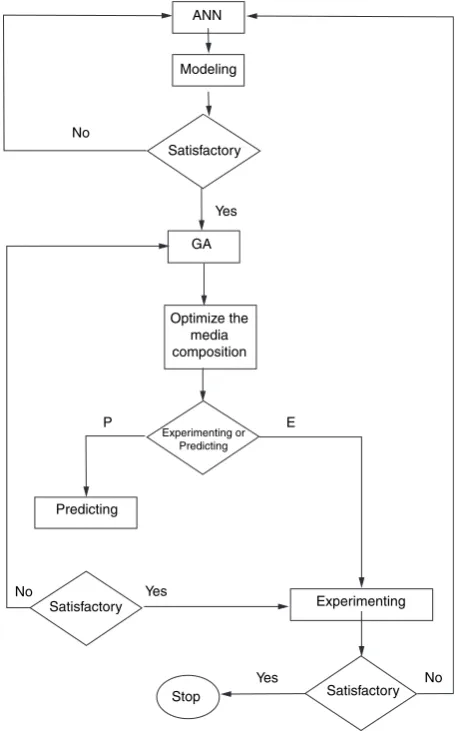
An FFNN together with the backpropagation is used as FFNN paradigm for nonlinear modelling in this study to reduce the experimental error and subsequent optimiza-tion of enzyme producoptimiza-tion using GA. Various steps involved in this study were represented schematically in flowchart (Fig. 1). FFNN consists of three layers namely input, hidden and output consisting of processing nodes (neurons). The network also contains an additional node, known as the bias, in the input and hidden layers. All nodes present in each layer are connected to subsequent layer nodes. The connection between each layer is termed as weight. The tan sigmoid activation function for hidden layer and linear transfer function for output nodes were used in the present study. The input data vectors were scaled to code values as)1 to +1 according to Zhuet al.
(1996) and Colemanet al.(2003).
The FFNN is a nonlinear function-mapping device that determines the N-dimensional nonlinear function vector,
f, where f: X fi Y, where X is a set of ‘n’ number of input vectors (i.e. X= {xn}; n= 1,2,…,N and x= [x1,x2,…,xn]T) and Y is a set of the corresponding output vector (protease production) (i.e. Y= {yn}; n= 1,2,…,Nand y= [y1,y2,…,yN].
In the present study, six microbial growth and metabo-lism related fermentation factors such as glucose, soya bean meal concentrations, incubation temperature, medium pH, medium volume (ml) in 250-ml flask and inoculum size (Table 1) were selected based on prelimin-ary experimental results and used.
The precise form offis determined by:
i Network topology
ii Choice of the activation function used for computing the outputs of the hidden and output nodes and
iii Network weight matrices (weightH and weightO) and bias (biasIand biasH) (where weightH is weight on con-nections between input and hidden nodes; weightO is weight on connections between hidden and output nodes; biasIis input bias; biasHis hidden layer bias).
The following equation is the outcome of the neural network training relating the input to the output variable, given in terms of weights and biases.
Table 1Selected factors and their minimum and maximum concen-tration used for alkaline protease production by isolatedBacillus circu-lansunder submerged fermentation
Coded
variable Variable Lower Upper
x1 Glucose, (gram per100 ml) 0Æ25 2Æ5 x2 Soya bean meal, (gram per 100 ml 0Æ25 2Æ5
x3 Temperature (C) 27 39
x4 pH 8 12
x5 Volume (ml) 25 125
x6 Inoculum size (ml) 1 5
ANN
Modeling
Satisfactory No
GA
Experimenting or Predicting
E
Predicting
Yes
Yes No
No Satisfactory
Stop Satisfactory
Experimenting P
Yes
Optimize the media composition
Youtput ¼ WeightsO
2
1þeð2weightsHinput vectorþinput biasðb1ÞÞ1
þHidden layer biasðbHÞ
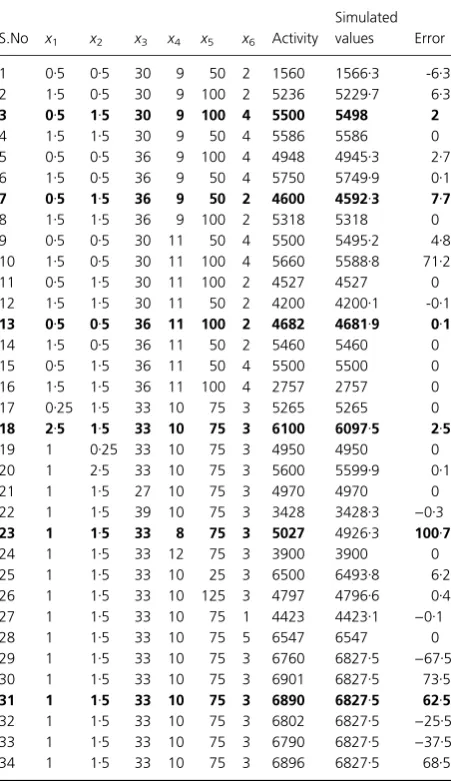
The hidden neurons were increased step by step till the best correlation was achieved (limited to 13 in the present study, because increase in the number of hidden neurons usually results in a better learning performance, although there is a practical upper limit because too many hidden neurons may result in problems such as including the process noise, which is also known as overlearning). In total, 34 experimental runs were performed in this study, 28 runs (approx. 80%) were selected for training and remaining 6 runs (approx. 20%; the data shown in bold letters in Table 2) were used for testing. The goodness of fit was determined by the coefficient R2, which describes the extent of variance in the modelled variables. The error was calculated based on the difference between experi-mental and predicted values. Mean absolute percentage error (MAPE) and mean square error (MSE) were com-puted using simulated and experimental data according to Zhang and Fang (2006). The percent contribution of each selected parameter was calculated using factor fitness scores, which were generated during training of the net-work and the contribution of each factor was calculated by using the below formula.
Percentage contribution of each factor
¼ Factor fitness score Total factors score 100
GA optimization
GAs are employed to search and optimize the maximum of a function over some domain space. Points in the domain space of the search (usually real numbers) are encoded as bit strings, called chromosomes. Each bit position in the string is called a gene and each starting solution (here selected fermentation parameter) is known as population. Every population is evaluated for their fit-ness while solving the problem. From the initial popula-tion of chromosomes, a new populapopula-tion is generated using three genetic operations: reproduction (generation of new population), crossover (exchange of bits in a pair of chromosome) and mutation (flipping of bits in off-spring).
GA optimization was performed using FFNN output values (weights and bias) using same fitness function. Each GA output simulation was used to search in differ-ent subspace and to locate the global maximum on the objective function surface. The underlying optimization
objective is to find the L-dimensional optimal decision variables by fixing the lower and upper bounds (Table 1) (xlL<xl<xlU l = 1, 2, 3,…, L). xdenotes the fermenta-tion operating condifermenta-tions (L= 6) and xlL and xlU repre-sent the lower and upper bounds on xl. In this study, different parameters of GA optimization such as chromo-some length (lchr) as 60, population size (Npop) as 60, crossover probability as 0Æ9 and mutation probability (Pmut) as 0Æ01 were assumed based on literature reports (Fang et al. 2003). Optimum conditions were selected after evaluation of GA for 500 generations (Ngmax= 500) to achieve fine-tuned fermentation conditions in the given range of input parameters. Neural networks and GA toolboxes of MATLAB 7.0 (The Mathworks, Inc., Natick, MA, USA) were used in modelling studies.
Table 2 Alkaline protease production experimental set up, protease activity (experimental and predicted) and error predicted
S.No x1 x2 x3 x4 x5 x6 Activity
Simulated values Error
1 0Æ5 0Æ5 30 9 50 2 1560 1566Æ3 -6Æ3 2 1Æ5 0Æ5 30 9 100 2 5236 5229Æ7 6Æ3
3 0Æ5 1Æ5 30 9 100 4 5500 5498 2
4 1Æ5 1Æ5 30 9 50 4 5586 5586 0
5 0Æ5 0Æ5 36 9 100 4 4948 4945Æ3 2Æ7 6 1Æ5 0Æ5 36 9 50 4 5750 5749Æ9 0Æ1
7 0Æ5 1Æ5 36 9 50 2 4600 4592Æ3 7Æ7
8 1Æ5 1Æ5 36 9 100 2 5318 5318 0
9 0Æ5 0Æ5 30 11 50 4 5500 5495Æ2 4Æ8 10 1Æ5 0Æ5 30 11 100 4 5660 5588Æ8 71Æ2
11 0Æ5 1Æ5 30 11 100 2 4527 4527 0
12 1Æ5 1Æ5 30 11 50 2 4200 4200Æ1 -0Æ1 13 0Æ5 0Æ5 36 11 100 2 4682 4681Æ9 0Æ1
14 1Æ5 0Æ5 36 11 50 2 5460 5460 0
15 0Æ5 1Æ5 36 11 50 4 5500 5500 0
16 1Æ5 1Æ5 36 11 100 4 2757 2757 0
17 0Æ25 1Æ5 33 10 75 3 5265 5265 0
18 2Æ5 1Æ5 33 10 75 3 6100 6097Æ5 2Æ5
19 1 0Æ25 33 10 75 3 4950 4950 0
20 1 2Æ5 33 10 75 3 5600 5599Æ9 0Æ1
21 1 1Æ5 27 10 75 3 4970 4970 0
22 1 1Æ5 39 10 75 3 3428 3428Æ3 )0Æ3 23 1 1Æ5 33 8 75 3 5027 4926Æ3 100Æ7
24 1 1Æ5 33 12 75 3 3900 3900 0
25 1 1Æ5 33 10 25 3 6500 6493Æ8 6Æ2 26 1 1Æ5 33 10 125 3 4797 4796Æ6 0Æ4 27 1 1Æ5 33 10 75 1 4423 4423Æ1 )0Æ1
28 1 1Æ5 33 10 75 5 6547 6547 0
29 1 1Æ5 33 10 75 3 6760 6827Æ5 )67Æ5 30 1 1Æ5 33 10 75 3 6901 6827Æ5 73Æ5
31 1 1Æ5 33 10 75 3 6890 6827Æ5 62Æ5
Results
Alkaline protease production by any microbial strain depends on various fermentation, environmental and growth conditions. Our preliminary studies indicated that the enzyme production by isolated B. circulans is greatly regulated by carbon (glucose 1%) and nitrogen (soya bean meal 1%) sources in addition to incubation temper-ature (33C), pH of the medium (pH 10Æ0), initial inocu-lum concentration (3Æ0% of 24 h grown 0Æ8 absorbance culture at 600 nm) and aeration (75 ml medium in 250-ml conical flask) (results not shown). Maximum enzyme production of 3245 U ml)1was observed under the above conditions. Hence, further experiments were carried to evaluate the impact of each above parameter and its con-centration on alkaline protease production. Each selected parameter’s range at which enzyme production was noticed was considered to determine the lower and upper limit (Table 1) and further each parameter was divided into different levels by taking the consensus of research team. Experimental lay out was prepared using modified fractional factorial central composite design (MATLAB 7.0) and the data were analysed using FFNN (Table 2). Desai et al. (2006) reported similar experimental study for production of exopolysaccharide (EPS) using Lactoba-cillus plantarum.
The protease production values were varied depending on the experimental conditions (Table 2). The FFNN pro-gram was initially tested using Levenberg–Marquardt backpropagation (Rumelhart et al. 1986), Bayesian regu-larization backpropagation (MacKay 1992; Foresee and Hagan 1997), Conjugate gradient backpropagation with
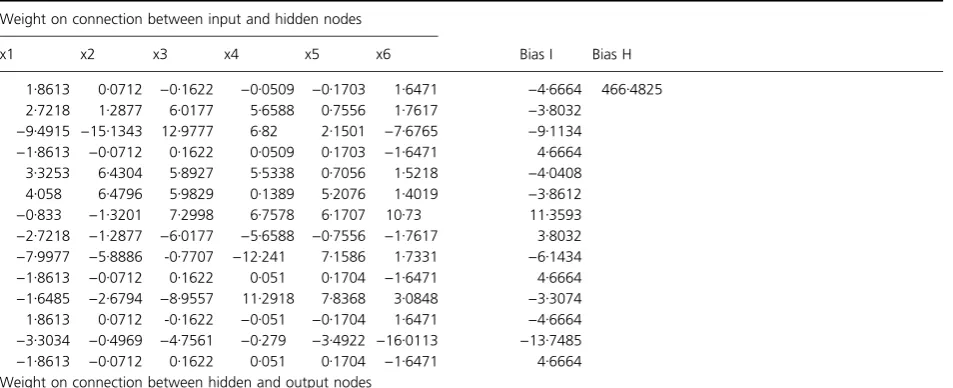
Powell–Beale restarts (Powell 1977) and scaled conjugate gradient backpropagation (Moller 1993). Among all these, Levenberg–Marquardt backpropagation showed a better correlation between experimental (1560–6896 Units) and simulated values (1566–6826 Units). Initially, weight and bias values were taken randomly during network training and were further optimized to minimize the error. The final optimized weight and bias values were presented in Table 3. The average error (average difference between software predicted and experimental value) was observed to be approx. 0Æ95% (Table 2).
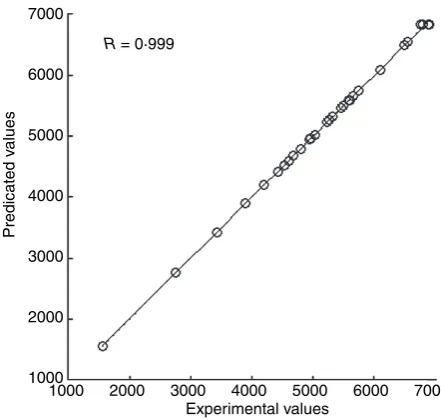
At optimum correlated conditions, 13 neurons were observed in the hidden layer suggesting ‘6-13-1’ FFNN topology for this experiment (Fig. 2). Figure 3 depicted the quality of the network for all data points of training and testing. The simulated data showed the excellent cor-relation with the observed data. The overall MAPE and MSEs were observed to be 0Æ0048, 27Æ9, 0Æ001128 and 22Æ45 enzyme activity (U ml)1) for training and testing, respectively. The smallest value of MSE suggested that the FFNN possesses good approximation and generalization characteristics for production of alkaline protease by this bacterial strain. The goodness of the neural network pre-diction was analysed by calculating the coefficient of R2, which was found to be 0Æ9993. Figure 3 also shows that the predictions were concentrated near the diagonal line on the graph and almost no scattering points were found. The FFNN output enzyme production data were fur-ther optimized to get the best fermentation parameters using GA. Because, in general, all algorithms give a local optimized solution for the nonlinear problems, whereas the GA gives a global solution. Table 4 depicts the best
Table 3The weight and bias values of nonlinear function at optimum conditions
Weight on connection between input and hidden nodes
Bias I Bias H
x1 x2 x3 x4 x5 x6
1Æ8613 0Æ0712 )0Æ1622 )0Æ0509 )0Æ1703 1Æ6471 )4Æ6664 466Æ4825 2Æ7218 1Æ2877 6Æ0177 5Æ6588 0Æ7556 1Æ7617 )3Æ8032
)9Æ4915 )15Æ1343 12Æ9777 6Æ82 2Æ1501 )7Æ6765 )9Æ1134
)1Æ8613 )0Æ0712 0Æ1622 0Æ0509 0Æ1703 )1Æ6471 4Æ6664
3Æ3253 6Æ4304 5Æ8927 5Æ5338 0Æ7056 1Æ5218 )4Æ0408 4Æ058 6Æ4796 5Æ9829 0Æ1389 5Æ2076 1Æ4019 )3Æ8612
)0Æ833 )1Æ3201 7Æ2998 6Æ7578 6Æ1707 10Æ73 11Æ3593
)2Æ7218 )1Æ2877 )6Æ0177 )5Æ6588 )0Æ7556 )1Æ7617 3Æ8032
)7Æ9977 )5Æ8886 -0Æ7707 )12Æ241 7Æ1586 1Æ7331 )6Æ1434
)1Æ8613 )0Æ0712 0Æ1622 0Æ051 0Æ1704 )1Æ6471 4Æ6664
)1Æ6485 )2Æ6794 )8Æ9557 11Æ2918 7Æ8368 3Æ0848 )3Æ3074
1Æ8613 0Æ0712 -0Æ1622 )0Æ051 )0Æ1704 1Æ6471 )4Æ6664
)3Æ3034 )0Æ4969 )4Æ7561 )0Æ279 )3Æ4922 )16Æ0113 )13Æ7485
)1Æ8613 )0Æ0712 0Æ1622 0Æ051 0Æ1704 )1Æ6471 4Æ6664
Weight on connection between hidden and output nodes
possible optimal conditions obtained after performing various GA trails and only the best four conditions among all were selected for further verification. From the given experimental data, it could be seen that the maximum protease yield was 6896 U ml)1 before and
increased to 8320 U ml)1 after the FFNN–GA hybrid optimization indicating an increase of approximately 20%. These results were in accordance with Dutta et al.
(2004), where an increase of protease yield from 56 to 58Æ5 U ml)1was reported by optimizing the pH, tempera-ture and inoculum size with RSM and ANN models while Desai et al. (2006) showed increased EPS yield with the help of PB–ANN–GA methods.
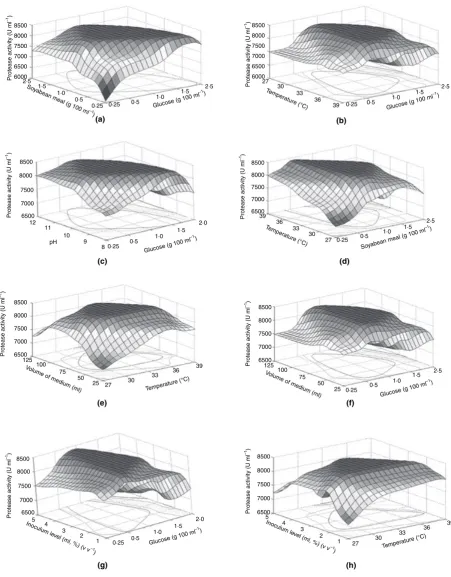
Based on the above experimental results, surface con-tours were generated to understand the impact of one factor on the other using fitness function with the help of MATLAB 7.0. Maximum production surfaces observed are symmetric and flat near the optimum envi-ronment (Fig. 4). The protease production varied with variation of glucose and soya bean meal concentration ratio in the fermentation medium (Fig. 4a). For exam-ple, maximum enzyme production can be possible in any given carbon source range of 0Æ3–2Æ5% (w⁄v) by altering the nitrogen source (soya bean meal) concentra-tion in the range of 0Æ25–2Æ5% (w⁄v) in the medium (Fig. 4a) indicating the carbon and nitrogen source ratio regulate the protease production in this bacterial strain. Analysis of glucose interaction with incubation tempera-ture (Fig. 4b) indicated that optimal protease production could be possible in the incubation temperature range of 28–38C with the supplementation of glucose in the range of 0Æ5–1Æ8% (w⁄v) in fermentation medium. Fur-ther increase in glucose concentration caused reduced enzyme production (Fig. 4b). Similar trend was noticed with volume of the medium (Fig. 4f). Selected glucose concentration range also showed positive effect on alka-line protease production at lower level of medium pH (7–10 pH range; Fig. 4c). Comparative evaluation between incubation temperature and inoculum level sug-gested that 2–4% (ml) inoculum was effective for maxi-mum enzyme production in the temperature range of 28–37C (Fig. 4h). Similar enzyme production trend was observed with incubation temperature vs medium volume (Fig. 4e). It was interesting to note that 33C was effective for optimum enzyme production with 2– 4% inoculum range and 50–100 ml of volume in 250-ml conical flask (Fig. 4e,h).
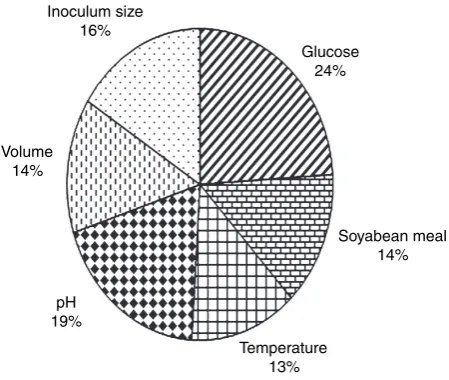
Figure 5 represents the each fermentation factor contri-bution on the overall alkaline protease production by this
B. circulans. Maximum impact was observed with glucose
Hidden layer
WeightH
biasH
biasI
Input layer
Output layer
Protease yield Glucose
Soyabean Meal
pH Temperature
Inoculum Size
Tan-sigmoid transfer function
Linear transfer function
Volume
WeightO
Figure 2Feed-forward neural network architecture used for alkaline protease production fermentation factors optimization.
7000
7000 6000
R = 0·999
6000 5000
5000 4000
4000 3000
3000
Experimental values
Predicated v
a
lues
2000
2000 1000
1000
Figure 3Correlation chart for experimental and FFNN predicted alka-line protease production data. (s) Data points; (____) Best line fit; (……) E = P.
Table 4The best possible selected
fermentation conditions predicted and verified enzyme yields
S.No Glucose
Soya bean
meal Temperature pH Volume
Inoculum size
GA-optimized yield
Experimental yield
1 1Æ12 1Æ21 34Æ5 9Æ5 85 4Æ5 8210 8228
2 1Æ2 1Æ21 34Æ58 9Æ65 86 5Æ1 8283 8320
3 1Æ22 1Æ12 34Æ6 9Æ66 86 5Æ3 8308 8240
8500 8000 7500 7000 6500 8500 8000 7500 7000 6500 75 50 25 27 1 2 3 4 5 1 2 3 4 5 30 33 36 39 27 30 33 36 39 100 125 75 50 25 100 125 8500 8000 7500 7000 6500 8500 8000 7500 7000 6500 8500 8000 7500 7000 6500 8500 8000 7500 7000 6500 6000
Protease activity (U ml
–1
)
Protease activity (U ml
–1
)
Protease activity (U ml
–1)
Protease activity (U ml
–1)
Protease activity (U ml
–1
)
P
rotease activity (U ml
–1
)
Protease activity (U ml
–1
)
Protease activity (U ml
–1)
2·5
2·5 1·5
So
yabean meal (g 100 ml
–1
)
Soyabean meal (g 100 ml
–1)
Volume of medium (ml)
Volume of med
ium (ml) Temper
ature (°C)
Temperature (°C)
Temperature (°C) Glucose (g 100 ml
–1)
Glucose (g 100 ml –1) Glucose (g 100 ml
–1) Glucose (g 100 ml
–1)
Glucose (g 100 ml –1)
Temper ature (°C)
Inoculum le
vel (ml, %) (v v
–1
)
Inoculum le
vel (ml, %) (v v
–1 ) 1·5 1·0 1·0 0·5 0·5 0·25 0·25 (a) 27 2·5 30 1·5 33 1·0 36 0·5 39 0·25 2·5 1·5 1·0 0·5 0·25 2·5 1·5 1·0 0·5 0·25 2·0 1·5 1·0 0·5 0·25 2·0 1·5 1·0 0·5 0·25 27 30 33 36 39 12 11 10 pH 9 8 8500 8000 7500 7000 6500 6000 8500 8000 7500 7000 6500 (b) (c) (d) (e) (f) (g) (h)
Figure 4Effect of selected fermentation factors interactions on alkaline protease production by isolatedBacillus circulans.(a) Glucosevs Soya bean meal (b) Glucosevstemperature (c) GlucosevspH (d) Soya bean mealvstemperature (e) Temperaturevsvolume of the medium (f) Glucose vsvolume of the medium (g) Glucosevsinoculum level (h) Temperaturevsinoculum level. [Note: In all the above figures, only two factors men-tioned onxandyaxes were varied and other four factors values were as follows: Glucose: 12Æ0 (g l)1, w⁄v), Soya bean meal: 12Æ1 (g l)1, w⁄v),
(24%) followed by pH of the medium (19%) and the least was noticed with incubation temperature (13%) under FFNN–GA optimized environment.
Discussion
In this study, six different bacterial growth-associated fac-tors were studied in terms of their individual influence on alkaline protease production. Table 2 clearly indicates the influence of above selected fermentation factors on alkaline protease production by this microbial strain, where minimum and maximum enzyme production was noticed to be 1560 and 6900 U ml)1 depending on the fermentation factors’ concentrations⁄values, respectively. Validation of FFNN–GA results revealed an increase in enzyme production from 3245 to 8320 denoting >2Æ5-fold increase in enzyme yield with the medium (pH 9Æ65) con-sisting of glucose 12Æ0 and soya bean meal 12Æ1 (g l)1) at 34Æ58C using 86 ml of fermentation medium in 250-ml conical flask with inoculum level of 5Æ1 ml (Table 4). Such optimization mediated enzyme yield improvement was also reported with bacterial and fungal strains (Prak-ashamet al.2007a,b). These results suggest that fermenta-tion parameters greatly influence the extracellular production of proteases in this microbial strain and their interaction plays an important role in the synthesis of this enzyme because of their regulatory role in the induction or repression of the enzyme production. A similar cata-bolic control mechanism for extracellular enzyme produc-tion has been described for Pseudomonas maltophilia
(Boethling 1975), Yersinia ruckeri (Secades and Guijarro 1999) andPseudoalteromonassp. SM9913 (Liet al.2004).
The enzyme production was regulated by carbon and nitrogen sources ratio. An effective protease production could be achieved by varying one of these two sources by keeping the other nutrient concentration constant (Fig. 4). One percent glucose supplementation was effec-tive for optimum protease production in the studied soya bean meal concentration range of 0Æ25–2Æ5% (g, w⁄v), at a temperature range of 28–39C, at varied medium pH of 8–12, at different inoculum levels (1Æ0–5Æ0% (ml, v⁄v) and in different volumes (25–125 ml in 250-ml conical flask; Fig. 4) indicating among all the factors, glucose had the maximum influence followed by pH of the medium (Fig. 5) on bacterial metabolism in alkaline protease pro-duction. Though the influence of increased inoculum on enhanced enzyme production was well reported in the lit-erature (Kumar and Takagi 1999; Prakasham et al.2006); however, soya bean meal concentration regulated produc-tivity of protease as observed in this study was not docu-mented.
Interactive influence of selected fermentation factors was analysed using three-dimensional surface plots simu-lated by network output. Each contour curve represents an infinite number of combinations of two test variables with the other maintained at their respective optimized levels. These surface contours revealed symmetric and flat surface near the optimum environment (Fig. 4) unlike other RSM contours reported in the literature (Himabin-duet al.2006) suggesting that the optimum protease pro-duction by this microbial strain could be achieved in wide concentration ranges. The above data further sup-ported that interaction among fermentation parameters was one of the important aspects in achieving optimum productivity of any metabolite and further improvement in enzyme production is possible with regulation of inter-active influences between selected fermentation para-meters. This data helps in simulation of economic fermentation medium especially, with respect to selection of carbon and nitrogen source concentrations in scale-up studies to produce maximum alkaline protease produc-tion using this B. circulans.
Overall, alkaline protease production by B. circulans
was optimized using hybrid of FFNN–GA, selecting the physical parameters and medium composition. The FFNN model was constructed on the basis of data from 34 fer-mentation experiments. This FFNN model showed excel-lent prediction accuracy and generalization ability. The alkaline protease yield obtained in the validation experi-ments was 8320 Units, which were in close agreement with the GA, optimized yield of 8283 Units. It can, thus, be seen that the usage of FFNN–GA hybrid methodology has resulted in a significant improvement in the alkaline protease yield (>2Æ5-fold). The approach presented in this paper is sufficiently general and thus can also be
Inoculum size 16%
Glucose 24%
Soyabean meal 14%
Temperature 13% pH
19% Volume
14%
employed for modelling and optimization of other bio-processes.
Acknowledgement
Authors thank Department of Science and Technology, New Delhi, Council of Scientific and Industrial Research, New Delhi for financial support.
References
Achary, A., Hariharan, K.A., Bandhyopadhyaya, S., Ramachan-dran, R. and Jayaraman, K. (1997) Application of numeri-cal modeling for the development of optimized complex medium for D-hydantoinase production from Agrobacte-rium radiobacterNRRL B11291.Biotechnol Bioeng55, 148– 154.
Akhnazarova, S. and Kafarov, V. (1982)Experiment optimiza-tion in chemistry and chemical engineering. Moscow: Mir Publications.
Arulsudar, N., Subramanian, N. and Murthy, R.S.R. (2005) Composition of artificial neural network and multiple lin-ear regression in the optimization of formulation parame-ters of leuprolide acetate loaded liposomes.J Pharm Pharm Sci8, 243–258.
Banerjee, C.U., Sani, R.K., Azmi, W. and Soni, R. (1999) Ther-mostable alkaline protease fromBacillus brevisand its characterization as a laundry detergent additive.Process Biochem35, 213–219.
Boethling, R.S. (1975) Regulation of extracellular protease secretion inPseudomonas maltophilia.J Biotechnol123, 954–961.
Coleman, M.C., Buck, K.K.S. and Block, D.E. (2003) An integrated approach to optimization ofEscherichia coli fermentations using historical data.Biotechnol Bioeng84, 274–285.
Desai, K.M., Akolkar, S.K., Badhe, Y.P., Tambe, S.S. and Lele, S.S. (2006) Optimization of fermentation media for exo-polysaccharide production fromLactobacillus plantarum using artificial intelligence based technique.Process Bio-chem41, 1842–1848.
Dutta, J.R., Dutta, P.K. and Banerjee, R. (2004) Optimization of culture parameters for extracellular protease production from a newly isolatedPseudomonassp. using response sur-face and artificial neural network models.Process Biochem 39, 2193–2198.
Fang, B., Hongwen, C., Xiolan, X., Ning, W. and Zongding, H. (2003) Using genetic algorithms coupling neural networks in a study of xylitol production: medium optimization. Process Biochem38, 979–985.
Foresee, F.D. and Hagan, M.T. (1997) Gauss–Newton approxi-mation to Bayesian regularization. InProceedings of the 1997 International Joint Conference on Neural Networks, Houston, Texas, USA, June 9–12, pp. 1930–1935.
Freyer, S., Weuster-Botz, D. and Wandery, C. (1992) Medium optimization using genetic algorithms.Bioeng8, 16–25. Genckal, H. and Tari, C. (2006) Alkaline protease production
from alkalophilicBacillussp. isolated from natural habi-tats.Enzyme Microb Technol39, 703–710.
Gupta, R., Beg, Q.K. and Lorenz, P. (2002) Bacterial alkaline proteases: molecular approaches and industrial applica-tions.Appl Microbiol Biotechnol59, 15–32.
Hagihara, B., Matsubara, H., Nakai, M. and Okunuki, K. (1958) Crystalline bacterial proteinase. I. Preparation of crystalline proteinase of Bacillus subtilis.J Biochem45, 185–194.
Hanai, T., Honda, H., Ohkusu, E., Ohki, T., Tohayama, H., Muramastu, T. and Kobayashi, T. (1999) Application of an artificial neural network and genetic algorithm for determination of process orbits in the koji making process. J Biosci Bioeng87, 507–512.
Himabindu, M., Ravichandra, P., Vishalakshi, K. and Anna-purna, J. (2006) Optimization of critical medium compo-nents for the maximal production of gentamicin by Micromonospora echinosporaATCC 15838 using response surface methodology.Appl Biochem Biotechnol134, 143– 154.
Hongwen, C., Baishen, F. and Zongding, H. (2005) Optimiza-tion of process parameters for key enzymes accumulaOptimiza-tion of 1,3,propanediol production fromKlebsilla pneumoniae. Biochem Eng J25, 47–53.
Joo, H.S., Kumar, C.G., Park, G.C., Paik, S.R. and Chang, C.S. (2003) Oxidant and SDS stable alkaline protease from Bacillus clausiiI-52: production and some properties. J Appl Microbiol95, 267–272.
Kamimura, R., Kostantinov, K. and Stephanopolus, G. (1996) Knowledge-based systems, artificial neural networks and pattern recognition: application in biotechnological processes.Curr Opin Biotechnol7, 231–234.
Kulkarni, S.G., Choudary, A.K., Nandi, S., Tambe, S. and Kulkarni, B.D. (2004) Modeling and monitoring of batch process using principal component analysis (PCA) assisted generalized regression neural networks (GRNN).Biochem Eng J18, 193–210.
Kumar, C.G. and Takagi, H. (1999) Microbial alkaline prote-ases: from a bioindustrial viewpoints.Biotechnol Adv17, 561–594.
Li, W.J., Pan, J., He, H.L., Chen, X.L., Zhang, Y.Z. and Gao, P.J. (2004) Optimization of cold adapted protease fermen-tation by benthal psychrotrophicPseudoaltermonassp. SM9913.J Shangdong Univ39, 104–108.
Liu, C.H., Hwang, C.F. and Liao, C.C. (1999) Medium optimi-zation for glutathione production bySaccharomyces cerevi-siae.Process Biochem34, 17–23.
MacKay, D.J.C. (1992) Bayesian interpolation.Neural Comput 4, 415–447.
Montague, G. and Morris, J. (1994) Neural-network contribu-tions in biotechnology.Trends Biotechnol12, 312–324. Nagata, Y. and Chu, K.H. (2003) Optimization of a
fermenta-tion medium using neural networks and genetic algo-rithms.Biotechnol Lett25, 1837–1842.
O’Meara, G.M. and Munro, P.A. (1984) Selection of a proteo-lytic enzyme to solubilize lean beef tissue.Enzyme Microb Technol6, 181–185.
Powell, M.J.D. (1977) Restart procedures for the conjugate gradient method.Math Prog12, 241–254.
Prakasham, R.S., Kuriakose, B. and Ramakrishna, S.V. (1999) The influence of inert solids on ethanol production by Sac-charomyces cerevisiae.Appl Biochem Biotechnol82, 127–134. Prakasham, R.S., Subba Rao, Ch., Sreenivas Rao, R. and
Sarma, P.N. (2005) Alkaline protease production by an isolatedBacillus circulansunder solid-state fermentation using agroindustrial waste: process parameters optimiza-tion.Biotechnol Prog21, 1380–1388.
Prakasham, R.S., Subba Rao, Ch. and Sarma, P.N. (2006) Green gram husk: an inexpensive substrate for alkaline protease production byBacillussp. in solid-state fermenta-tion.Bioresour Technol97, 1449–1454.
Prakasham, R.S., Rao, Ch.S., Rao, R.S., Lakshmi, G.S. and Sarma, P.N. (2007a) L-asparaginase production by isolated Staphylococcussp. - 6A: design of experiment considering interaction effect for process parameter optimization. J Appl Microbiol102, 1382–1391.
Prakasham, R.S., Subba Rao, Ch., Sreenivas Rao, R. and Sarma, P.N. (2007b) Enhancement of acid amylase pro-duction by an isolatedAspergillus awamori.J Appl Micro-biol102, 204–211.
Rao, R.S., Prakasham, R.S., Prasad, K.K., Rajesham, S., Sarma, P.N. and Rao, L.V. (2004) Xylitol production by Candida sp.: parameter optimization using Taguchi approach. Pro-cess Biochem39, 951–956.
Rao, R.S., Jyothi, C.P., Prakasham, R.S., Rao, Ch.S., Sarma, P.N. and Rao, L.V. (2006) Strain improvement ofCandida tropicalisfor the production of xylitol: biochemical and physiological characteristics of wild-type and mutant strain CT-OMV5.J. Microbiol44, 113–120.
Rebecca, B.D., Pena-Vera, M.T. and Diaz-Castaneda, M. (1991) Production of fish protein hydrolysates with bacte-rial proteases, yield and nutritional value.J Food Sci56, 309–314.
Rumelhart, D.E., Hinton, G.E. and Williams, R.J. (1986) Learning representations by back-propagating errors. Nat-ure323, 533–536.
Secades, P. and Guijarro, J.A. (1999) Purification and charac-terization of an extracellular protease from the fish patho-genYersinia ruckeriand effect of culture conditions on production.Appl Environ Microbiol65, 3969–3975. Sreenivas Rao, R., Pavana Jyothi, Ch., Prakasham, R.S., Sarma,
P.N. and Venkateswar Rao, L. (2006) Xylitol production from corn fiber and sugarcane bagasse hydrolysates by Candida tropicalis.Bioresour Technol97, 1974–1978. Subramanian, N., Yajnik, A. and Murthy, R.S.R. (2004)
Artifi-cial neural network as a alternative to multiple regression analysis in optimizing formulation parameters of cytrabine liposomes.AAPS PharmSciTech5, 1–9.
Tanimoto, S.-Y., Tanabe, S., Watanabe, M. and Arai, S. (1991) Enzymatic modification of zein to produce a non-bitter peptide fraction with a very Fisher ratio for patients with hepatic encephalopathy.Agric Biol Chem55, 1119– 1123.
Turk, B. (2006) Targeting proteases: successes, failures and future prospects.Nat Rev Drug Discov5, 785–798. Weuster-Botz, D. and Wandrey, C. (1995) Medium
optimiza-tion by genetic algorithm for continuous producoptimiza-tion of formate dehydrogenase.Process Biochem30, 563–571. Zhang, G. and Fang, B. (2006) A uniform design-based back
propagation neural network model for amino acid compo-sition and optimal pH in G⁄11 xylanase.J Chem Technol Biotechnol81, 1185–1189.
Zhu, Y.H., Rajalahti, T. and Linko, S. (1996) Application of neural networks to lysine production.Chem Eng J62, 207–214.