Vol. 15, No. 1, 2017, 67-75
ISSN: 2279-087X (P), 2279-0888(online) Published on 11 December 2017
www.researchmathsci.org
DOI: http://dx.doi.org/10.22457/apam.v15n1a6
67
Annals of
A Study on Intuitionistic L-Fuzzy Metric Spaces
S. Yahya Mohamad1 and E.Naargees Begum21
PG & Research Department of Mathematics, Government Arts College Trichy-22, Tamilnadu, India. E-mail: [email protected]
2
Department of Mathematics, Bharathiyar Arts & Science College for Women Deviyakurichi, Tamilnadu, India. Email: [email protected]
Received 10 November 2017; accepted 5 December 2017
Abstract. Intuitionistic fuzzy set can be utilized as a proper tool for representing hesitancy concerning both membership and non-membership of an element to a set. Atanassov introduced and studied the concept of Intuitionistic fuzzy sets.The intuitionistic fuzzy models give more precision, flexibility and compatibility to the system as compared to the classical and fuzzy models. In this paper, a new concept of Intuitionistic fuzzy metric space is introduced and some theorems about Inuitionistic L-fuzzy metric space are discussed.
Keywords: Intuitionistic fuzzy set, intuitionistic l-fuzzy metric space, operations on intuitionisitc L-metric spaces.
AMS Mathematics Subject Classification (2010): 05C72, 54E50, 03F55 1. Introduction
Fuzzy sets are sets whose elements have degrees of membership. Fuzzy sets are introduced by Zadeh [7] as an extension of the classical notion of sets. The concept of an intuitionistic fuzzy set can be viewed as an alternative approach to define a fuzzy set in cases where available information is not sufficient for the definition of an imprecise concept by means of a conventional fuzzy set. In general, the theory of intuitionistic fuzzy sets is the generalization of fuzzy sets.
In the year 1989 Atanassov[1] introduced Interval valued intuitionistic fuzzy sets and many researchers have shown interest in the IFS theory and successfully applied in many other fields.
This paper is organized as follows. The definition of fuzzy metric space and intuitionistic fuzzy metric space and are introduced in section 2. In section 3, we extend the fuzzy metric space to L-fuzzy metric space, In that, the range of the function will be a lattice. Also the definitions of intuitionistic L- Fuzzy metric space are introduced. In section 4, we dicuss about the theorems on intuitionistic L- Fuzzy metric space in weakly compaitable.
2. Preliminaries
S. Yahya Mohamad and E.Naargees Begum
68
membership of element x in fuzzy set A for each x ∈ X. It is clear that A is completely determined by the set of tuples A = {(u, µA(u))|u ∈ X}.
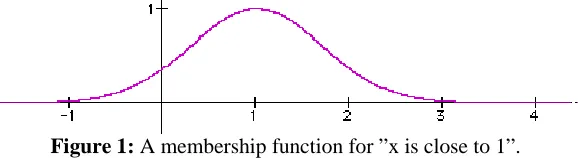
Example 2.1. The membership function of the fuzzy set of real numbers ”close to 1”, is can be defined as A(t) = exp(−β(t − 1)2)where β is a positive real number.
Figure 1: A membership function for ”x is close to 1”.
Definition 2.2. An L-fuzzy set ϕ on U is a mapping ϕ:U→ L, where L is a ‘transitive partially ordered set’. In this work, we assume that (L,≤) is a preordered set. Notice that it is natural to assume that the relation ≤ is not antisymmetric; if x, y ∈L are synonyms, that is, words or expressions that are used with the same meaning, then x ≤ y and x ≥ y, but still x and y are distinct words.
Example 2.2. Suppose that U consists of a group of people. The L-fuzzy set, whose membership function ϕ , describes how well the persons in U can ski. For instance, there exist people who can ski very well, some ski badly, and some are moderate skiers.
Definition 2.3. Let a set E be fixed. An IFS A in E is an object of the following . A = { ( x,µA( x ) , ʋA(x ) ), x∈E }, Where the functions µA ( x ) : E [0, 1] and ʋA (x ) : E [0,
1] determine the degree of membership and the degree of non-membership of the element x∈E, respectively, and for every x∈E: 0 ≤ µA( x )+ ʋA (x ) ≤1 When ʋA (x) = 1 - µA (x)
for all x∈E is ordinary fuzzy set. In addition, for each IFS A in E, if πA(x)= 1- µA (x) − ʋA
(x) Then πA(x) is called the degree of indeterminacy of X to A or called the degree of hesitancy of x to A. It is obvious that 0 ≤πA (x) ≤1, for each x∈E.
Example 2.3. An IF-set is a pair of mappings µ:X [0,1], ʋ: X [0,1] such that µ (x) +
ʋ (x) ≤ 1 for any x ∈X. In our case X is the set of all pupils in the considered class. If A(x) is the number of acceptation of the pupil x (hence A(x) ∈{0,1,…n} where n is the number of pupils in the class), then we put µ(x) = A(x)/ n
Similarly µ(x) =N(x) /n ,where N(x) is the numbers of non-acceptation of the pupil x. Since A(x) + N(x) ≤ n. We obtain µ(x) + ʋ(x) =A(x)/n+N(x)/n ≤ 1, hence the pair (µ,ʋ) is an example of an IF-set.
Definition 2.4. A binary operation *: [0,1] x [0,1]→[0,1] is called at- norm if ([0,1],*) is anabelian topological monoid with unit 1 such that a*b ≤c*d whenever a≤ c and b ≤ d for a, b, c, d ϵ [0,1].
69
Definition 2.5. A binary operation * : [0,1] x [0,1] → [0,1] is a continuous t-norm if it
satisfies the following conditions
a) * is a associative and commutative b) a*1 = a for all a ϵ [0,1]
c) * is continuous
d) a*b ≤ c*d whenever a ≤ c and b ≤ d, for each a, b, c, d ϵ [0,1].
Example 2.5. a*b = ab and a*b =(a,b)
Definition 2.6. The 3-tuple(X,M,*) is said to be a fuzzy metric space if X be a non empty set and * be a continuous t-norm. A fuzzy set X2 x (0,∞) is called a fuzzy metric on X if x, y, z ∈X and s, t >0 , the following condition holds
a) M (x, y, t) =0
b) M (x, y, t) = 1 iff x=y c) M (x, y, t) = M(y, x, t );
d) M (x, y, t + s) ≥ M(x, y, t) * M(x, y, s)
e) M (x, y, .) : (0, +∞) [0, 1] is left continuous
The function M(x,y,t) denote the degree of nearness between x and y with respect to t respectively.
Definition 2.7. A 5-tuple(X, M, N, *, ◊) is said to be an intuitionistic fuzzy metric space
if X is an arbitrary set, * is a continuous t-norm, ◊ is a continuoust- conorm and, M, Nare fuzzy sets on X2× [0, ∞) satisfying the conditions:
1) M(x, y, t) + N(x, y, t) ≤ 1 for all, x,y ϵX and ; t ˃ 0 2) M(x, y, 0) =0 for all, x,y ϵX,
3) M(x, y, t) = 1 for all, x,y ϵX, and t ˃ 0 if and only if x = y;
4) M(x, y, t) = M(y, x, t) for all, x,y ϵX and t> 0;
5) M(x, y, t)*M(y, z, s) ≤ M(x, z, t+s), for all, x, y, z ϵ X and s,t ˃0;
6) M(x, y, .):[0,∞)→[0,∞]is left continuous, for all, x,y ϵ X; 7) lim→∞M(x, y, t) = 1 for all, x,y ϵ X and t ˃ 0;
8) N(x, y, 0) = 1for all, x,y ϵ X ;
9) N(x, y, t) = 0, for all x,y ϵ X and t ˃ 0 if and only if x=y;
10) N(x, y, t) = N(y, x, t) for all, x,y ϵ X, and t> 0;
11) N(x, y, t) ◊ N(y, z, s) ≥ N(x, z, t+s) for all x, y, z ϵX and s,t ˃0;
12) N(x, y, .):[0,∞)→[0,1]is right continuous, for all x,y ϵ X; 13)lim→∞N(x, y, t) = 0 for all x,y ϵ X.
The functions M(x, y, t)and N(x, y, t) denote the degree of nearness and the degree of non-nearness between x and y w.r.t. t respectively.
Definition 2.8. Let X be a non-empty set and f:X → X be a mappings . A point x ϵ X is
called a fixed point of f if x remains invariant under f i.e. fx = x. In graphical terms, a fixed point means the point (x, fx) is on the line y = x, or in other words, the graph of f has a point in common with line y = x.
Example 2.6. A mappings f : R→R defined by f(x)= 3x, for all x ϵ R, x = 0 is the unique
S. Yahya Mohamad and E.Naargees Begum
70 3. Intuitionistic L-fuzzy metric space
Definition 3.1. A 5-tuple(X, M, N, *, ◊) is said to be an intuitionistic L-fuzzy metric space if X is an arbitrary set, * is a continuous t-norm, ◊ is a continuous t- conorm and, M, N are L-fuzzy sets on X2× [0, ∞) satisfying the conditions:
1. M(x, y, t) + N(x, y, t) ≤ 1 for all, x,y ϵX and ; t ˃ 0 2. M(x, y, 0) = 0 for all, x,y ϵX,
3. M(x, y, t) = 1 for all, x,y ϵX, and t ˃ 0 if and only if x = y;
4. M(x, y, t) = M(y, x, t) for all, x,y ϵX and t> 0;
5. M(x, y, t)*M(y, z, s) ≤ M(x, z, t+s), for all, x, y, z ϵ X and s,t ˃0;
6. M(x, y, .):[0,∞)→[0,∞]is left continuous, for all, x,y ϵ X; 7. lim→∞M(x, y, t) = 1 for all, x,y ϵ X and t ˃ 0;
8. N(x, y, 0) = 1for all, x,y ϵ X ;
9. N(x, y, t) = 0, for all x,y ϵ X and t ˃ 0 if and only if x=y; 10. N(x, y, t) = N(y, x, t) for all, x,y ϵ X, and t> 0;
11. N(x, y, t) ◊ N(y, z, s) ≥ N(x, z, t+s) for all x, y, z ϵX and s,t ˃0;
12. N(x, y, .):[0,∞)→[0,1]is right continuous, for all x,y ϵ X; 13. lim→∞N(x, y, t) = 0 for all x,y ϵ X.
The functions M(x, y, t) and N(x, y, t) denote the degree of nearness and the degree of non-nearness between x and y w.r.t. t respectively.
Definition 3.2. Let (X, M, N, *, ◊) be an intuitionistic L-fuzzy metric space. Then 1) A
sequence {xn} in X is said to be Cauchy sequence if, for all and t˃0 and p ˃ 0,
lim→∞M(x, x, t) = 1 andlim→∞N(x, x, t) = 1
2) A sequence {xn} in X is said to be convergent to a point x ϵ X, if for all t ˃ 0.
lim→∞M(x, x, t) = 1 and lim→∞N(x, x, t) = 0
Definition 3.3. An intuitionistic L-fuzzy metric space (X, M, N, *, ◊) is said to be complete if and only if every Cauchy sequence in X is convergent.
Example 3.1. Let = ∈ ∪{0} and let * be the continuous t-norm and ◊ be the
continuous t- conorm defined by a*b = ab, and a◊b = min {1,a+b} respectively, for all a,b
ϵ[0,1]. For each t ϵ (0,∞) and x,y ϵ X, define M and N by
( , !, ") = #|%&'| , " > 0
0, " = 0 ) and ( , !, ") = # |%&'|
|%&'|, " > 0 1, " = 0 ) Clearly (X, M, N, *, ◊) is complete intuitionistic L- fuzzy metric space.
Definition 3.4. A pair of self mappings (A,S)of a intuitionistic L-fuzzy metric space (X, M, N, *, ◊)is said to be commuting if and M(ASx, SAx, t) =1 and N(ASx,SAx, t) = 0 for all x ϵX.
Definition 3.6. A pair of self mappings (A,S M, N, *, ◊) is said to be
that for all t>0. M(ASx, SAx, t) clearly, every pair of weakly c with R=1.
Definition 3.7. Two mappings A and S of a Intuitionistic L *, ◊) are called reciprocally continuous
sequence such that Aun→
they are obviously reciprocally continuous but converse is not true.
Theorem 3.8. Let (X, M, N, *, continuous t-norm * and continuous
for all tϵ[0,1].Further, let (A,S)and (B,T) be point wise mappings of X satisfying:
A(X) ≤ T(X), B(X) ≤ S(X),….. (1) there exists a constant k
M(Ax, By, kt) ≥ M(Ty, By, t)*M(Sx, Ax, t)*M(Sx, By,
α)t)*M(Ty, Sx, t)
N(Ax, By, kt) ≤ N(Ty, By, t)
α)t)◊N(Ty, Sx, t) for all x,y ϵ X, t>0 and α
pair (A,S) or (B,T) on (X, M, N, *, Proof: First, assume that
and S are reciprocally continuous. Let {x for some z ϵX as n→∞.Since
and SSun→Sz as n→∞ and since (A,S) is compatible, we have
lim→∞*+,, +*,,
=>lim→∞*+,, +-,
That is ASun→Sz as n ASun= Tvn. Thus, we have, SSu
ASun=Tvn.Now we claim that Bv
Suppose not, then taking α
M( ASun , Bvn , kt)≥M ( , ASun , (2-α)t) *M
t)◊N(SSun,ASun,t)◊N(SSun,Bvn, Taking n→∞, we get
M(Sz, Bvn , kt) ≥M (Sz, N(SZ, Bvn , kt) ≤N (Sz, Bv That is,
M(Sz, Bvn, kt) ≥ M(Sz, Bv
N(Sz, Bvn, kt) ≤ N(Sz, Bv
we have Bvn→Sz as n→∞
Now, we claim that .Az=S M( Az, Bvn , kt)≥M (Tvn Sz, t)
71
A pair of self mappings (A,S),of a intuitionistic L-fuzzy metric space (X, ) is said to be point wise R-weakly commuting, if given x ϵ X, there exist such that for all t>0. M(ASx, SAx, t) ≥ M(Ax, Sx, 1/R), and N(ASx, SAx, t) ≥
clearly, every pair of weakly commuting mappings is point wise R-weakly commuting
Two mappings A and S of a Intuitionistic L-fuzzy metric space (X, M, N, reciprocally continuous if ASun→Az, SAun→Sz, whenever {x
→z, Sun→z, for some z in X. If A and S are both continuous, then they are obviously reciprocally continuous but converse is not true.
Let (X, M, N, *, ◊) be a complete intuitionistic L-fuzzy metric space with norm * and continuous t-conorm ◊ defined by t*t ≥ t and (1
[0,1].Further, let (A,S)and (B,T) be point wise R-weakly commuting pairs of self mappings of X satisfying:
≤ S(X),….. (1)
there exists a constant k ϵ (0,1) such that ……(2)
M(Ty, By, t)*M(Sx, Ax, t)*M(Sx, By, αt)*M(Ty, Ax,(2
N(Ty, By, t) ◊ N(Sx, Ax, t)◊ N(Sx, By, αt)◊N(Ty, Ax,(2
X, t>0 and α(0,2) . Then the continuity of one of the mappings in pair (A,S) or (B,T) on (X, M, N, *, ◊) implies their reciprocal continuity.
First, assume that A and S are compatible and S is continuous. We show that are reciprocally continuous. Let {xn} be a sequence such that Au
→∞.Since S is continuous, we have SAun→Sz and SSu
→∞ and since (A,S) is compatible, we have
, " 1,lim→∞*+,, +*,, " 0 " 1,lim→∞*+,, +-, " 0
→Sz as n→∞. By (1), for each n, there exists for all n . Thus, we have, SSun→Sz, SAun→Sz, and Tvn→Sz as n .Now we claim that Bvn→Sz as n→∞.
Suppose not, then taking α=1in (2), we have
(Tvn , Bvn ,t) * M (SSun , ASun ,t) * M (SSun , Bvn M (Tvn , SSun ,t) N ( ASun , Bvn , kt) ≤ N
◊N(SSun,Bvn, αt) ◊N(Tvn, ASun, (2-α)t) ◊ N (Tvn ,
, Bvn ,t) * M (Sz, Sz,t) * M (Sz, Bvn ,t) * M (Sz, Sz,t Bvn , t) ◊ N(Sz, Sz, t) ◊ N(Sz, Bvn, t) ◊N(Sz, Sz, t)
M(Sz, Bvn, t),
N(Sz, Bvn, t). →∞
Az=Sz. Again take α=1in (2), we have
n , Bvn ,t) * M (Sz, Az,t) * M (Sz, Bvn ,t) * M (Tvn ,
fuzzy metric space (X, X, there exist such
≥ N(Ax, Sx, 1/R) weakly commuting
fuzzy metric space (X, M, N, Sz, whenever {xn} is a
If A and S are both continuous, then
fuzzy metric space with t and (1-t) ◊ (1-t) ≤ (1-t) weakly commuting pairs of self
t)*M(Ty,
N(Ty,
Ax,(2-(0,2) . Then the continuity of one of the mappings in compatible
is continuous. We show that A } be a sequence such that Aun→z and Sun→z Sz and SSun→Sz as n→∞
. By (1), for each n, there exists for all n ϵ X such that Sz as n→∞ whenever
Bvn , αt) * M (Tvn N (Tvn , Bvn , , SSun , t)
t) * M (Sz, Sz,t) N(Sz, Sz, t) ◊ N(Sz, Sz, t)
S. Yahya Mohamad and E.Naargees Begum
72
N( Az, Bvn , kt)≤ N (Tvn , Bvn ,t) ◊ N (Sz, Az,t) ◊ N (Sz, Bvn ,t) ◊ N (Tvn , Az,t) * N (Tvn , Sz, t)
As n→∞
M (Az, Sz, kt) ≥ M (Sz, Sz,t) * M (Sz, Az,t) * M (Sz, Sz,t) * M (Sz, Az,t) * M (Sz, Sz,t) N(Az, Sz, kt) ≤ N(Sz, Sz,t)◊ N(Sz, Az, t) ◊ N(Sz, Sz, t) ◊N(Sz, Az, t) ◊ N(Sz, Sz, t) i.e.M(Az, Sz, kt) ≥ M(Sz, Az, t)
N(Az, Sz, kt) ≤ M(Sz, Az, t) Therefore, we have. Az = Sz Hence, SAun→ Sz, ASun→Sz = Az as n→∞
This proves that A and S are reciprocally continuous on X. Similarly, it can be proved that B and T are reciprocally continuous if the pair (B,T)is assumed to be compatible and T is continuous.
4. Intuitionistic L-fuzzy metric space in weakly compatible
Theorem 4.1. Let (X, M, N, *, ◊) be a complete intuitionistic L-fuzzy metric space with
continuous t-norm * and continuous t-conorm ◊ defined by t*t ≥ t and (1-t)◊(1-t) ≤(1-t)for all tϵ[0,1]. Further, let (A, S) and (B, T) be point wise R-weakly commuting pairs of self mappings of X satisfying (1), (2). If one of the mappings in compatible pair (A,S) or (B,T) is continuous, then A, B, S and T have a unique common fixed point.
Proof: Let x0ϵX. By (1), we define the sequences{xn} and{yn} in X such that for all, n =
0,1,2...
Y2n=Ax2n=Tx2n+1,y2n+1= Bx2n=1Sx2n+1, We show that{yn} is a Cauchy sequence in X. By
(2) take α=1-β, βϵ(0,1) ,we have
M( y2n+1, y2n+2 , kt) = M (Bx2n+1, Ax2n+2 , kt) = M ( Ax2n+2 , Bx2n+1, kt) ≥ M (Tx2n+1,
Bx2n+1,t) * M (Sx2n+2 , Ax2n+2 ,t)
M (Sx2n+2, Bx2n+1, (1-β)t) * M (Tx2n+1, Ax2n+2 , (1-β)t) * M (Tx2n+1, Sx2n+2 , t)
= M( y2n , y2n+1, t) * M ( y2n+1, y2n+2 , t) * M ( y2n+1, y2n+2 , (1-β)t) *
M ( y2n, y2n+2, (1-β)t) *1* M ( y2n, y2n+1,t)
=M ( y2n+1, y2n+2, β t) * M ( y2n, y2n+1,t)
≥M ( y2n, y2n+1, t) * M ( y2n+1, y2n+2, t) * M ( y2n+1, y2n+2, (1-β )t)
Now, taking β→1, we have
M( y2n+1 , y2n+2, kt )≥ M ( y2n , y2n+1 ,t) * M ( y2n+1 , y2n+2 ,t) * M(y2n+1 ,y2n+2 ,t)
M ( y2n+1, y2n+2, kt) ≥ M ( y2n, y2n+1,t) * M ( y2n+1, y2n+2,t)≥ M( y2n,y2n+1,t)
M(y2n+1 , y2n+2 , kt) ≥ M ( y2n , y2n+1 ,t)
Similarly, we can show that
M(y2n+2 , y2n+3 , kt)≥ M ( y2n+1 , y2n+2 ,t)
Also,
N ( y2n+1, y2n+2, kt) =N (Bx2n+1, Ax2n+2, kt) =N ( Ax2n+2, Bx2n+1, kt) ≤ N (Tx2n+1, Bx2n+1,t)◊
N ( Sx2n+2, Ax2n+2,t ) ◊ N (Sx2n+2,Bx2n+1,(1-β)t) ◊ N(tx2n+1,Ax2n+2, (1-β)t) ◊N (Tx2n+1,Sx2n+2,t)
= N ( y2n, y2n+1, kt) ◊ N (y2n+1, y2n+2,t) ◊ N ( y2n+1, y2n+2, (1-β)t) ◊ N (y2n, y2n+2, (1+β)t)◊ N (
y2n, y2n+1, t)
= N ( y2n, y2n+1, kt) ◊ N (y2n+1, y2n+2,t) ◊ 0 ◊ N ( y2n+1, y2n+2, t) ◊ N (y2n, y2n+2, βt)◊ N ( y2n,
y2n+1, t)
≤N ( y2n , y2n+1 ,t) ◊ N ( y2n+1 , y2n+2 ,t) ◊ N ( y2n+1 , y2n+2 , β t)
Taking β→1, we get
73
N ( y2n+1 , y2n+2 , kt) ≤ N ( y2n , y2n+1 ,t) ◊ N ( y2n+1 , y2n+2 ,t)
≤
N ( y2n , y2n+1 ,t)
N ( y2n+1 , y2n+2 , kt) ≤ N ( y2n , y2n+1 ,t)
Similarly, it can be shown that N ( y2n+1 , y2n+2 , kt) ≤ N ( y2n , y2n+1 ,t)
Therefore, for any n and t, we N ( yn , yn+1 , kt) ≤ N ( yn-1 , yn ,t)
Hence{yn} is a Cauchy sequence in X. Since X is complete, so {yn} converges to z in X.
Its subsequences {Ax2n},{Tx2n+1},{Bx2n+1} and {Sx2n+2} also converge to z.
Now, suppose that (A, S) is a compatible pair and S is continuous. Then A and S are reciprocally continuous, then SAxn→Sz, ASxn→Az as n→∞.
As, (A, S) is a compatible pair. This implies lim
&∞(*+ , +-, ") = 1, (*-, +-, ") = 0
This gives M(Az, Sz, t) = 1, N(Az, Sz, t) = 0 as n→∞ Hence, Sz = Az.
Since A(X)⊆ T(X), therefore there exists a point p ϵ X such that Sz = Az =Tp. Now, again by taking α = 1 in (2), we have
M(Az,Bp,kt)≥M(Tp, Bp,t)* M (Sz,Az,t)*M (Sz,Bp,t) * M (Tp, Az,t)*M (Tp, Sz,t) M(Az,Bp,kt) ≥M(Az, Bp,t) * M (Az,Az,t)*M (Az,Bp,t) * M (Az, Az,t)*M (Az,Az,t) And
N(Az,Bp,kt) ≤N(Tp, Bp,t) ◊ N (Sz,Az,t) ◊ N(Sz,Bp,t) ◊ N (Tp, Az,t) ◊ N(Tp, Sz,t) N(Az,Bp,kt) ≤ N(Az, Bp,t) ◊ N (Az,Az,t) ◊ N(Az,Bp,t) ◊ N(Az, Az,t) ◊ N(Az, Az,t) Thus, Az = Bp = Sz = Tp
Since, A and S are point wise R-weakly commuting mappings, therefore there exists R > 0 Such that,
M(ASz, SAz, t) ≥ M(Az, Sz, t/R)= 1 And N(ASz, SAz, t) ≤N(Az, Sz, t/R)= 0.
Hence, ASz = SAz and ASz = SAz = AAz = SSz.
Similarly B and T are point wise R- weakly commuting mappings, we have BBp = BTp = TBp =TTp.
M (AAz, Bp, kt) ≥ M (Tp, Bp,t) * M (SAz, AAz,t) * M (SAz, Bp,t) * M (Tp, AAz,t) * M (Tp, SAz,t)
M (AAz, Az, kt) ≥ M (Tp,Tp,t) * M (AAz, AAz,t) * M (AAz, Az,t) * M (Az, AAz,t) * M (Az, AAz,t)
And
N(AAz, Bp,kt) ≤ N(Tp, Bp,t)◊ N(SAz, AAz,t)◊ N(SAz, Bp,t)◊ N (Tp, AAz,t)◊ N(Tp, SAz,t) N(AAz, Az, kt) ≤ N(Tp,Tp,t)◊ N(AAz, AAz,t)◊ N ( AAz, Az,t)◊ N ( Az, AAz,t)◊ N ( Az, AAz,t) M(AAz, Az, kt) ≥ M(AAz, Az, t),
N(AAz, Az, t) ≤ N(AAz, Az, t).
By theorem, we have SAz = AAz = Az. Hence Az is common fixed point of A and S. Similarly by (2) Bp = Az is a common fixed point of B and T. Hence Az is a common fixed point of A, B, S and T.
Uniqueness:
Suppose that Ap (≠Az) is another common fixed point of A, B, S and T. Then by (2), take α =1
M(AAz, BAp, kt) ≥ M(TAp, BAp, t)*M(SAz, AAz, t)*M(SAz, BAp, t)* M(TAp, AAz, t)*M(TAp, SAz, t)
S. Yahya Mohamad and E.Naargees Begum
74 And
N(AAz, BAp, kt) ≤ N(TAp, BAp, t)◊N(SAz, AAz, t)◊N(SAz, BAp, t)
◊N(TAp, AAz, t)◊N(TAp, SAz, t)
N(Az, Ap, kt) ≤ N(Ap, Ap, t)◊N(Az, Az, t)◊N(Az, Ap, t)◊N(Ap, Az, t)◊N(Ap, Az, t) This gives M(Az, Ap, kt) ≥ M(Az, Ap, t) and N(Az, Ap, kt) ≤ N(Az, Ap, t) By theorem, Ap = Az Thus uniqueness follows.
Taking S = T = Ix in above theorem, we get following result.
Corollary 4.1.1. Let (X, M, N, *, ◊) be a complete intuitionistic L-fuzzy metric space with continuous t- norm * and continuous t- conorm ◊ defined by t*t ≥ t and (1-t) ◊ (1-t)
≤ (1-t) for all t ϵ [0,1].
Further, let A and B are reciprocally continuous mapping on X satisfying M(Ax, By, kt) ≥ M(y, By, t)*M(x, Ax, t)*M(x, By, αt)*M(y, Ax, (2-α)t)*M(y, x, t) N(Ax, By, kt) ≤ N(y, By, t) ◊ N(x, Ax, t) ◊ N(x, By, αt) ◊ N(y, Ax, (2-α)t) ◊ N(y, x, t) For all u, v ϵ
X, t ˃ 0 and α ϵ (0,2) then pair A and B has a unique common fixed point We give now example to illustrate the above theorem.
Example 4.1. Let X = [0,∞] and let M and N be defined by M(u, v, t) =
|/&0| and
N(u,v,t) = |/&0|
|/&0|. Then (X, M, N, *, ◊) is complete Intuitionistic L-fuzzy metric space.
Let A, B, S, and T be self maps on x defined as, Ax = Bx = 3x/4 and Sx = Tx = 2x for all x ϵ X. Clearly,
1) Either of pair (A,S) or (B,T) be continuous self mapping on X. 2) A(x) ⊆ T(x), B(x)⊆ S(x);
3) {A, S} and {B, T} are R- weakly commuting pairs as both pairs commute at coincidence points.
4) {A, S} and {B, T} satisfies inequality (2), for all x, y ϵ X, where k ϵ (0,1) Hence all conditions of theorem are satisfied and x = 0 is a unique common fixed point of A, B, S, T.
5. Conclusion
Last three decades were very productive for fuzzy mathematics and the recent literature has observed the fuzzy application in almost every direction of mathematics such as arithmetic, topology, graph theory, probability theory, logic etc. In this work a general analysis has been done to reveal the links between the fixed point properties and the fuzzy metric spaces. The analysis can be used to form some new fixed point theorems by using different types.
REFERENCES
1. K.T.Atanassov, Intuitionistic fuzzy sets, Fuzzy Sets and Systems, 20(1) (1986) 87-96. 2. K.T.Atanassov, More on intuitionistic fuzzy sets, Fuzzy Sets and Systems, 33(1)
(1989) 37-45.
3. M. A. Erceg, Metric spaces in fuzzy set theory, Journal of Mathematical Analysis and Applications, 69(1) (1979) 205–230.
75
5. O. Kaleva and S. Seikkala, On fuzzy metric spaces, Fuzzy Sets and Systems, 12(3) (1984) 215–229.
6. B.Singh and M.S.Chouhan, Common fixed points of compatible maps in fuzzy metric spaces, Fuzzy Sets and Systems, 115 (2000) 471-475.