Anale. Seria Informatică. Vol. IX fasc. 1 – 2011
Annals. Computer Science Series. 9th Tome 1st Fasc. – 2011
9
A
A
C
C
a
a
s
s
e
e
S
S
t
t
u
u
d
d
y
y
:
:
S
S
e
e
r
r
v
v
e
e
r
r
P
P
e
e
r
r
f
f
o
o
r
r
m
m
a
a
n
n
c
c
e
e
M
M
e
e
a
a
s
s
u
u
r
r
e
e
m
m
e
e
n
n
t
t
f
f
o
o
r
r
E
E
-
-
L
L
e
e
a
a
r
r
n
n
i
i
n
n
g
g
S
S
y
y
s
s
t
t
e
e
m
m
i
i
n
n
C
C
a
a
m
m
p
p
u
u
s
s
E
E
n
n
v
v
i
i
r
r
o
o
n
n
m
m
e
e
n
n
t
t
M
MoohhddNNaazzrriiIIssmmaaiill
System and Networking Department, University of Kuala Lumpur Kuala Lumpur, Malaysia
Abstract. This paper presents an e-learning system that has supported a real-time voice over IP and video conferencing in campus environment. This e-learning system has been installed into a server which is running under Windows operating system. We have measure and evaluate the performance of e-learning system in the server. The e-learning server is measure on CPU utilization, RAM usage, packet transmission and bandwidth usage based on number of students access. Based on the results then we will predict the performance of e-learning server for future if number of students increase.
Keywords: performance, voice over IP, e-learning, video-conferencing, RAM, CPU, bandwidth.
Introduction
The objective of this study is: i) to develop e-learning system with video conferencing and voice over IP for real time functionality; ii) to analyze the performance of learning server based on number of users access into learning system; iii) to predict number of users that can support by the e-learning server.
Anale. Seria Informatică. Vol. IX fasc. 1 – 2011
Annals. Computer Science Series. 9th Tome 1st Fasc. – 2011
various formats in an effort to determine their effectiveness. Currently, based on previous work, there is no study on the measurement of e-learning server performance. In addition, some studies have developed frameworks for discussion of appropriate tools and techniques [***97, ***03a].
1. Related works
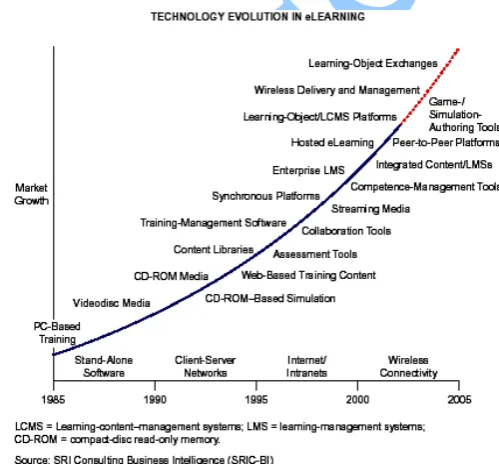
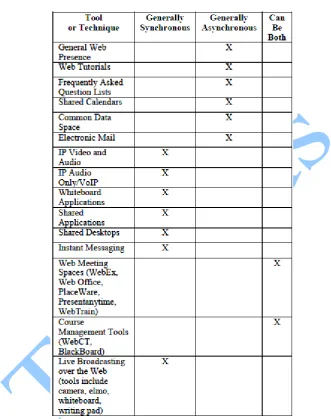
E-learning is the most recent way to achieve distance education, carried out by distributing learning material and processes over the Internet [CLA07]. E-learning (EL) has become an increasingly popular mode of instruction in higher education due to the continual advances in Internet and multimedia technologies [S+06]. Figure 1 shows the evolution of e-learning process and infrastructure. E-learning system is using two approaches such as synchronous and asynchronous. Table 1 provides a summary of the synchronous and asynchronous approach in e-learning system.
Anale. Seria Informatică. Vol. IX fasc. 1 – 2011
Annals. Computer Science Series. 9th Tome 1st Fasc. – 2011
11 Table 1: E-learning system: Synchronous and Asynchronous Approach
Anale. Seria Informatică. Vol. IX fasc. 1 – 2011
Annals. Computer Science Series. 9th Tome 1st Fasc. – 2011
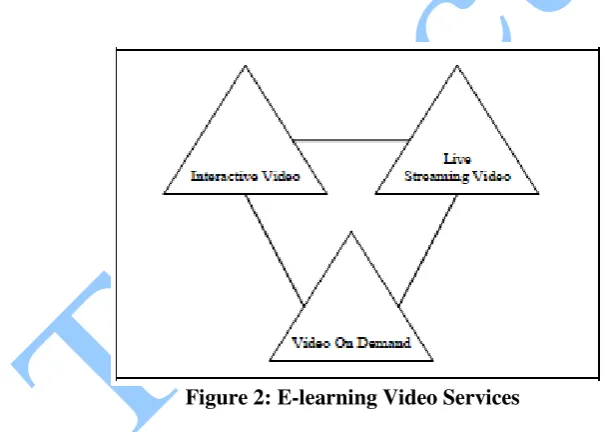
Today, video and voice application is very important in e-learning system. There are three approaches to incorporating video over IP in the classroom, be it a pure distance learning class or an enhancement to a traditional class. Figure 2 shows these three types: live streaming video, interactive video, and video-on-demand. In a technologically advanced setting, video over IP and collaboratory tools allow activities that take place in the traditional classroom to occur in the distance learning environment. To deliver live real-time streams, a media server is required. For on-demand archived files, either a media server or an Internet server can be used. The hardware requirements are modest. For live real-time delivery a small server has more than enough capacity. Other consideration during implementation of e-learning system is bandwidth issue. Campuses may have high-speed Internet/Intranet access. However, off campus locations still suffer from lack of bandwidth. Virtual class caters to people with all kinds of Internet connection speeds as low as dialup.
Figure 2: E-learning Video Services
2. Methodology
Anale. Seria Informatică. Vol. IX fasc. 1 – 2011
Annals. Computer Science Series. 9th Tome 1st Fasc. – 2011
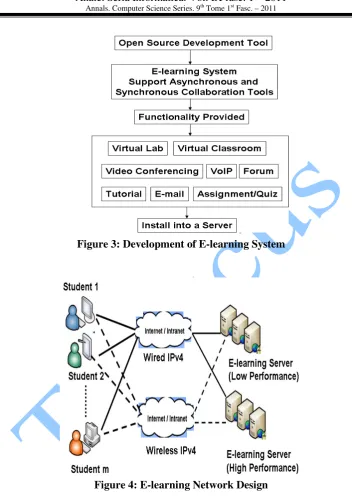
13 Figure 3: Development of E-learning System
Figure 4: E-learning Network Design
Anale. Seria Informatică. Vol. IX fasc. 1 – 2011
Annals. Computer Science Series. 9th Tome 1st Fasc. – 2011
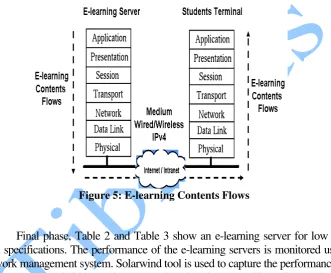
server; and ii) prediction on number of students accessing e-learning server. Figure 4 shows e-learning network design in campus network environment and it is divided into low and high performance server. Figure 5 shows e-learning contents flow from server to student terminal. E-e-learning is located under application layer and transmitted over wired/wireless IPv4. Therefore, to ensure that e-learning system able to operate efficiently, it must have a high-quality server performance.
Figure 5: E-learning Contents Flows
Anale. Seria Informatică. Vol. IX fasc. 1 – 2011
Annals. Computer Science Series. 9th Tome 1st Fasc. – 2011
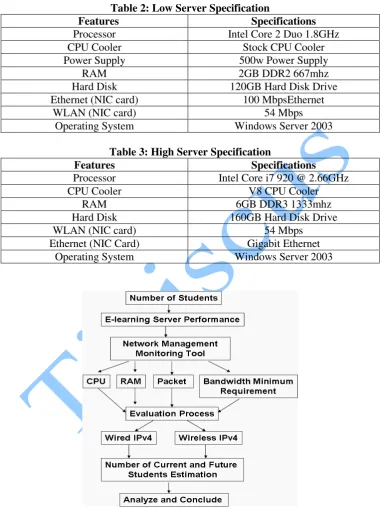
15 Table 2: Low Server Specification
Features Specifications
Processor Intel Core 2 Duo 1.8GHz
CPU Cooler Stock CPU Cooler
Power Supply 500w Power Supply
RAM 2GB DDR2 667mhz
Hard Disk 120GB Hard Disk Drive
Ethernet (NIC card) 100 MbpsEthernet
WLAN (NIC card) 54 Mbps
Operating System Windows Server 2003
Table 3: High Server Specification
Features Specifications
Processor Intel Core i7 920 @ 2.66GHz
CPU Cooler V8 CPU Cooler
RAM 6GB DDR3 1333mhz
Hard Disk 160GB Hard Disk Drive
WLAN (NIC card) 54 Mbps
Ethernet (NIC Card) Gigabit Ethernet
Operating System Windows Server 2003
Anale. Seria Informatică. Vol. IX fasc. 1 – 2011
Annals. Computer Science Series. 9th Tome 1st Fasc. – 2011
3. e-Learning development, experimental and analysis
This section has shown the development, analyzing, measuring and comparison of e-learning server performance in campus network environment.
3.1. Development of e-learning system
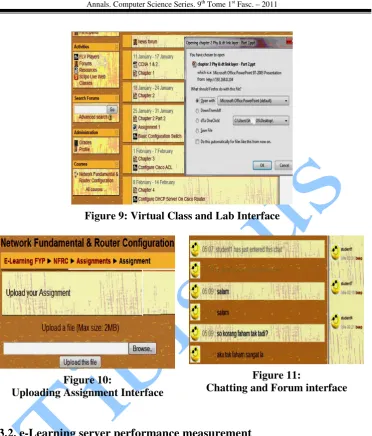
We show several examples on e-learning interface such as: i) login interface (refer to Figure 7);
ii) video conferencing interface (refer to Figure 8); iii) virtual classroom and virtual lab (refer to Figure 9); iv) uploading assignment interface, and
v) chatting and forum interface (refer to Figure 10 and Figure 11). All these functionality have been installed into a single server.
Figure 7:
E-Learning System – Login Interface Figure 8:
Anale. Seria Informatică. Vol. IX fasc. 1 – 2011
Annals. Computer Science Series. 9th Tome 1st Fasc. – 2011
17 Figure 9: Virtual Class and Lab Interface
Figure 10:
Uploading Assignment Interface
Figure 11:
Chatting and Forum interface
3.2. e-Learning server performance measurement
Anale. Seria Informatică. Vol. IX fasc. 1 – 2011
Annals. Computer Science Series. 9th Tome 1st Fasc. – 2011
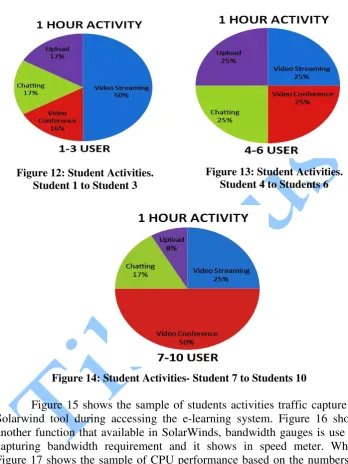
Figure 12: Student Activities. Student 1 to Student 3
Figure 13: Student Activities. Student 4 to Students 6
Figure 14: Student Activities- Student 7 to Students 10
Anale. Seria Informatică. Vol. IX fasc. 1 – 2011
Annals. Computer Science Series. 9th Tome 1st Fasc. – 2011
19 Figure 15: Network Management System
Figure 16: Bandwidth Performance
Anale. Seria Informatică. Vol. IX fasc. 1 – 2011
Annals. Computer Science Series. 9th Tome 1st Fasc. – 2011
3.3. Packet Transmission
Based on the result captured by network management tool, it shows that packet received and sent for low and high performance server has same traffic trend via wired and wireless technology (refer to Figure 18 and Figure 19). It also shows the same packet sent for low and high performance server via wired and wireless technology (refer to Figure 18 and Figure 19).
Figure 18: Low Server Specification: Size of Packet Transmission
Anale. Seria Informatică. Vol. IX fasc. 1 – 2011
Annals. Computer Science Series. 9th Tome 1st Fasc. – 2011
21
3.4. Bandwidth requirement
In this section, we will estimate and evaluate number of current and future students access into e-learning server via wired and wireless technology. As a result, low server specification (100 Mbps) shows that 10 students with high activities (video conference, video streaming, upload and chatting) access concurrently into e-learning server need bandwidth requirement approximately 80 Mbps for wired environment. In wireless environment, there have bottleneck and congestion due to speed of wireless network interface card limited to 54 Mbps (refer to Figure 20 and Figure 21). In addition, it also occur packet loss for wireless environment. However, low server specification (100 Mbps wired environment) has fully utilized the bandwidth capacity compare to high server specification (1 to 10 Gbps) (refer to Figure 20 and Figure 21).
Anale. Seria Informatică. Vol. IX fasc. 1 – 2011
Annals. Computer Science Series. 9th Tome 1st Fasc. – 2011
Figure 21: High Server Specification: Size of Bandwidth Requirement
Based on the trends and results analysis then we predict and plan the number of future students need additional bandwidth requirement. Table 4 shows the current students traffic in e-learning server. There are two additional students can be supported by the low server specification via wired environment (100 Mbps) but for wireless environment there is no additional students allow to access e-learning server (refer to Table 5). Next experiment, we conduct a test on high server specification (refer to Table 6) using Ethernet 1000 Mbps speed. Based on the trends and results analysis then we predict and plan the number of future students that need additional bandwidth requirement for high server specification. In our prediction and planning it shows that high server specification is able to support more than 50 students concurrently (refer to Table 7) compare to wireless environment.
Table 4: Low Server Specification - Performance of 10 Students Activities
Users 1 2 3 4 5 6 7 8 9 10
Wired (100 Mbps)
25.5 28.7 35.9 46.7 50.1 64.7 68.8 71.4 79.4 81.2 Wireless
(54 Mbps)
Anale. Seria Informatică. Vol. IX fasc. 1 – 2011
Annals. Computer Science Series. 9th Tome 1st Fasc. – 2011
23 Table 5: Low Server Specification - Prediction and Planning
for Additional Students Future: Prediction
and Planning Additional Users One user Two Users
Wired (100 Mbps) 88 95
Bandwidth
Requirement (Mbps) Wireless (54 Mbps) Fully Utilized
Table 6: High Server Specification- Performance of 10 Students Activities (Bandwidth Requirement)
Users 1 2 3 4 5 6 7 8 9 10
Wired (100 Mbps)
23.5 29.1 34.1 42.7 47.4 57.5 64.5 69.5 72.5 84.4 Wireless
(54 Mbps)
19.3 22.2 28.6 30.6 35.1 37.2 39.3 41.8 42.3 45.3
Table 7: High Server Specification – Prediction and Planning for Additional Students (Bandwidth Requirement)
Future: Prediction
and Planning Additional Users 10 users 20 users 50 users
Wired (1000 Mbps) 154 224 434
Bandwidth
Requirement (Mbps) Wireless (54 Mbps) Fully Utilized, not recommended
3.5. CPU Usage
Anale. Seria Informatică. Vol. IX fasc. 1 – 2011
Annals. Computer Science Series. 9th Tome 1st Fasc. – 2011
Figure 22: Low Server Specification: CPU Usage
Figure 23: High Server Specification – CPU Usage
Anale. Seria Informatică. Vol. IX fasc. 1 – 2011
Annals. Computer Science Series. 9th Tome 1st Fasc. – 2011
25 plan for high server specification, the result shows that it able to support more than 13 students access into e-learning server concurrently (refer to Table 10 and Table 11). It also has approximately 55% of CPU availability for wired and wireless environment (refer to Table 10 and Table 11).
Table 8: Low Server Specification- Performance of 10 Students Activities (CPU Usage)
Users (Intel Core 2
Duo 1.8GHz) 1 2 3 4 5 6 7 8 9 10
Wired (CPU, %) 52 56 59 61 64 69 71 76 81 83 Wireless (CPU, %) 63 66 65 67 69 70 72 72 76 75
Table 9: Low Server Specification – Prediction and Planning for Additional Students (CPU Usage)
Future: Prediction and Planning
Additional
Users 11 users 12 users 13 users
Wired (%) 87 91 95
CPU Requirement (%)
(Intel Core 2 Duo 1.8GHz) Wireless (%) 77.5 80 83 Future: Prediction and
Planning
Recommendation: e-learning server is fully utilized and allow for 3 additional students only.
Table 10: High Server Specification- Performance of 10 Students Activities (CPU Requirement)
Users (Intel Core i7
920 @ 2.66GHz) 1 2 3 4 5 6 7 8 9 10 Wired (CPU, %) 19 19 20 23 24 24 25 27 31 35 Wireless (CPU, %) 25 26 26 26 27 28 30 32 36 39
Table 11: High Server Specification – Prediction and Planning for Additional Students (CPU Requirement)
Future: Prediction and Planning Additional Users 11 users 12 users 13 users Free: CPU Usage
Wired (%) 38 41 44 56
CPU Requirement (%) (Intel Core i7 920 @
2.66GHz)
Wireless (%) 42 45 48 52
Future: Prediction and Planning
Recommendation: CPU e-learning server is under utilized and able to support more students for wired and wireless
Anale. Seria Informatică. Vol. IX fasc. 1 – 2011
Annals. Computer Science Series. 9th Tome 1st Fasc. – 2011
3.6. Memory Requirement
In this section, we will estimate and evaluate memory usage based on number of current and future students access into e-learning server via wired and wireless technology. As a result, low server specification (2GB, RAM) shows that 10 students with high activities (video conference, video streaming, upload and chatting) access concurrently into e-learning server will consume high memory usage requirement approximately 1800 MB/1.8 GB above for wired environment. In wireless environment, it also shows the same trends with wired environment (refer to Figure 24).
In addition, low server specification (2 GB, RAM) has generated high utilization of RAM compare to high server specification (6 GB, RAM) (refer to Figure 24 and Figure 25). High server specification has generated 1800 MB/1.8 GB memory usage for 10 students access into e-learning server and able to support additional students (refer to Figure 25).
Anale. Seria Informatică. Vol. IX fasc. 1 – 2011
Annals. Computer Science Series. 9th Tome 1st Fasc. – 2011
27 Figure 25: High Server Specification: Memory Usage
Again, based on the trends and results analysis then we predict and plan the number of future students that need additional memory requirement for low and high server specification. In our prediction and planning, it shows that low server specification unable to support any additional students and it almost achieved 2 GB (refer to Table 12 and Table 13). Then we predict and plan for high server specification (6 GB, memory), the result shows that it able to support more than 13 students access into e-learning server concurrently (refer to Table 14 and Table 15). It also produces approximately 4 GB of memory availability for wired and wireless environment (refer to Table 15).
Table 12: Low Server Specification- Performance of 10 Students Activities (Memory Usage)
Users
(2 GB RAM) 1 2 3 4 5 6 7 8 9 10
Wired 742 855 902 986 1076 1237 1499 1639 1762 1848 Wireless 889 902 981 1010 1164 1251 1329 1521 1751 1883
Table 13: Low Server Specification – Prediction and Planning for Additional Students (Memory Usage)
Future: Prediction and Planning
Additional
Users One user Two Users
Wired Fully Utilized: Not recommended Memory (RAM)
Anale. Seria Informatică. Vol. IX fasc. 1 – 2011
Annals. Computer Science Series. 9th Tome 1st Fasc. – 2011
Table 14: High Server Specification- Performance of 10 Students Activities (Memory Usage)
Users
(6 GB RAM) 1 2 3 4 5 6 7 8 9 10
Wired 182 238 376 548 723 815 932 1021 1134 1252 Wireless 369 478 554 671 754 898 984 1199 1276 1328
Table 15: High Server Specification – Prediction and Planning for Additional Students (Memory Requirement)
Future: Prediction and Planning Additional Users 11 users 12 users 13 users Free: RAM Usage Wired (6000MB/6GB) 1392/ 1.39 1532/ 1.53 1672/ 1.67 4328/ 4.32 RAM Requirement
(MB/GB) Wireless
(6000MB/6GB) 1528/ 1.528 1728/ 1.72 1928/ 1.92 4072/ 4.07 Future: Prediction and Planning
Recommendation: RAM e-learning server is under utilized and able to support more students for wired and
wireless environment.
Conclusion
This paper discussed the implementation of e-learning system over IPv4 in campus network environment. This study is focusing on the performance of e-learning server based on bandwidth requirement, CPU usage and memory consume. We conclude that base on our findings; implementation of e-learning system on low server specification has consumed high resources such as CPU, bandwidth, RAM and degrades the quality of e-learning system. In addition, it only can support a few number of student (10 students) to access e-learning system concurrently. However, high server specification is able to support more students (more than 20 students) to access e-learning system concurrently.
Anale. Seria Informatică. Vol. IX fasc. 1 – 2011
Annals. Computer Science Series. 9th Tome 1st Fasc. – 2011
29
References
[A+99] Mary Anne Andrusyszyn, Mary van Soeren, Heather Spence Laschinger, Dolly Goldenberg, Alba DiCenso, Journal of
Distance Education, 14.1, Evaluation of Distance Education
Delivery Methods for a Primary Care Nurse Practitioner Program. Retrieved from
http://cade.athabascau.ca/vol14.1/andrusyszyn_et_al.html, 1999
[CLA07] M. F. Costabile, R. Lanzilotti, C. Ardito - On the importance of
the user interface for e-learning systems quality. Source,
International Association Of Science And Technology For Development, Proceedings of the Second IASTED International Conference on Human Computer Interaction, Chamonix, France, pp.193-198, 2007
[EAV09] Iasmina Ermalai, Diana And one, Radu Vasiu - Study cases on elearning technologies used by universities in Romania and
worldwide, WSEAS Transactions on Communications, Vol. 8(8)
(August 2009), pp. 785-794, 2009
[GD07] Laura Guerra-Cardus, Ovgu Dogangun - Drag and drop
streaming: the next revolution in e-learning, User Services
Conference, Proceedings of the 35th annual ACM SIGUCCS conference on User services, Orlando, Florida, USA, pp. 139 – 142, 2007
[S+06] Sawai Siritongthaworn, Donyaprueth Krairit, Nicholas J. Dimmitt, H. Paul - The study of e-learning technology implementation: A preliminary investigation of universities in
Thailand, Education and Information Technologies, Vol. 11(2)
(April 2006), pp.137 – 160, 2006
[Tho99] Herb Thompson - Education Technology & Society, 3, The Impact of Technology and Distance Education: A Classical Learning Theory Viewpoint. Retrieved from
http://ifets.ieee.org/periodical/vol_3_99/herb_thompson.pdf,
Anale. Seria Informatică. Vol. IX fasc. 1 – 2011
Annals. Computer Science Series. 9th Tome 1st Fasc. – 2011
[***03a] *** - Distance Education at a Glance. Retrieved March 5, 2003 from University of Idaho, Engineering Outreach Web site:
http://www.uidaho.edu/eo/distglan.html, 2003
[***03b] *** - The Rights Stuff: Ownership in the Digital Academy. Retrieved March 5, 2003 from http://thenode.org/ltreport/ip, 1999