*For correspondence:sdnibley@ gmail.com
Competing interests:The authors declare that no competing interests exist.
Received:25 November 2016 Accepted:08 December 2016 Published:26 July 2017
Author Keywords:ultrasound, general practitioner, GP, pocket, tendon
CopyrightsBJGP Open 2017; DOI:10.3399/
bjgpopen17X100893
GP-confirmed complete Achilles tendon
rupture using pocket-sized ultrasound: a
case report
SJ Davis,
MBChB1*, A Lott,
MBBS2, E Besada,
MD31
GP & University Lecturer, Department of General Practice, Institute of Community
Medicine, University of Tromsø, Tromsø, Norway;
2Junior Radiologist, Department
of Radiology, Institute of Clinical Medicine, University of Tromsø (UiT) The Arctic
University of Norway, Tromsø, Norway;
3Rheumatologist & University Lecturer,
Department of Rheumatology, Institute of Clinical Medicine, University of Tromsø
(UiT) The Arctic University of Norway, Tromsø, Norway
Introduction
The incidence of complete Achilles tendon rupture is 18 per 100 000 patient-years1 and is usually
diagnosed clinically by GPs. The extent of clinical misdiagnosis is unknown in Norway, but may be high.2This is important as delayed treatment has unfavourable consequences.1,3We report how a
GP, with no clinical ultrasound experience, recorded images with a pocket-sized ultrasound device (PSUD) under supervision to confirm a complete Achilles tendon rupture. This could present a new indication for GP ultrasound.
Case report
A 36-year-old man experienced acute pain above the right heel accompanied by an audible snap while sprinting. He immediately had difficulty walking and 3 hours later consulted an on-call GP. Pos-terior ankle swelling with a tender depression 3 cm proximal to the calcaneum was found. Active plantar flexion against resistance was weak and Simmonds–Thompson test was ‘partially positive’ on applying a strong calf-squeeze. Based on these findings, calf muscle rupture was diagnosed as the Achilles tendon was thought to be intact. The patient was advised to elevate the foot and wait 2 weeks for improvement. Two days later a second GP, who was aware of a history of an audible snap, considered complete tendon rupture and reexamined the patient. Findings included an absent right heel raise due to weakness, minimal active plantar flexion against gravity and lying prone, significant right ankle swelling without bruising, and an altered angle of declination. Palpation elicited no ankle bony tenderness, yet a painful gap was identified 6 cm proximal from the calcaneal attachment, along the line of the Achilles tendon. Simmonds–Thompson’s test was clearly positive. The positive Simmond’s triad indicated a clinical diagnosis of complete rupture of the Achilles tendon.
A 3.4–8 MHz linear array probe PSUD (VScan dual probe, GE Healthcare), set at a depth of 3.5 cm, was used under the supervision of a rheumatologist experienced in ultrasound. The tendon was enlarged from 1 cm to 6 cm above the calcaneal insertion, where a clear gap was seen (Figure 1). Two hours later a radiologist-performed ultrasound (LOGIQ E9, GE Healthcare) and reported an enlarged distal tendon and a complete rupture at 5–6 cm from the calcaneal attach-ment, creating a 2.7 cm blood-filled gap (Figure 2). Surgical exploration 8 days post-injury found a complete Achilles tendon rupture ‘5–10 cm above the ankle joint’.
Discussion
Tromsø Hospital serves a large area with a population of approximately 160 000. Between 2010– 2014 an average of 21 patients per year were referred by their GP for suspected Achilles rupture.
PRACTICE & POLICY
*For correspondence:sdnibley@ gmail.com
Competing interests:The authors declare that no competing interests exist.
Received:25 November 2016 Accepted:08 December 2016 Published:26 July 2017
Author Keywords:ultrasound, general practitioner, GP, pocket, tendon
CopyrightsBJGP Open 2017; DOI:10.3399/
bjgpopen17X100893
*For correspondence:sdnibley@ gmail.com
Competing interests:The authors declare that no competing interests exist.
Received:25 November 2016 Accepted:08 December 2016 Published:26 July 2017
Author Keywords:ultrasound, general practitioner, GP, pocket, tendon
CopyrightsBJGP Open 2017; DOI:10.3399/
bjgpopen17X100893
GP-confirmed complete Achilles tendon
rupture using pocket-sized ultrasound: a
case report
SJ Davis,
MBChB1*, A Lott,
MBBS2, E Besada,
MD31
GP & University Lecturer, Department of General Practice, Institute of Community
Medicine, University of Tromsø, Tromsø, Norway;
2Junior Radiologist, Department
of Radiology, Institute of Clinical Medicine, University of Tromsø (UiT) The Arctic
University of Norway, Tromsø, Norway;
3Rheumatologist & University Lecturer,
Department of Rheumatology, Institute of Clinical Medicine, University of Tromsø
(UiT) The Arctic University of Norway, Tromsø, Norway
Introduction
The incidence of complete Achilles tendon rupture is 18 per 100 000 patient-years1 and is usually
diagnosed clinically by GPs. The extent of clinical misdiagnosis is unknown in Norway, but may be high.2This is important as delayed treatment has unfavourable consequences.1,3We report how a
GP, with no clinical ultrasound experience, recorded images with a pocket-sized ultrasound device (PSUD) under supervision to confirm a complete Achilles tendon rupture. This could present a new indication for GP ultrasound.
Case report
A 36-year-old man experienced acute pain above the right heel accompanied by an audible snap while sprinting. He immediately had difficulty walking and 3 hours later consulted an on-call GP. Pos-terior ankle swelling with a tender depression 3 cm proximal to the calcaneum was found. Active plantar flexion against resistance was weak and Simmonds–Thompson test was ‘partially positive’ on applying a strong calf-squeeze. Based on these findings, calf muscle rupture was diagnosed as the Achilles tendon was thought to be intact. The patient was advised to elevate the foot and wait 2 weeks for improvement. Two days later a second GP, who was aware of a history of an audible snap, considered complete tendon rupture and reexamined the patient. Findings included an absent right heel raise due to weakness, minimal active plantar flexion against gravity and lying prone, significant right ankle swelling without bruising, and an altered angle of declination. Palpation elicited no ankle bony tenderness, yet a painful gap was identified 6 cm proximal from the calcaneal attachment, along the line of the Achilles tendon. Simmonds–Thompson’s test was clearly positive. The positive Simmond’s triad indicated a clinical diagnosis of complete rupture of the Achilles tendon.
A 3.4–8 MHz linear array probe PSUD (VScan dual probe, GE Healthcare), set at a depth of 3.5 cm, was used under the supervision of a rheumatologist experienced in ultrasound. The tendon was enlarged from 1 cm to 6 cm above the calcaneal insertion, where a clear gap was seen (Figure 1). Two hours later a radiologist-performed ultrasound (LOGIQ E9, GE Healthcare) and reported an enlarged distal tendon and a complete rupture at 5–6 cm from the calcaneal attach-ment, creating a 2.7 cm blood-filled gap (Figure 2). Surgical exploration 8 days post-injury found a complete Achilles tendon rupture ‘5–10 cm above the ankle joint’.
Discussion
Tromsø Hospital serves a large area with a population of approximately 160 000. Between 2010– 2014 an average of 21 patients per year were referred by their GP for suspected Achilles rupture.
PRACTICE & POLICY
*For correspondence:sdnibley@ gmail.com
Competing interests:The authors declare that no competing interests exist.
Received:25 November 2016 Accepted:08 December 2016 Published:26 July 2017
GP-confirmed complete Achilles tendon
rupture using pocket-sized ultrasound: a
case report
SJ Davis,
MBChB1*, A Lott,
MBBS2, E Besada,
MD31
GP & University Lecturer, Department of General Practice, Institute of Community
Medicine, University of Tromsø, Tromsø, Norway;
2Junior Radiologist, Department
of Radiology, Institute of Clinical Medicine, University of Tromsø (UiT) The Arctic
University of Norway, Tromsø, Norway;
3Rheumatologist & University Lecturer,
Department of Rheumatology, Institute of Clinical Medicine, University of Tromsø
(UiT) The Arctic University of Norway, Tromsø, Norway
Introduction
The incidence of complete Achilles tendon rupture is 18 per 100 000 patient-years1 and is usually
diagnosed clinically by GPs. The extent of clinical misdiagnosis is unknown in Norway, but may be high.2This is important as delayed treatment has unfavourable consequences.1,3We report how a
GP, with no clinical ultrasound experience, recorded images with a pocket-sized ultrasound device (PSUD) under supervision to confirm a complete Achilles tendon rupture. This could present a new indication for GP ultrasound.
Case report
A 36-year-old man experienced acute pain above the right heel accompanied by an audible snap while sprinting. He immediately had difficulty walking and 3 hours later consulted an on-call GP. Pos-terior ankle swelling with a tender depression 3 cm proximal to the calcaneum was found. Active plantar flexion against resistance was weak and Simmonds–Thompson test was ‘partially positive’ on applying a strong calf-squeeze. Based on these findings, calf muscle rupture was diagnosed as the Achilles tendon was thought to be intact. The patient was advised to elevate the foot and wait 2 weeks for improvement. Two days later a second GP, who was aware of a history of an audible snap, considered complete tendon rupture and reexamined the patient. Findings included an absent right heel raise due to weakness, minimal active plantar flexion against gravity and lying prone, significant right ankle swelling without bruising, and an altered angle of declination. Palpation elicited no ankle bony tenderness, yet a painful gap was identified 6 cm proximal from the calcaneal attachment, along the line of the Achilles tendon. Simmonds–Thompson’s test was clearly positive. The positive Simmond’s triad indicated a clinical diagnosis of complete rupture of the Achilles tendon.
A 3.4–8 MHz linear array probe PSUD (VScan dual probe, GE Healthcare), set at a depth of 3.5 cm, was used under the supervision of a rheumatologist experienced in ultrasound. The tendon was enlarged from 1 cm to 6 cm above the calcaneal insertion, where a clear gap was seen (Figure 1). Two hours later a radiologist-performed ultrasound (LOGIQ E9, GE Healthcare) and reported an enlarged distal tendon and a complete rupture at 5–6 cm from the calcaneal attach-ment, creating a 2.7 cm blood-filled gap (Figure 2). Surgical exploration 8 days post-injury found a complete Achilles tendon rupture ‘5–10 cm above the ankle joint’.
Discussion
Tromsø Hospital serves a large area with a population of approximately 160 000. Between 2010– 2014 an average of 21 patients per year were referred by their GP for suspected Achilles rupture.
PRACTICE & POLICY
Author Keywords:ultrasound, general practitioner, GP, pocket, tendon
CopyrightsBJGP Open 2017; DOI:10.3399/
bjgpopen17X100893
GP-confirmed complete Achilles tendon
rupture using pocket-sized ultrasound: a
case report
SJ Davis,
MBChB1*, A Lott,
MBBS2, E Besada,
MD31
GP & University Lecturer, Department of General Practice, Institute of Community
Medicine, University of Tromsø, Tromsø, Norway;
2Junior Radiologist, Department
of Radiology, Institute of Clinical Medicine, University of Tromsø (UiT) The Arctic
University of Norway, Tromsø, Norway;
3Rheumatologist & University Lecturer,
Department of Rheumatology, Institute of Clinical Medicine, University of Tromsø
(UiT) The Arctic University of Norway, Tromsø, Norway
Introduction
The incidence of complete Achilles tendon rupture is 18 per 100 000 patient-years1 and is usually
diagnosed clinically by GPs. The extent of clinical misdiagnosis is unknown in Norway, but may be high.2This is important as delayed treatment has unfavourable consequences.1,3We report how a
GP, with no clinical ultrasound experience, recorded images with a pocket-sized ultrasound device (PSUD) under supervision to confirm a complete Achilles tendon rupture. This could present a new indication for GP ultrasound.
Case report
A 36-year-old man experienced acute pain above the right heel accompanied by an audible snap while sprinting. He immediately had difficulty walking and 3 hours later consulted an on-call GP. Pos-terior ankle swelling with a tender depression 3 cm proximal to the calcaneum was found. Active plantar flexion against resistance was weak and Simmonds–Thompson test was ‘partially positive’ on applying a strong calf-squeeze. Based on these findings, calf muscle rupture was diagnosed as the Achilles tendon was thought to be intact. The patient was advised to elevate the foot and wait 2 weeks for improvement. Two days later a second GP, who was aware of a history of an audible snap, considered complete tendon rupture and reexamined the patient. Findings included an absent right heel raise due to weakness, minimal active plantar flexion against gravity and lying prone, significant right ankle swelling without bruising, and an altered angle of declination. Palpation elicited no ankle bony tenderness, yet a painful gap was identified 6 cm proximal from the calcaneal attachment, along the line of the Achilles tendon. Simmonds–Thompson’s test was clearly positive. The positive Simmond’s triad indicated a clinical diagnosis of complete rupture of the Achilles tendon.
A 3.4–8 MHz linear array probe PSUD (VScan dual probe, GE Healthcare), set at a depth of 3.5 cm, was used under the supervision of a rheumatologist experienced in ultrasound. The tendon was enlarged from 1 cm to 6 cm above the calcaneal insertion, where a clear gap was seen (Figure 1). Two hours later a radiologist-performed ultrasound (LOGIQ E9, GE Healthcare) and reported an enlarged distal tendon and a complete rupture at 5–6 cm from the calcaneal attach-ment, creating a 2.7 cm blood-filled gap (Figure 2). Surgical exploration 8 days post-injury found a complete Achilles tendon rupture ‘5–10 cm above the ankle joint’.
Discussion
Tromsø Hospital serves a large area with a population of approximately 160 000. Between 2010– 2014 an average of 21 patients per year were referred by their GP for suspected Achilles rupture.
Davis Set al. BJGP Open 2017;DOI: 10.3399/bjgpopen17X100893 1 of 3
*For correspondence:gc.island@ gmail.com pollybrandon@mac. com
Competing interests:The authors declare that no competing interests exist.
Received:14 August 2016 Accepted:16 August 2016 Published:09 January 2017
This article is Open Access:
https:// creativecommons.org/licenses/ by/4.0/)
sBJGP Open 2017; DOI:10.3399/ bjgpopen17X100557
Primary care in the Calais Jungle
Gerry Clare,
BSc, MSc, PhD, FRCOphth1*, Polly Nyiri,
MBBChir, DTM&H, MA International Health2*
1
Consultant ophthalmologist, Western Eye Hospital, London, UK;
2GP, Health
Inclusion Clinic, Guy’s and St Thomas’ Hospital NHS Foundation Trust, London, UK
Introduction
Last summer our small medical team visited the Calais ’Jungle’. Since that time much has changed and the camp is being demolished and by the time this article is read, it will probably be long gone. Some youngsters are finally being brought to the UK under the ’Dubs’ amendment. However, once this camp is cleared it will not solve the ongoing flight of refugees from war torn areas: other camps are already appearing.
July 2016
A young Afghan man caught his finger on a sharp point while trying to cross a barbed wire fence. The finger was partially degloved. He attended the local hospital, where they placed a few sutures, but now, 2 weeks later, the skin is necrotic and the underlying tissue looks infected. He is in danger of losing his finger.
A middle-aged Sudanese man has been having rigors and is generally unwell. He says it is similar to when he last had malaria.
A young Ukrainian woman complains of lower back pain and urinary frequency.
The paths of these three people may never have crossed; yet here they are, denizens of the Calais Jungle. They turn up to a makeshift primary care ‘clinic’ that we set up in the heart of the unofficial refugee camp one weekend in July 2016.
With only basic medical supplies, we are immediately challenged by what we see. How can we arrange secondary care for the young Afghan in danger of losing his finger? We try to persuade him to return to the original local hospital, but he is reluctant. It was not a good experience for him the first time round.
With the other two patients, it is easier. They can attend the Salam clinic run by a local association during weekdays. Later, we receive word that malaria has been confirmed in our Sudanese patient.
More people arrive, presenting with scabies, rat bites, tinea, chest infections, and wheezing from inhaling smoke from fires lit to cook and keep warm in their tents at night. We examine a severely malnourished 2-year-old boy. We meet several of the camp’s 600 unaccompanied children, at grave risk of sexual exploitation. We learn that there is inadequate safeguarding in place to protect them. A young Eritrean man comes in worried about his eye. He has sustained direct ocular trauma from a rubber bullet, and will never see normally again out of that eye. We see haematomas from police batons, and hear about children being exposed to tear gas again and again (Figure 1).
The reality
These are no ordinary patients. They have travelled far from home to escape war, poverty, and mis-ery. They have endured personal odysseys to get here, experienced untold hardships, and suffered unimaginable privations. Many have survived the loss of their families, torture, and rape. Their jour-neys over, for the moment at least, they must make their homes in the Calais Jungle. Their new shel-ters are in many cases mere tarpaulin covers, and their new beds just rugs on the ground. They own next to nothing. There is little for them to do, besides use their ingenuity to cross the English Chan-nel in search of a better life. They are vulnerable to exploitation, crime, injury, and disease. Poten-tially violent clashes with local police, with other ethnic groups resident in the Jungle, or local far
Clare G and Nyiri P. BJGP Open 2017;DOI: 10.3399/bjgpopen17X100557 1 of 5
PRACTICE & POLICY
CC BY license (
The Authors; *For correspondence:
Received:18 April 2017
Accepted:14 August 2017
Published:10 January 2018
Author Keywords:classification, methods, case-mix, general practice, physician assistants , physician associate
Copyrights2018, DOI:10.3399/ bjgpopen18X101277
Capturing complexity in clinician case-mix:
classification system development using
GP and physician associate data
Mary Halter,
MSc, PhD1*, Louise Joly,
MSc, PhD2,
Simon de Lusignan,
MSc, MD, FRCGP, FBCS CITP, FHEA3, Robert L Grant,
MSc4,
Heather Gage,
MSc, PhD5, Vari M Drennan,
MSc, PhD61
Associate Professor, Faculty of Health, Social Care & Education, Kingston
University & St George’s, University of London, London, UK;
2Research Fellow,
Social Care Workforce Unit, King’s College London, London, UK;
3Professor of
Primary Care and Clinical Informatics, Department of Clinical and Experimental
Medicine, University of Surrey, Guildford, UK;
4Honorary Research Fellow, Faculty
of Health, Social Care & Education, Kingston University & St George’s, University of
London, London, UK;
5Professor of Health Economics, School of Economics,
University of Surrey, Guildford, UK;
6Professor of Health Care and Policy Research,
Faculty of Health, Social Care & Education, Kingston University & St George’s,
University of London, London, UK
Abstract
Background:There are limited case-mix classification systems for primary care settings which are applicable when considering the optimal clinical skill mix to provide services.
Aim:To develop a case-mix classification system (CMCS) and test its impact on analyses of patient outcomes by clinician type, using example data from physician associates’ (PAs) and GPs’ consultations with same-day appointment patients.
Design & setting: Secondary analysis of controlled observational data from six general practices employing PAs and six matched practices not employing PAs in England.
Method:Routinely-collected patient consultation records (PAn= 932, GPn= 1154) were used to design the CMCS (combining problem codes, disease register data, and free text); to describe the case-mix; and to assess impact of statistical adjustment for the CMCS on comparison of outcomes of consultations with PAs and with GPs.
Results: A CMCS was developed by extending a system that only classified 18.6% (213/1147) of the presenting problems in this study’s data. The CMCS differentiated the presenting patient’s level of need or complexity as: acute, chronic, minor problem or symptom, prevention, or process of care, applied hierarchically. Combination of patient and consultation-level measures resulted in a higher classification of acuity and complexity for 639 (30.6%) of patient cases in this sample than if using consultation level alone. The CMCS was a key adjustment in modelling the study’s main outcome measure, that is rate of repeat consultation.
Conclusion: This CMCS assisted in classifying the differences in case-mix between professions, thereby allowing fairer assessment of the potential for role substitution and task shifting in primary care, but it requires further validation.
Introduction
Primary health care has a pivotal role in the delivery of health care internationally1
and understanding who consults, for what reasons, is important for epidemiology, research, planning, reporting, and quality improvement, as well as for potential use in funding models,2
including decisions about optimal professional skill mix. Increasingly, health professionals other than doctors are being employed to address problems of medical staff shortages and rising patient demand.3–5 In the UK, this shift is exemplified in the deployment of physician associates (PAs, known outside the UK as physician assistants) in general practice to provide consultations, mainly seeing patients booked into same-day or urgent appointments,6
a role similar that of PAs in the US.7
Health service planners and other decision makers require evidence as to the effectiveness, safety, efficiency, and acceptability of substituting for doctors, and any valid comparison requires understanding of case-mix.
The International Classification of Primary Care (ICPC) was developed to address the perceived inadequacies of the International Classification of Diseases (ICD)8
in describing primary care practice.9
The ICPC is well-established in a minority of countries,9–11
its unique feature being its biaxial structure, which includes reason for encounter as well as morbidity. Like other classification systems,12the purpose is to describe patient complexity of morbidity (and, in the case of adjusted clinical groups, predicted health resource use12
) over a period of time.9
Complexity in patients13 is a contested concept,14
and there are some arguments that certain classification systems, such as the ambulatory care groups (ACGs),15 are limited by defining chronicity as the likelihood of recur-rence of the diagnosis16
and do not translate fully into other cultural settings.17
Classification meth-odologies that identify acuity (the level of severity of an illness and immediacy of requirements for care18
) and the complexity of the patient as a whole, are rare. Where they are used,19,20 greater transparency in the reporting of case definitions is argued for.21
De Jonget al22presented a general practice classification system, developed using ICPC coding data extracted from routinely-recorded electronic medical records, clustered into chronic and onco-logical diseases (using Knottneruset al23
), or minor illnesses and acute diseases (using the judgments of five experienced GPs). This approach met the needs of this study conceptually (investigating the substitution of doctors by PAs in same-day or urgent consultations in primary care in England24); however, only 18.6% of the condition descriptors in the study data could be mapped to those listed in De Jong’s study as acute or minor.22
In addition, those listed by De Jonget al as chronic22
included conditions that the authors would not have expected to receive such a classifica-tion (for example, acute myocardial infarcclassifica-tion or suicide attempt). This study was also intended to capture the complexity of the patient in primary care, albeit complexity lacking a single definition,14,25
as this has been considered an explanation for high intra-GP variability in patient management.26
Although full complexity of clinical practice cannot be reflected in patient-centred risk adjustments,16this study sought to address complexity (defined as elements being entwined or interwoven into one system)27
by combining the acuity of the patient condition at the urgent appointment with any comorbid chronic conditions into one patient classification descriptor.
Box 1. Definitions of terms used within the case-mix classification system (CMCS)
Term Definition used in the CMCS
Acuity Severity, intensity, and immediacy of care required for a presenting condition in a patient.
Complexity Interaction between existing conditions and the condition the patient presents with.
Hierarchy Ranking by relative status of acuity and complexity.
Categorisation Assigning each presenting condition to a category defined by acuity.
Classification Assigning each person into a hierarchical system according to their condition category or categories.
Box 2. Primary care case-mix and complexity index
Case-mix and complexity index
classification Definition of the classification
Definition of the classification for each patient
Acute 1. Recent or rapid onset and of short duration (<4 weeks), such as acute pain. 2. Serious, sometimes requiring immediate intervention, such as acute abdomen.52
1 problem the patient presents with is classified as acute by de Jong et al22or by current authors.
Chronic (synonym: longterm)
As used in ICPC relating to an illness or disability of6 months duration.52
Patient has no acute problems; AND patient has a chronic condition, as recorded on a disease register, (with any presenting problem) OR1 problem the patient presents with is classified as chronic.
Minor problem or symptom
Minor acute illnesses include some of the commonest problems presented in general practice, such as upper respiratory tract infections or skin rashes.53
Patient has no acute problems, no record on a disease register, no chronic problems, AND1 problem the patient presents with is classified as a minor problem or symptom by de Jonget al22or the current authors.
Prevention Action to avoid occurrence or development of a health problem and/or its
complications. Can be divided into four categories:
. Primary prevention: action taken to avoid or remove the cause of a health problem in an individual or a population before it arises. Includes health promotion and specific pro-tection, such as immunisation. . Secondary prevention: action taken
to detect a health problem at an early stage in an individual or a pop-ulation, thereby facilitating cure, or reducing or preventing it spreading, or reducing or preventing its long-term effects (for example, methods, screening, case finding, and early diagnosis).
. Tertiary prevention: action taken to reduce the chronic effects of a health problem in an individual or a popula-tion by minimising the funcpopula-tional impairment consequent to the acute or chronic health problem (for example, prevent complications) diabetes). Includes rehabilitation. . Quaternary prevention: action taken
to identify patient at risk of overme-dicalisation, to protect them from new medical invasion, and to sug-gest to them interventions, which are ethically acceptable.52
Patient has no acute problems, no record on a disease register, no chronic problems, no minor problems or symptoms,
AND1 problem the patient presents with is classified as prevention.
Process of care (synonym: procedure)
In medical care, constitutes the actions undertaken by a physician.52
In the US, PAs have a long history and there are large numbers working in primary care.28 The role has been more recently introduced into the UK29
and other countries.30-33
While this introduc-tion has largely been in isolated developments,30
this is changing rapidly.34
Numerous studies describe the types of patient consultations that PAs undertake in primary care but presentation of clearly comparative data on case-mix is less common.35 In this study, a picture emerges of either selected consultations for PAs,36
or of doctors attending more chronic37,38
or more serious problems39
while PAs attend more unspecified conditions.40,41
In this research24,42
it was therefore anticipated that there would be difference in the case-mix of PAs and GPs,6
and that this could con-found the analyses.43
This study reports how a revised classification system was built that addressed complexity in the general practice patient case data, and how the impact of this on the analyses of outcomes of care delivered by GPs and PAs was tested (reported elsewhere24,42). The overall aim was to develop a method to describe what clinicians do in a way that would allow different types of clinicians to be meaningfully compared.
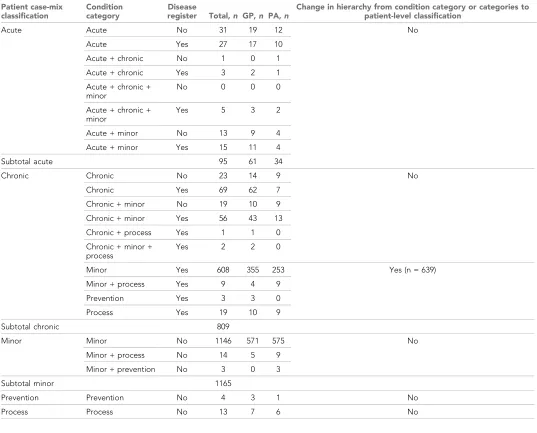
Table 1.Listing of presenting condition classification and disease register combinations forming patients’ case-mix classification
Patient case-mix classification
Condition category
Disease
register Total, n GP,n PA,n
Change in hierarchy from condition category or categories to patient-level classification
Acute Acute No 31 19 12 No
Acute Yes 27 17 10
Acute + chronic No 1 0 1
Acute + chronic Yes 3 2 1
Acute + chronic + minor
No 0 0 0
Acute + chronic + minor
Yes 5 3 2
Acute + minor No 13 9 4
Acute + minor Yes 15 11 4
Subtotal acute 95 61 34
Chronic Chronic No 23 14 9 No
Chronic Yes 69 62 7
Chronic + minor No 19 10 9
Chronic + minor Yes 56 43 13
Chronic + process Yes 1 1 0
Chronic + minor + process
Yes 2 2 0
Minor Yes 608 355 253 Yes (n = 639)
Minor + process Yes 9 4 9
Prevention Yes 3 3 0
Process Yes 19 10 9
Subtotal chronic 809
Minor Minor No 1146 571 575 No
Minor + process No 14 5 9
Minor + prevention No 3 0 3
Subtotal minor 1165
Prevention Prevention No 4 3 1 No
Method
. Design: CMCS development and testing, using example patient data from a controlled
obser-vational study.
. Setting:Data were collected from 12 volunteer general practices in England, six employing a
PA and six not, matched by health economy and patient population size, during two study ref-erence periods in 2011–2012.24,42
. Participant data: The study included 2086 routinely-collected electronic consultation records
of patients who attended a same-day PA (n= 932) or GP (n= 1154) appointment (the predom-inant appointment type for PAs at the time25
) in the study periods. Data were extracted on condition, as documented in free text and/or in a coding system (the majority of the practices used Read Codes44
). Data were also extracted on the number and type of chronic conditions the patient had, as recorded on a disease register (that is, the UK primary care pay-for-perfor-mance [P4P] Quality and Outcomes Framework45).
. Intervention: The intervention involved the development of the primary care CMCS and
the testing of its impact on the analysis of outcomes of consultation with different types of clinicians, in this case PAs and GPs. The definition of terms used is shown inBox 1.
Development of a primary care CMCS
Concepts and their definitions were discussed by the research team, and the concept of hierarchy evolved during in-person and email discussion, continued until consensus was reached. Following this, each patient condition in the dataset was searched for by LJ and MH in the lists De Jonget al
classified as acute or minor,22
and those with a direct match to a diagnosis were assigned De Jong
et al’s categorisation. All remaining conditions in the dataset were assigned to one of De Jong
et al’s categories, or to categories further defined by the GP author (SdeL); these decisions were based on the range of patient conditions in the data, and SdeL’s experience in chairing international primary care medical informatics groups and multiple publications on this issue.46-50
As a second stage, each patient consultation — frequently containing more than one condition in one category, or conditions in different categories — was placed into a hierarchy that allowed the patient to move up the hierarchy of complexity in the presence of one presenting condition in a higher (more acute) category, or the registration of a patient on a P4P45
chronic conditions register.
Testing the impact of the CMCS on analyses of PA and GP outcomes
The amount of movement was described from the categorisation of a first condition to the overall classification of that patient. Analyses of the odds or rate ratio for the primary outcome (rate of reconsultation for the same problem within 14 days) and process outcomes (advice given, and num-bers of diagnostic tests, referrals, prescriptions, and procedures) for PAs against the reference of GPs were carried out under three alternative adjustment models: case-mix only; other predictor or confounding variables only; and case-mix with other predictors or confounders (the fully adjusted model). The impact of each of these adjustments was assessed using generalised estimating equa-tion models (GEE).51
The correlation matrix was set to be exchangeable; that is, patients were assumed to have some shared characteristics within each practice, whether from demographics or organisation of the practice. Cases with missing data on any one of the variables entered into each of the GEEs were excluded for analysis of that outcome. Analyses were carried out using IBM SPSS (version 22).
The study’s anticipated outcomes were a developed primary care case-mix classification system and an assessment of the impact of this on analysis of processes and outcomes of care of different clinicians, using the example of PAs and GPs.
Results
The resultant structure of the primary care CMCS
Placing the example presenting condition data into a category
The 2086 patients in the study presented with 1147 condition descriptors. Examples of the catego-ries applied are as follows: an ‘alcohol withdrawal-induced seizure’ or ‘hyperemesis gravidarum’ was classified as acute; an ‘asthma review’ or ‘multiple sclerosis’ was classified as chronic; ‘productive cough’ or ‘diarrhoea and vomiting’ as a minor problem or symptom; ‘HIV screening’ or ‘smoking ces-sation’ as prevention; and ‘removal of suture from skin’ or ‘solicitor’s report’ as a process of care. A full listing of condition descriptors and their categorisation is available from the authors on request.
Placing the example patients’ data into the CMCS: changes to
classification level associated with the measure of patient complexity
Three-quarters (n= 1548) of the patients in the study presented with only one condition; 38.3% of these (n= 593) had a condition co-terminous with one described as chronic. Of the quarter (n= 538) of the patients presenting with >1 condition, 397 (73.8%) of these presented with2 conditions that all received the same individual category (for example, four minor problems or symptoms presenta-tions), but 133 (33.5%) of these patients also presented with a chronic condition. The remainder (n= 141) of those presenting with >1 condition did so with problems that received differing categorisa-tions; of these 91 (64.5%) also presented with a chronic condition. The classification afforded, according to the category or categories of the patient’s urgent and chronic conditions in combina-tion, is shown inTable 1.
To exemplify the categories in combination, the patient who presented for ‘stiff neck’ (categor-ised as a minor problem or symptom) and ‘anxiety states’ (categor(categor-ised as acute) was classified in complexity as acute. The patient presenting with ‘dyspepsia’ (categorised as a minor problem or symptom) and also recorded as being on the chronic kidney disease register was classified as chronic. This patient-level classification resulted in a higher classification of acuity and complexity for 639 (30.6%) of the patient cases in this sample; of these cases, 58.2% (n= 372) had consulted a GP and 41.8% (n= 267) a PA. Data for each patient case are available from the authors on request.
Testing the impact of the classification system on analyses of the
processes and outcomes of care by different types of clinician, using
the PA and GP example
A small number of cases had missing data on variables added to the analysis; the sample size used for each analysis was thereforen= 929 for PA consultation andn= 1148 for GP consultation.
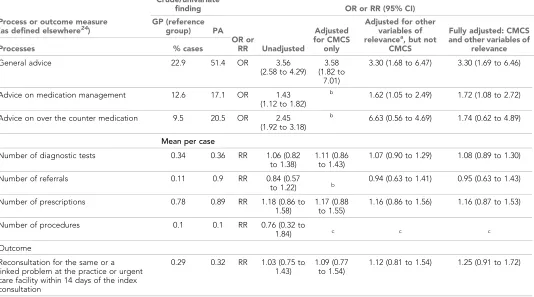
The case-mix of the two clinician types differed in this study, and the CMCS was therefore used in all analyses to ensure that case-mix differences were adjusted for in any comparison.24,42The results presented in Table 2 show three sets of analyses: unadjusted; adjusted solely for CMCS; and adjusted for CMCS and other relevant variables (age, Index of Multiple Deprivation [IMD], and num-ber of visits in the previous 3 months). The analyses use the three main classifications: acute, chronic and minor, excluding process and procedure classifications due to small numbers involved.
Adjusting for CMCS changed differences between the two groups of clinicians notably from the crude estimates, as in the case of ’advice on medication management’. Other measures, such as the ’number of referrals’, were changed little by CMCS but notably by other demographic variables. For the primary outcome of re-consultation rate, the adjustment for CMCS alone resulted in only a small change in the estimate, while the larger change was associated with a combination of the CMCS and other variables (in this case: age, IMD, and number of visits in the previous 3 months).
Discussion
Summary
This study developed a classification aiming to address complexity in general practice by combining severity and medical immediacy of the urgent condition with information about any chronic condi-tions. A greater proportion of cases for one clinician type (GP rather than PA cases here) were classi-fied as complex as a result of this, and making allowance for this complexity (rather than for urgent condition alone) resulted in some changes in the estimates of difference between the two groups.52,53
Strengths and limitations
The disease register measure selected for this study as a measure of comorbidity was part of a P4P scheme.45While P4P is potentially effective in changing physician behaviour, it may lead to some gaming and focus on some activities at the expense of others.54,55 It also takes a single disease-based approach.56This study may therefore have failed to fully represent complexity. It also may not have been able to distinguish levels of acuity within, for example, conditions such as abdominal pain. However, a measure of complexity has been achieved beyond that previously used in research on this topic, and this has been done using not only system codes but also clinicians’ free text descriptors. The authors acknowledge that, in using the judgments of one family physician (as opposed to a panel of five by De Jonget al22) issues of potential differences of clinical opinion, or of bias, have not been addressed.
Comparison with existing literature
This study set out to both develop a classification system and test its impact on analysis, and there-fore has two sets of interpretations. It is recognised that any classification system is reductionist and use of the biopsychosocial model including the patient’s reason for encounter may be preferable.56
Classification systems are also critiqued for failing to capture complexity and the undif-ferentiated symptoms encountered commonly in primary care;56
to have struggled with the concept of symptoms at all;57and to change identity through the fact of classification.58Research using any coded information from primary care databases, if used without free text, can miss cases of relevance.59 In using free text to inform this classification system, alongside coded information, this study aims to lay a foundation for more accurate comparison of the workload among the primary care workforce.
Table 2.Crude, CMCS-adjusted, other variable-adjusted and CMCS and other variable-adjusted odds ratios or rate ratios of process and outcome measure differences between PAs and GPs24
Process or outcome measure (as defined elsewhere24
)
Crude/univariate
finding OR or RR (95% CI)
GP (reference
group) PA
OR or
RR Unadjusted
Adjusted for CMCS
only
Adjusted for other variables of relevancea, but not
CMCS
Fully adjusted: CMCS and other variables of
relevance
Processes % cases
General advice 22.9 51.4 OR 3.56
(2.58 to 4.29) 3.58 (1.82 to
7.01)
3.30 (1.68 to 6.47) 3.30 (1.69 to 6.46)
Advice on medication management 12.6 17.1 OR 1.43 (1.12 to 1.82)
b
1.62 (1.05 to 2.49) 1.72 (1.08 to 2.72)
Advice on over the counter medication 9.5 20.5 OR 2.45 (1.92 to 3.18)
b 6.63 (0.56 to 4.69) 1.74 (0.62 to 4.89)
Mean per case
Number of diagnostic tests 0.34 0.36 RR 1.06 (0.82 to 1.38)
1.11 (0.86 to 1.43)
1.07 (0.90 to 1.29) 1.08 (0.89 to 1.30)
Number of referrals 0.11 0.9 RR 0.84 (0.57
to 1.22) b
0.94 (0.63 to 1.41) 0.95 (0.63 to 1.43)
Number of prescriptions 0.78 0.89 RR 1.18 (0.86 to 1.58)
1.17 (0.88 to 1.55)
1.16 (0.86 to 1.56) 1.16 (0.87 to 1.53)
Number of procedures 0.1 0.1 RR 0.76 (0.32 to
1.84) c c c
Outcome
Reconsultation for the same or a linked problem at the practice or urgent care facility within 14 days of the index consultation
0.29 0.32 RR 1.03 (0.75 to 1.43)
1.09 (0.77 to 1.54)
1.12 (0.81 to 1.54) 1.25 (0.91 to 1.72)
aWith an independent association with outcome (see full report for detail).24bCould not be estimated in SPSS.cNumbers too small for further adjustment. CMCS =
In terms of the application of the classification system to analyses of groups of clinicians, sim-ilar PA and GP case-mix difference has been reported elsewhere.37-40
However, comparison is limited by the implicit rather than explicit use of terms such as ‘minor’ or ‘chronic’ in previously published studies, and the lack of adjustment for these case-mix differences in analyses of outcome.
Implications for research
Task-shifting includes the creation of new professional groups, whereby tasks are shifted from workers with more general training to workers with specific training for a particular task.60
However, PAs are trained as generalists rather than specialists,61
and may be seen as an example of where task shifting can be a promising policy option to increase the productive effi-ciency of the delivery of healthcare services.60 However, a records-based analysis is required to measure the impact of skill-mix on task-shifting in primary care, and such analyses should include careful statistical adjustment based on explicit rather than implicit definitions of case-mix classifi-cation. The system proposed in this study requires further testing, refinement, and validation of the classification in other studies.
In conclusion, this study demonstrated the development of a classification of complexity as well as the difference that applying such classification to analyses makes to results of comparisons of dif-ferent professionals working in the same system. In particular, the classification allows analyses to account for greater complexity in the patients seen by the GPs. Policymakers, workforce planners, and employers of PAs, or any other clinician substitutes, will need to consider these differences both when considering task allocation and when evaluating efficiency (including cost) and effectiveness. Researchers should be encouraged to consider further developing and evaluating the classification in other studies.
Funding
This project was funded by the National Institute for Health Research (NIHR) Health Services and Delivery Research (HS&DR) programme (project number 09/1801/1066). The views and opinions expressed herein are those of the authors and do not necessarily reflect those of the HS&DR Pro-gramme, NIHR, the NHS, or the Department of Health.
Service support costs, enabling general practices to allocate staff time to the collection of data from patient consultation records, were received from the UK Comprehensive Research Networks covering the four study regions.
Ethics approval
The study was approved by the Surrey NHS Research Ethics Committee (reference 10/H1109/28).
Provenance
Freely submitted; externally peer reviewed.
Acknowledgements
The authors acknowledge the contribution of the article’s reviewers.
References
1. World Health Organization. Primary care: putting people first In.World Health Report 2008: Primary Health Care — Now More than Ever. Geneva: World Health Organization, 2008.
2. National Casemix and Classification Centre, University of Woolongong. Comments on the document “Activity based funding for Australian public hospitals: towards a pricing framework”.http://ahsri.uow.edu. au/content/groups/public/@web/@chsd/documents/doc/uow119700.pdf(accessed 6 Dec 2017).
3. The Joint Commission, with support from Aramark.Health care at the crossroads: guiding principles for the development of the hospital of the future. https://www.jointcommission.org/assets/1/18/Hosptal_Future. pdf. (accessed 6 Dec 2017).
4. Health and Education National Strategic Exchange. Review of Medical and Dental School Intakes in England.
https://www.gov.uk/government/uploads/system/uploads/attachment_data/file/213236/medical-and-dental-school-intakes.pdf(accessed 6 Dec 2017).
5. The Connexion. Stats reveal truth on GP shortage. http://www.connexionfrance.com/statistics-reveal-truth-on-shortage-of-french-doctors-11594-news-article.html. (accessed 6 Dec 2017).
7. Morgan PA, Abbott DH, McNeil RB,et al. Characteristics of primary care office visits to nurse practitioners, physician assistants and physicians in United States Veterans Health Administration facilities, 2005 to 2010: a retrospective cross-sectional analysis.Hum Resour Health2012;10:1.doi: 10.1186/1478-4491-10-42
8. World Health Organization. International Classification of Primary Care (ICPC-2). Geneva. World Health Organization. 2003.
9. Soler JK, Okkes I, Wood M, et al. The coming of age of ICPC: celebrating the 21st birthday of the International Classification of Primary Care.Fam Pract2008;25(4):312–317.doi: 10.1093/fampra/cmn028
10. Australian Institute of Health and Welfare.Australia’s Health 2004. Canberra: Australian Institute of Health and Welfare, 2004.
11. de Lusignan S. Codes, classifications, terminologies and nomenclatures: definition, development and application in practice.Inform Prim Care2005;13(1):65–69.doi: 10.14236/jhi.v13i1.580
12. Starfield B, Lemke K. Complexity of patient illness versus complexity of patient visits. http://www. annfammed.org/content/8/4/291.long/reply#annalsfm_el_13780(accessed 19 Dec 2017).
13. Safford MM, Allison JJ, Kiefe CI. Patient complexity: more than comorbidity. the vector model of complexity.J Gen Intern Med2007;22(3):382–390.doi: 10.1007/s11606-007-0307-0
14. Green LA. The implications of measuring complexity.Ann Fam Med2010;8(4):291–292.doi: 10.1370/afm. 1147
15. Weiner JP, Starfield BH, Lieberman RN. Johns Hopkins Ambulatory Care Groups (ACGs). A case-mix system for UR, QA and capitation adjustment.HMO Pract1992;6(1):13–19.
16. Katerndahl DA, Wood R, Jae´n CR. A method for estimating relative complexity of ambulatory care.Ann Fam Med2010;8(4):341–347.doi: 10.1370/afm.1157
17. Halling A, Fridh G, Ovhed I. Validating the Johns Hopkins ACG Case-Mix System of the elderly in Swedish primary health care.BMC Public Health2006;6(1):1.doi: 10.1186/1471-2458-6-171
18. Brennan CW, Daly BJ. Patient acuity: a concept analysis.J Adv Nurs2009;65(5):1114–1126.doi: 10.1111/j. 1365-2648.2008.04920.x
19. Everett CM, Thorpe CT, Palta M, et al. Division of primary care services between physicians, physician assistants, and nurse practitioners for older patients with diabetes.Med Care Res Rev2013;70(5):531–541.
doi: 10.1177/1077558713495453
20. Parkerson GR, Michener JL, Yarnall KS,et al. Duke Case-Mix System (DUMIX) for ambulatory health care.J Clin Epidemiol1997;50(12):1385–1394.doi: 10.1016/S0895-4356(97)00217-5
21. Bhattarai N, Charlton J, Rudisill C,et al. Coding, recording and incidence of different forms of coronary heart disease in primary care.PLoS ONE2012;7(1):e29776.doi: 10.1371/journal.pone.0029776
22. De Jong J, Visser MR, Wieringa-de Waard M. Exploring differences in patient mix in a cohort of GP trainees and their trainers.BMJ Open2011;1(2):e000318.doi: 10.1136/bmjopen-2011-000318
23. Knottnerus JA, Metsemakers J, Ho¨ppener P,et al. Chronic illness in the community and the concept of ’social prevalence’.Fam Pract1992;9(1):15–21.doi: 10.1093/fampra/9.1.15
24. Drennan VM, Halter M, Brearley S,et al. Investigating the contribution of physician assistants to primary care in England: a mixed-methods study.Health Services and Delivery Research2014;2(16):1–136.doi: 10.3310/ hsdr02160
25. Peek CJ, Baird MA, Coleman E. Primary care for patient complexity, not only disease.Fam Syst Health2009;
27(4):287–302.doi: 10.1037/a0018048
26. Rethans JJ, Saebu L. Do general practitioners act consistently in real practice when they meet the same patient twice? Examination of intradoctor variation using standardised (simulated) patients.BMJ1997;314 (7088):1170–1173.doi: 10.1136/bmj.314.7088.1170
27. Sturmberg JP, Martin CM, Katerndahl DA. It is complicated! Misunderstanding the complexities of ’complex’.J Eval Clin Pract2017;23(2):426–429.doi: 10.1111/jep.12579
28. American Academy of Physician Assistants. Physician assistant census report: results from the 2010 AAPA Census.http://www.aapa.org/workarea/downloadasset.aspx?id=1454(accessed 6 Dec 2017).
29. Drennan VM, Chattopadhyay K, Halter M,et al. Physician assistants in English primary care teams: a survey.
J Interprof Care2012;26(5):416–418.doi: 10.3109/13561820.2012.686538
30. Frossard LA, Liebich G, Hooker RS, et al. Introducing physician assistants into new roles: international experiences.Med J Aust2008;188(4):199–201.
31. Jones IW, Hooker RS. Physician assistants in Canada: update on health policy initiatives.Can Fam Physician
2011;57(3):e83–e88.
32. Nederlandse Associatie Physician Assistants [Dutch Association of Physician Assistants]. English Information.
http://www.napa.nl/kennisbank/english/(accessed 14 Dec 2017)
33. O’Connor TM, Hooker RS. Extending rural and remote medicine with a new type of health worker: physician assistants.Aust J Rural Health2007;15(6):346–351.doi: 10.1111/j.1440-1584.2007.00926.x
34. Gallagher J, BBC News. NHS plans rapid expansion of ’doctor’s assistant’ jobs.http://www.bbc.co.uk/news/ health-28896625(accessed 6 Dec 2017).
35. Halter M, Drennan V, Chattopadhyay K,et al. The contribution of physician assistants in primary care: a systematic review.BMC Health Serv Res2013;13:223.doi: 10.1186/1472-6963-13-223
36. Fethke C, Ekwo E, Daniels M. Management practices: task allocation between physicians and physician assistants.J Ambul Care Manage1979;2(2):31–45.
38. Grzybicki DM, Sullivan PJ, Oppy JM, et al. The economic benefit for family/general medicine practices employing physician assistants.Am J Manag Care2002;8(7):613–662.
39. Duttera MJ, Harlan WR. Evaluation of physician assistants in rural primary care.Arch Intern Med1978;138 (2):224–22.doi: 10.1001/archinte.1978.03630260036013
40. Parle JV, Ross NM, Doe WF. The medical care practitioner: developing a physician assistant equivalent for the United Kingdom.Med J Aust2006;185(1):13–17.
41. Simkens ABM, van Baar ME, van Balen FAM, et al. The Physician Assistant in General Practice in the Netherlands.J Physician Assist Educ2009;20(1):30–38.doi: 10.1097/01367895-200920010-00005
42. Drennan V, Halter M, Joly L,et al. Physicians Assistants and General Practitioners: a comparison of same day appointment consultations.Br J Gen Pract2015;65(634):e344–e350.doi: 10.3399/bjgp15X684877
43. Dean BB, Lam J, Natoli JL,et al. Review: use of electronic medical records for health outcomes research: a literature review.Med Care Res Rev2009;66(6):611–638.doi: 10.1177/1077558709332440
44. NHS Digital. Read Codes.https://digital.nhs.uk/article/1104/Read-Codes(accessed 21 Dec 2017).
45. NHS Employers. 2014/15 General Medical Services (GMS) Contract Quality and Outcomes Framework (QOF): guidance for GMS contract 2014/15.http://www.nhsemployers.org/~/media/Employers/
Publications/2014%2015%20QOF%20guidance%20stakeholders.pdf(accessed 6 Dec 2017)
46. de Lusignan S. Codes, classifications, terminologies and nomenclatures: definition, development and application in practice.Inform Prim Care2005;13(1):65–69.doi: 10.14236/jhi.v13i1.580
47. de Lusignan S, van Weel C. The use of routinely collected computer data for research in primary care: opportunities and challenges.Fam Pract2006;23(2):253–263.doi: 10.1093/fampra/cmi106
48. de Lusignan S, Liaw ST, Michalakidis G,et al. Defining datasets and creating data dictionaries for quality improvement and research in chronic disease using routinely collected data: an ontology-driven approach.
Inform Prim Care2011;19(3):127–134.doi: 10.14236/jhi.v19i3.805
49. de Lusignan S, Chan T, Jones S. Large complex terminologies: more coding choice, but harder to find data — reflections on introduction of SNOMED CT (systematized nomenclature of medicine — clinical terms) as an NHS standard.Inform Prim Care2011;19(1):3–5.doi: 10.14236/jhi.v19i1.787
50. de Lusignan S. In this issue: ontologies a key concept in informatics and key for open definitions of cases, exposures, and outcome measures.J Innov Health Inform2015;22(2):170170.doi: 10.14236/jhi.v22i2.170
51. Snijders TAB, Bosker RJ.Multilevel analysis: an introduction to basic and advanced multilevel modeling. 2nd ed. London: Sage Publications Ltd, 2012.
52. Bentzen N. Preface inWonca Dictionary for General/Family Practice. Copenhagen: WONCA International Classification Committee, 2003.http://www.ph3c.org/4daction/w3_CatVisu/en/wonca-dictionary-of-general/ family-practice.-2003.html?wDocID=92(accessed 6 Dec 2017).
53. Jones R, White P, Armstrong D.et al. Managing acute illness. http://www.kingsfund.org.uk/sites/files/kf/ field/field_document/managing-acute-illness-gp-inquiry-research-paper-mar11.pdf(accessed 6 Dec 2017). 54. Dixon A, Khachatryan A, Wallace A,et al. The Quality and Outcomes Framework (QOF): does it reduce
health inequalities? Southampton: National Institute of Health Research: Queen’s Printer and Controller of HMSO, 2011.http://www.netscc.ac.uk/hsdr/files/project/SDO_FR_08-1716-207_V01.pdf(accessed 22 Dec 2017).
55. Smith PC, Mossialos E, Papanicolas I.et al. Performance measurement for health system improvement. Experiences, challenges and prospects. Copenhagen: World Health Organization 2008 and World Health Organization, on behalf of the European Observatory on Health Systems and Policies.http://www.who.int/ management/district/performance/PerformanceMeasurementHealthSystemImprovement2.pdf(accessed 6 Dec 2017).
56. Gillam S. Should the quality and outcomes framework be abolished? Yes.BMJ2010;340:c2710.doi: 10. 1136/bmj.c2710
57. Soler JK, Okkes I. Reasons for encounter and symptom diagnoses: a superior description of patients’ problems in contrast to medically unexplained symptoms (MUS).Fam Pract2012;29(3):272–282.doi: 10. 1093/fampra/cmr101
58. Armstrong D. Diagnosis and nosology in primary care.Soc Sci Med2011;73(6):801–807.doi: 10.1016/j. socscimed.2011.05.017
59. Ford E, Nicholson A, Koeling R, et al. Optimising the use of electronic health records to estimate the incidence of rheumatoid arthritis in primary care: what information is hidden in free text?BMC Med Res Methodol2013;13:105.doi: 10.1186/1471-2288-13-105
60. Fulton BD, Scheffler RM, Sparkes SP,et al. Health workforce skill mix and task shifting in low income countries: a review of recent evidence.Hum Resour Health2011;9:1.doi: 10.1186/1478-4491-9-1
61. Miles DL, Rushing WA. A study of physicians’ assistants in a rural setting.Med Care1976;15(12):987–995.