THE ADOPTION OF CLOUD COMPUTING FOR SMALL AND MEDIUM ACCOUNTING FIRMS
A thesis submitted in partial fulfilment of the requirements for the Degree of Master of Commerce in Accounting
in the University of Canterbury by Xinding Ma
Acknowledgements ... 7
Abstract ... 8
Chapter 1. Introduction ... 9
Chapter 2. Literature Review: Cloud Computing ... 11
Definition of Cloud Computing ... 11
The Business Case for Cloud Computing ... 13
2.2.1 Risks and Uncertainties ... 15
2.2.2 Attitude towards Cloud Computing ... 17
Cloud Computing and Accounting ... 18
Summary ... 19
Chapter 3. Literature Review on IS Adoption ... 20
Diffusion of Innovations theory ... 20
Technological, Organisational and Environmental (TOE) Framework ... 21
Iacovou’s EDI adoption model ... 22
3.3.1 An Application in New Zealand context: Mehrtens et al (2001) ... 24
Chapter 4. Literature Review: Empirical Studies of Cloud Computing Adoption ... 27
Benefits and Drawbacks of Cloud Computing ... 28
Organisational ... 30
External Environment ... 31
Chapter 5. Research Gaps, Questions and Model ... 33
Research Gaps ... 33
Research Topic and Question ... 34
Scope of Research ... 35
5.3.2 Cloud Adoption ... 37
Model Development ... 38
Chapter 6. Research Design ... 40
Research Framework ... 40
Methodology ... 40
6.2.1 Multiple Case Study ... 41
6.2.2 Data Collection ... 42
6.2.3 Semi-Structured Interviews ... 43
Chapter 7. Within-case Findings ... 44
Firm A ... 45
7.1.1 Cloud Computing for Client Service ... 46
7.1.2 Cloud Computing for Practice Management ... 48
Firm B ... 49
7.2.1 Cloud Computing for Client Service ... 50
7.2.2 Cloud Computing for Practice Management ... 54
Firm C ... 55
7.2.3 Cloud Computing for Client Service ... 56
7.2.4 Cloud Computing for Practice Management ... 56
Firm D ... 60
7.3.1 Cloud Computing for Client Service ... 61
7.3.2 Cloud Computing for Practice Management ... 63
Firm E ... 64
7.4.1 Cloud Computing for Client Service ... 65
7.4.2 Cloud Computing for Practice Management ... 68
Firm F ... 68
7.5.2 Cloud Computing for Practice Management ... 72
Provider Omicron ... 74
7.6.1 Cloud Computing for Client Service ... 74
7.6.2 Cloud Computing for Practice Management ... 75
Chapter 8. Cross-case Findings ... 77
Summary: Cloud Computing for Client Service ... 78
8.1.1 Perceived Benefits and Risks ... 80
8.1.2 Organisational Factors ... 82
8.1.3 External Environment ... 83
Summary: Cloud Computing for Practice Management ... 85
8.2.1 Perceived Benefits and Risks ... 87
8.2.2 Organisational ... 88
8.2.3 Environment ... 89
Chapter 9. Discussion ... 91
The Roles of Cloud Computing ... 91
9.1.1 Interorganisational Nature of Cloud Computing ... 92
9.1.2 Practice Management Systems as ERP ... 92
Competitive advantage of Cloud Software ... 94
9.2.1 Value ... 94
9.2.2 Rarity ... 96
9.2.3 The Earthquake Effect ... 97
Implications of cloud “paradigm” for Accountants ... 97
Cloud-based ERP for accountants ... 99
9.4.1 Adopters ... 100
9.4.2 Non-Adopter: Reasons for Non-Adoption ... 100
Research Question Revisited ... 103
Contributions to Literature ... 106
Implications to Practice ... 107
Limitations of Study ... 107
Future Research Directions ... 109
Appendix 1: Interview Questions and Schedule ... 111
Tables of Figures
Table 2-1: empirical studies regarding the attitude towards cloud computing ... 17
Table 3-1: Diffusion of Innovation (DOI) theory ... 21
Table 3-2: Technological, Organisational and Environmental (TOE) Framework ... 22
Table 3-3: model used in Mehrtens et al. (2001) Bold indicates additions from Iacovou et al (1995) model ... 26
Table 4-1: cloud adoption studies ... 28
Table 5-1: Summary of gaps identified ... 34
Table 5-2: Comparison of the definition of small business with other countries ... 36
Table 7-1: Summary of Interviewees ... 44
Table 7-2: cloud adoption for Firm A ... 46
Table 7-3: cloud adoption for Firm B ... 50
Table 7-4: cloud adoption for Firm C ... 56
Table 7-5: cloud adoption for Firm D ... 61
Table 7-6: cloud adoption for Firm E ... 65
Table 7-7: cloud adoption for Firm F ... 69
Table 7-8: Provider Omicron's remarks about cloud accounting ... 74
Table 8-1: Summarised findings for cloud as client service. Italic indicates a factor that inhibited adoption. ... 79
Table 8-2: Summarised findings for cloud as practice manager. Italic indicates a factor that inhibited adoption. ... 86
Figure 1: EDI Adoption model, from Iacovou et al (1995) ... 23
Acknowledgements
I would like to thank everyone who has provided me with support, guidance and care while I am researching and writing this thesis.
Firstly, I would like to express my gratitude towards my supervisors, Mr Trevor Nesbit and Associate Professor Richard Fisher, who have provided me with invaluable assistance throughout the project. The thesis would not have been possible without their help.
Secondly, a special thank-you to the interviewees of this study, who took their valuable time to talk to me and shared with me information about their firms.
Abstract
Cloud computing is a contemporary information technology (IT) concept that has attracted overwhelming attention from the academics and practitioners of the IT industry. By
connecting a large number of servers around the world via the internet and pooling the resources that they generate, cloud computing is a promising innovation that is expected to deliver significant cost savings and unprecedented flexibility on how businesses consume IT resources. The accounting industry, in particular, perceives cloud computing as a potent threat to itself. However, prior studies that examine cloud computing from the business perspective are limited. Moreover, despite the rapid growth of cloud computing in the accounting industry, there is no prior study that focused on the accounting industry. The purpose of this study is to explore the factors that led to the rapid growth of cloud computing specifically in the accounting industry, and to explore the roles that cloud
computing played within the accounting firms. The accounting industry is chosen due to the high popularity of cloud computing within it, and the homogeneous nature of the
accountancy services. This study uses a multiple case study design, and semi-structured interviews are carried out with the decision makers of six accounting firms.
The results revealed that the concept of cloud computing refers to many types of
applications. For accounting firms, cloud computing consisted of an external (client-oriented) role and an internal (practice management) role. The rapid development of cloud computing occurs primarily in the external role, where cloud computing is used as a competitive tool. On the other hand, the usefulness of cloud-based practice management systems is limited to the micro accounting firms only.
This study makes an important contribution in the field of cloud computing research. It should be recognised that the role of cloud computing extends beyond its technological merits, and varies depending on the characteristics of the industry and the strategy of the business. It is recommended that future studies take into account the ways firms
Cloud computing had attracted considerable attention from the information technology (IT) industry since the term was coined in 2008. Described as a paradigm-shifting innovation, cloud computing brings together different pieces of technology and computing resources to create a coherent ecosystem over the internet. This resulted in significant improvements to the ability for IT service providers to aggregate and coordinate resources for computing-intensive tasks. For businesses that use cloud computing, cloud computing reduces the cost of purchasing and maintaining IT infrastructure, as well as providing better flexibility in terms of how computing resources can be bought and consumed.
However, due to the contemporary nature of cloud computing technology, the demand side of cloud computing is yet to mature. Cloud computing is a vague concept that takes various forms in practice, and there are multiple definitions that attempt to describe different characteristics and forms of cloud computing (Marston, Li, Bandyopadhyay, Zhang, & Ghalsasi, 2011). The theoretical benefits that cloud computing provide are yet to be fully realised by IT professionals, as many of the existing cloud products either do not fully utilise these benefits, or simply marketing hype (Hoberg, Wollersheim, & Krcmar, 2012). The concept also induces concerns and uncertainties regarding the safety, privacy and reliability of cloud computing.
In spite of the theoretical benefits, confusion and concerns of cloud computing, the
accounting industry is one area that cloud computing is flourishing. Cloud-based accounting software like Xero had experienced exponential growth in terms of popularity, market share and share price since 2008 (Xero, 2014). Cloud-based accounting applications have been perceived by the accounting industry as potent threats against conventional accounting practices, even though their features are not as comprehensive as the desktop counterparts. Cloud service providers like WorkflowMax (2013) and CCH (2013) posited that the
popularisation of cloud computing could drastically alter the state of the accounting industry, but their interest in the cloud computing market reduces the credibility of their claims.
cloud computing adoption studies also do not provide an adequate explanation. The majority of existing cloud computing literature tends to focus on the technical, supply-side issues of cloud computing (what is the most efficient way to generate and distribute computing resources that meet the users’ needs?), rather than the demand-side (why do people and businesses use cloud computing?). The demand-side studies of cloud computing also vary considerably in terms of the contextual factors. These factors, such as country and industry, generally have a strong influence on how businesses conduct their operations and achieve their goals. Moreover, the adoption studies do not explicitly link the adoption behaviour with the business’ operating environments, strategies or processes.
This is an exploratory study that intends to investigate the demand-side aspects of cloud computing in the context of the accounting industry. A multiple case study design is used. The unit of analysis is accounting firms (firm-level), with an emphasis placed on small accounting firms. Data is gathered by conducting semi-structured interviews with the decision makers from six different accounting firms. The study focuses on the decision makers’ perception towards the new cloud phenomenon, and the factors that led to their decision to adopt (or reject) cloud computing.
The accountants’ usage of cloud-based technology is divided into two categories: adopting cloud computing in order to improve the service to their clients (as an interorganisational system), and using cloud-based practice management systems for their own use. This is an important distinction, as prior studies of cloud computing have not clearly defined the scope of cloud computing in terms of the purpose of the systems.
This thesis is structured as follows. Chapters 2 to 4 review the existing literature on the meaning and the significance of cloud computing to the business community, followed by a review of previous cloud computing adoption studies. Chapter 5 identifies the gaps in the literature, and specifies the research questions and scope of this study. Chapter 6 discusses and justifies the methods that are chosen to undertake the study. Chapters 7 and 8 present the findings from the research and analyse the results to identify patterns. Chapter 9 attempts to explain the observations by establishing connections between the results and the relevant theories. Finally, Chapter 10 concludes the study by discussing the
Cloud computing is widely regarded as a paradigm-shifting innovation that can significantly alter the way IT resources are provided, used and paid for businesses (Armbrust et al., 2010). Unlike other IT innovations, cloud computing combines pre-existing heterogeneous
technologies into a coherent ecosystem, rather than establishing a new set of systems entirely (Avram, 2014). Unfortunately, this makes the definition and the scope of cloud computing particularly difficult to ascertain.
The literature review is separated into three chapters. This chapter examines the definition of cloud computing, the arguments that favour and reject the feasibility of cloud computing, and the claims of cloud computing’s impact on the accounting industry. Chapter 3 discusses the firm-level information system (IS) adoption models, while Chapter 4 reviews the
empirical studies on cloud computing adoption.
Definition of Cloud Computing
The most widely accepted definition of cloud computing is proposed by National Institute of Science and Technology (NIST). This definition is commonly used as a foundation, where later studies derive their interpretations of cloud computing based on these factors (Hoberg et al., 2012). According to NIST, cloud computing is defined as “… a model for enabling ubiquitous, convenient, on-demand network access to a shared pool of configurable computing resources… that can be rapidly provisioned and released with minimal
management effort or service provider interaction” (Mell & Grance, 2011). This definition outlined five characteristics that are essential to a cloud computing model:
• on-demand self-service (computing resources are allocated automatically based on
load),
• broad network access (resource is accessible via the internet, irrespective of client’s
platform),
• resource pooling (all computing resources are generated and pooled together before
• rapid elasticity (ability to increase or shrink computing resources to meet
fluctuations in users’ resource pattern), and
• measured service (users’ resource use can be monitored and controlled).
Software as a Service (SaaS) is the most common and most mature form of cloud computing. Under SaaS, the hardware and software are provided by the cloud service provider, and users are granted access to the software (Gupta, Seetharaman, & Raj, 2013; Sultan, 2011). Typically, the SaaS model relieves users from the expertise and efforts required to maintain their own software, but allows very limited scope for users to customise the system (Mell & Grance, 2011).
SaaS is not the only form of cloud computing, however. It is commonly established that cloud computing is available in three forms: SaaS, Platform as a Service (PaaS) and
Infrastructure as a Service (IaaS) (Mell & Grance, 2011). In contrast to SaaS, IaaS provides only data storage and computing resource hardware infrastructure, and users have to deploy their own operating systems and software (Mell & Grance, 2011). IaaS eliminates the need to maintain hardware while allowing for a high degree of flexibility and customisation by the user, but does not typically relieve the user from having to maintain their own software. For this reason, IaaS is most favoured by large institutions such as large corporations (PwC, 2011) and universities (Sarkar & Young, 2011). PaaS offers a middle ground, where the cloud service provider maintains a platform of systems and toolkits, and users may deploy their own applications that are compatible (Mell & Grance, 2011). The boundary between IaaS and PaaS is not well-defined, as neither of them provides an out-of-the-box solution like SaaS (Armbrust et al., 2010). However, there are subtle differences in their intended markets: PaaS focuses more on supporting businesses to develop their own applications, rather than providing the hardware (Weinhardt, Anandasivam, Blau, & Stößer, 2009).
the previous definition suggests, cloud computing can refer to any IT infrastructure that separates the user of computing resource from the providers of said resources.
However, the concepts incipient in cloud computing is not unique, or new. Critics
questioned the appropriateness of labelling cloud computing as a new paradigm, because of its resemblance to existent concepts such as grid computing and application service
providers (ASP) (Weinhardt et al., 2009). The similarity caused significant confusion over the substance of cloud computing and its improvements over the predecessors (Armbrust et al., 2010). Evidently, earlier articles and definitions had implicitly equated Software as a Service to cloud computing, even though SaaS was only a part of the latter (Payton, 2010;
Stanoevska-Slabeva & Wozniak, 2010). This also created labelling issues, as IT providers misused “cloud computing” for marketing purposes (Hoberg et al., 2012). For example, web-based email services (such as Hotmail) satisfy the definition of cloud computing, yet it existed well before the term cloud computing was invented (Du & Cong, 2010).
Cloud computing does distinguish itself from grid computing, in that it utilises virtualisation much more heavily than grid computing. This allows the computing resources to be
accessed from the internet rather than a specialised interface, and makes it possible to enforce service-level agreements between the cloud provider and customers (Stanoevska-Slabeva & Wozniak, 2010; Weinhardt et al., 2009). However, a detailed discussion regarding the technical differences between grid and cloud computing is outside the scope of this study.
The Business Case for Cloud Computing
Cloud computing is described as a new paradigm in the form of “… convergence between… IT efficiency… and business agility” (Marston et al., 2011, p. 177). Effectively, the concept of cloud computing allows businesses to use IT services more flexibly than conventional in-house solutions, and often at a much lower cost.
Resources under the cloud computing model are pooled and can be provided to any user at any given time, which means that cloud service providers can supply a virtually unlimited amount of computing resources to their users at a very short notice, as well as reallocating computing resources that a user no longer needs to other users (referred to as rapid downscaling).
In practice, this allows business users to make last-minute adjustments to their IT services to match their actual demand. This relieves businesses from having to forecast resource usage into the future, or carry additional capacity that are not needed during the majority of the year (and paying for those unused capacity) (Armbrust et al., 2010; Marston et al., 2011). This is particularly beneficial for businesses whose resource usage pattern fluctuates
significantly, or the demand for computing resources consists of irregular peaks and troughs (Marston et al., 2011). Additionally, cloud computing provides the ability to spread
computation-intensive tasks over a large amount of servers around the world. For projects that were previously deemed to be too resource-consuming using traditional IT
infrastructure, cloud computing can tap into a much larger pool of computing resources to complete the computing-intensive tasks more quickly (Grossman, 2009).
Cloud computing also reduces the risk of investing in IT infrastructure by substituting capital investment with operating expenses. IT infrastructure is a highly risky investment, because while IT systems are often believed to produce significant benefits and even competitive advantages, there is no guarantee that such benefits would necessarily accrue to the firm (Clemons, 1986; King, Grover, & Hufnagel, 1989). In fact, the relationship between
implementing new IT systems and the firm’s competitive advantage is anecdotal at best, and questionable at worst (Zhang & Lado, 2001). In more recent years, the Global Financial Crisis had severely cut back businesses’ capital investments and discouraged risk-taking behaviour (Grubisic, 2014).
The fact that cloud computing requires practically no up-front IT investment was perceived as a very desirable trait. Since cloud-based services are charged based on usage or
businesses, as they generally lack the financial capital and expertise necessary to acquire, implement or manage sophisticated IT systems (Iacovou, Benbasat, & Dexter, 1995). The elimination of up-front investment by cloud computing means that small businesses are also able to adopt cutting-edge IT systems, derive benefits from them, and make them better equipped in terms of information systems to compete with their larger counterparts (Marston et al., 2011).
Finally, by centralising computing resources, cloud computing offers greater efficiency and less maintenance on the user’s part. In-house IT solutions are usually highly inefficient, as most corporate servers have an average utilisation rate of approximately 30% (Marston et al., 2011). By combining and consolidating computing resources, cloud service providers can take advantage of economies of scale and realise cost savings up to a factor of seven
(Armbrust et al., 2010). This cost savings may be passed onto the users, which ultimately lowers their total IT cost. Moreover, since applications and infrastructure over the cloud reside with the cloud service provider, this eliminates the need on the user’s end to incur additional expenditure or time to manage the IT systems.
2.2.1 Risks and Uncertainties
Despite the apparent benefits of cloud computing, the characteristics of cloud computing embody inherent risks and uncertainties for it users. As cloud computing is provided by a third party over the internet, data is stored in remote servers, rather than onsite. As a result, cloud computing requires businesses to relinquish their physical control over their data, and may give rise to anxieties regarding the security, reliability and privacy of the users’ data (Armbrust et al., 2010).
The security of cloud-based storage is a concern particularly for CPA firms (chartered
data are in fact safer in the cloud, as cloud providers have better economies of scale to implement proper access controls. In comparison, businesses that host their IT
infrastructure in-house may not be able to implement the equivalent level of security measure, due to the lack of resources. Moreover, more recent empirical studies suggest that smaller firms perceive data security less importantly than their larger counterparts, and small businesses are in a better position to negotiate a trade-off between the benefits of cloud computing and perceived data security (Gupta et al., 2013; Sobragi, Maçada, & Oliveira, 2014; Sultan, 2011).
Privacy is another major concern for users of cloud computing. While security and privacy are often mentioned together, the security measures discussed above do not generally resolve privacy concerns (Armbrust et al., 2010). Since users’ data reside with cloud providers, this gives rise to the perception and suspicion that cloud providers may abuse their privileged access to the users’ data for their own commercial benefit without the knowledge or consent of the user (Du & Cong, 2010; Gupta et al., 2013; Kingsford, 2014). For smaller businesses seeking to adopt cloud-based ERP systems, data privacy represents one of the most significant obstacles to its popularity and reception (Grubisic, 2014). Unlike data security, the solutions to the privacy concerns lie in social tools (contracts and
2.2.2 Attitude towards Cloud Computing
The interest and strengths of cloud computing did not necessarily translate into intention, however. As the two studies below show, IT professionals were sceptical towards whether cloud computing is viable enough to replace the traditional IT model.
Author Data Source Factors
(Lin & Chen, 2012) IT Professionals, Taiwan Customer needs, compatibility, relative advantage, maintenance. (PwC, 2011) Senior and middle
managers of large businesses; and IT outsourcers.
[image:17.595.65.517.169.323.2]Security, relative advantage, workload readiness.
Table 2-1: empirical studies regarding the attitude towards cloud computing
Lin and Chen (2012) investigated the understanding and concerns of cloud computing by IT professionals. An IT professional was defined as someone with at least three years of working experience in IT companies or the IT department of large companies. The respondents identified customer needs as a major determinant for their cloud adoption decision, as the businesses are reluctant to adopt cloud-based solutions without explicit request from their customers. The compatibility of cloud-based software with the
company’s existing information systems and policies is another concern that impedes the respondents’ enthusiasm towards cloud computing. Cloud-based systems are considered to be beneficial for individual staff members and informal teams, but adopting cloud
additional workload of only 3% would be migrated into the cloud in the next three years. The concern for security, especially the loss of control over data, was perceived as a major issue by 62% of respondents. The large corporations also faced substantial switching costs, due to the fact that their existing database management systems and certain applications were originally written for the traditional IT service model, and significant modifications were necessary to take advantage of the cloud-based architecture.
In short, the studies indicate a strong reluctance by IT professionals to adopt cloud computing. This suggest that the benefits of cloud computing are mostly theoretical and unexplored. Since there was little time for cloud computing to evolve and mature, this result is hardly surprising. However, the accounting industry is a notable exception.
Cloud Computing and Accounting
Historically, accounting systems were the primary driving force behind the demands for IT systems (Cragg & King, 1993). In recent years, the rise of new, cloud-based accounting software had led to sombre forecasts in the accounting sector. It is little surprise, perhaps, that accounting firms have become particularly interested in the adoption of cloud
computing, and an increasing number of accountants began to provide cloud-based
accounting solutions to their clients. Yet, despite the rate of development, academic studies that explicitly examined the impact of cloud computing on accounting industry was virtually non-existent.
A research report conducted by CCH (2013) had indicated an overwhelming interest in cloud-based accounting. The report surveyed 1018 owners of small to medium enterprises (SMEs) and 212 accountants across Australia for their perceptions towards cloud computing. According to the report, 65% of the SMEs and 60% of the accountants indicated that they would consider adopting cloud computing. The interest is much stronger among younger accountants and business owners (35 years of age and younger).
Moreover, the report concluded that cloud accounting may prove to be a threat for
disturbing news to accountants, given that 63% of accountants’ work consists of
transactional services. Transactional services include financial reporting, tax returns and simple financial analysis, which can be easily automated by cloud-based software due to the highly structured and low skill level requirement nature of the work. In other words,
accountants risk having their “cash cow” businesses cut out by cloud computing via the loss of business or reduction in revenue potential due to automation.
This concern is echoed by other providers of cloud accounting solutions, albeit less sombre. WorkflowMax (2013), for example, suggests that cloud computing would transform
accountants’ jobs by automating the “mundane, number-crunching tasks”, and supporting accountants’ roles as business advisors. Nonetheless, if the argument of CCH (2013) is accepted that number-crunching comprises over half of accountants’ job, cloud computing is expected to significantly change the form and ways accounting is practiced.
Although it is imprudent to discount their statements entirely, it should be noted that that the neutrality of the viewpoints above are questionable. Since both CCH and WorkflowMax are cloud service providers in the accounting industry, this gives them a vested interest in the future of cloud-based accounting solutions. Their viewpoints may contain marketing hype. It is also difficult to ascertain the extent to which their findings and commentaries are tainted with their own vested interests and biases.
Summary
In summary, cloud computing is recognised as an important innovation that can potentially transform how businesses use IT to conduct their operations. Meanwhile, there is a
This chapter examines the relevant theories pertaining to IS adoption. The adoption of information technology systems is the process of “… using computer hardware and software applications to support operations, management, and decision making in the business.” (Thong, 1999, p. 192). Adoption specifically prescribes that the IS is used productively, which implies that the IS must be generating some form of benefit (Oliveira & Martins, 2011; Thong, 1999). An IS adoption theory provides a framework, based on which the factors that affect the adoption of an information system are categorised.
The vast majority of studies on IS adoption utilise one of the following models: Diffusion of Innovations (DOI) theory, and Technological, Organisational and Environment (TOE)
Framework. These models are combined and refined by subsequent studies. This section provides an overview of these models. Alternative theories, such as Technology Acceptance Model (TAM) and Unified Theory of Acceptance and Use of Technology (UTAUT) are not examined, as they relate to individual-level adoption. Hence, they are outside the scope of this study.
Diffusion of Innovations theory
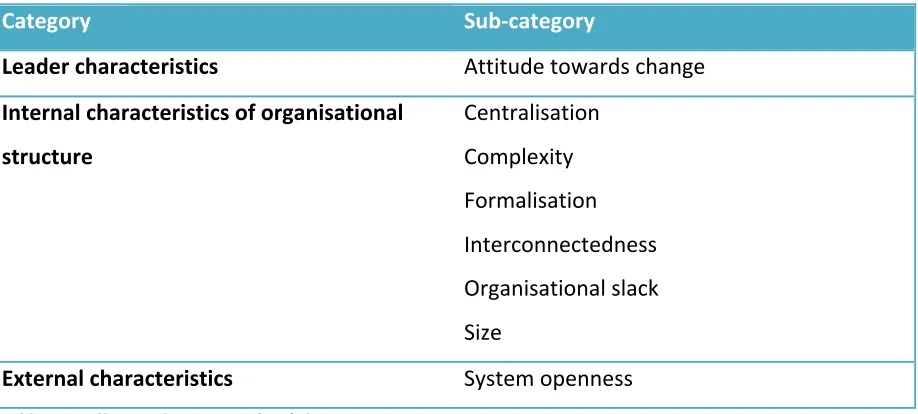
DOI at the firm level proposes that organisational innovativeness is related to three factors: leader characteristics, organisational structure and organisational characteristics (Rogers (1995), as cited in Oliveira & Martins, 2011). The factors are shown in the table below. In the “internal characteristics of organisational structure” category of the model, centralisation refers to the extent of which decision making authority within a firm rests with the minority. Complexity refers to the knowledge and expertise the members in that business possess. Formalisation refers to how rigidly rules within the organisation are followed. Interconnecteness measures the extent of social networks the organisation has. Organisational slack refers to the available resources (financial or otherwise) the
While DOI provides a comprehensive set of factors to evaluate the technical merits of an IS innovation, the omission of the external environment aspect is a major drawback (Oliveira & Martins, 2011; Oliveira, Thomas, & Espadanal, 2014; Yazn, Savvas, & Feng, 2013). For this reason, DOI is more commonly used as a complementary perspective, rather than as a standalone model.
Category Sub-category
Leader characteristics Attitude towards change Internal characteristics of organisational
structure
Centralisation Complexity Formalisation Interconnectedness Organisational slack Size
[image:21.595.71.530.190.397.2]External characteristics System openness Table 3-1: Diffusion of Innovation (DOI) theory
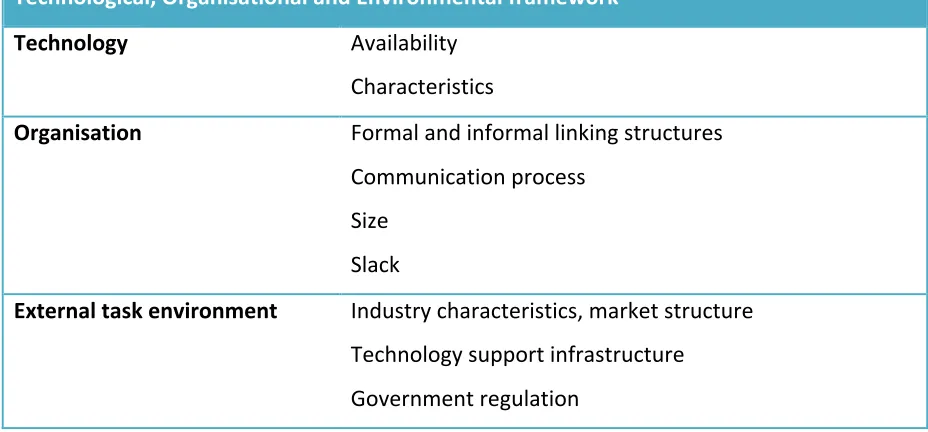
Technological, Organisational and Environmental framework
Technology Availability
Characteristics
Organisation Formal and informal linking structures Communication process
Size Slack
External task environment Industry characteristics, market structure Technology support infrastructure
[image:22.595.65.529.82.298.2]Government regulation Table 3-2: Technological, Organisational and Environmental (TOE) Framework
Compared to the DOI theory, TOE focuses more on the surrounding environment, rather than the innovation itself or the organisation. The TOE Framework is not exclusive to any specific information systems, which makes it a versatile framework suited to a wide range of IT innovations (Oliveira & Martins, 2011).
Iacovou’s EDI adoption model
Iacovou’s model was developed by Iacovou et al. (1995), and was originally used to study the factors for small businesses to adopt Electronic Data Interchange (EDI) systems. EDI is a standard that facilitated direct communication interface between firms within the supply chain. Adopting EDI systems eliminated the need for businesses to process documents such as purchase orders and invoices manually, as well as improvements to the businesses’ response time and operating efficiency ("What is EDI?"). One of the unusual features of EDI is that an EDI system is most effective when, and only when, all of a firm’s trading partners are adopting the same system. This creates additional factors when considering EDI
adoption.
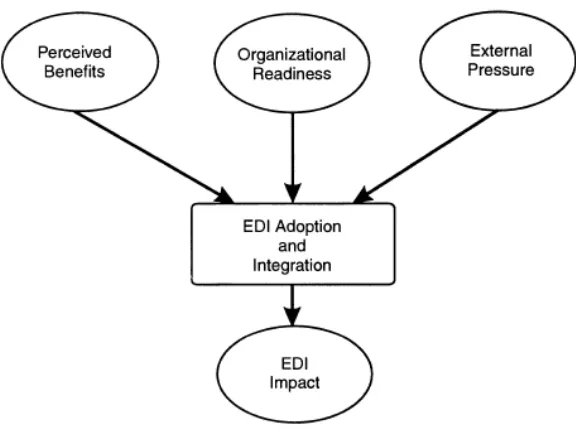
Figure 1: EDI Adoption model, from Iacovou et al (1995)
As shown in Figure 1, the authors established EDI Integration as a separate concept to EDI Adoption. According to the authors, EDI adoption referred to the business’ capability to transact via EDI, and integration referred to the extent to which EDI is embedded within the business practices. This is to recognise that some firms operated EDI-capable equipments in isolation to the rest of the business. EDI integration can be further divided into internal integration (interconnection between various business applications) and external integration (linkage between itself and external trading partners).
The perceived benefits factor emphasised the importance of competitive advantage in an environment where IS affected more than one firm. The benefits may cover all of cost, competitive advantage and perception aspects of outsourcing decisions. Iacovou et al (1995) found that benefits of EDI adoption accrued in two forms: direct benefits and indirect
benefits. Direct benefits refer to cost reduction and efficiency improvements, while indirect benefits include improved business relationships and customer service quality. It was found that, by achieving higher level of EDI integration, the firm derived greater indirect benefits in terms of competitive advantage.
operating expenses of EDI systems. In addition, the efficacy of EDI systems depends on the extent of integration into existing business practices, which can be costly. Technological resources refer to the level of sophistication of IT usage within the firm, as firms that are more familiar with IT systems can adopt new IT systems more quickly and comfortably than those that don’t. This view can be expanded using other factors identified in relevant IS adoption literature, such as firm size and management attitude (discussed in section 4.2: Organisational).
An important contribution of the study is the identification of trading partners as a source of pressure. Because EDI relied on networking between firms, the effectiveness of EDI was optimised only when all of a firm’s trading partners adopted the same technology. This provided the incentive for businesses to urge its customers and suppliers to adopt EDI, and small firms were particularly vulnerable to such pressure due to their (lack of) relative power and position.
While the Iacovou model appears to be similar to the TOE framework, the former incorporates concepts and factors that were specific to EDI, such as the notion of competitive advantage and pressure from trading partners.
3.3.1 An Application in New Zealand context: Mehrtens et al (2001) The study conducted by Mehrtens, Cragg, and Mills (2001) studied the factors that
characterised by long and complex supply chains. The internet-based technology is used primarily in information sectors.
The study undertaken by Mehrtens et al. (2001) also utilised a multiple case study research design, and inherited the three categories from Iacovou’s model: perceived benefits, organisational readiness and external pressure. The final model of the study is shown in Table 3-3, with the factors that were additional to the Iacovou’s model shown in bold. In terms of perceived benefits, three factors were observed. The internet had a relative advantage over traditional methods of communication like telephone and faxes, in that the internet expanded businesses’ source of information to a global scale and allowed better communication. The website provided a better channel of advertising and customer service. In addition, adoption of the internet also sought to reinforce the business’ image and
promotion.
Findings pertaining to organisational readiness revealed that the knowledge of non-professionals played a more significant role than non-professionals. This is primarily due to the businesses’ lack of access to experts: commonly, adoption of internet is championed by owners, who do not necessarily have professional expertise in technology. Sophistication of the business’ IT system was another relevant factor. However, a major departure from the Iacovou model is that financial resources and firm size were found to be irrelevant. One likely explanation for the financial resource is that the adoption of internet did not result in significant resource expenditure, for which the same can be said about cloud computing. While external pressure was also an important factor, the source of pressure differed considerably from Iacovou et al. (1995). In the case of internet adoption, the most
Mehrtens et al
Perceived benefits Relative advantage in terms of efficiency and cost. Source of information.
Business tool (firm image and promotion). Organisational readiness Internet knowledge among non-professionals.
Adequate computer systems. External Pressure Pressure from customers.
[image:26.595.66.519.85.274.2]Pressure from other groups (suppliers, prospective employees)
This chapter reviews the empirical studies of cloud computing to examine their methods used and their key findings. A summary table of studies reviewed is shown in Table 4-1. Due to the differences in geographical locations, time, sample characteristics and the scope of cloud computing of the studies, care should be taken when comparing the findings directly. Nonetheless, these studies provided empirical evidence towards the factors that
encouraged cloud computing adoption.
Authors Model used Sample and Method Prominent findings (Benlian & Hess,
2011) Opportunity and risk framework (Theory of Reasoned Action)
349 responses out of 2,000 German companies. Survey method.
Cost advantage, strategic flexibility and quality improvements are the most salient perceived opportunity; while security risks is the most salient risk belief.
(Benlian, Hess, & Buxmann, 2009)
374 responses from 297 German
companies (from random sample of 5,000). Survey method.
SaaS with low specificity, strategic significance and uncertainty are most likely to be adopted. Office and collaboration most adopted; ERP least adopted.
(Gupta et al., 2013)
n/a (benefits and risk factors only)
211 small and micro firms in APAC region. Survey method.
(Low, Chen, & Wu, 2011)
TOE 111 high-tech firms from Taiwan (out of top 500 firms). Survey method.
Environmental factor significant; relative advantage significantly negative.
(Oliveira et al., 2014)
TOE + DOI 369 firms in Portugal in manufacturing and service sectors. Survey method.
Combined DOI and TOE models; technology readiness; environmental not significant.
(Yazn et al., 2013) TOE 15 SMEs in north east England. Multiple case study method.
[image:28.595.65.535.73.339.2]Geo-restriction was important factor; top management crucial to adoption success. Table 4-1: cloud adoption studies
Benefits and Drawbacks of Cloud Computing
Prior cloud computing adoption studies have found that the most important factors that prompted businesses to adopt cloud computing are cost reduction, scalability, and ease of use. On the other hand, the most prominent impediments to adopting cloud computing are concerns regarding the security and privacy of cloud computing.
Cost reduction is often viewed as the key factor that led to the adoption of cloud computing, if not the dominant one. Sobragi et al. (2014) found cost savings to be a decisive factor for firms to adopt cloud computing, and Morgan and Conboy (2013) found that cost savings were strong motivators towards adopting the cloud. Small business studies, such as Oliveira et al. (2014) and Carcary, Doherty, Conway, and McLaughlin (2014), also found that cost reduction was the most common benefit experienced by small businesses.
aspect of cloud computing is very limited. A possible explanation for this difference could be due to different business environments. Yazn et al. (2013) studied firms in information-based service industries, such as IT, business services and education. The Asia-Pacific context of Gupta’s (2013) study is also likely to give rise to contextual differences in the operating environment.
Scalability refers to the ability to adjust capacity accordingly to seasonal trends and business growth. For some firms, it was a decisive factor to adopt cloud computing (Sobragi et al., 2014). The ability to change the amount of computing resources provided allows firms to control their operations and IT infrastructure more effectively, and significantly reduce the development time to release new products (Morgan & Conboy, 2013; Yazn et al., 2013). However, the benefit of scalability appears to be dependent on the industry and nature of the business. Some businesses, such as information based service industries, did not perceive scalability to be a benefit (Yazn et al., 2013).
Ease of use was another important factor that can potentially assist or hinder cloud adoption. It is becoming an expectation that cloud services are easier to use than their desktop predecessors (Yazn et al., 2013). Gupta et al. (2013) found that ease of use was even more important than cost reduction, although the definition of ease of use in that study included the experience on mobile devices. Software applications that are more straightforward and intuitive can ease the process of transitioning employees onto the new, cloud-based services (Morgan & Conboy, 2013).
generally more willing to trade security for convenience (Gupta et al., 2013; Oliveira et al., 2014; Sultan, 2011).
Organisational
In addition to the merits of IS itself, the characteristics of the adopting firm itself are also highly relevant to the decision to adopt new information system. Based on prior literature, the prominent organisational factors include the owner’s characteristics and firm size. Owners’ characteristics had been identified by Thong (1999), who noted that smaller firms tend to have a more centralised decision making structure. As a result, the owners’ attitude and management style exerts greater influence on the firm’s decisions. Prior literature had consistently identified the owner’s IT knowledge as a prominent factor. Cragg and King (1993) found that small business owners and managers that were more enthusiastic towards IT technology were more likely to adopt new IS for their businesses, while businesses whose owners had limited IT expertise and time were less supportive towards adopting new IS. Owner-managers generally play the crucial role of providing support to the adoption of new technology through active championing (Mehrtens et al., 2001) and
allocating the necessary resources (Yazn et al., 2013).
al., 2002), and that both internet-based services (cloud computing included) lower the barriers to conducting business.
External Environment
Despite the differences in the characteristics that exist between information systems, competitive pressure and customer pressure were consistently identified as the primary sources of external pressure. In the meantime, service providers and consultants can play an important role in supporting businesses to adopt cloud computing products.
Competitive pressure can be a powerful source of motivation for adopting IS, but empirical studies thus far report inconsistent findings. Cragg and King (1993) found that small firms consider IT as a competitive necessity to maintain their own competitive position. Mehrtens et al. (2001) concurs that businesses may be expected to adopt certain information systems (such as the internet), so that they appear competent and up-to-date (Johnston & Vitale, 1988). Low et al. (2011) found competitive pressure to be a significant variable in cloud computing adoption. On the other hand, several studies have found no relationship between competitive pressure and adoption behaviour (Oliveira et al., 2014; Thong, 1999; Yazn et al., 2013).
Alternatively, customers are another major source of pressure. The demands from the customers can be a powerful motivator for firms to adopt new IS, and businesses are less likely to adopt new information systems when no such needs exist (Lin & Chen, 2012). On the other hand, some customers may be reluctant to use new technology, which may hinder the adoption. In the case of cloud computing, the risks associated with relinquishing control can potentially cause clients to discourage the firm from adopting cloud-based software (CCH, 2013).
Finally, external experts may play an important role in supporting firms’ decision to adopt cloud-based systems. Frequent contact with experts can help the firm to utilise its IT
Based on the review of the literature on cloud computing and relevant empirical studies, this chapter identifies the gaps within the body of literature reviewed, and poses the
research questions that this study seeks to answer. This section also defines the parameters and scope of this study, and specifies the model that is used to guide research direction.
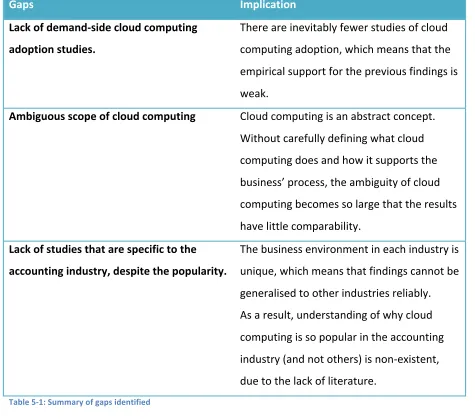
Research Gaps
First and foremost, research into the business perspective of cloud computing is limited. The business perspective is concerned with the ways cloud computing can provide value to customers (Marston et al., 2011). Until recently, few studies had investigated the factors that motivated or discouraged businesses to adopt cloud computing (Hoberg et al., 2012). Based on the review of empirical studies on cloud computing adoption, the existing pool of literature does not provide a consistent body of evidence, from which inferences can be drawn reliably. As the studies use a variety of theories and perspectives, the studies retains a high level of autonomy to pick specific benefits, limitations and risks of cloud computing. This feature is criticised in the TOE framework (Yazn et al., 2013). More importantly, the studies tend to quote the definition of cloud computing directly from Mell and Grance (2011), which is highly abstract and is very ambiguous in scope.
The lack of studies in the accounting industry is also a major gap. Cloud computing in
accounting industry is experiencing much more rapid growth than other industries. Yet, little is known about the reasons or the factors that fuelled this growth, as there were no studies on cloud phenomenon in accounting firms. Also, due to the differences in business
Gaps Implication Lack of demand-side cloud computing
adoption studies.
There are inevitably fewer studies of cloud computing adoption, which means that the empirical support for the previous findings is weak.
Ambiguous scope of cloud computing Cloud computing is an abstract concept. Without carefully defining what cloud computing does and how it supports the business’ process, the ambiguity of cloud computing becomes so large that the results have little comparability.
Lack of studies that are specific to the accounting industry, despite the popularity.
[image:34.595.63.538.76.495.2]The business environment in each industry is unique, which means that findings cannot be generalised to other industries reliably. As a result, understanding of why cloud computing is so popular in the accounting industry (and not others) is non-existent, due to the lack of literature.
Table 5-1: Summary of gaps identified
Research Topic and Question
This study seeks to provide some empirical evidence towards the research gaps discussed above. This is an exploratory study that investigates the factors that motivated small accounting firms to adopt cloud-based technology, and the implications for the accounting sector as a result of the popularisation of cloud computing.
Specifically, this study addresses the following questions:
2. Why do accounting firms choose to adopt cloud-based software solutions for their business, and for their clients? What are the factors that motivated or discouraged the adoption of cloud computing?
3. What are the accountants’ perceptions towards the cloud computing paradigm? What are the likely implications of cloud computing for the accounting industry?
Scope of Research
5.3.1 Small Businesses
This study focuses primarily on smaller accounting service firms, for the following reasons: (i) prior literature had explicitly recognised the different IS adoption behaviour between small firms and large firms, (ii) larger accounting firms are often influenced by their parent organisations, and (iii) cloud computing is expected to be much more beneficial to small businesses than their larger counterparts.
The distinction of “small” businesses is significant in the IS adoption literature, as the adoption models for larger firms are not transferable to small businesses (Kuan & Chau, 2001; Sadowski et al., 2002; Thong, 1999). Small businesses face drastically different circumstances and challenges from their larger counterparts. Generally speaking, small businesses are characterised by their inherently more flexible management structure (Sadowski et al., 2002) and highly centralised decision making authority (Thong, 1999). These features allow them to adopt new IT innovations more rapidly than their larger counterparts. On the other hand, smaller businesses face fiercer competition, and their access to financial and human resources are more limited (Kuan & Chau, 2001; Thong, 1999). This makes it more risky for small businesses to adopt IS innovations, as their lack of
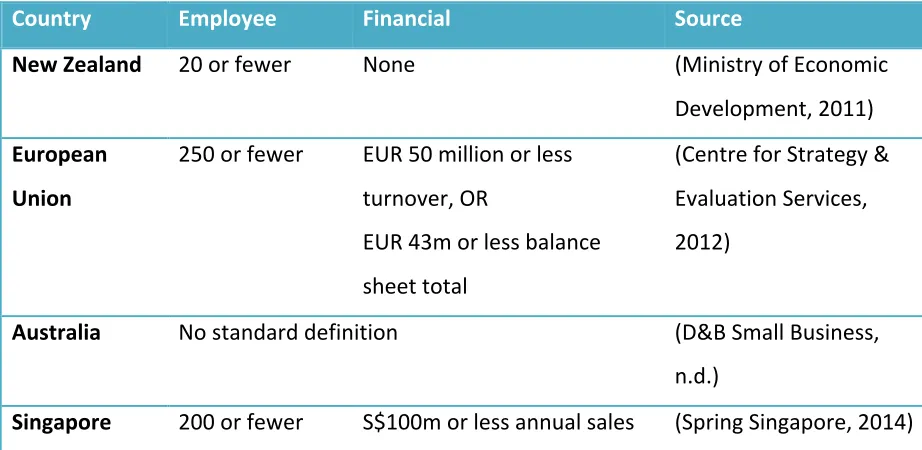
resources may prevent them from deriving the full benefit of new technology (Iacovou et al., 1995), as well as placing them in a more vulnerable position if the adoption of the new system fails (Sadowski et al., 2002).
Because almost all IS adoption studies are conducted overseas, the term “small” should be interpreted in light of other countries’ standards for small businesses. New Zealand
account for 44% of overall employment (Ministry of Economic Development, 2011). Moreover, at 19 employees or fewer, New Zealand’s definition of small to medium
enterprises (SMEs) is much lower compared to other jurisdictions. For example, European Union (EU) defines small businesses as 50 employees or fewer and SMEs as 250 employees or fewer (Centre for Strategy & Evaluation Services, 2012), while Singapore’s definition of SME is 200 employees or fewer (Spring Singapore, 2014).
Country Employee Financial Source
New Zealand 20 or fewer None (Ministry of Economic
Development, 2011) European
Union
250 or fewer EUR 50 million or less turnover, OR
EUR 43m or less balance sheet total
(Centre for Strategy & Evaluation Services, 2012)
Australia No standard definition (D&B Small Business, n.d.)
[image:36.595.66.527.245.470.2]Singapore 200 or fewer S$100m or less annual sales (Spring Singapore, 2014) Table 5-2: Comparison of the definition of small business with other countries
5.3.2 Cloud Adoption
The term “cloud computing” encompasses considerable ambiguity, as cloud computing can refer to a large number of applications and forms. For the purpose of this research, “cloud computing” for accounting firms is categorised into two roles: cloud computing offered as client service; and cloud computing for practice management.
The distinction of the two roles is based on the internally and externally focused
applications proposed by Clemons (1986). Externally focused applications add value by bringing real benefits to the firm’s customers, as well as the firm itself. Internally focused applications are usually invisible to the firm’s customers, and add value by providing
benefits to the firm only. This distinction is important for analysing how information systems contribute to a firm’s competitive advantage, as the purpose, features and benefits of an externally focused application differ considerably from that of an internally focused system. The client service role of cloud computing emphasises the accountants’ capacity as business advisors for their clients. Business advisory requires extensive information sharing between the accountant and the client, and accountants may be directly involved in managing their clients’ accounting information system (CCH, 2013; WorkflowMax, 2013). In this role, cloud computing refers to the cloud-based software packages that support the client’s accounting system, which may be managed by the accounting firm. The cloud-based accounting
software applications are intended to create value for the client, and the accounting firm does not derive any benefit from adopting the system other than fees from its clients. Xero is the most frequently used cloud-based accounting software.
The practice management role focuses on the use of cloud computing by the accountant firm to manage its own internal process. The practice management system is internally focused, which means it does not interact directly with the clients, and that the accounting firm adopts the practice management system as the final user.
Model Development
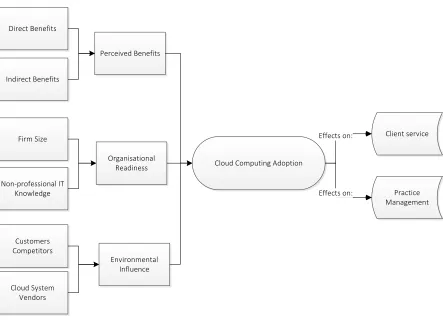
The research model is depicted in Figure 2. The depiction provides a visual illustration that differentiates the two aspects of adoption discussed in this section, and the theories that are primarily used to study the adoption behaviour.
Cloud Computing Adoption Perceived Benefits
Direct Benefits
Indirect Benefits
Organisational Readiness Firm Size
Non-professional IT Knowledge
Environmental Influence
Client service
Practice Management
Customers Competitors
Cloud System Vendors
Effects on:
[image:38.595.76.519.255.579.2]Effects on:
Figure 2: Research model
recognise that cloud computing comprises two roles. The two roles correspond to the discussion of “cloud adoption” in Section 5.3.2.
Each of the three base categories is split into two subcategories. For Perceived Benefit, direct benefits refer to tangible, explicit and easily quantifiable benefits as a result of adopting cloud computing, such as reduced cost and improved efficiency. Indirect benefits refer to the more subtle yet profound effects that are difficult to quantify, such as market competitiveness and firm image.
In Organisational Readiness, the two observed factors are firm size and non-professional IT knowledge. The former is included because of the inconclusive findings regarding the relationship between firm size and IT adoption. The latter is derived from Mehrtens et al. (2001), who found that, within the context of internet-based technology, non-IT
professionals (particularly the owners) played a significant role in its adoption, while the role of IT professionals was negligible. Due to the nature of reduced maintenance, the staff’s and partners’ expertise in computers and technology is even more crucial in accepting the cloud concept.
This chapter details the methods that are used to carry out the research, and provides justifications for the chosen methods. According to McKerchar (2010), a typical research design consists of three consistent and coherent components: research framework, methodology and methods. The three components are discussed in the sections below.
Research Framework
Research framework is the fundamental, intuitional beliefs of reality the researcher holds towards the phenomenon (McKerchar, 2010). This study adopts a research framework of postpositivism, which implies the ontological position of critical realism. Critical realism is the belief that, while an external reality exists independently to the subjective assessment of the observers (researchers), the understanding of that reality is influenced by the observer’s sensory experience and other mediums (Bisman, 2010). Subsequently, the purpose of postpositivist research is to identify “structures that give rise to actions and events that can be experienced in the empirical domain” (Wollin, 1996, as cited in Bisman, 2010).
As the study is intended to be exploratory in nature, the postpositivism framework is particularly suitable. The purpose of this study can be viewed as discovering an external phenomenon that is already in effect (i.e. the adoption of cloud computing by accounting firms). Postpositivism is better suited to this study compared to positivism and
interpretivism, because positivism’s naïve realism ontological perspective cannot accommodate for multiple or inconsistent findings (hence, unnecessarily restricting the findings of this study and loss of valuable information). Interpretivism, on the other hand, is too context-specific, which would constrain the exploratory value of this study.
Methodology
Methodology is the intermediary between philosophical beliefs and specific methods
many researchers, including Bryman and Bell (2011), questioned the extent of opposition between the two approaches, as there is no deterministic relationship between
quantitative/qualitative approaches and philosophical beliefs. Furthermore, as
postpositivism is a middle-ground between positivism and interpretivism (Bisman, 2010), the simple distinction between quantitative and qualitative is no longer useful. This study adopts a primarily inductive methodology, through the use of qualitative methods. Inductive approach is the process of building theories from empirical observations (McKerchar, 2010). In contrast to deduction, inductive approach focuses on generating meaningful theories and explanations that are context- and population-specific, rather than universally-applicable rules or laws. This feature is consistent with the purpose of this study, which seeks to gain detailed information (i.e. how and why questions) and create new theories, rather than testing existing theories. Deductive approach, on the other hand, would be less effective in this particular study, because existing empirical studies is very limited, and a deductive approach would result in very little gains in new insights. This study is carried out using the multiple case study design, and semi-structured
interviews are used as the primary method of data collection. This methodology is selected due to its effectiveness in addressing the research questions and gaps in literature.
6.2.1 Multiple Case Study
Multiple-case study method retains the ability to collect and analyse data that is rich and detailed, and provides greater external validity over single-case studies. The different cases in a multiple case study provide multiple perspectives that can be used either to reinforce the theory through replication logic, or examine cases with opposing characteristics as rival theories (Yin, 2009). Multiple-case study also reduces the extent to which the case is overly narrow or idiosyncratic due to specific factors associated with certain cases (Eisenhardt, 1989). Given that prior research on the area of cloud computing for accounting industry is virtually non-existent, the multi-perspective provided by the cases is a crucial contribution. The unit of analysis for this study is organisation level, as it allows the research to be focused on the accounting firms. A case consists of a single chartered accounting firm. When an accounting firm has multiple branches, a case consists of a single branch of the firm. However, care is taken that only one branch of a national network of firm is selected. For this research, studying a single industry of accountancy contributes to the internal validity, as the industry provides a control that eliminates the differences due to industry characteristics. Furthermore, because accounting firms are highly homogeneous, the firms’ own circumstances are less likely to vary significantly, and there is a reduced likelihood of “noise” that may be present in the findings.
6.2.2 Data Collection
The subject firms were selected on the basis of replication approach. Under this approach, data collection and data gathering is simultaneous. Data from each firm is collected
individually and analysed, the findings of which determines whether further cases are necessary, and the characteristics that are useful in reinforcing or contrasting with existing evidence (Yin, 2009). Six cases were investigated, which provided a suitable balance between providing a robust empirical grounding, and the complexity and resource constraints (Eisenhardt, 1989).
accounting firm partners on their respective websites. Existing contacts are also utilised whenever they are available.
6.2.3 Semi-Structured Interviews
The decision makers and the IT champions within each accounting firm are identified, and a semi-structured interview is undertaken with up to two of them. Interviewing two people ensures that information is gathered from both the internal practice management
perspective and the external client service perspectives. It is expected that each interview takes between 30 and 45 minutes.
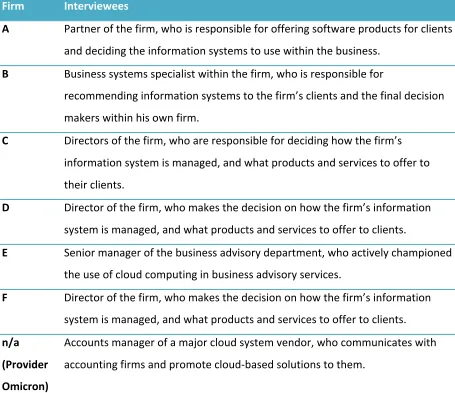
This chapter provides the results for the six case firms, and the factors that were significant in adopting cloud technologies are analysed. Table 7-1 provides the profiles of the
interviewees.
In addition to the accounting firms, a manager from a cloud-based software provider is also interviewed. A cloud service provider provides a complementary perspective, as he would be in a better position to comment on the industry as a whole.
Firm Interviewees
A Partner of the firm, who is responsible for offering software products for clients and deciding the information systems to use within the business.
B Business systems specialist within the firm, who is responsible for
recommending information systems to the firm’s clients and the final decision makers within his own firm.
C Directors of the firm, who are responsible for deciding how the firm’s information system is managed, and what products and services to offer to their clients.
D Director of the firm, who makes the decision on how the firm’s information system is managed, and what products and services to offer to clients.
E Senior manager of the business advisory department, who actively championed the use of cloud computing in business advisory services.
F Director of the firm, who makes the decision on how the firm’s information system is managed, and what products and services to offer to clients. n/a
(Provider Omicron)
[image:44.595.70.525.283.676.2]Accounts manager of a major cloud system vendor, who communicates with accounting firms and promote cloud-based solutions to them.
Firm A
Firm A is a small accounting firm located in Christchurch. Its primary business lines consist of transactional accounting services (such as bank reconciliations, receivables, payables and payroll) and information system consulting (implementing appropriate IT infrastructure for clients’ business needs). Business advisory is limited to operational issues, such as budgeting variance analysis and cash flow planning. Audit or assurance services are not offered. Its clients are predominantly agricultural and construction businesses around the Canterbury region. The business employs approximately 10 employees in total.
The firm has two partners, each managing one of the two business lines (bookkeeping and IT consulting). The accounting function is managed by a single partner, who oversees the strategic and business processes, including determining what software and information systems are used to address clients’ specific needs and manage the firm’s own operations. The IT business line provides a wider range of IT-related consulting and implementation for clients, such as: server setup, email and systems development using off-the-shelf software. The interview was undertaken with the accounting partner, who is both a chartered
Enablers/Inhibitors Client Practice Management Adoption Yes (Xero, WorkflowMax)
Since 2008
Yes (cloud-based SaaS)
Benefits Flexibility w/ services Easy to use (for clients) Communication w/ external parties
Short-term commitment
Flexibility in supporting business process
Limitations/risks Lack of Feature None Organisational Owner’s IT expertise
Access to IT expertise Outsourcing of bookkeeping
Owner’s IT expertise Access to IT expertise Prior IS arrangement Firm size
Firm size <10 employees Environment Client pressure
Software ecosystem
Vendor support
[image:46.595.63.533.77.460.2]Ecosystem (linkage w/ clients’ products)
Table 7-2: cloud adoption for Firm A
7.1.1 Cloud Computing for Client Service
Firm A offers Xero and WorkflowMax to its clients for accounting solutions and workflow management, respectively. Clients are given access to their own Xero and WorkflowMax accounts, and they can input day-to-day transactions into the systems. Examples include: inputting timesheets, recording sales and purchase invoices, and perform bank
reconciliations. Firm A, however, retains full control over the clients’ accounts.
“Traditionally, accountants have been focusing inwardly, and as such have been promoting the use of software that helps them at their end but not taking into account the needs on a day to day basis of the client. Many of the new products to market have been developed with the client in mind so if you can help implement these types of solutions the client is getting far greater value and it demonstrates the value you are able to bring – ultimately bringing clients closer.”
Cloud-based software has allowed the firm to become more flexible. Flexibility is interpreted as the ability for the cloud-based software to match to clients’ needs:
“The business outsources some of our data-entry work to external parties, so we were looking for products that had the best functionality and provided the maximum efficiency / productivity gains… Xero suited our business model well [as an account manager and bookkeeper]… [Also,] the range of add-ons makes it very valuable for [our] clients across their entire business”
For Firm A’s clients, the ease of use and intuitiveness was an important consideration, and one major factor that led to the choice of Xero. An example of Xero’s ease of use is the bank reconciliation process, a process that is essential to managing the cash flow of a business, yet a complex concept in accounting:
“With Xero, all [the clients] need to do is click ‘match’, and it will do all the work for you. The tick-and-match process is very intuitive, and the client doesn’t need to know anything about how to prepare a bank reconciliation statement.”
“Online banking had been around for years, and everyone uses it… People don’t feel that it’s unsafe to transfer money over the internet anymore… And the same thing will probably happen to Xero once it gains critical mass. Xero’s a good place to start for those [clients] who want to get their feet wet with the whole cloud thing.”
While external pressure was not a prominent threat for Firm A, the interviewee identified that clients may exert considerable pressure on accountants that are unwilling to adopt cloud. The benefits of cloud-based accounting software are intended to appeal to non-accounting professionals, rather than accountants themselves:
“Xero is designed with non-professionals in mind, not accountants. Xero is designed in such a way that hides the ugly accounting behind its intuitive interface. Accountants, on the other hand, don’t necessarily find Xero to be any easier to use than what they’re used to… In a way, some accountants are ‘forced’ to adopt cloud-based software because that’s what their clients want”.
Also, the software ecosystem played a significant role in convincing them to stay with Xero. As Xero had been around for longer than its competitors, it was able to establish a stronger software ecosystem:
“We currently have no intention to replace Xero with any alternatives. We were using Xero for a long time, and so we have become experts in its use… Also the range of add-ons makes it very valuable for clients across their entire business.”
7.1.2 Cloud Computing for Practice Management
Firm A also utilised cloud-based packages for managing its own practice. Xero and