J. Water Resource and Protection, 2010, 2, 560-568
doi:10.4236/jwarp.2010.26064 Published Online June 2010 (http://www.SciRP.org/journal/jwarp)
Differential Evolution Algorithm with Application to
Optimal Operation of Multipurpose Reservoir
Dattatray Gangaram Regulwar1, Sumant Anant Choudhari2, Pallakury Anand Raj3 1Department of Civil Engineering, Government College of Engineering,
Aurangabad, India
2Research Scholar, National Institute of Technology, Warangal, India 3Department of Civil Engineering, National Institute of Technology, Warangal, India
E-mail:{dgregulwar, sumantchoudhari}@rediffmail.com, [email protected] Received March 12,2010; revised April 7,2010; accepted May 4,2010
Abstract
This paper includes an application of Differential Evolution (DE) for the optimal operation of multipurpose reservoir. The objective of the study is to maximize the hydropower production. The constraints for the op-timization problem are reservoir capacity, turbine release capacity constraints, irrigation supply demand con-straints and storage continuity. For initializing population, the upper and lower bounds of decision variables are fixed. The fitness of each vector is evaluated. The mutation and recombination is performed. The control parameters, i.e., population size, crossover constant and the weight are fixed according to their fitness value. This procedure is performed for the ten different strategies of DE. Sensitivity analysis performed for ten strategies of DE suggested that, De/best/1/bin is the best strategy which gives optimal solution. The DE al-gorithm application is presented through Jayakwadi project stage-I, Maharashtra State, India. Genetic algo-rithm is utilized as a comparative approach to assess the ability of DE. The results of GA and ten DE strate-gies for the given parameters indicated that both the results are comparable. The model is run for dependable inflows. Monthly maximized hydropower production and irrigation releases are presented. These values will be the basis for decision maker to take decisions regarding operation policy of the reservoir. Results of ap-plication of DE model indicate that the maximized hydropower production is 30.885 × 10⁶ kwh and the
cor-responding irrigation release is 928.44 Mm3.
Keywords:Optimization, Hydropower Production, Differential Evolution, Reservoir Operation
1. Introduction
Water for drinking purpose, for use in industry, irrigation and hydropower production, is main factor for hindering developments in many parts of the globe. Hence, proper management of available water resources is essential. Reservoir operation forms an important role in water re- sources development. Yeh [1] reviewed reservoir ma- nagement and operation models. Algorithms and meth-ods surveyed include linear programming (LP), dynamic programming (DP), nonlinear programming (NLP), and simulation. Oliveira and Loucks [2] have presented op-erating rules for multireservoir systems by using genetic search algorithms. Simulation was used to evaluate each policy by computing performance index for a given flow series. Wardlaw and Sharif [3] have presented several alternative formulations of a genetic algorithm for
D. G. REGULWAR ET AL. 561
range of policies has been developed.
Storn [8] has represented a heuristic approach for minimizing nonlinear and non differentiable continuous space function. The proposed method which requires few control variables is robust, easy to use and lends itself very well to parallel computation. Lampinen [9] has pro- posed differential evolution algorithm for handling non- linear constraint functions. Differential Evolution (DE) algorithms claimed to be very efficient when they are applied to solve multimodal optimal control problems (Lopez Cruz et al. [10]). Differential evolution was used for the optimization of non-convex Mixed Integer Nonlinear Programming (MINLP) problems. The results of DE were compared with simplex, simulated annealing and genetic algorithm (Babu and Angira [11]). Vasan and Srinivasaraju [12] have demonstrated application of differential evolution to Bilaspur project in Rajasthan, India. The objective was to determine suitable cropping pattern for maximum benefits. Ranjithan [13] has pre-sented the role of evolutionary computation in environ-mental and water resources systems analysis and dis-cussed various methods such as Simulated Annealing, Tabu Search, GA, Evolutionary strategies, Particle swarm and Ant colony optimization. Janga Reddy and Nagesh Kumar [14] have studied Multi Objective Dif-ferential Evolution (MODE) with an application to a reservoir system optimization. The evolutionary opera-tors used in differential evolution algorithms are very much suitable for problems having interdependence among the decision variables.Vasan and Komaragiri Srinivasa Raju [15] have demonstrated the applicability of DE to a case study of Mahi Bajaj Sagar project (MBSP), India. Ten different strategies of DE were em-ployed to assess the ability of DE for solving higher di-mensional problems as an alternative methodology for ir- rigation planning. The results were compared with LP.
In Genetic Algorithm (GA) low mutation rate is re-quired to get global optimum [16]. The low mutation rate may get trouble with problems having interdependent relationships between variables and may require more number of function evaluations [17]. In reservoir opera-tion the interdependence relaopera-tionship may exist among decision variables. Interdependencies among variables can be tackled by properly rotating the co-ordinate sys-tem of the given function as it is done in Differential Evolution. DE has all properties necessary to handle complex problems with interdependencies between pa-rameters [18]. DE maintains correlated self-adopting mutation step sizes in order to make timely progressive optimization. There is interdependence among variables therefore the evolutionary operators of DE are suitable to tackle these problems. This paper presents the applicabil-ity of DE for determining operation policies of a multi-purpose reservoir.
2. Methodology
Differential evolution is a recent evolutionary optimiza-tion technique. It is simple, faster convergent and robust. The main difference between GA and DE is that GA depends on crossover while DE uses mutation as primary search mechanism. DE uses weighted differences be-tween solution vectors to perturb the population. Unlike genetic algorithms, no binary coding of the population members is necessary. The general convention used for different variants of DE is DE/a/b/c. Here DE is for Dif-ferential evolution, ‘a’ is a string which denotes the vec-tor to be perturbed, ‘b’ denotes the number of difference vectors taken for perturbation of ‘a’ and ‘c’ is the cross-over method. According to Price and Storn [19] different strategies of DE are DE/rand/1/bin, DE/best/1/bin, DE/ best/2/bin, DE/rand/2/bin, DE/rand-to-best/1/bin, DE/ rand/1/exp, DE/best/1/exp, DE/best/2/exp, DE/rand/2/ exp, and DE/rand-to-best/1/exp.
DE holds D-dimensional real valued vectors of Np
population in pair. The current population Px, includes vectors xi,g added or created randomly or by comparison with other vectors.
, , max
, , ,
P 0,1,..., 1, 0,1,..., , 0 1 1.
g i g
i g j i g
i Np g g
x j , ,...,D
x x
x (1)
The index, g = 0, 1,… gmax, shows the generation of a vector. A population index i is assigned to each vector which ranges from 0 to Np-1. The index ‘j’indicates pa-rameter within vector ranges from 0 to D-1. After ini-tialization, an intermediary population Pv,g, of Np mutant vectors, vi,g produced by random mutation.
, , max
, , ,
P 0,1,... 1, 0,1,..., , 0,1,..., 1.
g i g
i g j i g
i Np g g
v j D
v v
v (2)
Each vector in the current population is then recom-bined with a mutant to produce a trial population, Pu of
Np trial vectors, ui,g
, , max
, , ,
P 0,1,..., 1, 0,1,..., , 0,1,..., 1.
g i g
i g j i g
i Np g g
u j D
u u
u (3)
During crossover, trial vectors overwrite the mutant population, so a single array can hold both populations. Then the cost of the trial vector is compared with the cost of the target vector, the vector having low cost will go into the next generation.
2.1. Case Study
D. G. REGULWAR ET AL. 562
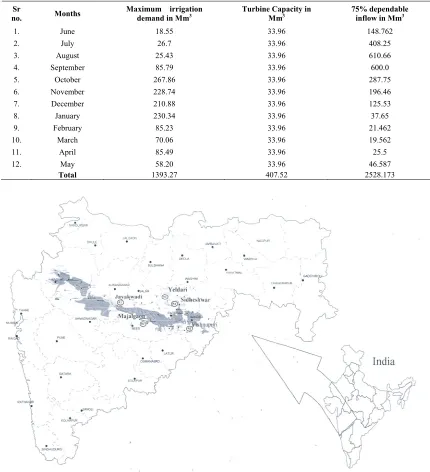
storage is 2171 106 m3. Total installed capacity for power generation is 12.0 MW (Pumped storage plant). Irrigable command area is 1416.40 km2. The schematic representation of the physical system showing Jayakwadi project stage-I is shown in Figure 1. Monthly historical flow data for 73 years is collected and 75% dependable monthly flows are estimated using the Weibull plotting position formula. The inflow, irrigation demand, turbine capacity are presented in Table 1.
2.2. Model Formulation
The objective of the study is to maximize the hydro-power production and present operation policy of a case study reservoir. Mathematically it can be expressed as:
12
1 Max t
t
Z P
(4) [image:3.595.81.511.216.688.2]where Pt = Hydropower produced in kwh during month ‘t’. If the monthly releases for hydropower (RP) are
Table 1. Inflow, irrigation demand and power demand.
Sr
no. Months Maximum irrigation demand in Mm3 Turbine Capacity in Mm3 75% dependable inflow in Mm3
1. June 18.55 33.96 148.762
2. July 26.7 33.96 408.25
3. August 25.43 33.96 610.66
4. September 85.79 33.96 600.0
5. October 267.86 33.96 287.75
6. November 228.74 33.96 196.46
7. December 210.88 33.96 125.53
8. January 230.34 33.96 37.65
9. February 85.23 33.96 21.462
10. March 70.06 33.96 19.562
11. April 85.49 33.96 25.5
12. May 58.20 33.96 46.587
Total 1393.27 407.52 2528.173
D. G. REGULWAR ET AL. 563
expressed in Mm3, head (h) in meters, then power pro-duced P in KW hours for a 30 day month is given by P = 2725 × (RP) × (h). The model is subjected to the follow-ing constraints.
2.2.1. Releases into Turbine and Capacity Constraints
The releases into turbines for power production, should be less than or equal to the flow through turbine capacity (TC) for all the months. Also, power production in each month should be greater than or equal to the firm power (FP). These constraints can be written as:
( ) 1, 2,3...12.
RP t TC t (5)
( ) 1, 2,3,...12.
RP t FP t (6)
2.2.2. Irrigation Supply-Demand Constraints The releases into canals for irrigation (RI) should be less than or equal to the maximum irrigation demand (IDmax) for all the months. Also, the releases into the canals for irrigation should be greater than or equal to the minimum irrigation demand (IDmin). The irrigation release-demand constraint, can, therefore be written as: max ( ) ( ) 1, 2,3,...12.
RI t ID t t (7)
min ( ) ( ) 1,2,3...12
RI t ID t t (8)
2.2.3. Reservoir Storage-Capacity Constraints The storage in the reservoirs (S) should be less than or equal to the maximum storage capacity (SC) and greater than or equal to the minimum storage capacity (Smin) for all months. These constraints can be written as: ( ) 1, 2,3...12.
S t SC t (9)
min ( ) 1, 2,3...12
S t S t (10)
2.2.4. Reservoir Storage-Continuity Constraints
This constraint relate to the turbine releases (RP), irriga-tion releases (RI), release for drinking and industrial wa-ter supply (RWS) which is taken as a constant, reservoir storage (S), inflows into the reservoirs (IN), Losses from the reservoirs for all months. The losses from the reser-voirs are taken as function of storage as given by Loucks
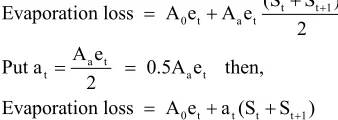
et al. [20]. Let Ao is reservoir water surface area corre-sponding to the dead storage volume and et is evapora-tion rate corresponding to the time period t (in depth units). Aa is the reservoir water spread area per unit volume of active storage. Then the actual evaporation during the time period ‘t’ is given by
t t 1 0 t a t
a t
t a t
0 t t t t 1 (S S ) Evaporation loss A e A e
2 A e
Put a 0.5A e then, 2
Evaporation loss A e a (S S )
Then the hydrologic continuity constraint can be written as:
0
(1 ) ( 1) (1 ) ( ) ( ) ( ) ( )
( ) ( ) ( ) ( ) ( )
t t
t a S t a S t IN t RP t RI t SP t WS t FCR t RP t A e t
(11)
3. Results and Discussion
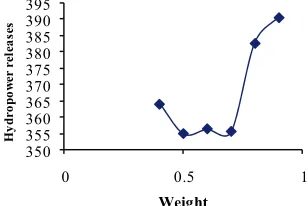
[image:4.595.86.255.629.689.2]Differential Evolution (DE) has ten strategies. The model is run with DE parameters, i.e., crossover constant and weight for each strategy. The population is fixed by run-ning the model for different population sizes in combina-tion with crossover constants and weight. For deciding crossover constant and weight for each strategy, the model is run for different crossover constants, i.e., 0.7, 0.75, 0.8, 0.85, 0.9, 0.95 with the combination of weight ranging from 0.2 to 0.9 with the increment of 0.05. For every combination fitness is calculated and compared with population. Based on this approach population is fixed as 400. For getting optimal solution, generation is fixed as 500. The DE parameters, i.e., crossover con-stants and weight are decided for each strategy and pre-sented in Table 2. The relationships between weight and hydropower releases corresponding to crossover constant are presented graphically in Figures 2 to 11. By consid-ering these DE parameters, the optimization model is run and optimized values of objective function are presented for all strategies in Table 2. The random seed should be greater than one. So for seed also the model is run for various seed values, i.e., 1 to 90, and 77 is fixed from the comparison of results.
D. G. REGULWAR ET AL. 564
Table 2. Comparison of strategies of differential evolution.
Sr.
No. Strategy CR F Annual hydropower produced kwh Annual Irrigation releases Mm3
1 DE/best/1/exp 0.85 0.70 29651500 927.271
2 DE/rand/1/exp 0.95 0.70 30365652 827.383
3 DE/rand-to-best/1/exp 0.80 0.90 27208474 872.191
4 DE/best/2/exp 0.95 0.50 29268860 976.005
5 DE/rand/2/exp 0.85 0.60 29380314 881.820
6 DE/best/1/bin 0.85 0.90 30885738 928.442
7 DE/rand/1/bin 0.95 0.80 28513356 853.046
8 DE/rand-to-best/1/bin 0.85 0.90 27368522 862.894
9 DE/best/2/bin 0.85 0.90 29247944 906.402
10 DE/rand/2/bin 0.95 0.80 30099228 947.816
330 340 350 360 370 380
0 0.5 1
H
yd
ro
po
w
er
rel
ea
se
s
[image:5.595.70.506.90.431.2]Weight
Figure 2. Relationship between weight and strategy No. 1 for crossover 0.85.
355 360 365 370 375 380 385
0 0.2 0.4 0.6 0.8 1
H
yd
ro
po
w
er
rel
ea
se
s
[image:5.595.72.267.432.538.2]Weight
Figure 3. Relationship between weight and strategy 2 for crossover 0.95.
335 340 345 350 355 360 365
0 0.5 1
Weight
H
yd
ro
po
w
er re
le
as
es
Figure 4. Relationship between weight and strategy No. 3 for crossover 0.8.
330 340 350 360 370 380 390
0 0.2 0.4 0.6 0.8 1
H
y
d
rop
ow
er
r
ele
ase
s
[image:5.595.341.502.440.544.2]Weight
Figure 5. Relationship between weight and strategy No. 4 for crossover 0.95.
3 56 3 58 3 6 0 3 6 2 3 6 4 3 6 6 3 6 8
0 0.5 1
Weight
H
yd
ro
po
w
er rel
ea
se
[image:5.595.73.249.577.689.2]s
Figure 6. Relationship between weight and strategy No. 5 for crossover 0.85.
350 355 360 365 370 375 380 385 390 395
0 0.5 1
H
y
d
rop
ow
er
r
ele
ase
s
Weight
[image:5.595.346.500.586.689.2]D. G. REGULWAR ET AL. 565 345 350 355 360 365 370
0 0.5 1
Weight H yd ro po w er rel ea se s
Figure 8. Relationship beween weight and strategy No. 7 for crossover 0.95. 345 350 355 360 365
0 0.5 1
Weight H yd ro po w er rel ea se s
Figure 9. Relationship between weight and strategy No. 8 for crossover 0.85.
345 350 355 360 365 370 375 380 385 390 395
0 0.2 0.4 0.6 0.8 1
H yd ro p ow er rel ea se s Weight
Figure 10. Relationship between weight and strategy No. 9 for crossover 0.85.
330 335 340 345 350 355 360 365
0 0.2 0.4 0.6 0.8 1
H yd ro po w er re le as es Weight
Figure 11. Relationship between weight and strategy No. 10 for crossover 0.95.
25000000.000 26000000.000 27000000.000 28000000.000 29000000.000 30000000.000 31000000.000 32000000.000 H yd rop ow er p rod u cti on
Name of strategy Figure 12. Comparison of strategies.
0 50 100 150 200 250 June Augu st Octob er Dece mbe r Febr
uary April
Months Irri ga ti on rel ea se s
Figure 13. Optimal releases for irrigation (DE/best/1/bin).
0 500000 1000000 1500000 2000000 2500000 3000000
June July Augu st Sept embe r Octob er Nov ember Decem ber Janu ary Febr uary
March Ap ril May
Months Hy dr op ow er p rod uc ti on
Figure 14. Optimal hydropower production (DE/best/1/bin).
D. G. REGULWAR ET AL. 566
Table 3. Comparison of optimal releases for irrigation and hydropower production by DE and GA.
Month
Release for irrigation Mm3
By DE
Release for irriga-tion Mm3
By GA
Hydropower produced 106 kwh
By DE
Hydropower produced 106 kwh
By GA
June 9.65 14.20 2.405 2.581 July 16.58 16.94 2.552 2.548 August 13.47 16.63 2.671 2.571
September 55.10 58.14 2.811 2.56
October 232.55 178.05 2.575 2.562
November 148.90 146.51 2.776 2.576
December 109.42 145.18 2.738 2.571
January 144.63 129.31 2.717 2.552
February 44.38 55.59 2.544 2.559
March 64.87 48.87 2.577 2.564 April 52.12 54.67 2.384 2.572 May 36.76 38.09 2.137 2.553
[image:7.595.65.532.305.485.2]TOTAL 928.442 902.19 30.887 30.769
Table 4. Irrigation releases obtained by the DE strategies and GA in Mm3.
Month DE1 DE2 DE3 DE4 DE5 DE6 DE7 DE8 DE9 DE10 GA
June 9.7 9.7 9.7 9.7 9.7 9.7 9.7 9.7 9.7 9.7 14.20
July 16.6 16.6 16.6 16.6 16.6 16.6 16.6 16.6 16.6 16.6 16.94
August 13.5 13.5 13.5 13.5 13.5 13.5 13.5 13.5 13.5 13.5 16.63
September 57.4 34.8 56.2 56.2 52.3 55.1 49.7 46.3 72.9 62.5 58.14
October 232.6 138.9 162.4 162.4 138.8 232.6 140.6 162.4 162.4 162.4 178.05
November 148.9 149.6 157.9 209.1 151.7 148.9 160.3 193.9 118.5 117.9 146.51
December 109.4 127.9 109.3 109.3 85.4 109.4 123.2 109.3 85.4 109.3 145.18
January 134.9 145.2 145.8 211.8 195.1 144.6 147.7 151.9 176.6 223.7 129.31
February 51.9 44.3 34.6 51.9 74.5 44.4 52.7 34.6 74.5 34.6 55.59
March 63.1 64.9 53.2 67.4 46.0 64.9 55.6 66.9 63.6 67.8 48.87
April 44.5 34.7 74.8 44.5 62.0 52.1 34.7 34.7 56.0 74.8 54.67
May 44.5 47.4 38.3 23.7 36.4 36.8 48.9 23.2 56.8 55.0 38.09
Total 927.0 827.4 872.2 976.0 881.8 928.4 853.0 862.9 906.4 947.8 902.19
DE1 DE/best/1/exp, DE2 DE/rand/1/exp, DE3 DE/rand-to-best/1/exp, DE4 DE/best/2/exp, DE5 DE/rand/2/exp, DE6 DE/best/1/bin, DE7 DE/rand/1/bin, DE8 DE/rand-to-best/1/bin, DE9 DE/best/2/bin, DE10 DE/rand/2/bin
Table 5. Hydropower production obtained by the DE strategies and GA in kwh (× 106).
Month DE1 DE2 DE3 DE4 DE5 DE6 DE7 DE8 DE9 DE10 GA
June 2.41 2.42 2.11 2.35 2.32 2.40 2.37 2.29 2.41 2.30 2.58
July 2.35 2.52 2.18 2.52 2.48 2.55 2.23 2.17 2.57 2.80 2.55
August 2.61 2.61 2.14 2.26 2.51 2.67 2.56 2.19 2.41 2.53 2.57
September 2.36 2.72 2.02 2.73 2.67 2.81 2.16 2.08 2.78 2.87 2.56
October 2.86 2.58 2.54 2.53 2.82 2.58 2.53 2.46 2.79 2.63 2.56
November 2.76 2.83 2.48 2.72 2.76 2.78 2.01 2.41 2.62 2.65 2.58
December 2.80 2.36 2.46 2.29 2.23 2.74 2.71 2.23 2.36 2.41 2.57
January 2.69 2.62 2.38 2.48 2.68 2.72 2.32 2.56 2.67 2.79 2.55
February 2.63 2.45 1.99 2.36 2.22 2.54 2.52 2.32 2.44 2.26 2.56
March 1.79 2.58 2.41 2.38 2.46 2.58 2.55 2.13 2.62 2.19 2.56
April 2.21 2.45 2.41 2.36 2.00 2.38 2.40 2.44 1.85 2.37 2.57
May 2.18 2.22 2.08 2.27 2.23 2.14 2.15 2.09 1.73 2.30 2.55
[image:7.595.63.533.531.711.2]D. G. REGULWAR ET AL. 567
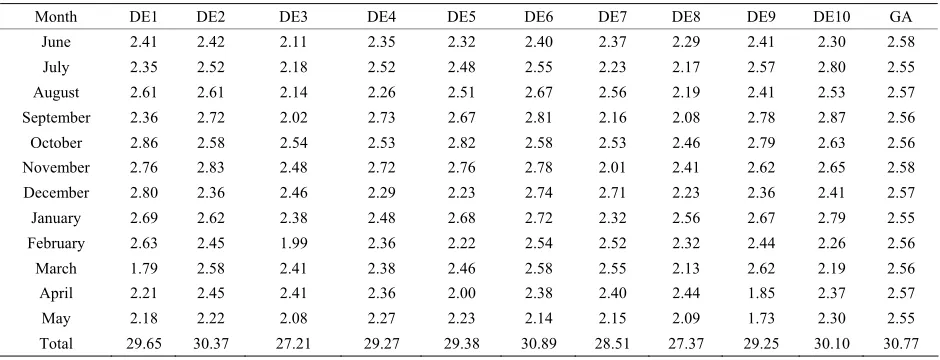
monthly optimal hydropower production by DE strate-gies and GA. Tables 4 and 5 gives exhaustive compari-son of all DE strategies and GA for irrigation releases and hydropower production. This comparison among all strategies of DE and GA provides applicability of dif-ferential evolution for optimal operation of multi-purpose reservoir.
4. Conclusions
In the present study a multipurpose reservoir in Godavari River sub basin in Maharashtra State, India is considered. A multiobjective operation model for maximization of hydropower production is proposed using differential evolution algorithm. Results of application of DE model indicate that the maximized hydropower production is 30.885 × 10⁶ kwh and the corresponding irrigation re-lease is 928.44 Mm3. From the results it can be seen that the monthly maximized irrigation release and hydro-power production can be the basis for decision maker to take decision for reservoir operation. Genetic algorithm is utilized as a comparative approach. The results of GA and different DE strategies for irrigation releases and hydropower production show that both the results are close and comparable. Therefore it can be said that DE can be used as an alternative methodology for optimal operation of multipurpose reservoir. Differential evolu-tion algorithm works with numerical values. Therefore highly complex objective functions do not introduce any difficulties and even discontinuous functions are accept-able. From the results, it can be said that the DE can be effectively applied to multi-objective operation problem and the reservoir can be operated for optimal reservoir releases for irrigation and hydropower production after meeting the other demands from the reservoir.
5. Acknowledgements
The authors are thankful to Rainer Storn, K. Price and J. Lampinen for their guidance during the work. Also, the authors are thankful to Command Area Development Authority, Aurangabad, Maharashtra state, India for pro- viding necessary data for the analysis.
6. References
[1] W. W.-G. Yeh, “Reservoir Management and Operations Models: A State-of-the-Art Review,” Water Resources Research, Vol. 21, No. 12, 1985, pp. 1797-1818.
[2] R. Oliveira and D. P. Loucks, “Operating Rules for Multi-Reservoir Systems,” Water Resource Research, Vol. 33, No. 4, 1997, pp. 839-852.
[3] R. Wardlaw and M. Sharif, “Evaluation of Genetic Algo-rithm for Optimal Reservoir System Operation,” Journal
ofWater Resource, Planning and Management, Vol. 125,
No. 1, 1999, pp. 25-33.
[4] M. Sharif and R. Wardlaw, “Multireservoir Systems Op-timization Using Genetic Algorithms: Case Study,” Jour-
nal of Computer in Civil Engineering, Vol. 14, No. 4,
2000, pp. 255-263.
[5] D. Nagesh kumar, A. Kumar and K. S. Raju, “Applica-tion of Genetic Algorithms for Optimal Reservoir Opera-tion,” Proceedings of X World Water Congress, Mel-bourne, 2000.
[6] K. S. Raju and D. Nagesh Kumar, “Irrigation Planning Using Genetic Algorithms,” Water Resource Manage-ment, Vol. 18, No. 2, 2004, pp. 163-176.
[7] D. G. Regulwar and P. A. Raj, “Development of 3-D Optimal Surface for Operation Policies of a Multireser-voir in Fuzzy Environment Using Genetic Algorithm for River Basin Development and Management,” Water
Re-source and Management, Vol. 22, No. 5, 2008, pp. 595-
610.
[8] R. Storn and K. Price, “Differential Evolution a Simple Evolution Strategy for Fast Optimization,” Dr Dobb’s Journal, Vol. 22, No. 4, 1997, pp. 18-24.
[9] J. Lampinen, “Multiconstraint Nonlinear Optimization by Differential Evolution Algorithm,” Technical Report, La- ppeenranta University of Technology, Laboratory of Pro- cessing,1999. http://www.lut.fi/~jlampine/debiblo.htm [10] I. L. Lopez Cruz, L. G. Van Willigenburg and G. Van
Straten, “Efficient Differential Evolution Algorithms for Multimodal Optimal Control Problems,” Journal of Ap-plied Soft Computing, Vol. 3, No. 2, 2003, pp.97-122. [11] B. V. Babu and R. Angira, “A Differential Evolution
Approach for Global Optimization of MINLP Problems,”
Proceedings of 4th Asia Pasific conference on Simulated
Evolution and Learning (SEAL2002), Vol. 2, Singapore,
2002, pp. 880-884.
[12] A. Vasan and K. Srinivasa Raju, “Optimal Reservoir Operation Using Differential Evolution,” International
Conference on Hydraulic Engineering: Research and
Practice (ICON-HERP-2004), Indian Institute of Tech-
nology Roorkee, India, 2004.
[13] S. R. Ranjithan, “Role of Evolutionary Computation in Environmental and Water Resources Systems Analysis,”
Journal of Water Resources Planning and Management,
ASCE, Vol. 131, No. 1, 2005, pp.1-2.
[14] M. J. Reddy and D. N. Kumar, “Multiobjective Differen-tial Evolution with Application to Reservoir System Op-timization,” Journal of Computing in Civil Engineering, ASCE, Vol. 21, No. 2, 2007, pp.136-146.
[15] A. Vasan and K. S. Raju, “Application of Differential Evolution for Irrigation Planning: An Indian Case Study,”
Water Resources Management, Vol. 21, No. 8, 2007, pp.
1393-1407.
[16] D. E. Goldberg, “Genetic Algorithms in Search, Optimi-zation and Machine Learning,” Addison-Wesley, Reading, Massachusetts, 1989.
Func-D. G. REGULWAR ET AL. 568
tions: A Survey of Some Theoretical and Practical As-pects of Genetic Algorithms,” Biology Systems, Vol. 39, No. 3, 1996, pp. 263-278.
[18] K. V. Price, “An Introduction to Differential Evolution, New Ideas in Optimization,” McGraw-Hill, London, 1999, pp. 79-108.
[19] K. Price and R. Storn, “Home Page of Differential Evoluti- on,” 2005. http://www.icsi.Berkeley.edu/~storn/code.html [20] D. P. Loucks, J. Stedinger and D. Haith, “Water Re-sources Systems Planning and Analysis,” Prentice-Hall, Eaglewood Cliffs, New Jersey, 1981.
Appendix: Notation
The following symbols are used in this paper
RP(t): Monthly releases for power generation during month t
TC: Flow corresponding to maximum capacity of turbine
FP: Flow corresponding to firm power. RI(t): Releases for irrigation during month t. IDmax(t): Maximum irrigation requirement of
command area during month t. IDmin (t): Minimum irrigation requirement of
command area during month t S(t): Storage volume in the reservoir
during month t
SC: Maximum storage volume of reservoir Smin: Dead storage volume of reservoir SP(t): Spills during month t
FCR(t): Feeder Canal Releases during month t β: Constant.