SRJSEL/BIMONTHLY/ANITA DESWAL & MADHU SAHNI(2001-2013)
DEC - JAN, 2015, VOL. II/VII www.srjis.com Page 2001
GENERAL WELL-BEING IN ADOLESCENTS ON THE BASIS OF GENDER AND
LOCALE
Anita Deswal, Ph. D. Assistant Professor, PDM College of Education, Sarai Aurangabad,
Bahadurgarh, Haryana
Madhu Sahni, Ph. D. Assistant Professor, Vaish College of Education, Rohtak, Haryana, India.
General Well-being is a combination of physical, emotional and social well-being which together is commonly
referred to as the health triangle. The present investigation was attempted to find out the influence of gender and
locale and their interaction on general well-being and its subscales in adolescents. The sample comprised of 340
adolescents randomly drawn from metropolitan area (Delhi) and non-metropolitan area (Bahadurgarh). Data were
analyzed by using 2×2 factorial design. Results showed a significant influence of gender on general well-being,
emotional well-being, social well-being and school well-being in adolescents. A significant influence of locale on
physical well-being and emotional well-being was also observed. Further, results reflect a significant interactive
influence of gender and locale on general well-being, emotional well-being, social well-being and school well-being
in adolescents. The findings of the study show that girls were higher on general well-being, social well-being and
school well-being and boys were higher on emotional well-being. Further, non-metropolitan adolescents were
higher on physical well-being than metropolitan adolescents and metropolitan adolescents were higher on
emotional well-being than non-metropolitan adolescents. These findings have vital implications to parents, teachers,
psychologists, counsellors, researchers, health policy-makers and school administrators to understand the influence
of gender and locale on general well-being in adolescents. Delimitations of the study and suggestions for future
researches have also been discussed.
Key Words: General well-being, Physical well-being, Emotional well-being, Social well-being, School well-being
and adolescents.
SRJSEL/BIMONTHLY/ANITA DESWAL & MADHU SAHNI(2001-2013)
DEC - JAN, 2015, VOL. II/VII www.srjis.com Page 2002 GENERAL WELL-BEING IN ADOLESCENTS ON THE BASIS OF GENDER AND
LOCALE: Adolescence is a transitional period between childhood and adulthood. It is a stage
where a child is no longer a child due to biological changes but has also not attained the status of
a young adult because growth and development process is still on. The age range for adolescents
varies in different countries/cultures. In Indian society, it begins with 13 and ends around at 18.
Adolescence period is universally known as a period of changes (Hill, 1983). Children entering
adolescence face three big challenges biological, psychological and social (Ramaswamy &
Kumar, 2012). When a child enters in this stage, it requires intensive readjustment to family,
school and society and many adolescents experience anxiety, unpleasantness or strong feeling
due to biological changes (Singh & Udainiya, 2009). They are growing physically facing
psychological instability due to hormonal changes. They are in search of identity and want to
associate themselves to society. If they are healthy in terms of physical, psychological, they can
contribute to society and nation significantly.
General well-being as a construct refers to the harmonious functioning of the physical as well as
psychological aspects of the personality, giving satisfaction to the self and benefit to the society
(Siwach, 2000). It has been defined as encompassing people’s cognitive and effective
evaluations of their lives (Karatzias et al., 2006). Other terms have been used, interchangeably
with the general well-being, included health (Emmons & Kings, 1988), life satisfaction and
psychological well-being (Karatzias et al., 2001a, 2002a; Huebner et al., 2004) and quality of life
as “a general sense of well-being” (Campbell, 1976). In general well-being, main emphasis is
given to the health because health is the general condition of a person in all aspects. It is a level
of functional and metabolic efficiency of an organism, often implicitly human. World Health
Organization (1948) defined health “as a state of complete physical, mental, and social
well-being and not merely the absence of disease or infirmity”. The spiritual dimension on health was
added much later in the WHO definition (Dalal & Misra, 2006).
Some existing research on adolescents has identified a number of significant factors associated
with general well-being. These include demographic (humbner et al., 2004), personality such as
emotional stability (Vittuso, 2001), general confidence (Chang & Furnham, 2003), self esteem
(Bekhuis, 1994; Vingilis, Wade, & Adlaf, 1998), life events (Mccullaugh, Huebner, & Laughlin,
2000) and school performance (Chang & Furnham, 2003). Furthermore, low levels of general
SRJSEL/BIMONTHLY/ANITA DESWAL & MADHU SAHNI(2001-2013)
DEC - JAN, 2015, VOL. II/VII www.srjis.com Page 2003 adolescence. These included delinquency (Goldstein & Heaven, 2000), victimization (Karatzias
et al., 2002a, 2002b). Karatzias et al (2006) focussed on self esteem and affectivity as
prospective predictors of general well-being in adolescents. Natvig, Albrektsen, & Qvarnstram
(2003) found that school factors such as social support received from teachers can enhance
general well-being levels. Deneve & Copper (1998) explained the general well-being variance of
adolescents by demographic factors ranged 3% to 6%. Similarly to adults’ population, variables
such as age and gender have been found to be relatively weak predictors of general well-being in
adolescents (Huebver et al., 2004).
When it comes to general well-being research on children and adolescents, a little work has been
carried out so far, as compared to the bulk of related work on adults (Jirojanakul et al., 2003).
However, there are several reasons why research on adolescents’ general well-being is important.
Firstly, adolescents, as an age group, are thought to reflect society’s future productive powers,
therefore their well-being may be highly important as it might encourage resilience and
protectiveness (Burt, 2009). In addition, although adolescence is generally considered a time of
good health and well-being, this particular age group still presents with high rated of mental
health disorders (Irwin, Burg, & Cart, 2002).
The present research aimed to study the adolescents’ general well being on the basis of gender
and locale. In the present study, the term general well-being includes physical, emotional and
social aspects along with school with reference to adolescents.
Gender is an important aspect for investigation while looking general well-being in adolescents.
Generally males are considered to be superior and females as inferior commonly in our culture
(Singh & Udainiya, 2009). Indian society is not open especially for girls. Boys and girls have to
fulfil different roles due to their biological structure. If they are not developed in a full and
mature manner and haven’t attained the state of good physical and psychological health, they
can’t lead a happy life which gives birth to many social evils.
The other important factor which influences the adolescent’s general well-being is locale. More
that 70% population in India resides in villages and small cities. Urban areas and metropolitan
cities have more facilities and opportunities to develop than villages and small cities. The
localities in which adolescents reside and get education contribute to their general well-being.
Therefore, gender and locale have been examined in combination in the present study so that a
SRJSEL/BIMONTHLY/ANITA DESWAL & MADHU SAHNI(2001-2013)
DEC - JAN, 2015, VOL. II/VII www.srjis.com Page 2004 general well-being in adolescents.
Objective: To study the main influence of gender and locale and their interactive influence on
general well-being and its subscales in adolescents.
Hypothesis: There is no significant influence of gender and locale and their interactive influence
on general well-being and its subscales in adolescents.
Method
Design: A 2 × 2 factorial design with unequal numbers was used in the present study.
Sample: The sample for the present study comprised of 340 adolescents with age ranging from
13 to 17 years studying in grade IX to XII in government schools of metropolitan area (Delhi)
and non-metropolitan area (bahadurgarh). Stratified random sampling technique was used to
collect the sample. Total sample was divided into groups (Gender – boys and girls, Locale –
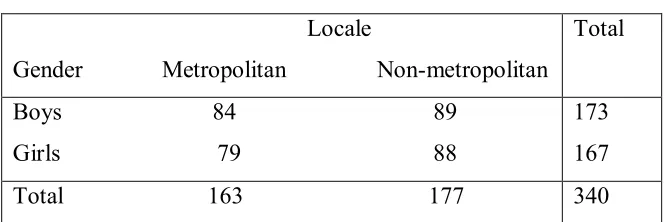
metropolitan and non-metropolitan) at each level according to the design of the study. Table 1
[image:4.612.135.469.356.467.2]shows description of the sample:
Table 1: Description of the Sample
Locale
Gender Metropolitan Non-metropolitan
Total
Boys 84 89
Girls 79 88
173
167
Total 163 177 340
Tool: The general well-being in adolescents was measured by general well-being scale
constructed and standardised by Kalia and Deswal (2011). The scale is meant for adolescents
only. It is consisted of 55 items under four sub-scales: physical well-being, emotional well-being,
social well-being and school well-being. It is a self-reporting five point scale included positive
and negative items based on the lines of Likert. Items of the scale are in statement form. Scoring
of the positive items is followed a system of 1,2,3,4,5 and in case of negative items, the scoring
procedure is to be reversed. The reliability of the general well-being scale was estimated by
using split-half method and spearman-brown method. The reliability coefficient was found .99
and total reliability of the scale was estimated .99. The validity of the scale was checked by
calculating the coefficient of correlations between scores on the total scale and scores on each of
SRJSEL/BIMONTHLY/ANITA DESWAL & MADHU SAHNI(2001-2013)
DEC - JAN, 2015, VOL. II/VII www.srjis.com Page 2005 validity, the scale ensures greater significance and wide application in the measurement of
general well-being in adolescents.
Procedure: The investigator approached the schools selected by stratified random sampling
technique. The investigator contacted to the principals and explained the purpose and relevance
of the study individually and obtained the consent from school authorities. Copies of general
well-being scale were provided to adolescent participants. Before administering the research
instrument, the investigators established rapport with the participants and requested to fill the
same honestly and accurately. The instructions were written on the front page of the scale. The
investigators communicated in hindi and english languages whenever necessary. They were
provided 15-20 minutes to complete the research instrument. Thus, the data were collected and
analyzed using the statistical technique.
Statistical Analysis: Two-way analysis of variance was applied to study 2 levels of gender (boys
and girls) and two levels of locale (metropolitan and non-metropolitan). Descriptive statistics
were also computed. Partial eta square method was used to calculate the effect size.
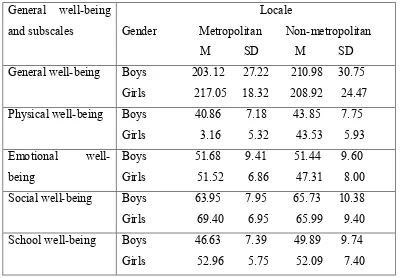
[image:5.612.102.503.422.700.2]Results and Discussion: Table 2 shows descriptive analysis for the constructs used in the study.
Table 2: Mean and SD scores representing Gender and Locale for General Well-being and
its Subscales in Adolescents
General well-being
and subscales
Locale
Gender Metropolitan Non-metropolitan
M SD M SD
General well-being Boys 203.12 27.22 210.98 30.75
Girls 217.05 18.32 208.92 24.47
Physical well-being Boys 40.86 7.18 43.85 7.75
Girls 3.16 5.32 43.53 5.93
Emotional
well-being
Boys 51.68 9.41 51.44 9.60
Girls 51.52 6.86 47.31 8.00
Social well-being Boys 63.95 7.95 65.73 10.38
Girls 69.40 6.95 65.99 9.40
School well-being Boys 46.63 7.39 49.89 9.74
SRJSEL/BIMONTHLY/ANITA DESWAL & MADHU SAHNI(2001-2013)
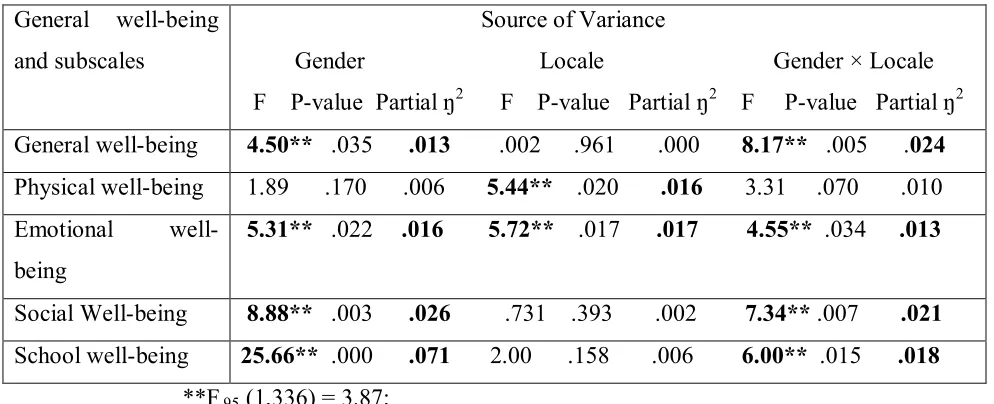
[image:6.612.65.562.112.314.2]DEC - JAN, 2015, VOL. II/VII www.srjis.com Page 2006 Table 3: Summary of ANOVA for 2×2 Factorial Design for General Well-being and its
subscales in Adolescents on the basis of Gender and Locale
General well-being
and subscales
Source of Variance
Gender Locale Gender × Locale
F P-value Partial ŋ2 F P-value Partial ŋ2 F P-value Partial ŋ2
General well-being 4.50** .035 .013 .002 .961 .000 8.17** .005 .024
Physical well-being 1.89 .170 .006 5.44** .020 .016 3.31 .070 .010
Emotional
well-being
5.31** .022 .016 5.72** .017 .017 4.55** .034 .013
Social Well-being 8.88** .003 .026 .731 .393 .002 7.34** .007 .021
School well-being 25.66** .000 .071 2.00 .158 .006 6.00** .015 .018
**F.95 (1,336) = 3.87;
The data were subjected to two-way ANOVA and results revealed a significant main influence of
gender on general well-being in adolescents, F (1, 336) = 4.50, P<.05 (partial eta2 = .013)
indicating that girls (M = 212.77, SD = 22.09) were higher on general well-being than boys (M =
207.16, SD = 29.27). It can be seen from the table 3 that a mere 1.3% of the variance was
accounted for main influence of gender on general well-being in adolescents. This finding is
contrary with previous finding (Jirojanakul et al., 2003) that suggested non-significant
association between gender and general well-being in adolescents. Singh & Udainiya (2009) also
revealed non-significant effect of gender on the measure of well-being.
The ANOVA on the first order interactive influence of gender and locale on general well-being
in adolescents came out to be significant, F (1, 336) = 8.17, P<.05 (partial eta2 = .024) indicating
that girls of metropolitan area (M= 217.05, SD = 18.32) showed higher general well-being than
girls of non-metropolitan area (M= 208.92, SD = 24.47) and their other counterparts. Results
clearly show a mere 2.4% of the variance was accounted for interactive influence of gender ×
Locale on general well-being in adolescents. On the basis of current finding it may be inferred
that despite gender inequality, the girls of metropolitan area are getting more exposure and
liberty to grow up than their counterparts. In metropolitan area, most of the parents are educated
and working and they do not impose unnecessary conditions on their adolescent girls.
SRJSEL/BIMONTHLY/ANITA DESWAL & MADHU SAHNI(2001-2013)
DEC - JAN, 2015, VOL. II/VII www.srjis.com Page 2007 access to facilities e.g. internet, participation in co-curricular activities, library and grooming
facilities. Thus, this enhances their general well-being.
Table 3 clearly demonstrate a significant main influence of locale on physical well-being in
adolescents, F (1, 336) = 5.44, P<.05 (partial eta2 = .016) indicating that non-metropolitan
adolescents (M = 43.70, SD = 6.89) were higher on physical well-being than metropolitan
adolescents (M = 41.97, SD = 6.44). A mere 1.6% of the variance for main influence of locale on
physical well-being in adolescents was also observed. One possible explanation for this result
could be that non-metropolitan adolescents generally have better nutritional status than
adolescents in metropolitan area and also receive better caring practices through joint family
system that often prevails in metropolitan area. Joint family system facilitates the adolescents’
development pattern in healthier manner (Singh & Udainiya, 2009). Hence, it influences their
physical well-being in a significant manner.
Table 3 revealed a significant main influence of gender on emotional well-being in adolescents,
F (1, 336) = 5.31, P<.05 (partial eta2 = .016) indicating that boys (M = 51.55, SD = 9.48) were
higher on emotional well-being than girls (M = 49.30, SD = 7.76). A mere 1.6% of the variance
was accounted for main influence of gender on emotional well-being in adolescents. The present
finding is consistent with Finch, Kolody, & Vega (2000) finding that mental health outcomes
differ in sexes. In another study, Achenbach & Edelbrock (1979) indicated that boys and girls are
not affected equally by emotional and behavioural problems. Twice as many adolescent girls as
boys were reported to have emotional problems. Mayer et al (2008) also found that adolescent
boys have good mental health and better on interpersonal, adaptability and stress management
skills than the adolescent girls. These results are congruous with the finding of the present
investigation.
A significant main influence of locale on emotional well-being in adolescents, F (1, 336) = 5.72,
P<.05 (partial eta2 = .017) was also found indicating that metropolitan adolescents (M = 51.60,
SD = 8.25) were higher on emotional well-being than non-metropolitan adolescents (M = 49.38,
SD = 9.06). It can be seen from the table 3 that a mere 1.7% of the variance was accounted for
main influence of locale on emotional well-being in adolescents. The result is in line with the
earlier research (Malhotra & Sabharwal, 2013) that rural adolescents have better mental health
SRJSEL/BIMONTHLY/ANITA DESWAL & MADHU SAHNI(2001-2013)
DEC - JAN, 2015, VOL. II/VII www.srjis.com Page 2008 It is observed from the table 3 that interactive influence of gender and locale on emotional
well-being in adolescents came out to be significant, F (1, 336) = 4.55, P<.05 (partial eta2 = .013)
indicating that boys of metropolitan area (M= 51.68, SD = 9.41) showed higher general
well-being than boys of non-metropolitan area (M= 51.44, SD = 9.60) and their other counterparts. A
mere 1.3% of the variance was observed for interactive influence of gender × locale on
emotional well-being in adolescents. The current finding is inconsistent with Francisa & Jasmine
(2012) investigation that reported female higher secondary students have better mental health
than male higher secondary students but found no significant difference between urban higher
secondary students and rural higher secondary students.
Results clearly revealed a significant main influence of gender on social well-being in
adolescents, F (1, 336) = 8.88, P<.05 (partial eta2 = .026) indicating that girls (M = 67.60, SD =
8.48) were higher on social well-being than boys (M = 207.16, SD = 29.27). A mere 2.6% of the
variance was accounted for main influence of gender on social well-being in adolescents. It can
be said in this context that adolescent girls prefer to be in their peer group than boys. Girls
contributed to household chores and play a significant role in shaping behaviour pattern of the
family. On the other hand, due to easy access to media and internet, they are more socially active
and getting social recognition than their previous generations. The gap between boys and girls
are narrowing. Thus, this influences their social well-being positively.
It can be seen from the table 3 that interactive influence of gender and locale on social
well-being of adolescents came out to be significant, F (1, 336) = 7.34, P<.05 (partial eta2 = .021)
indicating that girls of metropolitan area (M= 69.40, SD = 6.95) showed higher social well-being
than girls of non-metropolitan area (M= 65.99, SD = 9.40) and their other counterparts. A mere
2.1% of the variance was accounted for interactive influence of gender × locale on social
well-being in adolescents. It may be due to the fact that metropolitan girls have more opportunity for
self-expression and they are more socially active in real world as well as virtual world. They are
learning fast and dealing well with different aspects of life due to exposure of metropolitan city
than non-metropolitan girls. Traditional parenting is replaced by a good understanding and
regular conversation with adolescents especially in metropolitan cities. Parents are aware about
the need of their adolescent girls, so they support them. Thus, this raises their social well-being.
Table 3 showed a significant main influence of gender on school well-being in adolescents, F (1,
SRJSEL/BIMONTHLY/ANITA DESWAL & MADHU SAHNI(2001-2013)
DEC - JAN, 2015, VOL. II/VII www.srjis.com Page 2009 on school well-being than boys (M = 48.31, SD = 8.80). A mere 7.1% of the variance was also
observed for main influence of gender on school well-being in adolescents. On the basis of the
current finding, it may be inferred that girls are more studious, sincere and more regular in
schools than boys. Government has facilitated schools to provide education to girls and female
teachers are also appointed to teach them. Many schemes have been implemented to improve
their life conditions through schools. Curriculum is constructed according to their age, mental
level and interest. Advanced teaching methods are used to teach them and school also provides
opportunities to participate in co-curricular activities. So, they enjoy the schooling. This
significantly enhances their school well-being.
The ANOVA on the first order interactive influence of gender and locale on school well-being in
adolescents came out to be significant, F (1, 336) = 6.00, P<.05 (partial eta2 = .018) indicating
that girls of metropolitan area (M= 52.96, SD = 5.75) showed higher school well-being than girls
of non-metropolitan area (M= 52.09, SD = 7.40) and their other counterparts. A mere 1.8% of
the variance was accounted for main influence of gender × locale on school well-being in
adolescents. It can be said in this context that metropolitan schools are more facilitated and
provides exposure to their students. Metropolitan girls are more aware regarding their identity
and school is a place where they get recognition. Modern classroom environment, advanced
teaching methods, dynamic teachers and plenty of co-curricular activities gives them opportunity
to learn at their own pace. So, they enjoy schooling. Thus, they are high on school well-being
than their counterparts.
Implications and Delimitations: The purpose of this study was to explore the influence of
gender and locale on general well-being in adolescents. These two factors have rarely been
examined in combinations, especially in adolescents with reference to general well-being, as in
the present study. In rapidly changing present scenario, this study provides a ground to parents,
teachers, counsellors and researcher to understand the adolescents’ development pattern, their
needs and help to identify the main factors which influences the general well-being in
adolescents. If they are lacking behind in any dimension of general well-being, remedial
measures and support system should be provided to adolescents for their well-round
development. It makes them to lead a good life so that they can prove themselves as an asset to
SRJSEL/BIMONTHLY/ANITA DESWAL & MADHU SAHNI(2001-2013)
DEC - JAN, 2015, VOL. II/VII www.srjis.com Page 2010 It is important to mention the implications of the present study for the health and school
administration. Health policy-makers must restructure the health facilities in keeping the view of
adolescents’ development pattern which shapes and enhances their general well-being which
makes them lead a better life and rise to meet higher expectations of the society.
School is a miniature form of the society. It is a place where adolescents spend more time after
home. So, the school administration should also provide the opportunities, facilities and exposure
to students so that they can grow up in a mature adult.
The present study was conducted on certain delimitations. The study was confined to 340
adolescents drawn from government schools of metropolitan and non-metropolitan area. Indian
adolescent population is one of the biggest in the world, so in future the sample size must be
fairly large. This study was confined to sample of adolescents having two demographic variables
namely gender and locale. A similar study can be conducted on a large sample with different
independent variables. The present study was carried on government schools. A similar study
may be conducted on samples drawn from semi-government and public schools situated in rural
areas and a comparison and validation of results may be made. It will also be advisable to
conduct some comparative, follow-up, longitudinal and/or experimental studies as it is likely to
go a long way to measure the general well-being at different levels e.g. school level, college
level and university level and in job environment also. Some studies covering quality of life and
spiritual well-being and its influence on the behaviour pattern among the adolescents and adults
could be undertaken.
Thus, the present research explored the general well-being in adolescents on the basis of gender
and locale.
References:
Achenbach, T. M. & Edelbrock, C. S. (1979). The child behavioural profile II: Boys aged 12-16
and girls aged 6-16. Journal of Consulting and Clinical Psychology, Vol 47(2),
223-233.
Bekhuis, T. C. H. M. (1994). The self-esteem of adolescents in American public high schools: A
multilevel analysis of individual differences. Personality and Individual Differences,
SRJSEL/BIMONTHLY/ANITA DESWAL & MADHU SAHNI(2001-2013)
DEC - JAN, 2015, VOL. II/VII www.srjis.com Page 2011
Burt, M. R. (2002). Reasons to invest in adolescents. Journal of Adolescent Health, Vol 31(6
suppl 1), 136-152.
Campbell, A. (1976). Subjective measures of well-being. American Psychologist, Vol 31(2),
117–124.
Cheng, H. & Furnham, A. (2003). Personality, self-esteem and demographic predictions of
happiness and depression. Personality and Individual Differences, Vol 34(6), 921–
942.
Dalal, A. K. & Misra, G. (2006). Psychology of health and well-being: Some emerging
perspectives. Psychological Studies, Vol 51(2-3), 91-104.
DeNeve, K. M. & Cooper, H. (1998). The happy personality: A meta-analysis of 137 personality
traits and subjective well-being. Psychological Bulletin, Vol 124(2), 197–229.
Emmons, R. A. & King, L. A. (1988). Conflict among personal surviving: Immediate and
long-term implications for psychological and physical well-being. Journal of Personality
and Social Psychology, Vol 54, 1010-1018.
Finch, B. K., Kolody, B., & Vega, W. A. (2000). Perceived discrimination and depression among
Mexican-origin adults in California. Journal of Health Social Behaviour, Vol 41(3),
295-313.
Francisa, S. & Jasmine, A. (2012), Mental Health in relation to Family Environment, on line
journal, ISSN 2278, www.e-reflection.com, vol. 1, 3-4 2012, pp 18-24.
Goldstein, M. & Heaven, P. C. L. (2000). Perceptions of the family, delinquency and emotional
adjustment among youth. Personality and Individual Differences, Vol 29(6), 1169–
1178.
Hill, J. (1983). Early adolescence: A framework. Journal of Early Adolescence, Vol 3(1-2), 1-12.
Huebner, E. S., Valois, R. F., Suldo, S. M., Smith, L. C., McKnight, C. G., Seligson, J. L., &
Zullig, K. J. (2004). Perceived quality of life: A neglected component of adolescent
health assessment and intervention. Journal of Adolescent Health, Vol 34(4), 270–
278.
Irwin, C. E., Burg, S. J., & Cart, C. U. (2002). America’s adolescents: Where have we been,
where are we going? Journal of Adolescent Health, Vol 31(6), 91-121.
Jirojanakul, P., Skevington, S. M., & Hudson, J. (2003). Predicting young children’s quality of
SRJSEL/BIMONTHLY/ANITA DESWAL & MADHU SAHNI(2001-2013)
DEC - JAN, 2015, VOL. II/VII www.srjis.com Page 2012
Kalia, A. K. & Deswal, A. (2011). General Well-being Scale. Agra: National Psychological
Corporation.
Karatzias, A., Power, K. G., & Swanson, V. (2002b). Bullying and victimisation in Scottish
secondary schools: Same or separate entities? Aggressive Behavior, Vol 28(1), 45–61.
Karatzias, A., Power, K. G., Flemming, J., Lennan, F., & Swanson, V. (2002a). The role of
demographic, personality variables and school stress on predicting school
satisfaction/dissatisfaction: Review of the literature and research
findings. Educational Psychology, Vol 22(1), 33–50.
Karatzias, A., Chouliara, Z., Poer, K., & Swanson, V. (2006). Predicting general well-being from
self-esteem and affectivity: An exploratory study with Scottish adolescents. Quality
of Life Research, Vol 15, 1143-1151.
Malhotra, T. & Sabharwal, S. (2013). Anxiety and mental health of adolescents: A study.
International Education E-Journal, Vol 2(3), 114-121.
Mayer, J. B., Robert, S. R., & Barsade, S. G. (2008). Human Abilities: Emotional Intelligence.
Annual Review of Psychology, Vol 59(1), 507- 535.
McCullough, G., Huebner, E. S., & Laughlin, J. E. (2000). Life events, self-concept, and
adolescents’ positive subjective well-being. Psychology in the Schools, Vol 37(3),
281–290.
Natvig, G. K., Albrektsen, G., & Qvarnstrom, U. (2003). Associations between psychosocial
factors and happiness among school adolescents. International Journal of Nursing
Practice, 9(3), 166–75.
Ramaswamy, C. & Kumar, V. G. (2012). Assessment of adolescent problems in rural and urban
areas. Journal of the Indian Academy of Applied Psychology, Vol 38(1), 40-43.
Singh, B. & Udainiya, R. (2009). Self-efficacy and well-being of adolescents. Journal of the
Indian Academy of Applied Psychology, Vol 35(2), 227-232.
Siwach, S. (2000). A correlation study of stress, coping skills, general well-being and
job-outcome amongst police personnel. Unpublished Doctoral Dissertation, Department of Psychology. Maharishi Dayanand University, Rohtak.
Vingilis, E., Wade T. J., & Adlaf, E. (1998). What factors predict student self-rated physical
SRJSEL/BIMONTHLY/ANITA DESWAL & MADHU SAHNI(2001-2013)
DEC - JAN, 2015, VOL. II/VII www.srjis.com Page 2013 Vitterso, J. (2001). Personality traits and subjective well-being: Emotional stability, not
extraversion, is probably the important predictor. Personality and Individual
Differences, Vol 31(6), 903–914.
WHO.int, Preamble to the constitution of the World Health Organization as adopted by the
International Health Conference, New York, 19–22 June 1946; signed on 22 July 1947 by the representatives of 61 States (Official Records of the World Health