Representation Learning for Text-level Discourse Parsing
Yangfeng Ji
School of Interactive Computing Georgia Institute of Technology
Jacob Eisenstein
School of Interactive Computing Georgia Institute of Technology
Abstract
Text-level discourse parsing is notoriously difficult, as distinctions between discourse relations require subtle semantic judg-ments that are not easily captured using standard features. In this paper, we present a representation learning approach, in which we transform surface features into a latent space that facilitates RST dis-course parsing. By combining the machin-ery of large-margin transition-based struc-tured prediction with representation learn-ing, our method jointly learns to parse dis-course while at the same time learning a discourse-driven projection of surface fea-tures. The resulting shift-reduce discourse parser obtains substantial improvements over the previous state-of-the-art in pre-dicting relations and nuclearity on the RST Treebank.
1 Introduction
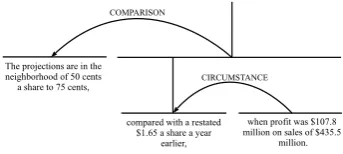
Discourse structure describes the high-level or-ganization of text or speech. It is central to a number of high-impact applications, such as text summarization (Louis et al., 2010), senti-ment analysis (Voll and Taboada, 2007; Somasun-daran et al., 2009), question answering (Ferrucci et al., 2010), and automatic evaluation of student writing (Miltsakaki and Kukich, 2004; Burstein et al., 2013). Hierarchical discourse representa-tions such as Rhetorical Structure Theory (RST) are particularly useful because of the computa-tional applicability of tree-shaped discourse struc-tures (Taboada and Mann, 2006), as shown in Fig-ure 1.
Unfortunately, the performance of discourse parsing is still relatively weak: the state-of-the-art F-measure for text-level relation detection in the RST Treebank is only slightly above 55% (Joty
when profit was $107.8 million on sales of $435.5
million. The projections are in the
neighborhood of 50 cents a share to 75 cents,
compared with a restated $1.65 a share a year
earlier,
[image:1.595.330.502.205.282.2]CIRCUMSTANCE COMPARISON
Figure 1: An example of RST discourse structure.
et al., 2013). While recent work has introduced increasingly powerful features (Feng and Hirst, 2012) and inference techniques (Joty et al., 2013), discourse relations remain hard to detect, due in part to a long tail of “alternative lexicalizations” that can be used to realize each relation (Prasad et al., 2010). Surface and syntactic features are not capable of capturing what are fundamentally se-mantic distinctions, particularly in the face of rel-atively small annotated training sets.
In this paper, we present a representation learn-ing approach to discourse parslearn-ing. The core idea of our work is to learn a transformation from a bag-of-words surface representation into a latent space in which discourse relations are easily iden-tifiable. The latent representation for each dis-course unit can be viewed as a discriminatively-trained vector-space representation of its meaning. Alternatively, our approach can be seen as a non-linear learning algorithm for incremental struc-ture prediction, which overcomes feastruc-ture sparsity through effective parameter tying. We consider several alternative methods for transforming the original features, corresponding to different ideas of the meaning and role of the latent representa-tion.
Our method is implemented as a shift-reduce discourse parser (Marcu, 1999; Sagae, 2009). Learning is performed as large-margin transition-based structure prediction (Taskar et al., 2003), while at the same time jointly learning to project the surface representation into latent space. The
resulting system strongly outperforms the prior state-of-the-art at labeled F-measure, obtaining raw improvements of roughly 6% on relation la-bels and 2.5% on nuclearity. In addition, we show that the latent representation coheres well with the characterization of discourse connectives in the Penn Discourse Treebank (Prasad et al., 2008).
2 Model
The core idea of this paper is to project lexical fea-tures into a latent space that facilitates discourse parsing. In this way, we can capture the meaning of each discourse unit, without suffering from the very high dimensionality of a lexical representa-tion. While such feature learning approaches have proven to increase robustness for parsing, POS tagging, and NER (Miller et al., 2004; Koo et al., 2008; Turian et al., 2010), they would seem to have an especially promising role for discourse, where training data is relatively sparse and ambi-guity is considerable. Prasad et al. (2010) show that there is a long tail of alternative lexicalizations for discourse relations in the Penn Discourse Tree-bank, posing obvious challenges for approaches based on directly matching lexical features ob-served in the training data.
Based on this observation, our goal is to learn a function that transforms lexical features into a much lower-dimensional latent representation, while simultaneously learning to predict discourse structure based on this latent representation. In this paper, we consider a simple transformation function, linear projection. Thus, we name the ap-proach DPLP: Discourse Parsing from Linear Pro-jection. We apply transition-based (incremental) structured prediction to obtain a discourse parse, training a predictor to make the correct incremen-tal moves to match the annotations of training data in the RST Treebank. This supervision signal is then used to learn both the weights and the projec-tion matrix in a large-margin framework.
2.1 Shift-reduce discourse parsing
We construct RST Trees using shift-reduce pars-ing, as first proposed by Marcu (1999). At each point in the parsing process, we maintain a stack and a queue; initially the stack is empty and the first elementary discourse unit (EDU) in the docu-ment is at the front of the queue.1 The parser can
1We do not address segmentation of text into elemen-tary discourse units in this paper. Standard
classification-Notation Explanation
V Vocabulary for surface features
V Size ofV
K Dimension of latent space
wm Classification weights for classm
C Total number of classes, which correspond to possible shift-reduce operations
A Parameter of the representation function (also the projection matrix in the linear representa-tion funcrepresenta-tion)
vi Word count vector of discourse uniti
v Vertical concatenation of word count vectors for the three discourse units currently being considered by the parser
λ Regularization for classification weights τ Regularization for projection matrix ξi Slack variable for samplei
ηi,m Dual variable for sampleiand classm
[image:2.595.308.529.63.259.2]αt Learning rate at iterationt
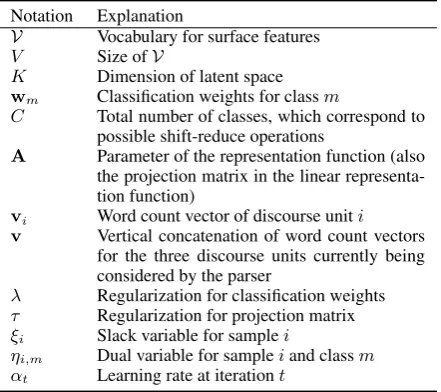
Table 1: Summary of mathematical notation
then choose either toshift the front of the queue onto the top of the stack, or toreducethe top two elements on the stack in a discourse relation. The reduction operation must choose both the type of relation and which element will be the nucleus. So, overall there are multiple reduce operations with specific relation types and nucleus positions. Shift-reduce parsing can be learned as a classifi-cation task, where the classifier uses features of the elements in the stack and queue to decide what move to take. Previous work has employed deci-sion trees (Marcu, 1999) and the averaged percep-tron (Collins and Roark, 2004; Sagae, 2009) for this purpose. Instead, we employ a large-margin classifier, because we can compute derivatives of the margin-based objective function with respect to both the classifier weights as well as the projec-tion matrix.
2.2 Discourse parsing with projected features
More formally, we denote the surface feature vo-cabulary V, and represent each EDU as the nu-meric vectorv∈NV, whereV = #|V|and then -th element ofvis the count of then-th surface fea-ture in this EDU (see Table 1 for a summary of no-tation). During shift-reduce parsing, we consider features of three EDUs:2 the top two elements on
based approaches can achieve a segmentation F-measure of 94% (Hernault et al., 2010); a more complex rerank-ing model does slightly better, at 95% F-Measure with automatically-generated parse trees, and 96.6% with gold an-notated trees (Xuan Bach et al., 2012). Human agreement reaches 98% F-Measure.
the stack (v1 andv2), and the front of the queue (v3). The vertical concatenation of these vectors is denotedv = [v1;v2;v3]. In general, we can formulate the decision function for the multi-class shift-reduce classifier as
ˆ
m= arg max
m∈{1,...,C}w >
mf(v;A) (1)
where wm is the weight for the m-th class and f(v;A) is the representation function parametrized by A. The score for class m (in our case, the value of taking the m-th shift-reduce operation) is computed by the inner prod-uctw>
mf(v;A). The specific shift-reduce opera-tion is chosen by maximizing the decision value in Equation 1.
The representation functionf(v;A)can be de-fined in any form; for example, it could be a non-linear function defined by a neural network model parametrized byA. We focus on the linear projec-tion,
f(v;A) =Av, (2)
whereA ∈ RK×3V is projects the surface repre-sentation v of three EDUs into a latent space of sizeKV.
Note that by settingw˜>
m =wm>A, the decision scoring function can be rewritten asw˜>
mv, which is linear in the original surface features. Therefore, the expressiveness of DPLPis identical to a linear separator in the original feature space. However, the learning problem is considerably different. If there areCtotal classes (possible shift-reduce op-erations), then a linear classifier must learn3V C
parameters, while DPLP must learn (3V +C)K parameters, which will be smaller under the as-sumption that K < C V. This can be seen as a form ofparameter tyingon the linear weights
˜
wm, which allows statistical strength to be shared across training instances. We will consider special cases of A that reduce the parameter space still further.
2.3 Special forms of the projection matrix
We consider three different constructions for the projection matrixA.
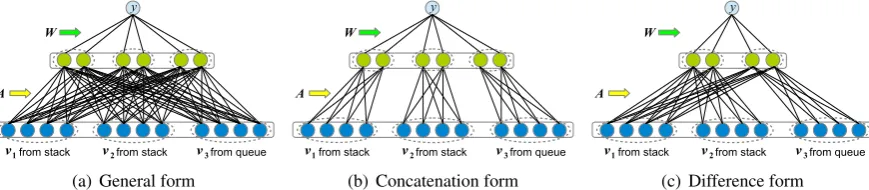
• General form: In the general case, we place
compositionality criterionof Marcu (1996) and consider only the nuclear EDU of the span. Later work may explore the composition of features between the nucleus and satellite.
no special constraint on the form ofA.
f(v;A) =A vv12
v3
(3)
This form is shown in Figure 2(a).
• Concatenation form: In the concatenation form, we choose a block structure forA, in which a single projection matrixBis applied to each EDU:
f(v;A) =
"
B 0 0
0 B 0
0 0 B
# "
v1
v2
v3
# (4)
In this form, we transform the representa-tion of each EDU separately, but do not at-tempt to represent interrelationships between the EDUs in the latent space. The number of parameters inAis 13KV. Then, the total number of parameters, including the decision weights{wm}, in this form is(V3 +C)K.
• Difference form. In the difference form, we explicitly represent the differences between adjacent EDUs, by constructingAas a block difference matrix,
f(v;A) = "
C −C 0
C 0 −C
0 0 0
# "
v1
v2
v3
#
, (5)
The result of this projection is that the la-tent representation has the form [C(v1 − v2);C(v1−v3)], representing the difference between the top two EDUs on the stack, and between the top EDU on the stack and the first EDU in the queue. This is intended to capture semantic similarity, so that reduc-tions between related EDUs will be preferred. Similarly, the total number of parameters to estimate in this form is(V + 2C)K
3.
3 Large-Margin Learning Framework
A W
y
v1from stack v2from stack v3from queue
(a) General form
A W
y
v1from stack v2from stack v3from queue
(b) Concatenation form
A W
y
v1from stack v2from stack v3from queue
[image:4.595.82.517.63.158.2](c) Difference form
Figure 2: Decision problem with different representation functions
Specifically, we formulate the following con-strained optimization problem,
min {w1:C,ξ1:l,A}
λ
2
C
X
m=1
kwmk22+
l
X
i=1
ξi+τ2kAk2F
s.t.(wyi−wm)>f(vi;A)≥1−δyi=m−ξi, ∀i, m
(6)
where m ∈ {1, . . . , C} is the index of the shift-reduce decision taken by the classifier (e.g., SHIFT, REDUCE-CONTRAST-RIGHT, etc), i ∈
{1,· · ·, l}is the index of the training sample, and wmis the vector of classification weights for class
m. The slack variablesξi permit the margin con-straint to be violated in exchange for a penalty, and the delta function δyi=m is unity ifyi = m, and
zero otherwise.
As is standard in the multi-class linear SVM (Crammer and Singer, 2001), we can solve the problem defined in Equation 6 via Lagrangian optimization:
L({w1:C, ξ1:l,A, η1:l,1:C}) =
λ
2
C
X
m=1
kwmk22+
l
X
i=1
ξi+τ2kAk2F
+X
i,m
ηi,m
n (w>
m−w>yi)f(vi;A) + 1−δyi=m−ξi o
s.t. ηi,m≥0∀i, m
(7) Then, to optimize L, we need to find a saddle point, which would be the minimum for the vari-ables {w1:C, ξ1:l} and the projection matrix A, and the maximum for the dual variables{η1:l,1:C}. IfA is fixed, then the optimization problem is equivalent to a standard multi-class SVM, in the transformed feature spacef(vi;A). We can obtain the weights {w1:C} and dual variables{η1:l,1:C} from a standard dual-form SVM solver. We then updateA, recompute{w1:C} and{η1:l,1:C}, and iterate until convergence. This iterative procedure is similar to the latent variable structural SVM (Yu and Joachims, 2009), although the specific details of our learning algorithm are different.
3.1 Learning Projection MatrixA
We updateAwhile holding fixed the weights and dual variables. The derivative ofLwith respect to Ais
∂L
∂A =τA+
X
i,m
ηi,m(w>m−w>yi)
∂f(vi;A)
∂A
=τA+X
i,m
ηi,m(wm−wyi)vi>
(8)
Setting∂∂AL = 0, we have the closed-form solution,
A= 1τ X
i,m
ηi,m(wm−wyi)vi>
= 1τ X
i,j
(wyi− X
m
ηi,mwm)vi>,
(9)
because the dual variables for each instance must sum to one,Pmηi,m= 1.
Note that for a given i, the matrix (wyi −
P
mηi,mwm)vi> is of (at most) rank-1. There-fore, the solution ofA can be viewed as the lin-ear combination of a sequence of rank-1 matrices, where each rank-1 matrix is defined by distribu-tional representationvi and the weight difference between the weight of true labelwyi and the
“ex-pected” weightPmηi,mwm.
One property of the dual variables is that f(vi;A) is a support vector only if the dual vari-able ηi,yi < 1. Since the dual variables for each
instance are guaranteed to sum to one, we have wyi −
P
mηi,mwm = 0 if ηi,yi = 1. In other
words, the contribution from non support vectors to the projection matrixAis 0. Then, we can fur-ther simplify the updating equation as
A= τ1 X
vi∈SV
(wyi−
X
m
ηi,mwm)vi> (10)
Algorithm 1Mini-batch learning algorithm
Input: Training set D, Regularization parame-tersλandτ, Number of iterationT, Initializa-tion matrixA0, and Thresholdε
whilet= 1, . . . , T do
Randomly choose a subset of training sam-plesDtfromD
Train SVM withAt−1 to obtain{w(t)m} and
{ηi,m(t)}
UpdateAtusing Equation 11 withαt= 1t
if kAt−At−1kF
kA2−A1kF < εthen
Return end if end while
Re-train SVM withDand the finalA
Output: Projection matrix A, SVM classifier with weightsw
3.2 Gradient-based Learning forA
Solving the quadratic programming defined by the dual form of the SVM is time-consuming, espe-cially on a large-scale dataset. But if we focus on learning the projection matrixA, we can speed up learning by sampling only a small proportion of the training data to compute an approximate op-timum for{w1:C, η1:l,1:C}, before each update of A. This idea is similar to the mini-batch learning, which has been used in large-scale SVM problem (Nelakanti et al., 2013) and deep learning models (Le et al., 2011).
Specifically, in iteration t, the algorithm ran-domly chooses a subset of training samplesDtto train the model. We cannot make a closed-form update to A based on this small sample, but we can take an approximate gradient step,
At= (1−αtτ)At−1+
αt
n X
vi∈SV(Dt)
w(yti)− X
m
η(i,mt)wm(t)
vi>
o
, (11)
where αt is a learning rate. In iteration t, we chooseαt = 1t. After convergence, we obtain the weights w by applying the SVM over the entire dataset, using the finalA. The algorithm is sum-marized in Algorithm 1 and more details about im-plementation will be clarified in Section 4. While minibatch learning requires more iterations, the SVM training is much faster in each batch, and the overall algorithm is several times faster than using the entire training set for each update.
4 Implementation
The learning algorithm is applied in a shift-reduce parser, where the training data consists of the (unique) list of shift and reduce operations re-quired to produce the gold RST parses. On test data, we choose parsing operations in an online fashion — at each step, the parsing algorithm changes the status of the stack and the queue ac-cording the selected transition, then creates the next sample with the updated status.
4.1 Parameters and Initialization
There are three free parameters in our approach: the latent dimension K, and regularization pa-rameters λ andτ. We consider the values K ∈ {30,60,90,150}, λ ∈ {1,10,50,100} and τ ∈ {1.0,0.1,0.01,0.001}, and search over this space using a development set of thirty document ran-domly selected from within the RST Treebank training data. We initialize each element of A0 to a uniform random value in the range[0,1]. For mini-batch learning, we fixed the batch size to be 500 training samples (shift-reduce operations) in each iteration.
4.2 Additional features
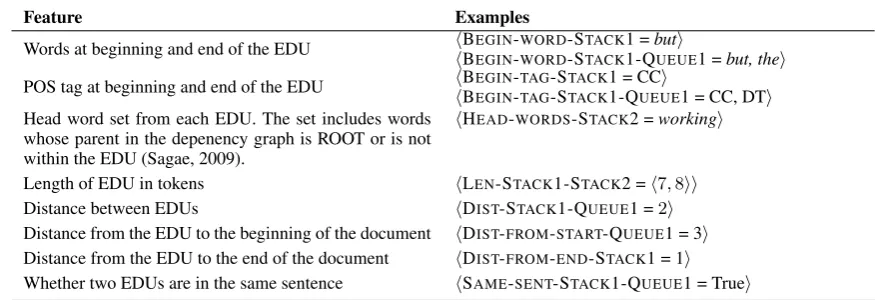
As described thus far, our model considers only the projected representation of each EDU in its parsing decisions. But prior work has shown that other, structural features can provide useful in-formation (Joty et al., 2013). We therefore aug-ment our classifier with a set of simple feature templates. These templates are applied to individ-ual EDUs, as well as pairs of EDUs: (1) the two EDUs on top of the stack, and (2) the EDU on top of the stack and the EDU in front of the queue. The features are shown in Table 2. In computing these features, all tokens are downcased, and nu-merical features are not binned. The dependency structure and POS tags are obtained from MALT-Parser (Nivre et al., 2007).
5 Experiments
We evaluate DPLP on the RST Discourse Tree-bank (Carlson et al., 2001), comparing against state-of-the-art results. We also investigate the in-formation encoded by the projection matrix.
5.1 Experimental Setup
train-Feature Examples
Words at beginning and end of the EDU hhBBEGINEGIN--WORDWORD-S-STACKTACK1 =1-QbutUEUEi 1 =but, thei POS tag at beginning and end of the EDU hhBBEGINEGIN--TAGTAG-S-STACKTACK1 = CC1-QUEUEi 1 = CC, DTi Head word set from each EDU. The set includes words
whose parent in the depenency graph is ROOT or is not within the EDU (Sagae, 2009).
hHEAD-WORDS-STACK2 =workingi
[image:6.595.77.515.64.214.2]Length of EDU in tokens hLEN-STACK1-STACK2 =h7,8ii Distance between EDUs hDIST-STACK1-QUEUE1 =2i Distance from the EDU to the beginning of the document hDIST-FROM-START-QUEUE1 = 3i Distance from the EDU to the end of the document hDIST-FROM-END-STACK1 = 1i Whether two EDUs are in the same sentence hSAME-SENT-STACK1-QUEUE1 = Truei
Table 2: Additional features for RST parsing
ing and 38 for testing in the standard split. As we focus on relational discourse parsing, we fol-low prior work (Feng and Hirst, 2012; Joty et al., 2013), and use gold EDU segmentations. The strongest automated RST segmentation methods currently attain 95% accuracy (Xuan Bach et al., 2012).
Preprocessing In the RST-DT, most nodes have exactly two children, one nucleus and one satellite. For non-binary relations, we use right-branching to binarize the tree structure. For multi-nuclear relations, we choose the left EDU as “head” EDU. The vocabularyV includes all unigrams af-ter down-casing. No other preprocessing is per-formed. In total, there are 16250 unique unigrams inV.
Fixed projection matrix baselines Instead of learning from data, a simple way to obtain a pro-jection matrix is to use matrix factorization. Re-cent work has demonstrated the effectiveness of non-negative matrix factorization (NMF) for mea-suring distributional similarity (Dinu and Lapata, 2010; Van de Cruys and Apidianaki, 2011). We can construct Bnmf in the concatenation form of the projection matrix by applying NMF to the EDU-feature matrix,M≈ WH. As a result,W describes each EDU with aK-dimensional vector, andHdescribes each word with aK-dimensional vector. We can then construct Bnmf by taking the pseudo-inverse ofH, which then projects from word-count vectors into the latent space.
Another way to construct B is to use neural word embeddings (Collobert and Weston, 2008). In this case, we can view the productBvas a com-position of the word embeddings, using the simple additivecomposition model proposed by Mitchell
and Lapata (2010). We used the word embeddings from Collobert and Weston (2008) with dimension
{25,50,100}. Grid search over heldout training data was used to select the optimum latent dimen-sion for both the NMF and word embedding base-lines. Note that the sizeK of the resulting projec-tion matrix is three times the size of the embed-ding (or NMF representation) due to the concate-nate construction.
We also consider the special case whereA=I.
Competitive systems We compare our approach with HILDA (Hernault et al., 2010) and TSP (Joty et al., 2013). Joty et al. (2013) proposed two dif-ferent approaches to combine sentence-level pars-ing models: sliding windows (TSP SW) and 1 sentence-1 subtree(TSP 1-1). In the comparison, we report the results of both approaches. All re-sults are based on the same gold standard EDU segmentation. We cannot compare with the re-sults of Feng and Hirst (2012), because they do not evaluate on the overall discoursestructure, but rather treat each relation as an individual classifi-cation problem.
Metrics To evaluate the parsing performance, we use the three standard ways to measure the per-formance: unlabeled (i.e., hierarchical spans) and labeled (i.e., nuclearity and relation) F-score, as defined by Black et al. (1991). The application of this approach to RST parsing is described by Marcu (2000b).3 To compare with previous works
on RST-DT, we use the 18 coarse-grained relations defined in (Carlson et al., 2001).
3We implemented the evaluation metrics by ourselves. Together with the DPLPsystem, all codes are published on
Method Matrix Form +Features K Span Nuclearity Relation Prior work
1. HILDA (Hernaultet al., 2010) 83.0 68.4 54.8
2. TSP 1-1 (Jotyet al., 2013) 82.47 68.43 55.73
3. TSP SW (Jotyet al., 2013) 82.74 68.40 55.71
Our work
4. Basic features A=0 Yes 79.43 67.98 52.96
5. Word embeddings Concatenation No 75 75.28 67.14 53.79
6. NMF Concatenation No 150 78.57 67.66 54.80
7. Bag-of-words A=I Yes 79.85 69.01 60.21
8. DPLP Concatenation No 60 80.91 69.39 58.96
9. DPLP Difference No 60 80.47 68.61 58.27
10. DPLP Concatenation Yes 60 82.08 71.13 61.63
11. DPLP General Yes 30 81.60 70.95 61.75
Human annotation 88.70 77.72 65.75
Table 3: Parsing results of different models on the RST-DT test set. The results of TSP and HILDA are reprinted from prior work (Joty et al., 2013; Hernault et al., 2010).
5.2 Experimental Results
Table 3 presents RST parsing results for DPLPand some alternative systems. All versions of DPLP outperform the prior state-of-the-art on nuclearity and relation detection. This includes relatively simple systems whose features are simply a projection of the word count vectors for each EDU (lines 7 and 8). The addition of the features from Table 2 improves performance further, leading to absolute F-score improvement of around 2.5% in nuclearity and 6% in relation prediction (lines 9 and 10).
On span detection, DPLP performs slightly worse than the prior state-of-the-art. These sys-tems employ richer syntactic and contextual fea-tures, which might be especially helpful for span identification. As shown by line 4 of the re-sults table, the basic features from Table 2 pro-vide most of the predictive power for spans; how-ever, these features are inadequate at the more semantically-oriented tasks of nuclearity and re-lation prediction, which benefit substantially from the projected features. Since correctly identifying spans is a precondition for nuclearity and relation prediction, we might obtain still better results by combining features from HILDA and TSP with the representation learning approach described here.
Lines 5 and 6 show that discriminative learning of the projection matrix is crucial, as fixed projec-tions obtained from NMF or neural word embed-dings perform substantially worse. Line 7 shows that the original bag-of-words representation to-gether with basic features could give us some ben-efit on discourse parsing, but still not as good as results from DPLP. From lines 8 and 9, we see
that the concatenation construction is superior to the difference construction, but the comparison between lines 10 and 11 is inconclusive on the merits of the general form of A. This suggests that using the projection matrix to model interre-lationships between EDUs does not substantially improve performance, and the simpler concatena-tion construcconcatena-tion may be preferred.
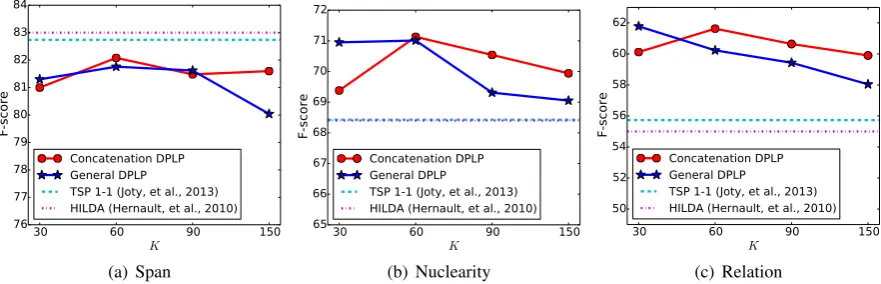
Figure 3 shows how performance changes for different latent dimensions K. At each value of
K, we employ grid search over a development set to identify the optimal regularizersλandτ. For the concatenation construction, performance is not overly sensitive toK. For the general form ofA, performance decreases with largeK. Recall from Section 2.3 that this construction has nine times as many parameters as the concatenation form; with large values ofK, it is likely to overfit.
5.3 Analysis of Projection Matrix
Why does projection of the surface features im-prove discourse parsing? To answer this question, we examine what information the projection ma-trix is learning to encoded. We take the projec-tion matrix from the concatenaprojec-tion construcprojec-tion andK = 60 as an example for case study. Re-calling the definition in equation 4, the projection matrixAwill be composed of three identical sub-matricesB ∈R20×V. The columns of theB ma-trix can be viewed as 20-dimensional descriptors of the words in the vocabulary.
For the purpose of visualization, we further re-duce the dimension of latent representation from
simpli-30 60 90 150
K
76 77 78 79 80 81 82 83 84
F-score
Concatenation DPLP General DPLP
TSP 1-1 (Joty, et al., 2013) HILDA (Hernault, et al., 2010)
(a) Span
30 60 90 150
K
65 66 67 68 69 70 71 72
F-score
Concatenation DPLP General DPLP
TSP 1-1 (Joty, et al., 2013) HILDA (Hernault, et al., 2010)
(b) Nuclearity
30 60 90 150
K
50 52 54 56 58 60 62
F-score
Concatenation DPLP General DPLP
TSP 1-1 (Joty, et al., 2013) HILDA (Hernault, et al., 2010)
[image:8.595.79.520.63.205.2](c) Relation
Figure 3: The performance of our parser over different latent dimensionK. Results for DPLPinclude the additional features from Table 3
fication for visualization is we consider only the top 1000 frequent unigrams in the RST-DT train-ing set. For comparison, we also apply t-SNE to the projection matrixBnmf recovered from non-negative matrix factorization.
Figure 4 highlights words that are related to dis-course analysis. Among the top 1000 words, we highlight the words from 5 major discourse con-nective categories provided in Appendix B of the PDTB annotation manual (Prasad et al., 2008): CONJUNCTION, CONTRAST, PRECEDENCE, RE -SULT, and SUCCESSION. In addition, we also highlighted two verb categories from the top 1000 words: modal verbs and reporting verbs, with their inflections (Krestel et al., 2008).
From the figure, it is clear DPLP has learned a projection matrix that successfully groups several major discourse-related word classes: particularly modal and reporting verbs; it has also grouped succession and precedence connectives with some success. In contrast, while NMF does obtain com-pact clusters of words, these clusters appear to be completely unrelated to discourse function of the words that they include. This demonstrates the value of using discriminative training to obtain the transformed representation of the discourse units.
6 Related Work
Early work on document-level discourse parsing applied hand-crafted rules and heuristics to build trees in the framework of Rhetorical Structure Theory (Sumita et al., 1992; Corston-Oliver, 1998; Marcu, 2000a). An early data-driven approach was offered by Schilder (2002), who used distribu-tional techniques to rate the topicality of each dis-course unit, and then chose among underspecified discourse structures by placing more topical
sen-tences near the root. Learning-based approaches were first applied to identify within-sentence dis-course relations (Soricut and Marcu, 2003), and only later to cross-sentence relations at the docu-ment level (Baldridge and Lascarides, 2005). Of particular relevance to our inference technique are incremental discourse parsing approaches, such as shift-reduce (Sagae, 2009) and A* (Muller et al., 2012). Prior learning-based work has largely focused on lexical, syntactic, and structural fea-tures, but the close relationship between discourse structure and semantics (Forbes-Riley et al., 2006) suggests that shallow feature sets may struggle to capture the long tail of alternative lexicaliza-tions that can be used to realize discourse rela-tions (Prasad et al., 2010; Marcu and Echihabi, 2002). Only Subba and Di Eugenio (2009) incor-porate rich compositional semantics into discourse parsing, but due to the ambiguity of their seman-tic parser, they must manually select the correct semantic parse from a forest of possiblities.
trans-although until
however also
though but
thus
later
can could would
should and
when
after so
once will
might may
beforethen
says say
reported said
saying believe think
must
asked report
(a) Latent representation of words from projection learning withK= 20.
but
would
when
also may can
then
must
might
once
however
so though thus
although
should
later until
will
before
after
could and
says said
say
asked saying think
believe report
Conjunction Contrast Precedence Result Succession Modal verb Reporting verb
[image:9.595.85.518.65.214.2](b) Latent representation of words from non-negative matrix factorization withK= 20.
Figure 4: t-SNE Visualization on latent representations of words.
forming the lexical representation of discourse units into a latent space to facilitate learning. As shown in Figure 4(a), this projection succeeds at grouping words with similar discourse func-tions. We might expect to obtain further improve-ments by augmenting this representation learning approach with rich syntactic features (particularly for span identification), more accurate decoding, and special treatment of intra-sentence relations; this is a direction for future research.
Discriminative learning of latent features for discourse processing can be viewed as a form of representation learning (Bengio et al., 2013). Also called Deep Learning, such approaches have recently been applied in a number of NLP tasks (Collobert et al., 2011; Socher et al., 2012). Of particular relevance are applications to the de-tection of semantic or discourse relations, such as paraphrase, by comparing sentences in an in-duced latent space (Socher et al., 2011; Guo and Diab, 2012; Ji and Eisenstein, 2013). In this work, we show how discourse structure annotations can function as a supervision signal to discriminatively learn a transformation from lexical features to a la-tent space that is well-suited for discourse parsing. Unlike much of the prior work on representation learning, we induce a simple linear transforma-tion. Extension of our approach by incorporating a non-linear activation function is a natural topic for future research.
7 Conclusion
We have presented a framework to perform dis-course parsing while jointly learning to project to a low-dimensional representation of the discourse
units. Using the vector-space representation of EDUs, our shift-reduce parsing system substan-tially outperforms existing systems on nuclearity detection and discourse relation identification. By adding some additional surface features, we ob-tain further improvements. The low dimensional representation also captures basic intuitions about discourse connectives and verbs, as shown in Fig-ure 4(a).
Deep learning approaches typically apply a non-linear transformation such as the sigmoid function (Bengio et al., 2013). We have con-ducted a few unsuccessful experiments with the “hard tanh” function proposed by Collobert and Weston (2008), but a more complete exploration of non-linear transformations must wait for future work. Another direction would be more sophis-ticated composition of the surface features within each elementary discourse unit, such as the hierar-chical convolutional neural network (Kalchbren-ner and Blunsom, 2013) or the recursive tensor network (Socher et al., 2013). It seems likely that a better accounting for syntax could improve the latent representations that our method induces.
Acknowledgments
References
Jason Baldridge and Alex Lascarides. 2005. Proba-bilistic head-driven parsing for discourse structure. InProceedings of the Ninth Conference on Compu-tational Natural Language Learning, pages 96–103.
Yoshua Bengio, Aaron Courville, and Pascal Vincent. 2013. Representation Learning: A Review and New
Perspectives. IEEE Transactions on Pattern
Analy-sis and Machine Intelligence, 35(8):1798–1828.
Ezra Black, Steve Abney, Dan Flickinger, Claudia Gdaniec, Ralph Grishman, Phil Harrison, Don Hin-dle, Robert Ingria, Fred Jelinek, Judith Klavans, Mark Liberman, Mitchell Marcus, Salim Roukos, Beatrice Santorini, and Tomek Strzalkowski. 1991. A Procedure for Quantitatively Comparing the
Syn-tactic Coverage of English Grammars. In Speech
and Natural Language: Proceedings of a Workshop Held at Pacific Grove, California, February 19-22, 1991, pages 306–311.
Jill Burstein, Joel Tetreault, and Martin Chodorow.
2013. Holistic discourse coherence annotation
for noisy essay writing. Dialogue & Discourse, 4(2):34–52.
Lynn Carlson, Daniel Marcu, and Mary Ellen Okurowski. 2001. Building a Discourse-tagged Corpus in the Framework of Rhetorical Structure
Theory. In Proceedings of Second SIGdial
Work-shop on Discourse and Dialogue.
Michael Collins and Brian Roark. 2004. Incremental
parsing with the perceptron algorithm. In
Proceed-ings of ACL, page 111. Association for Computa-tional Linguistics.
R. Collobert and J. Weston. 2008. A Unified Architec-ture for Natural Language Processing: Deep Neural
Networks with Multitask Learning. InICML.
R. Collobert, J. Weston, L. Bottou, M. Karlen, K. Kavukcuoglu, and P. Kuksa. 2011. Natural
Lan-guage Processing (Almost) from Scratch.Journal of
Machine Learning Research, 12:2493–2537.
Simon Corston-Oliver. 1998. Beyond string matching and cue phrases: Improving efficiency and coverage
in discourse analysis. InThe AAAI Spring
Sympo-sium on Intelligent Text Summarization, pages 9–15.
Koby Crammer and Yoram Singer. 2001. On the Algo-rithmic Implementation of Multiclass Kernel-based
Vector Machines. Journal of Machine Learning
Re-search, 2:265–292.
Georgiana Dinu and Mirella Lapata. 2010. Measur-ing Distributional Similarity in Context. InEMNLP, pages 1162–1172.
Vanessa Wei Feng and Graeme Hirst. 2012. Text-level Discourse Parsing with Rich Linguistic Features. In Proceedings of ACL.
David Ferrucci, Eric Brown, Jennifer Chu-Carroll, James Fan, David Gondek, Aditya A Kalyanpur, Adam Lally, J William Murdock, Eric Nyberg, John Prager, et al. 2010. Building Watson: An overview
of the DeepQA project. AI magazine, 31(3):59–79.
Katherine Forbes-Riley, Bonnie Webber, and Aravind Joshi. 2006. Computing discourse semantics: The predicate-argument semantics of discourse
connec-tives in D-LTAG. Journal of Semantics, 23(1):55–
106.
Weiwei Guo and Mona Diab. 2012. Modeling Sen-tences in the Latent Space. InProceedings of ACL, pages 864–872, Jeju Island, Korea, July. Association for Computational Linguistics.
Hugo Hernault, Helmut Prendinger, David A. duVerle, and Mitsuru Ishizuka. 2010. HILDA: A Discourse Parser Using Support Vector Machine Classification. Dialogue and Discourse, 1(3):1–33.
Yangfeng Ji and Jacob Eisenstein. 2013. Discrimina-tive Improvements to Distributional Sentence Simi-larity. InEMNLP, pages 891–896, Seattle, Washing-ton, USA, October. Association for Computational Linguistics.
Shafiq Joty, Giuseppe Carenini, Raymond Ng, and Yashar Mehdad. 2013. Combining Intra- and Multi-sentential Rhetorical Parsing for Document-level Discourse Analysis. InProceedings of ACL. Nal Kalchbrenner and Phil Blunsom. 2013. Recurrent
convolutional neural networks for discourse compo-sitionality. InProceedings of the Workshop on Con-tinuous Vector Space Models and their Composition-ality, pages 119–126, Sofia, Bulgaria, August. Asso-ciation for Computational Linguistics.
Terry Koo, Xavier Carreras, and Michael Collins. 2008. Simple Semi-supervised Dependency
Pars-ing. InProceedings of ACL-HLT, pages 595–603,
Columbus, Ohio, June. Association for Computa-tional Linguistics.
Ralf Krestel, Sabine Bergler, and Ren´e Witte. 2008. Minding the Source: Automatic Tagging of
Re-ported Speech in Newspaper Articles. In LREC,
Marrakech, Morocco, May. European Language Re-sources Association (ELRA).
Quoc V. Le, Jiquan Ngiam, Adam Coates, Abhik Lahiri, Bobby Prochnow, and Andrew Y. Ng. 2011. On Optimization Methods for Deep Learning. In ICML.
Ziheng Lin, Min-Yen Kan, and Hwee Tou Ng. 2009. Recognizing Implicit Discourse Relations in the
Penn Discourse Treebank. InEMNLP.
Daniel Marcu and Abdessamad Echihabi. 2002. An Unsupervised Approach to Recognizing Discourse
Relations. InProceedings of ACL, pages 368–375,
Philadelphia, Pennsylvania, USA, July. Association for Computational Linguistics.
Daniel Marcu. 1996. Building Up Rhetorical Structure Trees. InProceedings of AAAI.
Daniel Marcu. 1999. A Decision-Based Approach to
Rhetorical Parsing. In Proceedings of ACL, pages
365–372, College Park, Maryland, USA, June. As-sociation for Computational Linguistics.
Daniel Marcu. 2000a. The Rhetorical Parsing of
Un-restricted Texts: A Surface-based Approach.
Com-putational Linguistics, 26:395–448.
Daniel Marcu. 2000b.The Theory and Practice of
Dis-course Parsing and Summarization. MIT Press. Scott Miller, Jethran Guinness, and Alex Zamanian.
2004. Name Tagging with Word Clusters and Dis-criminative Training. In Daniel Marcu Susan
Du-mais and Salim Roukos, editors,HLT-NAACL, pages
337–342, Boston, Massachusetts, USA, May 2 -May 7. Association for Computational Linguistics. Eleni Miltsakaki and Karen Kukich. 2004. Evaluation
of text coherence for electronic essay scoring
sys-tems. Natural Language Engineering, 10(1):25–55.
Jeff Mitchell and Mirella Lapata. 2010. Composition in distributional models of semantics. Cognitive Sci-ence, 34(8):1388–1429.
Philippe Muller, Stergos Afantenos, Pascal Denis, and Nicholas Asher. 2012. Constrained Decoding for
Text-Level Discourse Parsing. In Coling, pages
1883–1900, Mumbai, India, December. The COL-ING 2012 Organizing Committee.
Anil Kumar Nelakanti, Cedric Archambeau, Julien Mairal, Francis Bach, and Guillaume Bouchard. 2013. Structured Penalties for Log-Linear
Lan-guage Models. InEMNLP, pages 233–243, Seattle,
Washington, USA, October. Association for Com-putational Linguistics.
Joakim Nivre, Johan Hall, Jens Nilsson, Atanas Chanev, G¨ulsen Eryigit, Sandra K¨ubler, Svetoslav Marinov, and Erwin Marsi. 2007. MaltParser: A language-independent system for data-driven
de-pendency parsing. Natural Language Engineering,
13(2):95–135.
Rashmi Prasad, Nikhil Dinesh, Alan Lee, Eleni Milt-sakaki, Livio Robaldo, Aravind Joshi, and Bonnie Webber. 2008. The penn discourse treebank 2.0. In LREC.
Rashmi Prasad, Aravind Joshi, and Bonnie Webber. 2010. Realization of discourse relations by other
means: alternative lexicalizations. InProceedings
of the 23rd International Conference on Computa-tional Linguistics: Posters, pages 1023–1031. Asso-ciation for Computational Linguistics.
Kenji Sagae. 2009. Analysis of Discourse Structure with Syntactic Dependencies and Data-Driven Shift-Reduce Parsing. InProceedings of the 11th Interna-tional Conference on Parsing Technologies (IWPT), pages 81–84, Paris, France, October. Association for Computational Linguistics.
Frank Schilder. 2002. Robust discourse parsing via discourse markers, topicality and position. Natural Language Engineering, 8(3):235–255.
Richard Socher, Eric H. Huang, Jeffrey Pennington, Andrew Y. Ng, and Christopher D. Manning. 2011. Dynamic Pooling and Unfolding Recursive Autoen-coders for Paraphrase Detection. InNIPS.
Richard Socher, Brody Huval, Christopher D. Man-ning, and Andrew Y. Ng. 2012. Semantic Composi-tionality Through Recursive Matrix-Vector Spaces. InEMNLP.
Richard Socher, Alex Perelygin, Jean Y Wu, Jason Chuang, Christopher D Manning, Andrew Y Ng, and Christopher Potts. 2013. Recursive deep mod-els for semantic compositionality over a sentiment
treebank. InProceedings of the Conference on
Em-pirical Methods in Natural Language Processing (EMNLP).
Swapna Somasundaran, Galileo Namata, Janyce Wiebe, and Lise Getoor. 2009. Supervised and unsupervised methods in employing discourse rela-tions for improving opinion polarity classification. InProceedings of EMNLP.
Radu Soricut and Daniel Marcu. 2003. Sentence Level Discourse Parsing using Syntactic and Lexical
Infor-mation. InNAACL.
Rajen Subba and Barbara Di Eugenio. 2009. An effec-tive Discourse Parser that uses Rich Linguistic
In-formation. InNAACL-HLT, pages 566–574,
Boul-der, Colorado, June. Association for Computational Linguistics.
K. Sumita, K. Ono, T. Chino, T. Ukita, and S. Amano. 1992. A discourse structure analyzer for Japanese
text. In Proceedings International Conference on
Fifth Generation Computer Systems, pages 1133– 1140.
Maite Taboada and William C Mann. 2006. Applica-tions of rhetorical structure theory. Discourse stud-ies, 8(4):567–588.
Benjamin Taskar, Carlos Guestrin, and Daphne Koller.
2003. Max-margin markov networks. InNIPS.
Joseph Turian, Lev Ratinov, and Yoshua Bengio. 2010. Word Representation: A Simple and General
Method for Semi-Supervised Learning. In
Proceed-ings of ACL, pages 384–394.
Tim Van de Cruys and Marianna Apidianaki. 2011. Latent Semantic Word Sense Induction and
Disam-biguation. In Proceedings of ACL, pages 1476–
Laurens van der Maaten and Geoffrey Hinton. 2008.
Visualizing Data using t-SNE. Journal of Machine
Learning Research, 9:2759–2605, November. Kimberly Voll and Maite Taboada. 2007. Not all
words are created equal: Extracting semantic orien-tation as a function of adjective relevance. In Pro-ceedings of Australian Conference on Artificial In-telligence.
Ngo Xuan Bach, Nguyen Le Minh, and Akira Shimazu. 2012. A Reranking Model for Discourse
Segmenta-tion using Subtree Features. In Proceedings of the
13th Annual Meeting of the Special Interest Group on Discourse and Dialogue, pages 160–168. Chun-Nam John Yu and Thorsten Joachims. 2009.